
 Login
Login Register
 Submit a Paper
 Propose a Special lssue
 Open Access
REVIEW

Advanced Signal Processing and Modeling Techniques for Automotive Radar: Challenges and Innovations in ADAS Applications
1 Department of Electronics and Communication Engineering, Sikkim Manipal Institute of Technology, Majhitar, Sikkim Manipal University, Gangtok, 737136, Sikkim, India
2 Department of Computer Science and Engineering, Sikkim Manipal Institute of Technology, Majhitar, Sikkim Manipal University, Gangtok, 737136, Sikkim, India
3 Department of Electronics and Communication Engineering, Indian Institute of Information Technology, Kalyani, 741235, West Bengal, India
4 Department of Electrical and Electronics Engineering, Faculty of Engineering, University of Lagos, Akoka, Lagos, 100213, Nigeria
5 Bachelor’s Program of Artificial Intelligence and Information Security, Fu Jen Catholic University, 510 Zhongzheng Road, New Taipei City, 242062, Taiwan
* Corresponding Authors: Samarendra Nath Sur. Email: ; Chun-Ta Li. Email:
# These authors contributed equally to this work
Computer Modeling in Engineering & Sciences 2025, 144(1), 83-146. https://doi.org/10.32604/cmes.2025.067724
Received 10 May 2025; Accepted 02 July 2025; Issue published 31 July 2025
 View Full Text
 Download PDF
Abstract
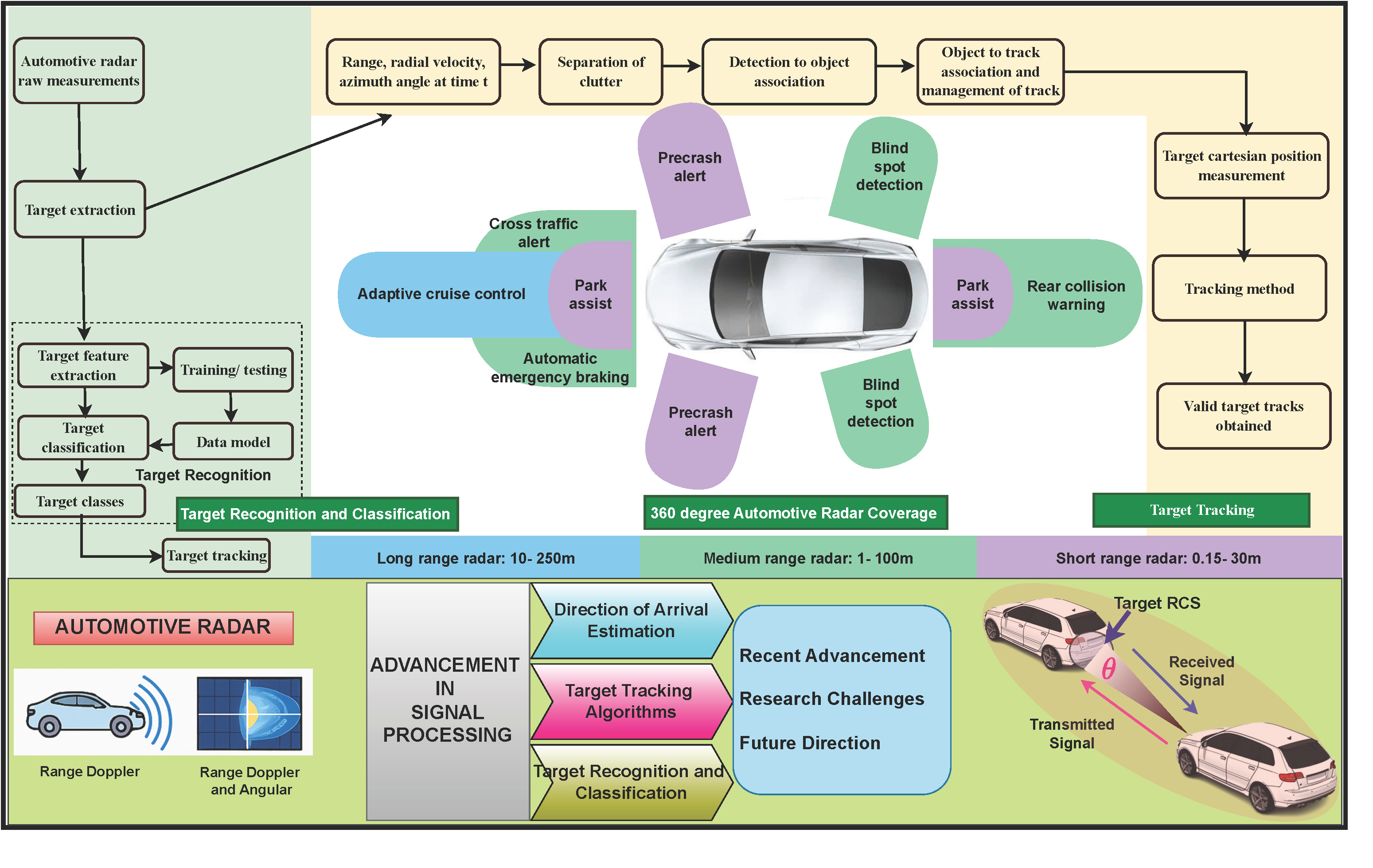
Automotive radar has emerged as a critical component in Advanced Driver Assistance Systems (ADAS) and autonomous driving, enabling robust environmental perception through precise range-Doppler and angular measurements. It plays a pivotal role in enhancing road safety by supporting accurate detection and localization of surrounding objects. However, real-world deployment of automotive radar faces significant challenges, including mutual interference among radar units and dense clutter due to multiple dynamic targets, which demand advanced signal processing solutions beyond conventional methodologies. This paper presents a comprehensive review of traditional signal processing techniques and recent advancements specifically designed to address contemporary operational challenges in automotive radar. Emphasis is placed on direction-of-arrival (DoA) estimation algorithms such as Bartlett beamforming, Minimum Variance Distortionless Response (MVDR), Multiple Signal Classification (MUSIC), and Estimation of Signal Parameters via Rotational Invariance Techniques (ESPRIT). Among these, ESPRIT offers superior resolution for multi-target scenarios with reduced computational complexity compared to MUSIC, making it particularly advantageous for real-time applications. Furthermore, the study evaluates state-of-the-art tracking algorithms, including the Kalman Filter (KF), Extended KF (EKF), Unscented KF, and Bayesian filter. EKF is especially suitable for radar systems due to its capability to linearize nonlinear measurement models. The integration of machine learning approaches for target detection and classification is also discussed, highlighting the trade-off between the simplicity of implementation in K-Nearest Neighbors (KNN) and the enhanced accuracy provided by Support Vector Machines (SVM). A brief overview of benchmark radar datasets, performance metrics, and relevant standards is included to support future research. The paper concludes by outlining ongoing challenges and identifying promising research directions in automotive radar signal processing, particularly in the context of increasingly complex traffic scenarios and autonomous navigation systems.Graphic Abstract
Keywords
Cite This Article
 Copyright © 2025 The Author(s). Published by Tech Science Press.
This work is licensed under a Creative Commons Attribution 4.0 International License , which permits unrestricted use, distribution, and reproduction in any medium, provided the original work is properly cited.
 Downloads
 Citation Tools
