
 Login
Login Register
 Submit a Paper
 Propose a Special lssue
 Open Access
ARTICLE
Greylag Goose Optimization and Deep Learning-Based Electrohysterogram Signal Analysis for Preterm Birth Risk Prediction
1 Department of Mathematics and Statistics, Faculty of Science, Imam Mohammad Ibn Saud Islamic University (IMSIU), Riyadh, 11432, Saudi Arabia
2 Faculty of Artificial Intelligence, Delta University for Science and Technology, Mansoura, 11152, Egypt
3 Jadara University Research Center, Jadara University, Irbid, 21110, Jordan
4 Faculty of Engineering, Design and Information & Communications Technology (EDICT), School of ICT, Bahrain Polytechnic, Isa Town, P.O. Box 33349, Bahrain
5 Applied Science Research Center, Applied Science Private University, Amman, 11931, Jordan
* Corresponding Authors: Anis Ben Ghorbal. Email: ; Marwa M. Eid. Email:
(This article belongs to the Special Issue: Swarm and Metaheuristic Optimization for Applied Engineering Application)
Computer Modeling in Engineering & Sciences 2025, 144(2), 2001-2028. https://doi.org/10.32604/cmes.2025.068212
Received 23 May 2025; Accepted 05 August 2025; Issue published 31 August 2025
 View Full Text
 Download PDF
Abstract
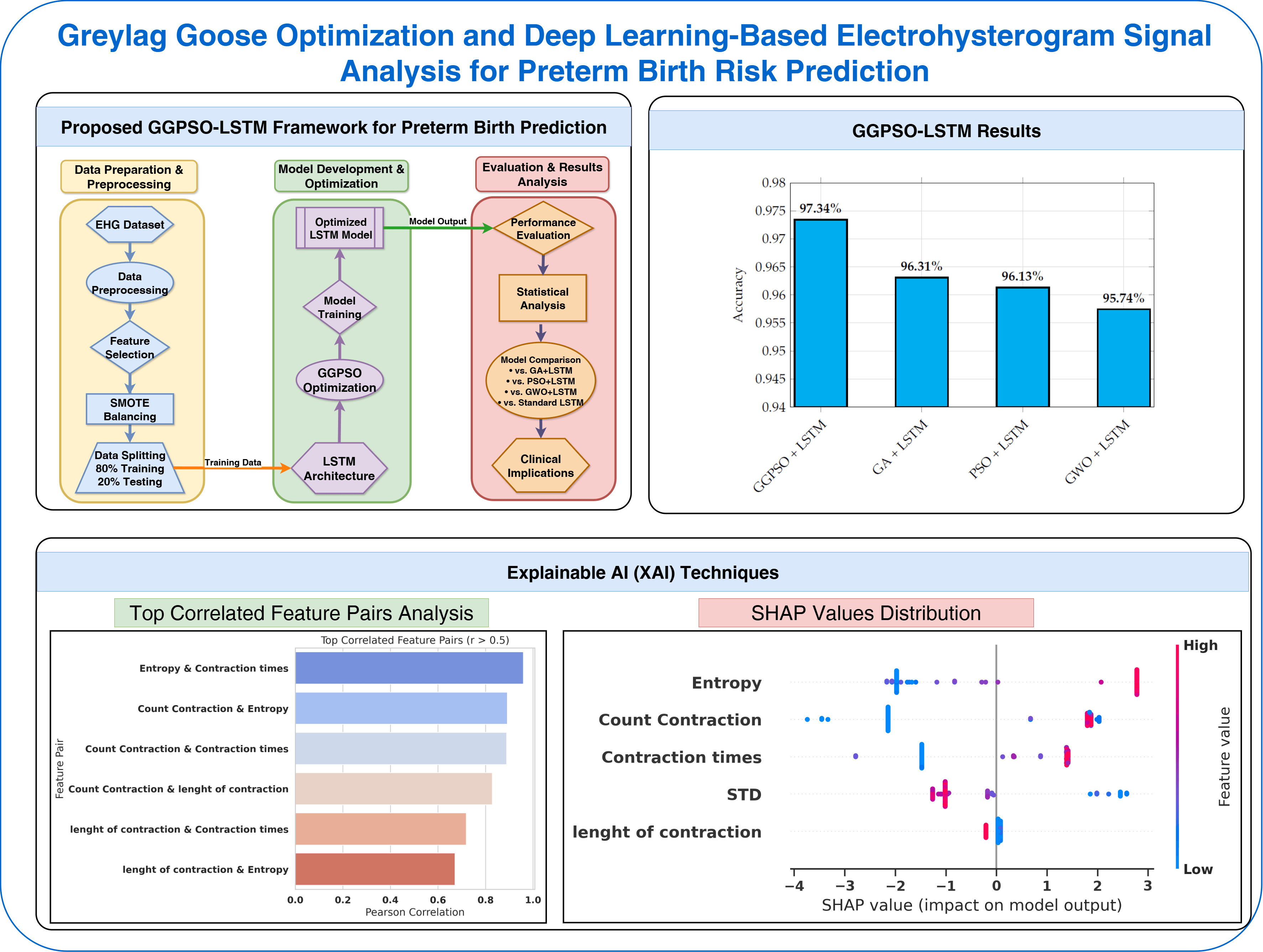
Preterm birth remains a leading cause of neonatal complications and highlights the need for early and accurate prediction techniques to improve both fetal and maternal health outcomes. This study introduces a hybrid approach integrating Long Short-Term Memory (LSTM) networks with the Hybrid Greylag Goose and Particle Swarm Optimization (GGPSO) algorithm to optimize preterm birth classification using Electrohysterogram signals. The dataset consists of 58 samples of 1000-second-long Electrohysterogram recordings, capturing key physiological features such as contraction patterns, entropy, and statistical variations. Statistical analysis and feature selection methods are applied to identify the most relevant predictors and enhance model interpretability. LSTM networks effectively capture temporal patterns in uterine activity, while the GGPSO algorithm finetunes hyperparameters, mitigating overfitting and improving classification accuracy. The proposed GGPSO-optimized LSTM model achieved superior performance with 97.34% accuracy, 96.91% sensitivity, 97.74% specificity, and 97.23% F-score, significantly outperforming traditional machine learning approaches and demonstrating the effectiveness of hybrid metaheuristic optimization in enhancing deep learning models for clinical applications. By combining deep learning with metaheuristic optimization, this study contributes to advancing intelligent auto-diagnosis systems, facilitating early detection of preterm birth risks and timely medical interventions.Graphic Abstract
Keywords
Cite This Article
 Copyright © 2025 The Author(s). Published by Tech Science Press.
This work is licensed under a Creative Commons Attribution 4.0 International License , which permits unrestricted use, distribution, and reproduction in any medium, provided the original work is properly cited.
 Downloads
 Citation Tools
