
 Login
Login Register
 Submit a Paper
 Propose a Special lssue
 Open Access
ARTICLE

Towards Secure and Efficient Human Fall Detection: Sensor-Visual Fusion via Gramian Angular Field with Federated CNN
1 Department of Information and Computer Science, King Fahd University of Petroleum & Minerals, Dhahran, 31261, Saudi Arabia
2 Interdisciplinary Research Center for Intelligent Secure Systems (IRC-ISS), King Fahd University of Petroleum & Minerals, Dhahran, 31261, Saudi Arabia
3 SDAIA-KFUPM Joint Research Center for AI and Interdisciplinary Research Center for Bio Systems and Machines, King Fahd University of Petroleum & Minerals, Dhahran, 31261, Saudi Arabia
* Corresponding Author: Md Mahfuzur Rahman. Email:
(This article belongs to the Special Issue: Exploring the Impact of Artificial Intelligence on Healthcare: Insights into Data Management, Integration, and Ethical Considerations)
Computer Modeling in Engineering & Sciences 2025, 145(1), 1087-1116. https://doi.org/10.32604/cmes.2025.068779
Received 06 June 2025; Accepted 22 September 2025; Issue published 30 October 2025
 View Full Text
 Download PDF
Abstract
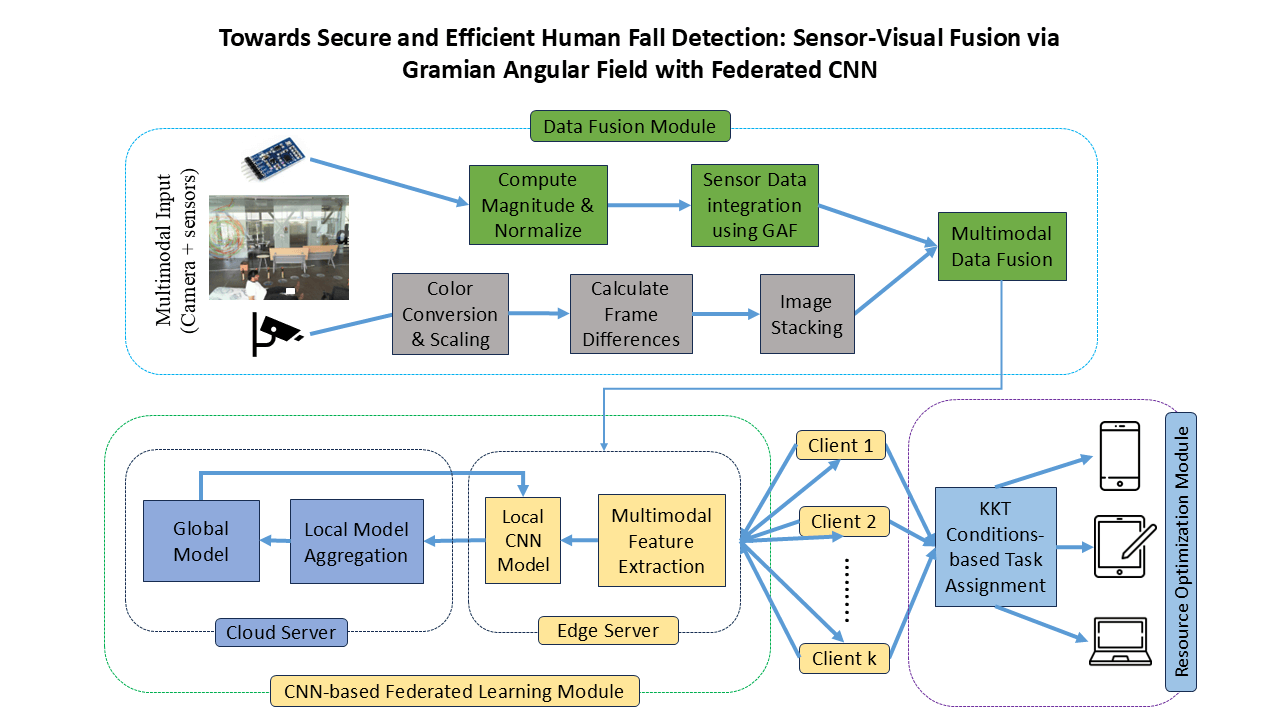
This article presents a human fall detection system that addresses two critical challenges: privacy preservation and detection accuracy. We propose a comprehensive framework that integrates state-of-the-art machine learning models, multimodal data fusion, federated learning (FL), and Karush-Kuhn-Tucker (KKT)-based resource optimization. The system fuses data from wearable sensors and cameras using Gramian Angular Field (GAF) encoding to capture rich spatial-temporal features. To protect sensitive data, we adopt a privacy-preserving FL setup, where model training occurs locally on client devices without transferring raw data. A custom convolutional neural network (CNN) is designed to extract robust features from the fused multimodal inputs under FL constraints. To further improve efficiency, a KKT-based optimization strategy is employed to allocate computational tasks based on device capacity. Evaluated on the UP-Fall dataset, the proposed system achieves 91% accuracy, demonstrating its effectiveness in detecting human falls while ensuring data privacy and resource efficiency. This work contributes to safer, scalable, and real-world-applicable fall detection for elderly care.Graphic Abstract
Keywords
Cite This Article
 Copyright © 2025 The Author(s). Published by Tech Science Press.
This work is licensed under a Creative Commons Attribution 4.0 International License , which permits unrestricted use, distribution, and reproduction in any medium, provided the original work is properly cited.
 Downloads
 Citation Tools
