
 Login
Login Register
 Submit a Paper
 Propose a Special lssue
 Open Access
REVIEW

A Comprehensive Review of Sizing and Allocation of Distributed Power Generation: Optimization Techniques, Global Insights, and Smart Grid Implications
1 Electrical Engineering Department, Imam Mohammad Ibn Saud Islamic University (IMISU), Riyadh, 11564, Saudi Arabia
2 Faculty of Construction and Environment, Hong Kong Polytechnic University, Hung Hom, Kowloon, Hong Kong, 310028, China
3 College of Electrical and Information Engineering, Hunan University, Changsha, 410083, China
4 School of Science, Computing and Engineering Technologies, Swinburne University of Technology, Hawthorn, VIC 3122, Australia
5 Electrical Engineering Department, Faculty of Engineering, Minia University, Minia, 61519, Egypt
6 College of Electrical Engineering and Automation, Fuzhou University, Fuzhou, 350116, China
* Corresponding Authors: Hassan M. Hussein Farh. Email: ; Mohamed A. Mohamed. Email:
Computer Modeling in Engineering & Sciences 2025, 145(2), 1303-1347. https://doi.org/10.32604/cmes.2025.071302
Received 04 August 2025; Accepted 14 October 2025; Issue published 26 November 2025
 View Full Text
 Download PDF
Abstract
Optimal sizing and allocation of distributed generators (DGs) have become essential computational challenges in improving the performance, efficiency, and reliability of electrical distribution networks. Despite extensive research, existing approaches often face algorithmic limitations such as slow convergence, premature stagnation in local minima, or suboptimal accuracy in determining optimal DG placement and capacity. This study presents a comprehensive scientometric and systematic review of global research focused on computer-based modelling and algorithmic optimization for renewable DG sizing and placement. It integrates both quantitative and qualitative analyses of the scholarly landscape, mapping influential research domains, co-authorship structures, the articles’ citation networks, keyword clusters, and international collaboration patterns. Moreover, the study classifies and evaluates the most prominent objective functions, key computational models and optimization algorithms, DG technologies, and strategic approaches employed in the field. The findings reveal that advanced algorithmic frameworks substantially enhance network stability, minimize real power losses, and improve voltage profiles under various operational constraints. This review serves as a foundational resource for researchers and practitioners, highlighting emerging algorithmic trends, modelling innovations, and data-driven methodologies that can guide future development of intelligent, optimization-based DG integration strategies in smart distribution systems.Keywords
Supplementary Material
Supplementary Material FileRenewable energy sources are increasingly being explored for power generation in Distributed generation (DG) systems. DG sources have long been recognized as a viable remedy for several power system issues, including high power losses, low reliability, power quality, and transmission power network congestion [1–4]. Power distribution networks can benefit from the efficient use of DGs to enhance the voltage stability and reliability while simultaneously reducing voltage deviation and power losses. However, improper implementation of these sources can lead to negative effects such as more power loss, voltage imbalance, inadequate protection coordination, reverse power flow, etc. [5]. Moreover, improper size and location of DGs can impact the fault current values at the common coupling point and power quality [6]. Consequently, it is crucial to consider the best way to use DGs while integrating them into distribution networks. The DG implementation is a nonlinear problem with multiple objectives, which is challenging because each objective is important on multiple units and scales. Because of potential conflicts of interest, multi-objective optimization problems must be carefully formulated. Many multi-distinct objectives can be simplified to single-objective problems by giving them distinct weights [7].
The unnecessary and uncontrolled construction of DGs presented major challenges and obstructions in the power distribution networks two decades ago. Modern distribution networks require both directions of the power flow to address the two primary problems of power loss and voltage changes, as opposed to bidirectional power flow from higher voltages to lower voltages [8,9]. Numerous optimization techniques are applied to attain the optimal DG allocation and sizing. Furthermore, the influence of the DG size and site on energy losses, energy flow, voltage profile and other properties has been studied by researchers over the years and reported in the literature. Scholars worldwide are working to reach the optimal DG sizing and placement to enhance the voltage profile and reduce the power loss in the current distribution network. They have offered a range of strategies and techniques for selecting the appropriate DG allocation and size.
Many research reviews on the best design of DGs have been conducted and published in the literature. For instance, the study in [10] presents the state-of-the-art on optimal DGs allocation in the power system network with multiple objectives and its limitations. Different load models affect DG allocation and size, and most extant literature employs the model of static load. As a result, the research in [10] focused on various models of voltage-dependent loads. Despite the numerous benefits provided by DGs, their random sizing and allocation generate several operational problems in power distribution networks. The power distribution network was created to manage one-way currents; however, the installation of DG results in both directions of the power flow. This results in technical difficulties including variations in power loss, voltage drop (in transmission and reception power), and disturbances in power reliability and consistency, as indicated in [11]. In order to reduce power losses and enhance voltage profiles, the primary goal of the study in [12] is to design an optimization approach for the best size and site of DG units in the network distribution. The Backward-Forward Sweep (BFS) was applied in this study to calculate the power flow, where a very adaptable multiple objective particle swarm optimizer was developed to choose the most suitable sizing and siting for the DG generators. According to the results in [12], adding DG units to specific buses greatly enhanced the voltage profile and reduced both the system’s active and reactive power loss. However, the cost of installing DG raises questions, and the technique has not been applied to a genuine electrical power distribution system. Alghamdi et al. in [13] proposed the Gaussian-Bare-Bones Levy Cheetah Optimization (GBBLCO) algorithm to address optimal power flow (OPF) problems for enhanced integration of renewable energy resources in power networks. The study demonstrated that GBBLCO outperformed conventional algorithms in minimizing operating costs, reducing emissions, managing voltage deviations, and improving voltage stability across multiple test systems. Yan et al. in [14] presented a comprehensive review of intelligent detection and classification techniques for power quality disturbances (PQDs) in modern electrical grids, focusing on new methodologies developed over the last five years. The paper evaluates both traditional and advanced PQD detection approaches, highlighting their effectiveness and scenarios for application, and discusses promising future trends to ensure safe and reliable grid operation in the context of renewable energy integration. Megantoro et al. in [15] review the use of metaheuristic algorithms for optimal reactive power dispatch (ORPD), emphasizing the complexities introduced by intermittent renewable distributed generation. Through comparative analysis on IEEE bus test systems, the study shows that algorithms inspired by physical phenomena provide robust solutions for reducing power losses, minimizing voltage deviations, and improving voltage stability in grids with high penetrations of solar and wind sources. Hua et al. in [16] introduced an integrated energy-efficient system that combines demand response, distributed generation, and storage batteries to optimize energy management in smart grids. The approach employs probabilistic modeling and advanced optimization techniques to reduce operational costs, mitigate pollution emissions, and balance load scheduling, demonstrating superior performance compared to conventional models in smart grid environments. The authors in [17] investigated the construction of the DG techniques, the objectives, and the methodologies. A thorough investigation of several objective functions, restrictions, and methods has been introduced in [18] for optimum DG allocation. The authors in [19] reviewed how well DG planning performed regarding both reactive and real power loss, stability, load capability, and fluctuations, transfer of power capability, voltage characteristics, and short circuit capability while being ecologically friendly. Efficient allocation of distributed generation (DG) in distribution networks is crucial for minimizing energy losses, reducing operational costs, and lowering generation expenses, especially as distribution network losses account for over 70% of total system losses [20]. The study [20] introduced an effective DG allocation model that incorporates power demand variation, demonstrating superior performance in reducing losses, system cost, and computational time compared to other models when evaluated with different distribution system scenarios. The allocation and sizing of distributed generation (DG) in the power system, as illustrated in Fig. 1, involve determining the optimal capacity and placement of DG units such as photovoltaic (PV) panels, wind turbines, and reciprocating engines within the distribution network. This process aims to minimize power losses (
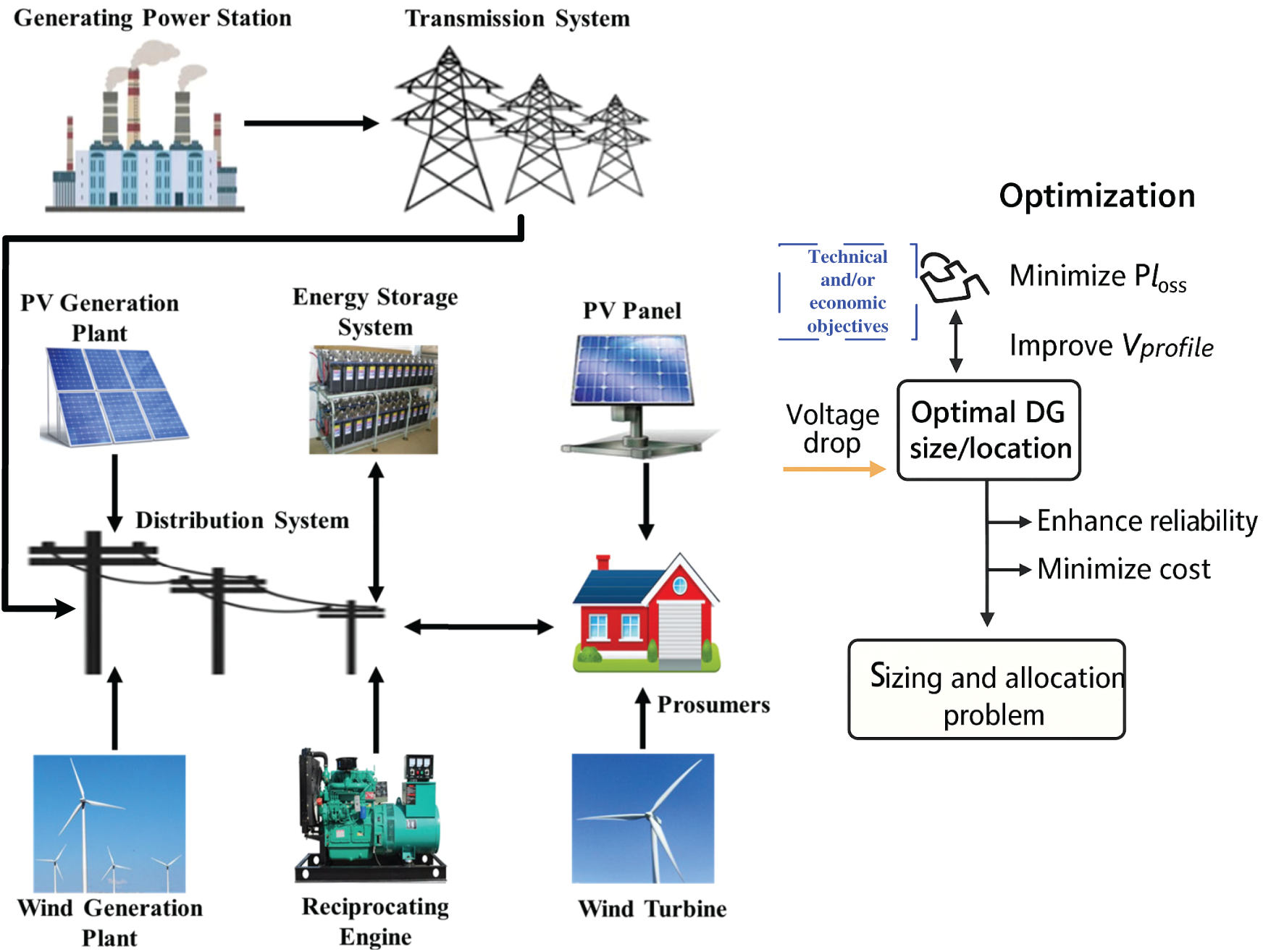
Figure 1: Illustration of the DG sizing and allocation problem in distribution networks
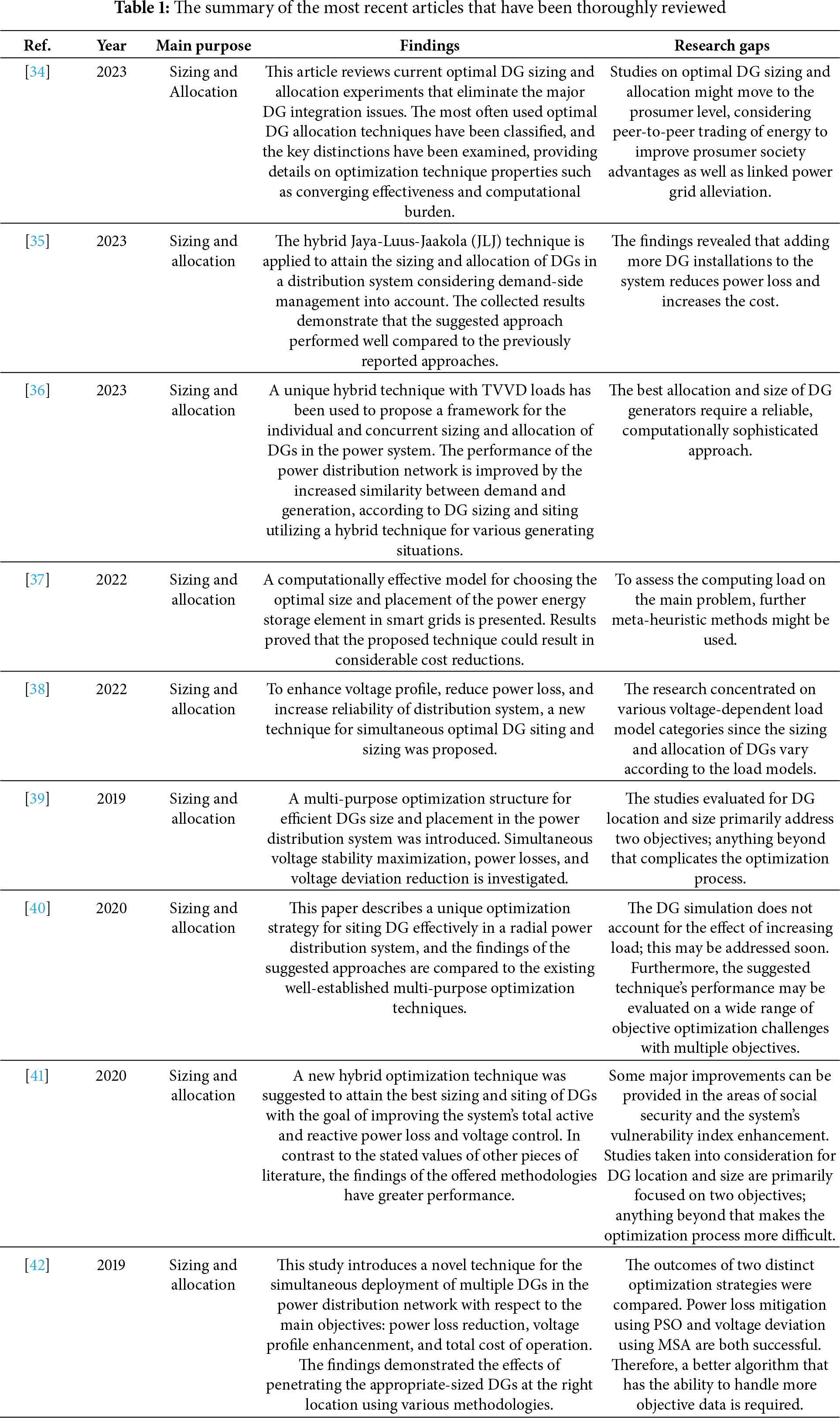
Recent studies emphasize the significant benefits of network reconfiguration combined with the optimal integration of multiple distributed generation (DG) units in radial distribution networks to enhance system reliability and efficiency, as explored in [21]. Optimization techniques like the Arithmetic Optimization Algorithm have been successfully applied for the simultaneous allocation of DG units and capacitor banks to improve voltage profiles and reduce losses in distribution systems, as detailed in [22]. Furthermore, advanced metaheuristic approaches such as the Electric Eel Foraging Optimization Algorithm have been developed for network reconfiguration with DG integration, focusing on power system performance under various load models, as presented in [23]. The combined approach of network reconfiguration, DG deployment, and capacitor bank installation has demonstrated considerable enhancement in distribution system performance, corroborated by findings in [24]. These contributions underscore the critical role of integrated optimization strategies in modern power distribution system management. Additionally, some other recent research [25–27] has advanced methods for the optimal sizing and placement of distributed generation (DG) units within distribution networks, especially under contingency scenarios such as N-1 outages. Innovative hybrid and integrated algorithms, including combinations of crow search, particle swarm, and firefly techniques [25–27], have been developed to improve system resilience, minimize losses, and ensure reliable integration of renewable energy sources even during faulty system conditions. Additionally, new frameworks for planning multi-energy systems consider generator contingencies and are being implemented in active distribution networks to enhance system robustness and sustainable energy integration [27]. The study in [28] integrates renewable energy resources, distributed generators, and energy storage into distribution networks, while also proposing a smart charging strategy for Plug-In Hybrid Electric Vehicles (PHEVs). Using hybrid metaheuristic optimizers Mountain Gazelle Optimizer (MGO), Improved Beluga Whale Optimization (IBWO), and Arithmetic Optimization Algorithm (AOA), the work demonstrates significant reductions in power losses and CO2 emissions on IEEE 33-bus and 85-bus systems. The findings highlight the potential of multi-objective optimization frameworks to enhance the technical, economic, and environmental performance of modern distribution networks. The review in [29] examines the role of smart grids as enablers of sustainable and resilient smart cities, where electrification and renewable integration address the energy trilemma of sustainability, security, and affordability. It emphasizes the contribution of Internet of Thing (IoT), artificial intelligence, and machine learning to efficient energy management and improved urban living conditions. Moreover, the paper outlines emerging applications, challenges, and strategies to enhance smart city infrastructure against both physical and cyber threats. On the other hand, some recent studies have increasingly emphasized the role of optimization and uncertainty modeling in the design of hybrid renewable energy systems (HRES). For instance, the authors in [30] demonstrated how coupling stochastic simulations with evolutionary algorithms enhances reliability and robustness in system sizing under variable resource conditions. Similarly, the authors in [31] highlighted the potential of decentralized decision-making frameworks to improve resource utilization and promote sustainability in renewable integration. In addition, the authors in [32] addressed the critical influence of fluctuating economic parameters on investment feasibility and operational performance, underscoring the need for risk-aware planning models. Collectively, these works underline that effective HRES planning requires both advanced optimization techniques and comprehensive uncertainty analyses to ensure sustainable, resilient, and economically viable energy solutions [30,32,33]. Table 1 summarizes the most recent research that has been extensively reviewed.
Despite the substantial body of literature examining technological progress and optimization strategies for the sizing and allocation of distributed generation (DG), a significant gap remains in the form of a comprehensive, systematic analysis that captures global research patterns, influential scholarly networks, and the integration of both qualitative and quantitative mapping of research trends. Most existing reviews [18,43–52] are predominantly 1) focused on individual optimization algorithms, specific methodologies, or case studies limited to particular regions, 2) Previous reviews often generalized DG as a single type, without sufficient differentiation between renewable vs. non-renewable DGs, 3) Prior reviews provided technical surveys but lacked scientometric analysis of the research field. As a result, they frequently lack macro-level bibliometric perspectives and fail to address the complex interrelationships among research clusters, objective functions, optimization techniques, and practical implementation challenges facing real-world power systems.
Furthermore, previous reviews addressing DG planning—encompassing sizing, allocation, multi-objective optimization, and the technical barriers of standalone vs. grid-connected deployment—have not fully resolved persistent challenges related to maximizing power system efficiency and minimizing costs. In particular, there is an evident absence of studies that systematically synthesize the current state of knowledge on DG sizing and allocation within modern distribution systems, especially through the lens of multi-objective optimization. To effectively address the multifaceted issues found in realistic, radial distribution networks—including those emerging from evolving DG technologies and global research trends—there is a pronounced need for an integrated, scientometric, and systematic review that contextualizes the field’s evolution and illuminates emerging directions for research and practice.
This review systematically addresses critical aspects of renewable distributed generation (DG) sizing and allocation by providing an exhaustive scientometric and systematic analysis of global research trends from 2000 to 2024. The primary objectives and contributions can be summarized as follows:
• Analyze Global Research Trends: To comprehensively examine the evolution and development of renewable DG sizing and allocation research across reputable, peer-reviewed journals worldwide, highlighting key advances and focus areas over the last two decades.
• Map the Scholarly Landscape: To offer an intricate qualitative and quantitative mapping of the DG research ecosystem, including prominent research channels, co-authorship networks, article citation patterns, keyword co-occurrence, and active countries’ collaborations. This mapping aims to foster enhanced international scholarly cooperation and knowledge exchange in the field.
• Categorize and Evaluate Key Themes: To systematically classify, analyze, and assess the predominant global research themes related to DG sizing and allocation. This includes a detailed examination of the most effective objective functions, optimization methods, enabling DG technologies, and strategic approaches applied in modern distribution systems.
• Integrate Technical, Economic, and Policy Perspectives: To provide a holistic understanding by incorporating technical considerations along with commercial and policy-related objectives, thereby encompassing the multifaceted dynamics influencing DG integration decisions.
• Offer a Foundational Reference: To serve as a foundational resource for researchers, practitioners, and policymakers, equipping them with actionable insights and evidence-based guidance to inform future research directions, enhance international collaboration, and support the design and implementation of optimal renewable DG systems within smart grids.
To the best of the authors’ knowledge, this work represents the first comprehensive scientometric and systematic review that combines quantitative bibliometric mapping with an in-depth qualitative synthesis of global research trends on renewable DG sizing and allocation.
This part describes the research methodology applied to conduct the systematic and scientometric review of this paper. The study methodology’s flowchart, shown in Fig. 2, contains all the logical steps and processes required to carry out this scientometric and systematic review paper. The PRISMA checklists can be found in the Supplementary Materials. To give a thorough overview of the methodology applied, the subsequent sections include descriptions of the key logic processes and procedures.
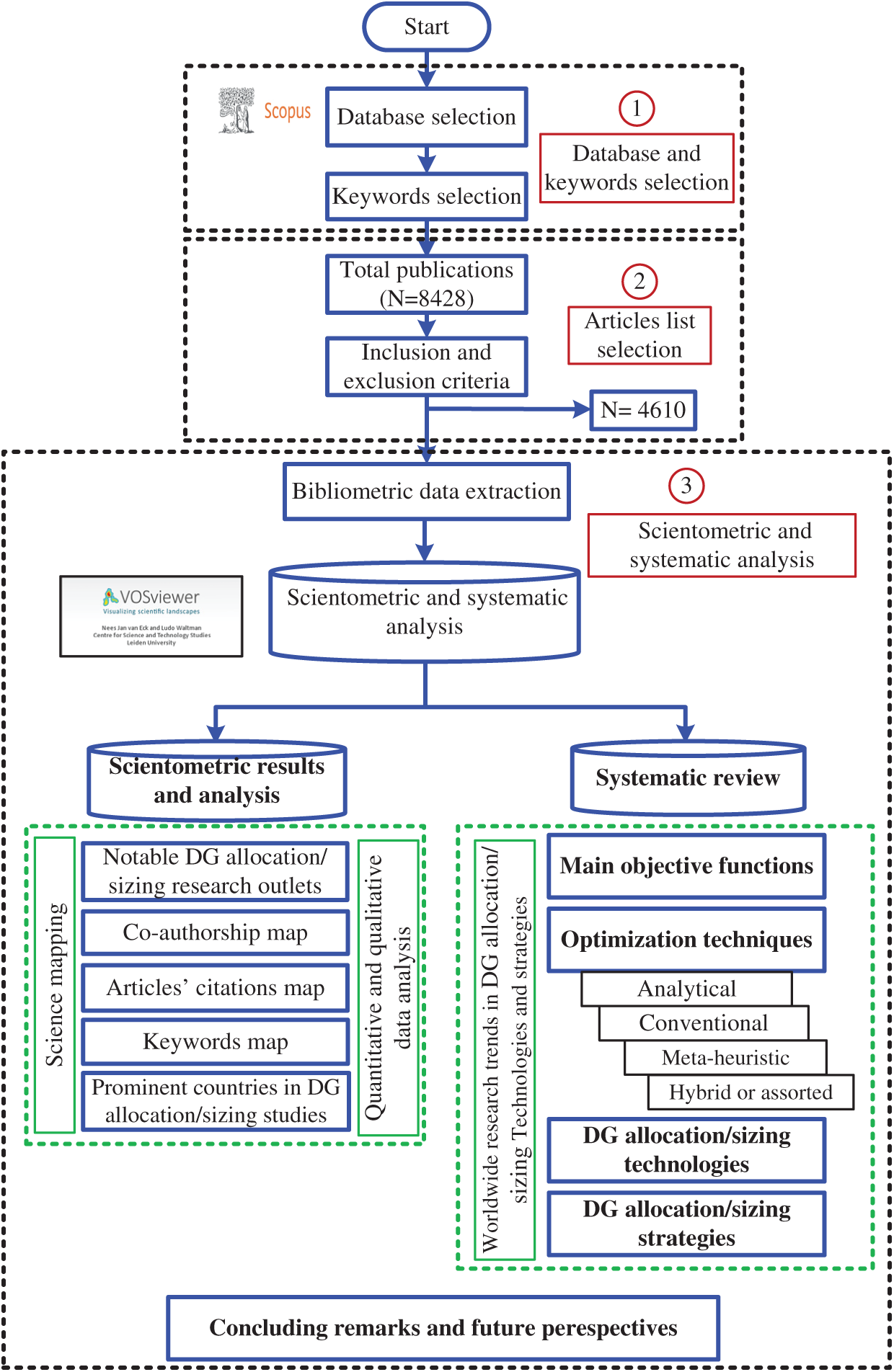
Figure 2: Comprehensive flowchart illustrating the research methodology adopted in this study
2.1 Selection of Keywords and Database
Scopus is used to extract research papers about DG allocation and sizing: technologies, strategies, and optimization techniques since bibliometric data is available in a greater variety than other search engine platforms. Also, Scopus integrates well with contemporary scientific mapping programs such as VOSviewer software. Finding the most reliable, pertinent, and recently published papers on the research topic depends heavily on the keywords you use. The main subject of this scientometric systematic review was “distributed generation sizing and allocation via various optimization approaches, main technologies, and strategies”. Thus, different search keywords were tested and iterated until the desired results were achieved. The search keywords that produced the desired results were (TITLE-ABS-KEY (“Distributed Generation” OR “Distributed Generator” OR “Distribution Generation” OR “DG” AND TITLE-ABS-KEY “Allocation” OR “Placement” OR “Siting” OR “Sizing” OR “Size” AND TITLE-ABS-KEY “Optimization” OR “Techniques” OR “Algorithms” OR “Approaches” OR “Strategies” OR “Methods”).
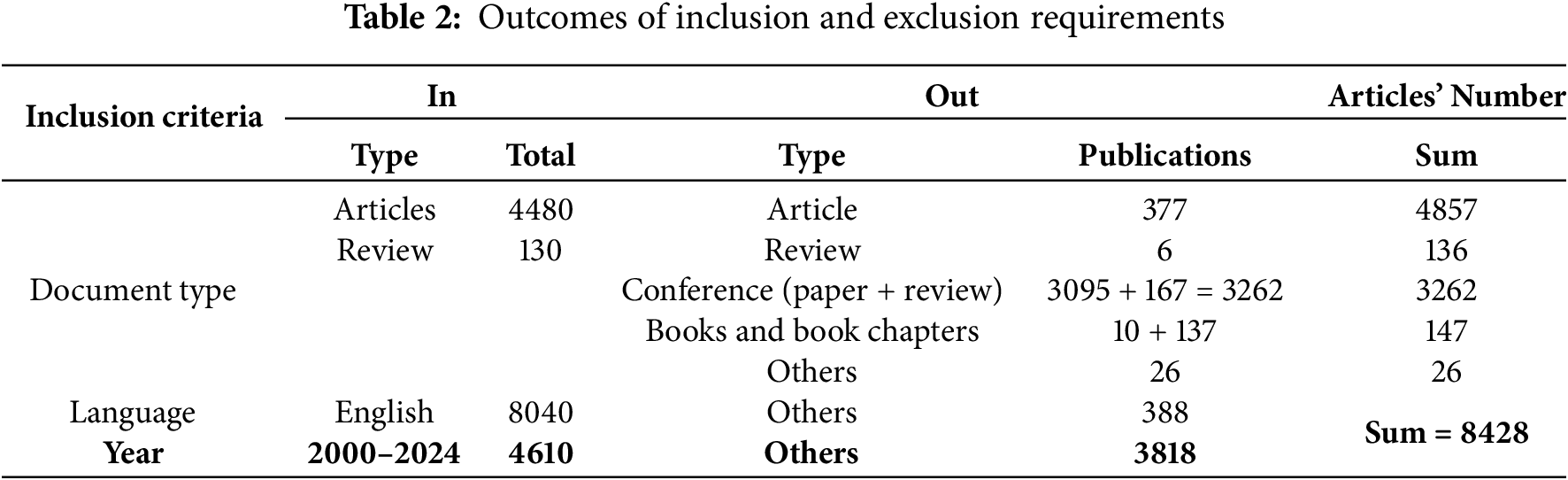
Any systematic or scientometric review’s inclusion and exclusion criteria must be clearly defined to filter the retrieved papers and preserve only the important ones [53]. The following criteria were used to determine whether a document met the study’s inclusion requirements: (1) research papers on DG-sizing/allocation optimization, technologies, and strategies that were published between 2000 and 2024; (2) publications that were only available as “Journal” sources in journals that were peer-reviewed; (3) only “article and review” papers were included; and (4) papers written in English were included. On the other hand, studies published before the year 2000 or after 2024 in which there were few and not recent publications before the year 2000 are excluded, as well as articles published in books, book chapters, conferences, articles in languages besides English, and any other kind of source. The outcomes of the exclusion and inclusion constraints are displayed in Table 2. There are 460 journal publications (Articles and reviews) on the DG-sizing/allocation technologies and strategies using the predetermined keywords and without any constraints. The 3818 document results were disregarded based on the exclusion criteria because of their language, article type, and publication year, which did not fit within the 2000–2024 period. However, as of December 2024, 4610 out of 8428 document findings comply with these limitations, which were in the subsequent scientometric analysis and systematic review.
2.3 Comprehensive Scientometric and Systematic Review
The datasets have been extracted using the most often used interchangeable keywords for DG-allocation/sizing optimization, technologies, and strategies to obtain a more comprehensive and trustworthy set of bibliometric information. It was downloaded as “Comma-Separated Values (CSV)” format. VOSviewer has been used to import the CSV file in order to map the DG-Allocation/Sizing optimization, technologies, and strategies research literature in a methodical manner. Using the VOSviewer software, the prominent research channels/sources, co-occurring keyword networks, co-authorship collaborations network, citation network of publications, countries/regions network, science maps, and bibliometric network were created for noteworthy DG-allocation/sizing optimization, technologies, and strategies.
Following the VOSviewer program’s import of the bibliometric data, the analysis was done in steps. The following was extracted and established by the authors using the scientometric quantitative analyses:
• The most well-known and fruitful DG-sizing/allocation optimization, technologies, and strategies research channels/sources.
• The most well-known authors and researchers according to the output of both qualitative and quantitative research.
• The most prolific and leading nations/countries in the fields of in DG-sizing/allocation optimization, technologies, and strategies research area.
• The studies are significantly cited in the fields of DG-sizing/allocation optimization, technologies, and strategies.
• The most popular/counted keywords were determined by looking up the authors’ keywords.
• Furthermore, the systematic review was conducted to identify research themes from the retrieved literature. This process divides the systematic review into three parts: objective functions and optimization algorithms for DG sizing and allocation, as well as the best technologies and strategies for allocation of DG and sizing.
3 Scientometric Results: Analysis and Discussions
Scientometric analyses are important as they provide quantitative insights into research trends, collaborations, and scholarly impact, thereby guiding future studies and evidence-based decision-making. In this section, the findings of the scientometric analyses that were obtained are presented in this section. These analyses provide valuable insights into the publication trends, publication outlets, topic trends, influential researchers and their work, and most active countries in the domain of DG allocation. By exploring these metrics, researchers can gain a more thorough knowledge of the renewable DG sizing/allocation field and identify key areas for future research.
3.1 Annual Global Research Trends
An analysis of the annual publication patterns within the domain of distributed generation (DG) sizing and allocation reveals a sustained and significant growth trajectory over the past two decades, as depicted in Fig. 3. The dataset comprises 4610 peer-reviewed journal articles retrieved through a rigorous systematic review process. The temporal distribution highlights a modest output in the early 2000s, with only 11 articles published in 2000, followed by a pronounced increase culminating in 499 publications in 2024. The increased publication rate of articles relating to DG sizing/allocation suggests that researchers are becoming more interested in this area of study and are devoting more time and resources to conducting research in this field. This trend indicates that DG sizing/allocation is an important and relevant topic of research and that it is gaining recognition and significance in the broader context of renewable energy research.
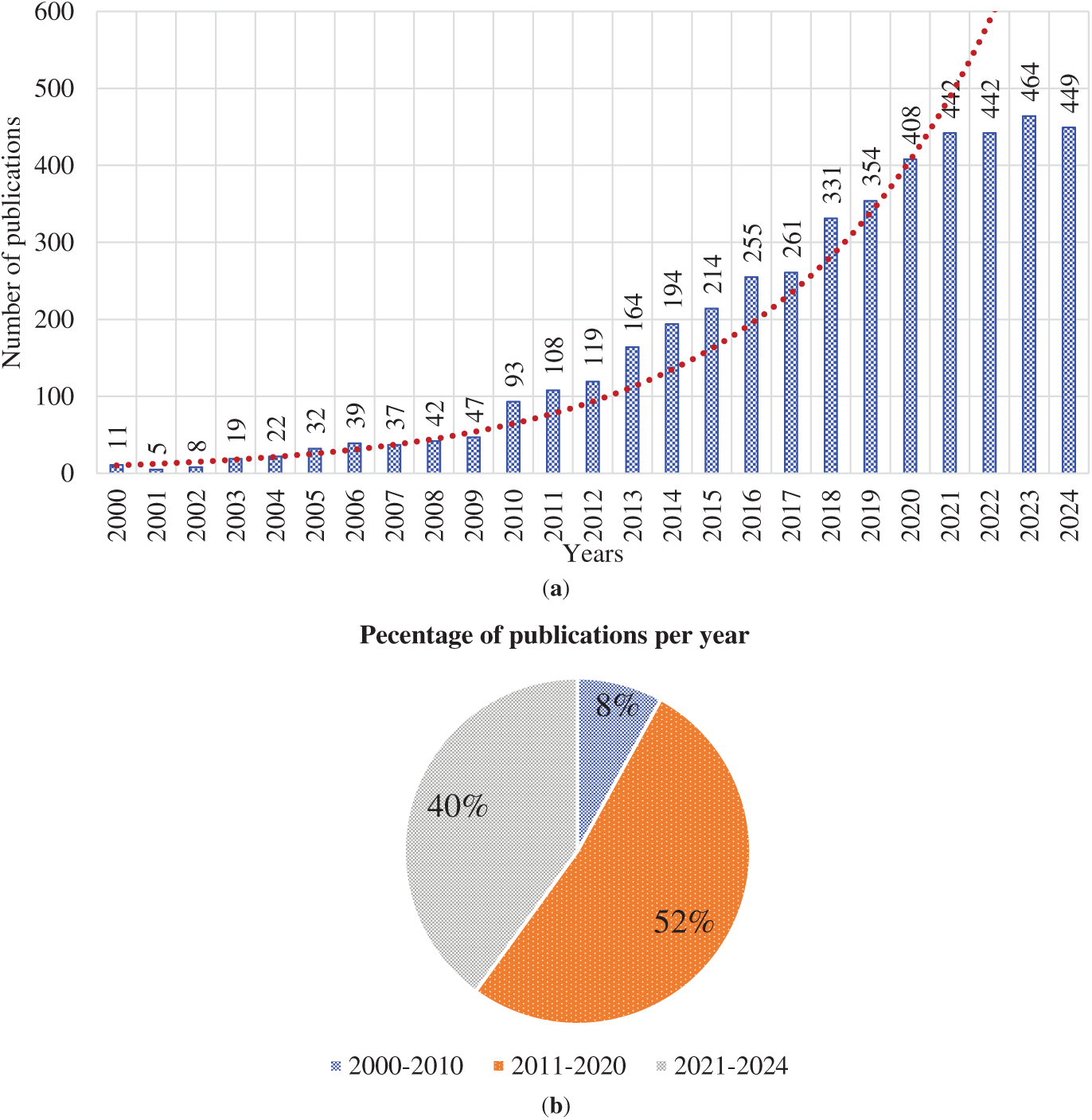
Figure 3: Annual publication trends: (a) Number of peer-reviewed articles published each year (Y-axis: number of articles, unitless; X-axis: year, 2000–2024). (b) Percentage distribution by decade (Y-axis: percent of total publications, %). Data are sourced from systematic Scopus search (see Section 2.1)
Further scrutiny of the publication distribution across decades, illustrated in Fig. 3b, reveals that merely 8% of the corpus was published during 2000–2010, while the majority (52%) emerged within the decade 2011–2020. Notably, the current decade (2021–2024) already accounts for 40% of the total publications, signifying a sustained momentum in research activities despite its shorter duration. This pattern not only reflects the dynamic evolution and growing relevance of DG sizing and allocation within the renewable energy and smart grid research communities but also suggests that forthcoming years are poised to contribute an even greater volume of scholarly output.
The escalating research intensity can be attributed to the escalating urgency of integrating renewable distributed generation to address environmental concerns, enhance grid reliability, and optimize power system performance. Consequently, the sizeable and growing body of literature indicates that DG sizing and allocation will remain a pivotal and expanding focus area, vital for both academia and industry stakeholders, facilitating innovation and informed decision-making in sustainable energy systems design and operation.
3.2 Mapping Scientific Outlets for Research
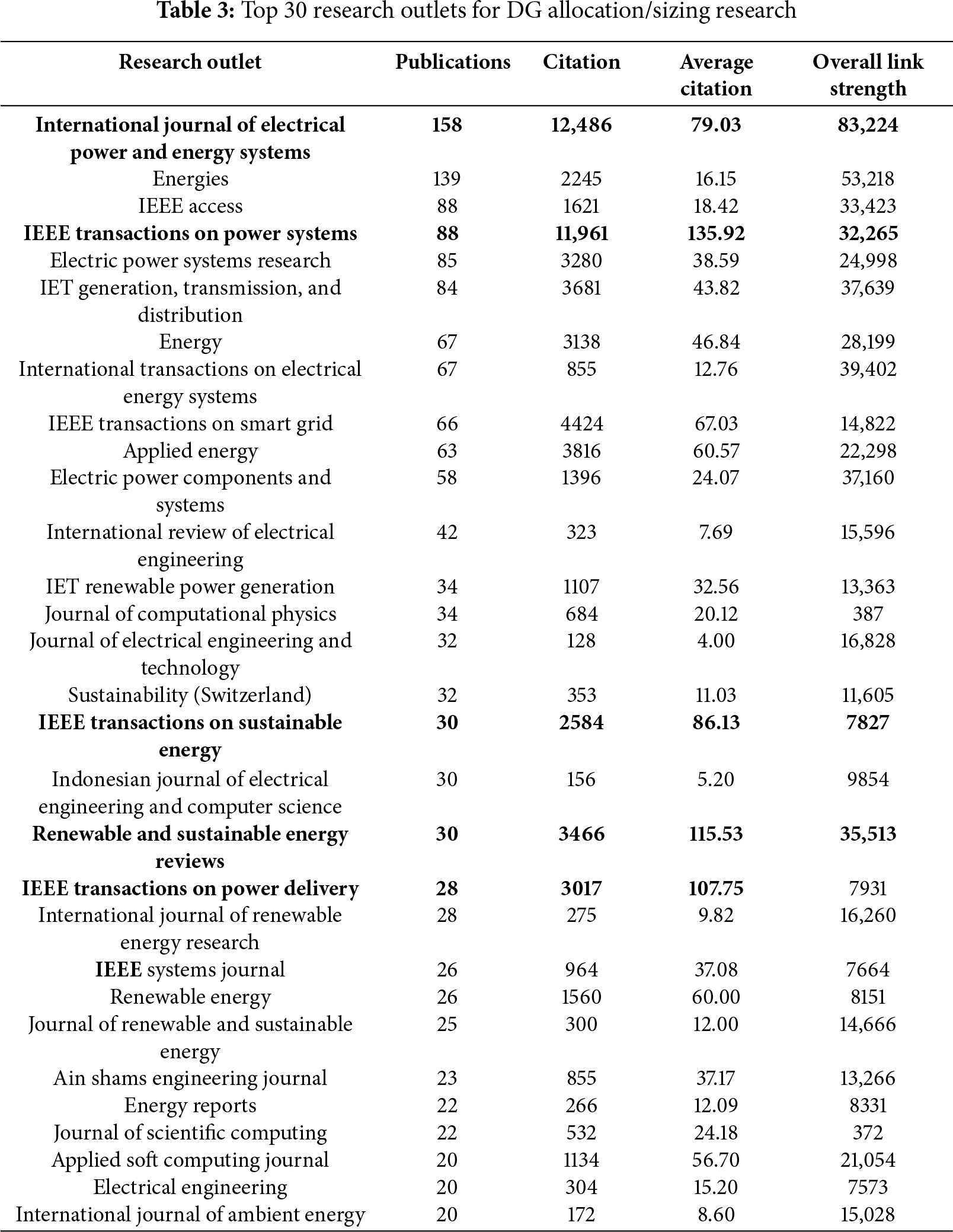
The scientific maps for the research outlets publishing articles related to DG sizing/allocation was conducted and explained in this section. The analysis is necessary to identify active research outlets in the area, which may be useful for researchers looking for academic information on DG sizing/allocation. The analysis was performed using the VOSviewer software, which allowed for the visualization of the co-occurrence of research outlets in the DG allocation literature. It should be noted that there is no standard rule for setting thresholds in the VOSviewer software. Twenty documents and one hundred citations were the minimal requirements, respectively. Just 60 of the 998 research outlets fulfilled these requirements. Fig. 4 shows a visualization of the top 60 research outlets on DG sizing/allocation. The map shows that the outlets are clustered into 4 clusters: red, blue, green, and yellow. Items in the same clusters show that they have similar characteristics, such as citation links, and are related to one another compared to items in a different cluster. In this analysis, the node size represents the articles number published in each research outlet. The articles number increases with node size. For the red cluster, “Energies”, “IEEE access”, and “International transactions on electrical energy systems” have the biggest node size and thus are the most productive research outlets. Similarly, the blue cluster is dominated by “International journal of electrical power and energy systems”, “Electric power components and systems”, and “International review of electrical engineering” having published 158, 58, and 42 articles, respectively. In the green cluster, the field is dominated by “IEEE transactions on power systems”, “Electric power systems research”, and “Institution of Engineering and Technology (IET) generation, transmission and distribution”. The smallest cluster in terms of numbers of articles is the yellow cluster, which is dominated by “Energy system” and “International journal of emerging electrical power system”. Overall, across all the clusters, the most productive publication outlets are “International journal of electrical power and energy systems”, “Energies”, and “IEEE access”.
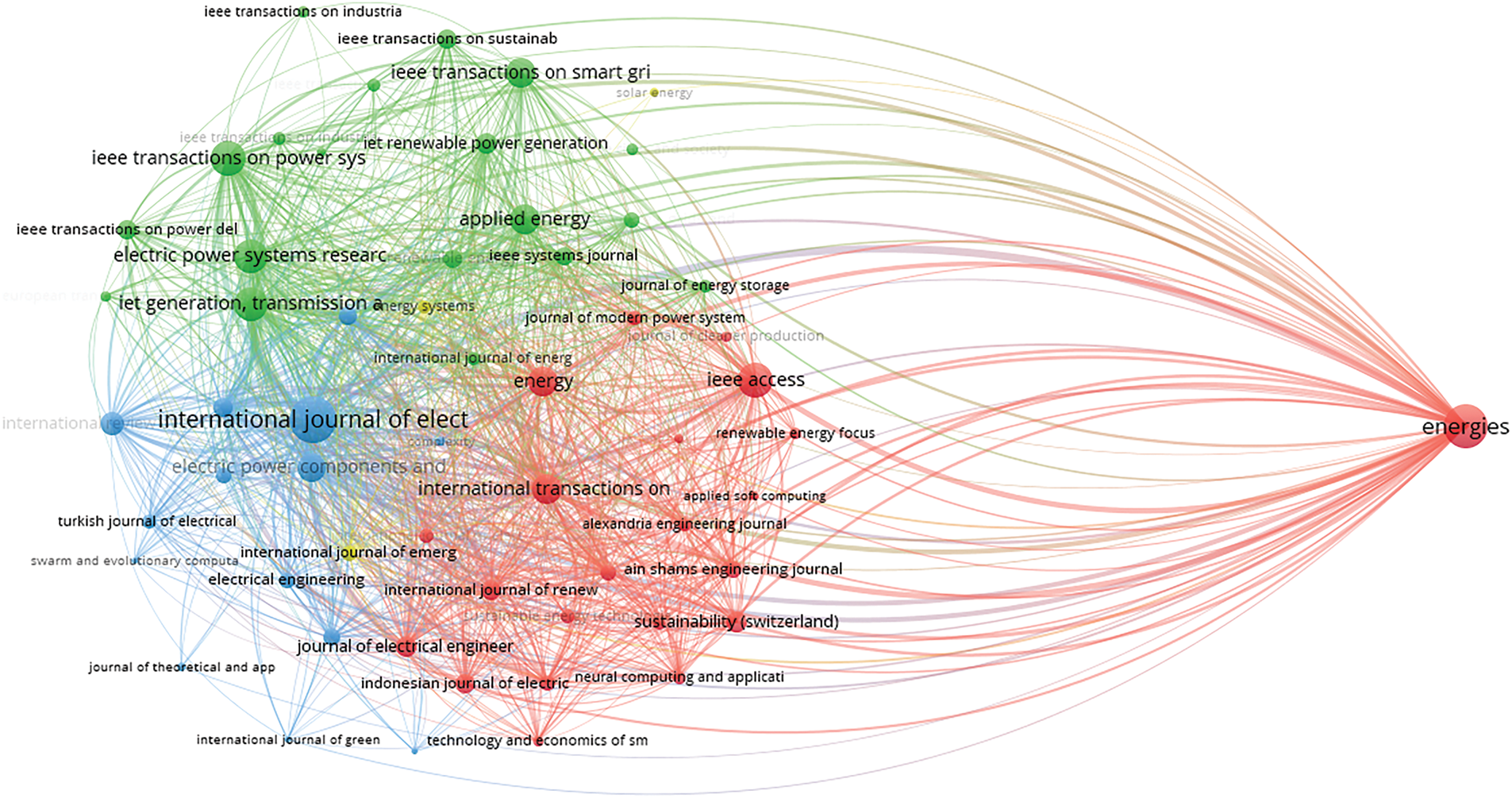
Figure 4: Mapping scientific outlets. Visualization of top 60 research outlets in DG sizing/allocation. Node size: number of articles published by each outlet; clusters represent citation-based thematic groupings (see Section 3.2). Color coding: red, blue, green, yellow clusters as described in text. Data extracted from Scopus dataset, and analyzed in VOSviewer
Table 3 presents the top 30 research outlets for DG allocation research, including the publications number together with information on their average citation, and the overall link strength. Although the number of articles shows how productive a research outlet could be, the average citations give a qualitative reflection of the publication channels [53]. In this connection, “IEEE transactions on power systems”, “Renewable and sustainable energy reviews”, “IEEE transactions on power delivery”, “IEEE transactions on sustainable energy”, and “International journal of electrical power and energy systems” are the most productive and impactful publishing channels in the domain of DG sizing/allocation. As can be seen, while looking at the articles number and average citations, the two journals that rank among the top 5 are “International journal of electrical power and energy systems” and “IEEE transactions on power systems”.
3.3 Science Mapping of Keyword Occurrence
The selection of appropriate keywords is crucial for any research manuscript, as they highlight the research focus. In doing so, they provide potential readers with an indication of the paper’s contents and subject matter. Therefore, keyword co-occurrence analysis was performed to investigate the most used keywords for DG allocation research. Utilizing VOSviewer, the keyword network map is created in Fig. 5 by selecting “fractional counting” as the counting method and “author keyword” as the analysis unit. The minimum keyword occurrences number is not strictly regulated, yet in the VOSviewer program, this parameter was set at thirty. Of the 8718 keywords used in all the articles, only 52 satisfied this threshold. According to Fig. 5, the keywords occur in 5 clusters, indicating different distinct research themes in the domain of DG allocation. The structured interpretation of the visualization of VOSviewer keyword co-occurrence network of Fig. 5 can be provided as follows.
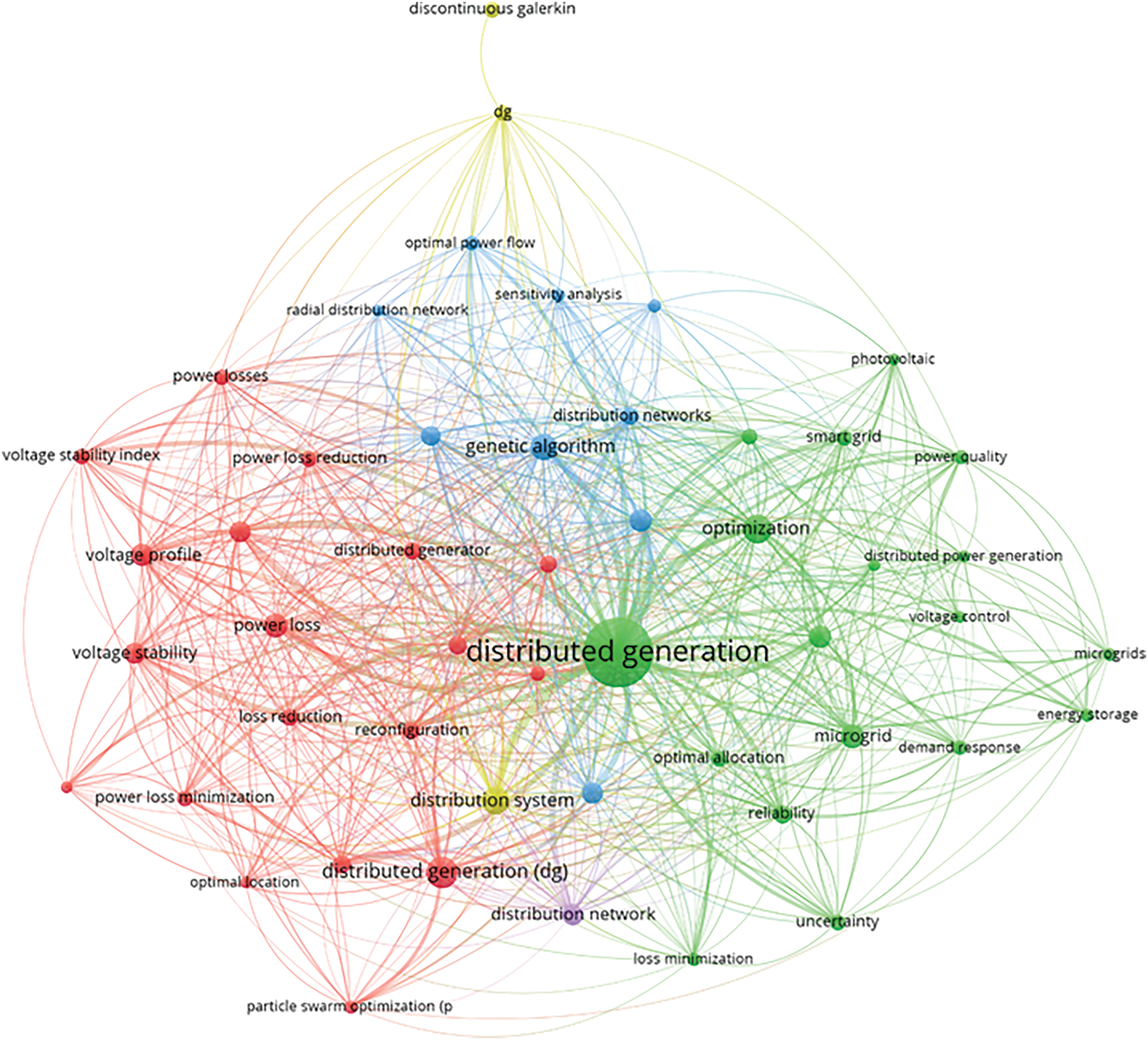
Figure 5: Keyword Co-occurrence Network. Network visualization of top 52 author keywords (minimum 30 occurrences). Node size: keyword frequency (unitless); edge thickness: co-occurrence link strength. Clusters (colors) as described in Section 3.3, representing major thematic groups: optimization, reliability, computational intelligence, etc. Data extracted from Scopus dataset, and analyzed in VOSviewer
3.3.1 Clustering Colors and Thematic Meaning
• Green cluster (right side): Focuses on optimization, microgrids, power quality, voltage control, renewable integration (e.g., photovoltaic, demand response, energy storage). Thematic meaning: Optimization techniques and system integration of distributed generation.
• Red cluster (left side): Concentrated around voltage stability, power losses, reconfiguration, loss minimization, power loss reduction. Thematic meaning: System reliability, stability, and loss reduction in distribution networks.
• Blue cluster (top-center): Includes genetic algorithm, sensitivity analysis, radial distribution networks. Thematic meaning: Computational intelligence and algorithmic methods for optimization.
• Yellow cluster (top small group): Small and isolated terms like discontinuous Galerkin (DG). Thematic meaning: Specialized or niche mathematical/analytical methods.
3.3.2 Central and Highly Linked Keywords
• “Distributed generation” (green, central, largest node): This is the most frequently occurring and most interconnected keyword. It reflects the core theme of the field: integration of distributed generation into power systems. Its size indicates high occurrence, and its centrality shows it connects multiple subfields (optimization, stability, microgrids).
• “Genetic algorithm” (blue, large node): Prominent as one of the most widely used optimization techniques in distributed generation studies. Its central linkages illustrate the importance of metaheuristic optimization methods in solving placement, allocation, and sizing problems.
• Other significant terms (e.g., “optimization”, “microgrid”, “voltage stability”): Their strong connections highlight them as recurring themes: ensuring system reliability, improving efficiency, and integrating renewables.
3.3.3 Practical Meaning of Link Strength and Occurrence
• High occurrence (node size): Indicates research hotspots with frequent attention. For example, distributed generation and optimization are core topics that dominate scholarly discussions.
• High link strength (thicker/denser connections): Shows concepts that co-occur frequently in publications, meaning they are often studied together. For example, distributed generation + optimization or genetic algorithm + distribution network. This reflects established methodological pairings in the field.
• Future research implications:
• Strong clustering around optimization algorithms suggests future work will continue to test and hybridize computational methods (e.g., combining genetic algorithms with AI/ML).
• The stability and reliability cluster signals ongoing interest in resilience and smart grid integration.
• Smaller/niche clusters (like discontinuous Galerkin methods) may represent emerging specialized approaches that could gain traction as systems become more complex.
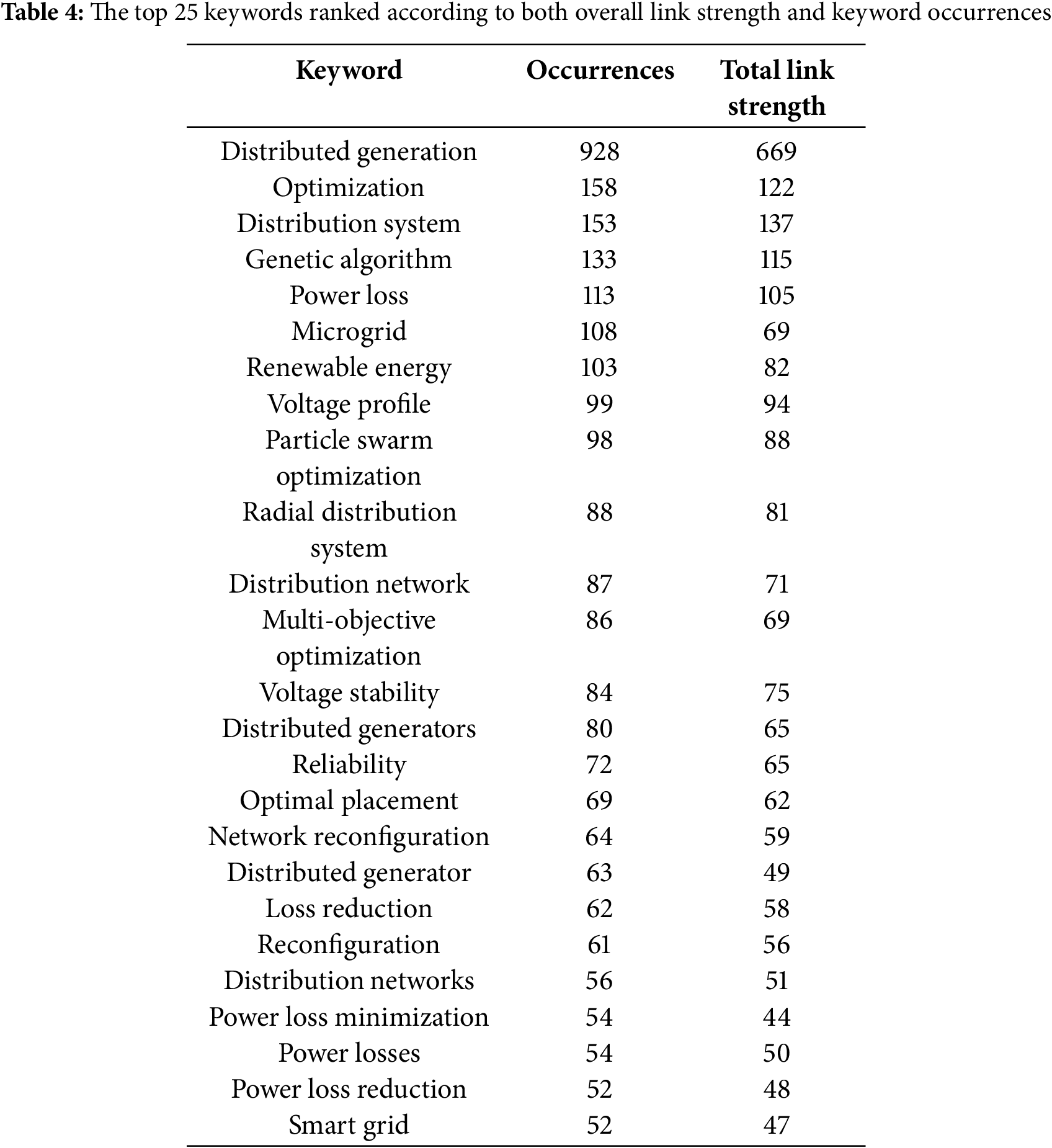
The top 25 keywords are provided in Table 4 and ranked according to overall link strength and keyword occurrences. It could be observed that “distributed generation”, “optimization”, “distribution system”, “genetic algorithm”, and “power loss” represent the top keywords in the domain of DG sizing/allocation research. Table 4 aims to provide readers with a clear overview of the most influential research themes and terminology in DG allocation/sizing studies. By highlighting the keywords most frequently used and most interconnected in literature, this table enables researchers to efficiently identify core topics, align their work with prevailing trends, enhance discoverability of their studies, and select appropriate terms for future literature searches or submissions. Thus, Table 4 serves as a valuable resource for understanding key focus areas and fostering effective scholarly communication in the field.
3.4 Authorship, Citation, and Co-Citation Analysis of Scholars
In this context, authorship indicates the number of articles that were authored or co-authored by a researcher. Similarly, one of the key indicators of the impact of a particular research area/field is the citation analysis of scholars. Citation analysis is a astratigy used to evaluate the impact and importance of scholarly publications and authors by examining the number of times other scholars have cited their work. On the other hand, co-citation analysis is a method used to identify the relationships between scholarly publications according to how frequently they are cited in the same body of work. This study’s citation and co-citation analyses were performed to investigate the most influential scholars and the key publications that have shaped the research on DG allocation. These analyses provide an insight into the impact and influence of scholars and their work in the field of DG allocation. This analysis can inform researchers and policymakers about future research directions, collaborations, and funding opportunities by identifying the most influential scholars and their key contributions.
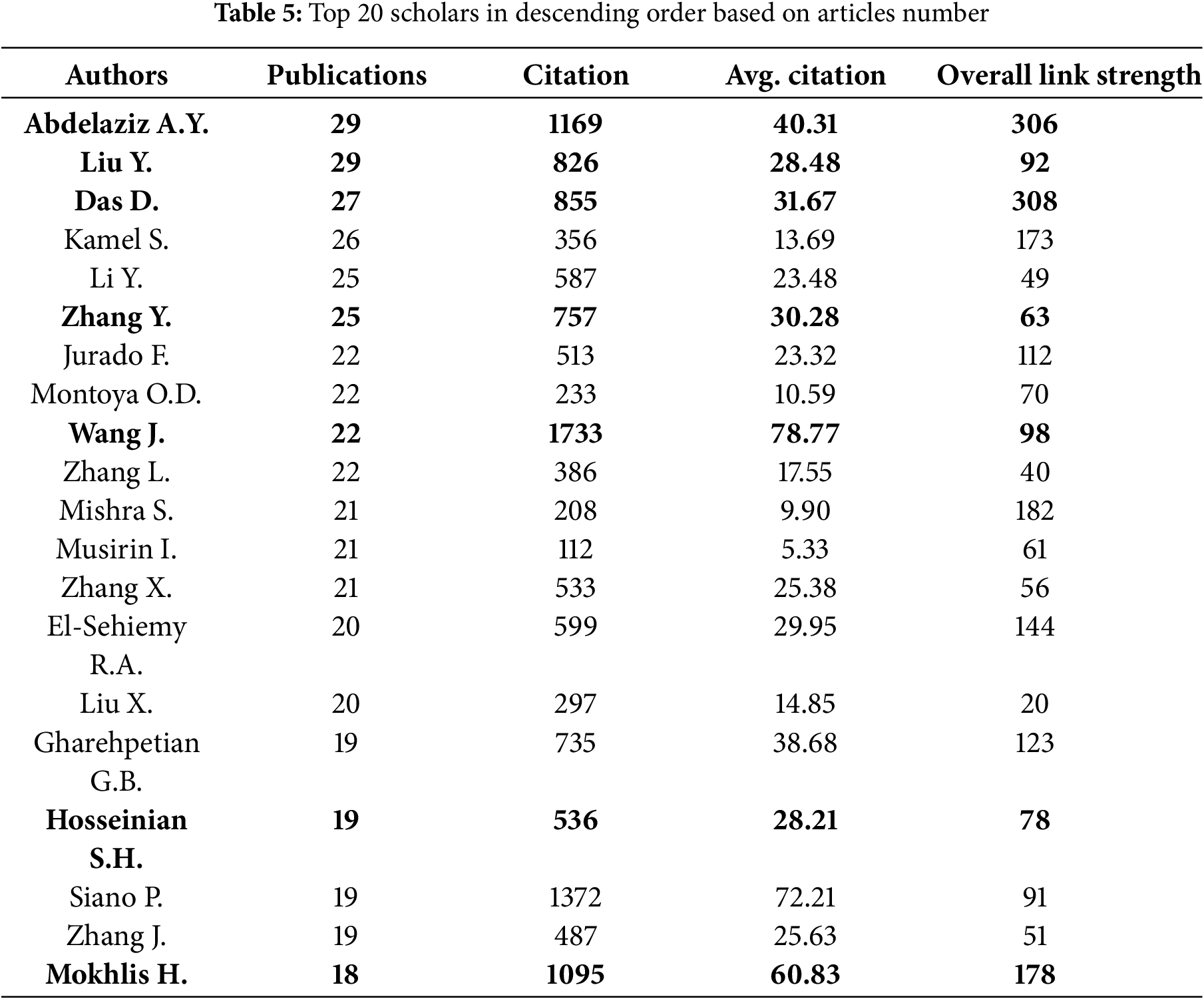
The number of articles and citations was fixed to 10 and 100, respectively, for the purpose of conducting the citation analysis. The results show that 76 authors met these criteria, and the resulting network map is shown in Fig. 6. Fig. 6 depicts that the influencing scholars are mapped in 6 clusters. The size of the node indicates the quantity of publications produced by a researcher. This Figure presents a citation network map of influential scholars in the field of distributed generation (DG) allocation, revealing six main clusters that likely correspond to distinct research groups or schools of thought focusing on specialized aspects such as optimization algorithms, DG sizing methodologies, and integration strategies. The top authors identified include Abdelaziz A.Y., Liu Y., Das D., Kamel S., and Li Y., who stand out due to their high publication volumes, strong network centrality indicated by large node sizes, and extensive cross-country collaborations that bridge diverse research communities. The map highlights prominent collaborative networks suggesting leadership roles within these clusters, yet also indicates potential research gaps where certain clusters may be less interconnected, pointing to opportunities for enhanced interdisciplinary coordination and exploration of under-addressed topics in DG allocation. Overall, the visualization underscores both the concentration of expertise among leading authors and the dynamic structure of collaborative efforts shaping the field. As per Table 5, which shows the top 20 scholars in the field of DG allocation in terms of the number of articles, “Abdelaziz A.Y.”, “Liu Y.”, “Das D.”, “Kamel S.”, and “Li Y.” are the most productive researchers.
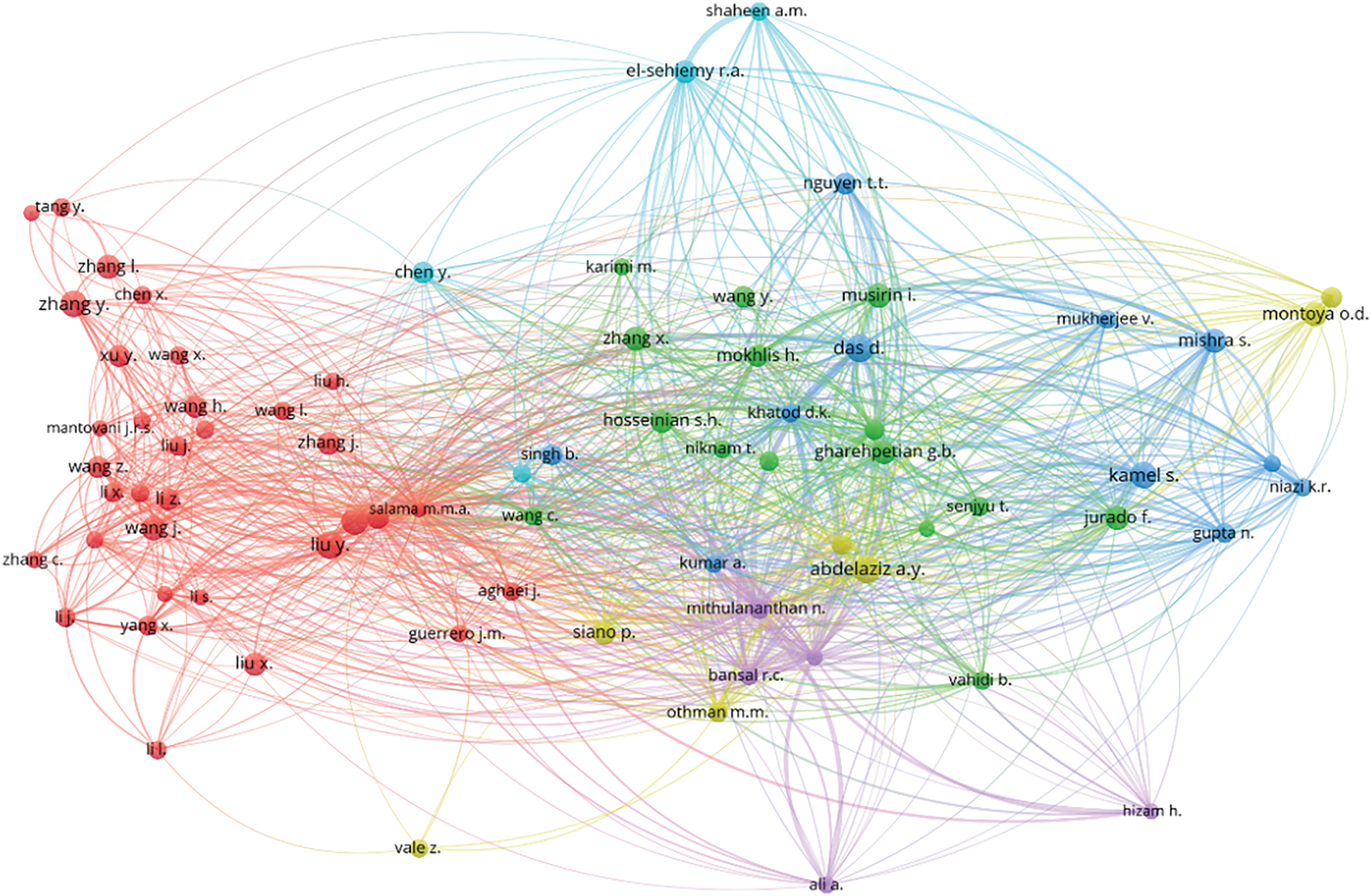
Figure 6: Scholar citation network map. Network map of top 76 contributing scholars in DG sizing/allocation (node size: number of articles; edge thickness: co-citation links; color clusters correspond to collaboration groups). Metrics defined in Table 5. Data extracted from Scopus dataset, and analyzed in VOSviewer
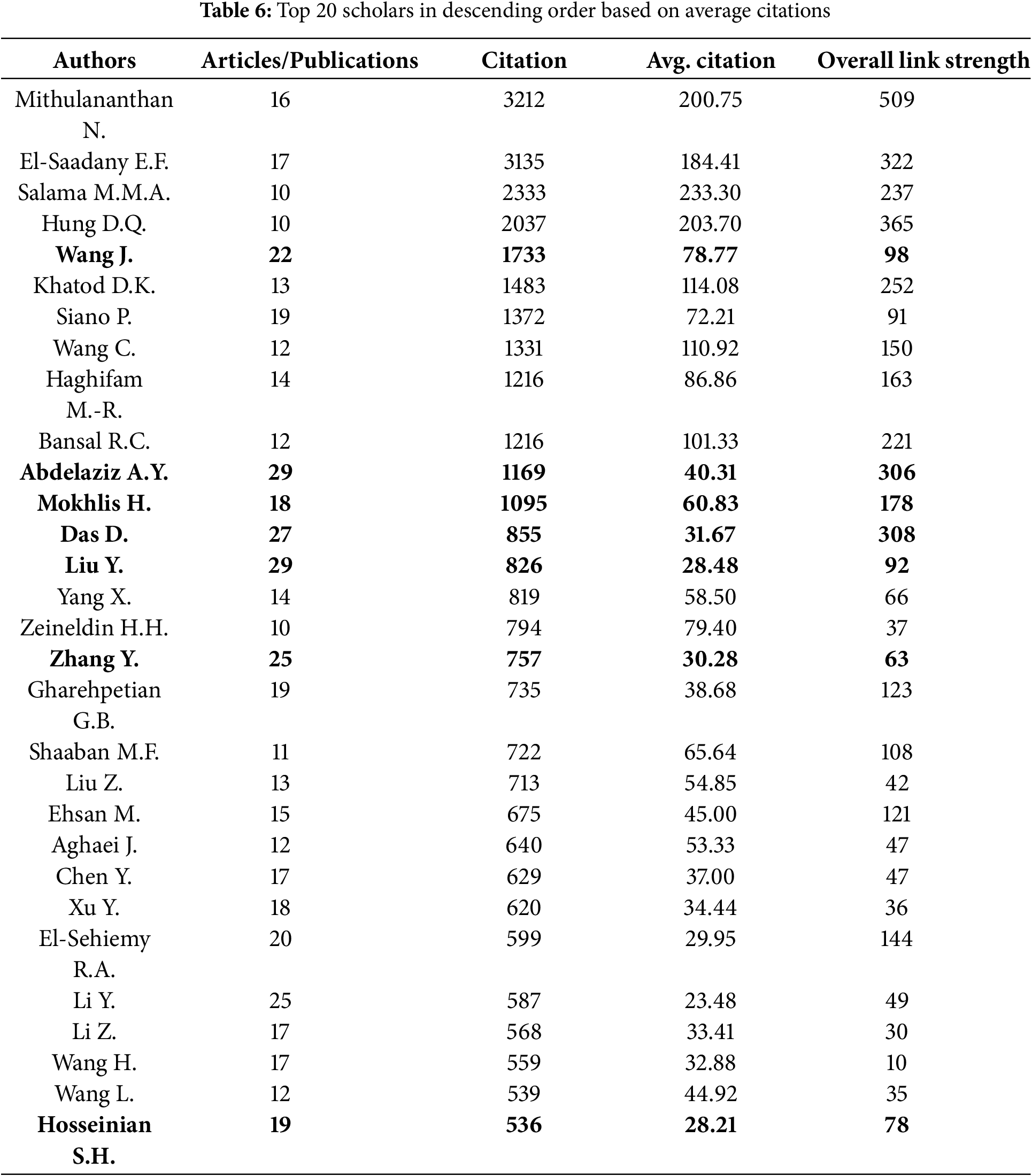
Although the number of articles indicates how productive a researcher is, the average citation (total citations divided by the number of articles) can give an overall qualitative ranking of a researcher. Hence, the top 20 researchers are shown in Table 5 according to their average amount of citations. According to the table, “Mithulananthan N.”, “El-Saadany E.F.”, “Salama M.M.A.”, “Hung D.Q.”, and “Wang J.” are the most prominent scholars. Overall, seven scholars: “Abdelaziz A.Y.”, “Liu Y.”, “Das D.”, “Zhang Y.”, “Wang J.”, “Hosseinian S.H.”, and “Mokhlis H.” appear in both Tables 5 and 6, indicating their significant contribution to DG allocation/sizing studies.
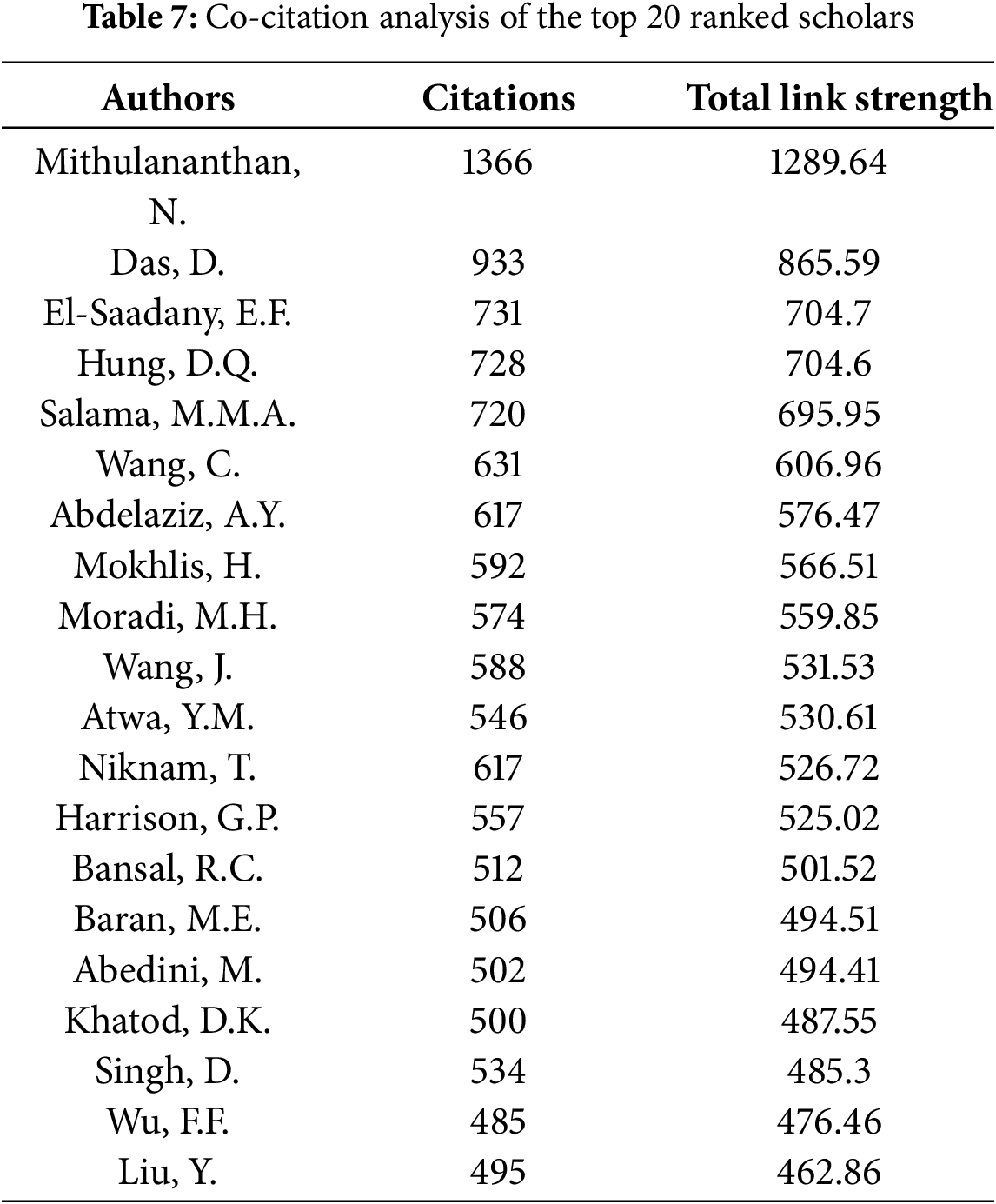
Co-citation analysis identifies authors who are frequently cited together, indicating that their works are foundational or closely related in the field, thus revealing the intellectual structure of research topics. In Fig. 7, three distinct clusters emerge, each representing a major research subfield or scholarly community within distributed generation (DG) allocation: the green cluster centered on Mithulananthan N., the blue cluster dominated by Wang J., and the red cluster focused around Salama M.M.A. These clusters reflect thematic or methodological concentrations that shape DG research. Authors such as Mithulananthan N., Das D., and El-Saadany E.F. exhibit the highest total link strengths, marking them as highly influential and central nodes within the knowledge network whose work underpins key developments in DG allocation. They have the highest total link strength of 1289.64, 865.59, and 704.7, respectively. The clustering suggests strong collaboration or citation patterns within subfields, while also hinting at possible interdisciplinary linkages between clusters. The co-citation analysis of the top 20 scholars based on the total/overall link strength is shown in Table 7. Overall, the robust co-citation links underscore the integration and maturity of these research lines, reflecting a well-connected and coherent scholarly domain.
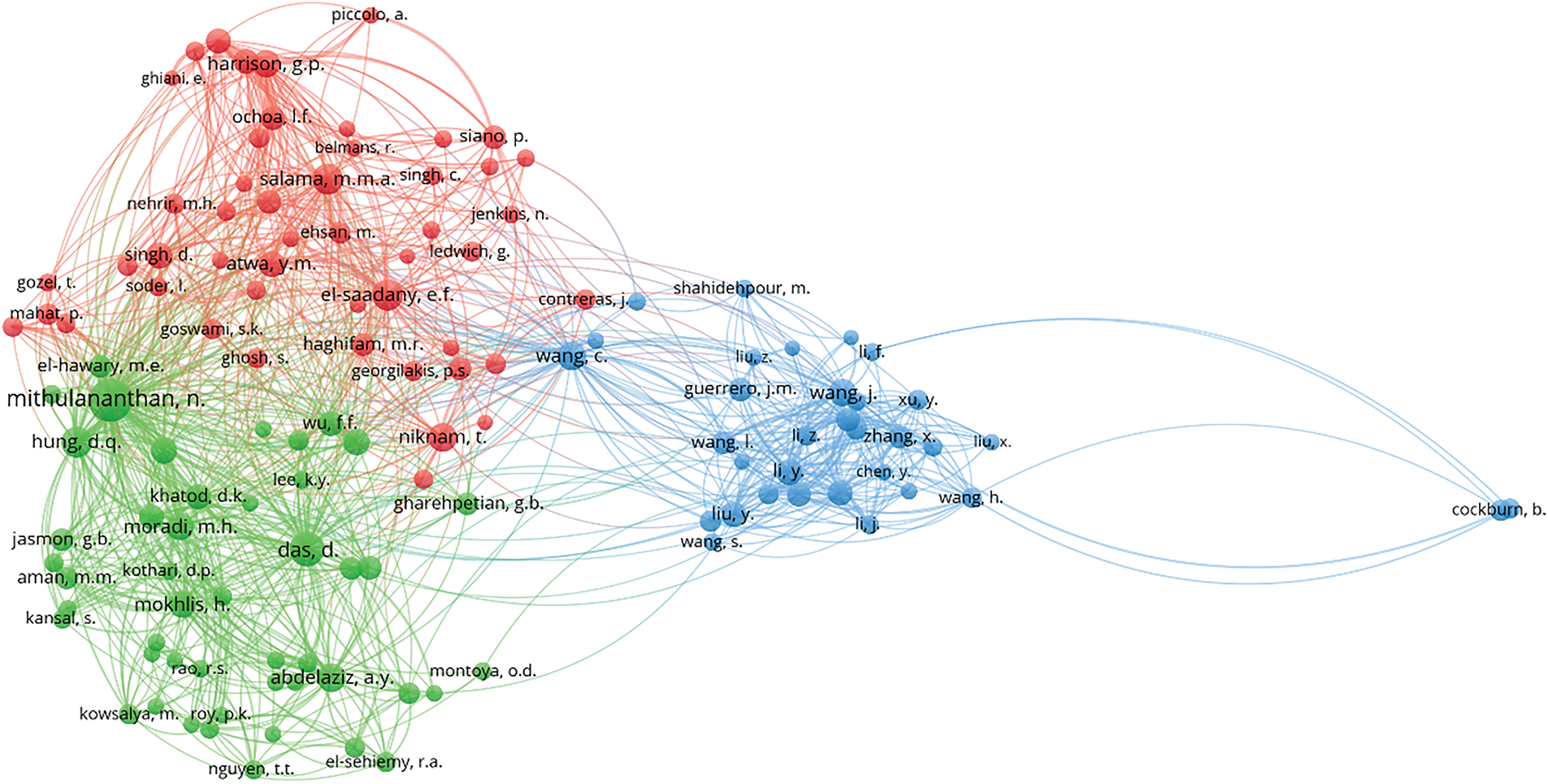
Figure 7: Co-citation mapping of authors. Visualization of co-citation clusters among leading scholars. Node size: total citations; edge thickness: co-citation frequency. Colors correspond to research clusters detailed in Section 3.4 and Table 7. Data extracted from Scopus dataset, and analyzed in VOSviewer
3.5 Articles’ Citations Network Analysis
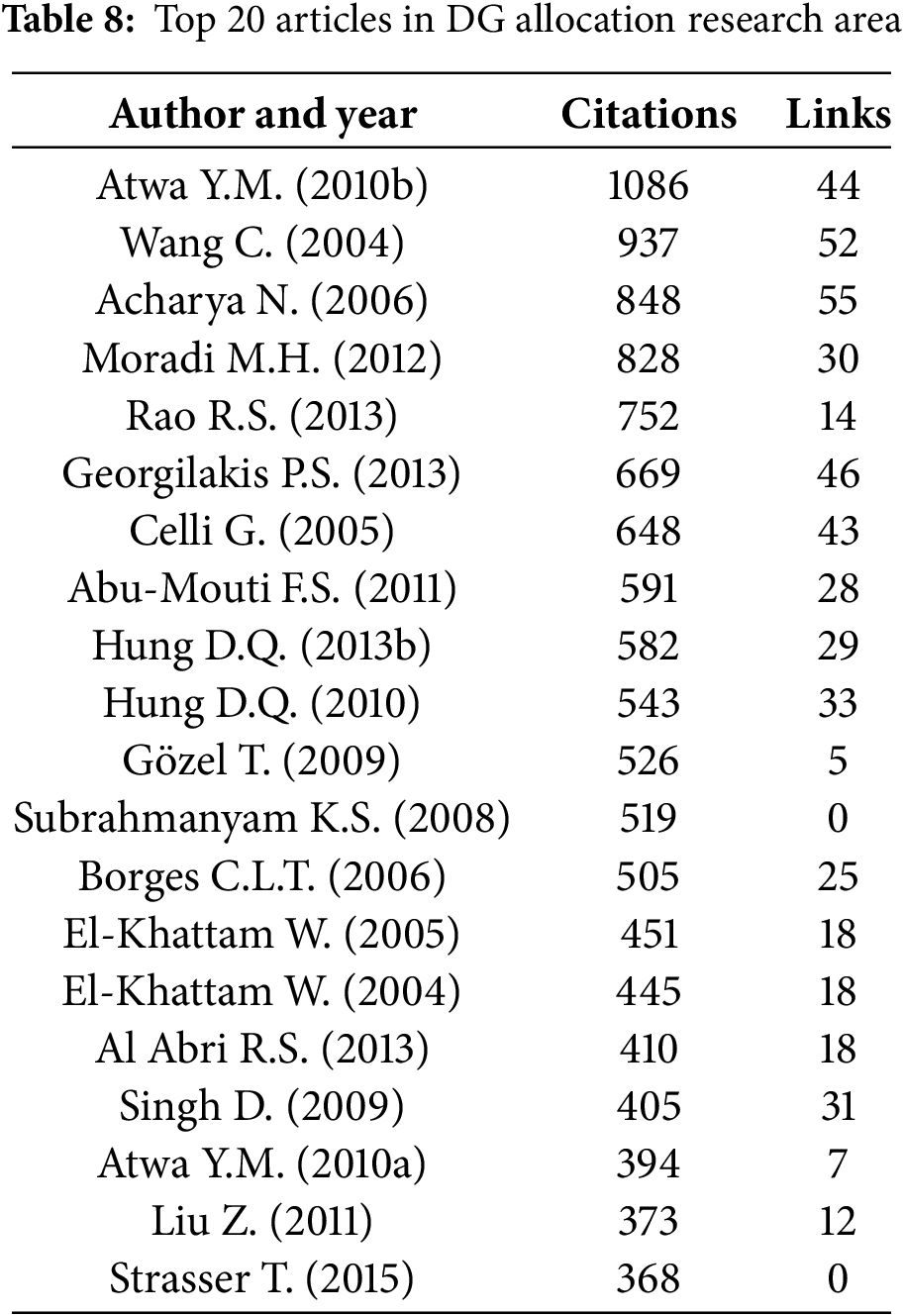
Citation network analysis is a mapping technique used to study the relationships between articles based on their citations. In this study, citation network analysis was done to determine the most influential articles in the field of DG allocation. The analysis was attained using the VOSviewer program with a minimum of 100 citations for an article to be included in the network map. 174 articles met this criterion, and the map is demonstrated in Fig. 8. The citation network map in Fig. 8 illustrates how articles influence each other through direct citation connections, enabling the visualization of key studies that have shaped the evolution of research on distributed generation (DG) sizing and allocation. In this context, “links” represent direct citation relationships between articles, while citation counts measure the impact of each publication based on how frequently it has been referenced by others. The top-cited articles, such as Atwa Y.M. (2010b) on optimal energy storage allocation, Wang C. (2004) on analytical placement approaches, and Acharya N. (2006) on DG allocation methodologies, are foundational due to their methodological innovations and comprehensive treatment of optimization problems, making them widely used references in the field. The network also reveals clusters of interconnected articles that focus on similar DG sizing and allocation challenges or share common optimization techniques, reflecting thematic subgroups within the literature. Overall, examining citation patterns in this map helps identify landmark works that have significantly influenced DG research and highlights emerging trends and directions for future study.
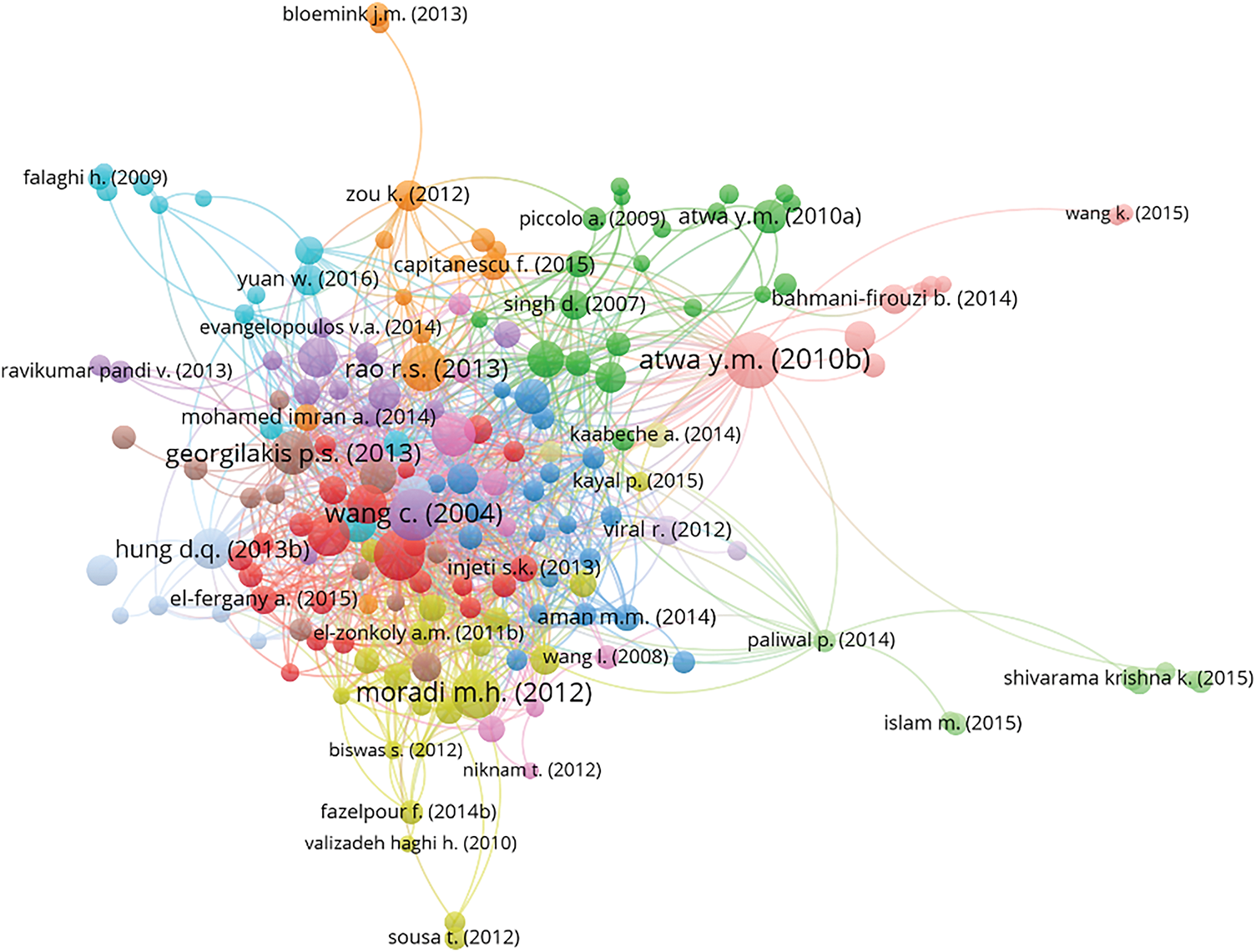
Figure 8: Article citation network. Network map of 174 most-cited articles (minimum 100 citations) in DG allocation research. Node size: citation count (see Table 8); edges: direct citation links. Colors signify thematic groupings among articles as determined by VOSviewer analysis (Section 3.5). Data extracted from Scopus dataset, and analyzed in VOSviewer
Table 8 shows the top 20 articles with their citation counts and links. The articles with the highest citation are “Optimal allocation of Energy Storage System in Distribution Systems with a High Penetration of Wind Energy” by Atwa Y.M. (2010b), with a link to 44; “Analytical Approaches for Optimal Placement of Distributed Generation Sources in Power Systems” with a link of 52, and “An Analytical Approach for DG Allocation in Primary Distribution Network” with a link of 55. This result indicates that this article is highly influential and has been cited frequently in previous literature related to DG allocation. The analysis’s findings can aid researchers in comprehending the most influential articles in the field and present research trends and directions.
3.6 Active Countries in the Domain of DG Allocation
In this section, the active countries that are contributing to the research domain of DG allocation/sizing are analyzed. This analysis is important as it sheds light on the geographical distribution of research activities in this field. The data derived from the authors’ affiliations with the papers that comprised this analysis was utilized to identify countries/nations that were actively involved. VOSviewer adjusted a country’s minimum articles number and citations at five and one hundred, respectively. Out of 117 countries, 59 of them met the threshold requirements. Fig. 9 shows the network map of the active nations/countries in the DG sizing/allocation field. In Fig. 9, the node size typifies the number of articles published by each study. Fig. 9 identifies India, Iran, China, USA, and Egypt as the countries with the highest productivity in terms of publications. On the other hand, Table 9 presents the top 20 countries/nations in terms of the average citation number. In this context, the top 5 most productive countries are Canada, North Macedonia, Greece, the Czech Republic, and Qatar.
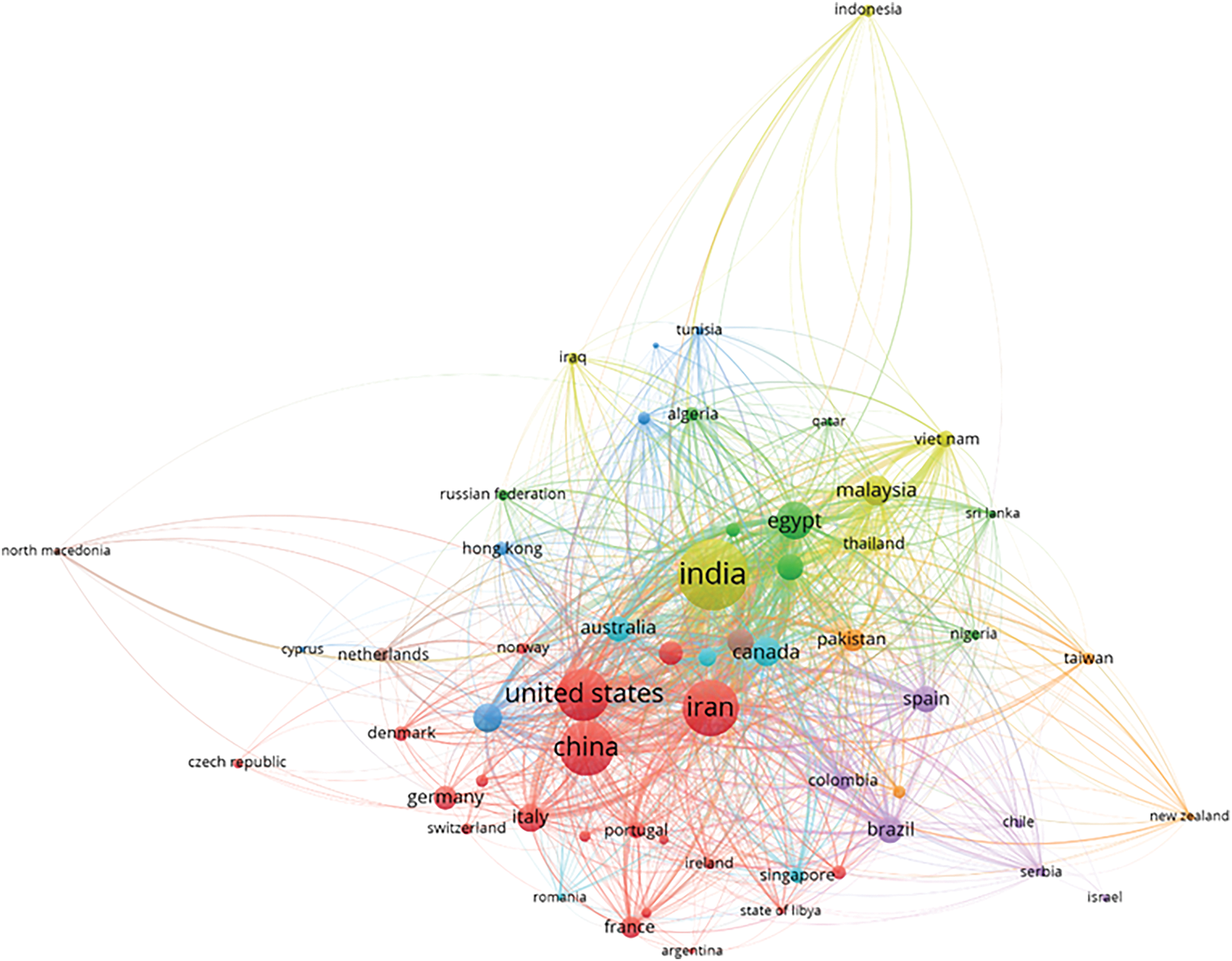
Figure 9: Country activity visualization. Network map of 59 most active countries in DG sizing/allocation (node size: article count; edge thickness: collaborative link strength as defined by co-authorship and citations). Color clusters correspond to regional or collaborative groupings identified in Section 3.6. Data extracted from Scopus dataset, analyzed in VOSviewer
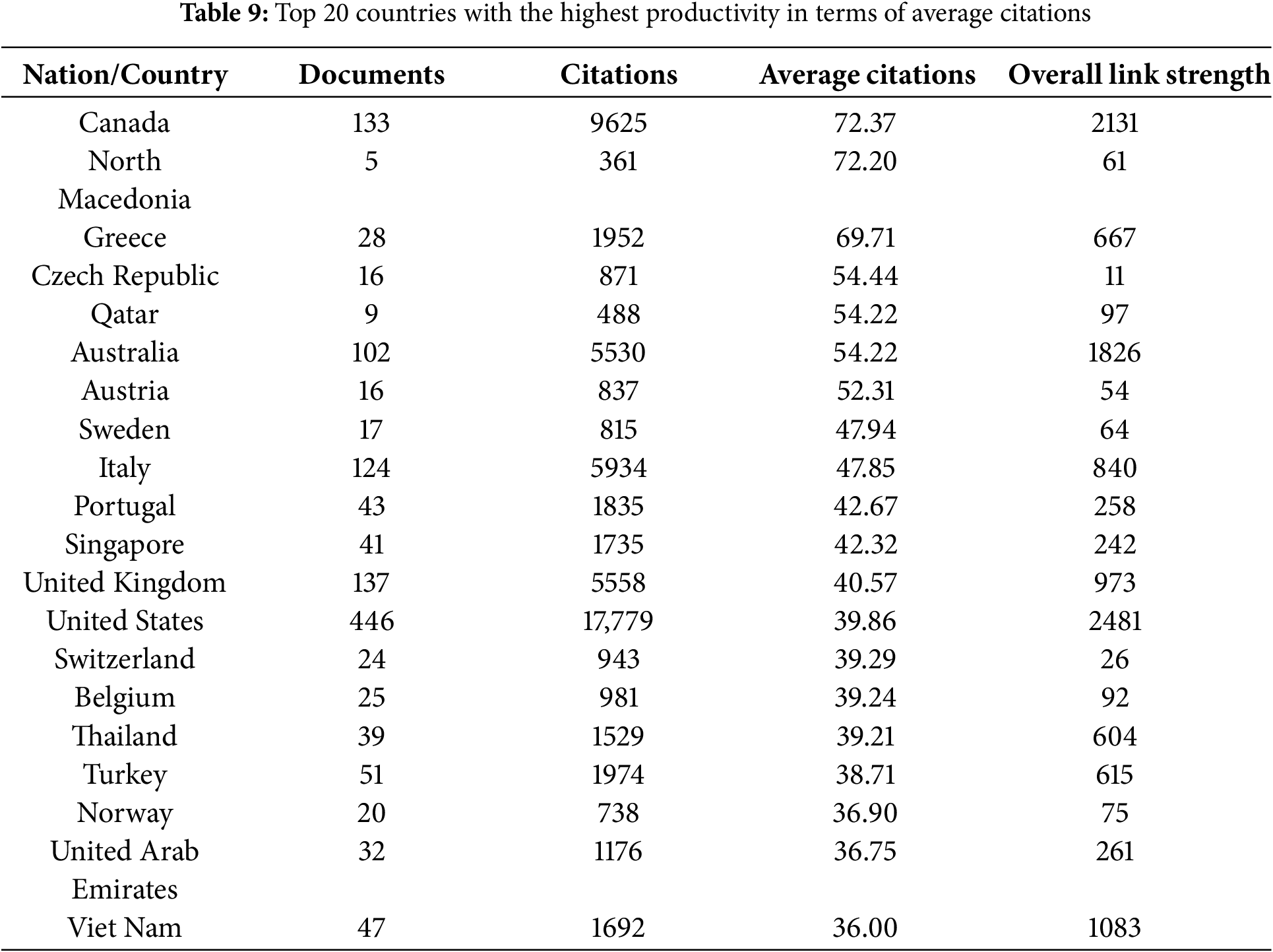
This analysis offers insightful information on how research activities are distributed in DG sizing/allocation field. Identifying the most active and impactful countries can help researchers identify potential collaborators and research partners in different regions of the world. Furthermore, it can help policymakers identify countries investing heavily in research and development in this field, and potentially guide funding and resource allocation decisions.
4 Major Global Research Trends of DG Sizing/Allocation Optimization, Technologies, and Strategies
Researchers’ interest in DG technologies has increased significantly because of their great benefits, including reduced power loss, friendly to the environment, improved voltage, deferred system upgrades, and higher reliability. However, the practical use of the DGs is challenging because social, political, and economic considerations influence the final best solution. Selecting the best placement, size, and kind of DG and network connection is necessary for integrating DG units into an existing energy system. Total power loss is decreased, as are the system stability and voltage profile, in addition to its dependability, load capacity, security, power quality, and power factor. All the benefits listed above would be undermined by improper DG-unit distribution. Therefore, it is crucial to allocate the DGs units at the best places and at the proper sizes.
Optimization approaches are used to develop solution strategies for DG-unit deployment. The DGs sizing and allocation can be considered as a nonlinear optimization problem. The system voltages are often maximized, while cost and power loss are typically reduced. The requirements for the solutions varied amongst applications. As a result, the methodology needs more data because it considers further objectives and constraints, which tends to make implementation more challenging. Different DG-unit problems have been mitigated using efficient optimization techniques. In this area, interesting and still-evolving technologies include meta-heuristic approaches like genetic algorithms, particle swarm optimizer, and evolutionary programming (EP). Some of those methods have been altered to improve the performance of their solutions or get around certain restrictions. Additionally, most of these tools have a lot of adjustable parameters.
4.1 Objective Functions for DG Sizing and Allocation
Utilizing a DG unit in power distribution networks has the benefit of reducing the power loss across the entire system while still meeting certain operational requirements. Put another way, applying DG units may be seen as an exercise in figuring out how to best put and amplify a given DG unit while staying within the bounds of equality and inequality to meet the required objective function. The power-flow analysis employed affects the DG-unit solution algorithm’s accuracy, precision, and adaptability. Hence, the accuracy of the technique is strongly dependent on that analysis. The power-flow analysis might represent the algorithm’s brains for the DGs solution. Consider the example of a two-bus power system with a DG unit illustrated in Fig. 10.
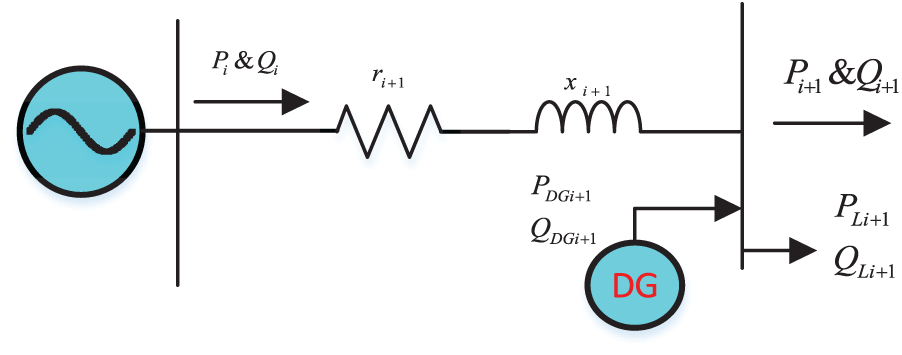
Figure 10: Single line diagram of a two-bus power system. Two-Bus Power System (Technical Diagram). Single-line diagram variables: Pi and Qi: active/reactive power at bus i (in MW/MVAR); Vi: bus voltage (in kV); ri + 1: resistance of line segment (in Ω). System objective defined in Eq. (1) (Section 4.1)
The objective is to lower the system’s actual power loss as shown below [54].
The system is characterized by three nonlinear power-flow equations [54]. These equations represent the equality constraints which can be described as follows [54]:
where i = 1, 2, 3, …, n.
The power system’s voltage limitations which are ±5% of the nominal voltage are the inequality restrictions/constraints [54]:
Furthermore, the thermal capacity of the system’s lines are considered as inequality restrictions and constraints.
The DG’s kVA size and power factor serve as the border (discrete) inequality restrictions.
In the proposed method in [54], practical considerations like DG sizes and power factors have been taken into consideration. The correctness of the findings is ensured by the proposed method’s initial treatment of rounded-off concerns related to the DG’s size or power factor. The predetermined DG sizes cover between 10% and 80% of the total system requirements (i.e.,
The DGs power factor(PF) is programmed to work at realistic values [55], i.e., unity, 0.95, 0.90, and 0.85 in the direction of the best outcome. Additionally, the load PF of the bus where the DGs is placed and the PF of the operating DG-unit must differ [56]. As a result, the bus where the DGs is located will have less net total power, including reactive and active.
In brief, the optimal DGs sizing, and allocation depends on the objective functions that are prespecified by the planners and designers and sought to be attained. The objectives may be single or multi-objectives and they can consist of economic and/or technical objectives. Fig. 11 summarizes the main objectives for DG allocation and sizing whether the objectives are single or multi-objectives and technical or economical or techno-economic.
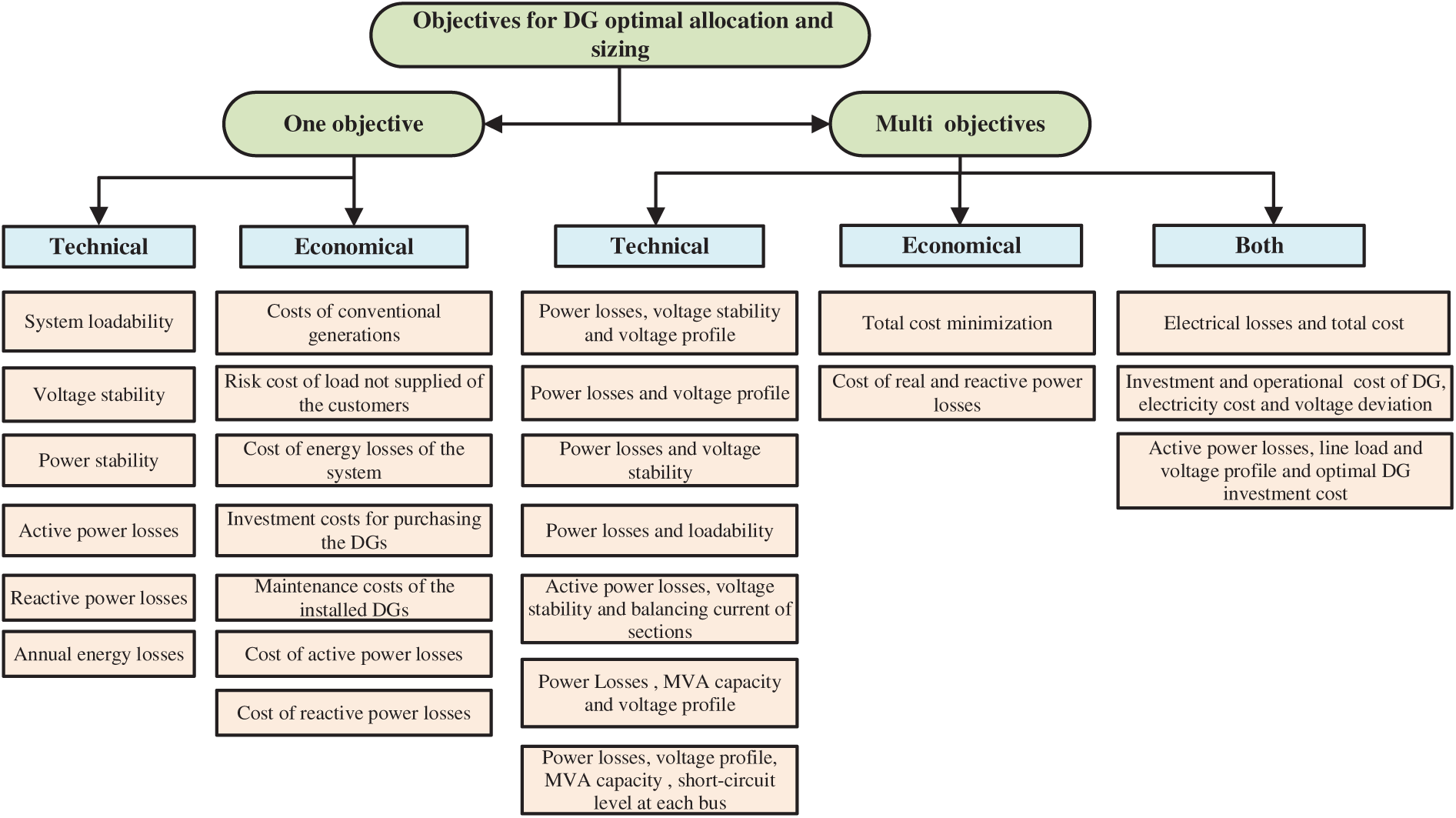
Figure 11: Planning objectives for optimal DGs allocation and sizing. Schematic summarizing technical and economic objectives for DG sizing/allocation (see Section 4.1)
4.2 The Optimization Techniques for DG Sizing and Allocation
To optimize the techno-economic benefits, DG units must be allocated at the ideal or optimal location and with the appropriate size. Benefits include operating and maintenance costs minimization and voltage profile enhancement, power system stability, quality, and reliability. The following categories represent the main technological techniques for appropriate DG sizing and allocation:
1. Analytical approaches
2. Conventional (non-heuristic) approaches
3. Meta-heuristic optimization approaches
4. Hybrid approaches
5. Assorted approaches
The optimal DG size and allocation in a distribution system will be significantly influenced by all the technical optimization techniques listed above. Various optimization approaches applied for perfect DG allocation and sizing are shown in Fig. 12. A system with enormous and complicated networks is not ideal for analytical and conventional (non-heuristic) techniques, which perform well for small and simple systems. However, the effectiveness of several meta-heuristic methods is improved. Their great precision and quick convergence are appropriate for extremely big and complicated systems. Combining two or more optimization techniques results in a hybrid optimization. It provides difficult multi-objective problems with more dependable and efficient global optimal solutions. According to methodology, algorithm, objective function, test system, benefits, and downsides, several DG deployment strategies are provided in Table 10.
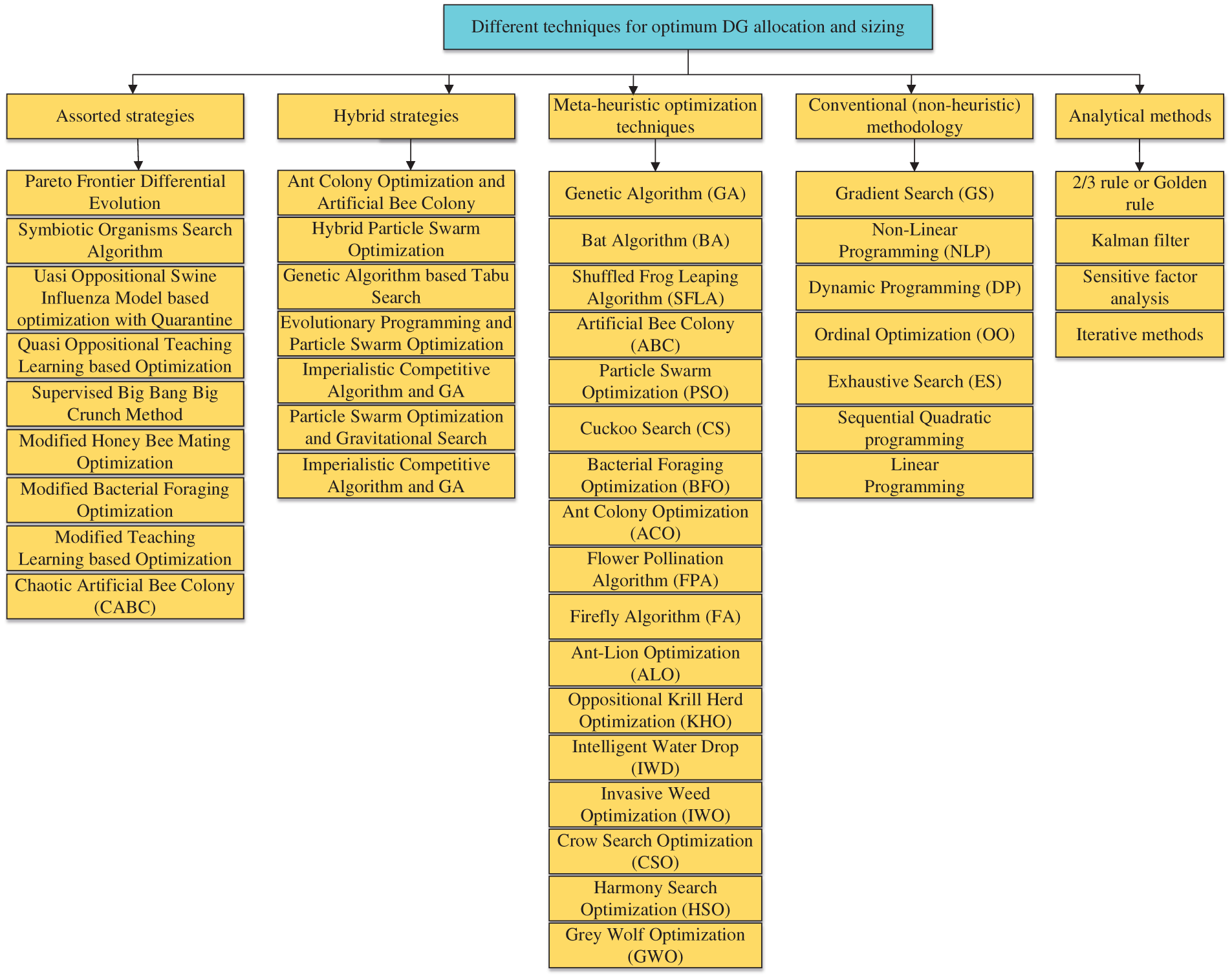
Figure 12: Different optimization approaches for optimal DG allocation and sizing. Diagram illustrates five main classes of optimization techniques (analytical, conventional, meta-heuristic, hybrid, assorted) as detailed in Section 4.2. Each block lists an approach applied to DG sizing/allocation

Table 10 presents a broad range of optimization methods categorized as Analytical, Conventional (non-heuristic), Meta-heuristic, Hybrid, and Assorted approaches, along with their main objectives, test systems, strengths (merits), and limitations.
• Analytical methods are instructional and computationally light but are non-optimal and lack applicability to large, complex networks. For example, linear differential and sensitivity-based methods work on small IEEE test systems but ignore economic/geographic factors and often only consider peak load conditions.
• Conventional (non-heuristic) approaches such as Non-Linear Programming, Mixed-Integer Non-Linear Programming, and Dynamic Programming include real operational constraints but frequently encounter issues like impractical solutions, high computational needs, and limitations when applied to real-world, large-scale systems.
• Meta-heuristic techniques (Genetic Algorithm, PSO, Tabu Search, etc.) are widely adopted for DG sizing/allocation due to their ability to handle nonlinear, multi-objective, and large-scale problems. For instance, the GA and PSO families are frequently used for loss reduction and voltage improvement. Table 10’s evidence indicates that metaheuristics generally offer better convergence, flexibility, and practical suitability for real/large systems. However, weaknesses include risk of premature convergence (GA), violation of constraints (PSO), or high computational burden (multi-objective cases).
• Hybrid approaches (e.g., hybrid PSO, ACO-ABC, PSO-EP) combine two algorithms, addressing the drawbacks of single methods and directly achieving better loss reduction, reliability, and computational efficacy for multi-dimensional, real-world cases. The table shows they achieve improved performance on benchmark networks but may have increased methodological complexity.
• Assorted methods such as Symbiotic Organisms Search, Pareto Frontier Differential Evolution, and Big Bang Big Crunch excel at global search and handling complex/realistic system objectives but tend to be computationally heavy or may require multiple runs for adequate convergence.
As detailed in Table 10, Analytical and Conventional methods are limited to small/simple systems, while Meta-heuristic and Hybrid techniques demonstrate superior performance for modern, large-scale, and multi-objective DG allocation tasks. For example, GA and PSO approaches achieve high solution quality but can face premature convergence or constraint violations, whereas Hybrid methods, such as PSO-EP, address these drawbacks at the cost of greater algorithmic complexity. Drawing directly from Table 10, for practical deployments in smart grids, Hybrid and Meta-heuristic approaches should be prioritized due to their proven balance of scalability, solution quality, and flexibility.
4.3 The Best DG Sizing and Allocation Technologies
The most widely utilized traditional DG technology from previous decades uses reciprocating internal combustion engines (diesel, micro-turbines). However, diesel generator units are only used for emergency standby due to rising fuel prices and environmental concerns. Fig. 13 depicts current centralized power generation as well as projected dispersed generation. Fig. 14 illustrates several DG systems for non-renewable and renewable sources together with their technological, environmental, and economical advantages.
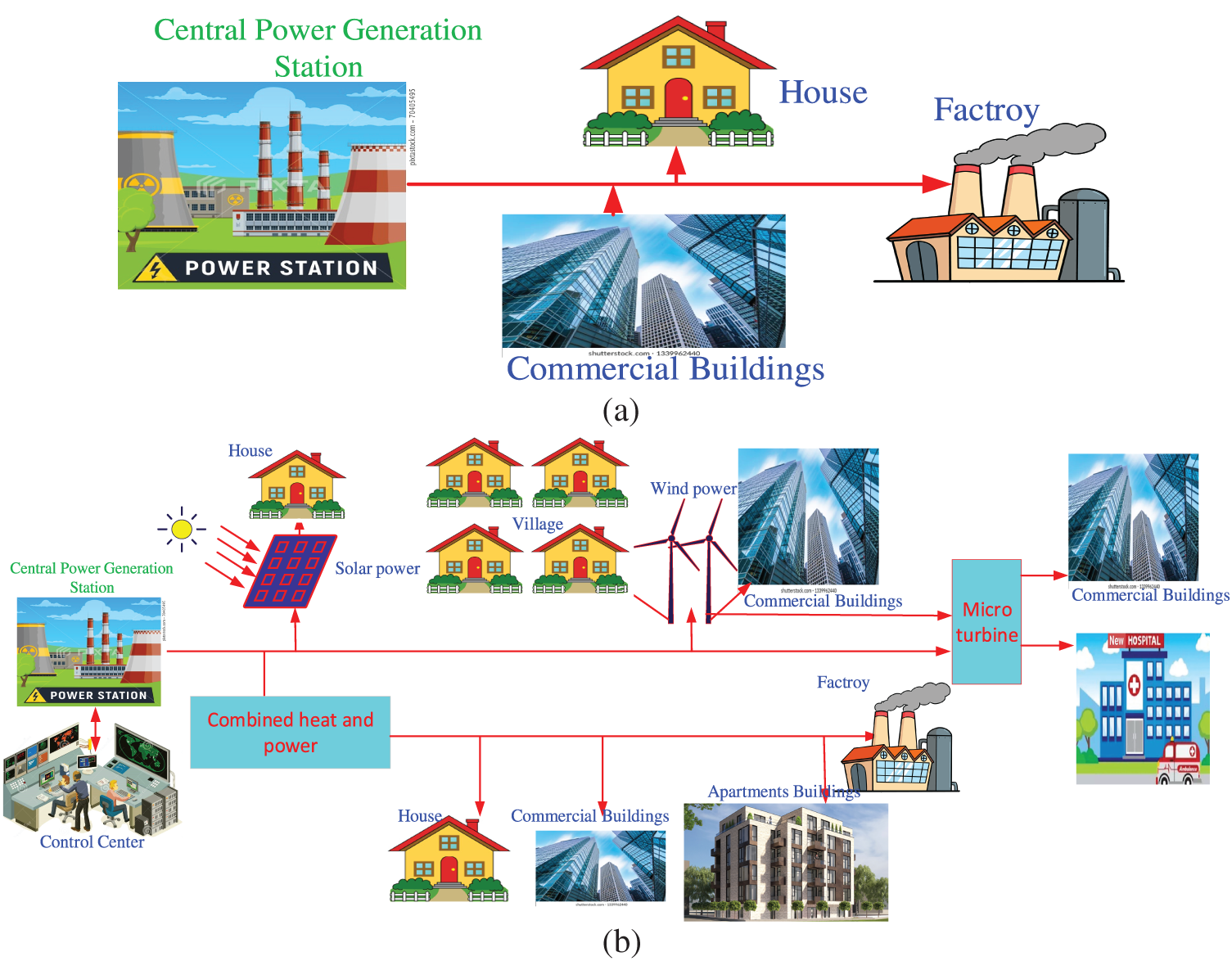
Figure 13: Centralized vs. distributed generation. (a) Current centralized generation configuration. (b) Projected future distributed generation arrangement (DG: distributed generation). Diagrams are conceptual; energy flows indicated by arrows. See Section 4.3 for context
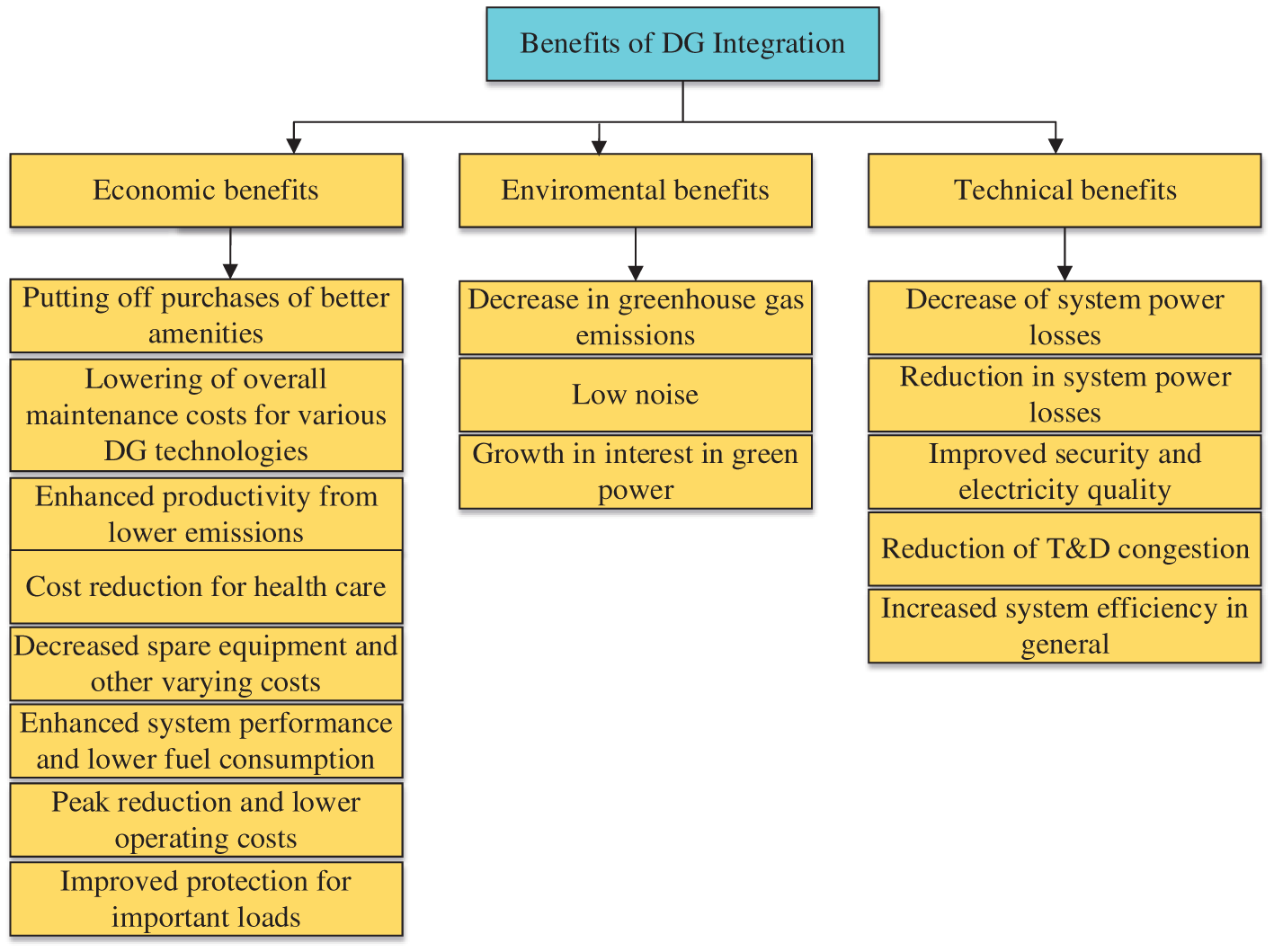
Figure 14: Techno- economic and environmental benefits. Diagrammatic summary of benefits from DG incorporation, listing technical, economic, and environmental impacts
4.3.1 Non-Renewable DG Allocation and Sizing Technologies
The reciprocating engine (RE), a non-renewable DGs technology, is a widely used and widely recognized technology. Based on the Environmental Protection Agency report, reciprocating engines produce more than 200 million units annually around the world, according to the US. The reciprocating engine power generators range is 10 to 18 MW. Frequently, over 95% of them can be used in applications that produce static power. Both diesel and spark ignition configurations have been used in REs. The Combined heat and power (CHP) systems based on REs often provide both thermal and electrical needs. Another form of REs is the microturbine, which has a high-speed, solitary shaft and simple mechanical assemblies. Since natural gas is utilized in micro-turbines for the ignition, this technology has lower NOx emissions than diesel generators. Micro-turbines are not environmentally favourable, despite having minimal NOx emissions [118–120]. Diesel generators stand out among non-renewable DGs because of their low cost and great dependability, which is the most widely used DG technique. Diesel generators will become dispatchable sources when they have instantaneous start and stop operation. It most likely works well when used alone.
4.3.2 Renewable DG Allocation and Sizing Technologies
The word “renewable” refers to primary, clean, domestic, or limitless energy sources. Reducing CO2, NOx, and other greenhouse emissions motivates the integration of Renewable Energy Resources (RER)-based DGs in the power distribution systems. The most popular DGs technologies that use renewable energy resources are fuel cells, biomass, solar PV, wind turbine generators, small/mini/micro hydropower, and biomass [121,122]. Reputable RER-based DG technologies are given in [123]. Due to its steady availability and enormous capacity, hydropower accounts for a significant portion of renewable energy worldwide. Since solar energy is so widely available and is non-polluting, it has drawn more attention. By 2030, Spain will need less energy, thanks to the production of power from renewable sources, with solar PV technology receiving particular attention. Another significant renewable energy source that creates clean energy is wind turbines. However, stochastic analyses are needed since solar and wind energy are intermittent. Another RER employed is biomass. It is made from organic resources (wood, agricultural waste, or trash), and once gasified, it can be utilized as gas turbine fuel [124–129]. A biogas-fuelled gas engine is assigned as DG in an imbalanced radial distribution network [130]. Unlike solar PV and wind energy sources, fuel cell green DG technologies would not be geographically constrained and could be installed anywhere in a distribution network. Fuel cells employ oxygen and hydrogen to produce heat, water, and electricity. The fuel cells have a substantially higher theoretical efficiency than traditional power plants.
4.4 The DG Allocation and Sizing Strategies
4.4.1 Prespecified/Predefined Allocation Strategy
The prespecified allocation strategy is based on the pre-specification of prospective candidate buses for allocating DGs into the current traditional distribution system (TDS) based on sensitivity indicators. Several studies have employed this strategy [131–135] to identify the prospective candidate buses and then allocate single or multiple DGs within the current TDS according to various sensitivity metrics. Prespecified busses with the lowest voltage profile are used in [131–135] to allocate one or two DGs. When allocating numerous DGs in a system, the voltage stability metric is applied to identify the weak busses [131,132,135]. In contrast, the authors of [136,137] use the voltage stability metric as well as the lowest voltage profile to determine which buses are candidates for the allocation of three DGs. In addition, using various mathematical formulas, the researchers in [67,138,139] found the ideal place to assign one DG in accordance with the reduction of power loss and or voltage profile.
4.4.2 Ranking Buses Strategy for DG Sizing/Allocation
The ranking buses strategy relies on non-sequential ordering or selecting/ranking the worst buses to allocate DG according to a certain objective or a sensitivity measure. For instance, the authors in [140] used a novel sensitivity measure to rank the top 10 buses for DG allocation. The optimum loss saving and related DG size are established for the buses other than the reference bus in [60]. The first optimum DG allocation corresponds to the highest saving loss given a specific DG size. Repetition of the previous procedure with the size and first DG fixed will place the subsequent DG. Repeating the same steps till there is no change in loss saving is another option. Moreover, the authors of [70,141] evaluated the power stability metric for each branch and determined that the first DG should be located at the point on the line where the power stability measure value is highest. According to how the first DG affected power stability metric in a multiple DGs placement, the subsequent DG placement was decided to be at the point where the power stability measure value is highest.
4.4.3 The Allocation Strategy Is Inherent in Sizing
The above-discussed strategies have various drawbacks. First, both strategies attempt to handle the DGs allocation and scaling issues individually despite their interdependencies. Therefore, to accomplish optimization, they should be dealt with concurrently. Second, depending on certain sensitivity indices, certain DGs at predetermined or ranked buses are applied. The energy system could profit technically and economically from this, but it wouldn’t be the optimal solution. The allocation inherited by the sizing strategy is proposed in [142] to overcome these drawbacks of the previous two strategies. This technique does not provide renewable distributed energy to specific buses like the previously stated solutions do. In the meantime, it assigns DG units first to each load bus. The optimizer then chooses which load bus among all the others, is the best fit for the DGs unit allocation. The optimizer can cancel the unfeasible solutions automatically. Therefore, the optimal size inherits the optimal placement of DGs.
5 Conclusion, Limitations and Future Perspectives
Integrating DG resources from renewable sources into the power system networks is crucial to improving power distribution network performance. The technological, economic, and environmental merits of appropriate DG incorporation have been identified, such as lowering power losses and enhancing the voltage profile, fuel saving, cost of energy reduction, lower investment with low operating and maintenance costs, and decreased greenhouse gas and CO2 emissions. Furthermore, they have also been recognized as an effective solution to several power system challenges.
The following are a few notable significant conclusions and recommendations that can be drawn from this thorough systematic and scientometric review:
• There are certain downsides to both prespecified and ranking systems. First, notwithstanding their interdependencies, both solutions try to investigate the sizing and allocation of the DGs separately. Therefore, they should be addressed together to achieve the optimum. Second, certain DGs are applied to specified or ranked buses according to specific sensitivity indices. Technically and economically, the energy system may benefit from this, but it wouldn’t be the best solution for action. The allocation inherited by the size technique is introduced and preferred to address and overcome these critical issues with the prior two sizing and allocation strategies.
• Several analytical heuristics, metaheuristics, and hybrid optimizers are also modified and proposed for the best DG sizing and allocation. For small and simple network systems, analytical and conventional approaches may suffice, but in practical, large-scale, and complex real-world distribution systems, metaheuristic and hybrid algorithms should be prioritized for robust and scalable solutions. The system will get more complicated as DG output, load demand, electricity price, and emission uncertainty are considered. For extremely massive systems, metaheuristic and hybrid approaches are ideally suited. They possess excellent convergence characteristics and great precision. These approaches offered basic single-objective solutions as well as complicated multi-objective issues with global optimal solutions. It has been discovered that numerous meta-heuristic optimization approaches are doing incredibly well in terms of achieving the best DG allocation and scaling. Many methods, including Salp Swarm Algorithm (SSA), Artificial Bee Colony (ABC), Shuffled Frog Leaping Algorithm (SFLA), Invasive Weed Optimization (IWO), Whale Optimization Algorithm (WOA), Intelligent Water Drops (IWD), and Cat Swarm Optimization (CSO), could appear to have promise in the future. Consequently, advising practitioners that, based on recent comparative research, hybrid metaheuristic approaches (e.g., PSO-GA, ACO-ABC) are most effective for addressing multi-objective DG sizing/allocation, especially under uncertainty.
• The publication’s number in DG sizing and allocation has increased significantly, particularly in the previous decade, demonstrating the topic’s significance. As a result, it represents the global trend of improving traditional power distribution networks’ technological, economic, and environmental issues. The authors noticed that the yearly worldwide research trend began with single DG sizing and allocation with a single objective function, and the researchers used classical/analytical techniques to solve this simple optimal power flow problem. After that, multiple DG sizing and allocation with single or multiple objectives, whether technical or economic or both, have been solved using metaheuristic/artificial intelligence and hybrid optimization algorithms to avoid the shortcomings of conventional/analytical techniques. Different strategies have been applied as discussed above, but not all strategies attained the optimal solutions; however, they may provide technological and/or economic advantages to the power distribution networks. These significant concerns are active development research areas that have piqued global scholars’ interest, particularly in the past decade.
• For researchers—focus on developing computationally efficient, scalable algorithms validated on large, realistic networks; further integrate stochastic and real-time constraints.
• For practitioners—adopt hybrid/multi-algorithm frameworks for optimal DG planning; select methods based on specific operational needs, network size, and uncertainty level.
• For both communities—the need to report comprehensive effect sizes and robustness analyses, not only solution values, to guide method selection for practical deployment.
• Hybrid DG allocation and scaling solutions are advised since they may produce more efficient and superior results.
• Future algorithm updates for the best DG size and allocation problem might lead to better performance and faster convergence and computational times.
• By taking static, seasonal, and realistic load models for further work, a distribution network expansion and protection plan using DG installation is proposed.
• The scope of future research may be expanded using DG for both on- and off-grid systems, as well as the investigation of the system performance under different scenarios of contingencies.
All output solutions for resolving a certain kind of problem are statistically identical. Selecting the best optimization method for a given issue will rely on the preferences of the individual and the designers.
Key Limitations and areas needing further research and practical validation are summarized as follows:
• Most reviewed studies assume static or simplified load models and focus primarily on radial distribution systems, limiting applicability to complex, dynamic, or meshed real-world networks.
• The optimization techniques discussed are predominantly tested on standard, small-scale benchmark systems (e.g., IEEE 33/69-bus), lacking validation with actual, large-scale distribution networks.
• Many optimization approaches in the literature do not comprehensively integrate practical constraints such as protection coordination, voltage regulation, reliability analysis, economic and regulatory factors, or stochastic behavior (loads and generation).
• The development of distribution systems for DGs with intermittent nature, such as wind turbine generators and solar photovoltaics, can further the research effort. Such planning entails stochastic research.
• Renewable DG integration is generally considered without fully addressing the combined role and modeling of energy storage systems (e.g., batteries), load uncertainties, or seasonal variations, which are critical for modern grids. The present analysis does not consider RERs-based DGs with battery energy storage systems or their importance.
• Many meta-heuristic and hybrid approaches face issues such as extensive parameter tuning, computational complexity for large-scale problems, or premature convergence; their generalizability and reproducibility are not always ensured.
• Some emerging directions (e.g., prosumer-level planning, peer-to-peer energy trading, resilience under contingencies, detailed economic-environmental trade-offs) are either briefly mentioned or remain as open areas for future work.
These points capture the significant limitations of the paper and highlight areas needing further research and practical validation.
Acknowledgement: The authors extend their appreciation to the Deanship of Scientific Research at Imam Mohammad Ibn Saud Islamic University (IMSIU) (grant number: IMSIU-DDRSP2503).
Funding Stetament: This work was supported and funded by the Deanship of Scientific Research at Imam Mohammad Ibn Saud Islamic University (IMSIU) (grant number: IMSIU-DDRSP2503).
Author Contributions: The authors confirm contribution to the paper as follows: study conception and design: Abdullrahman A. Al-Shamma’a, Hassan M. Hussein Farh, Ridwan Taiwo, AL-Wesabi Ibrahim, Abdulrhman Alshaabani, Saad Mekhilef, Mohamed A. Mohamed; data collection: Abdullrahman A. Al-Shamma’a, Hassan M. Hussein Farh, Ridwan Taiwo, AL-Wesabi Ibrahim, Abdulrhman Alshaabani, Saad Mekhilef, Mohamed A. Mohamed; analysis and interpretation of results: Abdullrahman A. Al-Shamma’a, Hassan M. Hussein Farh, Ridwan Taiwo, AL-Wesabi Ibrahim, Abdulrhman Alshaabani, Saad Mekhilef, Mohamed A. Mohamed, Abdullrahman A. Al-Shamma’a, Hassan M. Hussein Farh, Ridwan Taiwo, AL-Wesabi Ibrahim, Abdulrhman Alshaabani, Saad Mekhilef, Mohamed A. Mohamed; draft manuscript preparation: Abdullrahman A. Al-Shamma’a, Hassan M. Hussein Farh, Ridwan Taiwo, AL-Wesabi Ibrahim, Abdulrhman Alshaabani, Saad Mekhilef, Mohamed A. Mohamed. All authors reviewed the results and approved the final version of the manuscript.
Availability of Data and Materials: All the data is available in the paper.
Ethics Approval: Not applicable.
Conflicts of Interest: The authors declare no conflicts of interest to report regarding the present study.
Supplementary Materials: The PRISMA checklists can be found in the supplementary materials. The supplementary material is available online at https://www.techscience.com/doi/10.32604/cmes.2025.071302/s1.
References
1. López González DM, Garcia Rendon J. Opportunities and challenges of mainstreaming distributed energy resources towards the transition to more efficient and resilient energy markets. Renew Sustain Energy Rev. 2022;157:112018. doi:10.1016/j.rser.2021.112018. [Google Scholar] [CrossRef]
2. Al-Shamma’a AA, Hussein Farh HM, Noman AM, Al-Shaalan AM, Alkuhayli A. Optimal sizing of a hybrid renewable photovoltaic-wind system-based microgrid using Harris hawk optimizer. Int J Photoenergy. 2022;2022:4825411. doi:10.1155/2022/4825411. [Google Scholar] [CrossRef]
3. Omotoso HO, Al-Shaalan AM, Farh HMH, Al-Shamma’a AA. Techno-economic evaluation of hybrid energy systems using artificial ecosystem-based optimization with demand side management. Electronics. 2022;11(2):204. doi:10.3390/electronics11020204. [Google Scholar] [CrossRef]
4. Babu Magadum R, Kulkarni DB. Optimal placement and sizing of multiple distributed generators in power distribution networks. Int J Ambient Energy. 2024;45(1):2288136. doi:10.1080/01430750.2023.2288136. [Google Scholar] [CrossRef]
5. Passey R, Spooner T, MacGill I, Watt M, Syngellakis K. The potential impacts of grid-connected distributed generation and how to address them: a review of technical and non-technical factors. Energy Policy. 2011;39(10):6280–90. doi:10.1016/j.enpol.2011.07.027. [Google Scholar] [CrossRef]
6. Razavi SE, Rahimi E, Javadi MS, Nezhad AE, Lotfi M, Shafie-khah M, et al. Impact of distributed generation on protection and voltage regulation of distribution systems: a review. Renew Sustain Energy Rev. 2019;105(1):157–67. doi:10.1016/j.rser.2019.01.050. [Google Scholar] [CrossRef]
7. Wang M, Yu H, Jing R, Liu H, Chen P, Li C. Combined multi-objective optimization and robustness analysis framework for building integrated energy system under uncertainty. Energy Convers Manag. 2020;208:112589. doi:10.1016/j.enconman.2020.112589. [Google Scholar] [CrossRef]
8. Barukčić M, Varga T, Jerković Štil V, Benšić T. Co-simulation framework for optimal allocation and power management of DGs in power distribution networks based on computational intelligence techniques. Electronics. 2021;10(14):1648. doi:10.3390/electronics10141648. [Google Scholar] [CrossRef]
9. Injeti SK, Thunuguntla VK. Optimal integration of DGs into radial distribution network in the presence of plug-in electric vehicles to minimize daily active power losses and to improve the voltage profile of the system using bio-inspired optimization algorithms. Prot Control Mod Power Syst. 2020;5:3. doi:10.1186/s41601-019-0149-x. [Google Scholar] [CrossRef]
10. Kumar M, Soomro A, Uddin W, Kumar L. Optimal multi-objective placement and sizing of distributed generation in distribution system: a comprehensive review. Energies. 2022;15(21):7850. doi:10.3390/en15217850. [Google Scholar] [CrossRef]
11. Alarcon-Rodriguez A, Ault G, Galloway S. Multi-objective planning of distributed energy resources: a review of the state-of-the-art. Renew Sustain Energy Rev. 2010;14(5):1353–66. doi:10.1016/j.rser.2010.01.006. [Google Scholar] [CrossRef]
12. Moses IA, Kiprono LL, Talai SM. Optimal placement and sizing of distributed generation (DG) units in electrical power distribution networks. Int J Electr Electron Eng Stud. 2023;9(1):66–124. doi:10.37745/ijeees.13/vol9n166124. [Google Scholar] [CrossRef]
13. Alghamdi AS, Zohdy MA, Aldoihi S. Enhancing renewable energy integration: a Gaussian-bare-bones levy cheetah optimization approach to optimal power flow in electrical networks. Comput Model Eng Sci. 2024;140(2):1339–70. doi:10.32604/cmes.2024.048839. [Google Scholar] [CrossRef]
14. Yan Y, Chen K, Geng H, Fan W, Zhou X. A review on intelligent detection and classification of power quality disturbances: trends, methodologies, and prospects. Comput Model Eng Sci. 2023;137(2):1345–79. doi:10.32604/cmes.2023.027252. [Google Scholar] [CrossRef]
15. Megantoro P, Halim SA, Kamari NAM, Awalin LJ, Ali MS, Rosli HM. Optimizing reactive power dispatch with metaheuristic algorithms: a review of renewable distributed generation integration with intermittency considerations. Energy Rep. 2025;13:397–423. doi:10.1016/j.egyr.2024.12.020. [Google Scholar] [CrossRef]
16. Hua LG, Bilal M, Hafeez G, Ali S, Alghamdi B, Alsafran AS, et al. An energy-efficient system with demand response, distributed generation, and storage batteries for energy optimization in smart grids. J Energy Storage. 2025;117:115491. doi:10.1016/j.est.2025.115491. [Google Scholar] [CrossRef]
17. Paliwal P, Patidar NP, Nema RK. Planning of grid integrated distributed generators: a review of technology, objectives and techniques. Renew Sustain Energy Rev. 2014;40:557–70. doi:10.1016/j.rser.2014.07.200. [Google Scholar] [CrossRef]
18. Pesaran HAM, Huy PD, Ramachandaramurthy VK. A review of the optimal allocation of distributed generation: objectives, constraints, methods, and algorithms. Renew Sustain Energy Rev. 2017;75:293–312. doi:10.1016/j.rser.2016.10.071. [Google Scholar] [CrossRef]
19. Singh B, Sharma J. A review on distributed generation planning. Renew Sustain Energy Rev. 2017;76(8):529–44. doi:10.1016/j.rser.2017.03.034. [Google Scholar] [CrossRef]
20. Mahdavi M, Awaafo A, Schmitt K, Chamana M, Jurado F, Bayne S. An effective formulation for minimizing distribution network costs through distributed generation allocation in systems with variable loads. IEEE Trans Ind Appl. 2024;60(4):5671–80. doi:10.1109/TIA.2024.3382255. [Google Scholar] [CrossRef]
21. Parihar SS, Malik N. Network reconfiguration in the presence of optimally integrated multiple distributed generation units in a radial distribution network. Eng Optim. 2024;56(5):679–99. doi:10.1080/0305215x.2023.2187790. [Google Scholar] [CrossRef]
22. Pamuk N, Uzun UE. Optimal allocation of distributed generations and capacitor banks in distribution systems using arithmetic optimization algorithm. Appl Sci. 2024;14(2):831. doi:10.3390/app14020831. [Google Scholar] [CrossRef]
23. Maurya P, Tiwari P, Pratap A. Electric eel foraging optimization algorithm for distribution network reconfiguration with distributed generation for power system performance enhancement considerations different load models. Comput Electr Eng. 2024;119:109531. doi:10.1016/j.compeleceng.2024.109531. [Google Scholar] [CrossRef]
24. Jayabarathi T, Raghunathan T, Mithulananthan N, Cherukuri SHC, Loknath Sai G. Enhancement of distribution system performance with reconfiguration, distributed generation and capacitor bank deployment. Heliyon. 2024;10(7):e26343. doi:10.1016/j.heliyon.2024.e26343. [Google Scholar] [PubMed] [CrossRef]
25. Hussein Farh HM, Al-Shamma’a AA, Qamar A, Saeed F, Al-Shaalan AM. Optimal sizing and placement of distributed generation under N-1 contingency using hybrid crow search-particle swarm algorithm. Sustainability. 2024;16(6):2380. doi:10.3390/su16062380. [Google Scholar] [CrossRef]
26. Al-Shamma’a AA, Hussein Farh HM, Alsharabi K. Integrating firefly and crow algorithms for the resilient sizing and siting of renewable distributed generation systems under faulty scenarios. Sustainability. 2024;16(4):1521. doi:10.3390/su16041521. [Google Scholar] [CrossRef]
27. Yuan B, Wu Z, Wu C, Luo H, Wu C, Liu J. Framework for optimal planning of multi-energy systems in active distribution networks considering N-1 generator contingency. In: 2024 4th Power System and Green Energy Conference (PSGEC); 2024 Aug 22–24; Shanghai, China. p. 1067–72. doi:10.1109/PSGEC62376.2024.10721195. [Google Scholar] [CrossRef]
28. Alhasnawi BN, Zanker M, Bureš V. A new smart charging electric vehicle and optimal DG placement in active distribution networks with optimal operation of batteries. Results Eng. 2025;25(8):104521. doi:10.1016/j.rineng.2025.104521. [Google Scholar] [CrossRef]
29. Alhasnawi BN, Hashim HK, Zanker M, Bureš V. The rising, applications, challenges, and future prospects of energy in smart grids and smart cities systems. Energy Convers Manag X. 2025;27(5):101162. doi:10.1016/j.ecmx.2025.101162. [Google Scholar] [CrossRef]
30. Farh HMH, Al-Shamma’a AA, Alaql F, Omotoso HO, Alfraidi W, Mohamed MA. Optimization and uncertainty analysis of hybrid energy systems using Monte Carlo simulation integrated with genetic algorithm. Comput Electr Eng. 2024;120:109833. doi:10.1016/j.compeleceng.2024.109833. [Google Scholar] [CrossRef]
31. Mohamed MA, Shadoul M, Yousef H, Al-Abri R, Sultan HM. Multi-agent based optimal sizing of hybrid renewable energy systems and their significance in sustainable energy development. Energy Rep. 2024;12:4830–53. doi:10.1016/j.egyr.2024.10.051. [Google Scholar] [CrossRef]
32. Rezaei M, Dampage U, Das BK, Nasif O, Borowski PF, Mohamed MA. Investigating the impact of economic uncertainty on optimal sizing of grid-independent hybrid renewable energy systems. Processes. 2021;9(8):1468. doi:10.3390/pr9081468. [Google Scholar] [CrossRef]
33. Ba-swaimi S, Verayiah R, Ramachandaramurthy VK, ALAhmad AK. Long-term optimal planning of distributed generations and battery energy storage systems towards high integration of green energy considering uncertainty and demand response program. J Energy Storage. 2024;100:113562. doi:10.1016/j.est.2024.113562. [Google Scholar] [CrossRef]
34. Tercan SM, Demirci A, Unutmaz YE, Elma O, Yumurtaci R. A comprehensive review of recent advances in optimal allocation methods for distributed renewable generation. IET Renew Power Gener. 2023;17(12):3133–50. doi:10.1049/rpg2.12815. [Google Scholar] [CrossRef]
35. Meena VP, Yadav UK, Mathur A, Singh VP, Guerrero JM, Khan B. Location and size selection using hybrid Jaya-Luus-Jaakola algorithm for decentralized generations in distribution system considering demand-side management. IET Renew Power Gener. 2023;17(6):1535–44. doi:10.1049/rpg2.12692. [Google Scholar] [CrossRef]
36. Ahmed A, Nadeem MF, Kiani AT, Ullah N, Khan MA, Mosavi A. An improved hybrid approach for the simultaneous allocation of distributed generators and time varying loads in distribution systems. Energy Rep. 2023;9:1549–60. doi:10.1016/j.egyr.2022.11.171. [Google Scholar] [CrossRef]
37. Javadi MS, Gough M, Mansouri SA, Ahmarinejad A, Nematbakhsh E, Santos SF, et al. A two-stage joint operation and planning model for sizing and siting of electrical energy storage devices considering demand response programs. Int J Electr Power Energy Syst. 2022;138(5):107912. doi:10.1016/j.ijepes.2021.107912. [Google Scholar] [CrossRef]
38. Sellami R, Sher F, Neji R. An improved MOPSO algorithm for optimal sizing & placement of distributed generation: a case study of the Tunisian offshore distribution network (ASHTART). Energy Rep. 2022;8:6960–75. doi:10.1016/j.egyr.2022.05.049. [Google Scholar] [CrossRef]
39. Ali SM, Ali Mohamed AA, Hemeida AM. A Pareto strategy based on multi-objective for optimal placement of distributed generation considering voltage stability. In: 2019 International Conference on Innovative Trends in Computer Engineering (ITCE); 2019 Feb 19–21; Aswan, Egypt. p. 498–504. doi:10.1109/itce.2019.8646383. [Google Scholar] [CrossRef]
40. Saha S, Mukherjee V. A novel multi-objective modified symbiotic organisms search algorithm for optimal allocation of distributed generation in radial distribution system. Neural Comput Appl. 2021;33(6):1751–71. doi:10.1007/s00521-020-05080-6. [Google Scholar] [CrossRef]
41. Pesaran HAM, Nazari-Heris M, Mohammadi-Ivatloo B, Seyedi H. A hybrid genetic particle swarm optimization for distributed generation allocation in power distribution networks. Energy. 2020;209:118218. doi:10.1016/j.energy.2020.118218. [Google Scholar] [CrossRef]
42. Ali Saleh A, Ali Mohamed AA, Hemeida AM. Impact of optimum allocation of distributed generations on distribution networks based on multi-objective different optimization techniques. In: 2019 International Conference on Innovative Trends in Computer Engineering (ITCE); 2019 Feb 19–21; Aswan, Egypt. p. 401–7. doi:10.1109/itce.2019.8646610. [Google Scholar] [CrossRef]
43. Prakash P, Khatod DK. Optimal sizing and siting techniques for distributed generation in distribution systems: a review. Renew Sustain Energy Rev. 2016;57:111–30. doi:10.1016/j.rser.2015.12.099. [Google Scholar] [CrossRef]
44. Akorede MF, Hizam H, Aris I, Kadir M. A critical review of strategies for optimal allocation of distributed generation units in electric power systems. Int Rev Elect Eng. 2010;5(2):593–600. doi:10.1049/iet-gtd.2010.0199. [Google Scholar] [CrossRef]
45. Saxena V, Kumar N, Nangia U. An extensive data-based assessment of optimization techniques for distributed generation allocation: conventional to modern. Arch Computat Meth Eng. 2023;30(1):675–701. doi:10.1007/s11831-022-09812-w. [Google Scholar] [CrossRef]
46. Nizamani Q, Hashmani AA, Leghari ZH, Memon ZA, Munir HM, Novak T, et al. Nature-inspired swarm intelligence algorithms for optimal distributed generation allocation: a comprehensive review for minimizing power losses in distribution networks. Alexandria Eng j. 2024;105(3):692–723. doi:10.1016/j.aej.2024.08.033. [Google Scholar] [CrossRef]
47. Šipoš M, Klaić Z, Fekete K, Stojkov M. Review of non-traditional optimization methods for allocation of distributed generation and energy storage in distribution system. Tehnički Vjesnik. 2018;25(1):294–301. [Google Scholar]
48. Shomefun TS, Ademola A, Awosope COA, Adekitan AI. Critical review of different methods for siting and sizing distributed-generators. TELKOMNIKA. 2018;16(5):2395. doi:10.12928/telkomnika.v16i5.9693. [Google Scholar] [CrossRef]
49. Lincy G, Ponnavaikko M, Anselm L. Review of optimal siting and sizing techniques for distributed generation in the distribution system. Int J Pharm Res. 2018;10(4):80–3. [Google Scholar]
50. Vemula V, Vanitha R. Review on techniques of optimal placement and sizing of DG in distribution systems. Przegląd Elektrotechniczny. 2021;97:1–6. doi:10.15199/48.2021.12.01. [Google Scholar] [CrossRef]
51. Adegoke SA, Sun Y, Adegoke AS, Ojeniyi D. Optimal placement of distributed generation to minimize power loss and improve voltage stability. Heliyon. 2024;10(21):e39298. doi:10.1016/j.heliyon.2024.e39298. [Google Scholar] [PubMed] [CrossRef]
52. Singh N, Mohapatra A, Singh SN. Loss allocation methods in distribution networks: present status and challenges. Elect Pow Syst. 2024;236:110966. doi:10.1016/j.epsr.2024.110966. [Google Scholar] [CrossRef]
53. Tariq S, Hu Z, Zayed T. Micro-electromechanical systems-based technologies for leak detection and localization in water supply networks: a bibliometric and systematic review. J Clean Product. 2021;289(2):125751. doi:10.1016/j.jclepro.2020.125751. [Google Scholar] [CrossRef]
54. Abu-Mouti FS, El-Hawary ME. Optimal distributed generation allocation and sizing in distribution systems via artificial bee colony algorithm. IEEE Transact Power Deliv. 2011;26(4):2090–101. doi:10.1109/tpwrd.2011.2158246. [Google Scholar] [CrossRef]
55. Barker PP, De Mello RW. Determining the impact of distributed generation on power systems. I. Radial distribution systems. In: 2000 Power Engineering Society Summer Meeting; 2000 Jul 16–20; Seattle, WA, USA. p. 1645–56. [Google Scholar]
56. El-Hawary ME. Electrical power systems: design and analysis. Hoboken, NJ, USA: Wiley-IEEE Press; 1995. doi:10.1109/9780470544464. [Google Scholar] [CrossRef]
57. Wang C, Nehrir MH. Analytical approaches for optimal placement of distributed generation sources in power systems. IEEE Trans Power Syst. 2004;19(4):2068–76. doi:10.1109/tpwrs.2004.836189. [Google Scholar] [CrossRef]
58. Jabr RA, Pal BC. Ordinal optimisation approach for locating and sizing of distributed generation. IET Gener Transm Distrib. 2009;3(8):713–23. doi:10.1049/iet-gtd.2009.0019. [Google Scholar] [CrossRef]
59. Hung DQ, Mithulananthan N, Lee KY. Optimal placement of dispatchable and nondispatchable renewable DG units in distribution networks for minimizing energy loss. Int J Elect Pow Energy Syst. 2014;55:179–86. doi:10.1016/j.ijepes.2013.09.007. [Google Scholar] [CrossRef]
60. Viral R, Khatod DK. An analytical approach for sizing and siting of DGs in balanced radial distribution networks for loss minimization. Int J Elect Pow Energy Systs. 2015;67(3):191–201. doi:10.1016/j.ijepes.2014.11.017. [Google Scholar] [CrossRef]
61. Ghosh S, Ghoshal SP, Ghosh S. Optimal sizing and placement of distributed generation in a network system. Int J Elect Pow Energy Syst. 2010;32(8):849–56. doi:10.1016/j.ijepes.2010.01.029. [Google Scholar] [CrossRef]
62. Zhao Y, An Y, Ai Q. Research on size and location of distributed generation with vulnerable node identification in the active distribution network. IET Generat Trans Dist. 2014;8(11):1801–9. doi:10.1049/iet-gtd.2013.0887. [Google Scholar] [CrossRef]
63. Kashem MA, Le ADT, Negnevitsky M, Ledwich G. Distributed generation for minimization of power losses in distribution systems. In: 2006 IEEE Power Engineering Society General Meeting; 2006 Jun 18–22; Montreal, QC, Canada. doi:10.1109/pes.2006.1709179. [Google Scholar] [CrossRef]
64. Darfoun MA, El-Hawary ME. Multi-objective optimization approach for optimal distributed generation sizing and placement. Electric Power Comp Syst. 2015;43(7):828–36. doi:10.1080/15325008.2014.1002589. [Google Scholar] [CrossRef]
65. Atwa YM, El-Saadany EF. Probabilistic approach for optimal allocation of wind-based distributed generation in distribution systems. IET Renew Power Gener. 2011;5(1):79–88. doi:10.1049/iet-rpg.2009.0011. [Google Scholar] [CrossRef]
66. Kumar A, Gao W. Optimal distributed generation location using mixed integer non-linear programming in hybrid electricity markets. IET Gener Transm Distrib. 2010;4(2):281–98. doi:10.1049/iet-gtd.2009.0026. [Google Scholar] [CrossRef]
67. Hung DQ, Mithulananthan N, Bansal RC. Analytical expressions for DG allocation in primary distribution networks. IEEE Trans Energy Convers. 2010;25(3):814–20. doi:10.1109/tec.2010.2044414. [Google Scholar] [CrossRef]
68. Atwa YM, El-Saadany EF, Salama MMA, Seethapathy R. Optimal renewable resources mix for distribution system energy loss minimization. IEEE Trans Power Syst. 2010;25(1):360–70. doi:10.1109/tpwrs.2009.2030276. [Google Scholar] [CrossRef]
69. Khalesi N, Rezaei N, Haghifam MR. DG allocation with application of dynamic programming for loss reduction and reliability improvement. Int J Elect Pow Energy Syst. 2011;33(2):288–95. doi:10.1016/j.ijepes.2010.08.024. [Google Scholar] [CrossRef]
70. Aman MM, Jasmon GB, Mokhlis H, Bakar AHA. Optimal placement and sizing of a DG based on a new power stability index and line losses. Int J Elect Pow Energy Syst. 2012;43(1):1296–304. doi:10.1016/j.ijepes.2012.05.053. [Google Scholar] [CrossRef]
71. Prenc R, Škrlec D, Komen V. Distributed generation allocation based on average daily load and power production curves. Int J Elect Pow Energy Syst. 2013;53:612–22. doi:10.1016/j.ijepes.2013.05.033. [Google Scholar] [CrossRef]
72. Sanjay R, Jayabarathi T, Raghunathan T, Ramesh V, Mithulananthan N. Optimal allocation of distributed generation using hybrid grey wolf optimizer. IEEE Access. 2017;5:14807–18. doi:10.1109/access.2017.2726586. [Google Scholar] [CrossRef]
73. Nekooei K, Farsangi MM, Nezamabadi-Pour H, Lee KY. An improved multi-objective harmony search for optimal placement of DGs in distribution systems. IEEE Transact Smart Grid. 2013;4(1):557–67. doi:10.1109/tsg.2012.2237420. [Google Scholar] [CrossRef]
74. Popović DH, Greatbanks JA, Begović M, Pregelj A. Placement of distributed generators and reclosers for distribution network security and reliability. Int J Elect Pow Energy Syst. 2005;27(5–6):398–408. doi:10.1016/j.ijepes.2005.02.002. [Google Scholar] [CrossRef]
75. Ochoa LF, Padilha-Feltrin A, Harrison GP. Time-series-based maximization of distributed wind power generation integration. IEEE Trans Energy Convers. 2008;23(3):968–74. doi:10.1109/tec.2007.914180. [Google Scholar] [CrossRef]
76. Siano P, Mokryani G. Evaluating the benefits of optimal allocation of wind turbines for distribution network operators. IEEE Syst J. 2015;9(2):629–38. doi:10.1109/jsyst.2013.2279733. [Google Scholar] [CrossRef]
77. Harrison GP, Piccolo A, Siano P, Wallace AR. Hybrid GA and OPF evaluation of network capacity for distributed generation connections. Elect Pow Syst. 2008;78(3):392–8. doi:10.1016/j.epsr.2007.03.008. [Google Scholar] [CrossRef]
78. Singh D, Singh D, Verma KS. Multiobjective optimization for DG planning with load models. IEEE Trans Power Syst. 2009;24(1):427–36. doi:10.1109/tpwrs.2008.2009483. [Google Scholar] [CrossRef]
79. Carrano EG, Tarôco CG, Neto OM, Takahashi RHC. A multiobjective hybrid evolutionary algorithm for robust design of distribution networks. Int J Elect Pow Energy Syst. 2014;63(6):645–56. doi:10.1016/j.ijepes.2014.06.032. [Google Scholar] [CrossRef]
80. Ganguly S, Samajpati D. Distributed generation allocation on radial distribution networks under uncertainties of load and generation using genetic algorithm. IEEE Trans Sustain Energy. 2015;6(3):688–97. doi:10.1109/tste.2015.2406915. [Google Scholar] [CrossRef]
81. Cabral Leite J, Pérez Abril I, Santos Azevedo MS. Capacitor and passive filter placement in distribution systems by nondominated sorting genetic algorithm-II. Electric Power Systems. 2017;143:482–9. doi:10.1016/j.epsr.2016.10.026. [Google Scholar] [CrossRef]
82. Hamedani Golshan ME, Arefifar SA. Distributed generation, reactive sources and network-configuration planning for power and energy-loss reduction. IEE Proc, Gener Transm Distrib. 2006;153(2):127. doi:10.1049/ip-gtd:20050170. [Google Scholar] [CrossRef]
83. El-Zonkoly AM. Optimal placement of multi-distributed generation units including different load models using particle swarm optimization. Swarm Evolutio Comput. 2011;1(1):50–9. doi:10.1016/j.swevo.2011.02.003. [Google Scholar] [CrossRef]
84. Pereira Junior BR, Cossi AM, Contreras J, Mantovani JRS. Multiobjective multistage distribution system planning using tabu search. IET Generat, Transmiss Distrib. 2014;8(1):35–45. doi:10.1049/iet-gtd.2013.0115. [Google Scholar] [CrossRef]
85. Malekpour AR, Niknam T, Pahwa A, Kavousi Fard A. Multi-objective stochastic distribution feeder reconfiguration in systems with wind power generators and fuel cells using the point estimate method. IEEE Trans Power Syst. 2013;28(2):1483–92. doi:10.1109/tpwrs.2012.2218261. [Google Scholar] [CrossRef]
86. Siano P, Mokryani G. Assessing wind turbines placement in a distribution market environment by using particle swarm optimization. IEEE Trans Power Syst. 2013;28(4):3852–64. doi:10.1109/tpwrs.2013.2273567. [Google Scholar] [CrossRef]
87. Aghaei J, Muttaqi KM, Azizivahed A, Gitizadeh M. Distribution expansion planning considering reliability and security of energy using modified PSO (Particle Swarm Optimization) algorithm. Energy. 2014;65(1):398–411. doi:10.1016/j.energy.2013.10.082. [Google Scholar] [CrossRef]
88. Bagheri Tolabi H, Ali MH, Rizwan M. Simultaneous reconfiguration, optimal placement of DSTATCOM, and photovoltaic array in a distribution system based on fuzzy-ACO approach. IEEE Trans Sustain Energy. 2015;6(1):210–8. doi:10.1109/tste.2014.2364230. [Google Scholar] [CrossRef]
89. Guan W, Tan Y, Zhang H, Song J. Distribution system feeder reconfiguration considering different model of DG sources. Int J Elect Pow Energy Syst. 2015;68(3):210–21. doi:10.1016/j.ijepes.2014.12.023. [Google Scholar] [CrossRef]
90. Ramadan HS, Bendary AF, Nagy S. Particle swarm optimization algorithm for capacitor allocation problem in distribution systems with wind turbine generators. Int J Elect Pow Energy Syst. 2017;84(2):143–52. doi:10.1016/j.ijepes.2016.04.041. [Google Scholar] [CrossRef]
91. Zeinalzadeh A, Mohammadi Y, Moradi MH. Optimal multi objective placement and sizing of multiple DGs and shunt capacitor banks simultaneously considering load uncertainty via MOPSO approach. Int J Elect Pow Energy Syst. 2015;67(5):336–49. doi:10.1016/j.ijepes.2014.12.010. [Google Scholar] [CrossRef]
92. Tanwar SS, Khatod DK. Techno-economic and environmental approach for optimal placement and sizing of renewable DGs in distribution system. Energy. 2017;127(01):52–67. doi:10.1016/j.energy.2017.02.172. [Google Scholar] [CrossRef]
93. Teng JH, Liu YH. A novel ACS-based optimum switch relocation method. IEEE Trans Power Syst. 2003;18(1):113–20. doi:10.1109/tpwrs.2002.807038. [Google Scholar] [CrossRef]
94. Gomez JF, Khodr HM, DeOliveira PM, Ocque L, Yusta JM, Villasana R, et al. Ant colony system algorithm for the planning of primary distribution circuits. IEEE Trans Power Syst. 2004;19(2):996–1004. doi:10.1109/tpwrs.2004.825867. [Google Scholar] [CrossRef]
95. Vlachogiannis JG, Hatziargyriou ND, Lee KY. Ant colony system-based algorithm for constrained load flow problem. IEEE Trans Power Syst. 2005;20(3):1241–9. doi:10.1109/tpwrs.2005.851969. [Google Scholar] [CrossRef]
96. Ameli A, Ahmadifar A, Shariatkhah MH, Vakilian M, Haghifam MR. A dynamic method for feeder reconfiguration and capacitor switching in smart distribution systems. Int J Elect Pow Energy Syst. 2017;85(3):200–11. doi:10.1016/j.ijepes.2016.09.008. [Google Scholar] [CrossRef]
97. Nguyen TT, Truong AV, Phung TA. A novel method based on adaptive cuckoo search for optimal network reconfiguration and distributed generation allocation in distribution network. Int J Elect Pow Energy Syst. 2016;78(1):801–15. doi:10.1016/j.ijepes.2015.12.030. [Google Scholar] [CrossRef]
98. Moravej Z, Akhlaghi A. A novel approach based on cuckoo search for DG allocation in distribution network. Int J Elect Pow Energy Syst. 2013;44(1):672–9. doi:10.1016/j.ijepes.2012.08.009. [Google Scholar] [CrossRef]
99. Singh S, Ghose T, Goswami SK. Optimal feeder routing based on the bacterial foraging technique. IEEE Transact Power Deliv. 2012;27(1):70–8. doi:10.1109/tpwrd.2011.2166567. [Google Scholar] [CrossRef]
100. Devabalaji KR, Ravi K, Kothari DP. Optimal location and sizing of capacitor placement in radial distribution system using Bacterial Foraging Optimization Algorithm. Int J Elect Pow Energy Syst. 2015;71(1):383–90. doi:10.1016/j.ijepes.2015.03.008. [Google Scholar] [CrossRef]
101. Reddy PDP, Veera Reddy VC, Manohar TG. Application of flower pollination algorithm for optimal placement and sizing of distributed generation in Distribution systems. J Elect Syst Inform Technol. 2016;3(1):14–22. doi:10.1016/j.jesit.2015.10.002. [Google Scholar] [CrossRef]
102. Nadhir K, Chabane D, Tarek B. Firefly algorithm based energy loss minimization approach for optimal sizing & placement of distributed generation. In: 2013 5th International Conference on Modeling, Simulation and Applied Optimization (ICMSAO); 2013 Apr 28–30; Hammamet, Tunisia. p. 1–5. doi:10.1109/icmsao.2013.6552580. [Google Scholar] [CrossRef]
103. Dinakara Prasasd Reddy P, Veera Reddy VC, Gowri Manohar T. Ant Lion optimization algorithm for optimal sizing of renewable energy resources for loss reduction in distribution systems. J Elect Syst Inform Technol. 2018;5(3):663–80. doi:10.1016/j.jesit.2017.06.001. [Google Scholar] [CrossRef]
104. Kumar D, Samantaray SR, Kamwa I, Sahoo NC. Reliability-constrained based optimal placement and sizing of multiple distributed generators in power distribution network using cat swarm optimization. Elect Pow Compon Syst. 2014;42(2):149–64. doi:10.1080/15325008.2013.853215. [Google Scholar] [CrossRef]
105. Sultana S, Roy PK. Oppositional krill herd algorithm for optimal location of distributed generator in radial distribution system. Int J Elect Pow Energy Syst. 2015;73(3):182–91. doi:10.1016/j.ijepes.2015.04.021. [Google Scholar] [CrossRef]
106. Kefayat M, Lashkar Ara A, Nabavi Niaki SA. A hybrid of ant colony optimization and artificial bee colony algorithm for probabilistic optimal placement and sizing of distributed energy resources. Energy Convers Manag. 2015;92:149–61. doi:10.1016/j.enconman.2014.12.037. [Google Scholar] [CrossRef]
107. Doagou-Mojarrad H, Gharehpetian GB, Rastegar H, Olamaei J. Optimal placement and sizing of DG (distributed generation) units in distribution networks by novel hybrid evolutionary algorithm. Energy. 2013;54(1):129–38. doi:10.1016/j.energy.2013.01.043. [Google Scholar] [CrossRef]
108. Nayeripour M, Mahboubi-Moghaddam E, Aghaei J, Azizi-Vahed A. Multi-objective placement and sizing of DGs in distribution networks ensuring transient stability using hybrid evolutionary algorithm. Renew Sustain Energy Rev. 2013;25(1):759–67. doi:10.1016/j.rser.2013.05.016. [Google Scholar] [CrossRef]
109. Borges CLT, Falcão DM. Optimal distributed generation allocation for reliability, losses, and voltage improvement. Int J Elect Pow Energy Syst. 2006;28(6):413–20. doi:10.1016/j.ijepes.2006.02.003. [Google Scholar] [CrossRef]
110. Tan WS, Hassan MY, Rahman HA, Abdullah MP, Hussin F. Multi-distributed generation planning using hybrid particle swarm optimisation-gravitational search algorithm including voltage rise issue. IET Generat, Transmiss Distrib. 2013;7(9):929–42. doi:10.1049/iet-gtd.2013.0050. [Google Scholar] [CrossRef]
111. Moradi MH, Reza Tousi SM, Abedini M. Multi-objective PFDE algorithm for solving the optimal siting and sizing problem of multiple DG sources. Int J Elect Pow Energy Syst. 2014;56(4):117–26. doi:10.1016/j.ijepes.2013.11.014. [Google Scholar] [CrossRef]
112. Das B, Mukherjee V, Das D. DG placement in radial distribution network by symbiotic organisms search algorithm for real power loss minimization. Applied Soft Comput. 2016;49(10):920–36. doi:10.1016/j.asoc.2016.09.015. [Google Scholar] [CrossRef]
113. Sharma S, Bhattacharjee S, Bhattacharya A. Quasi-oppositional swine influenza model based optimization with quarantine for optimal allocation of DG in radial distribution network. Int J Elect Pow Energy Syst. 2016;74(3):348–73. doi:10.1016/j.ijepes.2015.07.034. [Google Scholar] [CrossRef]
114. Sultana S, Roy PK. Multi-objective quasi-oppositional teaching learning based optimization for optimal location of distributed generator in radial distribution systems. Int J Elect Pow Energy Syst. 2014;63(2):534–45. doi:10.1016/j.ijepes.2014.06.031. [Google Scholar] [CrossRef]
115. Othman MM, El-Khattam W, Hegazy YG, Abdelaziz AY. Optimal placement and sizing of distributed generators in unbalanced distribution systems using supervised big Bang-big crunch method. IEEE Trans Power Syst. 2015;30(2):911–9. doi:10.1109/tpwrs.2014.2331364. [Google Scholar] [CrossRef]
116. Niknam T, Taheri SI, Aghaei J, Tabatabaei S, Nayeripour M. A modified honey bee mating optimization algorithm for multiobjective placement of renewable energy resources. Appl Energy. 2011;88(12):4817–30. doi:10.1016/j.apenergy.2011.06.023. [Google Scholar] [CrossRef]
117. Devi S, Geethanjali M. Application of modified bacterial foraging optimization algorithm for optimal placement and sizing of distributed generation. Expert Syst Applicat. 2014;41(6):2772–81. doi:10.1016/j.eswa.2013.10.010. [Google Scholar] [CrossRef]
118. Basso T. IEEE, 1547 and 2030 standards for distributed energy resources interconnection and interoperability with the electricity grid. Golden, CO, USA: National Renewable Energy Lab. (NREL); 2014. [Google Scholar]
119. Canova A, Chicco G, Genon G, Mancarella P. Emission characterization and evaluation of natural gas-fueled cogeneration microturbines and internal combustion engines. Energy Convers Manag. 2008;49(10):2900–9. doi:10.1016/j.enconman.2008.03.005. [Google Scholar] [CrossRef]
120. Aussant CD, Fung AS, Ugursal VI, Taherian H. Residential application of internal combustion engine based cogeneration in cold climate—Canada. Energy Build. 2009;41(12):1288–98. doi:10.1016/j.enbuild.2009.07.021. [Google Scholar] [CrossRef]
121. Harrouz A, Abbes M, Colak I, Kayisli K. Smart grid and renewable energy in Algeria. In: 2017 IEEE 6th International Conference on Renewable Energy Research and Applications (ICRERA); 2017 Nov 5–8; San Diego, CA, USA. p. 1166–71. doi:10.1109/icrera.2017.8191237. [Google Scholar] [CrossRef]
122. Mura Y, Minowa H, Nakayama Y, Morihiro Y, Takeno K. A study of stand-alone power supply for “small green base station” with photovoltaic system. In: 2017 IEEE 6th International Conference on Renewable Energy Research and Applications (ICRERA); 2017 Nov 5–8; San Diego, CA, USA. p. 1172–4. doi:10.1109/icrera.2017.8191238. [Google Scholar] [CrossRef]
123. Ameli A, Bahrami S, Khazaeli F, Haghifam MR. A multiobjective particle swarm optimization for sizing and placement of DGs from DG owner’s and distribution company’s viewpoints. IEEE Transact Power Deliv. 2014;29(4):1831–40. doi:10.1109/tpwrd.2014.2300845. [Google Scholar] [CrossRef]
124. Ding M, Xu Z, Wang W, Wang X, Song Y, Chen D. A review on China’s large-scale PV integration: progress, challenges and recommendations. Renew Sustain Energy Rev. 2016;53(8):639–52. doi:10.1016/j.rser.2015.09.009. [Google Scholar] [CrossRef]
125. Girard A, Gago EJ, Ordoñez J, Muneer T. Spain’s energy outlook: a review of PV potential and energy export. Renew Energy. 2016;86(2):703–15. doi:10.1016/j.renene.2015.08.074. [Google Scholar] [CrossRef]
126. Jin T, Tian Y, Zhang CW, Coit DW. Multicriteria planning for distributed wind generation under strategic maintenance. IEEE Transac Power Deliv. 2013;28(1):357–67. doi:10.1109/tpwrd.2012.2222936. [Google Scholar] [CrossRef]
127. Cheng M, Zhu Y. The state of the art of wind energy conversion systems and technologies: a review. Energy Convers Manag. 2014;88(2):332–47. doi:10.1016/j.enconman.2014.08.037. [Google Scholar] [CrossRef]
128. Mena R, Hennebel M, Li YF, Ruiz C, Zio E. A risk-based simulation and multi-objective optimization framework for the integration of distributed renewable generation and storage. Renew Sustain Energy Rev. 2014;37:778–93. doi:10.1016/j.rser.2014.05.046. [Google Scholar] [CrossRef]
129. Mohammed YS, Mokhtar AS, Bashir N, Saidur R. An overview of agricultural biomass for decentralized rural energy in Ghana. Renew Sustain Energy Rev. 2013;20(3):15–25. doi:10.1016/j.rser.2012.11.047. [Google Scholar] [CrossRef]
130. Masud AA. An optimal sizing algorithm for a hybrid renewable energy system. Int J Renew Energy Res. 2017;7(4):1595–602. [Google Scholar]
131. Poornazaryan B, Karimyan P, Gharehpetian GB, Abedi M. Optimal allocation and sizing of DG units considering voltage stability, losses and load variations. Int J Elect Pow Energy Syst. 2016;79(9):42–52. doi:10.1016/j.ijepes.2015.12.034. [Google Scholar] [CrossRef]
132. Hung DQ, Mithulananthan N, Bansal RC. Analytical strategies for renewable distributed generation integration considering energy loss minimization. Appl Energy. 2013;105(12):75–85. doi:10.1016/j.apenergy.2012.12.023. [Google Scholar] [CrossRef]
133. Ullah Z, Wang S, Radosavljevic J, Lai J. A solution to the optimal power flow problem considering WT and PV generation. IEEE Access. 2019;7:46763–72. doi:10.1109/access.2019.2909561. [Google Scholar] [CrossRef]
134. Farh HMH, Al-Shaalan AM, Eltamaly AM, Al-Shamma’A AA. A novel crow search algorithm auto-drive PSO for optimal allocation and sizing of renewable distributed generation. IEEE Access. 2020;8:27807–20. doi:10.1109/access.2020.2968462. [Google Scholar] [CrossRef]
135. Moradi MH, Abedini M. A combination of genetic algorithm and particle swarm optimization for optimal DG location and sizing in distribution systems. Int J Elect Pow Energy Syst. 2012;34(1):66–74. doi:10.1016/j.ijepes.2011.08.023. [Google Scholar] [CrossRef]
136. Mohanty B, Tripathy S. A teaching learning based optimization technique for optimal location and size of DG in distribution network. J Elect Syst Inform Technol. 2016;3(1):33–44. doi:10.1016/j.jesit.2015.11.007. [Google Scholar] [CrossRef]
137. Moradi MH, Abedini M. A novel method for optimal DG units capacity and location in Microgrids. Int J Elect Pow Energy Syst. 2016;75(3):236–44. doi:10.1016/j.ijepes.2015.09.013. [Google Scholar] [CrossRef]
138. Acharya N, Mahat P, Mithulananthan N. An analytical approach for DG allocation in primary distribution network. Int J Elect Pow Energy Syst. 2006;28(10):669–78. doi:10.1016/j.ijepes.2006.02.013. [Google Scholar] [CrossRef]
139. Gözel T, Hocaoglu MH. An analytical method for the sizing and siting of distributed generators in radial systems. Elect Pow Syst Res. 2009;79(6):912–8. doi:10.1016/j.epsr.2008.12.007. [Google Scholar] [CrossRef]
140. Gampa SR, Das D. Optimum placement and sizing of DGs considering average hourly variations of load. Int J Elect Pow Energy Syst. 2015;66(3):25–40. doi:10.1016/j.ijepes.2014.10.047. [Google Scholar] [CrossRef]
141. Rambabu T, Prasad PV. Optimal placement and sizing of DG based on power stability index in radial distribution system. In: 2014 International Conference on Smart Electric Grid (ISEG); 2014 Sep 19–20; Guntur, India. p. 1–5. doi:10.1109/iseg.2014.7005586. [Google Scholar] [CrossRef]
142. Farh HMH, Eltamaly AM, Al-Shaalan AM, Al-Shamma’a AA. A novel sizing inherits allocation strategy of renewable distributed generations using crow search combined with particle swarm optimization algorithm. IET Renew Power Generat. 2021;15(7):1436–50. doi:10.1049/rpg2.12107. [Google Scholar] [CrossRef]
Cite This Article
 Copyright © 2025 The Author(s). Published by Tech Science Press.
This work is licensed under a Creative Commons Attribution 4.0 International License , which permits unrestricted use, distribution, and reproduction in any medium, provided the original work is properly cited.
 Downloads
 Citation Tools
