
 Login
Login Register
 Submit a Paper
 Propose a Special lssue
 Open Access
ARTICLE

Enhancing Roaming Security in Cloud-Native 5G Core Network through Deep Learning-Based Intrusion Detection System
1 Department of Electrical Engineering, Udayana University, Badung, 80361, Indonesia
2 Department of Cyber Security, Kookmin University, Seoul, 02707, Republic of Korea
* Corresponding Author: Ilsun You. Email:
(This article belongs to the Special Issue: Cutting-Edge Security and Privacy Solutions for Next-Generation Intelligent Mobile Internet Technologies and Applications)
Computer Modeling in Engineering & Sciences 2025, 145(2), 2733-2760. https://doi.org/10.32604/cmes.2025.072611
Received 30 August 2025; Accepted 10 October 2025; Issue published 26 November 2025
 View Full Text
 Download PDF
Abstract
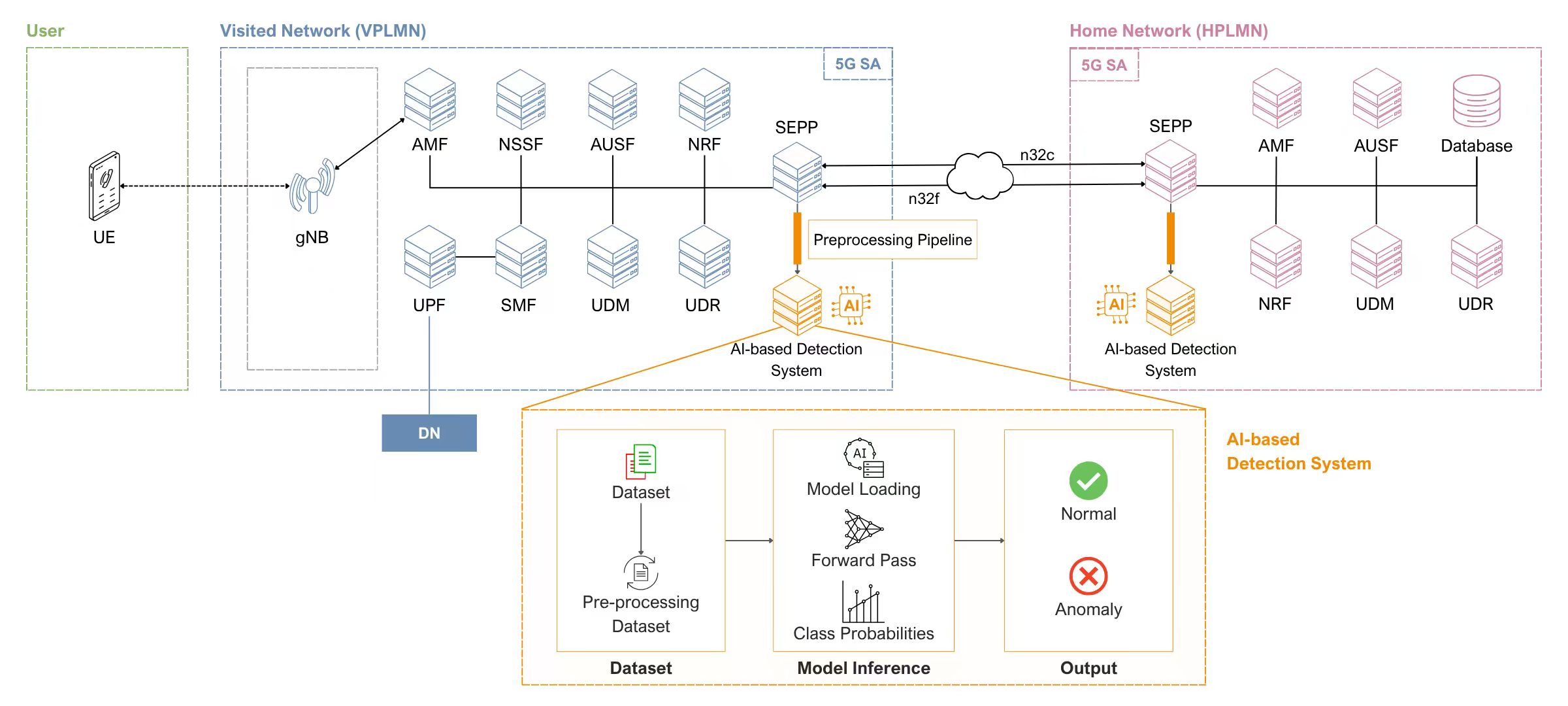
Roaming in 5G networks enables seamless global mobility but also introduces significant security risks due to legacy protocol dependencies, uneven Security Edge Protection Proxy (SEPP) deployment, and the dynamic nature of inter-Public Land Mobile Network (inter-PLMN) signaling. Traditional rule-based defenses are inadequate for protecting cloud-native 5G core networks, particularly as roaming expands into enterprise and Internet of Things (IoT) domains. This work addresses these challenges by designing a scalable 5G Standalone testbed, generating the first intrusion detection dataset specifically tailored to roaming threats, and proposing a deep learning based intrusion detection framework for cloud-native environments. Six deep learning models including Multilayer Perceptron (MLP), one-dimensional Convolutional Neural Network (1D CNN), Autoencoder (AE), Recurrent Neural Network (RNN), Gated Recurrent Unit (GRU), and Long Short-Term Memory (LSTM) were evaluated on the dataset using both weighted and balanced metrics to account for strong class imbalance. While all models achieved over 99% accuracy, recurrent architectures such as GRU and LSTM outperformed others in balanced accuracy and macro-level evaluation, demonstrating superior effectiveness in detecting rare but high-impact attacks. These results confirm the importance of sequence-aware Artificial Intelligence (AI) models for securing roaming scenarios, where transient and context-dependent threats are common. The proposed framework provides a foundation for intelligent, adaptive intrusion detection in 5G and offers a path toward resilient security in Beyond 5G and 6G networks.Graphic Abstract
Keywords
Cite This Article
 Copyright © 2025 The Author(s). Published by Tech Science Press.
This work is licensed under a Creative Commons Attribution 4.0 International License , which permits unrestricted use, distribution, and reproduction in any medium, provided the original work is properly cited.
 Downloads
 Citation Tools
