
 Login
Login Register
 Submit a Paper
 Propose a Special lssue
 Open Access
ARTICLE

EDTM: Efficient Domain Transition for Multi-Source Domain Adaptation
1 Department of Computer Science and Engineering, Kongju National University, Cheonan, Republic of Korea
2 Department of Electrical and Computer Engineering, Inha University, Incheon, Republic of Korea
3 Department of Civil and Environmental Engineering, Kongju National University, Cheonan, Republic of Korea
4 School of Computer Engineering, Hansung University, Seoul, Republic of Korea
* Corresponding Author: Jungeun Kim. Email:
# These authors contributed equally to this work
Computer Modeling in Engineering & Sciences 2026, 146(2), 33 https://doi.org/10.32604/cmes.2026.074428
Received 10 October 2025; Accepted 22 January 2026; Issue published 26 February 2026
 View Full Text
 Download PDF
Abstract
Domain adaptation aims to reduce the distribution gap between the training data (source domain) and the target data. This enables effective predictions even for domains not seen during training. However, most conventional domain adaptation methods assume a single source domain, making them less suitable for modern deep learning settings that rely on diverse and large-scale datasets. To address this limitation, recent research has focused on Multi-Source Domain Adaptation (MSDA), which aims to learn effectively from multiple source domains. In this paper, we propose Efficient Domain Transition for Multi-source (EDTM), a novel and efficient framework designed to tackle two major challenges in existing MSDA approaches: (1) integrating knowledge across different source domains and (2) aligning label distributions between source and target domains. EDTM leverages an ensemble-based classifier expert mechanism to enhance the contribution of source domains that are more similar to the target domain. To further stabilize the learning process and improve performance, we incorporate imitation learning into the training of the target model. In addition, Maximum Classifier Discrepancy (MCD) is employed to align class-wise label distributions between the source and target domains. Experiments were conducted using Digits-Five, one of the most representative benchmark datasets for MSDA. The results show that EDTM consistently outperforms existing methods in terms of average classification accuracy. Notably, EDTM achieved significantly higher performance on target domains such as Modified National Institute of Standards and Technolog with blended background images(MNIST-M) and Street View House Numbers(SVHN) datasets, demonstrating enhanced generalization compared to baseline approaches. Furthermore, an ablation study analyzing the contribution of each loss component validated the effectiveness of the framework, highlighting the importance of each module in achieving optimal performance.Keywords
In recent years, deep learning has achieved significant advancements in various fields such as image recognition, speech recognition, and natural language processing through training on large-scale datasets [1]. To effectively train on such datasets, the data collection process plays a crucial role. However, while data are generated at an extremely rapid rate, accurate labeling requires considerable time and cost, which hinders the advancement of deep learning models [2]. Consequently, addressing the challenge of data labeling has emerged as an essential task for the continued development of deep learning models.
Traditional deep learning models are typically effective only within the domain in which they have been trained. Even when the same labels are shared across datasets, differences in data distributions can significantly hinder predictive performance. This limitation necessitates re-labeling and retraining models for each new but similar dataset, which is both time-consuming and inefficient. While transfer learning can alleviate part of this burden by leveraging labeled target data to adapt a pretrained model, its applicability is limited in scenarios where target labels are unavailable. Domain adaptation addresses this issue by mitigating the distribution discrepancy between source and target data without relying on labeled target samples. By effectively integrating the characteristics of both domains, the model can extract domain-invariant feature representations, leading to consistent and robust predictions. Due to these capabilities, domain adaptation has emerged as a promising approach to reduce the cost and effort associated with data labeling, especially in settings where labeled data in the target domain are scarce or entirely absent.
With the increasing diversity of data and the emergence of domain-specific variations even within the same type of data, recent trends in deep learning have shifted toward leveraging diverse training data more effectively. Utilizing such a variety of data sources can improve model generalization, enable the acquisition of broader knowledge, and help prevent overfitting. One approach that applies this idea to domain adaptation is Multi-source Domain Adaptation (MSDA), which involves two key challenges: integrating knowledge from multiple source domains and aligning this knowledge with the target domain.
Traditional MSDA methods primarily focus on effectively mixing or aggregating the characteristics of multiple source domains, often relying on adversarial GAN-based frameworks to align the joint source–target distributions. While these adversarial approaches have demonstrated promising results, the min–max optimization tends to emphasize global distribution matching and may overlook more fine-grained, label-wise discrepancies across domains. Motivated by this limitation, our work adopts Maximum Classifier Discrepancy (MCD) to perform a more delicate and class-aware alignment process. By leveraging classifier-induced discrepancies rather than adversarial signals, MCD enables the model to capture subtle structural differences that GAN-based approaches may fail to address, thereby enabling more precise domain integration.
Although numerous studies have proposed methods to tackle both source integration and target alignment, solving these tasks simultaneously in a stable and effective manner remains a significant challenge. To address these issues, this paper introduces three complementary approaches.
The first method is the Ensemble-based Classifier Expert, which assigns weights to multiple source domain models using a domain classification model to generate a single integrated classifier [3]. Source domains that are more similar to the target domain contribute more significantly to the final prediction, thereby improving adaptation effectiveness.
The second method is Imitation Learning, where the target classifier is trained to mimic the output of the trained source ensemble model [3]. This enables the target model not only to learn from source-domain supervision but also to incorporate pseudo-label guidance for target data, enhancing prediction stability and adaptation quality.
The final method is Maximum Classifier Discrepancy (MCD), which considers label-wise data distributions during adaptation [4]. Unlike methods that align only the overall distribution, MCD adjusts discrepancies across individual labels, allowing for fine-grained and class-aware domain alignment.
By incorporating these three methods, we propose Efficient Domain Transition for Multi-source Domain Adaptation (EDTM), which effectively integrates knowledge from multiple source domains and aligns label-wise distributions between source and target domains. The proposed EDTM framework offers the following contributions:
• Developed a model that prioritizes source domains more similar to the target domain, enhancing the transferability of knowledge.
• Improved learning stability and prediction efficiency by training the target model to imitate the source ensemble’s outputs while adapting to target-specific characteristics.
• Achieved more precise domain integration through label-wise alignment using MCD.
• Conducted extensive experiments on benchmark MSDA datasets, demonstrating that EDTM consistently outperforms existing methods.
Many domain adaptation studies have been conducted to effectively align data distributions. Among them, numerous works have focused on domain adaptation using adversarial learning techniques. Ganin et al. [5] proposed Domain Adversarial Neural Networks (DANN), which align the distributions of two domains using a Gradient Reversal Layer. Tzeng et al. [6] introduced Adversarial Discriminative Domain Adaptation (ADDA), which leverages the Generative Adversarial Networks (GAN) algorithm to align distributions across domains. Saito et al. [4] highlighted a limitation of conventional adversarial learning methods, which align data without considering label-wise distributions. To address this, they proposed Maximum Classifier Discrepancy (MCD), a method that aligns domains while accounting for label-wise distribution differences.
2.2 Multi-Source Domain Adaptation
Multi-source domain adaptation has been actively studied to address the diversity of source domains and the distribution shift between source and target domains. Many works focus on handling source domain diversity by computing similarities between domains and integrating knowledge through weighted contributions. Zhao et al. [7] proposed Multi-source Distilling Domain Adaptation (MDDA), which calculates the similarity between target and source domains based on distance, assigns weights accordingly, and predicts data using an ensemble approach. Wang et al. [8] utilized statistical distance metrics such as Maximum Mean Discrepancy to measure feature distribution differences between each source domain and the target domain. These differences were then used as weights, allowing more similar source domains to contribute more significantly to target domain prediction. They proposed Learning to Combine for Multi-Source Domain Adaptation (LtC-MSDA).
Nguyen et al. [3] proposed Student-Teacher Ensemble Multi-source Domain Adaptation (STEM), which learns from diverse source domains using an Ensemble-based Teacher Expert and transfers this knowledge to the target model through Imitation Learning. This approach enhances prediction accuracy by aligning domain distributions using a GAN-based method.
This section describes the EDTM framework and its key components: Ensemble-based Classifier Expert, Imitation Learning, and MCD. Finally, the training process of EDTM is introduced.
Fig. 1 illustrates the overall architecture of the proposed EDTM framework. The framework utilizes data collected from multiple source domains (K domains), denoted as
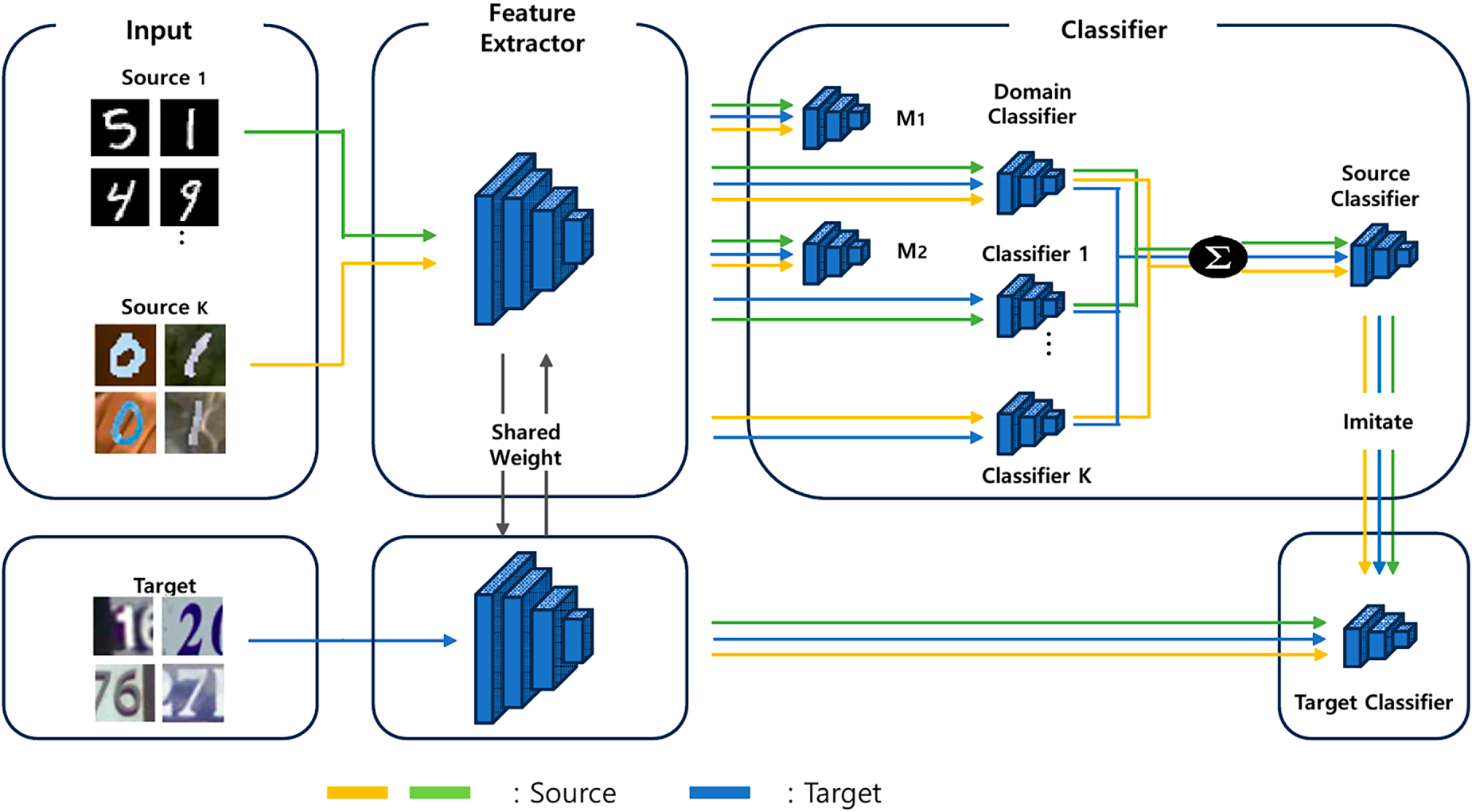
Figure 1: Overall architecture of the proposed EDTM framework. The model extracts shared features from multiple source and target domains using a common feature extractor. Source-specific classifiers and a domain discriminator are used to form a unified source classifier, which guides the target classifier through imitation learning. Additionally, MCD classifiers assist in learning domain-invariant and class-discriminative representations.
For clarity, all loss functions in this section are computed over mini-batches. We denote
First, both source and target data are fed into a shared feature extractor F, which maps them into a common representation space. For each source domain, a label classifier
The trained classifiers
In addition, two MCD classifiers
Through this architecture and training strategy, EDTM effectively combines information from multiple source domains and learns domain-aware, label-discriminative features tailored to the target domain.
3.2 Ensemble-Based Classifier Expert
The Ensemble-based Classifier Expert integrates the classifiers trained on each source domain,
This prediction result is used as a weight for each classifier
where
Compared to a single classifier trained on an individual source domain, the ensemble-based formulation reduces domain-specific bias by aggregating complementary knowledge from multiple sources and alleviates negative transfer by down-weighting less relevant domains, leading to more robust predictions on the target domain.
Compared to using a single classifier trained on a specific source domain, the ensemble-based formulation reduces domain-specific bias by aggregating complementary knowledge from multiple sources. Moreover, the adaptive weighting mechanism mitigates negative transfer by suppressing the influence of less relevant source domains, while preventing overfitting to a single source domain. As a result, the proposed ensemble classifier provides a more robust and stable decision boundary for target-domain samples.
Imitation Learning trains
where N represents the total number of labels, and
3.4 Maximum Classifier Discrepancy
MCD effectively aligns data distributions across domains while considering label distributions. First, the feature extractor (F) extracts features from
To leverage this property, the extracted features of
where
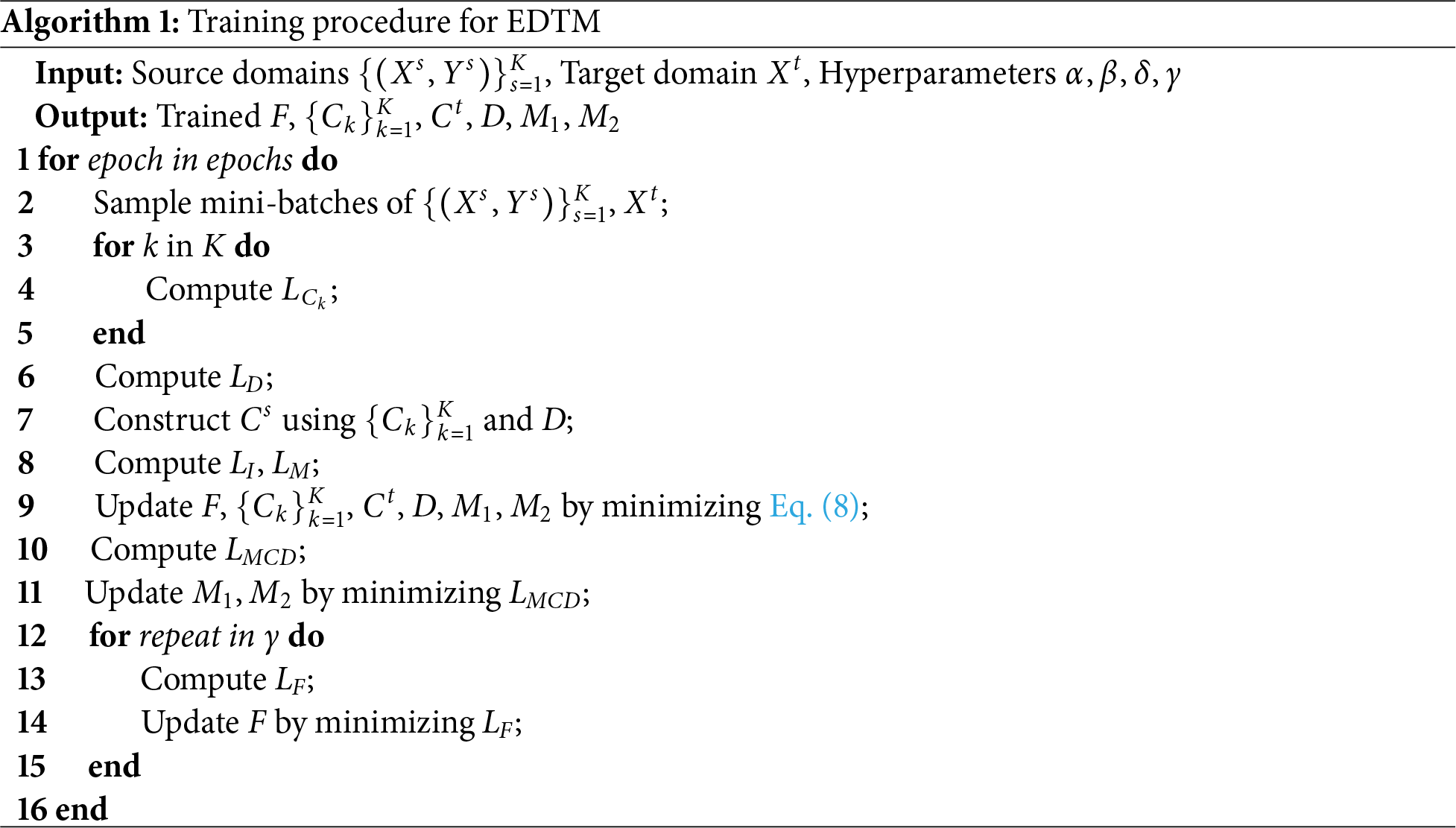
EDTM trains by sampling mini-batches
where this loss encourages each source classifier
This loss enables the domain classifier D to learn discriminative representations for identifying the originating source domain of each sample. Where
This imitation loss enforces output-level consistency between
This loss guides both classifiers
This joint optimization step aligns feature extraction, classification, domain discrimination, and imitation objectives within a unified training framework.
After this initial training phase,
This objective encourages the two classifiers to produce maximally discrepant predictions on target samples, facilitating the identification of target-domain uncertainty. Finally, F undergoes retraining. The following loss function ensures that F is trained to minimize
By minimizing this discrepancy, the feature extractor F learns target-invariant representations that align the predictions of
This section describes the datasets used in the experiments and the performance comparison between existing MSDA methods and the proposed EDTM. Finally, the experimental results are presented.
The datasets used for benchmarking are Digits-Five, Office-Caltech, and Office-31, which are representative benchmarks for evaluating the performance of domain adaptation algorithms. Digits-Five consists of Modified National Institute of Standards and Technology (MNIST) (mt) [9], Modified MNIST with blended background images (MNIST-M) (mm) [5], Street View House Numbers (SVHN) (sv) [10], Synthetic Digits(SYN) (sy) [5], and United States Postal Service(USPS) (up) [11], each containing class labels from 0 to 9. Since the classes are the same across datasets but the domains vary, this collection serves as an effective benchmark for evaluating MSDA performance.
Office-Caltech consists of four domains: Amazon, Webcam, DSLR, and Caltech, which share ten common object categories and are commonly represented using pre-extracted features from ResNet-101. This dataset configuration is based on the Office+Caltech-10 benchmark [12]. Office-31 contains three domains: Amazon, Webcam, and DSLR, with thirty-one object categories, providing a more diverse set of classes compared to Office-Caltech. The Office-31 dataset was originally introduced for visual domain adaptation research [13]. These datasets capture variations in image acquisition settings, backgrounds, and viewpoints, making them effective for assessing the robustness of domain adaptation methods in real-world scenarios. In our approach, one dataset is selected as the target domain, and the remaining datasets are used as source domains for training.
For datasets that do not provide a predefined train/test split, we randomly sample 20% of the data as the test set to ensure a consistent evaluation protocol across benchmarks. By performing cross-validation across each dataset, we assess the generalizability of the model’s performance.
To evaluate the performance of MSDA and verify the effectiveness of the proposed EDTM, we followed three experimental protocols widely adopted in previous studies. The protocols are as follows.
Single-best refers to the approach where adaptation to the target domain is performed using each of the four source domains individually, and the result with the highest accuracy is reported. This represents the traditional single-source domain adaptation method.
Source-combine is an approach in which data from multiple source domains are combined into one, and adaptation is performed based on the integrated data. This setting evaluates performance when information from diverse domains is merged.
Multi-source utilizes MSDA techniques to effectively learn from multiple source domains and transfer the knowledge to the target domain.
All experiments were repeated three times, and the average accuracy was used as the final evaluation metric. The common training settings were as follows: the learning rate was set to
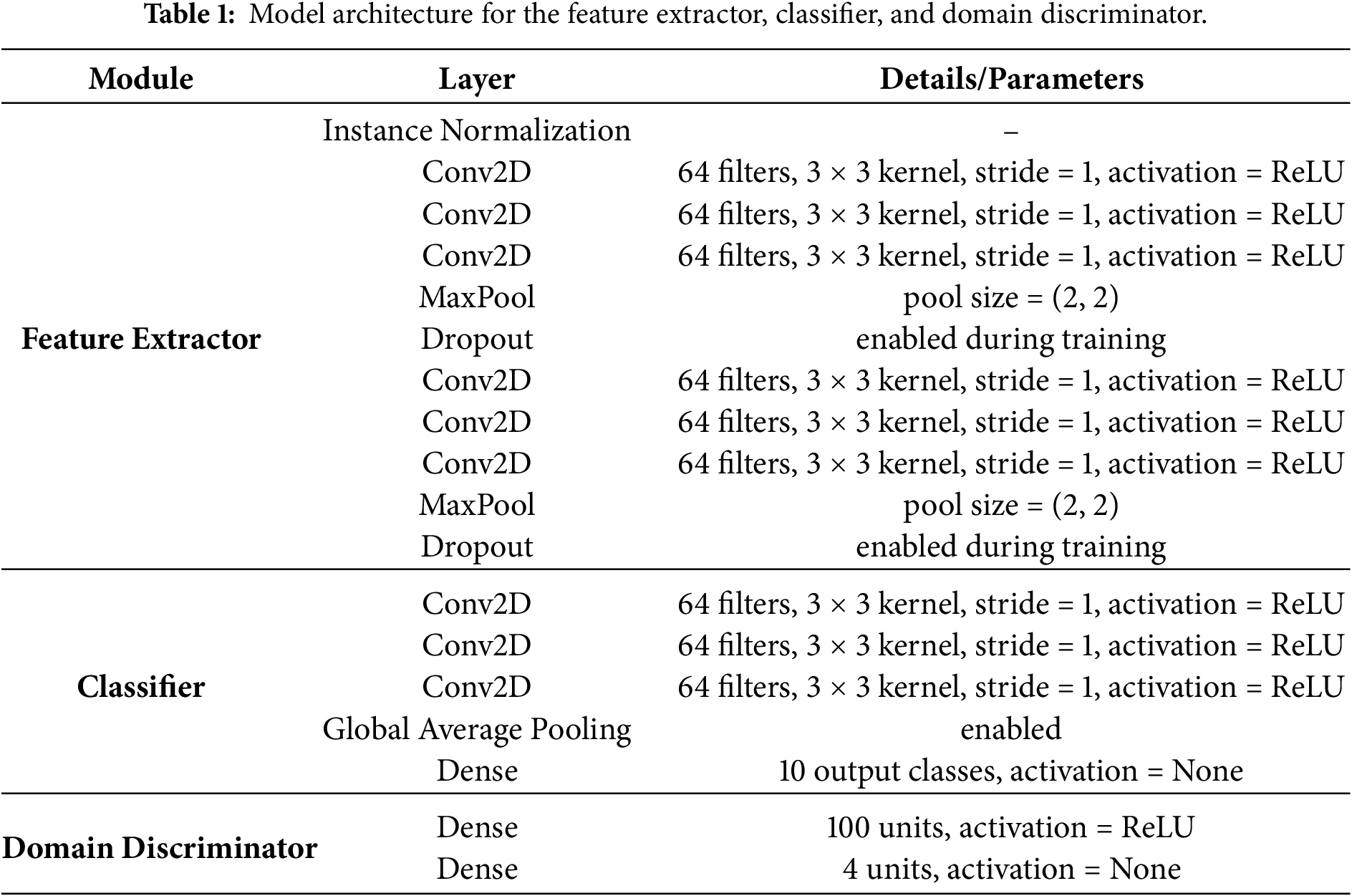
In addition, Table 1 summarizes the architecture used in our experiments on the Digits-Five dataset. The “Feature Extractor” describes the shared feature-learning backbone, the “Classifier” specifies the architecture of each individual classifier used for domain-specific prediction, and the “Domain Discriminator” corresponds to the network structure employed for domain classification. This table provides detailed layer configurations to support model interpretability and reproducibility.
4.3 Experiment Results on Digits-Five
Table 2 provides a detailed comparative analysis of domain adaptation methods evaluated on the Digits-Five benchmark, revealing distinct behavioral characteristics across the Single-best, Source-combine, and Multi-source settings.
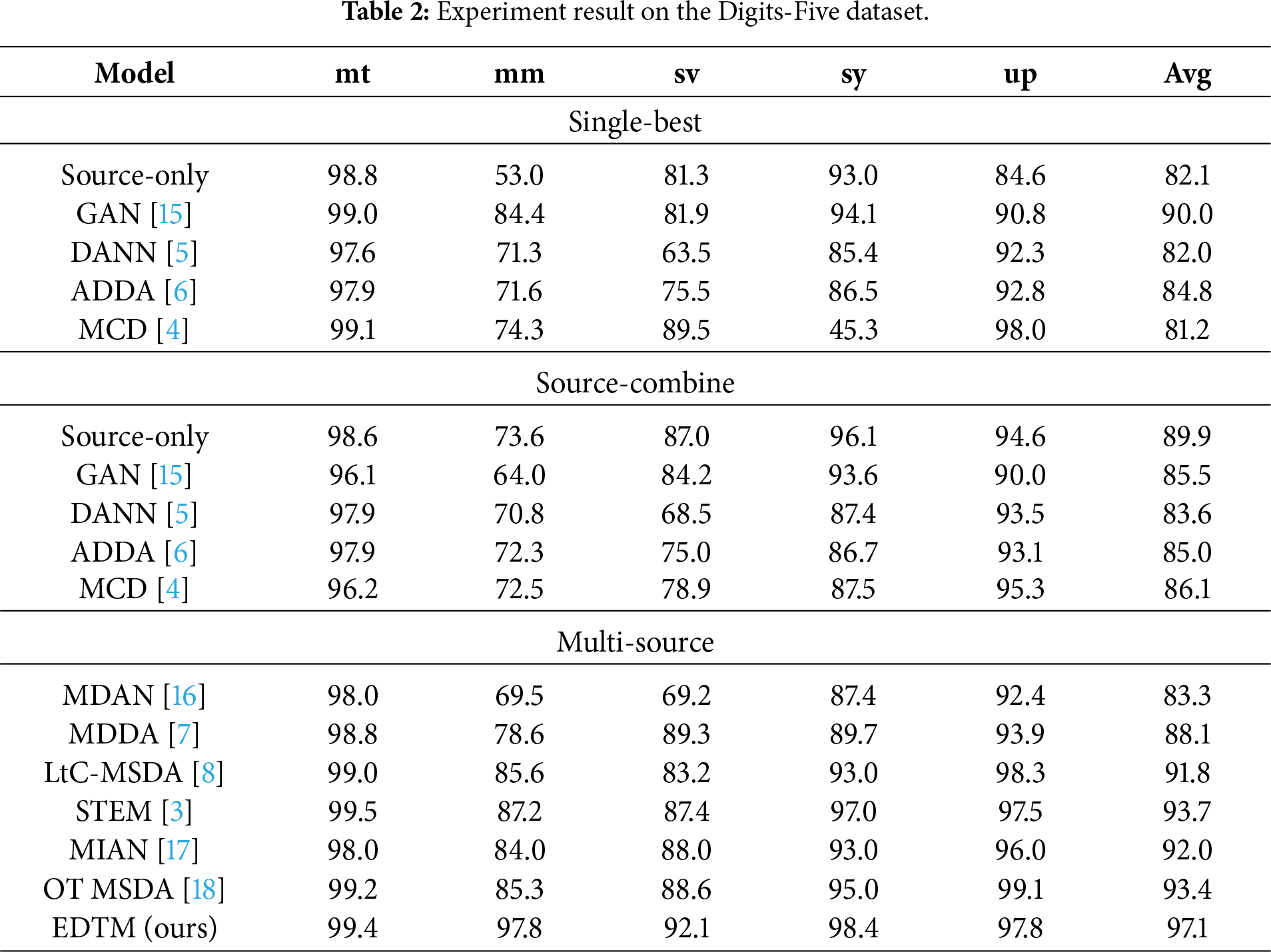
In the Single-best setting, each model is trained using a single source domain that yields the highest average performance. Under this setting, the GAN-based method achieves the best average accuracy among baseline approaches (90.0%), exhibiting strong performance on the mt, sy, and up domains. Nevertheless, its performance drops noticeably on the mm and sv domains (84.4% and 81.9%), indicating limited robustness to domain-specific visual discrepancies. Similar instability is observed in other single-source methods such as DANN, ADDA, and MCD. In particular, DANN and ADDA struggle significantly on the visually challenging mm and sv domains, while MCD suffers a severe performance collapse on the sy domain despite maintaining high accuracy on other targets. These results highlight a fundamental limitation of single-source adaptation: its effectiveness heavily depends on the latent compatibility between the selected source and the target domain. However, in unsupervised domain adaptation, such compatibility cannot be determined in advance due to the absence of target labels, which often leads to unstable optimization or insufficient feature alignment, as clearly evidenced by the sy-domain failure of MCD.
In the Source-combine setting, all source domains are jointly used for training, leading to improved generalization in many cases. The Source-only baseline, for example, shows a substantial increase in average accuracy to 89.9%, confirming that exposure to diverse source distributions is beneficial for learning more transferable representations. However, this improvement is not universal across all methods. Notably, GAN experiences a significant performance degradation compared to its Single-best counterpart, particularly on the mm domain, and MCD also exhibits reduced accuracy on specific targets such as sv. These observations indicate that naive aggregation of source domains can introduce negative transfer, where incompatible or conflicting knowledge from different sources interferes with effective feature learning. As a result, indiscriminate mixing of heterogeneous domains may obscure discriminative structures and lead to performance degradation, even relative to carefully selected single-source training.
In contrast, the Multi-source setting demonstrates clear advantages by explicitly modeling relationships among multiple source domains. Early MSDA methods such as MDAN and MDDA show moderate improvements but still exhibit weaknesses on challenging domains. More advanced approaches, including MIAN, OT MSDA, and STEM, achieve stronger and more stable performance by selectively weighting or aligning source contributions. MIAN attains an average accuracy of 92.0% with relatively balanced performance across all target domains. OT MSDA further improves the overall accuracy to 93.44%, achieving exceptionally high results on the mm and up domains (99.2% and 99.1%), which demonstrates the effectiveness of weighted domain alignment strategies. STEM achieves an average accuracy of 93.7% and serves as a strong benchmark by modeling domain divergence from an information-theoretic perspective.
Compared to STEM, the proposed EDTM achieves substantial and consistent performance gains across all target domains. In particular, EDTM significantly outperforms STEM on the most challenging domains, achieving 97.8% on mm, 92.1% on sv, and 97.8% on up. These improvements correspond to gains of +10.6%, +4.7%, and +0.3% over STEM, respectively. With an overall average accuracy of 97.1%, EDTM surpasses the previous best method by a large margin and establishes a new state-of-the-art on the Digits-Five benchmark. The results indicate that EDTM effectively mitigates negative transfer by selectively integrating complementary knowledge from multiple heterogeneous sources through expert-based learning and discrepancy-guided training. Consequently, EDTM achieves robust generalization even under severe domain shifts and pronounced style mismatches.
4.4 Experiment Results on Office-Series Datasets
Tables 3 and 4 report the performance comparison between the proposed EDTM and the state-of-the-art MSDA baseline, STEM, on the Office-series datasets. Although both datasets share the same high-level objective, they exhibit different degrees of domain heterogeneity, enabling an analysis of not only absolute accuracy but also the stability of adaptation across domains under practical experimental constraints.


On the Office-Caltech dataset, both methods achieve near-saturated performance on the visually similar and relatively low-variance domains (webcam and dslr), reaching 99.7%–100.0%. Under such conditions, the primary performance differentiator becomes the most challenging domain, caltech, whose visual characteristics deviate more substantially from the remaining sources. EDTM improves the caltech accuracy from 93.5% (STEM) to 94.6%, corresponding to a +1.1% gain, and consequently increases the overall average accuracy from 97.4% to 97.6%. An examination of per-domain performance gaps further indicates that domain heterogeneity still affects adaptation: EDTM exhibits a 5.4% gap between caltech (94.6%) and the saturated dslr domain (100.0%), whereas STEM shows a larger gap of 6.5%. This result suggests that even when most domains are relatively easy, effective multi-source adaptation requires selectively integrating complementary source knowledge while avoiding domination by over-confident or overly similar sources. Therefore, the Office-Caltech results emphasize that MSDA performance should be evaluated not only by average accuracy but also by how effectively residual errors on the most domain-shifted targets are reduced.
The Office-31 dataset represents a more challenging adaptation scenario due to larger cross-domain distribution shifts and more pronounced appearance variations. In our experimental setting, reliable domain adaptation to the amazon domain was not achieved, and thus results for this domain are not reported. This limitation reflects the inherent difficulty of the amazon domain, which exhibits substantial visual and semantic discrepancies from other sources under the considered MSDA configuration. Consequently, the analysis focuses on domains where stable adaptation behavior can be meaningfully assessed. Within this setting, EDTM significantly outperforms STEM on the webcam domain, achieving 80.3% compared to 71.6% (+8.7%). This improvement leads to an increase in the reported average accuracy from 77.4% to 81.5% (+4.1%). The substantial gain on the webcam domain is particularly informative, as visually constrained domains tend to amplify the risk of negative transfer when heterogeneous sources are combined indiscriminately. The observed improvement indicates that EDTM more effectively suppresses harmful inter-source interference and produces a more reliable alignment for the target domain. From the perspective of unsupervised domain adaptation, this robustness is critical because the optimal source–target compatibility cannot be identified in the absence of target labels. As a result, stability under domain heterogeneity, rather than sensitivity to a specific favorable source pairing, becomes a key criterion for robust MSDA.
Overall, the Office-series results demonstrate that EDTM consistently improves upon a strong MSDA baseline across both a near-saturated benchmark (Office-Caltech) and a more heterogeneous benchmark (Office-31), even under practical domain adaptation constraints. The performance gains are concentrated on the most domain-shifted and challenging targets (e.g., caltech in Office-Caltech and webcam in Office-31), supporting the claim that EDTM more effectively mitigates negative transfer and selectively integrates complementary source knowledge, leading to more stable and reliable multi-source domain adaptation.
To analyze the distributional differences between domains and to evaluate how effectively EDTM reduces this discrepancy, we visualized the learned feature representations using the t-SNE algorithm [19]. Following this methodology, we compare the feature distributions before and after domain adaptation on the Digits-Five benchmark. In this experiment, MNIST-M is used as the target domain, while the remaining datasets—MNIST, SVHN, SYN, and USPS—are utilized as source domains.
Fig. 2 illustrates the t-SNE results for both the Source-only model and the proposed EDTM. In the Source-only model (left), the source (red) and target (blue) samples are heavily entangled without forming clear class-wise clusters. The target MNIST-M features, in particular, appear densely concentrated near the center, indicating that the model fails to extract meaningful representations due to the strong domain shift introduced by texture and color perturbations.
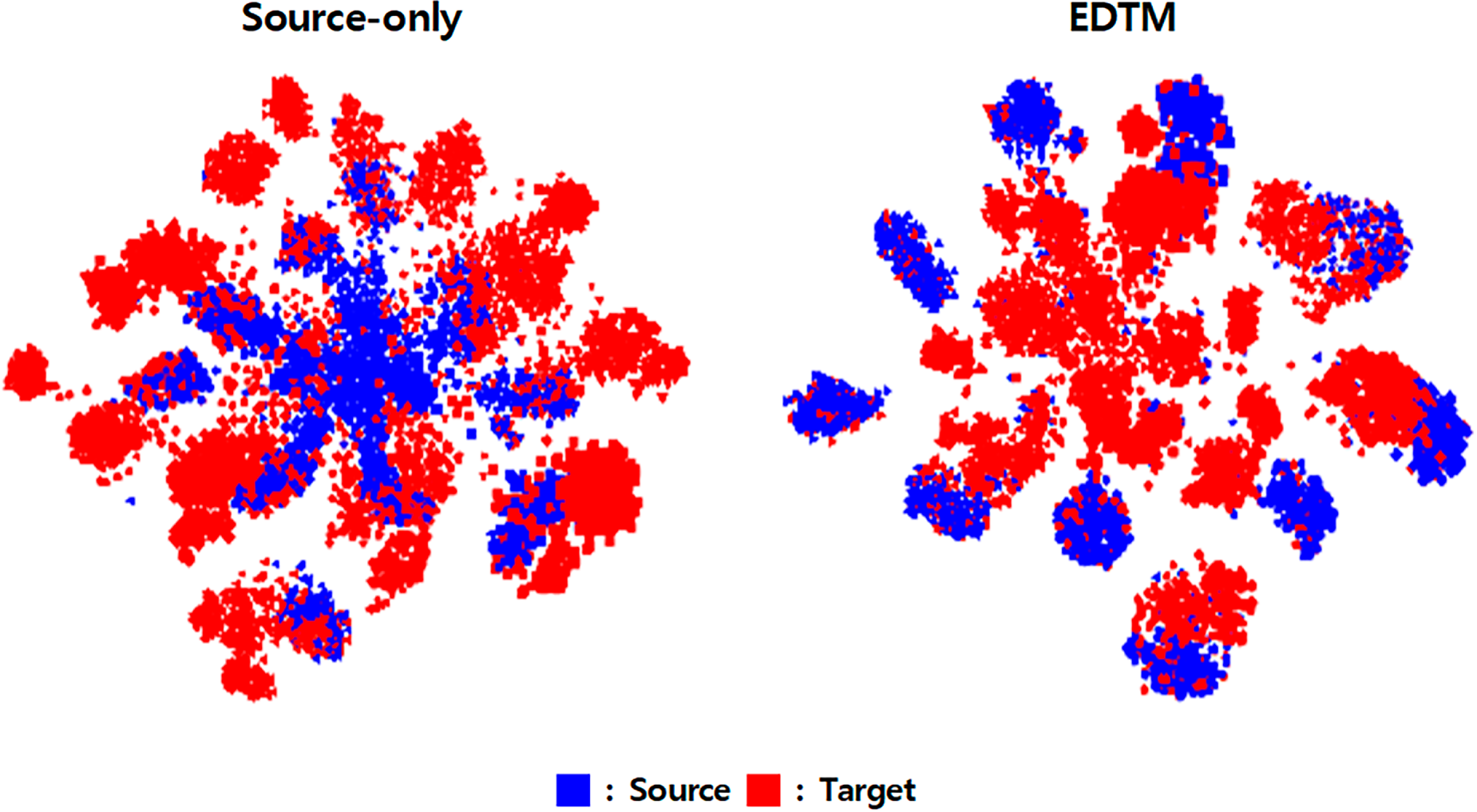
Figure 2: Feature visualization using t-SNE on the Digits-Five benchmark. Source domains (red): MNIST, SVHN, SYN, USPS; Target domain (blue): MNIST-M. Left: Source-only model showing severe domain mismatch. Right: EDTM achieving clear class-wise alignment across domains.
In contrast, the EDTM results (right) show that samples from all source domains and the target domain form distinguishable and well-aligned clusters. The target features closely follow the structure of the source clusters, demonstrating that EDTM effectively integrates information from multiple source domains and reduces the domain discrepancy. This alignment confirms that EDTM successfully transfers discriminative knowledge to the target domain, enabling class-consistent feature extraction even without access to target labels.
We conducted an ablation study to evaluate the contribution of each loss function in EDTM to the overall model performance. Table 5 presents the variation in accuracy as each loss component is incrementally incorporated.
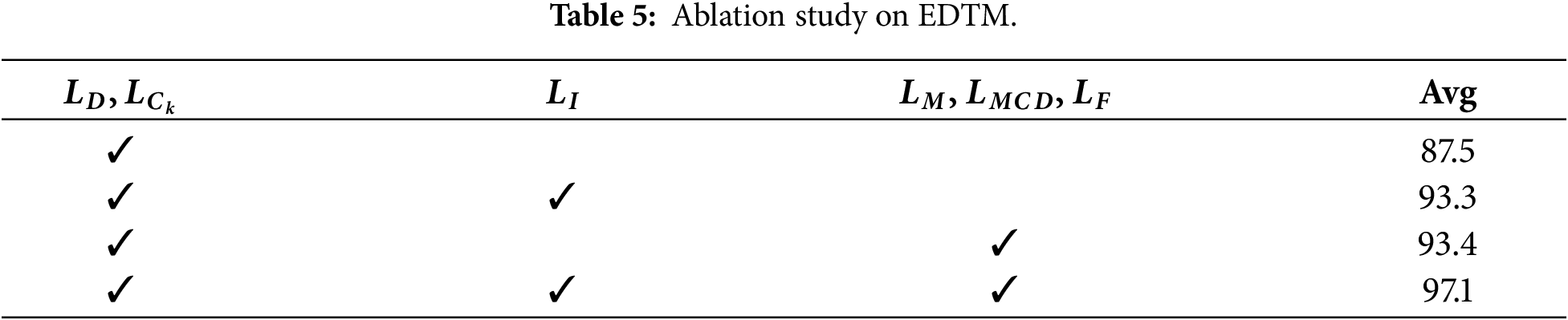
Initially, employing only the loss functions
The inclusion of the imitation learning loss
Similarly, augmenting the base configuration (
Finally, incorporating all proposed loss functions yielded the highest accuracy of 97.1%. These results demonstrate that each component contributes effectively to model performance, while jointly addressing different challenges in a complementary manner, thereby generating stronger learning synergy and enabling effective integration of the distributions between the source and target data.
In this paper, we propose the EDTM framework, which effectively addresses two key processes: integrating knowledge from diverse source domains and applying it to the target domain. Specifically, EDTM incorporates three main components. First, the Ensemble-based Classifier Expert assigns greater importance to source domains that are more similar to the target domain, allowing the model to emphasize more transferable knowledge during training. Second, Imitation Learning enables the model to adapt more effectively to the target domain by learning target-specific patterns based on pseudo-labels generated from the ensemble expert. Third, the MCD-based loss refines the alignment between the source and target domains by adjusting the label-wise distribution, ensuring fine-grained class-level adaptation.
These components are jointly optimized within EDTM, resulting in a model that robustly generalizes across domain shifts. Experimental results on the Digits-Five benchmark demonstrate that EDTM achieves state-of-the-art performance with an average accuracy of 97.1%, outperforming STEM by 3.8%. The improvements are especially notable on challenging domains such as mm and sv, where EDTM substantially surpasses previous approaches. Experiments on the Office-series datasets further confirm the robustness of the proposed method, with EDTM achieving the highest or near-highest accuracy across all evaluation settings.
The feature visualization using t-SNE highlights the effectiveness of domain alignment. Whereas the Source-only baseline shows scattered and ambiguous clusters for target samples, EDTM produces clear and well-separated feature distributions, indicating successful knowledge transfer and improved discriminability. The ablation study further verifies the contribution of each component. Starting with only
While MSDA naturally introduces more components than single-source adaptation, prior studies have consistently shown that leveraging multiple source domains can significantly reduce domain bias and improve generalization robustness [3,7,8]. Furthermore, EDTM maintains a computational structure with a time complexity of
Recent MSDA research has increasingly explored transformer-based architectures and self-supervised representation learning, aiming to capture richer cross-domain dependencies and to reduce reliance on labeled source data. Although EDTM employs a classifier-driven design rather than transformer encoders or contrastive self-supervision, its lightweight structure offers a complementary direction that emphasizes stability, interpretability, and efficiency. Integrating EDTM’s ensemble-driven domain weighting with transformer-based feature extractors or self-supervised pretraining may further enhance adaptation performance, suggesting a promising avenue for future exploration.
Despite its strong empirical performance, EDTM has limitations that could be addressed in future work. The framework relies on feature extractor quality and assumes that source domains contain sufficiently diverse knowledge to guide adaptation, which may be restrictive in extremely heterogeneous domain settings. Moreover, EDTM does not explicitly model long-range cross-domain interactions that transformer-based MSDA frameworks can capture. Future studies may investigate hybrid architectures that combine EDTM with transformer-based feature backbones, incorporate self-supervised objectives for improved representation learning, or extend EDTM to large-scale, high-resolution, or open-set domain adaptation scenarios.
Beyond these technical directions, an important next step is to evaluate EDTM on a broader collection of benchmark datasets and to validate its scalability in more diverse environments. In addition, applying EDTM to real-world data collected from practical industrial or manufacturing processes represents a promising future direction. Such extensions would not only demonstrate the robustness of EDTM in operational settings but also provide valuable insights into how MSDA techniques can be deployed in real applications requiring cross-domain generalization.
In summary, EDTM effectively combines ensemble learning, imitation learning, and distribution alignment into a computationally efficient MSDA framework. Strong performance across the Digits-Five and Office-series benchmarks demonstrates that EDTM not only surpasses existing methods but also provides a well-balanced approach between performance and system complexity, while offering a foundation that can be further enhanced in future transformer-based, self-supervised, or real-world MSDA research directions.
Acknowledgement: Not applicable.
Funding Statement: This work was partly supported by the National Research Foundation of Korea (NRF) grant funded by the Korea government (MSIT) (No. RS-2024-00406320) and by the Institute of Information & Communications Technology Planning & Evaluation (IITP)-Innovative Human Resource Development for Local Intellectualization Program Grant funded by the Korea government (MSIT) (IITP-2026-RS-2023-00259678).
Author Contributions: Conceptualization, Jaekyun Jeong and Jungeun Kim; data curation, Jaekyun Jeong and Mangyu Lee; formal analysis, Jaekyun Jeong and Mangyu Lee; investigation, Jaekyun Jeong and Mangyu Lee; methodology, Jaekyun Jeong and Jungeun Kim; validation, Jaekyun Jeong, Yun Wook Choo, Keejun Han and Jungeun Kim; writing—original draft, Jaekyun Jeong and Jungeun Kim; writing—review and editing, Jaekyun Jeong, Mangyu Lee, Yun Wook Choo, Keejun Han and Jungeun Kim. All authors reviewed and approved the final version of the manuscript.
Availability of Data and Materials: The data supporting the findings of this study are openly available from the official websites of the publicly available benchmark datasets used in this study. No new datasets were created in this study. The experiments were conducted using existing publicly available datasets, including MNIST (http://yann.lecun.com/exdb/mnist/), MNIST-M (https://github.com/pumpikano/tf-dann), SVHN (http://ufldl.stanford.edu/housenumbers/), USPS (https://ieee-dataport.org/documents/usps-handwritten-digits), Synthetic Digits (SYN) (https://github.com/pumpikano/tf-dann), Office-31 (https://www.cc.gatech.edu/∼judy/domainadapt/), and Office-Caltech (https://www.cc.gatech.edu/∼judy/domainadapt/).
Ethics Approval: Not applicable.
Conflicts of Interest: The authors declare no conflicts of interest.
References
1. Krizhevsky A, Sutskever I, Hinton GE. ImageNet classification with deep convolutional neural networks. Adv Neural Inf Process Syst. 2012;25:84–90. doi:10.1145/3065386. [Google Scholar] [CrossRef]
2. Quionero-Candela J, Sugiyama M, Schwaighofer A, Lawrence ND. Dataset shift in machine learning. Cambridge, MA, USA: MIT Press; 2009. [Google Scholar]
3. Nguyen V-A, Nguyen T, Le T, Tran QH, Phung D. STEM: an approach to multi-source domain adaptation with guarantees. In: Proceedings of the IEEE/CVF International Conference on Computer Vision. Piscataway, NJ, USA: IEEE; 2021. p. 9352–63. doi:10.1109/ICCV48922.2021.00922. [Google Scholar] [CrossRef]
4. Saito K, Watanabe K, Ushiku Y, Harada T. Maximum classifier discrepancy for unsupervised domain adaptation. In: Proceedings of the IEEE Conference on Computer Vision and Pattern Recognition. Piscataway, NJ, USA: IEEE; 2018. p. 3723–32. doi:10.1109/CVPR.2018.00392. [Google Scholar] [CrossRef]
5. Ganin Y, Ustinova E, Ajakan H, Germain P, Larochelle H, Laviolette F, et al. Domain-adversarial training of neural networks. J Mach Learn Res. 2016;17(59):1–35. doi:10.1007/978-3-319-58347-1_10. [Google Scholar] [CrossRef]
6. Tzeng E, Hoffman J, Saenko K, Darrell T. Adversarial discriminative domain adaptation. In: Proceedings of the IEEE Conference on Computer Vision and Pattern Recognition. Piscataway, NJ, USA: IEEE; 2017. p. 7167–76. doi:10.1109/CVPR.2017.316. [Google Scholar] [CrossRef]
7. Zhao S, Wang G, Zhang S, Gu Y, Li Y, Song Z, et al. Multi-source distilling domain adaptation. Proc AAAI Conf Artif Intell. 2020;34(7):12975–83. doi:10.1609/aaai.v34i07.6997. [Google Scholar] [CrossRef]
8. Wang H, Xu M, Ni B, Zhang W. Learning to combine: knowledge aggregation for multi-source domain adaptation. In: Computer Vision-ECCV 2020: European Conference on Computer Vision. Cham, Switzerland: Springer; 2020. p. 727–44. doi:10.1007/978-3-030-58598-3_43. [Google Scholar] [CrossRef]
9. LeCun Y, Cortes C, Burges C. The MNIST database of handwritten digits [Internet]. 1998 [cited 2026 Jan 10]. Available from: http://yann.lecun.com/exdb/mnist/. [Google Scholar]
10. Netzer Y, Wang T, Coates A, Bissacco A, Wu B, Ng AY. Reading digits in natural images with unsupervised feature learning. NIPS Workshop Deep Learn Unsupervised Feature Learn. 2011;2011(5):7. doi:10.1109/icdar.2011.95. [Google Scholar] [CrossRef]
11. Hull JJ. A database for handwritten text recognition research. IEEE Trans Pattern Anal Mach Intell. 1994;16(5):550–4. doi:10.1109/34.291440. [Google Scholar] [CrossRef]
12. Gong B, Shi Y, Sha F, Grauman K. Geodesic flow kernel for unsupervised domain adaptation. In: Proceedings of the IEEE Conference on Computer Vision and Pattern Recognition. Piscataway, NJ, USA: IEEE; 2012. p. 2066–73. doi:10.1109/CVPR.2012.6247911. [Google Scholar] [CrossRef]
13. Shekhar S, Patel VM, Nasrabadi NM, Chellappa R. Analysis of visual domain adaptation with sample transfer. In: Proceedings of the IEEE Conference on Computer Vision and Pattern Recognition Workshops. Piscataway, NJ, USA: IEEE; 2013. p. 354–61. [Google Scholar]
14. Kingma DP, Ba J. Adam: a method for stochastic optimization. arXiv:1412.6980. 2014. [Google Scholar]
15. Goodfellow I, Pouget-Abadie J, Mirza M, Xu B, Warde-Farley D, Ozair S, et al. Generative adversarial nets. arXiv:1406.2661. 2014. [Google Scholar]
16. Zhao H, Zhang S, Wu G, Moura JMF, Costeira JP, Gordon GJ. Adversarial multiple source domain adaptation. 2018 [cited 2026 Jan 10]. Available from: https://papers.neurips.cc/paper/8075-adversarial-multiple-source-domain-adaptation.pdf. [Google Scholar]
17. Park GY, Lee SW. Information-theoretic regularization for multi-source domain adaptation. In: Proceedings of the IEEE/CVF International Conference on Computer Vision. Piscataway, NJ, USA: IEEE; 2021. p. 9214–23. doi:10.1109/ICCV48922.2021.00908. [Google Scholar] [CrossRef]
18. Hu B, Wang J. A weighted multi-source domain adaptation approach for surface defect detection. IET Image Process. 2022;16(8):2210–8. doi:10.1049/ipr2.12484. [Google Scholar] [CrossRef]
19. Van der Maaten L, Hinton G. Visualizing data using t-SNE. J Mach Learn Res. 2008;9:2579–605. [Google Scholar]
Cite This Article
 Copyright © 2026 The Author(s). Published by Tech Science Press.
This work is licensed under a Creative Commons Attribution 4.0 International License , which permits unrestricted use, distribution, and reproduction in any medium, provided the original work is properly cited.
 Downloads
 Citation Tools
