
 Login
Login Register
 Submit a Paper
 Propose a Special lssue
 Open Access
REVIEW

A Review of Genetic Algorithms: Principles, Procedures, and Applications in Optimization
Department of Mathematics, College of Science and Humanities in Al-Kharj, Prince Sattam bin Abdulaziz University, Al-Kharj, Saudi Arabia
* Corresponding Author: M. A. El-Shorbagy. Email:
Computer Modeling in Engineering & Sciences 2026, 147(1), 6 https://doi.org/10.32604/cmes.2026.079859
Received 29 January 2026; Accepted 17 March 2026; Issue published 27 April 2026
 View Full Text
 Download PDF
Abstract
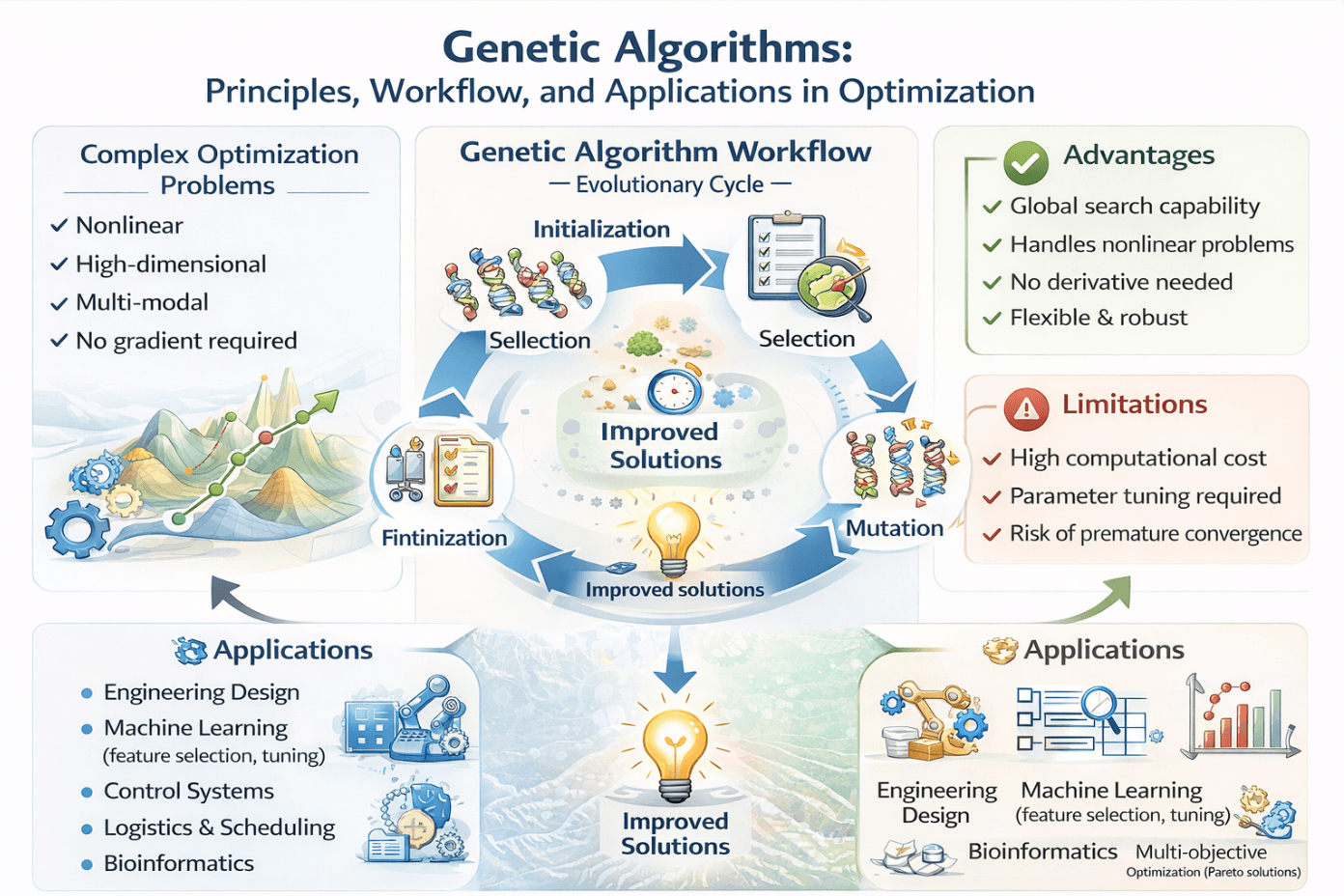
This paper provides a thorough examination of Genetic Algorithms (GAs), a category of evolutionary computation methods derived from the concepts of natural selection and genetics. The main concept and operational principle of GAs are elucidated, highlighting the evolution of populations of candidate solutions across multiple generations to get optimal or near-optimal solutions for complicated problems. The paper delineates the sequential phases of a conventional GA, encompassing problem formulation, solution encoding, initialization of population, fitness evaluation, selection, crossover, mutation, and termination criteria, so offering a coherent framework for comprehending the algorithm’s functionality. Moreover, numerous prominent genetic operators, including crossover and mutation, are examined, highlighting their distinct forms and processes for fostering diversity and exploration within the search space. Also, the paper emphasizes the benefits of GAs, including their capacity to address nonlinear, multi-modal, and high-dimensional optimization challenges without necessitating gradient information, along with their adaptability in resolving both continuous and discrete issues. The limitations and constraints of GAs, such as computing expense, parameter optimization, and the risk of premature convergence, are thoroughly analyzed. The paper examines various applications of GAs across fields, including engineering design, control systems, combinatorial optimization, machine learning, operations research, and multi-objective optimization, demonstrating the versatility and practical significance of this evolutionary method. This work establishes a robust basis for scholars and practitioners seeking to implement GAs in intricate optimization challenges. The review indicates that GAs have greatly progressed from Holland’s original formulation to specialized variations, such as real-valued, permutation, and tree-based encodings, each tailored to certain issue categories. The critical study indicates that although classical GAs are proficient in global exploration, their hybridization with local search techniques (memetic algorithms), swarm intelligence (GA-PSO), and surrogate models significantly improves convergence time and solution accuracy. The study highlights ongoing research deficiencies, such as the disparity between theoretical convergence proofs and the actual performance of algorithms, as well as the necessity for systematic recommendations in the design of hybrid algorithms.Graphic Abstract
Keywords
Genetic algorithm; evolutionary computation; global optimization; nonlinear optimization; computational intelligence; optimization techniques
Cite This Article
APA Style
El-Shorbagy, M.A. (2026). A Review of Genetic Algorithms: Principles, Procedures, and Applications in Optimization. Computer Modeling in Engineering & Sciences, 147(1), 6. https://doi.org/10.32604/cmes.2026.079859
Vancouver Style
El-Shorbagy MA. A Review of Genetic Algorithms: Principles, Procedures, and Applications in Optimization. Comput Model Eng Sci. 2026;147(1):6. https://doi.org/10.32604/cmes.2026.079859
IEEE Style
M. A. El-Shorbagy, “A Review of Genetic Algorithms: Principles, Procedures, and Applications in Optimization,” Comput. Model. Eng. Sci., vol. 147, no. 1, pp. 6, 2026. https://doi.org/10.32604/cmes.2026.079859
 Copyright © 2026 The Author(s). Published by Tech Science Press.
This work is licensed under a Creative Commons Attribution 4.0 International License , which permits unrestricted use, distribution, and reproduction in any medium, provided the original work is properly cited.
 Downloads
 Citation Tools
