
 Login
Login Register
 Submit a Paper
 Propose a Special lssue
 Open Access
ARTICLE

A Comparative Study of State-of-the-Art Meshless Methods for Flow and Transport Simulation in Porous Media
1 Department of Civil Engineering, Indian Institute of Technology Bombay, Mumbai, Maharashtra, India
2 Department of Civil Engineering, School of Infrastructure, Indian Institute of Technology Bhubaneswar Argul, Khordha, Odisha, India
3 Department of Environmental Science and Engineering, Indian Institute of Technology (Indian School of Mines), Dhanbad, Jharkhand, India
* Corresponding Author: T. I. Eldho. Email:
Computer Modeling in Engineering & Sciences 2026, 147(2), 26 https://doi.org/10.32604/cmes.2026.078705
Received 06 January 2026; Accepted 15 April 2026; Issue published 27 May 2026
 View Full Text
 Download PDF
Abstract
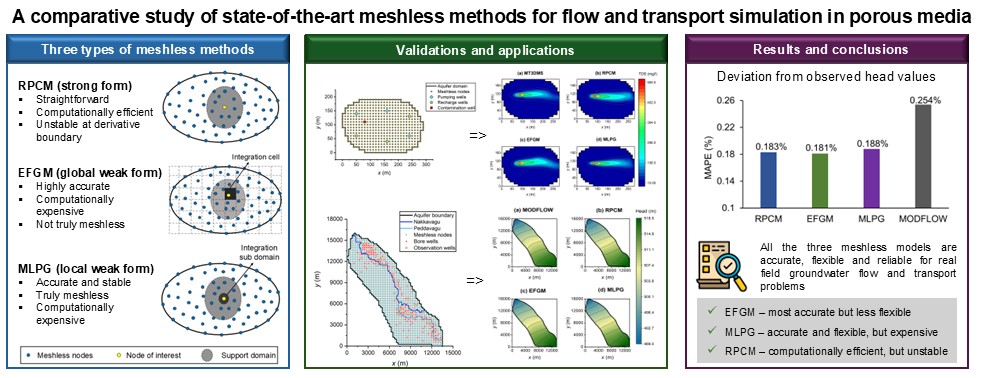
In recent years, meshless methods have been increasingly applied to the simulation of various engineering problems due to their inherent advantages over traditional mesh-based approaches, including greater flexibility, independence from predefined meshing, simpler adaptive analysis, improved automation, and suitability for complex problems. Several meshless methods have been used for porous media simulation, and are broadly categorized into collocation, global weak form and local weak form methods. In this study, a comprehensive comparison of the applicability of these three categories of meshless methods for simulating coupled flow and transport problems in porous media is presented. The Radial Point Collocation Method (RPCM) (strong form), the Element Free Galerkin Method (EFGM) (global weak form) and the Meshless Local Petrov Galerkin (MLPG) method (local weak form) are implemented and systematically compared. These methods are applied to the analysis of flow in a synthetic regular domain aquifer, flow and non-reactive contaminant transport in a synthetic irregular boundary porous media problem and groundwater flow in a field aquifer located in India. The simulated groundwater heads are compared with analytical solution, observed field data and results obtained from widely used MODFLOW-MT3DMS models. The deviation of the solutions from the analytical solution is in the range of 0.67% to 0.16% for the hypothetical case study. For the field-scale case study, mean absolute error of 0.183%, 0.181% and 0.188% are obtained for the RPCM, EFGM and MLPG models, respectively, outperforming MODFLOW, which exhibits a deviation of 0.254% from observed values. Overall, the present study reaffirms the practical applicability of these meshless methods for real-world groundwater problems and provides valuable insights into the utilization of each category of meshless method, with respect to problem type, computational efficiency and accuracy requirements.Graphic Abstract
Keywords
Cite This Article
 Copyright © 2026 The Author(s). Published by Tech Science Press.
This work is licensed under a Creative Commons Attribution 4.0 International License , which permits unrestricted use, distribution, and reproduction in any medium, provided the original work is properly cited.
 Downloads
 Citation Tools
