
 Login
Login Register
 Submit a Paper
 Propose a Special lssue
 Open Access
ARTICLE

Enhancing Bridge Vibration Control through Optimized Quasi-Zero-Stiffness Supports under Moving Mass
1 Centre InterMech Mo.Re., University of Modena and Reggio Emilia, Modena, Italy
2 Department of Mechanical Engineering, Shahid Bahonar University of Kerman, Kerman, Iran
3 Department of Engineering Enzo Ferrari, University of Modena and Reggio Emilia, Modena, Italy
* Corresponding Author: Francesco Pellicano. Email:
(This article belongs to the Special Issue: Advances in Modeling and Analysis of Complex Dynamics in Nonlinear Systems)
Computer Modeling in Engineering & Sciences 2026, 147(2), 18 https://doi.org/10.32604/cmes.2026.079313
Received 19 January 2026; Accepted 15 April 2026; Issue published 27 May 2026
 View Full Text
 Download PDF
Abstract
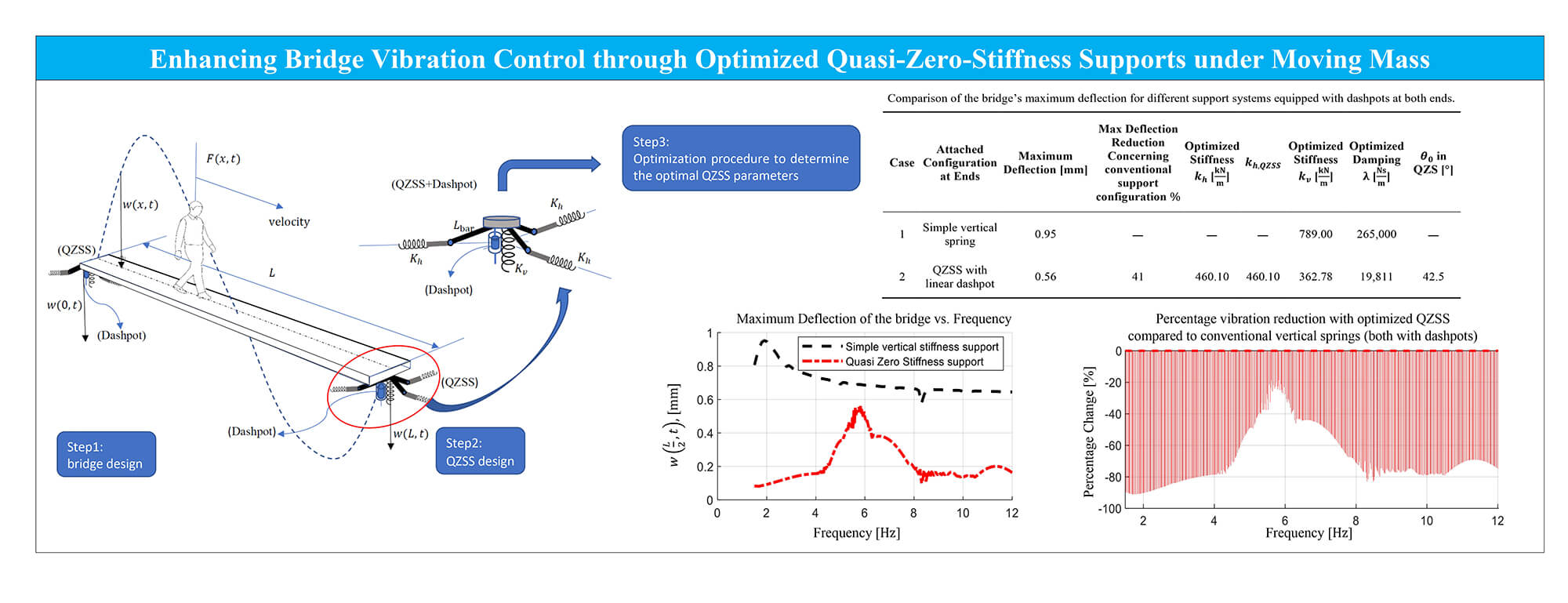
Lightweight bridges are increasingly used in modern infrastructure due to their structural efficiency; however, their relatively low stiffness and damping lead to a high sensitivity to vibration excitation induced by moving loads such as pedestrians and vehicles. Conventional vibration mitigation strategies are often insufficient to suppress low-frequency responses, which has caused the development of advanced nonlinear isolation mechanisms. This paper investigates the effectiveness of nonlinear quasi-zero stiffness supports (QZSS) in suppressing vertical vibrations of lightweight bridges. Such structures are highly susceptible to vibrations induced by moving loads because of low stiffness and dissipation, with consequent high amplification near the resonances. The bridge excitation is a moving mass, and its structure is modelled as an Euler-Bernoulli beam. The partial differential equation (PDE) is analyzed through the Bubnov-Galerkin approach after expanding the displacement field using a multimode eigenfunction series, the resulting ordinary differential equations are numerically solved using the Gauss-Kronrod algorithm. The optimal parameters of the QZSS are identified based on the criterion of maximum footbridge deflection. Comparative analyses demonstrate the superior performance of optimized nonlinear QZSS over conventional linear elastic supports. The results indicate that an optimally designed QZSS incorporated with a dashpot can reduce the maximum vibration amplitude by up to 67% under moving loads, demonstrating its effectiveness as a vibration mitigation strategy for lightweight bridges. Moreover, reductions of up to 90% can be achieved across the remaining frequency range.Graphic Abstract
Keywords
Cite This Article
 Copyright © 2026 The Author(s). Published by Tech Science Press.
This work is licensed under a Creative Commons Attribution 4.0 International License , which permits unrestricted use, distribution, and reproduction in any medium, provided the original work is properly cited.
 Downloads
 Citation Tools
