
 Login
Login Register
 Submit a Paper
 Propose a Special lssue
 Open Access
ARTICLE

Enhancing Epileptic Seizure Classification via Multi-Feature Fusion in a Transformer-LSTM Architecture
1 Faculty of Computer and Software Engineering, Huai’an University, Huai’an, China
2 School of Internet of Things, Nanjing University of Posts and Telecommunications, Nanjing, China
3 Saw Swee Hock School of Public Health, National University of Singapore, Singapore, Singapore
4 Institute of Medical Information, Chinese Academy of Medical Sciences, Beijing, China
* Corresponding Author: Gaoteng Yuan. Email:
Computer Modeling in Engineering & Sciences 2026, 147(3), 39 https://doi.org/10.32604/cmes.2026.081152
Received 24 February 2026; Accepted 27 April 2026; Issue published 30 June 2026
 View Full Text
 Download PDF
Abstract
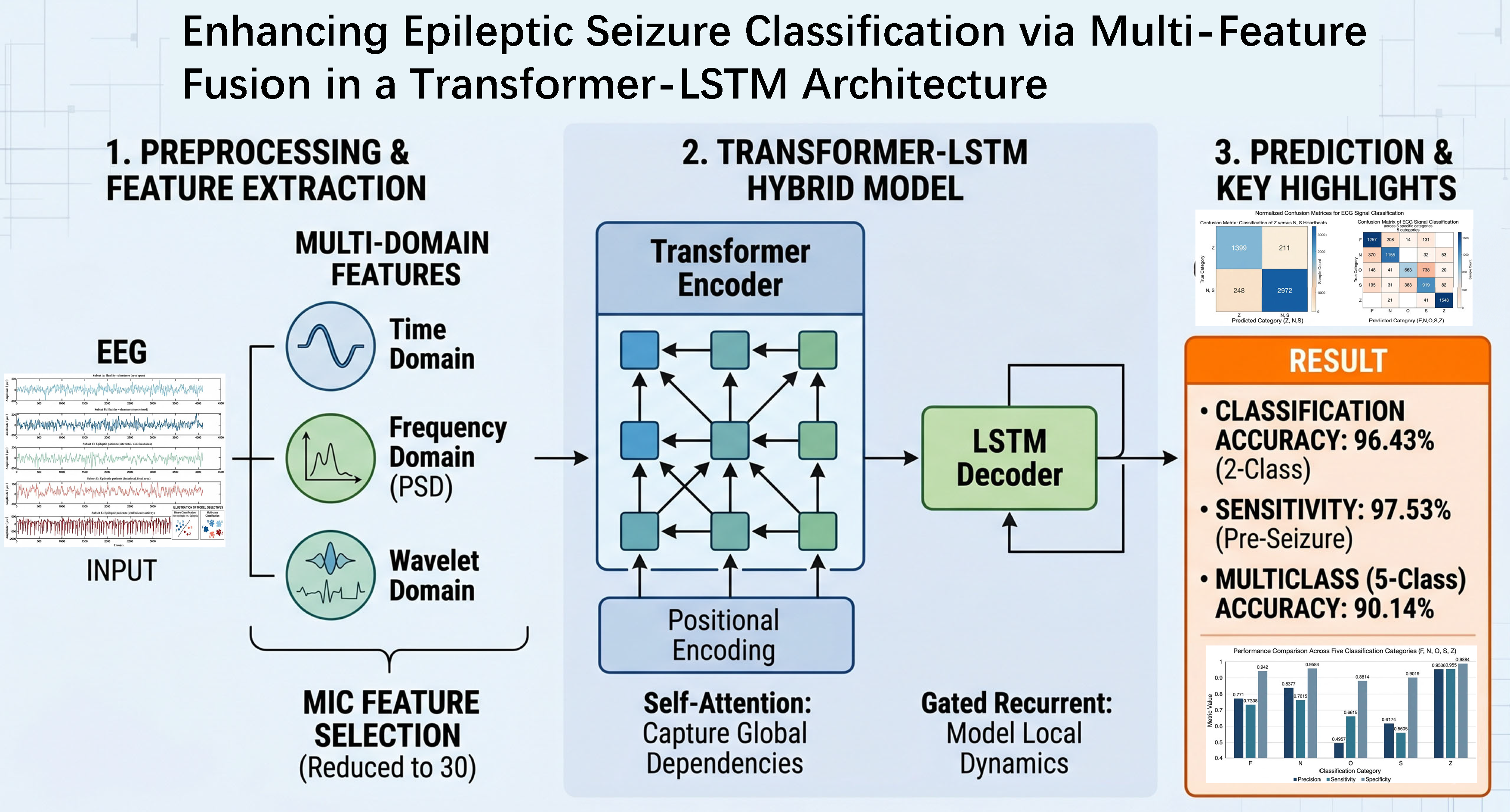
Epilepsy is a chronic neurological disorder characterized by recurrent seizures, posing significant challenges to patients’ quality of life. Accurate classification of seizure states is crucial for effective intervention. This paper presents a deep learning-based approach for epileptic seizure classification by integrating multi-feature analysis of electroencephalogram (EEG) signals. The proposed method begins with signal preprocessing, including denoising, segmentation, and label construction. Subsequently, a comprehensive set of temporal, spectral, and wavelet-based features—such as signal mean, power, heart rate, and wavelet coefficients—is extracted. Feature selection is then performed using the Maximal Information Coefficient (MIC) to identify the most discriminative inputs. A hybrid model combining a Transformer encoder and a Long Short-Term Memory (LSTM) network is developed to effectively capture both long-range dependencies and temporal dynamics in EEG sequences for seizure classification. Evaluated on the Bonn dataset using 5-fold cross-validation, the proposed method achieves an accuracy of 96.43% in distinguishing between epileptic patients and healthy subjects, with a sensitivity of 97.53% in detecting seizure states. It also attains a multi-class classification accuracy of 90.14% across different epileptic signal types. Ablation studies confirm that MIC-based feature selection improves accuracy by over 20% compared to using raw features without selection. The results demonstrate that the integration of multi-feature analysis with the Transformer-LSTM architecture offers an effective and reliable solution for EEG-based seizure classification.Graphic Abstract
Keywords
Cite This Article
 Copyright © 2026 The Author(s). Published by Tech Science Press.
This work is licensed under a Creative Commons Attribution 4.0 International License , which permits unrestricted use, distribution, and reproduction in any medium, provided the original work is properly cited.
 Downloads
 Citation Tools
