
 Login
Login Register
 Submit a Paper
 Propose a Special lssue
 Open Access
ARTICLE
Enhancing Facial Emotion Recognition Using DCNN through Effective Extraction for High-Level Features
Department of Computer System and Technology, Faculty of Computer Science & Information Technology, Universiti Malaya, Kuala Lumpur, Malaysia
* Corresponding Author: Mohd Yamani Idna Idris. Email:
(This article belongs to the Special Issue: Advances in Deep Learning and Computer Vision for Intelligent Systems: Methods, Applications, and Future Directions)
Computer Modeling in Engineering & Sciences 2026, 148(2), 42 https://doi.org/10.32604/cmes.2026.083479
Received 04 April 2026; Accepted 11 June 2026; Issue published 28 August 2026
 View Full Text
 Download PDF
Abstract
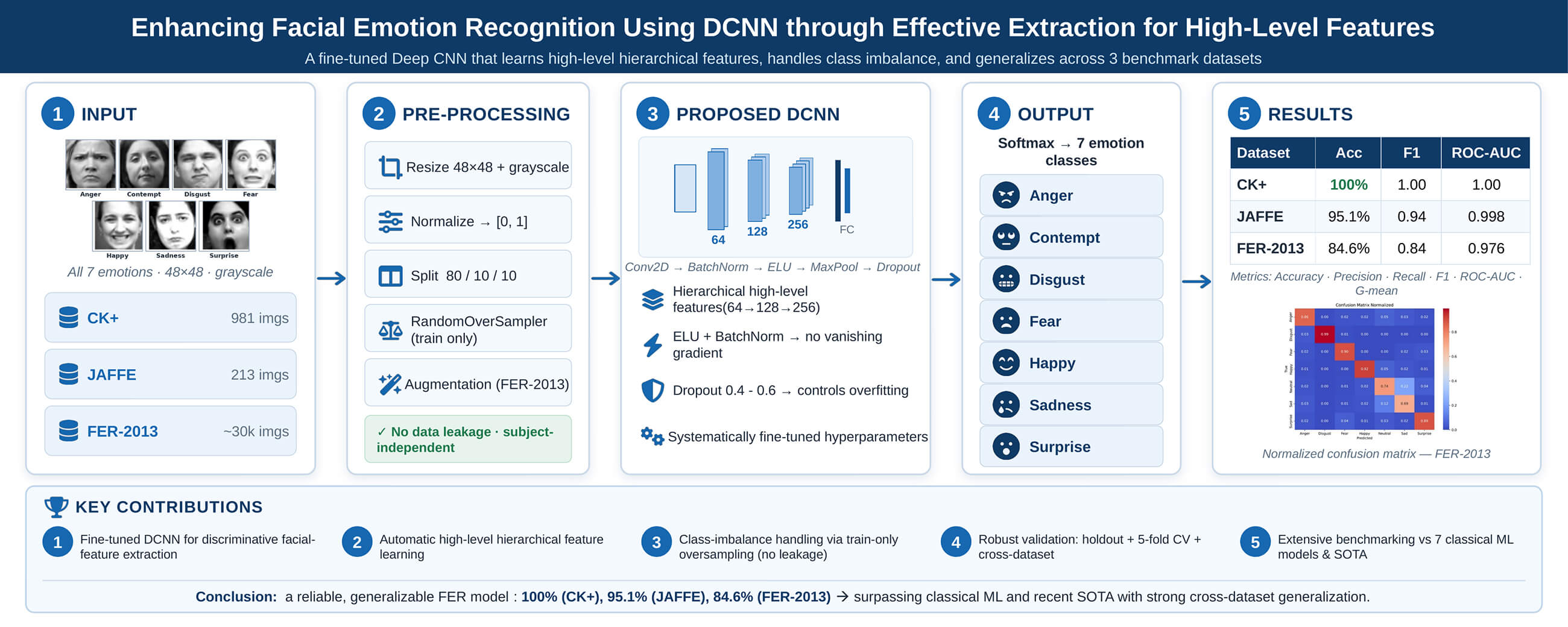
Facial emotion recognition (FER) aims to recognize and classify human emotional expressions accurately. Although there has been significant progress in developing FER models with respectable accuracy, the accuracy still has substantial room for improvement. These claims are supported by several factors, including poor parameter tuning, class imbalance, dataset bias, generalization limitations, and inefficient preprocessing. These factors make it more difficult to capture hierarchical and high-level features in training data. To address these limitations, therefore, this work develops and fine-tunes a deep convolutional neural network-based model to effectively learn discriminative facial features. First, the data are divided into training, validation, and testing. Then, an oversampling strategy is applied exclusively to the training data to mitigate class imbalance without introducing data leakage or overfitting. During training, the developed Deep CNN (DCNN) is carefully tuned and configured to extract high-level features efficiently from image data and is trained to manage face expression changes while accounting for class imbalance. Using multiple performance metrics, an extensive evaluation study is made for the proposed model across three datasets (CK+, JAFFE, and FER-2013) to show the model’s generalization and reliability. The proposed model’s accuracy on CK+, JAFFE, and FER-2013 is 100%, 0.95%, and 0.85%, respectively. To ensure a rigorous assessment, both 5-fold cross-validation and cross-dataset evaluations are conducted, providing insights into the model’s robustness and generalization capability across different data distributions. Furthermore, the proposed model is compared against classical machine learning approaches and recent state-of-the-art baselines and methods, demonstrating that the proposed DCNN achieves competitive and consistent performance, highlighting its effectiveness for real-world facial emotion recognition tasks.Graphic Abstract
Keywords
Cite This Article
 Copyright © 2026 The Author(s). Published by Tech Science Press.
This work is licensed under a Creative Commons Attribution 4.0 International License , which permits unrestricted use, distribution, and reproduction in any medium, provided the original work is properly cited.
 Downloads
 Citation Tools
