
 Login
Login Register
 Submit a Paper
 Propose a Special lssue
 Open Access
ARTICLE
Deep Learning-Based Spatiotemporal Surrogate Framework for Reconstructing Transient 3D Hydrogen Explosion Overpressure Fields
Department of AI and SW Convergence, Soongsil University, Seoul, Republic of Korea
* Corresponding Author: Sangjun Lee. Email:
Computer Modeling in Engineering & Sciences 2026, 148(3), 18 https://doi.org/10.32604/cmes.2026.086869
Received 22 June 2026; Accepted 27 August 2026; Issue published 28 September 2026
 View Full Text
 Download PDF
Abstract
Computational Fluid Dynamics (CFD) has become the benchmark approach for analyzing hydrogen explosions because it accurately resolves transient shock-wave propagation and complex blast-wave interactions. However, high-fidelity CFD simulations remain computationally expensive for repeated safety evaluation and large-scale parametric studies. To address this limitation, this study proposes a deep learning-based spatiotemporal surrogate framework for reconstructing transient three-dimensional () hydrogen explosion overpressure fields. High-resolution CFD datasets were generated using the OpenFOAM-basedKeywords
The rapid expansion of the hydrogen economy has accelerated the deployment of hydrogen infrastructure, including refueling stations, storage facilities, and transportation networks [1,2]. Although hydrogen is a promising clean energy carrier, its low ignition energy, wide flammability range, and rapid flame propagation characteristics present significant safety challenges [3,4]. In accidental leakage scenarios, hydrogen vapor cloud explosions can generate highly transient overpressure fields, posing severe structural threats in densely populated environments [5,6]. Evaluating explosion hazards and improving protective structures are therefore essential for safe hydrogen deployment. Because their effectiveness depends strongly on blast-wall height (
Computational Fluid Dynamics (CFD) is the standard tool for analyzing hydrogen explosions because it can resolve complex physical processes such as flame acceleration, turbulence–combustion interaction, shock-wave propagation, and wave reflection and diffraction under realistic geometrical conditions [7–11]. Numerous CFD studies have investigated hydrogen dispersion, explosion behavior, and the performance of protective barriers in hydrogen facilities [12]. However, resolving rapidly evolving shock fronts and steep pressure gradients requires fine spatial and temporal discretization, making high-fidelity simulations computationally expensive. Depending on the computational domain and mesh resolution, a single simulation may require several hours or even days to complete [7,9]. This computational burden limits the practical use of CFD for repeated design evaluation, parametric studies, and uncertainty quantification, motivating the development of computationally efficient surrogate models [13].
Deep learning-based surrogate models have recently attracted considerable attention as efficient alternatives to high-fidelity numerical simulations [13–15]. Prior studies have achieved high accuracy in predicting scalar metrics such as peak overpressure, impulse, safety distances, gas concentrations, and point-wise pressure histories [16–19]. Recent work has also explored sequential deep learning architectures, temporal convolutional networks, and graph neural networks for surrogate modeling and prediction of complex physical phenomena, including hydrogen safety applications [20–26]. Nevertheless, most existing approaches remain focused on scalar quantities or point-wise predictions. As a result, they cannot reconstruct the continuous spatiotemporal evolution of overpressure fields governed by wave propagation, reflection, diffraction, and attenuation. Since these physical processes directly influence blast-wall performance, point-wise predictions alone provide only limited support for field-level safety assessment.
Reconstructing transient three-dimensional (
This section reviews the foundations of the proposed framework in three parts: (i) CFD-based hydrogen explosion analysis and its computational limitations (Section 2.1); (ii) deep learning surrogate models in hydrogen safety and the limitations of scalar prediction (Section 2.2); and (iii) sequence-learning architectures for transient explosion modeling (Section 2.3). Together, these discussions highlight the persistent research gap in transient three-dimensional (3D) overpressure field reconstruction.
2.1 CFD-Based Hydrogen Explosion Analysis
Experimental investigation of hydrogen explosions is inherently challenging because full-scale explosion tests are expensive, difficult to reproduce, and involve considerable safety risks. Consequently, Computational Fluid Dynamics (CFD) has become one of the primary tools for hydrogen explosion analysis, providing detailed predictions of transient combustion and blast-wave phenomena under realistic engineering conditions [4,7,11]. Unlike empirical correlations or simplified analytical models, CFD directly solves the governing equations of mass, momentum, energy, and species transport, enabling detailed simulation of hydrogen dispersion, flame acceleration, turbulence–combustion interactions, shock-wave propagation, and transient overpressure evolution with high spatial and temporal resolution [4].
The capability of CFD for hydrogen explosion analysis has been demonstrated in numerous studies. Middha et al. [7] investigated hydrogen leak dispersion and explosion behavior using CFD simulations and reproduced transient explosion characteristics with good agreement. Both et al. [8] and Xie et al. [10] showed that reliable prediction depends strongly on appropriate turbulence modeling and numerical resolution, while Machniewski and Molga [9] demonstrated that CFD accurately captures blast-wave propagation, reflection, and diffraction in partially confined hydrogen explosions. Beyond fundamental explosion analysis, CFD has also been applied to practical hydrogen infrastructure safety studies. Su et al. [12] investigated hydrogen-enriched natural gas leakage and dispersion in buried pipelines under various operating conditions. Kang et al. [17] constructed a CFD database for hydrogen refueling stations equipped with protective barriers and demonstrated that CFD-generated datasets can support data-driven safety assessment. Kang et al. [28] evaluated blast-wall performance using OpenFOAM simulations validated against hydrogen explosion experiments, while Kang et al. [29] employed the OpenFOAM-based radXiFoam solver to investigate vapor cloud explosions in hydrogen refueling stations and analyzed the influence of blast-wall geometry on shock-wave reflection, diffraction, and overpressure attenuation. Since the radXiFoam solver adopted in the present study has been validated against experimental hydrogen explosion measurements in these previous studies [28,29], it provides reliable high-fidelity CFD data for surrogate model development.
Despite its predictive capability, high-fidelity CFD simulations remain computationally demanding. Accurate prediction of hydrogen explosion dynamics requires fine spatial discretization and small time steps to resolve steep pressure gradients, flame acceleration, shock-wave propagation, and wave–structure interactions [8,9]. Consequently, a single three-dimensional simulation may require several hours or even days of computation depending on the computational domain and mesh resolution [7,9]. These computational demands limit the practical use of CFD for repeated design evaluation, large-scale parametric studies, and rapid engineering assessment, creating the need for computationally efficient surrogate models.
2.2 Deep Learning-Based Surrogate Modeling for Hydrogen Explosion Prediction
Building on these high-fidelity CFD datasets, deep-learning surrogate models have been developed to approximate high-fidelity CFD solutions without repeatedly solving the governing equations of mass, momentum, energy, and species transport [13–15]. Instead, surrogate models learn the nonlinear mapping between simulation inputs and outputs from spatiotemporal data and provide predictions at a small fraction of the computational cost of CFD. This computational efficiency makes surrogate models suitable for repeated parametric evaluation, uncertainty quantification, and rapid engineering assessment while maintaining agreement with high-fidelity numerical simulations.
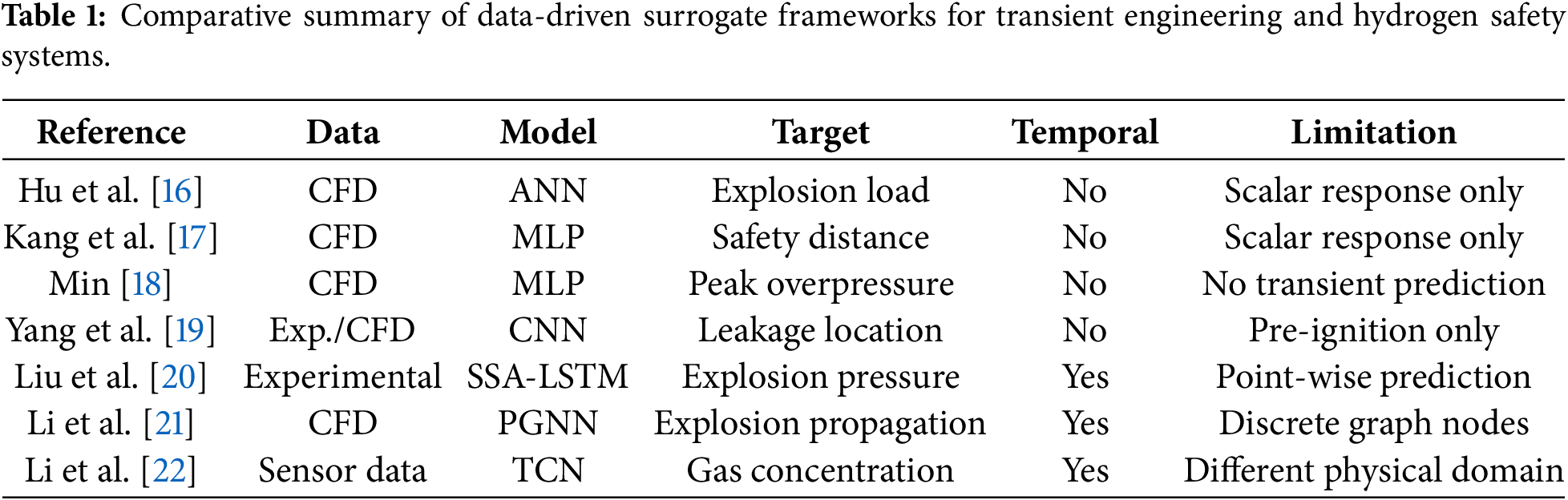
Early applications of surrogate modeling in hydrogen safety primarily focused on predicting scalar safety metrics or localized hazard indicators rather than reconstructing transient overpressure fields. Hu et al. [16] combined CFD-generated datasets with an artificial neural network (ANN) to predict accidental hydrogen-air explosion loads. Kang et al. [17] developed machine learning models for estimating safety distances and evaluating protective barrier effectiveness in hydrogen refueling stations, while Min [18] employed multi-layer perceptrons (MLPs) to estimate peak overpressure around hydrogen storage vessels under different blast-wall configurations. Yang et al. [19] proposed a deep learning framework for identifying hydrogen leakage locations and leakage intensity for pre-ignition safety monitoring. Although these studies demonstrated the applicability of machine learning to hydrogen safety problems, their prediction targets remained limited to peak values, safety distances, leakage conditions, or other localized variables. By contrast, reconstructing transient
Sequence-learning architectures have therefore attracted increasing attention for transient engineering problems because they explicitly model temporal dependencies in nonlinear dynamic systems. Liu et al. [20] proposed an SSA-LSTM-Multi-Head Attention framework for predicting coal-dust explosion pressure histories, demonstrating the capability of recurrent neural networks combined with attention mechanisms, although the prediction remained limited to point-wise pressure histories. Li et al. [21] introduced a probabilistic graph neural network (PGNN) for rapid hydrogen explosion prediction in hydrogen production plants, where graph representations captured interactions among monitoring points but remained confined to discrete graph nodes. Temporal Convolutional Networks (TCNs) have also been applied to nonlinear temporal prediction because dilated causal convolutions efficiently capture both short- and long-range temporal dependencies while preserving temporal causality [23,24]. Li et al. [22] applied TCN to nonlinear gas concentration forecasting, and Tofigh et al. [24] demonstrated the applicability of temporal convolution-based models to nonlinear transient engineering responses. As summarized in Table 1, existing surrogate models have primarily focused on scalar prediction, localized variables, or discrete spatial representations. The reconstruction of transient
2.3 Sequential Architectures and Research Scope
Transient
Based on the above considerations, this study develops a deep learning-based spatiotemporal surrogate framework for transient
3 Proposed Spatiotemporal Surrogate Framework
This section describes the proposed framework for reconstructing transient
3.1 CFD-Based Numerical Database Construction
Fig. 1 presents the overall workflow of the proposed surrogate framework. The workflow consists of five sequential steps: CFD simulation, numerical database construction, surrogate model training, model evaluation using RMSE and
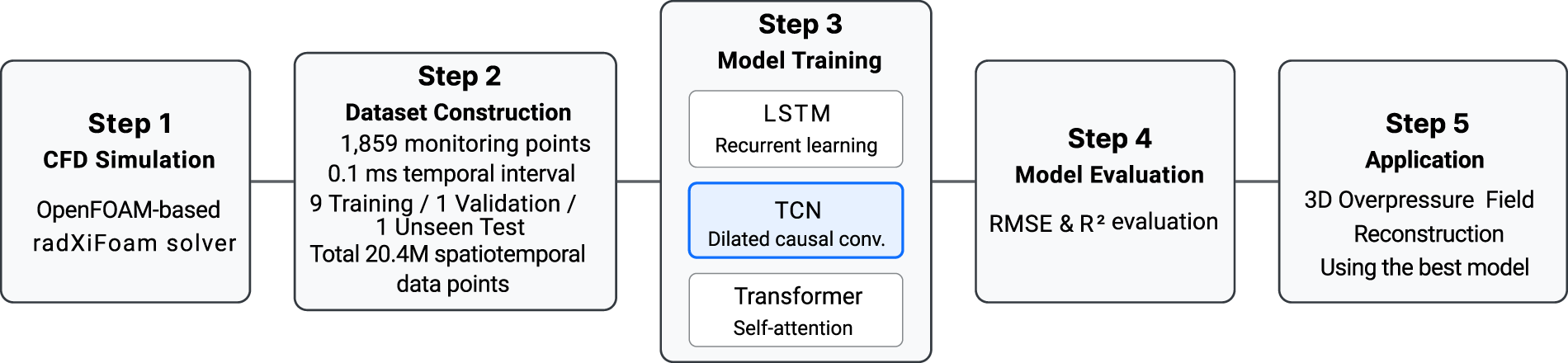
Figure 1: Overview of the proposed CFD-based deep learning surrogate framework for transient three-dimensional hydrogen explosion overpressure field reconstruction.
The CFD database was generated using the OpenFOAM-based radXiFoam solver [27]. As described in Section 2.1, radXiFoam has been validated against hydrogen explosion experiments and has been applied to hydrogen refueling station (HRS) safety analysis and blast-wall assessment [28,29]. The CFD results obtained from radXiFoam were used as the reference data for surrogate model training and evaluation. The computational domain, blast-wall geometry, mesh configuration, and pressure-monitoring arrangement used for database construction are shown in Fig. 2.
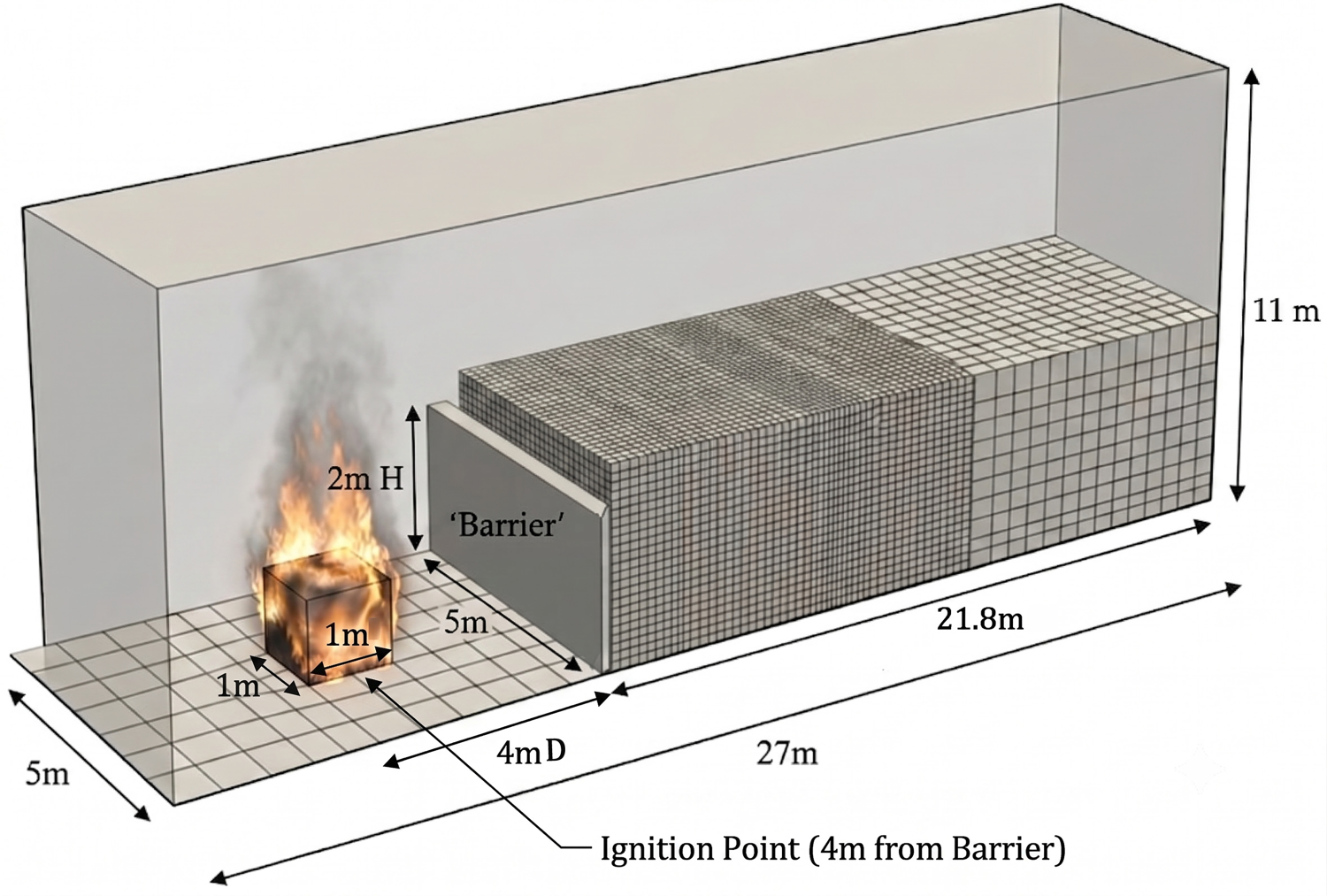
Figure 2: Representative CFD computational domain, blast-wall geometry, and mesh configuration adopted for numerical database construction. The computational domain is
The target configuration represents an urban hydrogen refueling station equipped with a protective blast wall. Blast-wall height (
The CFD database was constructed using a full-factorial design based on blast-wall height and setback distance. The blast wall was positioned at setback distances of
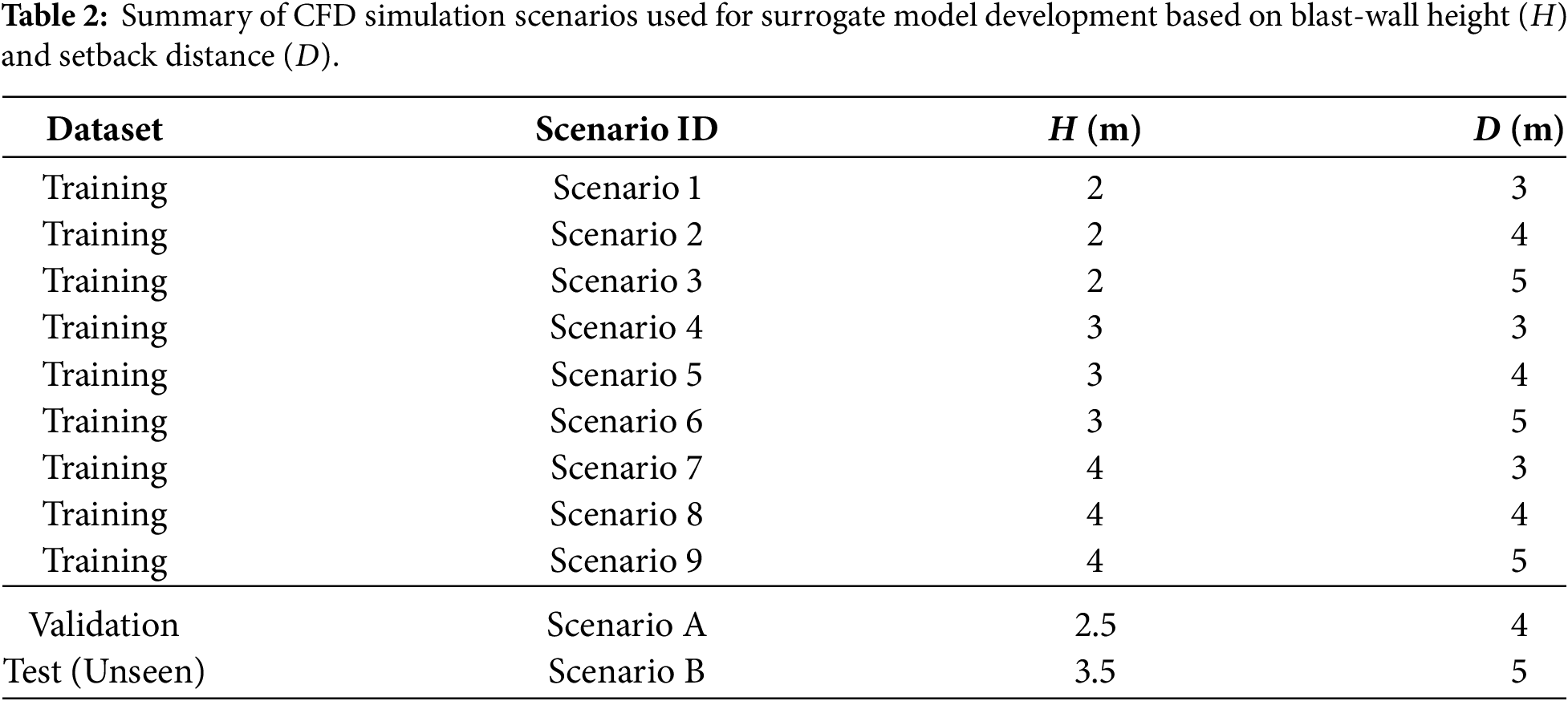
The validation and test cases were selected from intermediate geometric configurations that were not included in training, thereby assessing the interpolation capability of the surrogate models within the sampled design space. The final database contains approximately
3.2 Spatiotemporal Data Representation
The CFD database described in Section 3.1 consists of transient overpressure histories recorded at 1,859 monitoring locations distributed throughout the three-dimensional (3D) computational domain under multiple blast-wall configurations. To enable efficient learning of these highly transient explosion dynamics, the raw CFD outputs were reformulated into a spatiotemporal sequence representation that simultaneously incorporates spatial coordinates, geometric design parameters, and temporal pressure histories. Specifically, the input sequence vector at time step
where
Prior to model training, all input variables were normalized to the range of
where
where
Unlike previous data-driven studies that focused primarily on scalar quantities, such as peak overpressure or localized safety metrics [16–18], the present formulation aims to reconstruct the continuous three-dimensional spatiotemporal evolution of explosion overpressure fields. Consequently, the surrogate models are required to learn the nonlinear spatiotemporal evolution of blast-wave reflection, diffraction, and attenuation throughout the entire computational domain. This spatiotemporal formulation serves as the common input representation for all sequence-learning architectures investigated in this study.
3.3 Proposed Sequential Surrogate Framework
The proposed surrogate framework aims to approximate transient
LSTM is a recurrent neural network architecture designed to capture long-term temporal dependencies through memory cells and gating mechanisms [25]. The forget gate, which regulates the amount of historical information retained during the sequential update process, is expressed as
where
A lightweight Transformer architecture based on Multi-Head Self-Attention (MHSA) was employed as a representative attention-based baseline for transient hydrogen explosion prediction [26]. The attention operation is formulated as
where
The TCN architecture employs dilated causal convolutions to extract temporal features while strictly preserving temporal causality [22–24]. The dilated convolution operation is given by
where
using a fixed kernel size of
3.4 Training Strategy and Evaluation Protocol
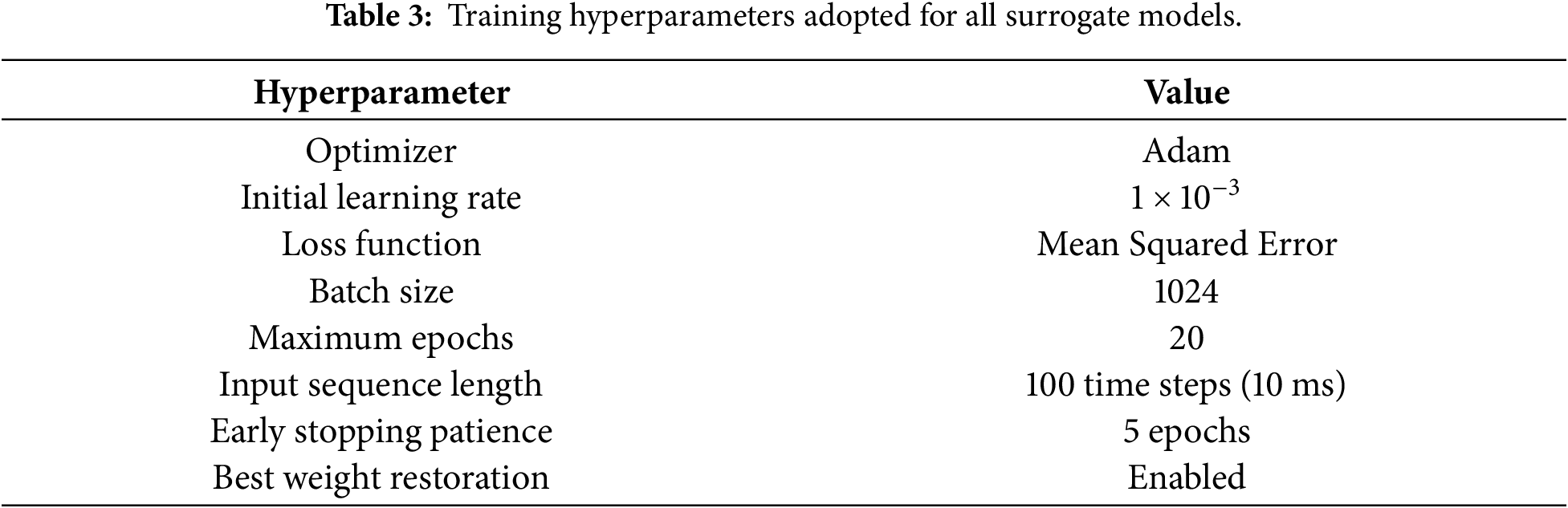
To ensure a fair and reproducible comparison of the representative sequence-learning paradigms, identical training and optimization strategies were employed for the LSTM, Transformer, and TCN architectures. All models were trained using the same CFD-generated numerical database and the uniform spatiotemporal input representation described in Sections 3.1 and 3.2. Consequently, any differences in predictive performance are expected to primarily reflect the intrinsic temporal learning characteristics of each architecture. The gradient-based optimization process was performed using the Adam optimizer because of its robust convergence characteristics for large-scale nonlinear regression problems involving spatiotemporal CFD datasets. The initial learning rate was fixed at
where
Considering the large-scale CFD database consisting of approximately 20.4 million spatiotemporal pressure records, a mini-batch size of 1024 was employed to achieve efficient optimization while maintaining stable gradient updates. The temporal input window length was fixed to 100 time steps, corresponding to a physical duration of
Crucially, Scenario B (
The training hyperparameters adopted uniformly for all sequence-learning architectures are summarized in Table 3. Through this unified optimization framework and rigorously controlled evaluation protocol, the present study provides an unbiased benchmark for assessing the relative suitability of representative sequence-learning architectures and identifying the most effective surrogate framework for reconstructing transient three-dimensional (3D) hydrogen explosion overpressure fields under unseen geometric configurations.
This section presents the prediction performance and spatiotemporal reconstruction capability of the proposed sequential surrogate framework for transient hydrogen explosion overpressure prediction. The comparative evaluation is organized into three complementary analyses. First, the prediction performance and computational efficiency of the LSTM, Transformer, and TCN architectures are assessed for an unseen blast-wall configuration (Section 4.1). Subsequently, the transient waveform reconstruction characteristics and prediction error distributions are comparatively analyzed to investigate the ability of each architecture to capture the highly transient characteristics of explosion overpressure evolution (Section 4.2). Finally, the spatial reconstruction capability of the selected surrogate model is evaluated through direct comparison with high-fidelity CFD reference solutions for transient 3D overpressure fields (Section 4.3).
4.1 Prediction Accuracy and Computational Efficiency
To evaluate the prediction performance of the sequential surrogate models, the LSTM, Transformer, and TCN architectures were assessed using the unseen Scenario B (

Among the evaluated architectures, the TCN model achieved the lowest RMSE of 0.001113 and the highest coefficient of determination (
4.2 Transient Waveform Reconstruction and Comparative Error Analysis
To further investigate the differences in prediction performance observed in Section 4.1, the transient waveform reconstruction characteristics of the LSTM, Transformer, and TCN architectures were comparatively analyzed using the unseen Scenario B configuration. Fig. 3 presents the reconstructed overpressure histories at a representative monitoring location together with the corresponding CFD reference solution. The selected monitoring point is located downstream of the blast wall, where strong shockwave reflection, diffraction, and attenuation phenomena are observed during transient propagation.
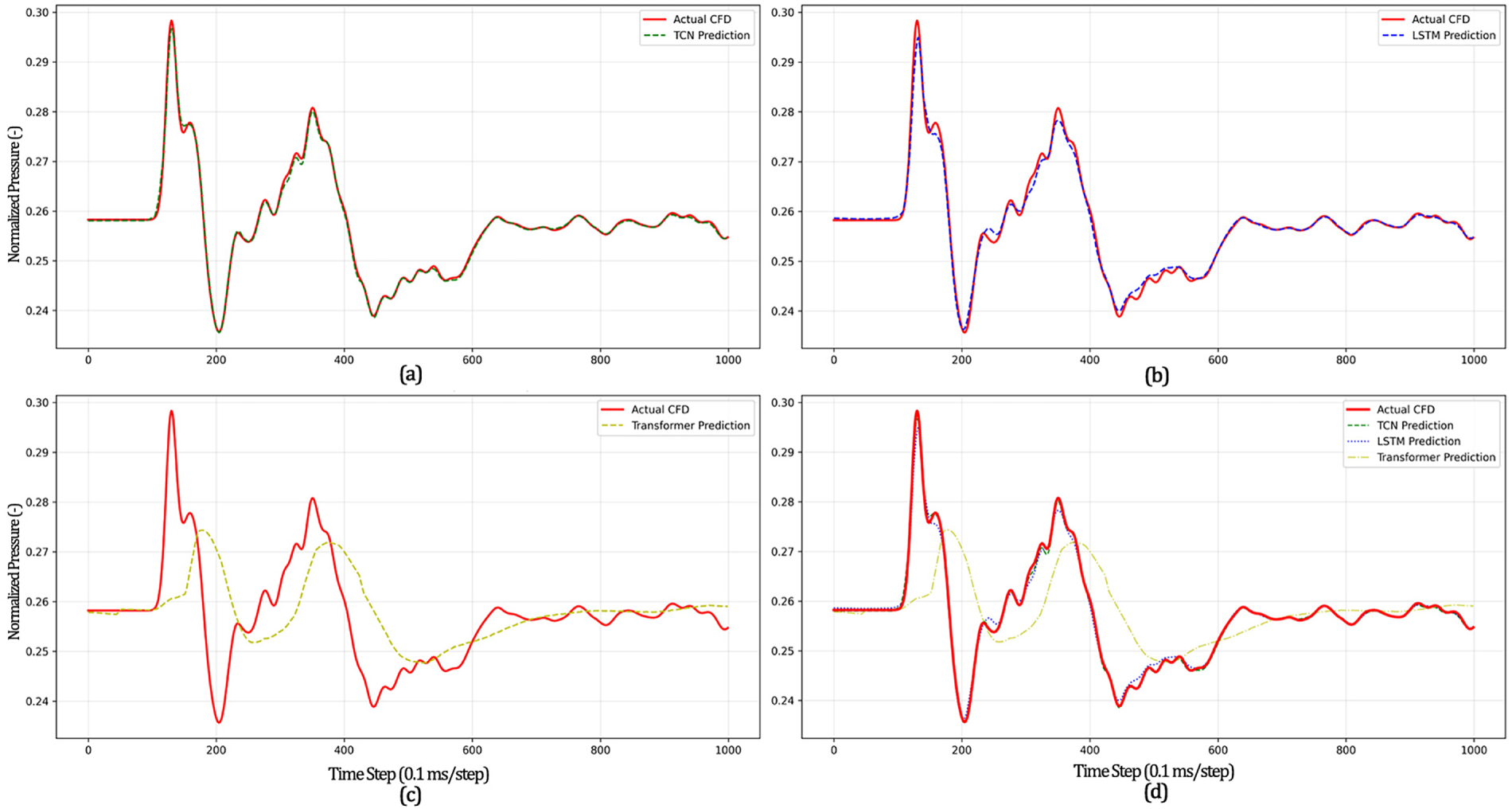
Figure 3: Comparison of reconstructed transient overpressure waveforms at the monitoring point (
As illustrated in Fig. 3, all three sequence-learning architectures successfully captured the overall temporal evolution of explosion overpressure. The reconstructed waveforms accurately captured the major stages of pressure rise, peak formation, and subsequent attenuation observed in the CFD reference solution. Nevertheless, noticeable differences were observed in the prediction accuracy near abrupt pressure variations and highly transient regions associated with shockwave propagation. Among the evaluated architectures, the TCN model exhibited the closest agreement with the CFD reference throughout the entire transient sequence. In particular, the predicted pressure peaks and subsequent attenuation behavior closely followed the CFD solution, with relatively small deviations during rapid pressure transitions. The LSTM model also captured the overall temporal evolution with reasonable accuracy; however, larger deviations were observed near sharp pressure peaks and during the later stages of wave attenuation. In contrast, the Transformer model exhibited comparatively larger discrepancies from the CFD reference, particularly around regions characterized by rapid pressure variations and localized transient fluctuations.
To quantitatively evaluate these reconstruction characteristics, Fig. 4 presents the global prediction error distribution and the temporal evolution of the mean absolute error (MAE) for the three architectures.
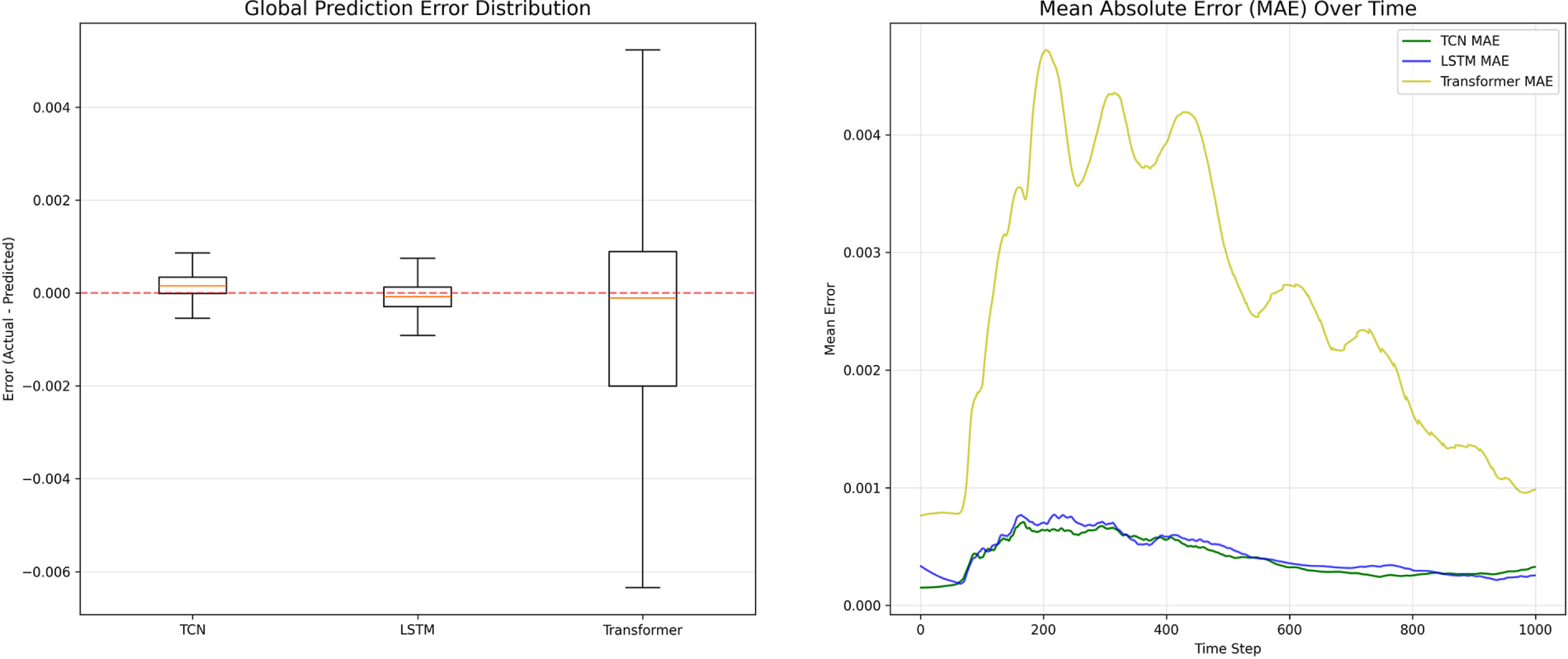
Figure 4: Comparative error analysis of sequential deep learning architectures for transient hydrogen explosion reconstruction: (a) global prediction error distribution based on the difference between CFD reference data and model predictions, and (b) temporal evolution of mean absolute error (MAE) over the transient sequence.
The prediction error distributions shown in Fig. 4a indicate that the TCN model maintained the narrowest prediction error distribution centered near zero, implying relatively stable reconstruction behavior across the entire transient sequence. The LSTM model also exhibited a concentrated error distribution but with slightly larger dispersion. In contrast, the Transformer architecture produced a broader error distribution and greater prediction variability throughout the unseen test scenario. The temporal MAE profiles presented in Fig. 4b highlight the differences in reconstruction accuracy among the evaluated architectures. The TCN model consistently maintained lower prediction errors throughout most of the transient sequence, particularly during periods of rapid pressure variation. The LSTM architecture achieved comparable performance during the early transient stages; however, its prediction errors gradually increased during later stages of the sequence. Meanwhile, the Transformer model exhibited larger MAE values over most of the temporal range, indicating comparatively lower reconstruction accuracy under highly transient explosion conditions.
Overall, the waveform reconstruction and error analyses reveal distinct reconstruction characteristics among the evaluated sequence-learning architectures. Although all three models reproduced the overall trend of transient overpressure evolution, differences were observed in their ability to capture rapid pressure variations and maintain prediction stability throughout the transient sequence. The TCN consistently showed the closest agreement with the CFD reference, which is reflected in its higher prediction accuracy reported in Section 4.1. This superior performance is considered to be associated with its dilated causal convolution architecture. By progressively expanding the receptive field while preserving local temporal information, the TCN effectively captures both rapid pressure variations and longer-term temporal evolution without relying on recurrent state updates. In contrast, the LSTM propagates information sequentially through recurrent memory, which may reduce its ability to follow abrupt pressure changes, while the Transformer architecture adopted in this study places greater emphasis on global temporal relationships than on localized transient features. Based on these comparative results, the TCN was selected for further evaluation. The following section further evaluates the selected TCN through direct comparisons between the reconstructed and CFD-generated transient 3
4.3 Spatial Overpressure Field Reconstruction
Based on the comparative evaluations presented in Sections 4.1 and 4.2, the TCN architecture was selected for further investigation of spatial reconstruction performance. To assess its ability to reproduce the spatial evolution of explosion-induced pressure waves, the transient 3
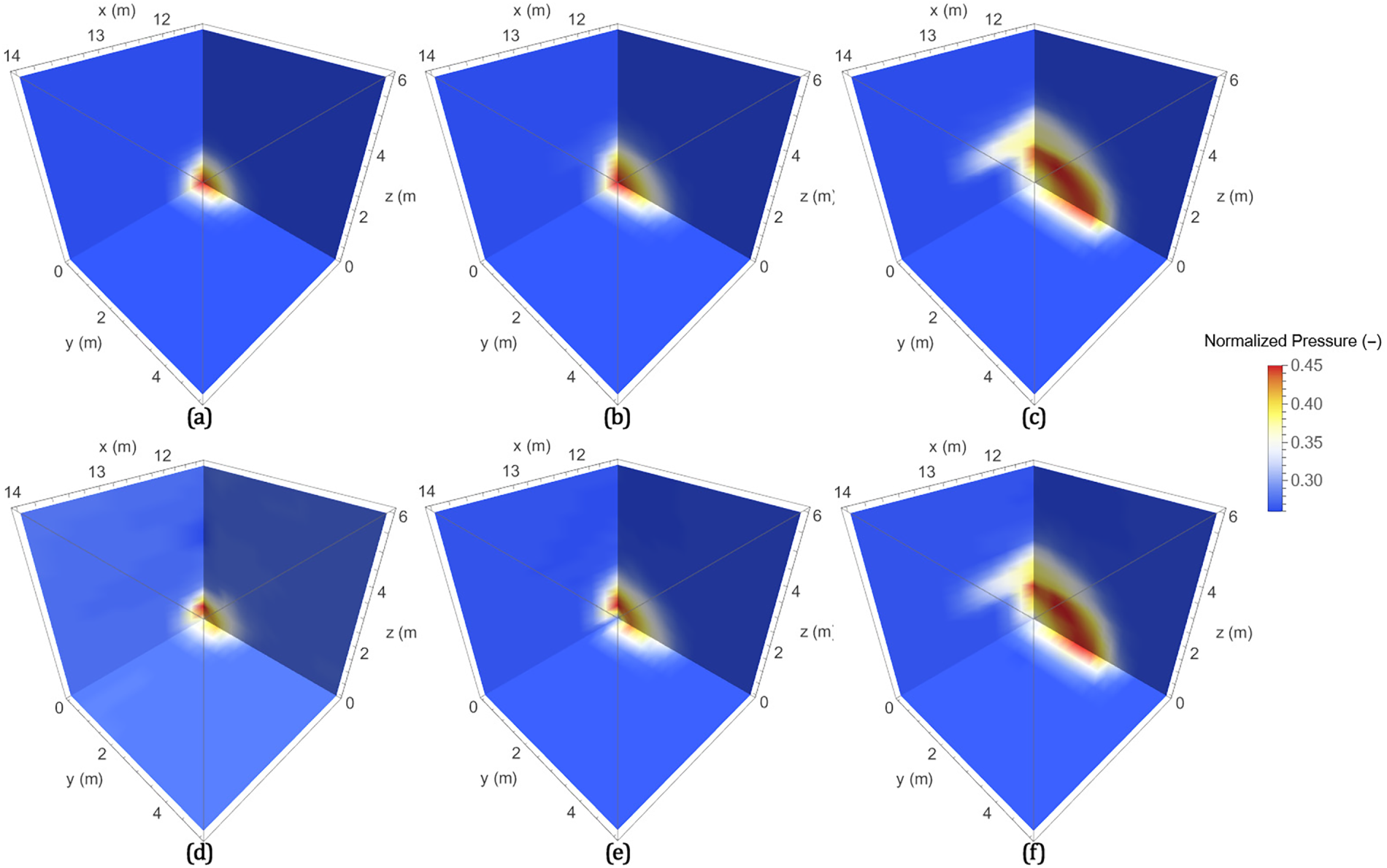
Figure 5: Comparison of transient three-dimensional overpressure fields between the CFD reference solution and the TCN-based surrogate model under the unseen Scenario B: (a) CFD reference at
As illustrated in Fig. 5, the TCN-based surrogate model successfully reproduced the overall spatiotemporal evolution of explosion-induced pressure waves throughout the downstream region behind the blast wall. The predicted pressure distributions exhibited close agreement with the CFD reference solutions in terms of shock-front location, pressure-wave morphology, and overall propagation behavior across all representative time instances. In particular, the locations and spatial morphology of the propagating shock fronts were accurately reconstructed during the early propagation stage (
These observations indicate that the surrogate model captured the global spatiotemporal characteristics of explosion-induced overpressure propagation rather than merely approximating local pressure responses at individual monitoring locations. The ability to reconstruct evolving shockwave structures and their interactions with geometric boundaries is particularly important for practical hydrogen safety applications, where spatially resolved pressure distributions are required for hazard assessment and protective barrier design. Overall, the spatial reconstruction results demonstrate that the selected surrogate framework accurately reproduces the transient three-dimensional (3D) hydrogen explosion overpressure fields under a previously unseen blast-wall configuration. Combined with the prediction and waveform reconstruction results presented in the preceding sections, these findings indicate that deep learning-based sequential surrogate modeling can effectively capture the essential spatiotemporal characteristics of explosion-induced pressure propagation while substantially reducing the computational cost associated with high-fidelity CFD simulations. Therefore, the proposed framework offers a computationally efficient surrogate methodology that complements high-fidelity CFD simulations, enabling rapid hydrogen explosion analysis, protective barrier evaluation, and quantitative safety assessment in hydrogen infrastructure applications.
This study presented a deep learning-based spatiotemporal surrogate framework for reconstructing transient three-dimensional (
The comparative evaluation showed that the TCN model achieved the highest reconstruction accuracy for an unseen interpolation test case within the sampled design space, yielding an
Several limitations should be acknowledged. The CFD database was generated under fixed hydrogen-air mixture and environmental conditions while varying only blast-wall height (
Future work will therefore include experimental validation of the proposed surrogate framework using hydrogen explosion measurements while extending the CFD database to encompass a broader range of operating conditions and more complex geometrical configurations. Physics-informed learning approaches, such as Physics-Informed Neural Networks (PINNs), and advanced spatiotemporal architectures, including Graph Neural Networks (GNNs), Convolutional Long Short-Term Memory (ConvLSTM), the Fourier Neural Operator (FNO), and DeepONet, will be investigated to improve the physical consistency and generalization capability of the surrogate model. Model interpretability will also be investigated using feature attribution and visualization techniques to better understand the influence of input variables on surrogate predictions for practical hydrogen safety assessment.
Acknowledgement: Not applicable.
Funding Statement: This work was supported by Innovative Human Resource Development for Local Intellectualization Program through the Institute of Information & Communications Technology Planning & Evaluation (IITP) grant funded by the Korea government (MSIT) (IITP-2026-RS-2022-00156360).
Author Contributions: The authors confirm their contributions to the paper as follows: Jiwon Hwang: Conceptualization, Methodology, Software, Validation, Formal Analysis, Investigation, Data Curation, Writing—Original Draft Preparation, Writing—Review and Editing, Visualization. Sangjun Lee: Supervision, Writing—Review and Editing, Project Administration, Funding Acquisition. All authors reviewed and approved the final version of the manuscript.
Availability of Data and Materials: The datasets generated and analyzed during the current study were produced using the radXiFoam CFD solver. The data are available from the corresponding author upon reasonable request.
Ethics Approval: Not applicable.
Conflicts of Interest: The authors declare no conflicts of interest.
Abbreviations
| ANN | Artificial Neural Network |
| CFD | Computational Fluid Dynamics |
| CNN | Convolutional Neural Network |
| HRS | Hydrogen Refueling Station |
| LSTM | Long Short-Term Memory |
| MAE | Mean Absolute Error |
| MHSA | Multi-Head Self-Attention |
| MLP | Multi-Layer Perceptron |
| MSE | Mean Squared Error |
| OpenFOAM | Open-source Field Operation and Manipulation (official expansion of the software name) |
| PGNN | Probabilistic Graph Neural Network |
| ReLU | Rectified Linear Unit |
| RMSE | Root Mean Square Error |
| SSA | Sparrow Search Algorithm |
| TCN | Temporal Convolutional Network |
References
1. International Energy Agency. Global hydrogen review 2023. Paris, France: International Energy Agency; 2023. [Google Scholar]
2. Hydrogen Council; McKinsey & Company. Global Hydrogen Flows: Hydrogen Trade as a Key Enabler for Efficient Decarbonization; Brussels, Belgium: Hydrogen Council; 2022 [cited 2026 Aug 20]. Available from: https://hydrogencouncil.com/en/global-hydrogen-flows/. [Google Scholar]
3. National Fire Protection Association. NFPA 2: Hydrogen Technologies Code; Quincy, MA, USA: NFPA; 2023 [cited 2026 Aug 20]. Available from: https://link.nfpa.org/all-publications/2/2023/. [Google Scholar]
4. Molkov V. Fundamentals of hydrogen safety engineering I. London, UK: Bookboon; 2012. [Google Scholar]
5. Lea CJ, Ledin HS. A review of the state-of-the-art in gas explosion modelling. [cited 2026 Jul 31]. Available from: https://www.fabig.com/external-publications/hse-hsl200202/. [Google Scholar]
6. LaChance J, Houf W, Middleton B, Fluer L. Analyses to support development of risk-informed separation distances for hydrogen codes and standards. Albuquerque, NM, USA: Sandia National Laboratories; 2009. [Google Scholar]
7. Middha P, Hansen OR, Grune J, Kotchourko A. CFD calculations of gas leak dispersion and subsequent gas explosions: validation against ignited impinging hydrogen jet experiments. J Hazard Mater. 2010;179(1–3):84–94. doi:10.1016/j.jhazmat.2010.02.061. [Google Scholar] [CrossRef]
8. Both AL, Atanga G, Hisken H. CFD modelling of gas explosions: optimising sub-grid model parameters. J Loss Prev Process Ind. 2019;60(1847):159–73. doi:10.1016/j.jlp.2019.04.008. [Google Scholar] [CrossRef]
9. Machniewski P, Molga E. CFD analysis of large-scale hydrogen detonation and blast wave overpressure in partially confined spaces. Process Saf Environ Prot. 2022;158(1–3):537–46. doi:10.1016/j.psep.2021.12.032. [Google Scholar] [CrossRef]
10. Xie H, Makarov D, Kashkarov S, Molkov V. CFD simulations of hydrogen tank fuelling: sensitivity to turbulence model and grid resolution. Hydrogen. 2023;4(4):1001–21. doi:10.3390/hydrogen4040058. [Google Scholar] [CrossRef]
11. Gamezo VN, Ogawa T, Oran ES. Numerical simulations of flame propagation and DDT in obstructed channels filled with hydrogen–air mixture. Proc Combust Inst. 2007;31(2):2463–71. doi:10.1016/j.proci.2006.07.220. [Google Scholar] [CrossRef]
12. Su Y, Li J, Yu B, Zhao Y, Han D, Sun D. Modeling of hydrogen blending on the leakage and diffusion of urban buried hydrogen-enriched natural gas pipeline. Comput Model Eng Sci. 2023;136(2):1315–37. doi:10.32604/cmes.2023.0260353. [Google Scholar] [CrossRef]
13. Brunton SL, Noack BR, Koumoutsakos P. Machine learning for fluid mechanics. Annu Rev Fluid Mech. 2020;52(1):477–508. doi:10.1146/annurev-fluid-010719-060214. [Google Scholar] [CrossRef]
14. Pathak J, Hunt B, Girvan M, Lu Z, Ott E. Model-free prediction of large spatiotemporally chaotic systems from data: a reservoir computing approach. Phys Rev Lett. 2018;120(2):024102. doi:10.1103/PhysRevLett.120.024102. [Google Scholar] [CrossRef]
15. Karniadakis GE, Kevrekidis IG, Lu L, Perdikaris P, Wang S, Yang L. Physics-informed machine learning. Nat Rev Phys. 2021;3(6):422–40. doi:10.1038/s42254-021-00314-5. [Google Scholar] [CrossRef]
16. Hu Q, Zhang X, Li Q, Hao H, Coffey C, Mitchell-Corbett F. Prediction and interpretability of accidental explosion loads from hydrogen-air mixtures using CFD and artificial neural network method. Int J Hydrogen Energy. 2024;66(6):135–47. doi:10.1016/j.ijhydene.2024.03.299. [Google Scholar] [CrossRef]
17. Kang HS, Hwang JW, Yu CH. A database extension for a safety evaluation of a hydrogen refueling station with a barrier using a CFD analysis and a machine learning method. Processes. 2023;11(10):3025. doi:10.3390/pr11103025. [Google Scholar] [CrossRef]
18. Min H. Prediction of hydrogen storage vessel explosion with blast wall using machine learning. Int J Comput Sci Mob Comput. 2024;13(7):12–22. doi:10.47760/ijcsmc.2024.v13i07.002. [Google Scholar] [CrossRef]
19. Yang G, Kong D, He X, Yu X. Prediction of hydrogen leakage location and intensity in hydrogen refueling stations based on deep learning. Int J Hydrogen Energy. 2024;68(8):209–20. doi:10.1016/j.ijhydene.2024.04.234. [Google Scholar] [CrossRef]
20. Liu Y, Li W, Wang H, Du T. SSA-LSTM-multi-head attention modelling approach for prediction of coal dust maximum explosion pressure based on the synergistic effect of particle size and concentration. Comput Model Eng Sci. 2025;143(2):2261–86. doi:10.32604/cmes.2025.064179. [Google Scholar] [CrossRef]
21. Li J, Li J, Xie Z, Shi J, Li Y, Chang Y, et al. Probabilistic graph neural network-based real-time hydrogen gas explosion prediction from hydrogen production plants. Safety Emerg Sci. 2025;1(2):9590012. doi:10.26599/SES.2025.9590012. [Google Scholar] [CrossRef]
22. Li S, Zhang S, Zhang C, Liang L, Zhang X. Temporal convolutional network for gas concentration prediction based on weighted loss and channel coupling attention. IEEE Sens J. 2025;25(6):9802–16. doi:10.1109/JSEN.2025.3529930. [Google Scholar] [CrossRef]
23. Bai S, Kolter JZ, Koltun V. An empirical evaluation of generic convolutional and recurrent networks for sequence modeling. arXiv:1803.01271. 2018. doi:10.48550/arXiv.1803.01271. [Google Scholar] [CrossRef]
24. Tofigh M, Kharazmi A, Smith DJ, Koch CR, Shahbakhti M. Temporal dilated convolution and nonlinear autoregressive network for predicting solid oxide fuel cell performance. Eng Appl Artif Intell. 2024;136(1):108994. doi:10.1016/j.engappai.2024.108994. [Google Scholar] [CrossRef]
25. Hochreiter S, Schmidhuber J. Long short-term memory. Neural Comput. 1997;9(8):1735–80. doi:10.1162/neco.1997.9.8.1735. [Google Scholar] [CrossRef]
26. Vaswani A, Shazeer N, Parmar N, Uszkoreit J, Jones L, Gomez AN, et al. Attention is all you need. In: Proceedings of the 31st International Conference on Neural Information Processing Systems; 2017 Dec 4–7; Long Beach, CA, USA. p. 5998–6008. [Google Scholar]
27. ksm0226. radXiFoam: OpenFOAM CFD solver for flamelet progress variable combustion model with radiation heat transfer. GitHub repository. [cited 2026 Mar 6]. Available from: https://github.com/ksm0226/radXiFoam. [Google Scholar]
28. Kang HS, Kim S-M, Kim J. Safety issues of a hydrogen refueling station and a prediction for an overpressure reduction by a barrier using OpenFOAM software for an SRI explosion test in an open space. Energies. 2022;15(20):7556. doi:10.3390/en15207556. [Google Scholar] [CrossRef]
29. Kang HS, Choi KS, Lee HW, Yu CH. CFD analysis of the effects of a barrier in a hydrogen refueling station mock-up facility during a vapor cloud explosion using the radXiFoam v2.0 code. Processes. 2024;12(10):2173. doi:10.3390/pr12102173. [Google Scholar] [CrossRef]
Cite This Article
 Copyright © 2026 The Author(s). Published by Tech Science Press.
This work is licensed under a Creative Commons Attribution 4.0 International License , which permits unrestricted use, distribution, and reproduction in any medium, provided the original work is properly cited.
 Downloads
 Citation Tools
