
 Login
Login Register
 Submit a Paper
 Propose a Special lssue
 Open Access
ARTICLE
Oracle-Conditioned Deep Q-Network Refinement of Small Brain Tumor Components in Axial Magnetic Resonance Imaging
1 School of Physical Education and Sports, International University of Tourism and Hospitality, Turkistan, Kazakhstan
2 School of Languages, International University of Tourism and Hospitality, Turkistan, Kazakhstan
3 School of Digital Technologies, Narxoz University, Almaty, Kazakhstan
* Corresponding Authors: Balnur Kenjayeva. Email: ; Daniyar Sultan. Email:
Computer Modeling in Engineering & Sciences 2026, 148(3), 46 https://doi.org/10.32604/cmes.2026.088762
Received 09 July 2026; Accepted 10 September 2026; Issue published 28 September 2026
 View Full Text
 Download PDF
Abstract
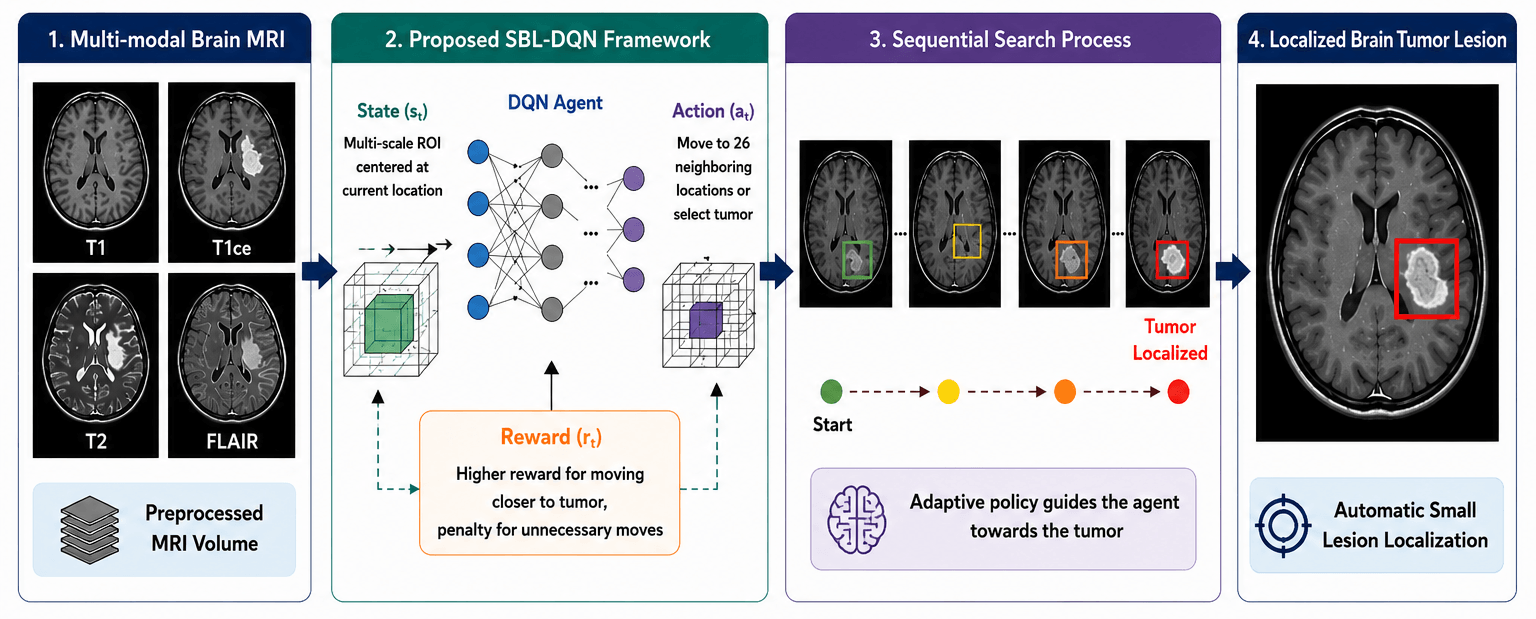
Brain tumor localization in magnetic resonance imaging remains challenging for small, low-contrast lesions. This study presents Small Brain Lesion Deep Q Network (SBL-DQN), a two-dimensional lesion-wise reinforcement-learning framework that refines an axis-aligned region of interest on a co-registered axial multi-channel MRI slice. In the current evaluation protocol, voxel reference masks are resampled, processed by 26-connected-component analysis, and filtered using a maximum in-plane diameter of 10 mm; one axial episode is then executed for each reference-enumerated component. The mask and component coordinates are not included in the DQN state, but ground-truth annotations are required to generate the evaluation candidate list and to compute reward traces and localization metrics. Accordingly, the reported experiment is oracle-conditioned lesion-wise localization refinement rather than autonomous lesion detection. The agent uses seven actions (up, down, left, right, zoom in, zoom out, and stop) and does not move through the anatomical z-axis. On the internal BraTS 2025 evaluation, the complete configuration yielded 97.46% localization accuracy, 97.23% precision, 96.88% recall, 97.05% F1-score, mean Intersection over Union of 0.834, AP@0.5 of 0.961, and center localization error of 0.91 mm. BraTS-METS 2025 and QIN-GBM-TREATMENT-RESPONSE remain qualitative transfer examples. Component-wise ablation, eligible-lesion accounting, and a balanced failure-case archive were not retained in the available experimental record; therefore, no individual component contribution, autonomous detection performance, or comprehensive robustness claim is made.Graphic Abstract
Keywords
Cite This Article
 Copyright © 2026 The Author(s). Published by Tech Science Press.
This work is licensed under a Creative Commons Attribution 4.0 International License , which permits unrestricted use, distribution, and reproduction in any medium, provided the original work is properly cited.
 Downloads
 Citation Tools
