
 Login
Login Register
 Submit a Paper
 Propose a Special lssue
 Open Access
ARTICLE
Assessment of T helper 17 cells/regulatory T cells balance and serum cytokine levels in patients with Crohn’s disease
1 Department of Medical Immunology, Beni Messous University Hospital Center, Algiers, Algeria
2 Faculty of Pharmacy, The University of Health Sciences, Algiers, Algeria
3 Department of Gastroenterology & Hepatology, Beni Messous University Hospital Center, Algiers, Algeria
4 Faculty of Medicine, The University of Health Sciences, Algiers, Algeria
* Corresponding Author: Reda Djidjik. Email:
# These authors contributed equally to this work as the first author
European Cytokine Network 2026, 37(3), 349-356. https://doi.org/10.32604/ecn.2026.082748
Received 22 March 2026; Accepted 24 June 2026; Issue published 28 September 2026
 View Full Text
 Download PDF
Abstract
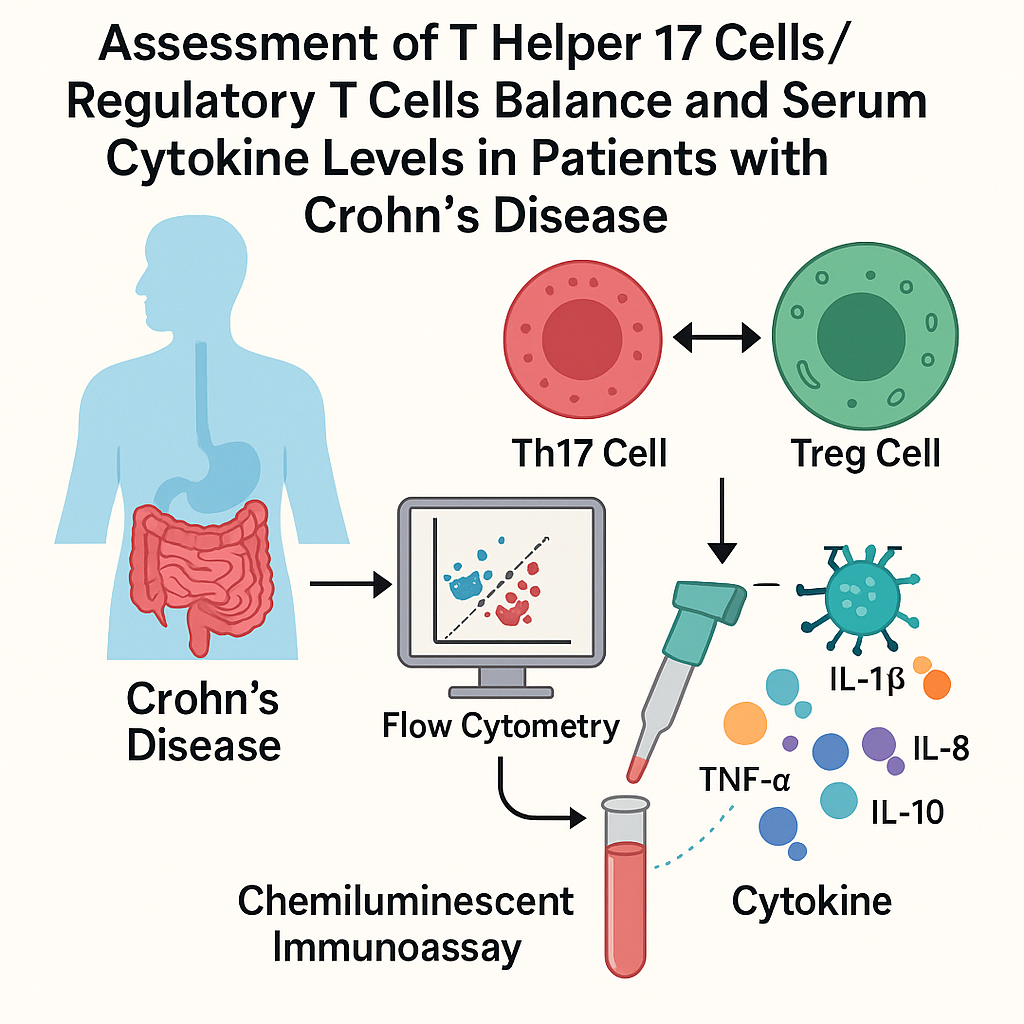
Background: Crohn’s disease (CD) is a chronic inflammatory disorder resulting from the interaction between genetic susceptibility, environmental factors, intestinal microbiota, and dysregulated immune responses. Despite major advances, the precise mechanisms underlying disease development remain incompletely understood. This study aimed to evaluate the proportions of Th17 and regulatory T (Treg) cells, as well as serum cytokine levels, in the peripheral blood of patients with CD. Methods: We enrolled 46 patients with active CD (median age: 31.5 years) and 30 healthy subjects (median age: 30.0 years). Th17 and Treg cell populations were analyzed by flow cytometry, while serum concentrations of TNF-α, IL-1β, IL-6, IL-8, and IL-10 were measured using a chemiluminescent immunoassay. Results: Our results showed a significantly higher proportion of Th17 cells (3.62 ± 1.65% vs. 1.83 ± 1.00%, p = 0.007) and a significantly lower proportion of Treg cells (1.03 ± 0.96% vs. 2.59 ± 2.04%, p < 0.001) in CD patients compared with healthy controls. In addition, serum levels of TNF-α, IL-1β, IL-6, and IL-8 were significantly increased in CD patients (p = 0.011, p = 0.012, p < 0.0001, p < 0.0001, respectively), whereas IL-10 levels did not differ significantly between the two groups (p > 0.05). Conclusion: The imbalance in the Th17/Treg ratio and the elevated levels of inflammatory cytokines support the presence of an active inflammatory process in CD. These findings suggest that such immunological alterations may represent potential biomarkers of disease activity, although further validation in larger longitudinal studies, including mucosal investigations, is required.Graphic Abstract
Keywords
Cite This Article
 Copyright © 2026 The Author(s). Published by Tech Science Press.
This work is licensed under a Creative Commons Attribution 4.0 International License , which permits unrestricted use, distribution, and reproduction in any medium, provided the original work is properly cited.
 Downloads
 Citation Tools
