
 Login
Login Register
 Submit a Paper
 Propose a Special lssue
 Open Access
REVIEW
Growth differentiation factor 15 (GDF15) in health and disease: a translational journey from metabolic stress to oncology and paediatric pathophysiology
1 Department of Experimental Medicine, Sapienza University of Rome, Rome, Italy
2 Department of Medical, Surgical and Health Sciences, University of Trieste, Trieste, Italy
* Corresponding Author: Emanuela Anastasi. Email:
European Cytokine Network 2026, 37(3), 249-257. https://doi.org/10.32604/ecn.2026.088372
Received 02 July 2026; Accepted 09 September 2026; Issue published 28 September 2026
 View Full Text
 Download PDF
Abstract
Growth Differentiation Factor 15 (GDF15) is a stress-responsive cytokine linking metabolism, inflammation and disease pathophysiology. In this review, we provide a comprehensive overview of its physiological and pathological functions, emphasising its relevance in various clinical contexts. We discuss the molecular mechanisms that regulate its expression and signalling, its role as a systemic biomarker of cellular and mitochondrial stress, and its function in maintaining metabolic homeostasis and in obesity-related disorders. In oncology, this cytokine plays a pivotal role by displaying context-dependent functions as a mediator of tumour progression, immune modulation and cancer-associated cachexia, making it both a biomarker and a therapeutic target. In paediatric medicine, GDF15 indicates treatment-related toxicity and systemic stress. Taken together, these findings establish the cytokine as a distinctive endocrine mediator that links stress sensing, metabolism, and disease adaptation across different developmental and clinical stages. Despite the growing body of evidence supporting its diagnostic and therapeutic potential, further research is needed to clarify its context-dependent biological actions and facilitate the successful clinical translation of GDF15-targeted strategies in the treatment of metabolic, oncological, and paediatric disorders.Keywords
Cytokines are key mediators of intercellular communication which regulate immune responses, inflammation, and metabolic homeostasis. Cytokine signaling dysregulation contributes to numerous pathological conditions including chronic inflammatory diseases, metabolic syndrome, and cancer. Among stress-responsive cytokines, Growth Differentiation Factor-15 (GDF15) has emerged as an important mediator of systemic stress responses (reviewed in [1]). GDF15 is a stress-inducible cytokine, synthesised as a precursor protein. It is then processed by proprotein convertases, including furin-like enzymes, to generate a biologically active, disulfide-linked homodimer (reviewed in [2]). Its expression is rapidly increased in response to cellular stress through multiple transcriptional pathways, including those dependent on p53 and inflammatory signalling cascades [3]. GDF15 is often considered to be a structurally and functionally atypical ligand within the Transforming Growth Factor β (TGF-β) superfamily. Although the mature peptide retains the cysteine-knot motif characteristic of this family, its primary sequence shows unusually low conservation across species compared to more canonical family members such as Bone Morphogenetic Protein 2. In addition to its systemic secretion, emerging evidence suggests that the GDF15 prodomain may transiently associate with extracellular matrix components, potentially forming a local reservoir which can be rapidly mobilised during tissue injury or metabolic stress. This storage-and-release mechanism may contribute to the rapid and significant increase in circulating GDF15 observed in inflammatory, toxic, and neoplastic conditions (reviewed in [4]). While several excellent reviews have addressed GDF15 within specific domains, such as its role in metabolic and cardiovascular disease, its multifaceted actions in oncology, or its systematic characterisation in paediatric disease, to our knowledge no single work has yet integrated these perspectives into one continuous translational narrative. The present review therefore aims to bridge these domains, tracing GDF15 biology from a fundamental stress-response signal through its context-dependent oncological functions to its emerging, and comparatively underexplored, relevance in paediatric pathophysiology.
2 The GDF15–GFRAL Signaling Axis: Molecular Mechanisms and Pathophysiological Implications
A major breakthrough in the understanding of GDF15 biology came with the identification of the glial cell-derived neurotrophic factor (GDNF) family receptor alpha-like (GFRAL) as its related receptor. GFRAL expression is restricted to area postrema and the nucleus tractus solitarius neurons in the brainstem, regions which lack a fully developed blood–brain barrier. This anatomical configuration allows circulating GDF15 to access central neural circuits involved in energy balance and visceral stress sensing directly (reviewed in [4]). GDF15-GFRAL binding promotes the recruitment of the receptor tyrosine kinase (RET), and there is accumulating evidence indicating that the RET51 isoform predominantly mediates downstream signal transduction (reviewed in [4]). The formation of the GDF15–GFRAL–RET signalling complex activates multiple intracellular pathways, including Extracellular Signal-Regulated Kinase (ERK), Phosphoinositide 3-Kinase/Protein Kinase B (PI3K/AKT) and Phospholipase C gamma (PLCγ). These responses include suppression of food intake, induction of aversive behaviour, modulation of autonomic output, and adaptation of systemic stress, highlighting the important role of this axis in integrating systemic metabolic and cellular stress signals in the central nervous system [5]. Notably, GDF15 signalling diverges substantially from canonical TGF-β family signalling, as it primarily operates through the GFRAL-RET receptor complex rather than through Small Mothers Against Decapentaplegic (SMAD)-dependent pathways. Nevertheless, in pathological contexts, particularly in cancer, GDF15 signalling extends beyond its primary endocrine functions. GDF15 has been associated with the activation of intracellular signalling cascades, including PI3K/AKT, MAPK/ERK and, in a context-dependent manner, SMAD2/3 pathways, in a wide range of solid malignancies. This signalling landscape promotes cellular proliferation, epithelial-mesenchymal transition (EMT), metastatic dissemination, and resistance to anticancer therapies (reviewed in [6,7]). High GDF15 circulating levels have been reported in colorectal, gastric, pancreatic, breast, lung, prostate and head and neck cancers and this condition is frequently associated with adverse clinical outcomes and poorer prognosis (reviewed in [1]) [8]. Within the tumour microenvironment, GDF15 is produced by malignant cells, tumour-associated fibroblasts and infiltrating macrophages, contributing to the establishment of metabolically and immunologically permissive niches [9–11] (figure 1).
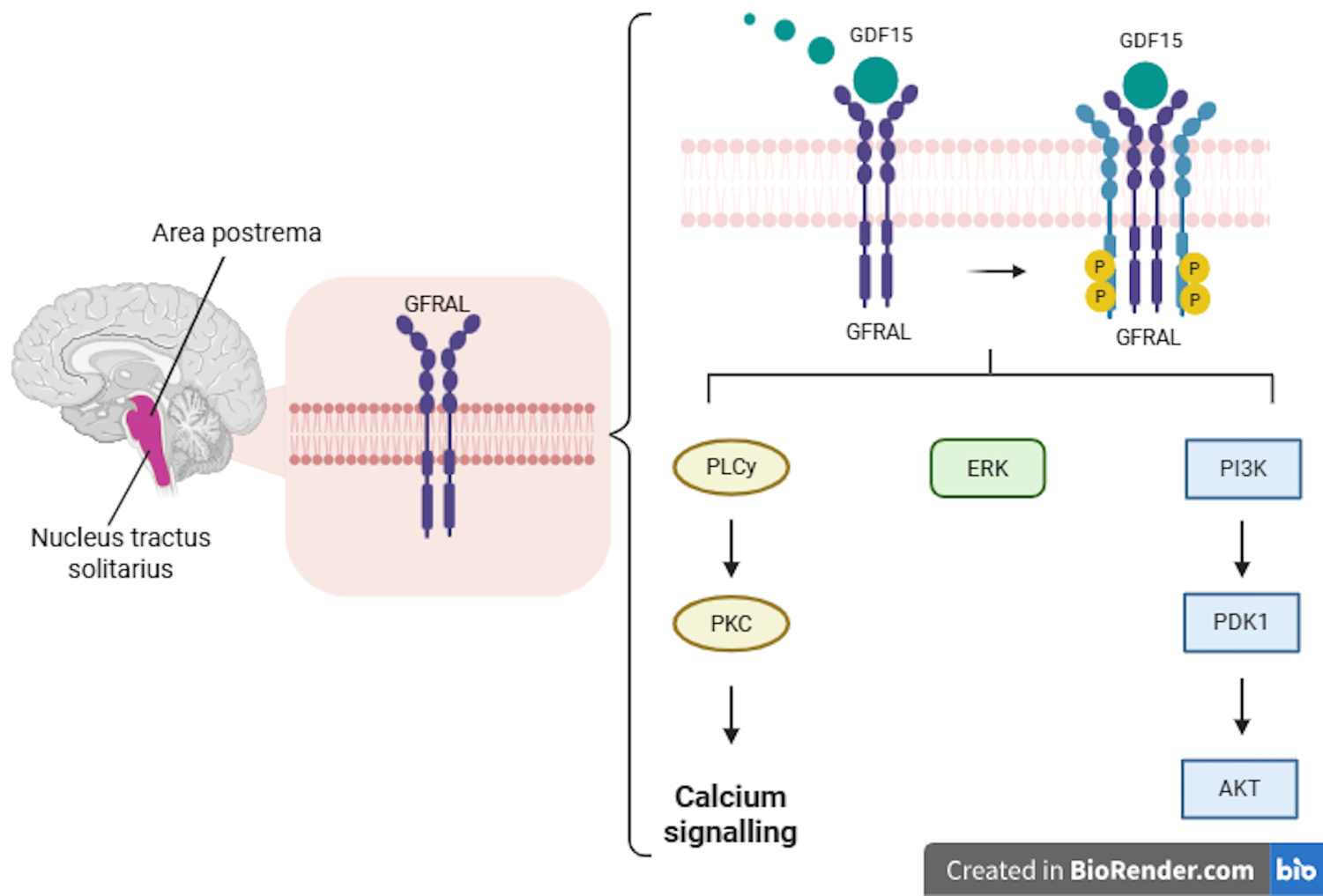
Figure 1: GDF15-GFRAL signalling in the brainstem. GDF15 binds to GFRAL, a receptor that is selectively expressed in the area postrema and the nucleus tractus solitarius of the hindbrain. Binding of the ligand promotes GFRAL association with the co-receptor RET, thereby triggering receptor phosphorylation and activation of downstream signalling. GFRAL, GDNF Family Receptor Alpha-Like; RET, Receptor Tyrosine Kinase; PLCγ, Phospholipase C Gamma; ERK, Extracellular Signal-Regulated Kinase; PI3K, Phosphoinositide 3-Kinase; AKT, Protein Kinase B; PKC, Protein Kinase C; PDK1, Phosphoinositide-Dependent Kinase-1.
3 GDF15 as an Endocrine Biomarker of Systemic Stress
GDF15 is currently recognized as a key endocrine biomarker of systemic stress. Its elevated circulating concentrations have been documented in a wide range of pathological conditions, such as cardiovascular disease, obesity, type 2 diabetes mellitus, chronic inflammatory disorders, and metabolic dysfunction (reviewed in [2,12]). Unlike the classical meal-related satiety signals such as cholecystokinin, glucagon-like peptide-1 and peptide YY, which primarily regulate the acute termination of food intake, GDF15 acts as an ongoing signal of disrupted homeostasis. Rather than reflecting acute nutritional status, circulating GDF15 levels appear to mirror persistent metabolic inflammatory, or cellular stress, thereby providing an integrated measure of the organism’s physiological burden (reviewed in [13,14]). Physical exercise is a paradigmatic example of this biological behaviour. Intense exercise is associated with a transient increase in circulating GDF15, which typically returns to baseline levels within approximately 24 h. This short-lived increase contrasts sharply with the sustained elevations observed in chronic pathological conditions such as cancer cachexia and metabolic disease. This highlights GDF15’s ability to discriminate between adaptive physiological responses and persistent pathological stress conditions [15] (reviewed in [16]).
4 GDF15 in Obesity and Metabolic Disease: A Stress-Induced Endocrine Signal Linking Energy Homeostasis and Therapeutic Opportunity
Circulating GDF15 levels are often high in obese men. This chronic pathological condition likely reflects a compensatory response to chronic metabolic stress, which is driven by inflammation, mitochondrial dysfunction, and insulin resistance. GDF15 has been conceived as a stress-induced “mitokine” since it is produced in response to mitochondrial disturbance. GDF15 is also a “myokine” and a “cardiokine”, as its expression is dynamically regulated in skeletal muscle and cardiac tissue in response to physiological or pathological stress, such as intense exercise and acute myocardial injury (reviewed in [16,17]). Experimental studies suggest that loss of GDF15 signalling leads to weight gain, whereas its overexpression decreases body weight and adiposity (reviewed in [13]) [18]. These effects are mostly due to GFRAL-dependent pathways in the brainstem that involve central neural circuits, which control feeding behaviour and reduce food intake. Reduced food intake and body weight have been observed in animal models after recombinant GDF15 was administered or its pathway was pharmacologically activated, whereas hyperphagia and weight gain have been promoted by inhibiting this axis [18]. A growing body of evidence suggests that several nutritional and pharmacological interventions appear to engage the GDF15–GFRAL axis as part of their metabolic effects (reviewed in [2]). For instance, Camptothecin (CPT) has been shown to induce a significant increase in circulating GDF15 in obese mice, resulting in a corresponding reduction in food intake and adiposity. Crucially, these effects are reduced by either immunoneutralising GDF15 or genetically ablating GFRAL, confirming the dependence on this pathway [19]. Similarly, ketogenic diet intervention has been associated with significant weight loss and increased GDF15 circulating levels in animal models and humans. Notably, however, these metabolic benefits are absent in GDF15- or GFRAL-deficient models, which further highlights the essential role of this signalling axis in mediating diet-induced changes in energy balance [20]. Pharmacological modulation of this pathway has also been observed with artesunate, a semi-synthetic derivative of artemisinin. In obese mice and cynomolgus macaques, it supports circulating GDF15 levels, resulting in reduced food intake and body weight. Notably, these effects occur without evidence of nausea or overt malaise in preclinical models. However, further clinical studies are required to establish the efficacy, tolerability, and safety of this approach in humans [21].
Pharmacokinetic Limitations and the Development of Long-Acting Analogues
GDF15 clinical application is currently limited by its relatively short plasma half-life, its tendency to aggregate and its susceptibility to proteolytic degradation. Collectively, these characteristics contribute to unstable systemic exposure and may limit therapeutic efficacy. These limitations have been overcome by developing long-acting fusion proteins using Fc or human serum albumin scaffolds. These engineered fusion proteins have been shown to induce anorexia and significant weight loss in obese rodents and non-human primates, while improving glucose homeostasis and reducing circulating triglyceride and insulin levels (reviewed in [22]). Furthermore, long-acting analogues, including fusion proteins designed to extend the biological half-life of the protein, have demonstrated sustained efficacy in reducing body weight in preclinical studies (reviewed in [23]). In particular, the GDF15–Fc fusion protein LY3463251 has shown promising results in preclinical models and early phase 1 clinical trials, suggesting the potential of GDF15-based treatments for managing obesity and its metabolic complications in the long term [24]. Notably, activation of the GDF15 pathway has been linked to nausea and aversive responses. However, preclinical studies in non-human primates have reported no overt nausea or vomiting. These observations suggest that appetite suppression may, under specific conditions, be dissociated from aversive side effects [25].
5 GDF15 and Cancer: Context-Dependent Roles in Tumour Progression and Tumour-Environmental Interactions
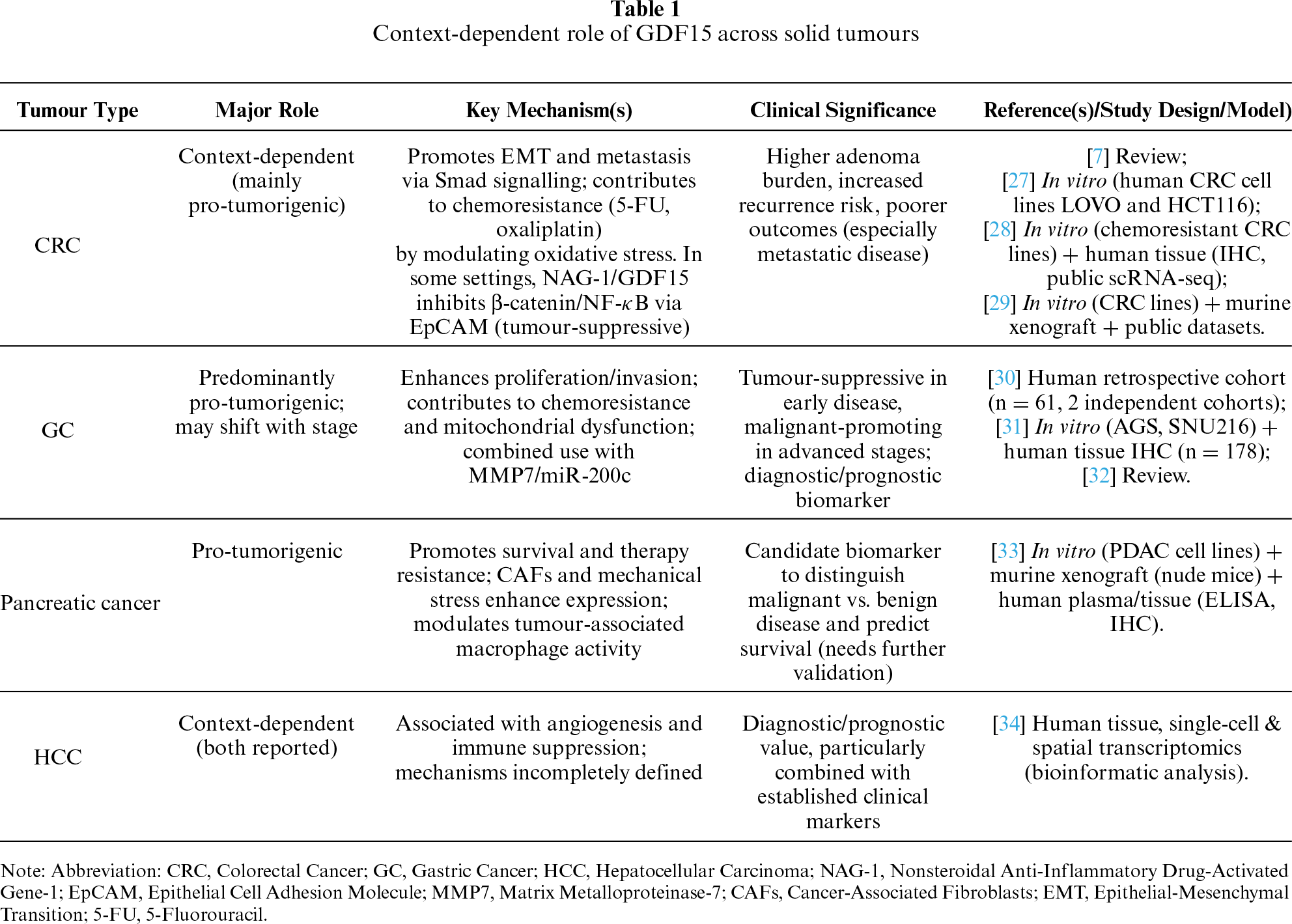
Over the past decade, GDF15 has attracted increasing attention because of its broad biological and clinical implications in oncology. Its role in cancer appears to be highly context-dependent, varying according to tumour type, molecular background, disease stage, and the microenvironment [18,26]. Depending on these factors, GDF15 may either promote or suppress tumour growth, invasion and metastatic dissemination, making it a potentially valuable but challenging biomarker to interpret. Elevated expression may reflect an adaptive response to tumour-associated stress or, alternatively, an active driver of malignant progression. Consequently, the biological and clinical significance of GDF15 should always be interpreted within the specific molecular, cellular and microenvironmental context of each tumour (Table 1). In colorectal cancer (CRC), increased circulating GDF15 levels have been associated with a higher burden of adenomas, an increased risk of recurrence and poorer clinical outcomes, particularly in patients with metastatic disease (reviewed in [7]). Experimental evidence suggests that GDF15 can promote EMT and metastatic dissemination through autocrine and paracrine mechanisms involving Smad signalling [27]. Moreover, GDF15 contributes to chemoresistance by modulating oxidative stress responses induced by agents such as 5-fluorouracil and oxaliplatin [28]. However, its role in CRC remains controversial. In certain experimental models, GDF15 exerts pro-apoptotic effects and variably regulates the PI3K/AKT pathway, whereas more recent evidence indicates that Nonsteroidal Anti-inflammatory Drug-activated Gene-1 (NAG-1)/GDF15 may inhibit β-catenin and Nuclear factor kappa-light-chain-enhancer of activated B cells (NF-κB) signalling through interaction with Epithelial Cell Adhesion Molecule (EpCAM), suggesting tumour-suppressive activity in specific molecular settings [29]. Collectively, these findings indicate that the biological effects of GDF15 in CRC are strongly influenced by the tumour microenvironment and the signalling networks involved (reviewed in [1]). Similarly, in gastric cancer (GC), elevated GDF15 expression has generally been associated with adverse clinical outcomes and has been proposed as both a diagnostic and prognostic biomarker [30]. Mechanistically, GDF15 appears to enhance proliferation and invasion through activation of pathways regulating cell growth and survival, potentially contributing to chemoresistance and mitochondrial dysfunction [31]. Combined assessment with other biomarkers, including matrix metalloproteinase-7 (MMP7) and miRNA-200c, has also been associated with poorer prognosis. Nevertheless, evidence suggests that the function of GDF15 may evolve during tumour progression, exerting tumour-suppressive effects in early disease while promoting malignant behaviour in advanced stages, highlighting the importance of disease context in determining its biological significance (reviewed in [32]). In pancreatic cancer, the GDF15-GFRAL signalling axis has emerged as an important contributor to tumour progression and metastatic spread. GDF15 promotes cell survival and therapeutic resistance through modulation of intracellular signalling pathways, while tumour-associated fibroblasts and mechanical stimuli within the microenvironment further enhance its expression, facilitating migration and invasion. In addition, GDF15 appears to influence antitumour immunity by modulating the activity of tumour-associated macrophages and other immune components [33]. Clinically, circulating GDF15 has been investigated as a biomarker for differentiating malignant from benign pancreatic disease and for predicting patient survival, although its utility requires further validation because of the marked heterogeneity of pancreatic tumours and their microenvironment [33]. In hepatocellular carcinoma (HCC), elevated serum GDF15 concentrations have been linked to angiogenesis, immune suppression, and disease progression, supporting its potential diagnostic and prognostic value, particularly when integrated with established clinical markers [34]. Nonetheless, as observed in other solid malignancies, GDF15 biological role in HCC remains incompletely understood, with studies reporting both tumour-promoting and tumour-suppressive functions depending on disease stage and molecular background. Overall, accumulating evidence indicates that GDF15 is a key mediator of tumour–microenvironment interactions. Produced not only by malignant cells but also by stromal and immune populations, this stress-responsive cytokine regulates multiple processes involved in cancer progression, including EMT, invasion, metastasis, and immune evasion (reviewed in [32]) [33]. In addition, GDF15 contributes to the establishment of immunosuppressive niches by impairing dendritic cell maturation and cytotoxic T-cell activity, whereas its expression by cancer-associated fibroblasts and tumour-associated macrophages further supports tumour growth and therapeutic resistance. Consistent associations between elevated tissue or circulating GDF15 levels and poor clinical outcomes across several solid malignancies underscore its promise as both a biomarker and a potential therapeutic target. However, given its pleiotropic and context dependent functions, the interpretation and clinical application of GDF15 must always consider the specific biological landscape of each tumour. Beyond its local effects within the tumour microenvironment, tumour-derived GDF15 also exerts systemic endocrine actions. It significantly affects host metabolism. Together, these effects contribute to the development of cancer-associated cachexia.
Cancer cachexia is a multifactorial syndrome characterised by involuntary weight loss, reduced appetite and progressive depletion of adipose and skeletal muscle mass. It is a major determinant of poor prognosis in cancer patients. Tumour-derived GDF15 plays a key role in the development of this condition with elevated circulating levels consistently associated with anorexia, negative energy balance, and cachectic phenotypes. This supports the idea that GDF15 plays a contributory role in disease pathogenesis, rather than merely being correlated with tumour burden. These effects are primarily mediated by activation of the central GFRAL-dependent pathway in the brainstem, driving sustained suppression of appetite and disruption of energy homeostasis. In addition to these central anorexigenic effects, chronic activation of the GDF15 axis contributes to peripheral metabolic alterations, including increased lipolysis and energy expenditure. Ultimately, this promotes progressive tissue wasting. Thus, this tumour–brain–periphery signalling axis represents a key mechanistic link between tumour progression and systemic metabolic failure. Taken together, these findings highlight the key role of GDF15 as an endocrine mediator in cancer cachexia, and suggest the therapeutic potential of the GDF15-GFRAL axis in preserving body mass and metabolic function in cancer patients (reviewed in [1,7,13]). Consequently, targeting GDF15 has emerged as a promising therapeutic strategy in oncology, offering the potential to reverse tissue wasting and overcome therapeutic resistance (reviewed in [35]). Recent studies have shown that an increase in GDF15 can alter the tumour microenvironment and reduce anti-tumour immunity. Therefore, combining GDF15 inhibitors with immune checkpoint inhibitors is a new approach that is expected to improve the efficacy of immune checkpoint inhibitors and reprogram immunometabolic suppression (reviewed in [35]). Beyond its role in systemic energy homeostasis, the same stress-responsive properties that make GDF15 a sensitive metabolic signal also underlie its context-dependent involvement in tumour biology, where it can act as both a mediator and a marker of malignant progression.
5.2 Therapeutic Targeting of the GDF15–GFRAL Axis
Therapeutic strategies targeting GDF15 include the use of monoclonal antibodies and GFRAL signalling inhibitors. Early clinical studies suggest that blocking this pathway may improve symptoms of cancer cachexia and restore appetite in affected patients. Ponsegromab is a humanised monoclonal antibody that neutralises circulating GDF15. This prevents ligand engagement with GFRAL and interrupts the assembly of the GFRAL-RET signalling complex in the hindbrain. This biological strategy is well suited to this target, as the GDF15-GFRAL interaction involves extensive protein-protein interfaces that are difficult to selectively disrupt with conventional small molecules. Nevertheless, recent structural screenings and chemical biology approaches have successfully identified small organic molecules capable of modulating GDF15 activity. Interestingly, these novel Small Organic Molecules demonstrated highly selective efficacy, being predominantly active against cancer cells expressing elevated levels of GDF15, while leaving normal, healthy cells virtually unaffected, thereby offering a promising alternative for targeted interventions [36]. In the randomized phase II PROACC-1 study, Ponsegromab improved body weight and appetite in patients with cancer cachexia and elevated baseline GDF15 concentrations showing a dose-dependent median weight gain relative to placebo of 1.22 kg (95% CrI, 0.37 to 2.25) for 100 mg, 1.92 kg (95% CrI, 0.92 to 2.97) for 200 mg, and 2.81 kg (95% CrI, 1.55 to 4.08) for the 400 mg dose at 12 weeks. The clearest benefit was observed in biomarker-selected patients. While these results support the use of GDF15 as both a therapeutic target and a stratification marker, follow-up remains limited and the long-term effects on functional endpoints, treatment tolerance and survival require confirmation [37]. Importantly, current clinical evidence supports Ponsegromab primarily as an anti-cachexia therapy rather than as a proven direct anticancer agent. While preclinical findings suggest that GDF15 blockade could boost antitumour defences, reduce therapy-induced starvation and possibly increase with immune checkpoint inhibitors, these antitumour benefits remain merely speculative and should be interpreted with caution until confirmed in suitably designed clinical trials [37]. Safety considerations are equally important. GDF15 is a pleiotropic stress-response cytokine, which means it can have many different effects on the body. So, a blockade of the chronic pathway could theoretically lead to increased appetite, weight gain, worsening insulin resistance or impaired adaptation to subsequent tissue and mitochondrial stress. This is even though early trials have not shown major short-term safety signals (reviewed in [38]). To reinforce these safety considerations, Cohen and Picard issued a critical warning about the potential risks of systemic GDF15 blockade. Since GDF15 acts as an essential evolutionary sensor that conveys information about somatic and mitochondrial energetic deficits to the brain, long-term pharmacological suppression of GDF15 could blunt vital adaptive mechanisms and have an adverse impact on patient survival, despite providing immediate improvements in cachectic symptoms (reviewed in [39]). The same axis that drives cancer-associated cachexia in adults is increasingly recognised as a broader indicator of stress and tissue injury across the lifespan, with growing evidence supporting its diagnostic relevance in paediatric medicine, where GDF15 reflects both physiological development and pathological insult.
In the paediatric population, circulating GDF15 reflects both physiological developmental processes and pathological stress responses. It acts as a dynamic biomarker of mitochondrial dysfunction, tissue injury, and systemic inflammation across a wide spectrum of diseases. In line with its role in developmental metabolic adaptation, circulating GDF15 levels are physiologically elevated at birth and during early infancy, beyond mitochondrial disorders. Increased levels have also been reported in congenital heart diseases, where GDF15 may integrate tissue injury with postnatal growth and endocrine adaptation. This highlights the need for age-specific reference intervals when interpreting clinical results. In paediatric mitochondrial disorders, elevated circulating GDF15 levels are associated with mitochondrial dysfunction and disease severity. This supports the use of GDF15 as a diagnostic tool for metabolic disorders in children (reviewed in [40]). Rather than a disease-specific marker, GDF15 acts as a “molecular thermometer”, reflecting tissue injury and metabolic stress (reviewed in [40]). In paediatric oncology, GDF15 functions as a sensitive sensor of tissue damage induced by malignancy and cytotoxic therapies. Clinical studies in newly diagnosed paediatric cancer patients show significantly higher GDF15 levels than healthy controls, suggesting its promising role in predicting chemotherapy-induced cachexia and gastrointestinal toxicity [41]. A critical application of GDF15 lies in the monitoring of anthracycline-induced cardiotoxicity. It has emerged as a more sensitive biomarker than traditional troponins for the detection of subclinical cardiomyopathy, showing a strong correlation with early diastolic dysfunction preceding detectable changes in conventional echocardiographic parameters, including left ventricular ejection fraction [42]. Beyond its role as a marker of tissue injury, GDF15 may also actively contribute to disease progression. In osteosarcoma, for example, it has been shown to promote pulmonary metastasis through modulation of the TGF-β signaling pathway, thereby highlighting its potential as a therapeutic target to limit tumour invasiveness [43]. In adolescents with polycystic ovary syndrome, patients often exhibit a relative functional GDF15 insufficiency, rather than absolute deficiency. Although circulating levels may fall within the normal range, they appear insufficient to counterbalance the hyperinsulinemia and low-grade inflammation that characterize the syndrome [44]. Notably, pharmacological interventions such as the SPIOMET combination have been shown to restore GDF15 to more optimal levels, thereby promoting reductions in ectopic fat and improving metabolic homeostasis without inducing anorexia. This observation suggests a dose-dependent and context-dependent therapeutic window for this cytokine [44]. The protein’s sensitivity to acute vascular injury is most evident in Hemorrhagic Shock and Encephalopathy Syndrome. In acute settings, GDF15 levels can increase by several hundred-fold within 24 h of symptom onset, reflecting the severity of the cytokine storm and the extent of systemic endothelial damage [45]. Collectively, GDF15 serves as a unifying molecular indicator across paediatric medicine, integrating developmental physiology, chronic metabolic dysfunction, and acute tissue injury. Its broad sensitivity highlights its potential role in precision paediatric medicine. However, clinical implementation requires age-, sex- and developmental-adjusted reference ranges for accurate interpretation (reviewed in [40]) (figure 2).
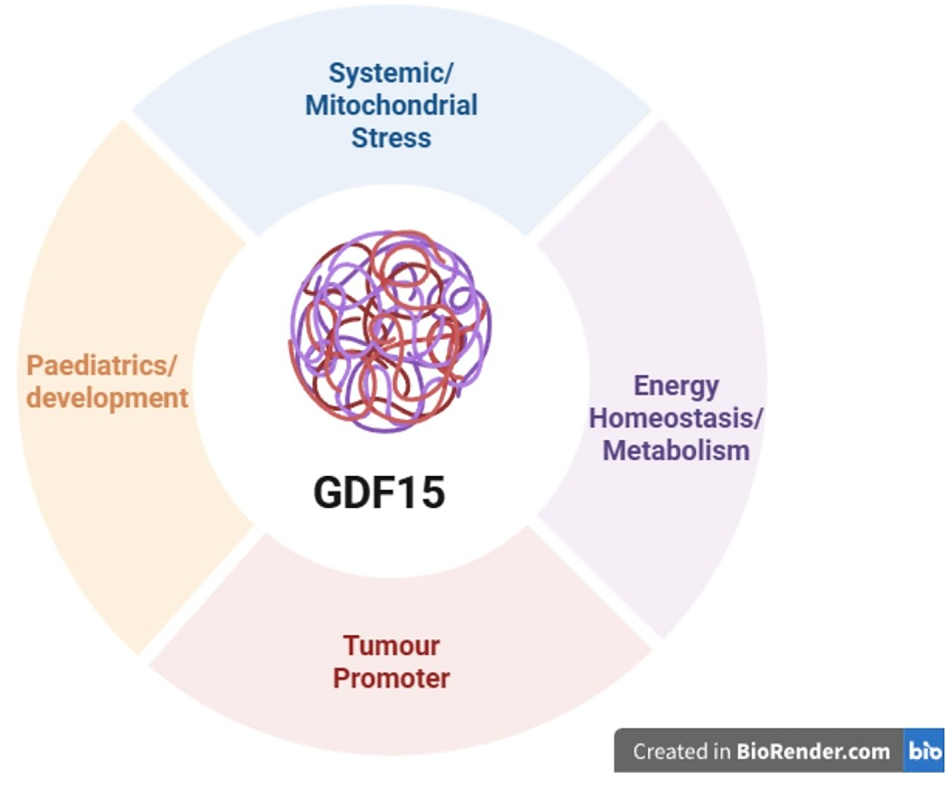
Figure 2: The multifaceted biological roles of GDF15. GDF15 sits at the intersection of four major functional domains: the systemic and mitochondrial stress responses, energy homeostasis and metabolism, tumour promotion, and paediatric and developmental processes.
Cytokines are fundamental mediators of intercellular communication, and their dysregulation contributes to a broad spectrum of human diseases, including metabolic disorders, cancer and systemic inflammatory conditions. Within this framework, GDF15 integrates signals from cellular stress, systemic metabolism, and neuroendocrine regulation in a variety of physiological and pathological contexts. Its biological actions are highly context-dependent, reflecting differences in disease type, stage, and microenvironmental cues. Current evidence suggests a potential role for the GDF15–GFRAL axis as a therapeutic target, particularly in cancer cachexia, although further studies are required to define efficacy, safety, and patient selection. Beyond oncology, GDF15 contributes to the regulation of metabolic stress responses and energy homeostasis, and has been proposed as a biomarker of mitochondrial and systemic stress in paediatric disorders. Overall, GDF15 is a key stress-induced endocrine signal linking cellular injury to systemic adaptation. However, several limitations currently constrain the clinical translation of GDF15: standardized, age- and sex-adjusted reference ranges are still lacking; the molecular determinants governing its shift between tumour-promoting and tumour-suppressive activity remain incompletely defined; and long-term safety and efficacy data for GDF15-targeted therapeutics, particularly in pediatric populations, are still limited. Furthermore, while this review maps the post-natal paediatric and adult oncological landscape of GDF15, future research should focus on fully elucidating its therapeutic potential and multi-organ impact within these specific patient populations. While there is growing support for its role as a biomarker and therapeutic target, particularly in oncology, cachexia and metabolic disease, further clarification of its context-dependent biological effects and regulatory mechanisms is required for its full clinical translation (figure 3).
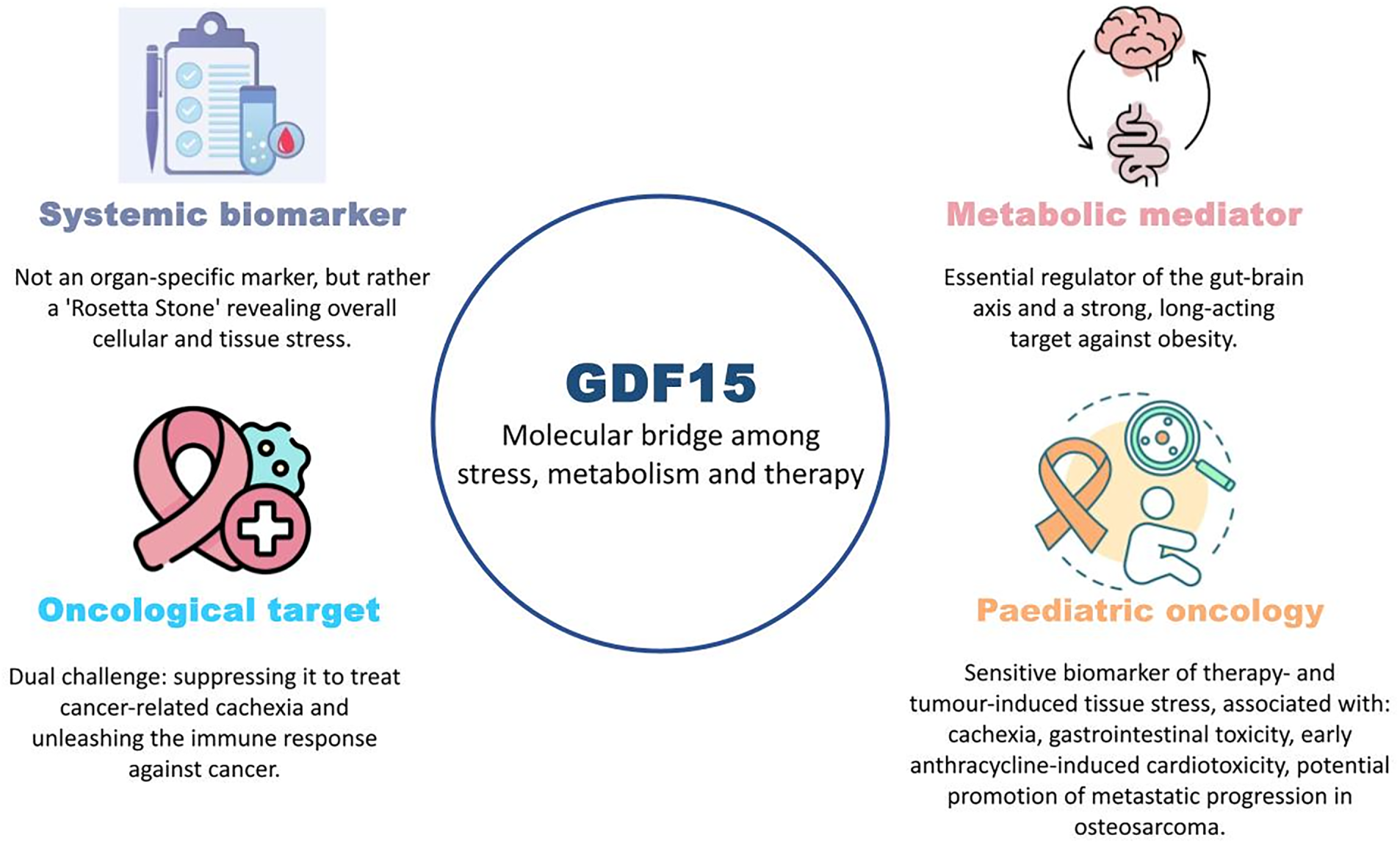
Figure 3: GDF15 at the crossroads of stress, metabolism and therapy. GDF15 functions as a systemic biomarker of tissue stress and as a key mediator of the gut-brain metabolic axis. It is also a dual-edged oncological target, being sensitive to therapy- and tumour-induced injury in paediatric oncology while offering therapeutic potential in cancer cachexia and obesity.
Acknowledgement: The authors license and acknowledge the use of BioRender.com for the creation of figures 1–3.
Funding Statement: The authors received no specific funding for this study.
Author Contributions: The authors confirm contribution to the paper as follows: Conceptualization, Emanuela Anastasi; visualization, Gaia Cicolani, Caterina Cocchi; writing—review and editing, Gaia Cicolani, Emanuela Anastasi, Caterina Cocchi. All authors reviewed and approved the final version of the manuscript.
Availability of Data and Materials: Not applicable.
Ethics Approval: Not applicable.
Conflicts of Interest: The authors declare no conflicts of interest.
Abbreviations
The following abbreviations are used in this manuscript:
| GDF15 | Growth Differentiation Factor 15 |
| TGF-β superfamily | Transforming Growth Factor β |
| GDNF | Glial Cell-Derived Neurotrophic Factor |
| GFRAL | Glial Family Receptor Alpha-Like |
| RET | Receptor Tyrosine Kinase |
| ERK | Extracellular Signal-Regulated Kinase |
| PI3K | Phosphoinositide 3-Kinase |
| AKT | Protein Kinase B |
| PLCγ | Phospholipase C Gamma |
| SMAD | Small Mothers Against Decapentaplegic |
| EMT | Epithelial-Mesenchymal Transition |
| CPT | Camptothecin |
| CRC | Colorectal Cancer |
| NAG-1 | Nonsteroidal Anti-Inflammatory Drug-Activated Gene-1 |
| EpCAM | Epithelial Cell Adhesion Molecule |
| MMP7 | Matrix Metalloproteinase-7 |
| GC | Gastric Cancer |
| HCC | Hepatocellular Carcinoma |
References
1. Siddiqui JA, Pothuraju R, Khan P, et al. Pathophysiological role of growth differentiation factor 15 (GDF15) in obesity, cancer, and Cachexia. Cytokine Growth Factor Rev 2022;64(6):71–83. doi:10.1016/j.cytogfr.2021.11.002. [Google Scholar] [CrossRef]
2. Tian T, Liu M, Little PJ, Strijdom H, Weng J, Xu S. Emerging roles of GDF15 in metabolic and cardiovascular diseases. Research 2025;8(1):0832. doi:10.34133/research.0832. [Google Scholar] [CrossRef]
3. Kim Y, Noren Hooten N, Evans MK. CRP stimulates GDF15 expression in endothelial cells through p53. Mediat Inflamm 2018;2018(2):8278039. doi:10.1155/2018/8278039. [Google Scholar] [CrossRef]
4. Rochette L, Zeller M, Cottin Y, Vergely C. Insights into mechanisms of GDF15 and receptor GFRAL: therapeutic targets. Trends Endocrinol Metab 2020;31(12):939–51. doi:10.1016/j.tem.2020.10.004. [Google Scholar] [CrossRef]
5. Buchholz K, Antosik P, Grzanka D, et al. Expression of the body-weight signaling players: GDF15, GFRAL and RET and their clinical relevance in gastric cancer. J Cancer 2021;12(15):4698–709. doi:10.7150/jca.55511. [Google Scholar] [CrossRef]
6. Xue Y, Zhang Y, Su Y, et al. The implicated role of GDF15 in gastrointestinal cancer. Eur J Clin Invest 2024;54(11):e14290. doi:10.1111/eci.14290. [Google Scholar] [CrossRef]
7. Filippini DM, Romaniello D, Carosi F, et al. The multifaceted role of growth differentiation factor 15 (GDF15a narrative review from cancer Cachexia to target therapy. Biomedicines 2025;13(8):1931. doi:10.3390/biomedicines13081931. [Google Scholar] [CrossRef]
8. Rai AB, Codi JAK, Suchitha GP, et al. Mapping growth differentiation factor-15 (GDF15)-mediated signaling pathways in cancer: insights into its role across different cancer types. Discov Oncol 2025;16(1):386. doi:10.1007/s12672-025-02121-1. [Google Scholar] [CrossRef]
9. Haake M, Haack B, Schäfer T, et al. Tumor-derived GDF-15 blocks LFA-1 dependent T cell recruitment and suppresses responses to anti-PD-1 treatment. Nat Commun 2023;14(1):4253. doi:10.1038/s41467-023-39817-3. [Google Scholar] [CrossRef]
10. Sugiyama K, Starling N, Chau I. New horizons with growth differentiation factor 15 in oncology: from cancer cachexia and tumour immunity to novel therapeutic strategies. Curr Oncol 2025;32(11):604. doi:10.3390/curroncol32110604. [Google Scholar] [CrossRef]
11. Zhou X, Zhou Z, Ju H, et al. Context-dependent role of GDF15: GDF15+ tumor-associated macrophages suppress OSCC progression by enhancing phagocytosis. Adv Sci 2026;13(29):e18525. doi:10.1002/advs.202518525. [Google Scholar] [CrossRef]
12. Dong XC, Xu DY. Research progress on the role and mechanism of GDF15 in body weight regulation. Obes Facts 2024;17(1):1–11. doi:10.1159/000535089. [Google Scholar] [CrossRef]
13. Breit SN, Brown DA, Tsai VW. The GDF15-GFRAL pathway in health and metabolic disease: friend or foe? Annu Rev Physiol 2021;83(1):127–51. doi:10.1146/annurev-physiol-022020-045449. [Google Scholar] [CrossRef]
14. Ignot-Gutiérrez A, Serena-Romero G, Guajardo-Flores D, Alvarado-Olivarez M, Martínez AJ, Cruz-Huerta E. Proteins and peptides from food sources with effect on satiety and their role as anti-obesity agents: a narrative review. Nutrients 2024;16(20):3560. doi:10.3390/nu16203560. [Google Scholar] [CrossRef]
15. Kleinert M, Clemmensen C, Sjøberg KA, et al. Exercise increases circulating GDF15 in humans. Mol Metab 2018;9:187–91. doi:10.1016/j.molmet.2017.12.016. [Google Scholar] [CrossRef]
16. Johann K, Kleinert M, Klaus S. The role of GDF15 as a myomitokine. Cells 2021;10(11):2990. doi:10.3390/cells10112990. [Google Scholar] [CrossRef]
17. Alexa RE, Ceasovschih A, Morăraşu BC, et al. Growth differentiation factor 15 as a link between obesity, subclinical atherosclerosis, and heart failure: a systematic review. Medicina 2026;62(1):132. doi:10.3390/medicina62010132. [Google Scholar] [CrossRef]
18. Mullican SE, Lin-Schmidt X, Chin CN, et al. GFRAL is the receptor for GDF15 and the ligand promotes weight loss in mice and nonhuman primates. Nat Med 2017;23(10):1150–7. doi:10.1038/nm.4392. [Google Scholar] [CrossRef]
19. Lu JF, Zhu MQ, Xie BC, et al. Camptothecin effectively treats obesity in mice through GDF15 induction. PLoS Biol 2022;20(2):e3001517. doi:10.1371/journal.pbio.3001517. [Google Scholar] [CrossRef]
20. Zhang N, Liu N, Zhao G, et al. Effects of a two-week modified ketogenic diet on circulating lipoprotein subclasses, GDF15, and FGF21 in obese adults. J Transl Med 2025;23(1):1244. doi:10.1186/s12967-025-07251-2. [Google Scholar] [CrossRef]
21. Guo X, Asthana P, Zhai L, et al. Artesunate treats obesity in male mice and non-human primates through GDF15/GFRAL signalling axis. Nat Commun 2024;15(1):1034. doi:10.1038/s41467-024-45452-3. [Google Scholar] [CrossRef]
22. Hale C, Véniant MM. Growth differentiation factor 15 as a potential therapeutic for treating obesity. Mol Metab 2021;46(9945):101117. doi:10.1016/j.molmet.2020.101117. [Google Scholar] [CrossRef]
23. Deng W, Zhao Z, Zou T, Kuang T, Wang J. Research advances in fusion protein-based drugs for diabetes treatment. Diabetes Metab Syndr Obes 2024;17:343–62. doi:10.2147/dmso.s421527. [Google Scholar] [CrossRef]
24. Benichou O, Coskun T, Gonciarz MD, et al. Discovery, development, and clinical proof of mechanism of LY3463251, a long-acting GDF15 receptor agonist. Cell Metab 2023;35(2):274–86.e10. doi:10.1016/j.cmet.2022.12.011. [Google Scholar] [CrossRef]
25. Zheng S, Polidori D, Wang Y, et al. A long-acting GDF15 analog causes robust, sustained weight loss and reduction of food intake in an obese nonhuman primate model. Clin Transl Sci 2023;16(8):1431–44. doi:10.1111/cts.13543. [Google Scholar] [CrossRef]
26. Hao X, Zhang Z, Kong J, et al. Hypothesis paper: GDF15 demonstrated promising potential in cancer diagnosis and correlated with cardiac biomarkers. Cardio-Oncology 2024;10(1):56. doi:10.1186/s40959-024-00263-9. [Google Scholar] [CrossRef]
27. Xu H, Zhang Q, Li Q, Gu F, Wang D, Tian Y. The oncogenic role of serum marker GDF15 in promoting colorectal tumorigenesis via EMT and stemness. Stem Cells Int 2026;2026(1):4695395. doi:10.1155/sci/4695395. [Google Scholar] [CrossRef]
28. Hashimoto M, Urabe S, Hata T, et al. GDF15 promotes 5-Fluorouracil and oxaliplatin resistance by promoting stem cell-like phenotype in colorectal cancer. Br J Cancer 2026;135(4):659–73. doi:10.1038/s41416-026-03379-0. [Google Scholar] [CrossRef]
29. Lee J, Kim I, Ryu J, Eling T, Baek SJ. NAG-1/GDF15 as a tumor suppressor in colorectal cancer: inhibition of β-catenin and NF-κB pathways via interaction with EpCAM. Cell Death Dis 2025;16(1):355. doi:10.1038/s41419-025-07695-w. [Google Scholar] [CrossRef]
30. Di Giorgio C, Natalizi N, Sette MR, et al. Tumor-derived LIF promotes GDF15-driven cachexia and adverse outcomes in gastric cancer. Cells 2026;15(4):355. doi:10.3390/cells15040355. [Google Scholar] [CrossRef]
31. Joo M, Kim D, Lee MW, Lee HJ, Kim JM. GDF15 promotes cell growth, migration, and invasion in gastric cancer by inducing STAT3 activation. Int J Mol Sci 2023;24(3):2925. doi:10.3390/ijms24032925. [Google Scholar] [CrossRef]
32. Ling T, Zhang J, Ding F, Ma L. Role of growth differentiation factor 15 in cancer cachexia (Review). Oncol Lett 2023;26(5):462. doi:10.3892/ol.2023.14049. [Google Scholar] [CrossRef]
33. Zhao Z, Zhang J, Yin L, et al. Upregulated GDF-15 expression facilitates pancreatic ductal adenocarcinoma progression through orphan receptor GFRAL. Aging 2020;12(22):22564–81. doi:10.18632/aging.103830. [Google Scholar] [CrossRef]
34. Feng X, Huai Q, Zhang F, et al. Single-cell and spatial analyses of the GDF family in tumors, with a focus on the prognostic and biological role of GDF15 in hepatocellular carcinoma. Cell Biosci 2025;15(1):92. doi:10.1186/s13578-025-01431-9. [Google Scholar] [CrossRef]
35. Lu L, Johnson CH, Khan SA, Irwin ML. GDF15 in the tumor microenvironment: a central mediator of cancer immunometabolism and therapeutic resistance. Cytokine Growth Factor Rev 2026;88(3):47–57. doi:10.1016/j.cytogfr.2026.01.004. [Google Scholar] [CrossRef]
36. Xiong J, Wu G, Ning J, Yan J, Yang J, Kang J. Neutralizing antibody against GDF15 for treatment of cancer-associated cachexia. PLoS One 2024;19(8):e0309394. doi:10.1371/journal.pone.0309394. [Google Scholar] [CrossRef]
37. Groarke JD, Crawford J, Collins SM, et al. Ponsegromab for the treatment of cancer cachexia. N Engl J Med 2024;391(24):2291–303. doi:10.1056/nejmoa2409515. [Google Scholar] [CrossRef]
38. Melero I, Klar K, Leo E. GDF-15 blockade: a multi-directional approach to potentiate cancer immunotherapy and alleviate cancer cachexia. Clin Transl Med 2025;15(4):e70280. doi:10.1002/ctm2.70280. [Google Scholar] [CrossRef]
39. Cohen AA, Picard M. Potential risks of blocking GDF15-based brain energy sensing. J Am Geriatr Soc 2026;74(5):1516–9. doi:10.1111/jgs.70399. [Google Scholar] [CrossRef]
40. Kronenberger DW, Zimmers TA, Ralston RK, Runco DV. Circulating growth differentiation factor 15 (GDF15) in paediatric disease: a systematic review. J Cachexia Sarcopenia Muscle 2025;16(2):e13712. doi:10.1002/jcsm.13712. [Google Scholar] [CrossRef]
41. Runco DV, DiMeglio LA, Vanderpool CP, et al. Growth differentiation factor 15 (GDF15) elevation in children with newly diagnosed cancer. Front Oncol 2023;13:1295228. doi:10.3389/fonc.2023.1295228. [Google Scholar] [CrossRef]
42. Kaya F, Arslan D, Vatansev H, et al. Growth-differentiation factor-15 and tissue doppler imaging in detection of anthracycline-induced cardiomyopathy during therapy of childhood cancers. J Pediatr Hematol Oncol 2016;38(3):e107–12. doi:10.1097/MPH.0000000000000491. [Google Scholar] [CrossRef]
43. Chen G, Wang M, Liu X. GDF15 promotes osteosarcoma cell migration and invasion by regulating the TGF-β signaling pathway. Mol Med Rep 2019;20(5):4262–70. doi:10.3892/mmr.2019.10664. [Google Scholar] [CrossRef]
44. de Zegher F, Díaz M, Villarroya J, et al. The relative deficit of GDF15 in adolescent girls with PCOS can be changed into an abundance that reduces liver fat. Sci Rep 2021;11(1):7018. doi:10.1038/s41598-021-86317-9. [Google Scholar] [CrossRef]
45. Yamaguchi H, Nishiyama M, Tokumoto S, et al. Elevated cytokine, chemokine, and growth and differentiation factor-15 levels in hemorrhagic shock and encephalopathy syndrome: a retrospective observational study. Cytokine 2021;137:155324. doi:10.1016/j.cyto.2020.155324. [Google Scholar] [CrossRef]
Cite This Article
 Copyright © 2026 The Author(s). Published by Tech Science Press.
This work is licensed under a Creative Commons Attribution 4.0 International License , which permits unrestricted use, distribution, and reproduction in any medium, provided the original work is properly cited.
 Downloads
 Citation Tools
