
 Login
Login Register
 Submit a Paper
 Propose a Special lssue
 Open Access
ARTICLE

What Factors Predict Prosocial Behavior during Social Crisis? A Cross-Sectional Study during the COVID-19 Pandemic in Spain
1 Department of Personality, Assessment and Psychological Treatment, University of Granada, Granada, 18071, Spain
2 Mind, Brain, and Behavior Research Center, University of Granada, Granada, 18011, Spain
3 Department of Health Sciences, Valencian International University, Valencia, 46001, Spain
4 Faculty of Health Sciences, Isabel I University, Burgos, 09001, Spain
5 School of Education, University of California, Irvine, CA 92617, USA
6 Psychology Department, Faculty of Education, Campus Duques de Soria, University of Valladolid, Soria, 42004, Spain
* Corresponding Author: Agar Marín-Morales. Email:
(This article belongs to the Special Issue: Mental Health Promotion and Psychosocial Support in Vulnerable Populations: Challenges, Strategies and Interventions)
International Journal of Mental Health Promotion 2025, 27(4), 561-576. https://doi.org/10.32604/ijmhp.2025.058881
Received 23 September 2024; Accepted 14 February 2025; Issue published 30 April 2025
 View Full Text
 Download PDF
Abstract
Background: Prosocial behavior plays a crucial role in improving interpersonal relationships and social well-being, especially in times of crisis. The COVID-19 pandemic caused a severe humanitarian crisis, prompting governments to implement measures such as social confinement. The main objective of the study was to analyze the psychological and sociodemographic variables that may predict prosocial behavior during quarantine. Methods: The sample consisted of 172 participants from Spain, divided into two groups based on whether they reported an increase in prosocial behaviors during quarantine. An online survey was administered to analyze the psychological and sociodemographic variables. Results: Overall, results demonstrate that emotional regulation, morality and age may predict prosocial behavior. Conclusions: Understanding the predictors of prosocial behavior during social crises is crucial for devising effective policies aimed at fostering community resilience and support networks, with particular attention to factors such as the capacity to regulate emotions, morality, and age.Keywords
Feelings, reasoning or empathy are some of the characteristics that differentiate human beings from other living beings; this becomes even more apparent when considering the ability to perform conscious actions whose sole purpose is the well-being of others [1]. This behavior is called prosocial behavior and refers to the set of intentional actions that are carried out for the benefit of others without expecting anything in return [2–4]. Research reveals that there are several types of prosocial behaviors: public, anonymous, altruistic, accommodating, emotional and emergency prosocial behaviors [5,6]. These behaviors help promote positive interpersonal relationships and provide greater personal and social well-being, notably in economic and health crises [2,4,7].
1.1 Prosocial Behavior and Sociodemographic Factors
In recent decades, researchers have focused on identifying the factors that determine prosocial behavior [8]. Numerous research studies show that sociodemographic and psychological factors influence prosocial behavior [9]. Regarding the sociodemographic factors, Auné et al. [10] found gender-related differences. Specifically, they established a positive correlation between female gender and donation behaviors and empathic behaviors. With regard to age, Nantel-Vivier et al. [11] concluded that prosocial behaviors were more common as age increased, especially during adulthood [12]. In terms of political ideology, the general trend suggests that a left-wing tendency is more associated with the expression of concern for others and issues of social equality. Furthermore, this political leaning correlates with greater empathy and a higher propensity for prosocial behaviors [13].
1.2 Prosocial Behavior and Psychological Factors
Numerous researches have highlighted the importance of psychological factors such as empathy, emotional regulation and morality as predictors of prosocial behavior [14–16]. Evidence suggests that empathy, comprising predicting, understanding and experiencing others’ feelings [17], is an important motivating factor for prosocial behavior. Concretely, both abilities to understand others’ points of view and feeling sympathy/concern for others were found to be strongly associated with altruistic spontaneous behaviors and planned to help such as charity or giving [18–21], especially during humanitarian crises.
The research proposes that the relationship between empathy and social behavior is not always direct [15] but rather modulated by emotional regulation [22]. Emotion regulation, defined as the capacity to exert control over an emotional response, may be a core component of empathic processing that can alter responses toward prosocial helping [23]. More precisely, adaptive emotion regulation strategies such as cognitive reappraisal have been found to modulate and sometimes even predict empathic concern (EC) and helping behavior [22,24], while the ability to reduce the ongoing emotion expression was found to be associated with reduced prosociality [24].
Furthermore, it should be mentioned that another variable related to prosocial behavior is the dimension of morality [25]. Concerning moral identity, defined as the importance of morality for our actions, has been positively related to a greater number of prosocial behaviors [25,26]. Likewise, specific moral disengagement mechanisms [27] have been identified as strongly related to violence justification [28]. Therefore, one of the main objectives of the present study is to determine if there is a relation between moral disengagement mechanisms and prosociality.
1.3 Prosocial Behavior during Social Crises
In addition to the factors mentioned before, prosocial behavior can be influenced by the social situation. Economic, environmental, or health crises can profoundly impact this behavior [29]. The literature on historical crises suggests that significant contextual changes require people to adopt a new mindset and adapt accordingly [7]. Specifically, the literature indicates two contrasting trends. One approach suggests that times of social crisis may promote negative or hostile responses and individualistic tendencies [7,30,31]. Conversely, another approach focusing on natural disasters has found that prosocial behaviors such as volunteering experience a significant increase during such crises [32].
Given the above, it is essential to explore predictors of prosocial behavior during COVID-19 quarantine, as these behaviors were crucial to improving the well-being of citizens during this difficult period.
Therefore, the objective of the following study is to evaluate the different prosocial conducts and analyze the psychological and sociodemographic variables related to the performance of prosocial and helping behaviors during COVID-19 quarantine. For this purpose, we evaluated moral disengagement, empathy, and emotion regulation as factors that may predict prosocial behavior. Relative to previous literature, we hypothesise that the prosocial group will demonstrate a greater diversity of prosocial behaviors, higher scores in emotional regulation and empathy [20,22], lower employment of moral disengagement mechanisms [26], older age [12], and a left-wing political orientation [13]. Concerning the characteristics predicting prosocial behavior, we hypothesise that emotional and empathic skills would be characteristic of the prosocial group while reduced emotional regulation and empathic skills, along with moral disengagement mechanisms, would be characteristic of the non-prosocial group.
First, we calculated the sample size with formal power analysis G*Power software (latest ver. 3.1.9.7; Heinrich-Heine-Universität Düsseldorf, Düsseldorf, Germany). Based on a previous study that uncovered a medium effect size [33], an expected power of 0.8, and an assumed alpha-level of 0.05, the sample size should be of a minimum of 80 participants in total (40 per group). The sample was composed of 172 participants, with an average age of 34.21 (SD = 11.41) and an average educational level of 5.07 (SD = 1.38), corresponding to university studies. The sample was composed of 53 men and 118 women. As for political orientation, 107 people self-identified as left-wing (62.2%), 53 as centrist (30.8%) and 12 as right-wing (7.0%). All participated voluntarily and signed the informed consent in accordance with the Organic Law 3/2018 on the Protection of Personal Data and Guarantees of Digital Rights. The study was approved by the Research Ethics Committee of the University of Granada (number: 4576/CEIH/2024). All data collected were anonymized to protect the privacy of participants. The study was conducted in accordance with the Declaration of Helsinki.
3.1 Sociodemographic Variables
Age, educational level and nationality were collected. They were also asked to rank their political orientation on a 10-point scale (1 very left-wing and 10 very right-wing).
Interpersonal Reactivity Index (IRI) [34,35]. The scale measures empathy composed of four dimensions: (a) Fantasy Scale (FS), which assesses the tendency to imaginatively transpose oneself into the feelings of fictional characters (b) Perspective-Taking (PT) Scale, which measures the ability to understand the feelings and viewpoints of others (c) EC Scale, which evaluates feelings of compassion and concern for others and (d) Personal Distress (PD) Scale, which reflects personal feelings of discomfort in response to others’ negative emotions. Cronbach’s α coefficients were α = 0.70 for PT; α = 0.71 for FS, α = 0.67 for EC; α = 0.70 for PD.
Cognitive Emotional Regulation Questionnaire (CERQ) [36]. This questionnaire measures nine cognitive strategies of emotional regulation (adaptive strategies and less adaptive strategies): (a) Self-blame, attributing negative events to oneself, (b) Acceptance, acknowledging the situation without trying to change it, (c) Rumination, repeatedly thinking about negative feelings or events, (d) Positive refocusing, focusing on positive aspects of the situation, (e) Refocus on planning, thinking about ways to deal with the situation, (f) Positive reappraisal, finding meaning in the negative experience, (g) Putting into perspective, considering the event as less important, (h) Catastrophizing, exaggerating the negative aspects of the situation, and (i) Blaming others, attributing responsibility for the situation to others. Cronbach’s α coefficients were α = 0.60 for Self-blame, α = 0.63 for Acceptance, α = 0.73 for Rumination, α = 0.89 for Positive refocusing, α = 0.79 for Refocus on planning, α = 0.86 for Positive reappraisal, α = for 0.82 Putting into perspective, α = for 0.71 Catastrophizing and α = 0.78 for Blaming others.
Difficulties in Emotion Regulation Scale (DERS) [37]. This scale assesses different features of the emotion regulation process that may have several difficulties associated, including (a) non-acceptance, non-acceptance of emotional responses, (b) goals, difficulties in goal-directed behaviors when distressed, (c) impulse, difficulties in controlling impulsive behaviors when the person is distressed, (d) strategies, limited access to emotion regulation strategies perceived as effective, (e) awareness, lack of emotional awareness, and (f) clarity, lack of emotional clarity. Cronbach’s α coefficients were α = 0.93 for total, α = 0.80 for impulse, α = 0.88 for strategies, α = 0.87 for non-acceptance; α = 0.81 for goals, α = 0.68 for awareness, α = 0.78 for clarity.
Moral disengagement questionnaire [38,39] in its Spanish version was validated by Rubio-Garay et al. [40]. It is a questionnaire composed of 36 items that measures the inclination to use the different moral disengagement mechanisms established by Bandura [39]: moral justification (“It is right to come to blows in order to protect friends”), euphemistic language (‘‘Pushing is just a way of joking”), advantageous comparison (“Stealing a little money is not at all serious if you think of the large sums of money that others steal”), displacement of responsibility (“When young people live in a dangerous neighbourhood you can’t reproach them for being aggressive”), diffusion of responsibility (“You can’t blame a gang member for the damage caused by the gang”), distortion of consequences (“Telling small lies is not so serious since they don’t hurt anyone”), attribution of blame (“People who neglect their things are to blame if they are stolen”) and dehumanisation of the victim (“Some people deserve to be treated like animals”). Cronbach’s α coefficients ranged from 0.82 to 0.93.
Prosocial behavior during quarantine. Participants had to answer the following questions: “Has your support for citizenship increased during the COVID-19 crisis?” (Yes/No). If they answered Yes, they were asked, “In what ways has your support for citizenship increased?” If they answered No, they were asked: “Why has your support for citizenship not increased?”.
The Prosocial Tendencies Measure (PTM) [41]. This is a 23-item self-report that assesses six different prosocial behaviors: compliant (Helping others when directly requested or when complying with a social norm: “When people ask me to help them, I don’t hesitate”), public (Helping others in situations where the helping act is visible to others, and there is public recognition involved: “I can help others best when people are watching me”), anonymous (Helping others without revealing one’s identity, often in situations where no recognition is expected or given: “I tend to help needy others most when they do not know who helped them”), dire (Helping others in urgent or emergency situations where immediate assistance is required: “I tend to help people who hurt themselves badly”), emotional (Helping others in response to their emotional distress or suffering: “I tend to help others particularly when they are emotionally distressed”), and altruistic (Helping others with no expectation of personal gain, driven by a sense of moral or selfless motivation: “I think that one of the best things about helping others is that it makes me look good”). The scoring is according to a 5 Likert scale from 1 (Does not describe me at all) to 5 (Describes me greatly). Cronbach’s α coefficients ranged from 0.61 to 0.80.
Prosociality Scale [42]. This scale consists of 16 items and allows measuring prosocial behaviors in adolescents and adults by means of a total score. This questionnaire also allows discriminating subjects who are mostly prosocial from those who are not. The scale measures prosocialness as a trait. It includes items such as “I help immediately those who are in need” and “I am willing to make my knowledge and abilities available to others.” Cronbach’s α was 0.91.
Due to the emergence of the pandemic and the declaration of the State of Alert by the Spanish Government, the sample was assessed through the Google form application. Questionnaires were administered during the second month of quarantine in Spain (from 1st April to 1st May, 2020), which was distributed via social media. The total duration to complete the tests was approximately 30 min. Regarding the order in the administration of the tests, participants filled out sociodemographic data first, followed by an empathy test, emotional regulation tests, morality and prosocial behavior tests.
Data were analyzed using Statistical Package for the Social Sciences, version 25 (SPSS; Armonk, NY, USA). First, a descriptive analysis of the sociodemographic, psychological, and prosocial behavior-quarantine variables of the sample was performed. Second, all participants were divided into two groups according to the item: “Prosocial behavior during quarantine”. To check whether there were differences between the prosocial group and the non-prosocial group, a student’s t-test analysis of means difference was performed, in which dependent variables were psychological and sociodemographic test, and the independent variable was the performance of prosocial behaviors during quarantine (Yes/No). Finally, to identify whether psychological variables predicted prosocial behavior during COVID-19 quarantine, we conducted a direct discriminant analysis method. The dependent variable was the performance of prosocial behaviors during quarantine (Yes/No). The independent variables were included based on the results of the student’s t-test. To optimize the prediction with the least number of variables. Wilks’s lambda was used to test the significance of the discriminant model. Coefficients were produced for all predictors, and the higher the coefficient, the more that item contributed to discriminating prosocial-non-prosocial participants. A p-value less than 0.05 was considered as statistical significance.
4.1 Characteristics of Prosocial Behaviors
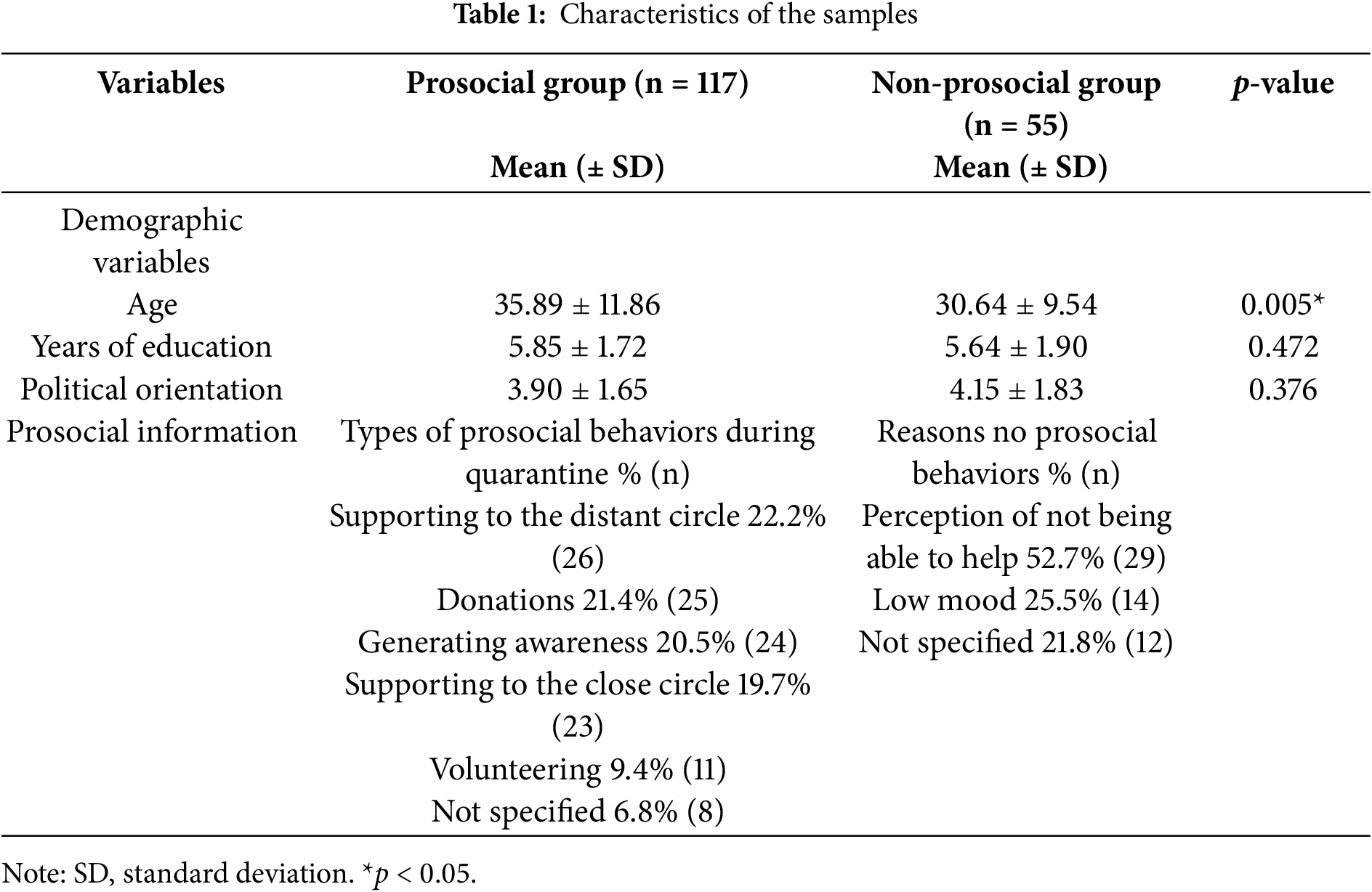
Descriptive analysis (Table 1) revealed that the types of prosocial behavior performed during the quarantine were: Generating awareness (20.5%), Supporting the close circle (19.7%), Supporting the distant circle (22.2%), Volunteering (9.4%); Donations (21.4%), and Not specified (6.8%). On the other hand, the reasons why the non-prosocial group did not carry out prosocial behaviors during the quarantine were the perception of not being able to help (52.7%), Low mood (25.5%), and Not specified (21.8%).
4.2 Between-Group Differences in Sociodemographic and Psychological Variables
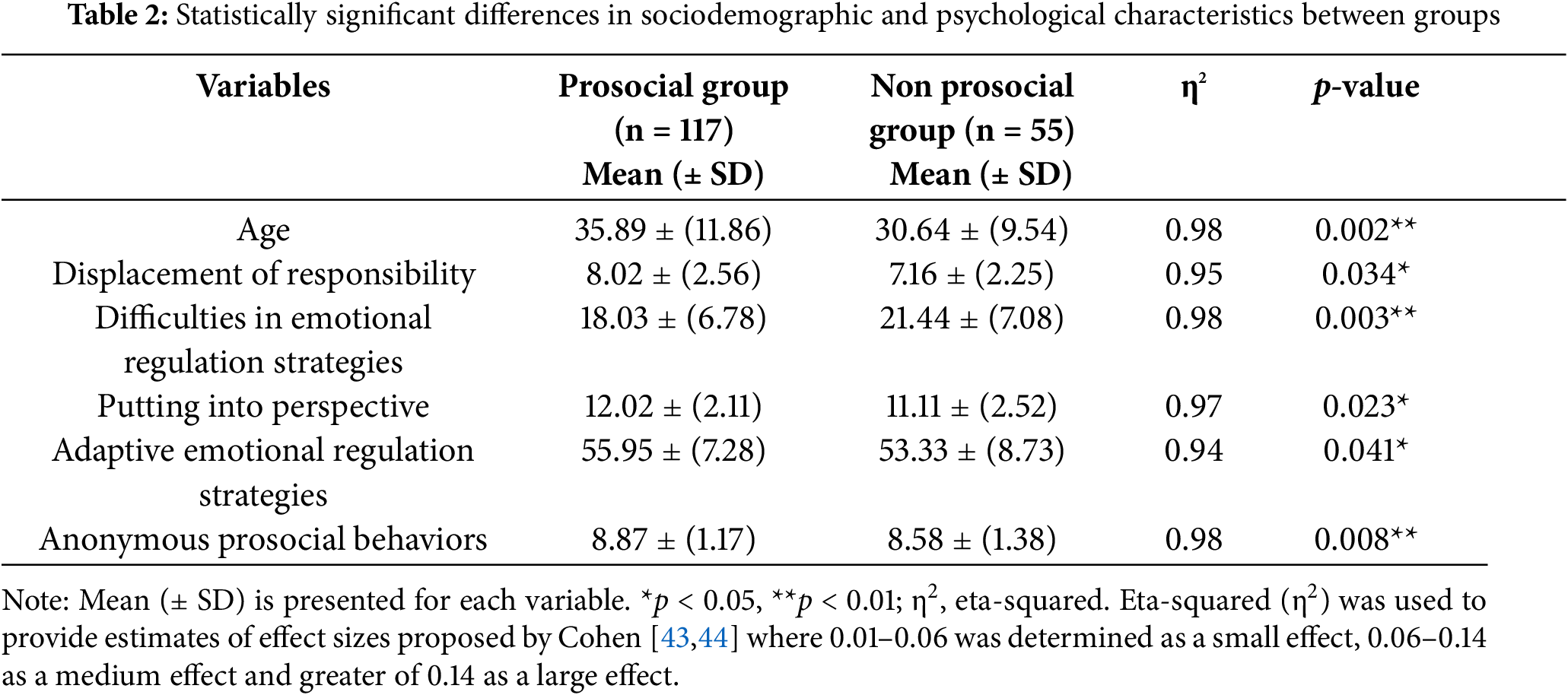
The student’s t-test means analysis revealed significant differences (Table 2) between groups in age (p = 0.002), anonymous prosocial behaviors (p = 0.008), moral disengagement mechanism of responsibility displacement (p = 0.034); adaptive emotional regulation strategies (p = 0.041); and difficulties to access emotional regulation strategies (p = 0.003). Specifically, the prosocial group was characterised by being older than the non-prosocial group. In addition, the prosocial group used more adaptive emotional regulation strategies, a moral disengagement mechanism of responsibility displacement, and prosocial behavior from anonymity to a greater extent.
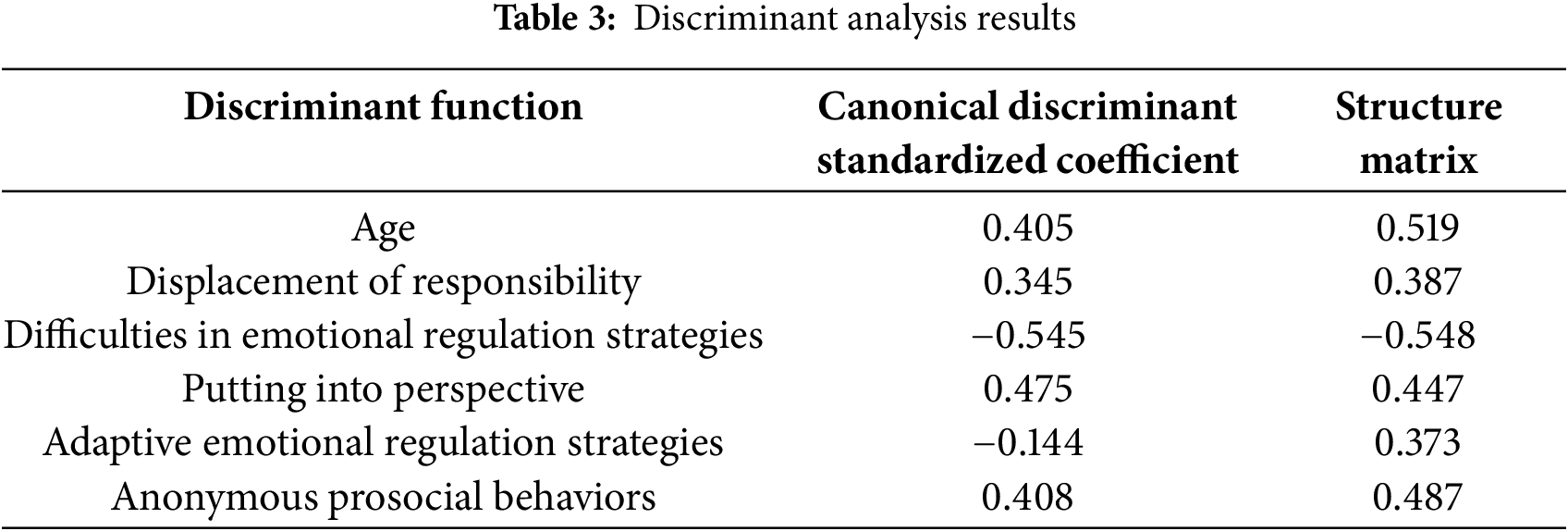
In relation to discriminant analysis, Wilks’ was significant (χ2 [6] = 27,692; p < 0.001), showing that the comparison groups have different averages in the discriminant variables, i.e., the independent variables have discriminant power between the groups. According to Wilks’ Lambda, all predictor variables were statistically significant (p < 0.05). To determine which variables contributed to explaining prosocial behavior during quarantine, we analyzed the standardised canonical discriminant function coefficients (Table 3). The variables with the highest discriminant power are: difficulties in accessing emotional regulation strategies (−0.545), followed by putting into perspective (0.475), anonymity (0.408), age (0.405), displacement of responsibility (0.345) and adaptive strategies (−0.144). In relation to the Structure matrix (Table 3), results showed, on one hand, that there was a direct correlation between prosocial behavior during quarantine and age, anonymous prosocial behavior, displacement of responsibility, and adaptive emotional regulation strategies. On the other hand, an inverse correlation was found between difficulties in accessing emotional regulation strategies and prosocial behavior. Therefore, the variables with the highest discriminant power are the emotional variables.
With regard to the location of group centroids from discriminant function analysis, the results indicated that, on average, the non-prosocial group is located in the negative scores of the independent variables (−0.616), and the prosocial group is located in the positive scores (0.289). Hence, it can be indicated that the independent variables have the ability to classify between the prosocial group and the non-prosocial group according to the score on the test.
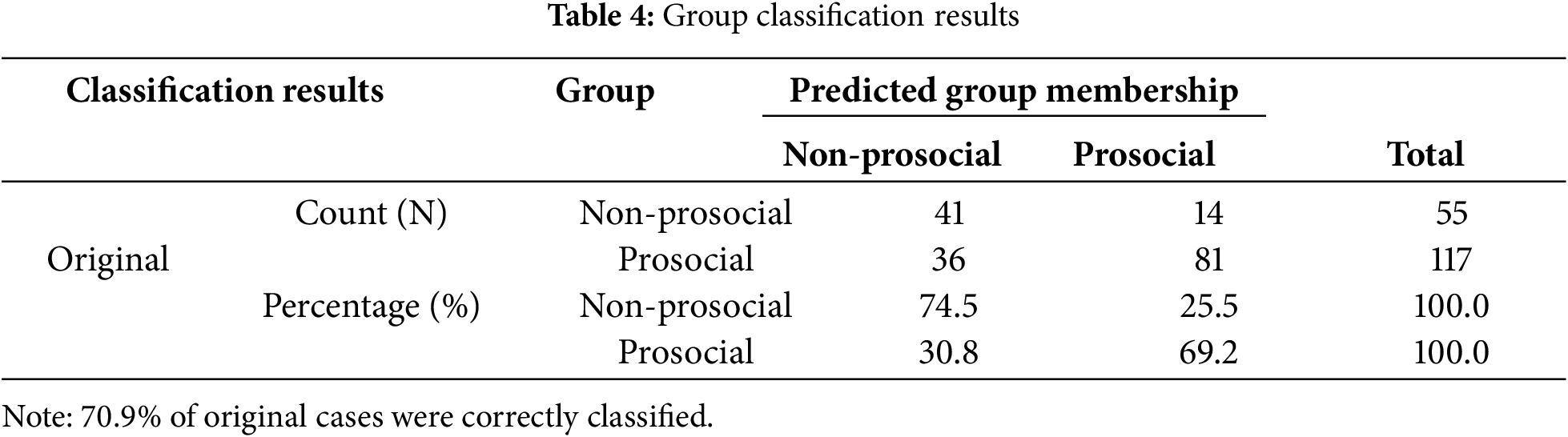
Finally, the analyzes in the accuracy of the function to discriminate both groups (Table 4) indicated that 70.9% of the sample has been correctly classified: 74.5% of the non-prosocial group, as well as 69.2% of the prosocial group. Consequently, the variables used as predictors could be useful to discriminate between people who will carry out prosocial behavior during health/economic crises and people who won’t.
The main objective was to study the psychological and sociodemographic variables (age, morality, emotional regulation, empathy) related to prosocial behavior. Unlike other previous crises, the COVID-19 pandemic was characterized by prolonged isolation due to mandatory lockdowns, pervasive media coverage highlighting infection rates and death tolls, and stress related to the rapid development and unequal distribution of vaccines [45–48]. These single factors in combination probably influenced prosocial behavior. [49,50].
The results indicated that age, anonymous prosocial behaviors, moral disengagement mechanism of responsibility displacement, and adaptive emotional regulation strategies showed a higher discriminant saturation in the prosocial group. Likewise, the non-prosocial group presented a higher discriminant saturation in difficulties in accessing emotional regulation strategies.
Results indicate that the majority of the evaluated sample engaged in performing prosocial behavior during the quarantine, demonstrating an increase in prosocial behaviors during social crises [32]. Prosocial behaviors performed were focused on donations (medical supply, economic, food), generating awareness (compliance with rules, showing empathy and solidarity in various contexts in the face of the pandemic situation and generating social awareness in social networks), supporting the distant circle (emotional/economic support to neighbours and vulnerable populations), supporting the close circle (emotional support to family and/or friends) and volunteering (support to associations, charity canteens, Non-Governmental Organizations (NGOs) or companies regardless of the professional word performed.
Concerning the psychological differences between groups, the results indicate that compared to the non-prosocial group, the prosocial group showed less difficulty in using emotional regulation strategies, greater use of the adaptive strategy of putting into perspective, greater tendency to help from anonymity, higher age, greater score in displacement of responsibility, and greater number of adaptive emotional regulation strategies.
According to age, it is presented as a good predictor variable of prosocial behavior. Our results are in line with previous studies [51–53]. Studies revealed that prosocial behavior in terms of financial generosity is higher in older adults than in younger adults [51], and that this increase in prosocial behavior was associated with raised emotional empathy [54].
In relation to the moral disengagement mechanism of displacement of responsibility (the act of concealing, not assuming or minimising the behavior performed through the attribution of responsibility to other people or a legitimate authority) [55], it has been found that it also has predictive power in prosocial behavior. Nevertheless, this result does not support previous literature or our hypothesis. Displacement of responsibility has been related to the justification of violence in aggressive individuals thus far [56,57]. Specifically, cyber-aggression or cyberbullying, bullying, intimate partner violence, etc. [28,58–60]. Likewise, it is connected with a reduced likelihood of performing prosocial behaviors [61].
In contrast to prior literature and in a novel way, the displacement of responsibility predicted prosocial behavior in the present global pandemic social crises. This is a situation of vulnerability that affects everyone equally and negatively in all aspects (health, economy, education, work, etc). We consider that the increase in prosocial behavior in catastrophic situations or disasters may be understood as a sense of social responsibility in the face of disaster and vulnerability [62]. Moreover, in these cases, prosocial behavior is promoted by governmental institutions and organized social groups [63], through the mass media every day during COVID-19. Thus, it has an evident role in promoting and directing prosocial behavior. Besides, our results could be explained in relation to the people’s psychological state during quarantine: People received massive information through television and social networks about the suffering caused by COVID-19 worldwide, added to the death of family and friends [64–67]. In this way, such moral disengagement could be related to the condition of vulnerability in which we found ourselves during quarantine: 1) arousing greater empathy towards disadvantaged people in the prosocial group [68] and, 2) orienting help to others who find themselves in emotionally evocative circumstances [41].
On the other hand, uncertainty, hopelessness, or helplessness during quarantine [67,69] would be related to the perception expressed by the non-prosocial group as “not being able to do anything about the situation”. This is the most frequent reason for not performing prosocial behaviors during the quarantine. These results may be related to the absence of differences in some variables between one group and the other. However, according to the objectives of this study, we found variables that had a very strong impact and predicted prosocial behavior or may inhibit it. At the same time, and as we have mentioned above, the press coverage during the pandemic has had a very strong impact on the population. Alarmism and sensationalism have been common, coinciding with an explosion in the number of infections and causing fear [70–72]. This is the cause of catastrophism in crises that can demobilize the actions of a large part of the population [72,73].
Regarding the variables related to emotional dysregulation, the results would suggest that individuals with difficulties in accessing emotional regulation strategies did not carry out prosocial behaviors during quarantine. These findings are supported by the study of Lockwood et al. [22], where they found that a maladaptive regulation strategy (expressive suppression) is negatively associated with prosocial inclinations. In addition, Park et al. [74] found that emotional dissonance was related to less sympathy for the feelings of others and less willingness to help people. Similar to the moral disengagement mechanism, the influence of social media during the lockdown may have played a role in this dynamic; while it provided a platform for maintaining connections and could positively affect prosocial behavior [75], the potential for negative emotional contagion in digital contexts might have further hindered the ability of individuals to engage in prosocial actions [76].
Also, these findings on emotional regulation as a motivating factor for prosocial behavior are in consonance with the theory of Eisenberg et al. [77], who defend the predictive power of the capacity to regulate emotions in prosocial behavior. On the other hand, people with low emotional regulation are more likely to exhibit antisocial rather than prosocial behavior in an emotional situation.
This last point underscores the need to explore both prosocial and antisocial responses in crisis contexts. Recent research has shown that antisocial behaviors can increase during crises due to perceived threats (e.g., health, economic threats) [78]. More concretely, studies have shown that individuals with antisocial tendencies, including low empathy and high levels of dark triad traits, are less likely to comply with COVID-19 containment measures and engage in fewer prosocial behaviors [79–81]. These findings suggest that antisocial tendencies are crucial for understanding how individuals behave during social crises and that they might be mediated by variables such as empathy or emotion regulation.
In turn, our results indicate that another predictor of prosocial behavior related to emotional regulation strategies is the mechanism of putting into perspective, which is focused on re-evaluation, diminishing and relativizing the severity of the event. This specific result could be related to studies about hope in the presence of catastrophe [82–84], which would involve experiencing positive effects to keep engagement and motivation in overwhelming situations [82,83].
Finally, regarding anonymous prosocial behavior, referring to the prosocial motivation or tendency based on helping others without anyone knowing about the help [41], the results indicate that it is a good predictor of prosocial behavior. The literature supports this result, indicating that this prosocial propensity is related to empathy, being understanding and socially responsible, being motivated by the sympathy of others and internalised norms [85]. Along the same line, other studies showed that more altruistic individuals under the anonymity condition offered higher amounts of money [86,87]. Our outcomes, along with previous literature, evidence that individual altruistic acts cannot be fully explained by the possibility of reciprocity. Moreover, altruistic motivation from anonymity may be related to the avoidance of criticism [88] and to avoid being seen as seeking the approval or respect of others when engaging in prosocial behavior [41].
6 Limitations and Implications
This study has several limitations. Firstly, it was carried out with a Spanish population, so the generalizability of the results could be limited to other cultures and countries. However, we consider that they could be generalizable since the findings replicate the results found in previous studies from different countries [22,89,90]. Second, self-report measures have been used, which may lead to social desirability bias [91,92]. Nevertheless, the instruments selected in our study count with literature supporting their psychometric validity. Thirdly, this study is cross-sectional, providing differences in prosocial behavior during a specific point in time, which makes it difficult to perform causal relationships between variables. In addition, this could be the reason why we have not found a relationship between prosocial behavior and other variables such as political orientation and empathy. Fourth, the political orientation variable may have been limited, as the literature shows it is associated with other variables related to socioeconomic status (SES), such as educational level, income, access to resources, and environmental characteristics, among others, which were not considered in this study. Fifth, the majority of the sample is composed of women, which may limit the generalizability of the results. Bearing this in mind and although it would be desirable to know more predictor variables, we consider our results a good approximation. However, it would be relevant to replicate these results in other health/economic crises, as well as to perform longitudinal studies to analyze whether changes in prosocial behavior and associated psychological variables are observed in crisis times. Therefore, future studies could develop emotion regulation and empathy tests specifically related to catastrophic situations [82–84]. Despite this limitation, the present study used the emotional regulation and empathy tests most commonly employed in the literature as a preliminary approach, given that studies focused on adults and prosocial behavior are very scarce, with the majority focusing on children and adolescents [93]. In addition, future studies should explore the influence of SES, along with political orientation, on prosocial behavior in greater depth, both individually and collectively. Lastly, future studies should examine the interaction between gender and prosocial behavior, as well as the related variables.
Despite these limitations, this study has several implications. At the psychological level, emotional support during social crises is needed, particularly in the promotion of adaptive emotional regulation strategies. We have shown that the non-prosocial group showed difficulties in emotional regulation, which may have been the reason why they did not engage in prosocial behaviors. At the educational and social level, it would be necessary to incorporate workshops in schools and colleges to promote emotional skills related to prosocial behavior, taking age into account. A relevant example is the Virtual Hero Program, which improved emotional regulation and promoted prosocial behavior in Colombian adolescents during COVID-19 isolation [94]. Its success highlights the potential of structured interventions to enhance well-being, solidarity, and prosocial actions in crisis contexts. Taking into account the findings of this study and the existing literature, it is evident that improving prosocial behaviors requires focusing on empathy [95], secure attachment [96], and emotional regulation [97]. Based on this, we propose designing an intervention program targeting these aspects, alongside the development of public policies that prioritize mental health, emotional education, and community solidarity to effectively promote prosocial behavior.
Predictors of prosocial behavior have been found to be age, displacement of responsibility, adaptive strategies of emotional regulation, and anonymous prosocial motivation. The findings would indicate that there has been a significant increase in prosocial behaviors during quarantine. At the same time, prosocial behavior can be encouraged and trained through the psychological variables found. Studies showed that prosocial behavior and altruism are essential aspects of facing the current social crisis caused by COVID-19. It is relevant to highlight that disasters can hardly be predicted, but moral and emotional education can be worked on. To enhance the effectiveness of educational and community programs aimed at promoting prosocial behavior, it is essential to integrate various predictive factors, such as age, adaptive emotional regulation strategies, and prosocial motivation. In particular, it is important to consider and adapt the intervention to the age of the participants and their levels of emotional regulation and moral characteristics. By personalizing the intervention in this way, we can ensure its effectiveness across various demographic groups.
Acknowledgement: We would like to give special thanks to all women and men who participated in the study during the COVID-19 crisis, particularly during the quarantine period, a time of profound concern and hardship for many. We would also like to thank Professor Miguel Pérez García, for motivating and supporting the realization of this study.
Funding Statement: This research was conceptualized and designed by A.M.M. at the onset of the COVID-19 lockdown in Spain, driven by both concern over the situation and an appreciation for the support and solidarity demonstrated by the population during those challenging times. A.M.M. was initially supported by the Ministry of Education, Culture and Sport (Predoctoral Contract University Faculty Training Program: FPU15/04335) and later by the Spanish Public Administration “Ministerio de Universidades” and the European Union through the “NextGenerationEU” (Postdoctoral contract Margarita Salas). The authors received no specific funding for this study.
Author Contributions: The authors confirm contribution to the paper as follows: study conception and design: Agar Marín-Morales; data collection: Agar Marín-Morales; analysis and interpretation of results: Agar Marín-Morales, Carmen Fernández-Fillol, Sofia Amaoui, Sandra Rivas-García; draft manuscript preparation: Agar Marín-Morales, Carmen Fernández-Fillol, Sofia Amaoui, Gustavo Carlo, Sandra Rivas-García. All authors reviewed the results and approved the final version of the manuscript.
Availability of Data and Materials: The authors declare the data used in this study are available.
Ethics Approval: All participated voluntarily and signed the informed consent in accordance with the Organic Law 3/2018 on the Protection of Personal Data and Guarantees of Digital Rights. The study was approved by the Research Ethics Committee of the University of Granada (number: 4576/CEIH/2024). All data collected were anonymized to protect the privacy of participants. The study was conducted in accordance with the Declaration of Helsinki.
Conflicts of Interest: The authors declare no conflicts of interest to report regarding the present study.
References
1. Jensen K. Prosociality. Curr Biol. 2016;26(16):R748–52. [Google Scholar] [PubMed]
2. Caprara GV, Kanacri BPL, Gerbino M, Zuffianò A, Alessandri G, Vecchio G, et al. Positive effects of promoting prosocial behavior in early adolescence: evidence from a school-based intervention. Int J Behav Dev. 2014;38(4):386–96. doi:10.1177/0165025414531464. [Google Scholar] [CrossRef]
3. Inglés C, Benavides G, Redondo J, García-Fernández JM, Ruiz-Esteban C, Estévez C, et al. Conducta prosocial y rendimiento académico en estudiantes españoles de Educación Secundaria Obligatoria. An Psicol. 2009;25:93–101. (In Spanish). [Google Scholar]
4. Martín GL. Crisis y comportamientos prosociales; el altruismo; 2015 [cited 2025 Feb 13]. Available from: http://hdl.handle.net/2445/65144. (In Spanish). [Google Scholar]
5. Balabanian C, Lemos V, Rubilar JV. Apego percibido y conducta prosocial en adolescentes. Rev Colomb Cienc Soc. 2015;6(2):18. (In Spanish). [Google Scholar]
6. Carlo G, Padilla-Walker L. Adolescent’s prosocial behaviors through a multidimensional and multicultural lens. Child Dev Perspect. 2020;14(4):265–72. doi:10.1111/cdep.12391. [Google Scholar] [CrossRef]
7. Alonso-Ferres M, Navarro-Carrillo G, Garrido-Macías M, Moreno-Bella E, Valor-Segura I. Connecting perceived economic threat and prosocial tendencies: the explanatory role of empathic concern. PLoS One. 2020;15(5):e0232608. doi:10.1371/journal.pone.0232608. [Google Scholar] [PubMed] [CrossRef]
8. Grant AM, Mayer DM. Good soldiers and good actors: prosocial and impression management motives as interactive predictors of affiliative citizenship behaviors. J Appl Psychol. 2009;94(4):900. doi:10.1037/a0013770. [Google Scholar] [PubMed] [CrossRef]
9. Garaigordobil M. Conducta prosocial: el papel de la cultura, la familia, la escuela y la personalidad. Rev Mex Invest Psicol. 2014;6:146–57. (In Spanish). [Google Scholar]
10. Auné S, Abal F, Attorresi H. Conducta prosocial y estereotipos de género/Prosocial behavior and gender stereotypes. Praxis. 2017;27(17):7–19. (In Spanish). [Google Scholar]
11. Nantel-Vivier A, Kokko K, Caprara GV, Pastorelli C, Gerbino MG, Paciello M, et al. Prosocial development from childhood to adolescence: a multi-informant perspective with Canadian and Italian longitudinal studies. J Child Psychol Psychiatry. 2009;50(5):590–8. doi:10.1111/j.1469-7610.2008.02039.x. [Google Scholar] [PubMed] [CrossRef]
12. Hubbard J, Harbaugh WT, Srivastava S, Degras D, Mayr U. A general benevolence dimension that links neural, psychological, economic, and life-span data on altruistic tendencies. J Exp Psychol Gen. 2016;145(10):1351. doi:10.1037/xge0000209. [Google Scholar] [PubMed] [CrossRef]
13. Simić A, Sacchi S, Pagliaro S, Pacilli MG, Brambilla M. Bringing us closer together: the influence of national identity and political orientation on COVID-19-related behaviors. Front Psychol. 2022;13:795654. doi:10.3389/fpsyg.2022.795654. [Google Scholar] [PubMed] [CrossRef]
14. Mestre MV, Tur AM, Samper P, Nácher MJ, Cortés MT. Estilos de crianza en la adolescencia y su relación con el comportamiento prosocial. Rev Latinoam Psicol. 2007;39(2):211–25. (In Spanish). [Google Scholar]
15. Eisenberg N, Eggum ND, Di Giunta L. Empathy-related responding: associations with prosocial behavior, aggression, and intergroup relations. Soc Issues Policy Rev. 2010;4(1):143–80. doi:10.1111/j.1751-2409.2010.01020.x. [Google Scholar] [PubMed] [CrossRef]
16. Hertz SG, Krettenauer T. Does moral identity effectively predict moral behavior?: a meta-analysis. Rev Gen Psychol. 2016;20(2):129–40. doi:10.1037/gpr0000062. [Google Scholar] [CrossRef]
17. Batson CD. These things called empathy: eight related but distinct phenomena. In: Decety J, Ickes W, editors. Social neuroscience. The social neuroscience of empathy. MIT Press; 2009. p. 3–15. [Google Scholar]
18. Einolf CJ. Empathic concern and prosocial behaviors: a test of experimental results using survey data. Soc Sci Res. 2008;37(4):1267–79. doi:10.1016/j.ssresearch.2007.06.003. [Google Scholar] [PubMed] [CrossRef]
19. Dickert S, Sagara N, Slovic P. Affective motivations to help others: a two-stage model of donation decisions. J Behav Decis Mak. 2011;24(4):361–76. doi:10.1002/bdm.697. [Google Scholar] [CrossRef]
20. Verhaert GA, Van den Poel D. Empathy as added value in predicting donation behavior. J Bus Res. 2011;64(12):1288–95. doi:10.1016/j.jbusres.2010.12.024. [Google Scholar] [CrossRef]
21. Decety J, Bartal IBA, Uzefovsky F, Knafo-Noam A. Empathy as a driver of prosocial behavior: highly conserved neurobehavioral mechanisms across species. Philos Trans R Soc Lond B Biol Sci. 2016;371(1686):20150077. doi:10.1098/rstb.2015.0077. [Google Scholar] [PubMed] [CrossRef]
22. Lockwood PL, Seara-Cardoso A, Viding E. Emotion regulation moderates the association between empathy and prosocial behavior. PLoS One. 2014;9(5):e96555. doi:10.1371/journal.pone.0096555. [Google Scholar] [PubMed] [CrossRef]
23. Decety J. The neurodevelopment of empathy in humans. Dev Neurosci. 2010;32(4):257–67. doi:10.1159/000317771. [Google Scholar] [PubMed] [CrossRef]
24. Lebowitz MS, Dovidio JF. Implications of emotion regulation strategies for empathic concern, social attitudes, and helping behavior. Emotion. 2015;15(2):187. doi:10.1037/a0038820. [Google Scholar] [PubMed] [CrossRef]
25. Frimer JA, Walker LJ. Reconciling the self and morality: an empirical model of moral centrality development. Dev Psychol. 2009;45(6):1669–81. doi:10.1037/a0017418. [Google Scholar] [PubMed] [CrossRef]
26. Bermejo F, Muller F. La identidad moral y su relación con las conductas prosociales en la adultez emergente. Universidad De Belgrano. Facultad De Humanidades. 2014 [cited 2025 Feb 13]. Available from: https://repositorioslatinoamericanos.uchile.cl/handle/2250/5169852(In Spanish). [Google Scholar]
27. Bandura A. Manual for constructing moral disengagement scales; 2017. [cited 2025 Feb 13]. Available from: https://albertbandura.com/pdfs/MANUAL%20FOR%20CONSTRUCTING%20MORAL%20DISENGAGEMENT%20SCALES.pdf. [Google Scholar]
28. Rubio-Garay F, Carrasco MA, Amor PJ. Aggression, anger and hostility: evaluation of moral disengagement as a mediational process. Scand J Psychol. 2016;57(2):129–35. doi:10.1111/sjop.12270. [Google Scholar] [PubMed] [CrossRef]
29. Tabernero C, Arenas A, Cuadrado E, Luque B. Incertidumbre y orientación hacia los errores en tiempos de crisis. La importancia de generar confianza fomentando la eficacia colectiva. Pap Psicol. 2014;35:107–14. (In Spanish). [Google Scholar]
30. Fritsche I, Jugert P. The consequences of economic threat for motivated social cognition and action. Curr Opin Psychol. 2017;18:31–6. doi:10.1016/j.copsyc.2017.07.027. [Google Scholar] [PubMed] [CrossRef]
31. Sánchez-Rodríguez Á, Jetten J, Willis G, Rodríguez-Bailón R. High economic inequality makes us feel less wealthy. Int Rev Soc Psychol. 2019;32(1). doi:10.5334/irsp.333. [Google Scholar] [CrossRef]
32. Dass-Brailsford P, Thomley R, de Mendoza AH. Paying it forward: the transformative aspects of volunteering after Hurricane Katrina. Traumatology. 2011;17(1):29. doi:10.1177/1534765610395619. [Google Scholar] [CrossRef]
33. Bailey PE, Brady B, Ebner NC, Ruffman T. Effects of age on emotion regulation, emotional empathy, and prosocial behavior. J Gerontol B Psychol Sci Soc Sci. 2020;75(4):802–10. doi:10.1093/geronb/gby084. [Google Scholar] [PubMed] [CrossRef]
34. Davis MH. A multidimensional approach to individual difference in empathy. JSAS Cat Sel Doc Psychol. 1980;10:85. [Google Scholar]
35. Pérez-Albéniz A, Paúl J, Etxeberría J, Montes MP, Torres E. Adaptación de interpersonal reactivity index (IRI) al español. Psicothema. 2003;15:267–72. (In Spanish). [Google Scholar]
36. Garnefski N, Kraaij V, Spinhoven P. Negative life events, cognitive emotion regulation and emotional problems. Pers Individ Dif. 2001;30(8):1311–27. doi:10.1016/S0191-8869(00)00113-6. [Google Scholar] [CrossRef]
37. Gratz KL, Roemer L. Multidimensional assessment of emotion regulation and dysregulation: development, factor structure, and initial validation of the difficulties in emotion regulation scale. J Psychopathol Behav Assess. 2004;26(1):41–54. doi:10.1023/B:JOBA.0000007455.08539.94. [Google Scholar] [CrossRef]
38. Bandura A, Barbaranelli C, Caprara GV, Pastorelli C. Mechanisms of moral disengagement in the exercise of moral agency. J Pers Soc Psychol. 1996;71(2):364. doi:10.1037/0022-3514.71.2.364. [Google Scholar] [CrossRef]
39. Bandura A. Selective moral disengagement in the exercise of moral agency. J Moral Educ. 2002;31(2):101–19. doi:10.1080/0305724022014322. [Google Scholar] [CrossRef]
40. Rubio-Garay F, Amor PJ, Carrasco MA. Dimensionality and psychometric properties of the Spanish version of the Mechanisms of Moral Disengagement Scale (MMDS-S). Rev Psicopatol Psicol Clin. 2017;22(1):43–54. (In Spanish). doi:10.5944/rppc.vol.22.num.1.2017.16014. [Google Scholar] [CrossRef]
41. Carlo G, Randall BA. The development of a measure of prosocial behaviors for late adolescents. J Youth Adolesc. 2002;31(1):31–44. doi:10.1023/A:1014033032440. [Google Scholar] [CrossRef]
42. Caprara GV, Steca P, Zelli A, Capanna C. A new scale for measuring adults’ prosocialness. Eur J Psychol Assess. 2005;21(2):77–89. doi:10.1027/1015-5759.21.2.77. [Google Scholar] [CrossRef]
43. Cohen J. Eta-squared and partial eta-squared in fixed factor ANOVA designs. Educ Psychol Meas. 1973;33(1):107–12. doi:10.1177/001316447303300111. [Google Scholar] [CrossRef]
44. Cohen J. Statistical power analysis for the behavioral sciences. 2nd ed. New York: Academic Press; 1988. [Google Scholar]
45. Clemente-Suárez VJ, Navarro-Jiménez E, Moreno-Luna L, Saavedra-Serrano MC, Jimenez M, Simón JA, et al. The impact of the COVID-19 pandemic on social, health, and economy. Sustainability. 2021;13(11):6314. doi:10.3390/su13116314. [Google Scholar] [CrossRef]
46. Douglas M, Katikireddi SV, Taulbut M, McKee M, McCartney G. Mitigating the wider health effects of COVID-19 pandemic response. BMJ. 2020;369. doi:10.1136/bmj.m1557. [Google Scholar] [PubMed] [CrossRef]
47. Pilkington V, Keestra SM, Hill A. Global COVID-19 vaccine inequity: failures in the first year of distribution and potential solutions for the future. Front Public Health. 2022;10:821117. doi:10.3389/fpubh.2022.821117. [Google Scholar] [PubMed] [CrossRef]
48. Xiong J, Lipsitz O, Nasri F, Lui LMW, Gill H, Phan L, et al. Impact of COVID-19 pandemic on mental health in the general population: a systematic review. J Affect Disord. 2020;277:55–64. doi:10.1016/j.jad.2020.08.001. [Google Scholar] [PubMed] [CrossRef]
49. Ramkissoon H. COVID-19 Place confinement, pro-social, pro-environmental behaviors, and residents’ wellbeing: a new conceptual framework. Front Psychol. 2020;11:2248. doi:10.3389/fpsyg.2020.02248. [Google Scholar] [PubMed] [CrossRef]
50. Varma MM, Chen D, Lin X, Aknin LB, Hu X. Prosocial behavior promotes positive emotion during the COVID-19 pandemic. Emotion. 2022;23(2):538–53. doi:10.1037/emo0001077. [Google Scholar] [PubMed] [CrossRef]
51. Rosi A, Nola M, Lecce S, Cavallini E. Prosocial behavior in aging: which factors can explain age-related differences in social-economic decision making? Int Psychogeriatr. 2019;31(12):1747–57. doi:10.1017/S1041610219000061. [Google Scholar] [PubMed] [CrossRef]
52. Sparrow EP, Spaniol J. Aging and altruism in intertemporal choice. Psychol Aging. 2018;33(2):315. doi:10.1037/pag0000223. [Google Scholar] [PubMed] [CrossRef]
53. Sparrow EP, Swirsky LT, Kudus F, Spaniol J. Aging and altruism: a meta-analysis. Psychol Aging. 2021. doi:10.1037/pag0000447. [Google Scholar] [PubMed] [CrossRef]
54. Beadle JN, Sheehan AH, Dahlben B, Gutchess AH. Aging, empathy, and prosociality. J Gerontol B Psychol Sci Soc Sci. 2015;70(2):213–22. doi:10.1093/geronb/gbt091. [Google Scholar] [PubMed] [CrossRef]
55. Bandura A. Moral disengagement in the perpetration of inhumanities. Pers Soc Psychol Rev. 1999;3(3):193–209. doi:10.1207/s15327957pspr0303_3. [Google Scholar] [PubMed] [CrossRef]
56. Hinrichs KT, Wang L, Hinrichs AT, Romero EJ. Moral disengagement through displacement of responsibility: the role of leadership beliefs. J Appl Soc Psychol. 2012;42(1):62–80. doi:10.1111/j.1559-1816.2011.00869.x. [Google Scholar] [CrossRef]
57. Obermann ML. Moral disengagement in self-reported and peer-nominated school bullying. Aggress Behav. 2011;37:133–44. doi:10.1002/ab.20378. [Google Scholar] [PubMed] [CrossRef]
58. Oliveira EA, Caravita CS, Colombo B, Donghi E, da Silva JL, Silva MAI. Self-justification processes related to bullying among Brazilian adolescents: a mixed methods study. Front Psychol. 2019;10:1086. doi:10.3389/fpsyg.2019.01086. [Google Scholar] [PubMed] [CrossRef]
59. Qi W. Harsh parenting and child aggression: child moral disengagement as the mediator and negative parental attribution as the moderator. Child Abuse Negl. 2019;91:12–22. doi:10.1016/j.chiabu.2019.02.007. [Google Scholar] [PubMed] [CrossRef]
60. Risser S, Eckert K. Investigating the relationships between antisocial behaviors, psychopathic traits, and moral disengagement. Int J Law Psychiatry. 2016;45:70–4. doi:10.1016/j.ijlp.2016.02.012. [Google Scholar] [PubMed] [CrossRef]
61. Gómez-Tabares AS, Narváez-Marín M, Correa-Duque MC. Conductas prosociales y desconexión moral en adolescentes desvinculados de grupos armados ilegales. Psicol Caribe. 2019;36(3):297–327. (In Spanish). [Google Scholar]
62. Alvarado-Ardiles R, Pradenas C, Yañez Vega N, CuadraMartínez D, Sandoval Díaz J. Teorías subjetivas del comportamiento prosocial: significados, desarrollo y motivaciones de jóvenes voluntarios ante un desastre socionatural. Liberabit. 2019;25(2):251–66. (In Spanish). [Google Scholar]
63. Pérez S, Lillo MP, Barrales SB, Astudillo V. Organizaciones de la Sociedad Civil en contexto de desastre: entre la subjetividad y la norma. Rev Sul-Am Psicol. 2016;4(2):343–68. (In Spanish). [Google Scholar]
64. Cinelli M, Quattrociocchi W, Galeazzi A, Valensise CM, Brugnoli E, Schmidt AL, et al. The COVID-19 social media infodemic. Nature. 2020;10:16598. doi:10.1038/s41598-020-73510-5. [Google Scholar] [PubMed] [CrossRef]
65. Gao J, Zheng P, Jia Y, Chen H, Mao Y, Chen S, et al. Mental health problems and social media exposure during COVID-19 outbreak. PLoS One. 2020;15(4):e0231924. doi:10.1371/journal.pone.0231924. [Google Scholar] [PubMed] [CrossRef]
66. González-Padilla DA, Tortolero-Blanco L. Social media influence in the COVID-19 pandemic. Int Braz J Urol. 2020;46:120–4. doi:10.1590/s1677-5538.ibju.2020.s121. [Google Scholar] [PubMed] [CrossRef]
67. Sandín B, Valiente RM, García-Escalera J, Chorot P. Impacto psicológico de la pandemia de COVID-19: efectos negativos y positivos en población española asociados al periodo de confinamiento nacional. Rev Psicopatol Psicol Clin. 2020;25(1):1–22. (In Spanish). [Google Scholar]
68. Martínez MDLLC. Enseñanzas de la pandemia COVID-19. El reencuentro con la vulnerabilidad humana. Bioethics Update. 2020;6(2):80–91. (In Spanish). [Google Scholar]
69. Viejo JMP, Barbé AD, Pérez MDRB, Pérez JL. Resiliencia para la promoción de la salud en la crisis COVID-19 en España. Rev Cienc Soc. 2020;26(4):52–63. (In Spanish). [Google Scholar]
70. Costa-Sánchez C, López-García X. Comunicación y crisis del coronavirus en España. Primeras lecciones. Prof Inf. 2020;29(3):437–55. (In Spanish). [Google Scholar]
71. Ramonet I. La pandemia y el sistema-mundo. Le Monde Diplomatique. 2020;25(4). [cited 2025 Feb 13]. Available from: https://www.archivodelafrontera.com/wp-content/uploads/2020/05/Ignacio-Ramonet-Pandemia-yeconom%C3%ADa-mundo-abril-2020.pdf (In Spanish). [Google Scholar]
72. Ramírez FB, Misol RC, Alonso MDC, Tizón JL. Pandemia de la COVID-19 y salud mental: reflexiones iniciales desde la atención primaria de salud española. Aten Primaria. 2020;53(1):89–101. (In Spanish). [Google Scholar]
73. Juanatey AG, Steible B. Estrategias comunicativas para la sostenibilidad: el potencial de las narrativas basadas en la justicia y los derechos humanos. In: Libro de Actas Akten Liburua Conference Proceedings. p. 1721–36. (In Spanish). [Google Scholar]
74. Park YN, Hyun H, Jhang J. Do emotional laborers help the needy more or less? The mediating role of sympathy in the effect of emotional dissonance on prosocial behavior. Front Psychol. 2019;10:118. doi:10.3389/fpsyg.2019.00118. [Google Scholar] [PubMed] [CrossRef]
75. Bottaro R, Faraci P. The use of social networking sites and its impact on adolescents’ emotional well-being: a scoping review. Curr Addict Rep. 2022;9(4):518–39. doi:10.1007/s40429-022-00445-4. [Google Scholar] [PubMed] [CrossRef]
76. Shao R, Shi Z, Zhang D. Social media and emotional burnout regulation during the COVID-19 pandemic: multilevel approach. J Med Internet Res. 2021;23(3):e27015. doi:10.2196/27015. [Google Scholar] [PubMed] [CrossRef]
77. Eisenberg N, Fabes RA. Emotion, regulation, and the development of social competence. In: Clark MS, editor. Review of personality and social psychology. Vol. 14. Emotion and social behavior; 1992. p. 119–50. [Google Scholar]
78. Wang E, An N, Gao Z, Kiprop E, Geng X. Consumer food stockpiling behavior and willingness to pay for food reserves in COVID-19. Food Secur. 2020;12:739–47. doi:10.1007/s12571-020-01092-1. [Google Scholar] [PubMed] [CrossRef]
79. O’Connell K, Berluti K, Rhoads S, Marsh AA. Reduced social distancing during the COVID-19 pandemic is associated with antisocial behaviors in an online United States sample. PLoS One. 2021;16(1):e0244974. doi:10.1371/journal.pone.0244974. [Google Scholar] [PubMed] [CrossRef]
80. Miguel FK, Machado GM, Pianowski G, de Francisco Carvalho L. Compliance with containment measures to the COVID-19 pandemic over time: do antisocial traits matter?. Pers Individ Dif. 2021;168:110346. doi:10.1016/j.paid.2020.110346. [Google Scholar] [PubMed] [CrossRef]
81. Pianowski G, Giromini L, Pimentel RO, Gonçalves AP, Machado GM, Hosseininasab A, et al. Cross-cultural investigation from nine countries on the associations of antisocial traits and the WHO’s containment measures for the COVID-19 pandemic. Scand J Psychol. 2023;64(2):194–204. doi:10.1111/sjop.12869. [Google Scholar] [PubMed] [CrossRef]
82. Dimino K, Horan KM, Stephenson C. Leading our frontline HEROES through times of crisis with a sense of hope, Efficacy, Resilience, and Optimism. Nurse Lead. 2020;18(6):592–6. doi:10.1016/j.mnl.2020.05.011. [Google Scholar] [PubMed] [CrossRef]
83. Cohen-Chen S, Crisp RJ, Halperin E. A new appraisal-based framework underlying hope in conflict resolution. Emot Rev. 2017;9(3):208–14. doi:10.1177/1754073916670023. [Google Scholar] [CrossRef]
84. Hathaway MD. Activating hope in the midst of crisis: emotions, transformative learning, and “the work that reconnects”. J Transform Educ. 2017;15(4):296–314. doi:10.1177/1541344616680350. [Google Scholar] [CrossRef]
85. Nejati M, Shafaei A. Leading by example: the influence of ethical supervision on students’ prosocial behavior. High Educ. 2018;75(1):75–89. doi:10.1007/s10734-017-0130-4. [Google Scholar] [CrossRef]
86. Rodrigues J, Ulrich N, Hewig J. A neural signature of fairness in altruism: a game of theta? Soc Neurosci. 2015;10(2):192–205. doi:10.1080/17470919.2014.977401. [Google Scholar] [PubMed] [CrossRef]
87. Raihani NJ. Hidden altruism in a real-world setting. Biol Lett. 2014;10(1):20130884. doi:10.1098/rsbl.2013.0884. [Google Scholar] [PubMed] [CrossRef]
88. Irwin K, Horne C. A normative explanation of antisocial punishment. Soc Sci Res. 2013;42(2):562–70. doi:10.1016/j.ssresearch.2012.10.004. [Google Scholar] [PubMed] [CrossRef]
89. Benita M, Levkovitz T, Roth G. Integrative emotion regulation predicts adolescents’ prosocial behavior through the mediation of empathy. Learn Instr. 2017;50:14–20. doi:10.1016/j.learninstruc.2016.11.004. [Google Scholar] [CrossRef]
90. Brethel-Haurwitz KM, Stoianova M, Marsh AA. Empathic emotion regulation in prosocial behavior and altruism. Cogn Emot. 2020;34(8):1532–48. doi:10.1080/02699931.2020.1783517. [Google Scholar] [PubMed] [CrossRef]
91. Caputo A. Social desirability bias in self-reported well-being measures: evidence from an online survey. Univ Psychol. 2017;16(2):245–55. doi:10.11144/Javeriana.upsy16-2.sdsw. [Google Scholar] [CrossRef]
92. Larsen M, Nyrup J, Petersen MB. Do survey estimates of the public’s compliance with COVID-19 regulations suffer from social desirability bias? J Behav Public Adm. 2020;3(2). doi:10.30636/jbpa.32.164. [Google Scholar] [CrossRef]
93. Vaish A, Hepach R. The development of prosocial emotions. Emot Rev. 2020;12(4):259–73. doi:10.1177/1754073919885014. [Google Scholar] [CrossRef]
94. Mesurado B, Resett S, Tezón M, Vanney CE. Do positive emotions make you more prosocial? Direct and indirect effects of an intervention program on prosociality in colombian adolescents during social isolation due to COVID-19. Front Psychol. 2021;12:710037. doi:10.3389/fpsyg.2021.710037. [Google Scholar] [PubMed] [CrossRef]
95. Spinrad TL, Gal DE. Fostering prosocial behavior and empathy in young children. Curr Opin Psychol. 2018;20:40–4. doi:10.1016/j.copsyc.2017.08.004. [Google Scholar] [PubMed] [CrossRef]
96. Gross JT, Stern JA, Brett BE, Cassidy J. The multifaceted nature of prosocial behavior in children: links with attachment theory and research. Soc Dev. 2017;26(4):661–78. doi:10.1111/sode.12242. [Google Scholar] [CrossRef]
97. Kemeny ME, Foltz C, Cavanagh JF, Cullen M, Giese-Davis J, Jennings P, et al. Contemplative/emotion training reduces negative emotional behavior and promotes prosocial responses. Emotion. 2012;12(2):338–50. doi:10.1037/a0026118. [Google Scholar] [PubMed] [CrossRef]
Cite This Article
 Copyright © 2025 The Author(s). Published by Tech Science Press.
This work is licensed under a Creative Commons Attribution 4.0 International License , which permits unrestricted use, distribution, and reproduction in any medium, provided the original work is properly cited.
 Downloads
 Citation Tools
