
 Login
Login Register
 Submit a Paper
 Propose a Special lssue
 Open Access
ARTICLE

The Relationship among Chinese Teachers’ Organizational Support, Career Adaptability and Job Satisfaction: The Mediating Effect of Decent Work
1 College of Education Science and Technology, Nanjing University of Posts and Telecommunications, Nanjing, 210023, China
2 Center for Research and Reform in Education, Johns Hopkins University, Baltimore, MD 21218, USA
3 School of Education, University of Wisconsin Madison, Madison, WI 53706, USA
4 Institute of Vocational and Adult Education, East China Normal University, Shanghai, 200062, China
* Corresponding Author: Feng Xu. Email:
(This article belongs to the Special Issue: Determinants and Subsequences of Subjective Well-being as a Microcosm of Social Change)
International Journal of Mental Health Promotion 2026, 28(1), 5 https://doi.org/10.32604/ijmhp.2025.073911
Received 28 September 2025; Accepted 08 December 2025; Issue published 28 January 2026
 View Full Text
 Download PDF
Abstract
Background: As an important indicator of subjective well-being (SWB), decent work is a key guarantee for the sustainable development of teachers and their psychological health and work quality. Faced with the rapid development of artificial intelligence and the global labor market, vocational college teachers are facing challenges such as workload pressure and limited career development, which may harm their well-being. This study aims to localize the measurement method of decent work in Chinese vocational education based on the theory of the Psychology of Working Theory, and explore the relationship mechanism between organizational support, career adaptability, decent work, and job satisfaction among vocational college teachers. Methods: A cross-sectional survey was conducted with 422 HVCU teachers in China (202 male, 220 female) using the localized Perceived Organizational Support Scale, Career Adaptability Scale, Decent Work Scale, and Job Satisfaction Scale. Results: The overall level of HVCU teachers’ decent work was above the median (Mean = 4.09, SD = 0.69), laying a foundation for their SWB. Decent work significantly and positively predicted job satisfaction (β = 0.620, p < 0.001). Organizational support (r = 0.58, p < 0.001) and career adaptability (r = 0.82, p < 0.001) can positively affect decent work, and further improve job satisfaction (collective R2 rising from 38.3% to 41.1%). Bootstrap analysis confirmed these mediating effects were robust. Conclusions: This study confirms that the combined effects of organizational support and career adaptability can enhance decent work, further improving teachers’ job satisfaction and subsequent subjective well-being. Besides, this study provides an empirical basis for improving the well-being of higher vocational teachers and the sustainable development of vocational education, and has practical significance for improving the teacher incentive policy.Keywords
Since the 21st century, the global labor market has undergone profound changes, and the career development of professionals such as teachers has faced increasing constraints [1]. Problems such as job insecurity and unbalanced work-life have become prominent, making existing career development research difficult to meet practical needs [2,3]. In order to meet the needs of the career counseling field, based on research in multiple fields such as occupational psychology, sociology of work, and multicultural psychology, Duffy, Blustein [4] first proposed the Psychology of Working Theory (PWT), which argues that it is necessary to consider socio-cultural as a major factor in understanding the career decisions and work experiences of all people. As a core variable of PWT, decent work is regarded as a key carrier of individual well-being and opportunity access, which can help individuals achieve need satisfaction, value realization, and happiness [5]. This theory provides a solid theoretical framework for exploring the influence mechanism of teachers’ work-related psychological outcomes.
As an important part of higher education in China, higher vocational colleges and universities (HVCU) shoulder the responsibility of cultivating technical and skilled talents. Teachers, as the core force of vocational education, are crucial to the quality of vocational education [6]. However, HVCU teachers often face unique challenges: compared with ordinary undergraduate teachers, they not only bear heavy teaching tasks (including practical teaching, enterprise cooperation, and other additional work) but also face constraints such as limited career development space and social cognitive biases [7,8]. Although the 2022 Vocational Education Law of the People’s Republic of China and the National Implementation Plan for Vocational Education Reform have clarified the rights and development paths of HVCU teachers [6], the equal status policy between vocational education and general higher education has not been fully realized, and the problem of teachers’ decent work still needs attention [9,10]. Similar problems exist in vocational education systems in other countries, such as insufficient teaching resources and limited career advancement opportunities for community college teachers in the United States [11]. These practical dilemmas directly affect HVCU teachers’ job satisfaction and professional retention, highlighting the urgency of exploring the mechanisms to improve their work well-being.
Existing studies have confirmed that organizational support and career adaptability are the key antecedents of teachers’ job satisfaction: organizational support can effectively relieve teachers’ work pressure and enhance their sense of professional belonging by providing external support such as teaching resource guarantee and career development guidance [12,13]. As the core psychological resource for individuals to cope with career changes, career adaptability can help teachers adjust career cognition, optimize work strategies, and improve job engagement and satisfaction in the context of education reform [14,15]. However, there are still two key gaps in the current research. On the one hand, most studies focus on the direct impact of organizational support and career adaptability on job satisfaction. Few studies explore the mediating transmission path (environment/individual factors → decent work → work well-being) based on PWT, especially the lack of mechanism verification for the group of teachers in HVCU in China. On the other hand, most of the existing decent work measurement tools are based on the development of the Western labor market, and the applicability of its dimensional structure (such as work safety and social protection) in China’s vocational education scene is not yet clear, which needs to be revised and verified locally to ensure the measurement validity [16].
Based on this, this study selected teachers from several HVCU in China as research samples, to verify the following two main problems, in order to deeply understand the status of teachers’ decent work and its relationship with influencing factors, explore ways to improve teachers’ decent work, and provide reference for retaining teachers in HVCU and promoting the sustainable development of teachers’ career.
Question 1: Does the localized revised decent work scale have good reliability and validity among teachers in China?
Question 2: After controlling the demographic variables, will organizational support and career adaptability affect the job satisfaction of teachers through the mediating effect of decent work?
2 Literature Review and Research Hypothesis
The official core definition of Decent Work is clearly articulated by the International Labour Organization as a state of employment where all individuals have access to productive work accompanied by fair wages, safe working conditions, comprehensive social protection, fundamental labor rights, and the opportunity to achieve personal fulfillment and social integration through labor [4]. Global labor market shifts have increasingly constrained career choices for university graduates, teachers, and other professionals. Issues like unemployment, job insecurity, and low wages have become more prominent, rendering existing research insufficient to address current needs [17]. Notably, this challenge is particularly salient for vocational education and training (VET) trainers, who often occupy a “sandwich” position facing dual pressures from management and apprentices—their decent work perceptions are significantly shaped by organizational resource support and opportunities for participation in decision-making, and the level of decent work among this group directly impacts the quality stability of the vocational education system [18]. In addition, a study from secondary vocational education in Indonesia suggests that resource investment in the vocational education system and its alignment with labor market demand directly affect young people’s opportunities to obtain decent work indicators such as formal employment, workplace training, and social security [19]. For vocational education teachers who play a central role in skill transmission, improving their perception of decent work depends on targeted quality improvement policies and institutional support, rather than just expanding the scale of education [19].
Consequently, Duffy et al. (2016) proposed the PWT, centering on decent work as a core variable [4]. They argued that decent work is a vital component of well-being and opportunity access, serving multiple functions that help individuals achieve needs fulfillment, value realization, and happiness [5]. Building on PWT, subsequent studies have confirmed that psychological resources such as career adaptability can positively predict individuals’ decent work perceptions, and decent work further exerts a significant negative impact on occupational stress—a mechanism that has been validated among VET apprentices [20]. After proposing PWT, Duffy et al. developed and preliminarily tested the Decent Work Scale, which consists of original components [5]. In addition, in response to these problems, many scholars have further studied the impact of predictors (individual and environment), outcome factors (personal achievement and work well-being), and educational mechanisms on decent work in follow-up studies [21,22]. A systematic review summarized that existing antecedents of decent work mainly focus on marginalization factors and economic constraints, while outcome variables emphasize the satisfaction of survival needs and job satisfaction, but the dimensional mechanism in specific vocational education groups still needs refinement [23].
In the Chinese context, Ma et al. (2023) revised the Decent Work Scale for university students (Chinese version), maintaining dimensional consistency with the original framework [16]. However, the development of the Decent Work Scale is mostly based on Western contexts, and there is a lack of localized adaptation research targeting the professional characteristics of vocational college teachers who focus on practical teaching and have prominent career development needs [23]. Relevant research on teachers has primarily explored mechanisms related to career development and work psychology [24,25]. Therefore, this study posits that adopting PWT as a theoretical framework will enhance understanding of decent work’s role among vocational college teachers, and the localized adaptation of the scale is also a necessary prerequisite for ensuring the validity of the research conclusions.
2.2 Decent Work and Job Satisfaction
Job satisfaction is typically used to describe an individual’s affective reactions, emotional experiences, and attitudes toward their occupation [26]. It is a significant employee attitudinal variable that arises from the assessment of the job or work experience in which it is performed [27]. It encompasses satisfaction with the job itself, remuneration, prospects for advancement, supervisory personnel, and colleagues. Job satisfaction is contingent upon whether the job allows the individual to actualize their values and whether it can satisfy their needs and interests, which manifests in varying degrees of high and low satisfaction. A high level of job satisfaction is contingent upon the alignment of the job with the individual’s needs and interests, as well as the presence of satisfactory working conditions and interpersonal cooperation. From the perspective of PWT, the concepts of teachers’ decent work and job satisfaction are closely related. The concept of “decent work” encompasses working conditions that ensure personal dignity, fair remuneration, occupational safety, a healthy work-life balance, and opportunities for career advancement [4]. In contrast, job satisfaction represents teachers’ comprehensive assessment of their job content, environment, role, and occupation. These dimensions collectively offer a comprehensive framework for understanding teachers’ job satisfaction. Various dimensions of decent work, including working conditions, remuneration, job security, and career development, have been shown to significantly and positively influence job satisfaction [28].
Previous research has also shown that improving decent work increases teachers’ job satisfaction, which reduces burnout and increases retention intentions [4,29]. The work-life balance promoted by decent work plays an important role in increasing job satisfaction and reducing turnover [21]. Some studies have confirmed that teachers’ job satisfaction is influenced by a variety of factors, including professional autonomy, support from colleagues and management, job resources, and career development opportunities [30,31,32]. Studies in different cultural and social contexts have shown that decent work principles are globally associated with job satisfaction [16]. Several studies have proposed strategies to improve the decent work situation of teachers, such as increasing salaries, improving working conditions, and increasing opportunities for professional development, and these improvements have been associated with increased job satisfaction among teachers [15,31]. Therefore, the following research hypotheses are proposed in this study.
Hypothesis 1 (H1): Decent work positively predicts the job satisfaction of teachers.
2.3 Organizational Support as a Predictor of Decent Work
Organizational support was first proposed by Kurtessis et al. (1986) and defined as the overall perception of employees that the organization values their contributions and cares about their well-being. The core includes three dimensions: job support, value identification, and interest concern [33]. This concept reveals the key role of employees’ perceptions of organizational support and care in motivating them to fulfill their responsibilities and enhancing their sense of organizational belonging and identity [34,35,36]. It is not difficult to see that when teachers believe that their educational institutions support their professional efforts and happiness, they are more likely to experience higher job satisfaction, lower burnout, and greater career commitment, all of which are fundamental elements of a fulfilling work environment [12,37]. The correlation between organizational support for teachers’ experience level and their job satisfaction is consistent with the concept of decent work [38]. The increase in organizational support has been proven to reduce teacher burnout and is positively correlated with teacher retention, indicating that conditions for decent work contribute to teacher stability [39]. In addition, research has shown that organizational support can promote teachers’ professional development, enhance their professional competence and job satisfaction, while improving their working conditions, including salary, job security, and workload [40]. These elements are crucial for ensuring decent work. In higher education institutions, the impact of organizational support on job satisfaction was found to be that female teachers rely more on emotional support, while male teachers are more sensitive to instrumental support (such as research resources) [41]. Organizational support not only helps improve the social status and professional dignity of teachers, strengthens their commitment to their work, but also enhances the quality of teaching and student learning outcomes, which is one of the core goals of decent work [42]. These studies not only provide cross-scenario references for organizational management in the field of vocational education but also emphasize the importance of organizational support in achieving decent work for teachers, and how this support affects teachers’ overall well-being and performance by increasing job satisfaction, reducing burnout, and enhancing professional commitment. Therefore, the following research hypotheses are proposed in this study.
Hypothesis 2a (H2a): Organizational support positively predicts the job satisfaction of teachers.
Hypothesis 2b (H2b): Organizational support positively predicts the decent work of teachers.
2.4 Career Adaptability as a Predictor of Decent Work
Career adaptability can be defined as an individual’s capacity to respond constructively, proactively adapt, and effectively navigate career development tasks, career demands, and career changes, which plays a pivotal role in educational reform [14]. Career adaptability encompasses four core dimensions: career concern, career control, career curiosity, and career confidence [43]. These dimensions collectively reflect an individual’s competencies in key areas such as self-awareness, goal setting, program execution, career exploration, interpersonal relationships, and emotion management [44]. Cross-cultural research among Vietnamese teachers reveals that educators with 6 to 20 years of experience exhibit the highest levels of career adaptability within a Confucian cultural context, reflecting the positive impact of accumulated professional experience on adapting to curriculum reforms [45]. Role Accumulation Theory indicates that teachers can enhance adaptability through dual mediation of self-efficacy and social support by engaging in practical activities such as school-enterprise collaboration projects and skill competition coaching [46].
In contrast, decent work encompasses a range of factors, including working conditions, job security, pay equity, and career development opportunities [5]. These elements exert a significant influence on the relationship between decent work and career adaptability, thereby underscoring the close interconnection. When teachers demonstrate high levels of career adaptability, it is often associated with the presence of favorable work conditions, such as adequate remuneration and a positive work environment. These factors can enhance teachers’ job satisfaction, which in turn can facilitate the advancement of their career adaptability. This creates a positive feedback loop that reinforces the relationship between these two constructs [31]. Previous studies have also confirmed that teachers with better career adaptability will have a more stable working status and investment [47]. The career stability and career development opportunities provided by decent work will help teachers establish long-term career planning. The autonomy of work and the opportunity to participate in decision-making in decent work can improve teachers’ work engagement [31]. When teachers are faced with career re-choice, a fair salary and career development support in decent work can help teachers make more wise career decisions [48]. Work safety and health protection can reduce teachers’ professional pressure, which is an important part of career adaptability [49]. At the same time, the retention rate is an important indicator to measure teachers’ career adaptability, while better decent work can help improve teachers’ retention rate and stabilize teachers’ career development [50]. The aforementioned studies indicate that teachers who demonstrate career adaptability are better equipped to navigate challenges and changes in their careers, ultimately leading to the attainment of decent work. Therefore, the following research hypotheses are proposed in this study.
Hypothesis 3a (H3a): Career adaptability positively predicts the job satisfaction of teachers.
Hypothesis 3b (H3b): Career adaptability positively predicts the decent work of teachers.
A review of the existing literature on decent work for teachers reveals that scholars have engaged in the process of conceptualizing the mechanisms of action and factors influencing the concept of decent work for teachers. This process has been undertaken with the objective of ensuring that the concepts of the psychology of work are equally applicable to the teaching community. Consequently, a number of potential strategies for supporting teacher retention have also been identified as significant findings of this research. Atitsogbe, Kossi [51] conducted a study in Africa employing a psychological approach to work and found a notable correlation between teachers’ perceptions of decent work and variables such as life satisfaction and job satisfaction. Similarly, Çolakoğlu and Toygar [52] employed a similar methodology and confirmed that discrepancies between the decent work of teachers in public and private schools in Turkey can have a psychological impact on them. A substantial body of research has consistently demonstrated that the issue of decent work for teachers is a matter that warrants attention and improvement. As a distinctive group of teachers in China, the decent work of teachers in HVCU is particularly illustrative and amenable to investigation, warranting further analysis. Therefore, the following research hypotheses are proposed in this study.
Hypothesis 4 (H4): Decent work can mediate teachers’ job satisfaction under the joint action of organizational support and career adaptability.
Therefore, based on the conclusions of available research and the framework and hypothetical propositions of the PWT [4]. This study argues that organizational support and career adaptability of teachers in HVCU can further enhance job satisfaction after jointly promoting decent work. This study constructed a mechanism of action between the four variables, as shown in the research hypothesis diagram in Fig. 1 below.
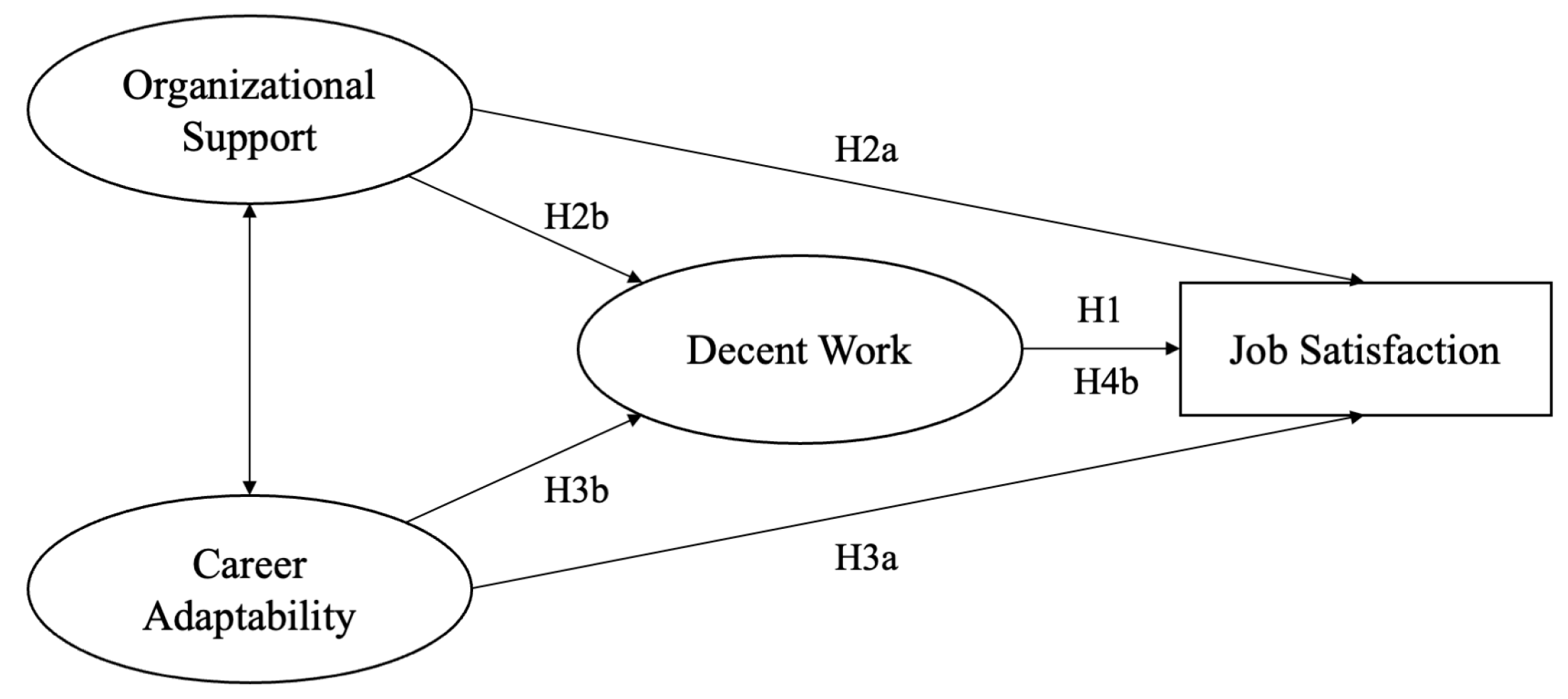
Figure 1: Research hypothesis diagram.
This study focuses on HVCU teachers in China. By using a stratified random sampling method, participants were selected from three stratified geographical regions (12 universities in Jiangsu, Anhui, and Sichuan), college types (public and private), and disciplines (engineering, humanities, economics and management, and technical skills) to ensure the representativeness of full-time in-service teachers in Chinese HVCU. The data collection was conducted from June to July 2023 with the assistance of the academic affairs offices of participating HVCU. Paper questionnaires were distributed along with written informed consent forms (explaining research objectives, data confidentiality, and voluntary participation rights) for independent on-site filling and return. At the beginning, all respondents were informed of the expected use of their data. After completing the questionnaire, participants are deemed to have agreed to use their data for the stated purpose. The entire research process of this study was supervised by relevant institutions and conducted in accordance with established research regulations. The selection criteria are: full-time employment at HVCU, at least 1 year of teaching experience at the current institution, and no more than 3 missing items per scale. The exclusion criteria are part-time/temporary workers, questionnaires with three or more missing items from each scale, or significant answer deviations (such as a uniform rating for all items). A total of 500 questionnaires were distributed in this study, and 435 were initially collected, with a response rate of 87.0%. Excluding 13 invalid questionnaires (3 with excessive missing data and 10 with answer bias), there are 422 valid questionnaires remaining (with an effective response rate of 84.4%). The sample includes 202 male teachers and 220 female teachers. Among them, there are 250 teachers majoring in natural sciences and 172 teachers majoring in humanities and social sciences.
This protocol was approved by the Ethics Committee of Nanjing University of Posts and Telecommunications (No. 20230168), and all study procedures were in accordance with the most recent version of the Declaration of Helsinki. All participants provided written informed consent to participate.
In the field of the theory of work psychology, the concept of decent work encompasses a range of essential elements, including the provision of physically and interpersonally safe working conditions, adequate rest time, organizational values that align with those of the family and broader social context, reasonable compensation, and access to sound healthcare. In light of the aforementioned considerations, this study makes reference to the self-reported decent work scale developed by Duffy, Allan [5] and corroborates the final translated version. Furthermore, it performs the localization test through consultation with several experts in the fields of education and psychology, as well as faculty members in higher education institutions. The scale comprises a total of 15 items, distributed across five dimensions: (1) physical and interpersonal safety in the workplace, (2) adequate rest time, (3) organizational values that align with those of the family and social context, (4) reasonable compensation, and (5) access to quality healthcare. The scale is scored on a five-point Likert scale, with responses ranging from 1 (strongly disagree) to 5 (strongly agree). A higher score on the decent work scale indicates a greater sense of fulfillment with one’s work. The structural validity of the scale was tested using confirmatory factor analysis (CFA), and the results showed that: χ2/df = 4.652 (χ2 = 826.34, df = 177), Root Mean Square Error of Approximation (RMSEA) = 0.093 (95% CI: 0.087–0.101), Normed Fit Index (NFI) = 0.937, Comparative Fit Index (CFI) = 0.950, Incremental Fit Index (IFI) = 0.950, and Tucker-Lewis Index (TLI) = 0.934. Although RMSEA approaches the ideal threshold of 0.08, both CFI and TLI are greater than 0.94, Standardized Root Mean Square Residual (SRMR) < 0.05. Moreover, considering the large sample size (n = 422) in this study, which may lead to high chi-square values, the overall fit meets the acceptable standards of psychometrics [53]. In this study, the Cronbach’s alpha coefficient for decent work was found to be 0.960.
3.2.2 Organizational Support Scale
The degree of organizational support perceived by teachers was gauged using the Perceived Organizational Support scale, which was developed by Rhoades et al. (1986) [38] after revision. The scale comprised a total of 8 items, which were grouped into three dimensions: job support, value identification, and interest relations. The scale was scored on a five-point Likert scale, with responses ranging from 1 (strongly disagree) to 5 (strongly agree). A higher score on the organizational support scale indicates that teachers have stronger organizational support. In the present study, the Cronbach’s alpha coefficient for organizational support was 0.973.
3.2.3 Career Adaptability Scale
The Career Adaptability Scale was derived from the Career Adaptability Scale-Short Version, which was developed by Hou, Leung [54] for the purpose of measuring the career adaptability of teachers in HVCU. The scale comprises a total of 12 questions and is divided into four dimensions: career concern, career control, career curiosity, and career confidence. The scale was scored on a five-point Likert scale, with responses ranging from 1 (strongly disagree) to 5 (strongly agree). A higher score on the Career Adaptability Scale indicates a greater degree of career adaptability. In the present study, the Cronbach’s alpha coefficient for career adaptability was 0.970.
The Job Satisfaction Scale was developed by Brayfield and Rothe [55] after revision for the purpose of measuring job satisfaction among faculty members in HVCU. The scale comprises a total of three questions, each pertaining to a single dimension. The scale was scored on a five-point Likert scale, with responses ranging from 1 (strongly disagree) to 5 (strongly agree). A higher score on the job satisfaction scale indicates a greater degree of job satisfaction among teachers. In the present study, the Cronbach’s alpha coefficient for job satisfaction was 0.831.
This study used SPSS 26.0 (IBM Corp., Armonk, NY, USA) and Amos 26.0 (IBM Corp., Armonk, NY, USA) to collaborate in data analysis, ensuring a unified connection between basic statistics and model testing. First, data preprocessing and basic analysis were conducted using SPSS 26.0, including the calculation of descriptive statistical indicators (mean, standard deviation [34]) for each variable, Pearson correlation analysis (to test preliminary associations between variables), reliability analysis (Cronbach’s alpha coefficient to verify internal consistency of the scale), Harman single factor test (exploratory factor analysis to test common method bias), the independent sample t-test and one-way analysis of variance (ANOVA, to test the gender and major difference), variance inflation factor (VIF, to test absence of multicollinearity interference), and the stepwise regression (to test the path effect). Second, Structural Equation Modeling (SEM) was constructed using Amos 26.0, and CFA was used to test the model fit of “organizational support—career adaptability—decent work—job satisfaction”. The deviation correction bootstrap method (95% confidence interval [CI]) with 5000 repeated samples was used to test the direct and mediating effects.
4.1 Common Method Deviation Test
As the data for this survey were self-reported by faculty members in HVCU, there may be common methodological biases. Accordingly, Harman’s one-factor test was employed to ascertain the presence of variable bias [56]. The results demonstrated that the eigenvalues of the four factors exceeded 1, and the explanatory power of the initial factor was less than 40% of the critical value (the variance value was 36.44%). It can thus be concluded that common methodological biases do not affect the data results.
4.2 Descriptive Statistics and ANOVA Analysis
Firstly, according to the analysis results in Table 1, the average value of decent work of HVCU teachers is 4.09, and the standard deviation is 0.69, which is above average. The average values of sub-dimensions also exceed 4.00. It is not difficult to see that HVCU teachers perform well in decent work.
Table 1: Teachers’ decent work and the overall level of its various factors.
| Level of Each Sub-Factor | Total Level | |||||
|---|---|---|---|---|---|---|
| Items | Physically and Interpersonally Safe Working Conditions | Access to Health Care | Adequate Compensation | Hours that Allow for Free Time and Rest | Organizational Values that Complement Family and Social Values | Decent Work |
| Mean | 4.12 | 4.10 | 4.11 | 4.12 | 4.03 | 4.09 |
| SD | 0.75 | 0.75 | 0.76 | 0.75 | 0.81 | 0.69 |
Secondly, from the analysis results in Table 2, it can be seen that the overall level of teachers’ decent work in HVCU and its factors are not significantly different because of gender differences through the independent sample t-test and one-way ANOVA. It can be seen that the overall level of decent work and the level of various factors of male teachers and female teachers in HVCU are roughly the same.
Table 2: Differences in the influence of gender on teachers’ decent work.
| Items | ANOVA Analysis | Independent Sample t-Test (t Value) | 95% CI for Mean Difference | ||
|---|---|---|---|---|---|
| F | p | LLCI | ULCI | ||
| Physically and Interpersonally Safe Working Conditions | 2.153 | 0.143 | 1.116 | −0.062 | 0.224 |
| 1.113 | −0.062 | 0.225 | |||
| Access to Health Care | 0.689 | 0.407 | 2.742 | 0.056 | 0.340 |
| 2.746 | 0.056 | 0.340 | |||
| Adequate Compensation | 1.172 | 0.280 | 2.873 | 0.066 | 0.354 |
| 2.876 | 0.067 | 0.354 | |||
| Hours that Allow for Free Time and Rest | 3.118 | 0.078 | 1.918 | −0.003 | 0.284 |
| 1.914 | −0.004 | 0.284 | |||
| Organizational Values that Complement Family and Social Values | 0.099 | 0.753 | 3.022 | 0.082 | 0.388 |
| 3.022 | 0.082 | 0.388 | |||
| Decent Work | 1.861 | 0.173 | 2.583 | 0.041 | 0.305 |
| 2.580 | 0.041 | 0.305 | |||
Thirdly, from the analysis results in Table 3, it can be seen that the overall level of teachers’ decent work in HVCU and its factors are not significantly different due to different majors through the independent sample t-test and one-way analysis of variance. Therefore, no matter what kind of professional teachers are, the overall level of decent work and the level of its various factors are roughly the same.
Table 3: Differences in the influence of major on teachers’ decent work.
| Items | Anova Analysis | Independent Sample t-Test (t Value) | 95% CI for Mean Difference | ||
|---|---|---|---|---|---|
| F | p | LLCI | ULCI | ||
| Physically and Interpersonally Safe Working Conditions | 1.154 | 0.283 | −0.939 | −0.215 | 0.076 |
| −0.935 | −0.216 | 0.077 | |||
| Access to Health Care | 0.231 | 0.631 | −0.105 | −0.153 | 0.138 |
| −0.106 | −0.153 | 0.137 | |||
| Adequate Compensation | 0.205 | 0.651 | −0.513 | −0.186 | 0.109 |
| −0.519 | −0.185 | 0.108 | |||
| Hours that Allow for Free Time and Rest | 0.354 | 0.552 | 0.251 | −0.128 | 0.165 |
| 0.250 | −0.128 | 0.166 | |||
| Organizational Values that Complement Family and Social Values | 0.641 | 0.424 | 0.856 | −0.089 | 0.225 |
| 0.850 | −0.090 | 0.227 | |||
| Decent Work | 0.011 | 0.917 | −0.081 | −0.141 | 0.130 |
| −0.081 | −0.140 | 0.129 | |||
4.3 Analysis of the Relationship between Teachers’ Decent Work and Influencing Factors
4.3.1 Descriptive Statistics and Correlation Analysis
According to the analysis results in Table 4, the Mean of teachers’ decent work in HVCU is 4.09, and the SD is 0.69, which is above average. The Mean of organizational support is 4.14, and the SD is 0.85, which is above average. The Mean of career adaptability is 4.34, and the SD is 0.85, which is at a high level. The Mean of job satisfaction is 4.12, and the SD is 0.73, which is in the upper-middle level. The results of correlation analysis show that there is a significant positive correlation between decent work and organizational support, career adaptability, and job satisfaction of teachers in HVCU (p < 0.001). Besides, to verify the absence of multicollinearity interference among core variables, the VIF and tolerance were calculated using SPSS 26.0. The results showed that the VIF of all variables was <10 and the tolerance was >0.1, which meets the criteria for multicollinearity testing. This indicates that the parameter estimation results of regression analysis and structural equation modeling are reliable and can be further analyzed. Therefore, it is of statistical significance to test the relationship between the four variables.
Table 4: Descriptive statistics and correlation analysis.
| Items | Mean | SD | 1 | 2 | 3 | 4 |
|---|---|---|---|---|---|---|
| 1. Decent Work | 4.09 | 0.69 | - | |||
| 2. Organizational Support | 4.14 | 0.85 | 0.58** | - | ||
| 3. Career Adaptability | 4.34 | 0.62 | 0.82** | 0.56** | - | |
| 4. Job Satisfaction | 4.12 | 0.73 | 0.62** | 0.48** | 0.57** | - |
Hayes and Scharkow [56] pointed out that the reliability of the indirect effect should be paid attention to in statistical intermediary analysis, and they suggested that the bootstrap confidence interval of deviation correction should be the most reliable test. Therefore, according to the research hypothesis model, this study takes organizational support and career adaptability as independent variables, job satisfaction as the dependent variable, and decent work as the intermediary variable; The intermediary effect of decent work is analyzed by the stepwise regression method. The results are shown in Table 5.
Table 5: Stepwise regression model analysis.
| No. | Dependent Variable | Independent Variables | R2 | β | t | F |
|---|---|---|---|---|---|---|
| Model (1) | Job satisfaction | Decent work | 0.383 | 0.620 | 8.594*** | 261.892*** |
| Model (2) | Job satisfaction | Organizational support | 0.404 | 0.185 | 7.237*** | 143.787*** |
| Decent work | 0.513 | |||||
| Model (3) | Job satisfaction | Organizational support | 0.411 | 0.165 | 5.236*** | 98.735*** |
| Career adaptability | 0.155 | |||||
| Decent work | 0.398 |
In order to clarify the incremental explanatory power of each variable to job satisfaction, this study constructs three stepwise regression equations for comparative analysis, and the results are shown in Table 5. Model 1 only includes the prediction of decent work on job satisfaction, R2 = 0.383. Model 2 adds the independent variable (organizational support) on the basis of Model 1, and R2 is raised to 0.404 (ΔR2 = 0.021, p < 0.001). Model 3 (full mediation model) further includes the independent variable (career adaptability), and R2 finally reaches 0.411 (ΔR2 = 0.028, p < 0.001). The gradual and significant increase of R2 shows that both independent variables and mediating variables can significantly enhance the explanatory power of the equation to job satisfaction, and decent work alone contributes 5.5% explanatory power, which confirms its key value as a core mediating effect.
Therefore, organizational support and professional adaptability can jointly enhance teachers’ job satisfaction through the mediating role of decent work. In addition, to validate the hypothesis model, this study used Amos 26.0 to verify the mediating effect through confidence interval standards and bias correction. Randomly select a total of 5000 samples from the population and use a 95% bootstrap CI to obtain the results. The results are shown in Table 6.
Table 6: Bootstrap analysis of path effect significance test.
| Paths | Direct/Indirect Effect Value | S.E. | C.R. | 95% CI | |
|---|---|---|---|---|---|
| LLCI | ULCI | ||||
| Direct Effect | |||||
| Organizational support → Job satisfaction | 0.110 | 0.047 | 2.344 | 0.021 | 0.260 |
| Career adaptability → Job satisfaction | 0.088 | 0.104 | 2.349 | 0.110 | 0.295 |
| Decent work → Job satisfaction | 0.636 | 0.111 | 5.744 | 0.438 | 0.888 |
| Indirect Effect | |||||
| Organizational support → Career adaptability → Decent work → Job satisfaction | 0.526 | 0.089 | 3.233 | 0.568 | 0.721 |
The results in Table 6 indicate that in the direct effects analysis, organizational support, career adaptability, and decent work can significantly predict job satisfaction, respectively. In the 95% CI test, zero values were not within the interval, which further confirms hypotheses H1, H2a, and H2b. At the same time, the results of the 95% confidence interval test in the indirect effects analysis are not within the interval, and the zero point is also not within the interval, which verifies research hypotheses H3a, H3b, H4, and the hypothesis model proposed in this study.
Meanwhile, this study constructed a structural equation model of job satisfaction, which further verified the mediating role of decent work. In order to verify the fit of the model, we analyzed the specific fit indicators using Amos 26.0. The results showed that: χ2 = 385.519, df = 84, χ2/df = 4.590, which meets the standard requirement of 2–5; RMSEA (root mean square error of approximation) = 0.092, which meets the requirement of less than 0.06–0.10; NFI (standard fit index) = 0.949, IFI (incremental fit index) = 0.960, CFI (comparative fit index) = 0.960, GFI (Goodness of Fit Index) = 0.896, and AGFI (Adjusted GFI) = 0.851, all of which satisfy the requirement of 0.85 or more, indicating that the model is well fitted. Therefore, the final structural equation model was constructed in this study based on the research hypothesis map established in hypothesis H2. The results are shown in Fig. 2.
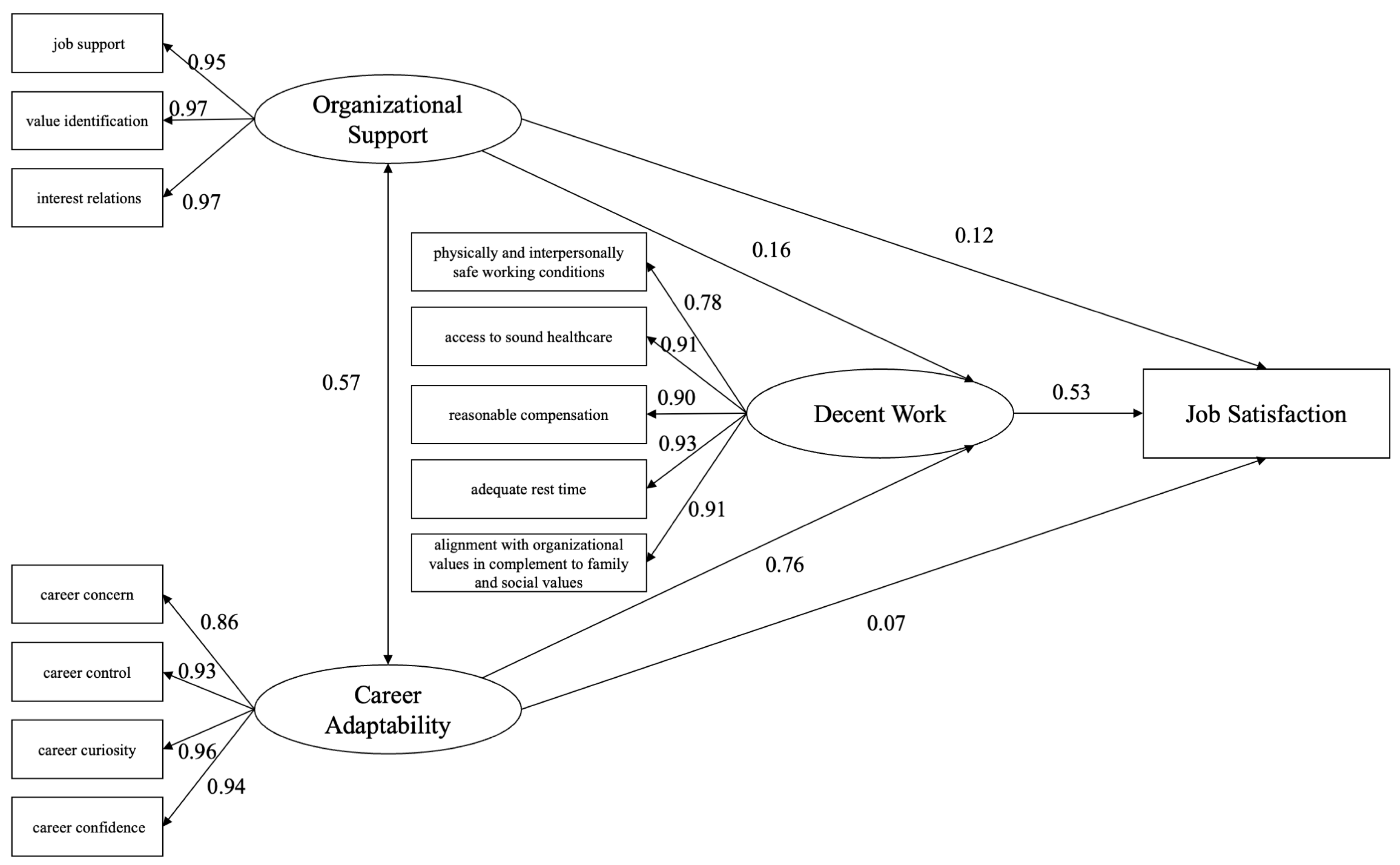
Figure 2: Structural equation model.
5.1 Impact of Demographic Variables on Decent Work of Teachers in HVCU
This study found that there is no significant gender difference in decent work for vocational college teachers, which differs from the cross national research results of Zammitti et al. (2024). The analysis of the teacher population in 15 countries showed that female teachers scored significantly lower than male teachers in terms of job security and pay equity, which may be related to the rigid gender division of labor in vocational education in these countries [57]. In the sample of this study, male and female teachers have relatively balanced subject distribution (balanced proportion of natural sciences and humanities and social sciences) and career development opportunities (unified training and promotion channels provided by universities). This homogenized institutional environment may offset the differences caused by gender, which is consistent with the view proposed by Nourafkan and Tanova (2023) that organizational system homogenization can weaken the impact of demographic variables on decent work [23].
In terms of major differences, this study also did not show significant differences. Similar variables such as school type have yielded different conclusions. According to the research on teachers in public and private schools in Turkey by Çolakoğlu and Toygar (2021), teachers working in public schools have a higher level of good job feeling than teachers working in private schools [52]. However, the sample of this study mainly comes from developed regions in the eastern and central western parts of Jiangsu, Anhui, and Sichuan. The allocation of resources (such as practical teaching funds and safety equipment) for teachers in different majors by universities is relatively balanced, and a unified social security system (such as medical and salary accounting standards) reduces the differences in treatment between majors. This is consistent with the conclusion of Choi et al. (2024) in the study of vocational education in Indonesia that equalization of institutional guarantees can narrow the differences in work experience between majors [19].
5.2 Impact of Other Variables on Decent Work of Teachers in HVCU
Based on the PWT, this study validated the positive predictive role of organizational support and career adaptability on decent work, aligning closely with the longitudinal findings of Duffy et al. (2020). Through a three-year longitudinal study, it was discovered that organizational resource support (e.g., teaching resources, promotion guidance) reduces job uncertainty, thereby enhancing individuals’ perceptions of decent work dimensions such as fair compensation and career development [22]. Concurrently, Marcionetti et al. (2025) confirmed through vocational apprenticeship research that career control and career curiosity within career adaptability help individuals better navigate workplace challenges, proactively pursue favorable working conditions, and ultimately elevate decent work standards [20].
Notably, the synergistic effect of organizational support and career adaptability demonstrates a more pronounced enhancement of decent work, extending the findings of Ma et al. (2023). They only validated the independent predictive role of organizational support on decent work among college students [16]. This study demonstrates that the interaction between external environmental support (organizational support) and individual psychological resources (career adaptability) can more comprehensively cover the five dimensions of decent work. This aligns with the core perspective of PWT theory that environmental and individual factors jointly influence work experience [4].
5.3 Reflections and Suggestions
It can be reasonably argued that decent work has the potential to exert a significant influence on the career advancement of those engaged in teaching roles within HVCU. As a crucial yet often inaccessible aspect of the education system, the quality of work performed by teachers in HVCU is inextricably linked to their continued willingness to teach and the sustainable development of their individual careers. It is therefore evident that ensuring the level of decent work for teachers in HVCU is of paramount importance. It is imperative to acknowledge the pivotal role of HVCU as the primary arena for the advancement of quality vocational education in China [58]. As a significant branch of higher education, this field is not to be regarded as “inferior” on the basis of its professional orientation. In order to underscore the significance of higher vocational education within China’s broader educational framework, the cultivation and advancement of educators in HVCU exerts a particularly influential role in shaping the future of these institutions.
The objective is to establish a comprehensive system that will facilitate the creation of a fair and harmonious working environment. The discourse on teachers’ right to a work environment that is conducive to their professional development and the realization of their intrinsic value as human beings corroborates the significant impact of the work environment on the quality of work [59]. The first and fifth dimensions of the revised decent work scale in this study are also elaborations of the work environment. The current system for teachers in China’s HVCU differs from that in ordinary undergraduate colleges and universities, with the majority of these institutions exhibiting notable discrepancies. The system is imperfect, and although numerous scholars have offered valuable insights into the management and development of HVCU, there is a dearth of detailed suggestions regarding the management of the working environment of teachers in these institutions. A fair and harmonious working environment is of significant importance for teachers at all levels of education. The working environments of teachers in HVCU are also subject to variation due to the distinctive characteristics of these institutions. These institutions occupy a unique position within the higher education sector, serving as a bridge between senior high school education and undergraduate education. They are tasked with the crucial responsibility of carrying on the work of HVCU. For instance, teachers of natural science must have access to the requisite office resources to provide students with practical opportunities. In contrast to undergraduate teaching, HVCU frequently requires teachers to collaborate with enterprises, which creates a non-school work environment that necessitates the establishment of an effective regulatory system. Similarly, the quality of the working environment can be either conducive or detrimental to the alignment of the teachers’ personal values with those of the organization. In the event of a discrepancy between the two, change is an inevitable consequence.
The implementation of pertinent policies is essential to ensure the provision of comprehensive and reasonable working conditions. In addition to the first, second and fourth dimensions of the revised Decent Work Scale should also be emphasized in work treatment. In 2022, the Central Committee of the Democratic Progressive Party of China submitted a proposal entitled “Teachers’ Law”, which was answered by the Ministry of Education. As is widely recognized, the majority of higher education institutions in China and Europe have implemented assessment policies for teaching staff. These policies are analogous to the “promotion or departure” policy observed in undergraduate colleges and universities [60]. The same can be said of the higher education sector in higher vocational education, where teaching staff are bound by the assessment policy. While the resulting job benefits are substantial, they are primarily in the form of healthcare and compensation. The fourth dimension of the Decent Work Scale is notably distinct in this study. In some instances, teachers are compelled to join the “internal rolls” to fulfill the school’s assessment requirements. The intense pressure of work in exchange for compensation may not align with the actual level of analysis. It is therefore recommended that, in addition to the implementation of the aforementioned policy requirements, the protection of teachers’ working conditions should also be emphasized.
The objective of this study is to present a framework for the management of a pipeline of multi-service developments. As previously stated, there is a considerable turnover and mobility of teaching staff in HVCU. Faculty members who are constrained in their professional growth within their institutions often pursue alternative avenues for advancement. For instance, those with a master’s degree may opt to pursue a doctoral degree with the objective of securing a more advantageous position upon graduation. Similarly, individuals with a doctoral degree may choose to leave their current roles in order to join an institution that offers enhanced working conditions, benefits, and opportunities for professional growth. Therefore, it is suggested that the management department of HVCU draw inspiration from the teacher development centers established in some colleges and universities. These centers provide a comprehensive range of induction assistance and work adaptation for new faculty members, while also offering veteran faculty members access to enhanced career development counselling and other services. This often necessitates the establishment of a competent department that can assume a leadership role and collaborate with other departments to oversee and coordinate the process. In some cases, external assistance may be required to ensure the optimal functioning of the department. For instance, teachers may require the input of professional psychologists in order to gain insight into their career development. Furthermore, the necessity for specialized knowledge may necessitate that educators’ departments seek the assistance of higher-level professionals in their respective fields.
Based on the findings and reflections of this study, and considering HVCU’s actual resources, the following action suggestions are proposed for the institutional management level.
First, implement a specialized growth plan for dual-qualified faculty. To precisely strengthen the core dimension of organizational support, focusing on key mediating pathways identified in the research, such as professional growth and promotion, work value, and social recognition, the institution can design targeted professional training and development programs. For instance, institutions could offer 2–3 sessions of industry-academia collaborative training per semester (e.g., workshops led by corporate technical experts on practical teaching skills). Establishing a visual platform for showcasing faculty teaching achievements (e.g., dedicated campus website sections or annual teaching exhibitions) would recognize excellence in course design and student competition mentoring, complemented by small-scale specialized awards. It is important to note that when institutional funding and industry-academia collaboration resources are limited, priority should be given to key disciplines (e.g., engineering, technical skills). A phased implementation approach and regional resource sharing among institutions (e.g., jointly inviting lecturers from neighboring institutions and sharing training costs) can be adopted to avoid resource wastage from blanket implementation.
Second, conduct workshops to enhance faculty professional adaptability. Targeted development of core competencies: Recognizing the critical role of career adaptability, institutions should regularly (quarterly) organize blended workshops combining in-person and online formats. For instance, workshops could offer modules such as practical teaching time management techniques (e.g., modular course outline design, student-led practical assignment allocation methods) and career stress regulation and emotional management (featuring insights from invited counselors or seasoned educators). Additionally, provide supporting toolkits (e.g., “Faculty Time Planning Template”, “Stress Self-Assessment Scale”) for independent use. It should be noted that if institutions lack dedicated training staff, they can collaborate with local university psychology departments or educational training institutions (using a resource exchange model, such as providing practical teaching venues in exchange for free training services) to reduce organizational costs.
Third, implement the Practical Teaching Safety and Compensation Equity Optimization Initiative. To reinforce foundational dimensions like workplace safety, health, fair compensation, and benefits mentioned in the “Decent Work” framework, institutions should enhance care measures. For instance, conduct annual safety inspections of practical teaching facilities and prioritize funding for upgrading core safety equipment (e.g., leakage protection devices for electrical training benches, protective gloves/goggles for mechanical training). Establish a performance-based compensation disclosure and feedback mechanism. Monthly disclosures of faculty teaching fees and research incentives should be posted within departments, alongside anonymous feedback channels (e.g., online surveys, suggestion boxes). Collect compensation equity feedback once per semester and implement targeted adjustments (e.g., standardizing cross-disciplinary teaching fee rates). It should be noted that during periods of tight funding, safety facility upgrades may be prioritized in the annual budget, with high-risk disciplines receiving priority. Furthermore, compensation adjustments must balance institutional financial sustainability to prevent single-dimensional optimizations from compromising other teaching resource allocations.
The most critical limitation of this study lies in its cross-sectional design and reliance on self-reported data from a single source, which to some extent undermines the robustness of its conclusions and its ability to establish causal inferences. All data were collected through self-reports by HVCU teachers. Although common method variance was controlled using Harman’s single-factor test and latent variable methods, the inherent subjective bias of self-reporting could not be entirely eliminated. This may have led to a slight overestimation of the correlation coefficients between variables. The cross-sectional design captures only contemporaneous associations between variables and cannot reveal the dynamic causal sequence among core variables. For instance, it cannot rule out the possibility of reverse causality. Therefore, the mediating effects validated in this study represent mechanisms at the statistical correlation level rather than explicit causal chains.
To address these limitations, future research can be optimized in three areas. First, adopt time-separated longitudinal tracking designs. Through multi-wave data collection and cross-lagged models, more precisely examine causal directions and dynamic mediating processes between variables. Second, expand multi-source data collection channels. Complement teacher self-reports with evaluations from departmental leaders on organizational support implementation and indirect feedback from students on teacher work status, reducing bias from single-source data. Third, incorporate more rigorous analytical remedies, such as including dummy variables unrelated to core constructs in statistical models to further isolate common method variance, or employing latent variable factor models to systematically control measurement-induced variation. Additionally, future research should account for institutional resource constraints and validate the cross-context applicability of the model across larger samples.
This study focuses on HVCU teachers and conducts two core tasks centered on the core variables of decent work. On the one hand, it revises the decent work scale based on PWT for localization and applicability to HVCU teachers, constructing and validating a mediation model of organizational support → occupational adaptability → decent work → job satisfaction. On the other hand, a stratified random sample of 422 HVCU teachers in China was selected. Data were collected using relevant scales and analyzed with SPSS 26.0 and Amos 26.0. Results revealed that HVCU teachers exhibited a relatively high overall level of decent work (mean = 4.09, SD = 0.69), with no significant influence from gender or major. Organizational support (r = 0.58, p < 0.001) and career adaptability (r = 0.82, p < 0.001) positively predicted decent work, synergistically enhancing job satisfaction (R2 increased from 38.3% to 41.1%). The mediating effect of decent work was validated as robust via Bootstrap estimation (95% CI did not include 0).
In a word, this study enriches scales suitable for vocational education, systematically verifies the applicability of PWT scale in HVCU teachers for the first time, and expands the application of PWT scale in vocational education. In practice, it provides clear directions for the management of higher vocational colleges and the policies of encouraging teachers. This study suggests that enhancing teachers’ decent work conditions and psychological resources through optimizing safety measures in practical teaching, improving fair compensation mechanisms, implementing industry-academia-research collaborative training, and organizing career adaptation workshops, among other measures, can boost job satisfaction and retention intentions. These efforts will ultimately support the high-quality, sustainable development of vocational education.
Acknowledgement:
Funding Statement: This research was funded by Nanjing University of Posts and Telecommunications Humanities and Social Sciences Research Fund Project (NYY222055), Special research project on teaching reform of innovation and entrepreneurship education in Nanjing University of Posts and Telecommunications (GCSJG202528), General Subject of Educational Science Planning in Jiangsu Province (C/2024/01/76), and General project of educational science research in Shanghai (C24288) and Key funded project of Shandong Vocational Education Teaching Reform Research in 2022 (2022052).
Author Contributions: The authors confirm contribution to the paper as follows: Conceptualization, Huaruo Chen and Gefan Wang; methodology, Huaruo Chen and Gefan Wang; software, Huaruo Chen, Gefan Wang and Hancai Qiu; validation, Huaruo Chen, Gefan Wang and Hancai Qiu; formal analysis, Huaruo Chen, Hancai Qiu and Hui Ma; investigation, Huaruo Chen and Zhentao Peng; resources, Huaruo Chen, Gefan Wang, Hui Ma and Feng Xu; data curation, Gefan Wang, Hancai Qiu, Hui Ma and Zhentao Peng; writing—original draft preparation, Huaruo Chen, Gefan Wang and Ruihan Liu; writing—review and editing, Huaruo Chen, Gefan Wang and Feng Xu; visualization, Huaruo Chen, Gefan Wang and Ruihan Liu; supervision, Huaruo Chen and Feng Xu; project administration, Huaruo Chen and Feng Xu; funding acquisition, Huaruo Chen and Feng Xu. All authors reviewed the results and approved the final version of the manuscript.
Availability of Data and Materials: The data that support the findings of this study are available from the Corresponding Author, Feng Xu, upon reasonable request.
Ethics Approval: This protocol was approved by the Ethics Committee of Nanjing University of Posts and Telecommunications (No. 20230168), and all study procedures were in accordance with the most recent version of the Declaration of Helsinki. All participants provided written informed consent to participate.
Conflicts of Interest: The authors declare no conflicts of interest to report regarding the present study.
References
1. Camp A , Zamarro G , McGee J . Looking back and moving forward: COVID-19’s impact on the teacher labor market and implications for the future. Educ Eval Policy Anal. 2025; 47( 4): 983– 1009. doi:10.3102/01623737241258184. [Google Scholar] [CrossRef]
2. Debus ME , Unger D , König CJ . Job insecurity and performance over time: the critical role of job insecurity duration. Career Dev Int. 2019; 25( 3): 325– 36. doi:10.1108/cdi-04-2018-0102. [Google Scholar] [CrossRef]
3. Almeida F , Santos JD . The effects of COVID-19 on job security and unemployment in Portugal. Int J Sociol Soc Policy. 2020; 40( 9–10): 995– 1003. doi:10.1108/ijssp-07-2020-0291. [Google Scholar] [CrossRef]
4. Duffy RD , Blustein DL , Diemer MA , Autin KL . The psychology of working theory. J Couns Psychol. 2016; 63( 2): 127– 48. doi:10.1037/cou0000140. [Google Scholar] [CrossRef]
5. Duffy RD , Allan BA , England JW , Blustein DL , Autin KL , Douglass RP , et al. The development and initial validation of the decent work scale. J Couns Psychol. 2017; 64( 2): 206– 21. doi:10.1037/cou0000191. [Google Scholar] [CrossRef]
6. Dong S . China’s new laws and policies on nongovernmental education: background, characteristics, and impact analysis. ECNU Rev Educ. 2020; 3( 2): 346– 56. doi:10.1177/2096531120918148. [Google Scholar] [CrossRef]
7. Fan X . Policy-driven development and the strategic initiative of one-million enrollment expansion in China’s higher vocational education. ECNU Rev Educ. 2020; 3( 1): 179– 86. doi:10.1177/2096531120903879. [Google Scholar] [CrossRef]
8. Jin X , Tigelaar D , van der Want A , Admiraal W . Novice teachers’ appraisal of expert feedback in a teacher professional development programme in Chinese vocational education. Teach Teach Educ. 2022; 112: 103652. doi:10.1016/j.tate.2022.103652. [Google Scholar] [CrossRef]
9. Ling Y , Chung SJ , Wang L . Research on the reform of management system of higher vocational education in China based on personality standard. Curr Psychol. 2023; 42( 2): 1225– 37. doi:10.1007/s12144-021-01480-6. [Google Scholar] [CrossRef]
10. Zhou N , Tigelaar DEH , Admiraal W . Vocational teachers’ professional learning: a systematic literature review of the past decade. Teach Teach Educ. 2022; 119: 103856. doi:10.1016/j.tate.2022.103856. [Google Scholar] [CrossRef]
11. Case AS , Kang E , Krutsch J , Bhojwani J , Fanok S , Contreras S . Stepping in and up to meet community needs: how community-based college access and success programs responded to COVID-19. J Community Psychol. 2022; 50( 7): 3023– 43. doi:10.1002/jcop.22812. [Google Scholar] [CrossRef]
12. Jiao C , Qian J , Liu H . The relationship between preschool inclusive education teachers’ organizational support and work engagement: the mediating role of teacher self-efficacy. Front Psychol. 2022; 13: 900835. doi:10.3389/fpsyg.2022.900835. [Google Scholar] [CrossRef]
13. Caesens G , Stinglhamber F . Toward a more nuanced view on organizational support theory. Front Psychol. 2020; 11: 476. doi:10.3389/fpsyg.2020.00476. [Google Scholar] [CrossRef]
14. Chen H , Fang T , Liu F , Pang L , Wen Y , Chen S , et al. Career adaptability research: a literature review with scientific knowledge mapping in web of science. Int J Environ Res Public Health. 2020; 17( 16): 5986. doi:10.3390/ijerph17165986. [Google Scholar] [CrossRef]
15. Wen Y , Chen H , Liu F , Wei X . The relationship between career calling and resilience among rural-oriented pre-service teachers: the chain mediating role of career adaptability and decent work. Behav Sci. 2023; 14( 1): 11. doi:10.3390/bs14010011. [Google Scholar] [CrossRef]
16. Ma Y , Autin KL , Ezema GN . Validation of the Chinese decent work scale. J Career Dev. 2023; 50( 1): 37– 51. doi:10.1177/08948453221080980. [Google Scholar] [CrossRef]
17. Kınıkoğlu CN , Can A . Between luck and stigma: gendered experiences of precarity in higher education in the UK and the US. Int Stud Sociol Educ. 2025; 34( 3): 261– 82. doi:10.1080/09620214.2024.2383217. [Google Scholar] [CrossRef]
18. Nicklich M , Blank M , Pfeiffer S . Realizing decent work in a “sandwich” position: assessing VET trainers’ working conditions in times of multiple transformations. Int J Res Vocat Educ Train. 2025; 12( 1): 101– 26. doi:10.13152/ijrvet.12.1.5. [Google Scholar] [CrossRef]
19. Choi S , Li H , Ogawa K , Tanaka Y . Secondary vocational education and decent work in Indonesia: differences between urban and rural areas. Int J Train Res. 2024; 22( 2): 125– 46. doi:10.1080/14480220.2023.2222939. [Google Scholar] [CrossRef]
20. Marcionetti J , Zambelli C , Rossier J . Influence of career adaptability and job control on decent work and occupational stress in a sample of apprentices. J Career Dev. 2025; 52( 1): 95– 111. doi:10.1177/08948453241304328. [Google Scholar] [CrossRef]
21. Duffy RD , Kim HJ , Perez G , Prieto CG , Torgal C , Kenny ME . Decent education as a precursor to decent work: an overview and construct conceptualization. J Vocat Behav. 2022; 138: 103771. doi:10.1016/j.jvb.2022.103771. [Google Scholar] [CrossRef]
22. Duffy RD , Kim HJ , Allan BA , Prieto CG . Predictors of decent work across time: testing propositions from psychology of working theory. J Vocat Behav. 2020; 123: 103507. doi:10.1016/j.jvb.2020.103507. [Google Scholar] [CrossRef]
23. Nourafkan NJ , Tanova C . Employee perceptions of decent work: a systematic literature review of quantitative studies. Curr Psychol. 2023; 42( 34): 29772– 800. doi:10.1007/s12144-023-04837-1. [Google Scholar] [CrossRef]
24. Wang J , Chang B . More marginalization, less career development? Linking marginalization profiles to decent work among rural teachers. Acta Psychol. 2025; 252: 104668. doi:10.1016/j.actpsy.2024.104668. [Google Scholar] [CrossRef]
25. Shabeer S , Fatima T , Ali L , Imran MK , Sarwar A . From anger to support: how decent work behavior affects emotional support and satisfaction. Asian Educ Dev Stud. 2025; 14( 5): 1167– 78. doi:10.1108/aeds-09-2024-0192. [Google Scholar] [CrossRef]
26. Butenko D , Rinaldi M , Brinchmann B , Brandseth OL , Killackey E , Mykletun A . The personality profile of IPS employment specialists, and how it relates to job satisfaction: a longitudinal cohort study. Scand J Psychol. 2023; 64( 1): 71– 9. doi:10.1111/sjop.12864. [Google Scholar] [CrossRef]
27. Song Z , Pan B , Wang Y . Can trait mindfulness improve job satisfaction? The relationship between trait mindfulness and job satisfaction of preschool teachers: the sequential mediating effect of basic psychological needs and positive emotions. Front Psychol. 2021; 12: 788035. doi:10.3389/fpsyg.2021.788035. [Google Scholar] [CrossRef]
28. Duffy RD , Gensmer N , Allan BA , Kim HJ , Douglass RP , England JW , et al. Developing, validating, and testing improved measures within the psychology of working theory. J Vocat Behav. 2019; 112: 199– 215. doi:10.1016/j.jvb.2019.02.012. [Google Scholar] [CrossRef]
29. Blustein DL , Lysova EI , Duffy RD . Understanding decent work and meaningful work. Annu Rev Organ Psychol Organ Behav. 2023; 10: 289– 314. doi:10.1146/annurev-orgpsych-031921-024847. [Google Scholar] [CrossRef]
30. Wilkins-Yel KG , Roach CML , Tracey TJG , Yel N . The effects of career adaptability on intended academic persistence: the mediating role of academic satisfaction. J Vocat Behav. 2018; 108: 67– 77. doi:10.1016/j.jvb.2018.06.006. [Google Scholar] [CrossRef]
31. Duffy RD , Douglass RP , Autin KL . Career adaptability and academic satisfaction: examining work volition and self efficacy as mediators. J Vocat Behav. 2015; 90: 46– 54. doi:10.1016/j.jvb.2015.07.007. [Google Scholar] [CrossRef]
32. Ma Y , Huang G , Autin KL . Linking decent work with academic engagement and satisfaction among first-generation college students: a psychology of working perspective. J Career Assess. 2021; 29( 1): 148– 63. doi:10.1177/1069072720943153. [Google Scholar] [CrossRef]
33. Kurtessis JN , Eisenberger R , Ford MT , Buffardi LC , Stewart KA , Adis CS . Perceived organizational support: a meta-analytic evaluation of organizational support theory. J Manag. 2017; 43( 6): 1854– 84. doi:10.1177/0149206315575554. [Google Scholar] [CrossRef]
34. Shanock LR , Shoss MK , Coyle-Shapiro J , Shore LM , Zagenczyk TJ , Buffardi LT , et al. Remembering Robert W. eisenberger: a tribute to his life and his work on perceived organizational support. Group Organ Manag. 2022; 47( 4): 872– 88. doi:10.1177/10596011221110650. [Google Scholar] [CrossRef]
35. Eder P , Eisenberger R . Perceived organizational support: reducing the negative influence of coworker withdrawal behavior. J Manag. 2008; 34( 1): 55– 68. doi:10.1177/0149206307309259. [Google Scholar] [CrossRef]
36. Shore LM , Wayne SJ . Commitment and employee behavior: comparison of affective commitment and continuance commitment with perceived organizational support. J Appl Psychol. 1993; 78( 5): 774– 80. doi:10.1037/0021-9010.78.5.774. [Google Scholar] [CrossRef]
37. Zhu C , Xia M , Xie H , Wang Y , Ye J , Xu J . Primary school teachers’ perceived organizational support and job satisfaction: the mediating role of collective efficacy. Soc Behav Pers. 2024; 52( 2): 1– 9. doi:10.2224/sbp.12915. [Google Scholar] [CrossRef]
38. Rhoades L , Eisenberger R . Perceived organizational support: a review of the literature. J Appl Psychol. 2002; 87( 4): 698– 714. doi:10.1037/0021-9010.87.4.698. [Google Scholar] [CrossRef]
39. Halbesleben JRB . Sources of social support and burnout: a meta-analytic test of the conservation of resources model. J Appl Psychol. 2006; 91( 5): 1134– 45. doi:10.1037/0021-9010.91.5.1134. [Google Scholar] [CrossRef]
40. White S , Bloomfield D , Le Cornu R . Professional experience in new times: issues and responses to a changing education landscape. Asia Pac J Teach Educ. 2010; 38( 3): 181– 93. doi:10.1080/1359866X.2010.493297. [Google Scholar] [CrossRef]
41. Mascarenhas C , Galvão AR , Marques CS . How perceived organizational support, identification with organization and work engagement influence job satisfaction: a gender-based perspective. Adm Sci. 2022; 12( 2): 66. doi:10.3390/admsci12020066. [Google Scholar] [CrossRef]
42. Stan R , Vîrgă D . Psychological needs matter more than social and organizational resources in explaining organizational commitment. Scand J Psychol. 2021; 62( 4): 552– 63. doi:10.1111/sjop.12739. [Google Scholar] [CrossRef]
43. Savickas ML . Career adaptability: an integrative construct for life-span, life-space theory. Career Dev Q. 1997; 45( 3): 247– 59. doi:10.1002/j.2161-0045.1997.tb00469.x. [Google Scholar] [CrossRef]
44. Savickas ML , Porfeli EJ . Career adapt-abilities scale: construction, reliability, and measurement equivalence across 13 countries. J Vocat Behav. 2012; 80( 3): 661– 73. doi:10.1016/j.jvb.2012.01.011. [Google Scholar] [CrossRef]
45. Liên NT , Hằng NVT , Hằng NT . Vietnamese teachers’ career adaptability in implementing the 2018 competency-oriented curriculum: a case within a Confucian heritage culture. Cogent Educ. 2025; 12( 1): 2554951. doi:10.1080/2331186X.2025.2554951. [Google Scholar] [CrossRef]
46. Feng Q , Chen X , Guo Z . How does role accumulation enhance career adaptability? A dual mediation analysis. Curr Psychol. 2023; 42( 12): 10426– 36. doi:10.1007/s12144-021-02304-3. [Google Scholar] [CrossRef]
47. Lent RW , Brown SD , Hackett G . Toward a unifying social cognitive theory of career and academic interest, choice, and performance. J Vocat Behav. 1994; 45( 1): 79– 122. doi:10.1006/jvbe.1994.1027. [Google Scholar] [CrossRef]
48. Hou C , Wu Y , Liu Z . Career decision-making self-efficacy mediates the effect of social support on career adaptability: a longitudinal study. Soc Behav Pers. 2019; 47( 5): 1– 13. doi:10.2224/sbp.8157. [Google Scholar] [CrossRef]
49. Jang H , Pak S , Lee D . Meta-analysis: the role of race/ethnicity and gender in career choice. J Asia Pac Couns. 2019; 9( 2): 119– 35. doi:10.18401/2019.9.2.8. [Google Scholar] [CrossRef]
50. Ingersoll RM . Teacher turnover and teacher shortages: an organizational analysis. Am Educ Res J. 2001; 38( 3): 499– 534. doi:10.3102/00028312038003499. [Google Scholar] [CrossRef]
51. Atitsogbe KA , Kossi EY , Pari P , Rossier J . Decent work in sub-Saharan Africa: an application of psychology of working theory in a sample of Togolese primary school teachers. J Career Assess. 2021; 29( 1): 36– 53. doi:10.1177/1069072720928255. [Google Scholar] [CrossRef]
52. Çolakoğlu C , Toygar A . The psychological effect of compensation on decent work dimensions: a research on public and private school teachers in Turkey. Int J Soc Econ. 2021; 48( 8): 1191– 212. doi:10.1108/ijse-04-2020-0236. [Google Scholar] [CrossRef]
53. Hu L , Bentler PM . Cutoff criteria for fit indexes in covariance structure analysis: conventional criteria versus new alternatives. Struct Equ Model A Multidiscip J. 1999; 6( 1): 1– 55. doi:10.1080/10705519909540118. [Google Scholar] [CrossRef]
54. Hou ZJ , Leung SA , Li X , Li X , Xu H . Career adapt-abilities scale—China form: construction and initial validation. J Vocat Behav. 2012; 80( 3): 686– 91. doi:10.1016/j.jvb.2012.01.006. [Google Scholar] [CrossRef]
55. Brayfield AH , Rothe HF . An index of job satisfaction. J Appl Psychol. 1951; 35( 5): 307– 11. doi:10.1037/h0055617. [Google Scholar] [CrossRef]
56. Hayes AF , Scharkow M . The relative trustworthiness of inferential tests of the indirect effect in statistical mediation analysis: does method really matter? Psychol Sci. 2013; 24( 10): 1918– 27. doi:10.1177/0956797613480187. [Google Scholar] [CrossRef]
57. Zammitti A , Moreno-Morilla C , Romero-Rodríguez S , Magnano P , Marcionetti J , Parola A . Editorial: health and well-being, quality education, gender equality, decent work and inequalities: the contribution of psychology in achieving the objectives of the Agenda 2030. Front Psychol. 2024; 15: 1353102. doi:10.3389/fpsyg.2024.1353102. [Google Scholar] [CrossRef]
58. Jing T , Chung E , Gregory ML . Vocational education in China: its history, roles, challenges and the way forward. J Cogn Sci Hum Dev. 2022; 8( 1): 112– 21. doi:10.33736/jcshd.4497.2022. [Google Scholar] [CrossRef]
59. Benevene P , De Stasio S , Fiorilli C . Well-being of school teachers in their work environment. Front Psychol. 2020; 11: 1239. doi:10.3389/fpsyg.2020.01239. [Google Scholar] [CrossRef]
60. Xu L , Wang XR . Protection of teachers’ rights in “promotion or departure” systemin colleges and universities: dilemma and road to cracking. J Teach Educ. 2024; 11( 1): 121– 30. (In Chinese). doi:10.13718/j.cnki.jsjy.2024.01.013. [Google Scholar] [CrossRef]
Cite This Article
 Copyright © 2026 The Author(s). Published by Tech Science Press.
This work is licensed under a Creative Commons Attribution 4.0 International License , which permits unrestricted use, distribution, and reproduction in any medium, provided the original work is properly cited.
 Downloads
 Citation Tools
