
 Login
Login Register
 Submit a Paper
 Propose a Special lssue
 Open Access
ARTICLE

Optimizing Sea-Spike Detection and Removal in Bathymetric Data: A Case Study of Bintulu, Sarawak
1 Faculty of Built Environment and Surveying, Universiti Teknologi Malaysia, Johor Bahru, 81310, Malaysia
2 Geomatic Innovation Research Group (GnG), Universiti Teknologi Malaysia, Johor Bahru, 81310, Malaysia
3 Faculty of Geomatics, Sabaragamuwa Universiti of Sri Lanka, P.O. Box 02, Belihuloya, 70140, Sri Lanka
* Corresponding Author: Kelvin Kang Wee Tang. Email:
Revue Internationale de Géomatique 2025, 34, 569-585. https://doi.org/10.32604/rig.2025.066200
Received 01 April 2025; Accepted 09 July 2025; Issue published 06 August 2025
 View Full Text
 Download PDF
Abstract
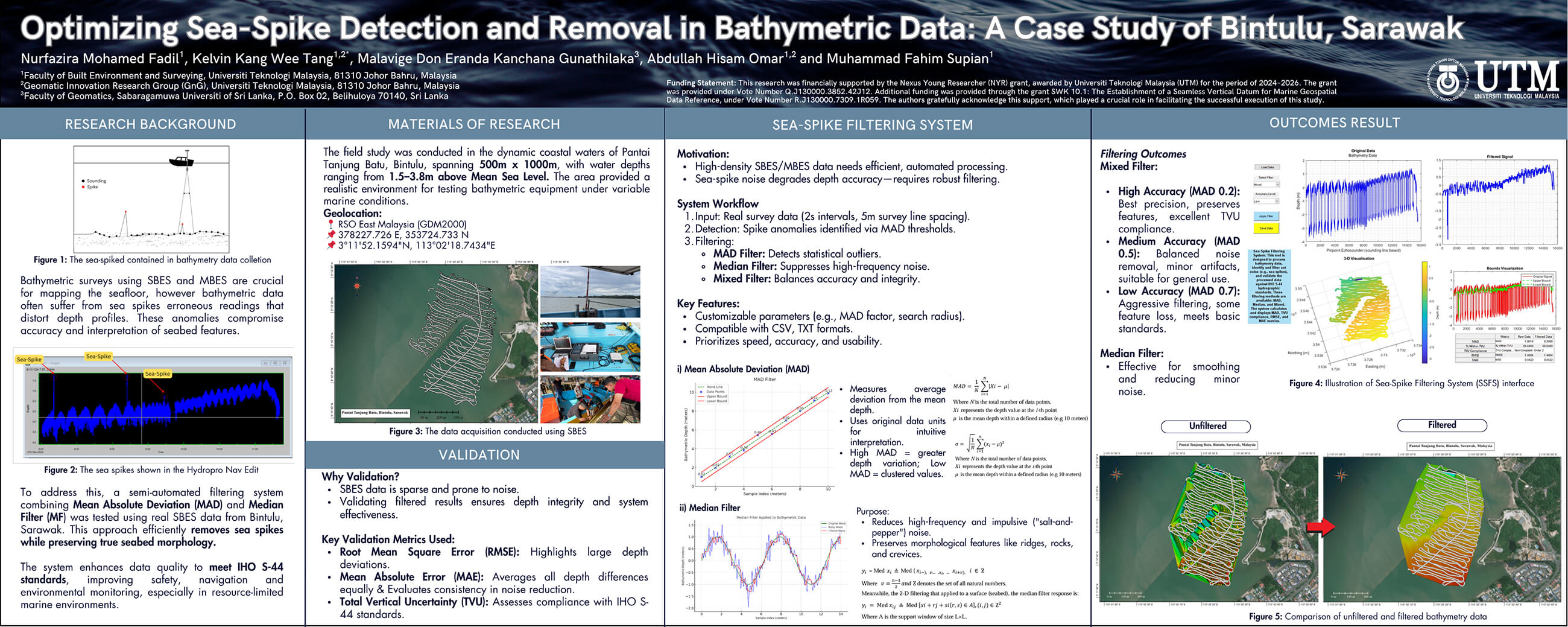
Single-beam echo sounders remain popular for seabed mapping because they possess an affordable cost and user-friendly design, delivering essential services for marine navigation, coastal management and resource conservation. High-amplitude echoes known as sea-spikes can severely harm depth measurement precision by disrupting readings, thus lowering the overall data accuracy. The manual processing method for outliers produces subjective results and demands excessive labor, which makes it difficult to accomplish trustworthy data processing. The study presents the Sea-Spike Filtering System (SSFS) as a semi-automatic system that utilizes mean absolute deviation (MAD) together with median filter (MF) techniques to efficiently find and eliminate false data in sea observations. The SSFS system showed reliable noise reduction abilities when tested with actual bathymetric data from Bintulu, Sarawak, thus delivering data quality upgrades that fulfilled 59.39% of International Hydrographic Organization (IHO) Order 2 Total Vertical Uncertainty (TVU) guidelines. The Mean Absolute Deviation value decreased substantially from 1.0618 to 0.4314, which enhanced noise reduction without influencing the Residual Mean Square Error or Mean Absolute Error statistics of 1.4188 and 0.9663 m, respectively. The successful elimination of sea-spike outliers through the system leads to general-purpose survey accuracy, yet more system improvements are required to meet the demanding safety standards in shallow water applications.Graphic Abstract
Keywords
Cite This Article
 Copyright © 2025 The Author(s). Published by Tech Science Press.
This work is licensed under a Creative Commons Attribution 4.0 International License , which permits unrestricted use, distribution, and reproduction in any medium, provided the original work is properly cited.
 Downloads
 Citation Tools
