
 Login
Login Register
 Submit a Paper
 Propose a Special lssue
 Open Access
ARTICLE

Predicting Soil Carbon Pools in Central Iran Using Random Forest: Drivers and Uncertainty Analysis
1 Department of Geography, Faculty of Geographical Sciences, Isfahan University, Isfahan, 81746-73441, Iran
2 State Key Laboratory of Desert and Oasis Ecology, Xinjiang Institute of Ecology and Geography, Chinese Academy of Sciences, Urumqi, 830011, China
3 Department of Soil Science, College of Agriculture, Isfahan University of Technology, Isfahan, 84156-83111, Iran
4 Soil Resource Management, Department of Soil Science, Faculty of Agriculture, University of Tehran, Karaj, 77871-31587, Iran
* Corresponding Author: Shamsollah Ayoubi. Email:
# These authors contributed equally to this work
(This article belongs to the Special Issue: Application of Remote Sensing and GIS in Environmental Monitoring and Management)
Revue Internationale de Géomatique 2025, 34, 809-829. https://doi.org/10.32604/rig.2025.069538
Received 25 June 2025; Accepted 27 August 2025; Issue published 06 November 2025
 View Full Text
 Download PDF
Abstract
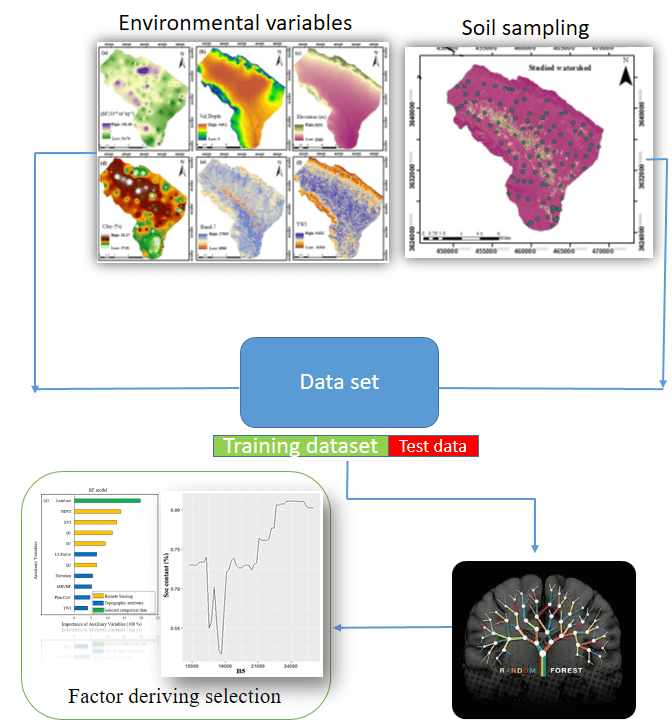
Accurate spatial prediction of soil organic carbon (SOC) and soil inorganic carbon (SIC) is vital for land management decisions. This study targets SOC/SIC mapping challenges at the watershed scale in central Iran by addressing environmental heterogeneity through a random forest (RF) model combined with bootstrapping to assess prediction uncertainty. Thirty-eight environmental variables—categorized into climatic, soil physicochemical, topographic, geomorphic, and remote sensing (RS)-based factors—were considered. Variable importance analysis (via) and partial dependence plots (PDP) identified land use, RS indices, and topography as key predictors of SOC. For SIC, soil reflectance (Bands 5 and 7, ETM+), topography, and geomorphic units were most influential. Climatic factors showed minimal impact in the studied semi-arid watershed. The RF model achieved moderate prediction accuracy (SOC: R2 = 0.43 ± 0.13, nRMSE = 0.28; SIC: R2 = 0.47 ± 0.11, nRMSE = 0.37). Via and PDP analyses enhanced model interpretability by clarifying environmental influences on SOC/SIC spatial distribution.Graphic Abstract
Keywords
Cite This Article
 Copyright © 2025 The Author(s). Published by Tech Science Press.
This work is licensed under a Creative Commons Attribution 4.0 International License , which permits unrestricted use, distribution, and reproduction in any medium, provided the original work is properly cited.
 Downloads
 Citation Tools
