Guest Editor(s)
Dr. Marco Gatta
Email: marco.gatta@opigeo.eu
Affiliation: OPIGEO Srl – spin-off of the University of Padova.
Via dell’Industria, Grisignano di Zocco (Vicenza), Italy
Homepage:
Research Interests: cement mineralogy, recycling of mineral waste material science, construction materials, circular economy, industrial symbiosis, water treatment

Dr. Maurizio (Pietro) Bellotto
Email: maurizio.bellotto@opigeo.eu
Affiliation: OPIGEO Srl – spin-off of the University of Padova.
Via dell’Industria, Grisignano di Zocco (Vicenza), Italy
Homepage:
Research Interests: material science, soft matter, construction materials, circular economy, industrial symbiosis, hydrometallurgy, pyrometallurgy, water treatment
Dr. Vesna Zalar Serjun
Email: vesna.zalar@zag.si
Affiliation: Department of Materials, Laboratory for Stone, Aggregate and Recycled materials, Slovenian National Building and Civil Engineering Institute, Ljubljana, Slovenia
Homepage:
https://orcid.org/0000-0003-1658-2466
Research Interests: construction and building materials, recycling, circular economy, industrial by products, hydration, immobilization, microstructure, environmental impact, phase composition

Dr. Andrea Bisciotti
Email: andrea.bisciotti@unife.it
Affiliation: Department of Physics and Earth Science, University of Ferrara, Ferrara, Italy; University of Ferrara, Ferrara, Italy
Homepage:
Research Interests: cement mineralogy, recycling of mineral waste, supplementary cementitious Materials (SCMs), X-ray powder diffraction, machine learning

Summary
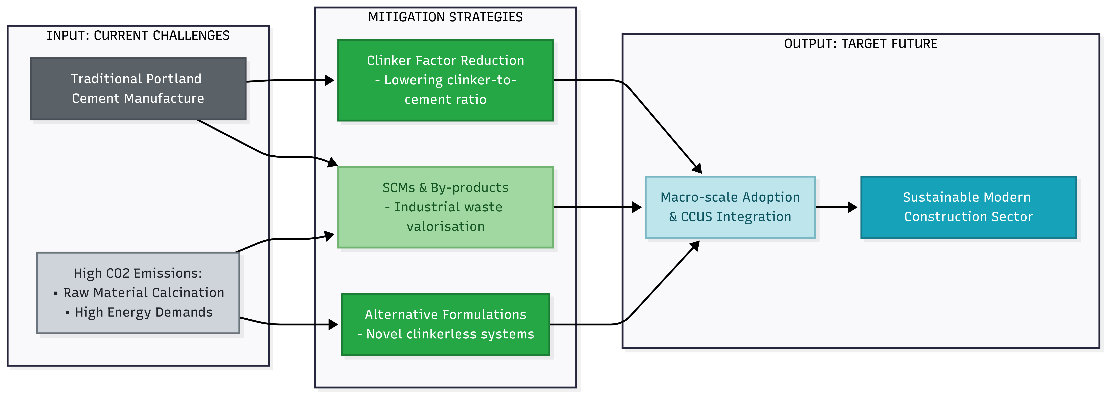
The construction sector, and specifically cement and concrete production, is currently at the forefront of the transition towards low-carbon manufacturing paradigms. Indeed, Portland cement synthesis entails substantial CO₂ emissions, stemming from both the calcination of raw materials during clinkerisation and the intensive energy demands of the manufacturing process. This pressing imperative to mitigate the sector's environmental footprint has catalysed the development of mitigation strategies. These focus on reducing the clinker factor, valorising alternative raw materials and industrial by-products, and fundamentally redesigning the formulation and processing of cementitious binder systems. Within this framework, research into low-embodied-carbon binders constitutes a pivotal vector for sector-wide decarbonisation. Concurrently, it introduces critical challenges regarding material performance, feedstock availability, industrial scalability, and regulatory compliance.
This special issue evaluates the prospects for the industrial deployment of low-carbon binders. It reviews state-of-the-art technologies and emerging alternatives, focusing heavily on their technology readiness levels (TRLs), CO₂ mitigation potential, and compatibility with existing production infrastructure.
The core areas of discussion include:
· The industrial deployment prospects of low-carbon binder systems
· The paradigm of the circular economy within cement manufacturing
· The incorporation of supplementary cementitious materials (SCMs)
· Innovations in alternative clinkerless formulations and integration with carbon capture, utilisation, and storage (CCUS) technologies.
By synthesising insights from academic research, industrial practices, and regulatory frameworks, this special issue delineates the opportunities and primary enabling factors that will govern the macro-scale adoption of low-emission binders, thereby driving the sustainable transformation of the construction sector.
Graphic Abstract
Keywords
low-carbon binders, cement and concrete decarbonisation, portland clinker reduction, Supplementary Cementitious Materials (SCMs), industrial by-products valorisation, alternative binder systems, Carbon Capture, Utilisation, and Storage (CCUS), Technology Readiness Levels (TRLs), sustainable construction materials

 Login
Login Register
 Submit a Paper
 Propose a Special lssue