
 Login
Login Register
 Submit a Paper
 Propose a Special lssue
 Open Access
ARTICLE
Asynchronous Tiered Federated Learning Storage Scheme Based on Blockchain and IPFS
1 College of Information Engineering, Shanghai Maritime University, Shanghai, 201306, China
2 Department of Computer Science and Information Engineering, Providence University, Taichung City, 43301, Taiwan
* Corresponding Author: Kuan-Ching Li. Email:
Computers, Materials & Continua 2025, 83(3), 4117-4140. https://doi.org/10.32604/cmc.2025.063630
Received 20 January 2025; Accepted 31 March 2025; Issue published 19 May 2025
 View Full Text
 Download PDF
Abstract
As is known, centralized federated learning faces risks of a single point of failure and privacy breaches, and blockchain-based federated learning frameworks can address these challenges to a certain extent in recent works. However, malicious clients may still illegally access the blockchain to upload malicious data or steal on-chain data. In addition, blockchain-based federated training suffers from a heavy storage burden and excessive network communication overhead. To address these issues, we propose an asynchronous, tiered federated learning storage scheme based on blockchain and IPFS. It manages the execution of federated learning tasks through smart contracts deployed on the blockchain, decentralizing the entire training process. Additionally, the scheme employs a secure and efficient blockchain-based asynchronous tiered architecture, integrating attribute-based access control technology for resource exchange between the clients and the blockchain network. It dynamically manages access control policies during training and adopts a hybrid data storage strategy combining blockchain and IPFS. Experiments with multiple sets of image classification tasks are conducted, indicating that the storage strategy used in this scheme saves nearly 50 percent of the communication overhead and significantly reduces the on-chain storage burden compared to the traditional blockchain-only storage strategy. In terms of training effectiveness, it maintains similar accuracy as centralized training and minimizes the probability of being attacked.Keywords
With the technological advancements in computing and communication technologies, mobile communication equipment and Internet of Things (IoT) devices can generate huge amounts of data suitable for model training. However, these data often have privacy restrictions on usage, making it impossible to aggregate them for model training. The concept of “Federated Learning” was first introduced by McMahan et al., which allows training data to be distributed across different local devices [1]. Participating parties no longer need to share the raw training data but can collectively train a global model by sharing their local model. However, synchronous federated learning algorithms suffer from issues such as inconsistent communication efficiency among participants and imbalanced computational speed [1–3], and the central server has to wait for the slowest device to respond before proceeding to the next round of training. Moreover, a large number of clients upload their model parameters to the server, causing the transmission bottleneck.
To address the aforementioned challenges, Xie et al. have proposed asynchronous federated optimization methods based on traditional federated learning algorithms [4,5]. Chai et al. have introduced asynchronous federated training methods based on a hierarchical approach, where clients are divided into different layers based on response latency and asynchronously communicate with the server [6,7]. This hierarchical mechanism better adapts to the device heterogeneity and enhances the overall performance of federated training.
However, existing federated learning algorithms are designed assuming the central aggregator is secure. In practical scenarios, a malicious central aggregator may steal or tamper with model data, leading to privacy breaches or disruption of normal training. Furthermore, malicious participants can launch poisoning attacks by uploading malicious model parameters or gradients, introducing a backdoor into the model, and causing the global model to train in a direction unfavorable for convergence.
To address the security issues as mentioned above, Lyu et al. proposed differential privacy [8], while Truex et al. introduced a fully homomorphic encryption algorithm [9]. However, these methods suffer from issues such as slow speed and lack of decentralization due to the introduction of noise or extensive use of encryption algorithms. In recent years, an increasing number of researchers have utilized blockchain to manage the federated learning model training process and data storage management. For instance, Goel et al. leveraged blockchain technology to store CNN models by storing each layer of the model in blocks of the blockchain. The blockchain’s hash chain structure was utilized to provide tamper resistance and secure verification for the model [10]. Mondal et al. employed smart contracts in blockchain to achieve distributed machine learning, eliminating centralization and utilizing differential privacy techniques to counter poisoning attacks [11]. Feng et al. proposed a blockchain-based asynchronous federated learning framework that optimized the control of block generation rate to reduce the latency of federated learning. It dynamically adjusted the training frequency of asynchronous federated learning to prevent frequent uploads of local models, which could overload blockchain transactions [12].
In practical IoT scenarios such as IoT, mobile edge networks, computer vision, and finance, collaborative federated training is a holistic process that includes local training, device interactions, and model aggregation on the server. Security vulnerabilities can arise at any point. At the algorithm level, as a widely used technique, federated learning typically requires a framework that strikes a balance between model convergence speed, model accuracy, cross-client fairness, communication efficiency, and security [13]. Meanwhile, due to the collaborative nature of the training process, federated learning faces security issues at the management level as well. Wang et al. proposed a blockchain-based secure data aggregation strategy for edge computing-enabled IoT [14]. They also proposed a blockchain-based heterogeneous hierarchical trust assessment strategy for 5G-ITS using joint deep learning techniques [15].
In addition, access control technology [16,17], as an information security mechanism, is widely used in managing access permissions for resources or information on the blockchain because it can be efficiently deployed on the blockchain through smart contracts [18–20]. For example, Li et al. implemented medical device supply chain management through access control smart contracts [21]. Jiang et al. proposed a blockchain-based trusted model evaluation framework for deep learning and applied it in mobile object segmentation and designed access control policies to manage operations on blockchain [22].
One of the challenges faced by blockchain-based federated learning is the heavy burden of on-chain storage when dealing with a large-scale model. Large-scale models possess more robust representational capabilities and significantly improve performance in various tasks such as natural language processing, computer vision, and speech recognition, however, they impose significant communication and storage burdens on federated training. To address this problem, Wang et al. utilized ASTORE to alleviate system storage overhead [23]. Jiang et al. employed IPFS as an auxiliary storage tool for model files in the blockchain system to alleviate the on-chain storage burden [22]. Introducing IPFS as an additional distributed storage service can share part of the data storage pressure for the blockchain, providing new possibilities for solving the storage performance bottleneck problem of blockchain-based federated training.
Currently, two main issues have not been effectively addressed in existing research on blockchain-based federated learning. Firstly, the increasing number of clients and the complexity of models lead to a heavier storage burden on the blockchain and a surge in communication volume. Secondly, the security of communication between the clients and the nodes on the blockchain has not been adequately considered in previous work. To fill this research gap, we propose a storage scheme for asynchronous tiered federated learning based on blockchain and IPFS, which is not dependent on specific blockchain platform architecture, making it highly scalable and suitable for various research and production applications. At the technical level, the strategy employed in our scheme differs from the existing work. The proposed blockchain-based federated learning scheme demonstrates good storage performance, high communication efficiency, and secure privacy protection by access control policies. The main contributions and innovations are as follows:
1. We apply the asynchronous tiered federation learning aggregation algorithm to the blockchain framework and design a layered blockchain-based architecture that ensures decentralization and security of the asynchronous federation aggregation process.
2. We design an access control model based on asynchronous tiered federated learning and deploy it in smart contracts to achieve decentralized permission management of clients, which has not been proposed in any other research.
3. This scheme designs and implements a hybrid on-chain and off-chain storage strategy for federated learning with the help of IPFS distributed file system, which is safe, efficient, and effectively reduces the storage burden and communication overhead of the blockchain in the process of federated training.
4. The proposed scheme applies to any deep learning model and any blockchain platform, demonstrating robust scalability. We deploy the scheme on the Hyperledger Fabric framework and showcase its full functionality. Finally, we conduct experiments on multiple datasets and settings to validate and analyze this scheme’s federated training effectiveness, storage performance, communication overhead, and security.
5. We compare this scheme with several other federated learning frameworks, and our security analysis demonstrates the effectiveness of the proposed scheme in countering model inference attacks, backdoor attacks, illegal client connection attacks, data theft, data forgery, and identity forgery attacks.
The remainder of this work is organized as follows. In Section 2, we present the background knowledge for this work. In Section 3, we provide a detailed description of the overall architecture, operational steps, and module designs of the proposed scheme. In Section 4, we present the necessary experimental procedures and results, analyzing them from storage performance, communication performance, and security perspectives. Finally, concluding remarks and future research works are given in Section 5.
In this section, we present some background knowledge and necessary concepts for the proposed research.
2.1 Asynchronous Tiered Federated Learning
The most used method in federated learning is FedAvg, where the training approach involves randomly selecting a subset of clients to participate in aggregation during each round of training and synchronously waiting for responses from all selected clients [1]. However, FedAvg encounters the straggler issue when dealing with large-scale edge devices due to limitations in computational and communication capabilities, making it challenging to achieve global synchronization among clients and thus resulting in slow training speed [4].
To address the abovementioned issues, Chai et al. proposed a layered asynchronous training approach to mitigate the heterogeneous latency issue among different devices [6,7]. The strategy based on layered federated training is that the central server allocates clients to different logical layers based on their response latency before formal training. During each round of training, the central server only needs to wait for clients with similar response speeds within the same layer, effectively improving training efficiency and accelerating the convergence of the global model.
Blockchain is a decentralized tamper-proof ledger that is widely used and consists of a series of records called “blocks” that are linked together using specific cryptographic algorithms [24]. The blocks are maintained in a network of several mutually distrusting peer nodes, with each peer maintaining a copy of the ledger, thus eliminating the reliance on a centralized institution [25]. Blockchain platforms typically support programmable script execution. Cryptocurrencies like Bitcoin use scripts to validate transactions [26], while platforms like Hyperledger Fabric employ smart contracts as trusted decentralized applications [27]. Smart contracts can replace the central aggregator in federated learning and handle tasks such as managing model storage, exchange, and aggregation. To ensure scalability, this work investigates the architecture of mainstream blockchain platforms, as shown in Table 1.
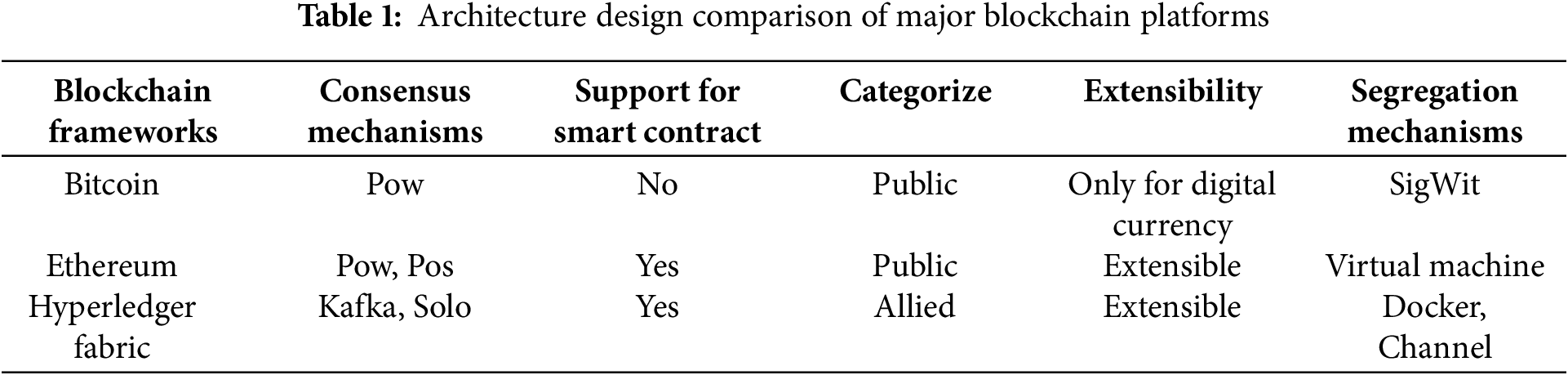
Compared to various blockchain frameworks in the research results, Hyperledger Fabric is more friendly to supporting smart contracts, adopts a consortium chain-level privacy architecture, and is easy to deploy. Most importantly, due to its robust scalability, it can support smart contracts for different businesses, making it more convenient for practical applications. Considering the above factors, Hyperledger Fabric is selected as the blockchain platform to support the deployment of this scheme.
2.3 Attribute-Based Access Control Model
Attribute-Based Access Control (ABAC) is a fine-grained and flexible authorization model that checks whether a user has the permissions to perform operations on an object based on entity attributes, action types, and relevant environment conditions [28]. The ABAC model consists of AS (authorization subject), AO (authorization object), EE (environment entity), and AP (authorization policy), which together form the access rule. Administrators assign specific values to these four components based on access rules, creating an access control policy,
However, applying ABAC carries the risk that if the ABAC access control policies are illegitimately created, the private data protected by this authorization model may be at risk of leakage. Blockchain technology can address these risks with its anonymity, immutability, and decentralization, and it can protect and provide traceability to access control policies.
Deep learning is an important branch of machine learning, and various deep learning frameworks are popular in academia and industry, such as PyTorch, TensorFlow, and Keras. They all assist in saving complex model parameters as binary files and reloading model parameters when needed. In practical federated learning scenarios, participants cannot exchange model parameters by passing specific model variables as they would in a local setting. An effective solution is to communicate by exchanging model parameter files in a consistent format. Therefore, we need a secure and efficient model storage technology to support federated learning applications in real-world scenarios.
Common model storage technologies include data encryption, access control, blockchain, and the Inter Planetary File System (IPFS). As a decentralized, distributed, and tamper-proof digital ledger, blockchain is often used as a secure data storage platform. However, as the amount of data on the blockchain increases, it becomes essential to allocate on-chain storage space effectively to store more valuable information.
IPFS is a peer-to-peer distributed file storage system [29]. It utilizes content-based addressing. When a user initiates a file upload request, the IPFS service generates a content identifier (CID) based on the file’s content hash value and returns the CID as the unique identifier for the file. IPFS offers high-performance data transmission and decentralized storage services, and the content-based addressing mechanism provides it with a certain level of tamper resistance.
In this section, we present a secure and efficient scheme for federated training and data storage that ensures strict privacy protection. Based on blockchain technology, it utilizes access control techniques to validate the legitimacy of client requests, employs an asynchronous, tiered federated aggregation algorithm for federated training, and adopts an on-chain and off-chain hybrid model storage strategy to improve communication efficiency and alleviate the storage burden on the blockchain.
Assuming
The potential threat scenarios that this scheme may face are limited to the following situations. Curious clients may attempt to access the updated model parameters of other participants during the training process and plan attack behaviors based on them. For instance, the attribute inference attack utilizes stolen model parameters as input features to train attack models and infer the sensitive attributes of other participant’s data [30]. Malicious clients may also attempt to connect with the blockchain network to carry out disruptive actions such as short-link non-poisoning backdoor attacks [31,32].
The proposed scheme consists of three main modules: the federated training module, the access control module, and the data storage module. The system framework is illustrated in Fig. 1.

Figure 1: The system architecture
The federated training module is responsible for federated aggregation. Smart contracts deployed on the blockchain act as central aggregators to avoid a single point of failure. The access control module manages the interaction process between clients and the blockchain. Any requests submitted by clients to the blockchain must undergo identity verification and access control policy validation. Access privileges to the global model for different rounds are dynamically generated during the training process. The data storage module consists of the blockchain network and IPFS service, which manages client identity information, dynamic access control policies, and model resources. The data required by access control policy and CIDs of model files are stored on the blockchain network in a
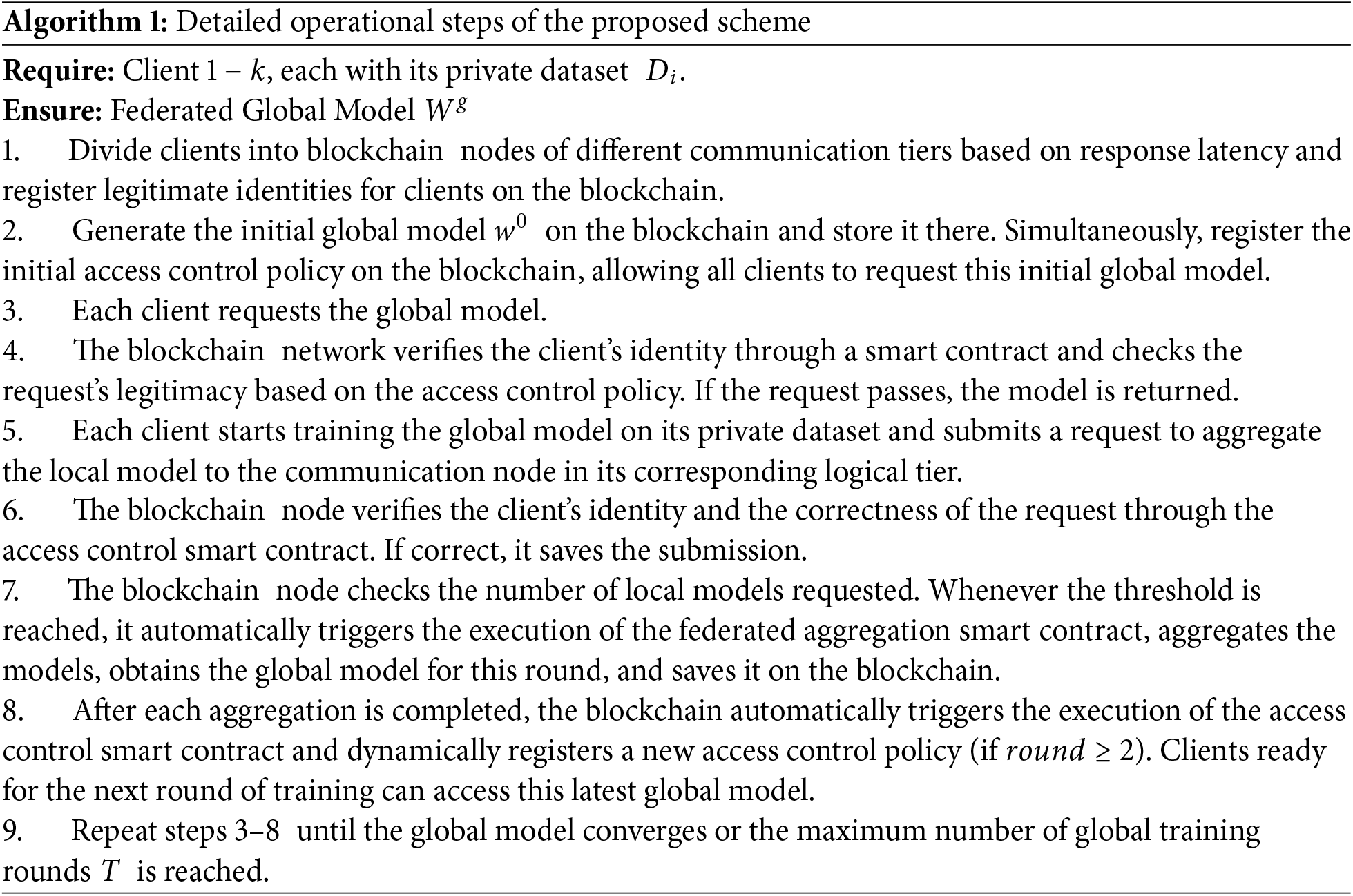
The detailed operational steps of this scheme are provided in Algorithm 1 and Fig. 2. Implementation details of each module will be discussed in subsequent sections.

Figure 2: The detailed implementation and the algorithm depicted in Algorithm 1
3.2 Blockchain-Based Asynchronous Tiered Federated Training
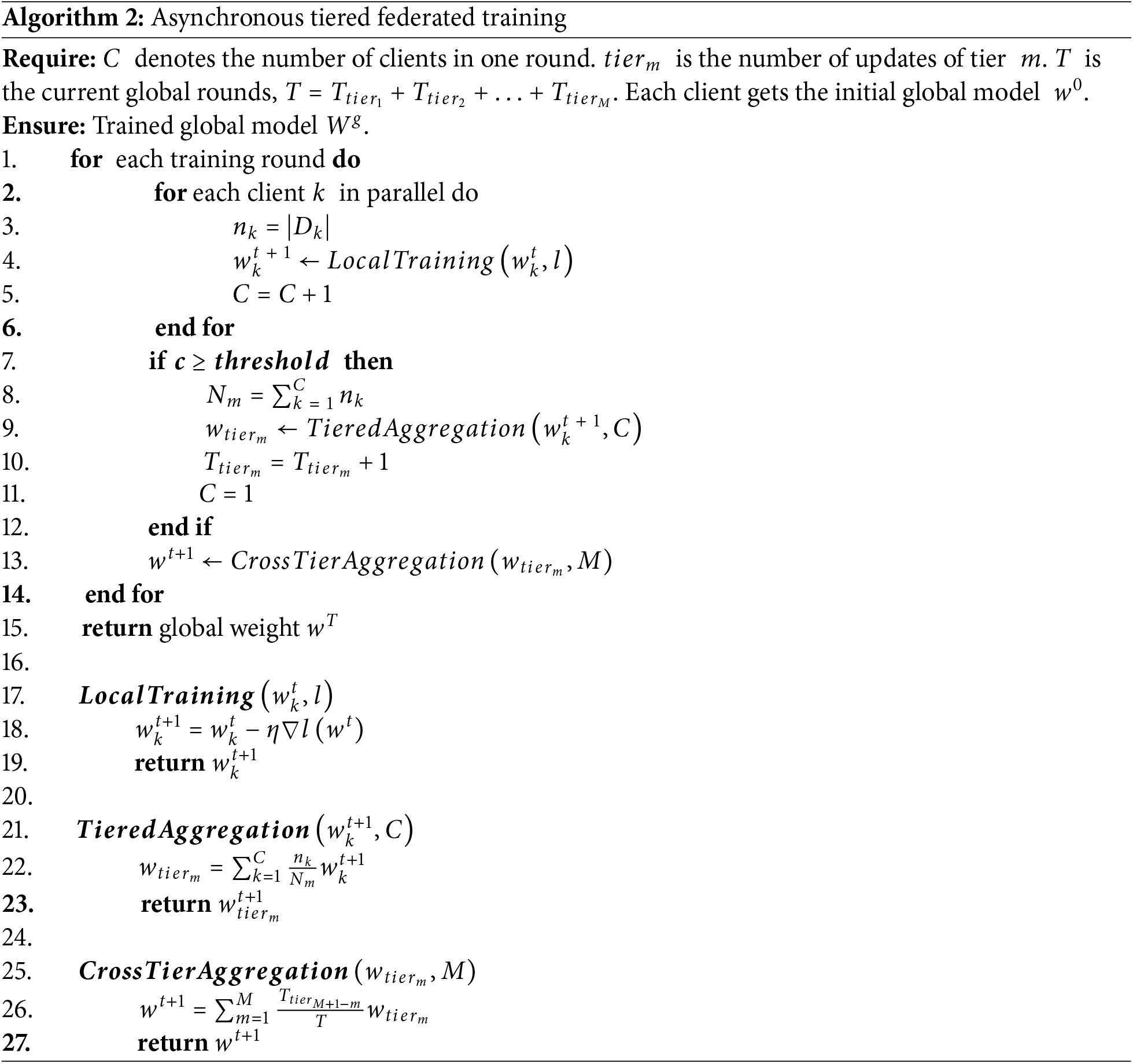
In the federated training module, model aggregation is managed by the federated aggregation smart contract. This contract implements a decentralized, asynchronous tiered federated aggregation algorithm. Before training begins, each client is assigned to a different logical communication layer based on their response latency. Considering that each node on the blockchain needs to store a copy of the data, in scenarios with many clients participating in training, it can impose a significant storage burden on the blockchain. To address this, we reduce the number of blockchain nodes and maintain one blockchain node participating in consensus for each logical communication layer, instead of assigning each client to a consensus node.
In each training round, clients complete local training and submit their local models to the blockchain. When the number of submissions from clients in the same layer reaches the set threshold, it automatically triggers the execution of the federated aggregation smart contract. This smart contract implements both intra-layer aggregation and inter-layer aggregation processes. Clients participating in aggregation within each round belong to the same layer and utilize Eq. (1).
To perform intra-layer aggregation to obtain the updated model for this layer, the intra-layer aggregation algorithm within the same layer is the Federated Averaging (FedAvg) algorithm introduced in Section 2.1. After updating the layer model for the current communication layer, Eq. (2) is applied.
To perform cross-layer global model aggregation and obtain the global model
Unlike other federated learning frameworks, the federated training process in this scheme is not led by a central server. Instead, it is orchestrated by smart contracts deployed on the blockchain acting as central aggregators, passively waiting for client requests, achieving an utterly decentralized management architecture. Model data is transmitted between clients and the blockchain network, and its security is maintained by the blockchain and access control smart contracts.
In our scheme, the interaction between clients and the blockchain network is divided into two categories: (1) To submit local models to the blockchain network. (2) To request the aggregated global model. The above processes correspond to security vulnerabilities that are twofold: (1) Unauthorized malicious clients may upload malicious local models to disrupt the entire federated training process. (2) The updated global model is stored on the blockchain. And the layer aggregation models for each layer and the local models submitted by each client are saved. Clients may access model data other than the global model, leading to privacy leaks.
To securely share model resources, this scheme uses access control to manage access requests from clients to the blockchain.
3.3.1 Definition of Access Control Model
The scheme adopts an Attribute-Based Access Control model (ABAC) to achieve fine-grained and flexible access control. The basic concepts of ABAC have been introduced in Section 2.3. In our scheme, the user entity (AS) represents the client, the object entity (AO) represents model resources, and the permission operation (AP) represents a client’s upload or access operation on-chain model resources. The definitions of attributes for each entity are provided below.
Definition 1. Cl ient defines the attributes of the client entity. Client = {ClientID, ClientTier, TierRound, GlobalRound}.
Definition 2.
3.3.2 Federated Secure Access Policies
The access control policy in this scheme is called the Federated Secure Access Policy (FSAP), where
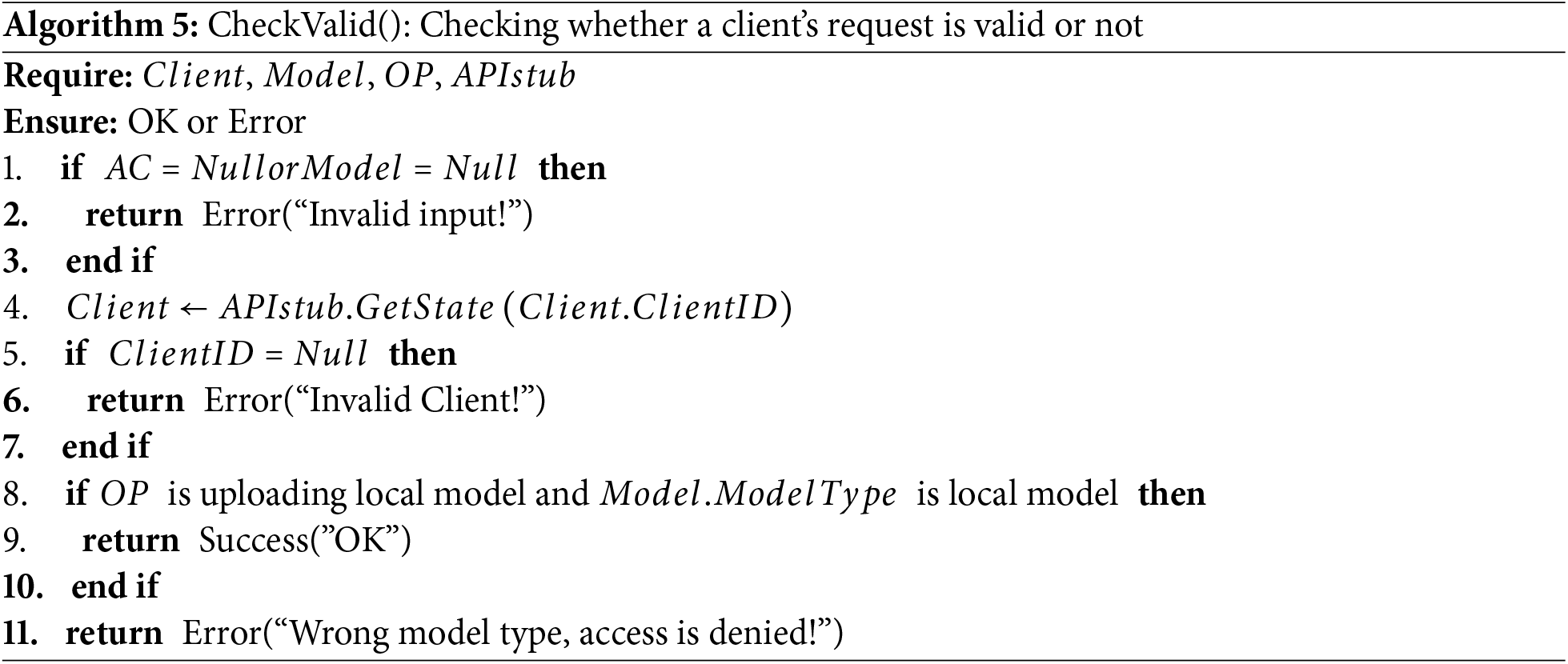
Before exchanging model data between clients and the blockchain network, identity legitimacy verification and access control request verification are required. Initially, an access control request
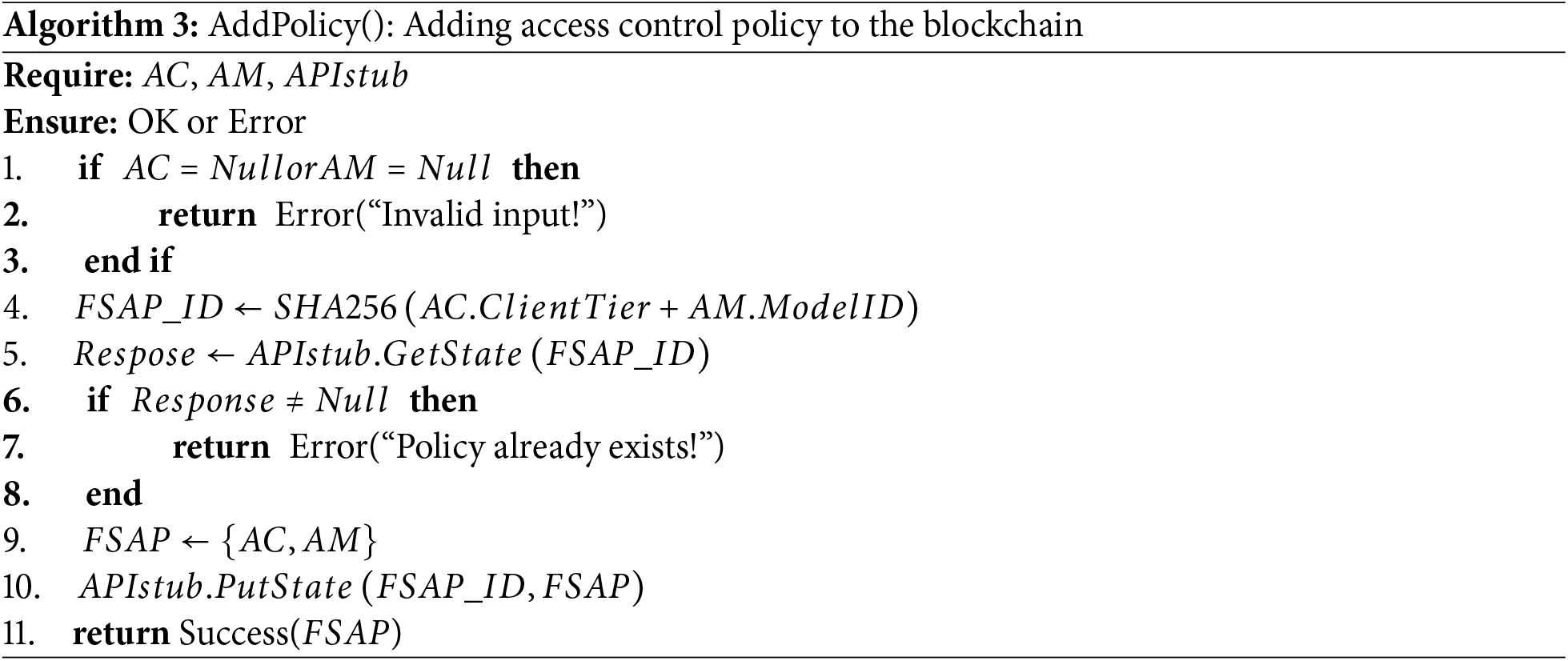
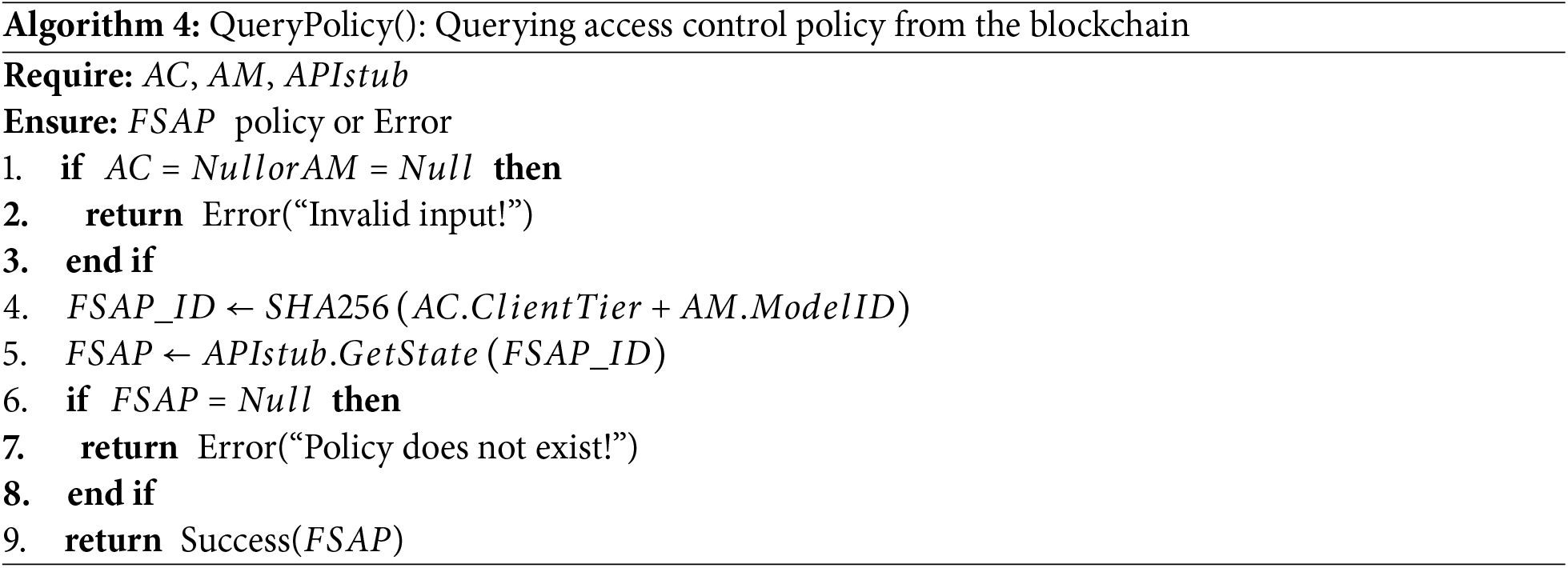
To achieve decentralized dynamic management of client access to on-chain resources, a smart contract named the Federal Secure Access Contract (FSAPC) is designed, which includes the following methods:
Algorithms 3–5 describe the main methods in this smart contract.
As the round of federated training increases, the data storage burden on the blockchain will intensify and throughput will also be constrained. This scheme employs a combined on-chain and off-chain storage strategy to reduce communication costs and storage burdens. The storage of client’s identity information and access control policies has been discussed in previous Section 3.3.2, and this section focuses on the exchange and storage strategy for model data.
In this work, IPFS is utilized as off-chain auxiliary storage service to store actual model files, generating a unique CID for each file. The CID returned by the IPFS service is encrypted and saved on blockchain as the attribute
In this storage strategy, clients and the blockchain no longer exchange actual model files. Clients upload the encrypted CID of their local model as part of the

Figure 3: Data flow of the proposed scheme, showing the data interactions between components
Explanation of each step in Fig. 3 is as follows:
1. The client uploads a local model file to IPFS service.
2. IPFS service returns the corresponding CID.
3. Client sends local model identifier to blockchain network.
4. Blockchain sends CID to IPFS service.
5. IPFS service returns the corresponding model file.
6. Blockchain returns a global model identifier.
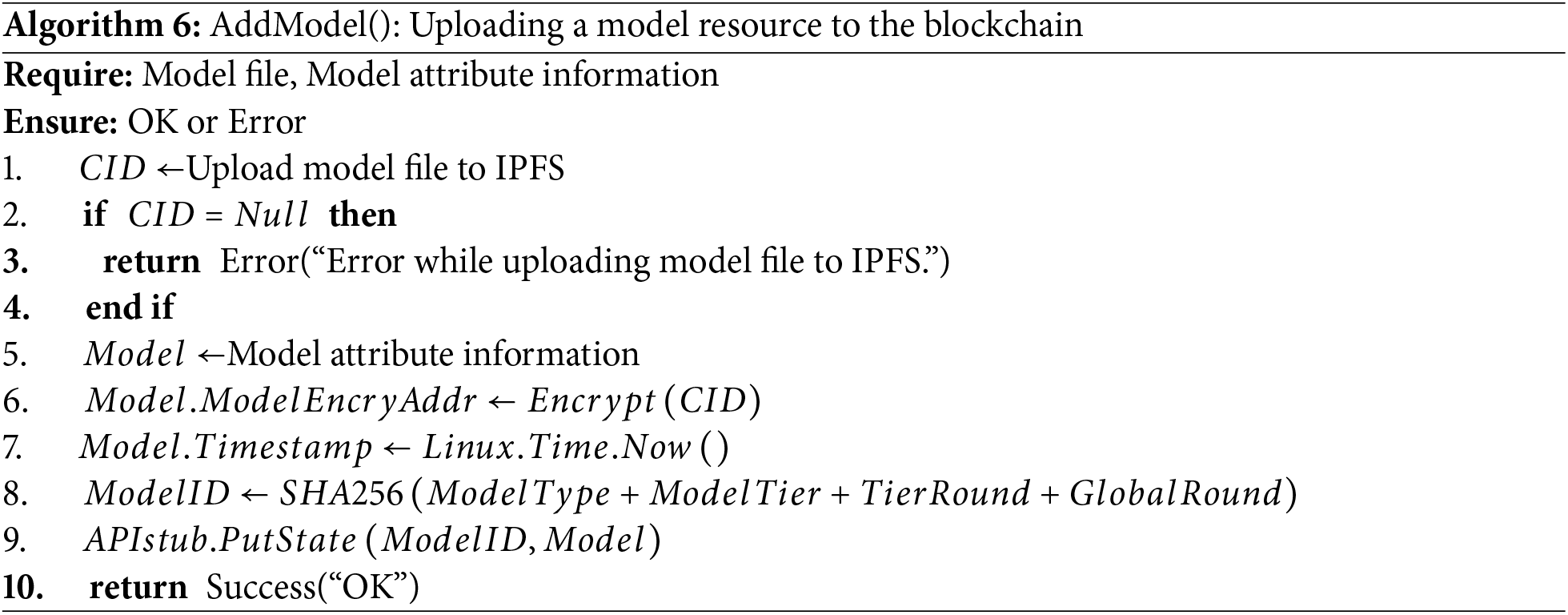
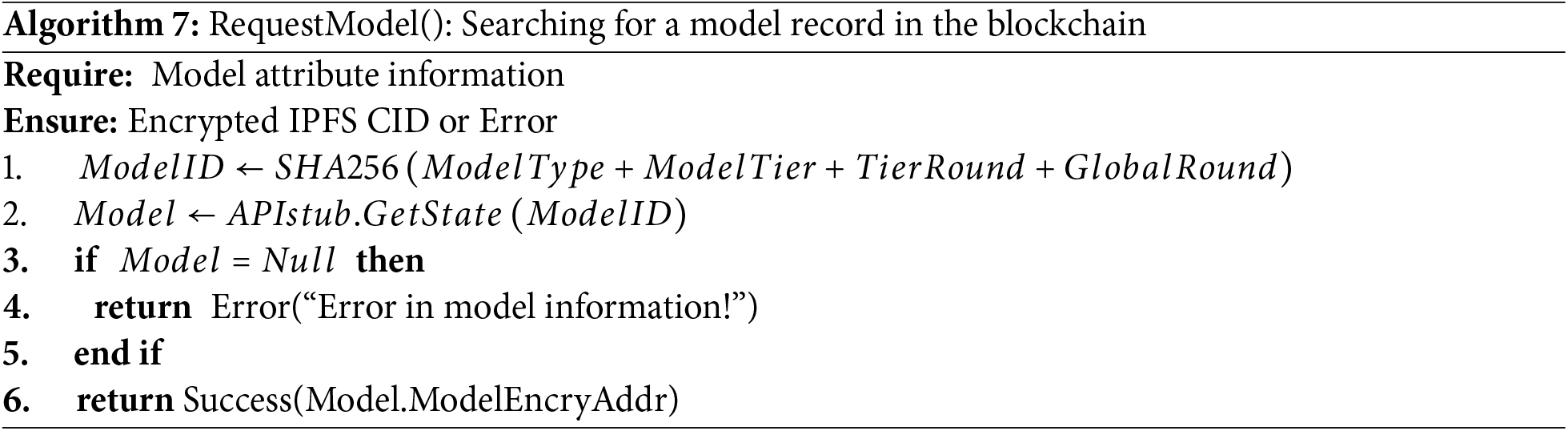
To achieve the decentralization and efficient management of the storage process described above, a Model Storage Smart Contract (MSC) is designed with the following main methods:
Algorithms 6 and 7 provide algorithmic descriptions of the two methods mentioned above.
As experimentation, we deployed the Hyperledger Fabric blockchain platform [27], utilized Golang for smart contract programming, employed Node.js for client applications, and executed all client nodes in separate Docker containers. All experiments were conducted on Linux servers equipped with Intel(R) Xeon(R) Silver 4214R CPU and RTX 3080Ti GPU, with 12 CPU cores and 45 GB RAM. The setup involved 40 clients distributed across 4 nodes on the blockchain network, each with 10 clients.
The federated learning training on convolutional neural networks performed in this research utilized the MNIST and CIFAR-10 standard datasets. MNIST comprises 60,000 training images of size 28 ∗ 28 and 10,000 test images, with 1 input channel and images categorized into 10 classes [33]. CIFAR-10 includes 50,000 training images of size 32 ∗ 32 and 10,000 test images, with 3 input channels and images categorized into 10 classes [34]. We randomly divide the data based on the data sample index. The local training settings were that local epoch set to 3, local batch size set to 10, and all clients using the same learning rate across different datasets.
This subsection demonstrates the key steps and functionalities of the experiments. As shown in Fig. 4 the smart contracts executed in the experiment, method names, and input parameters are marked with blue underlines, while the experiment results are marked with red underlines.

Figure 4: QueryPolicy execution result
Fig. 4 illustrates the query result of an FSAP access control policy on the blockchain, obtained by invoking the
Fig. 5 displays the verification result of a client’s request initiated on the blockchain. The client information and model information are the same as shown in Fig. 3. As described in Section 3.3.2, this client has undergone identity validation, operation type validation and access control policy validation through the
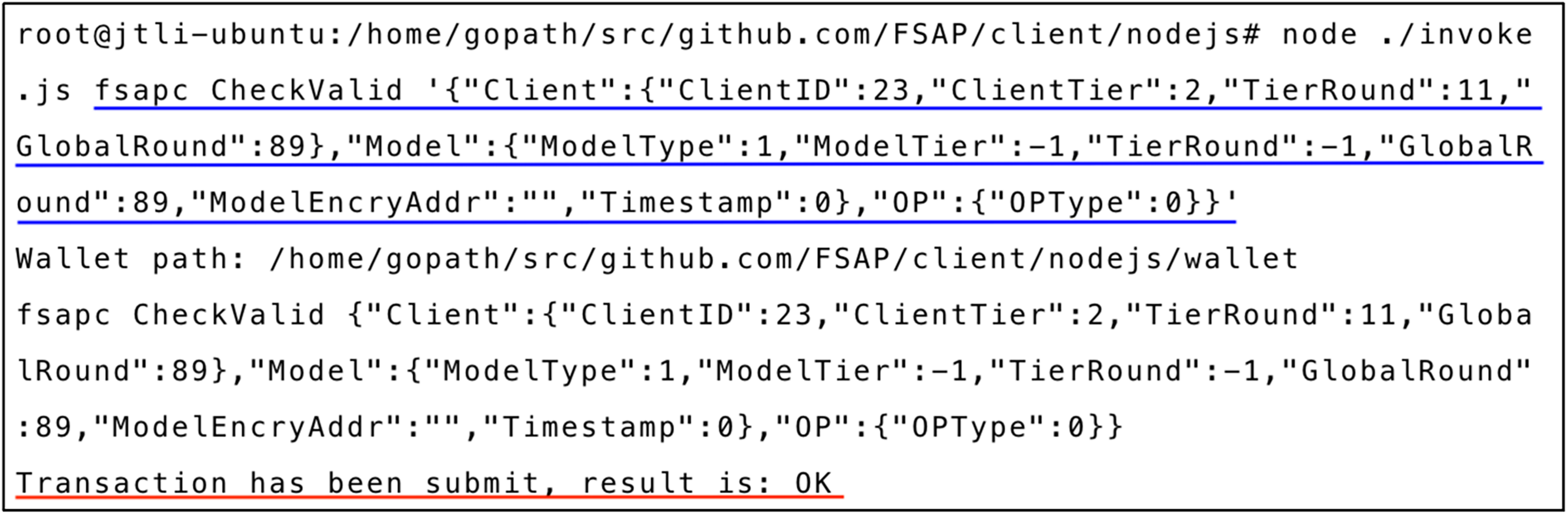
Figure 5: CheckValid execution result
Fig. 6 shows the result of adding model resource records to the blockchain ledger, obtained by calling the
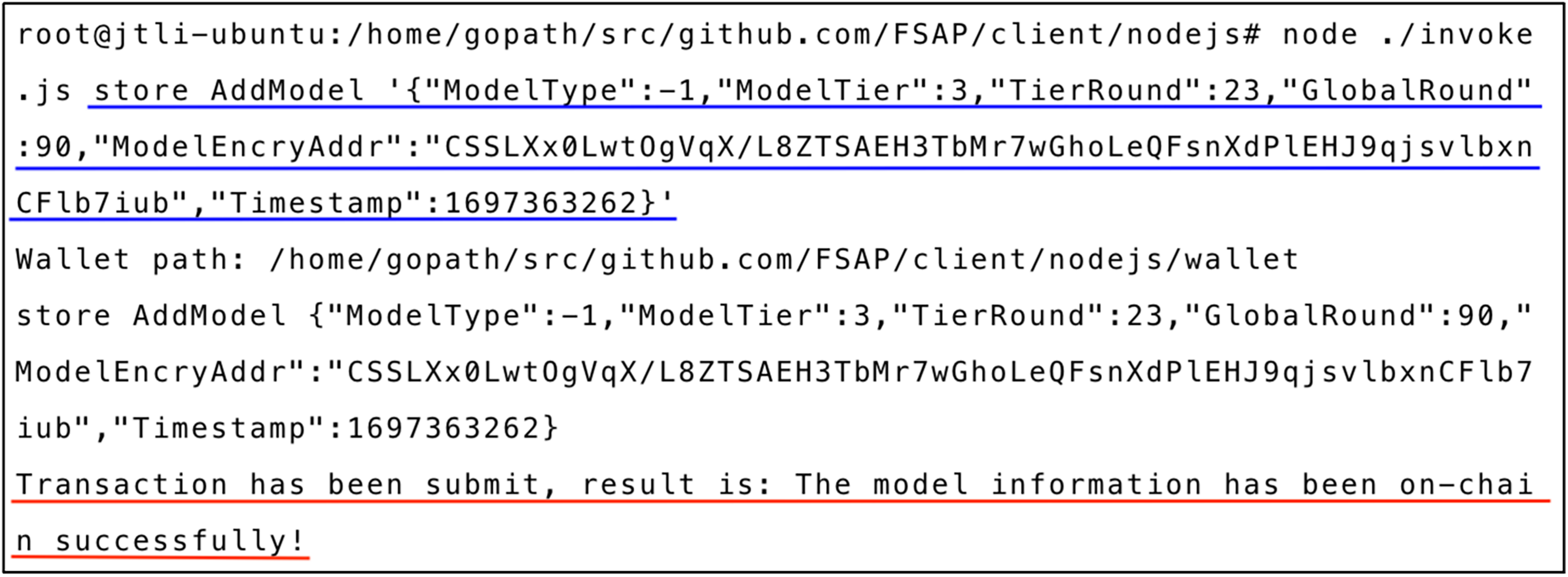
Figure 6: AddModel execution result
Fig. 7 illustrates the result of querying the global model for round 89 by executing the method
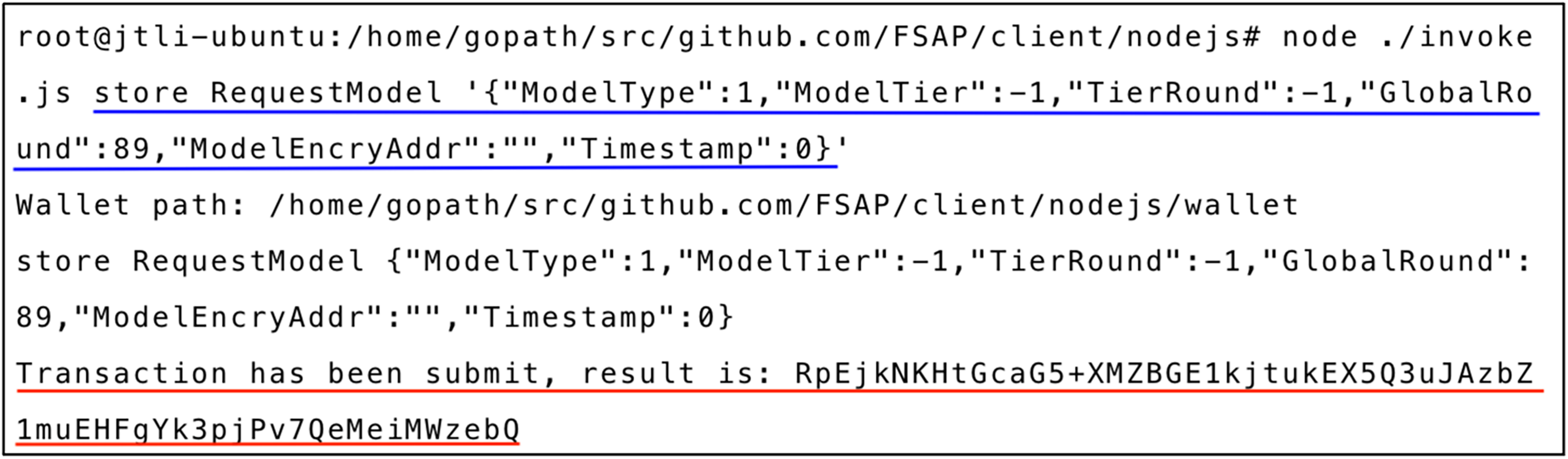
Figure 7: RequestModel execution result
Figs. 8 and 9 depict the results of an unauthorized access attempt. This unauthorized access was a random probe from a curious client. A client in communication layer 1 attempted to access a model in the global training round 92. The
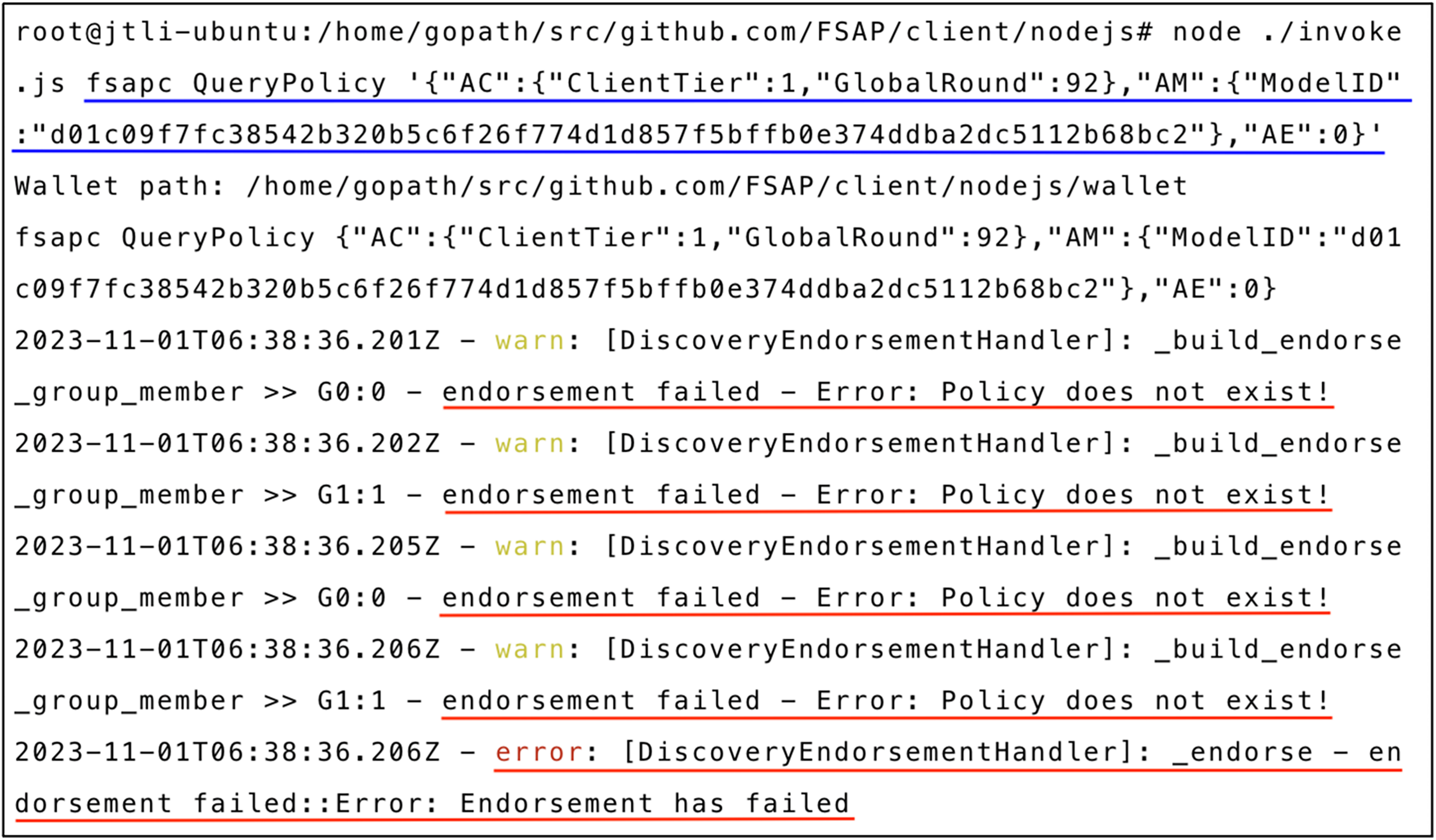
Figure 8: QueryPolicy query failure
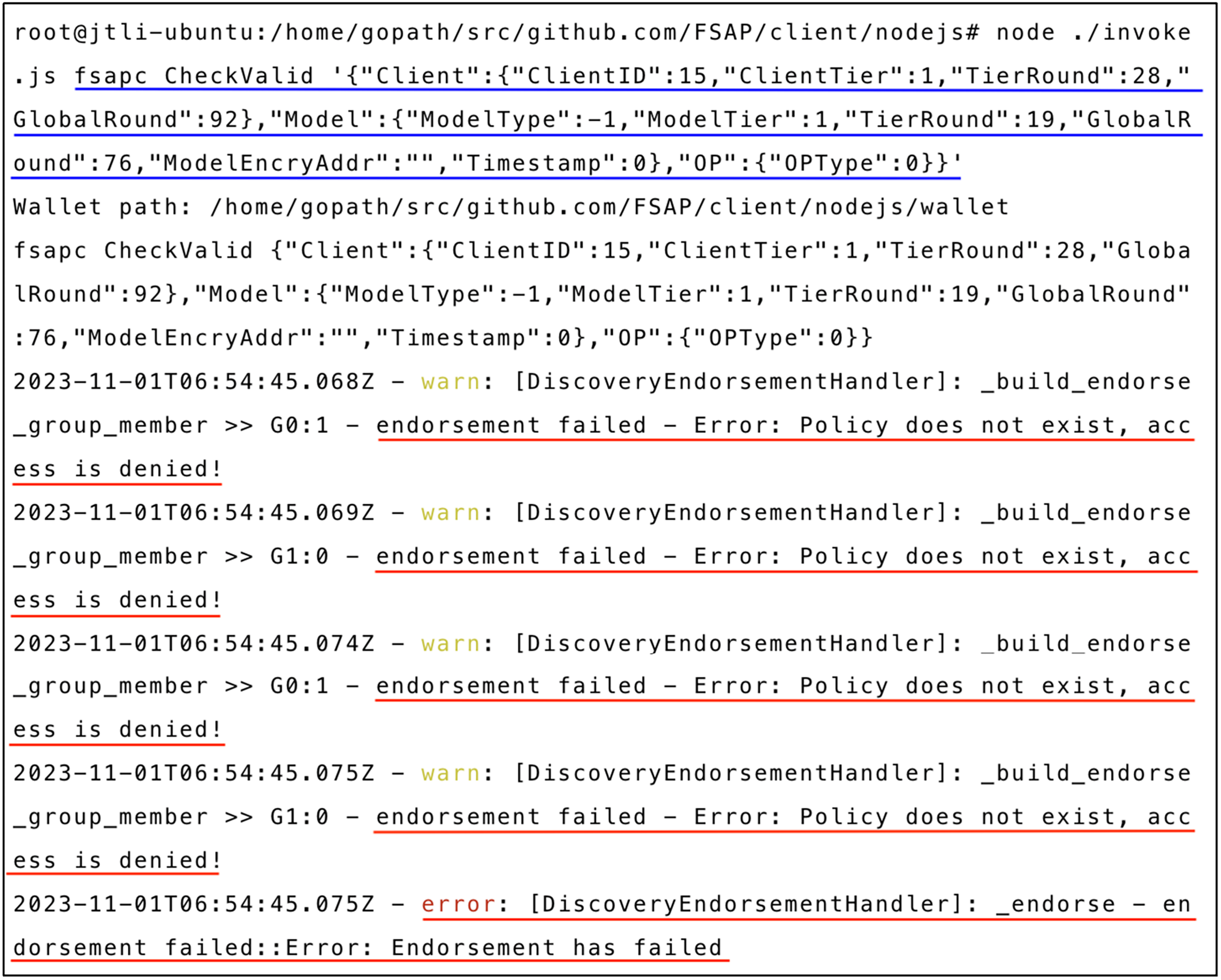
Figure 9: CheckValid verification failure
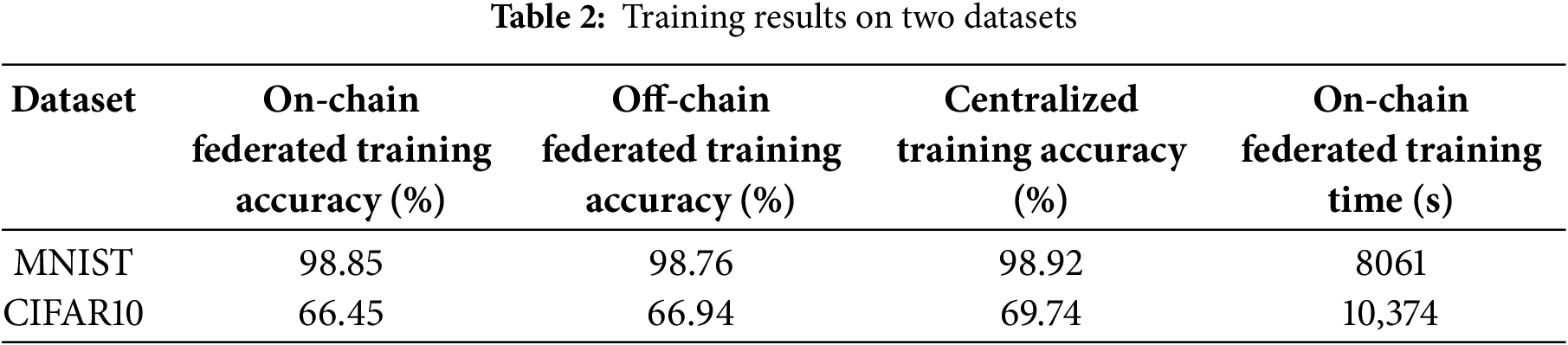
Fig. 10a,b and Table 2 demonstrate the federated training results of our experiments, including the accuracy rate and global elapsed time of training. The experimental results show that the blockchain-based asynchronous tiered federated learning algorithm used in this scheme achieves similar accuracy rates as centralized training. Compared to off-chain training without blockchain, the main time loss in this scheme is due to the time consuming for clients to exchange model data with the blockchain network, the execution time of multiple smart contracts and the consensus verification time of various nodes of the blockchain network. Among them, the node consensus time consumption is not within the scope of this work. We will provide a detailed analysis of the time overhead of this scheme in subsequent Section 4.2.2.

Figure 10: On-chain federated training performance. (a) On-chain federated training accuracy with global training rounds; (b) On-chain federated training accuracy over time
To verify the advantages of the collaborative storage strategy in this scheme, we compared multiple strategies based on the performance metric of the storage space occupied by model resources saved on-chain. Assuming the number of client requests submitted per round is
Our storage strategy is to reasonably compress the number of on-chain nodes based on the federated training hierarchy. Nodes on blockchain must store
For the hybrid storage strategy and the blockchain-only storage strategy, we only consider the storage space occupied by model resources, excluding client identities and dynamic access control policy data stored on the blockchain ledger. The model scale chosen for federated learning in this scheme is variable without an upper limit, and we conducted experiments using a model based on the CIFAR-10 dataset. The size of the model resource files used in this experiment is 895 KB, and according to statistics, each resource record on-chain requires storage space within 200 bytes. In the experimental setup, the global model converges around 100 rounds, and we observed the on-chain storage performance of the three storage strategies before 100 rounds during the experiment. As shown in Fig. 10a, before the accuracy reaches 0.6, we recorded the consumption of on-chain storage space for every 0.1 increase in accuracy. In the later stages of training, as the improvement in accuracy slows with the global training rounds after the accuracy reaches 0.6, we recorded the consumption of on-chain storage space for every 0.01 increase in accuracy. The graph shows that as the global model accuracy improves, the consumption of on-chain storage resources under the blockchain-only strategy increases sharply. In contrast, under the collaborative storage strategy used in this scheme, the consumption of on-chain storage resources changes very gradually. In Fig. 11b, we recorded the on-chain storage space consumption at global rounds 20, 40, 60, 80, and 100, showing that under the collaborative storage strategy, as the global rounds increase, less storage space is consumed on blockchain.
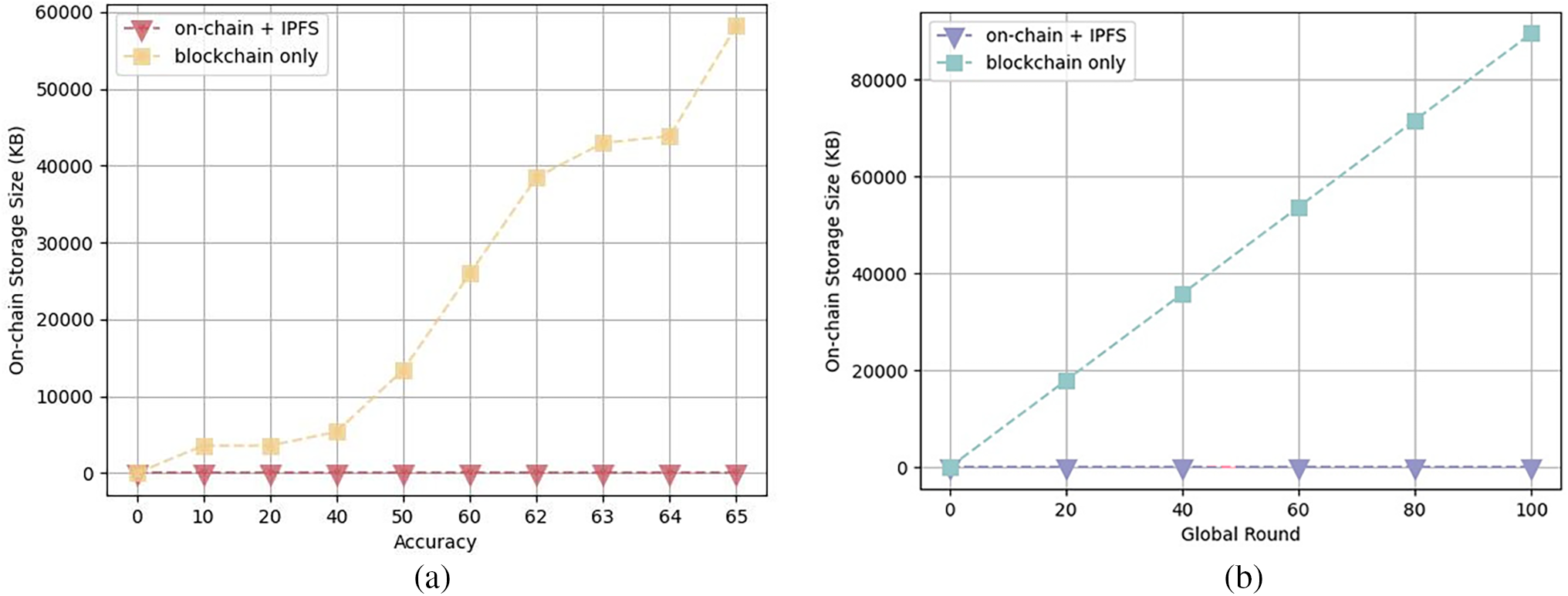
Figure 11: On-chain storage space consumption. (a) On-chain storage space consumption with accuracy changes; (b) On-chain storage space consumption with global rounds change
The experimental results demonstrate that with the increase in global rounds and improvement in global model accuracy, the growth of on-chain storage space under the collaborative storage strategy is significantly lower than under the blockchain-only strategy, which indicates that the hybrid storage strategy in this scheme effectively reduces the storage burden on the blockchain, enhancing the scheme’s storage performance.
To evaluate the communication overhead of the scheme, we considered the main steps in the federated training process. Specifically, apart from the necessary time spent on federated aggregation, the remaining overhead can be divided into the following three aspects: (request-response) overhead between clients and the blockchain, execution overhead of access control smart contracts, and communication overhead of model storage, including the execution of relevant smart contracts and communication between parties and the IPFS server.
We use
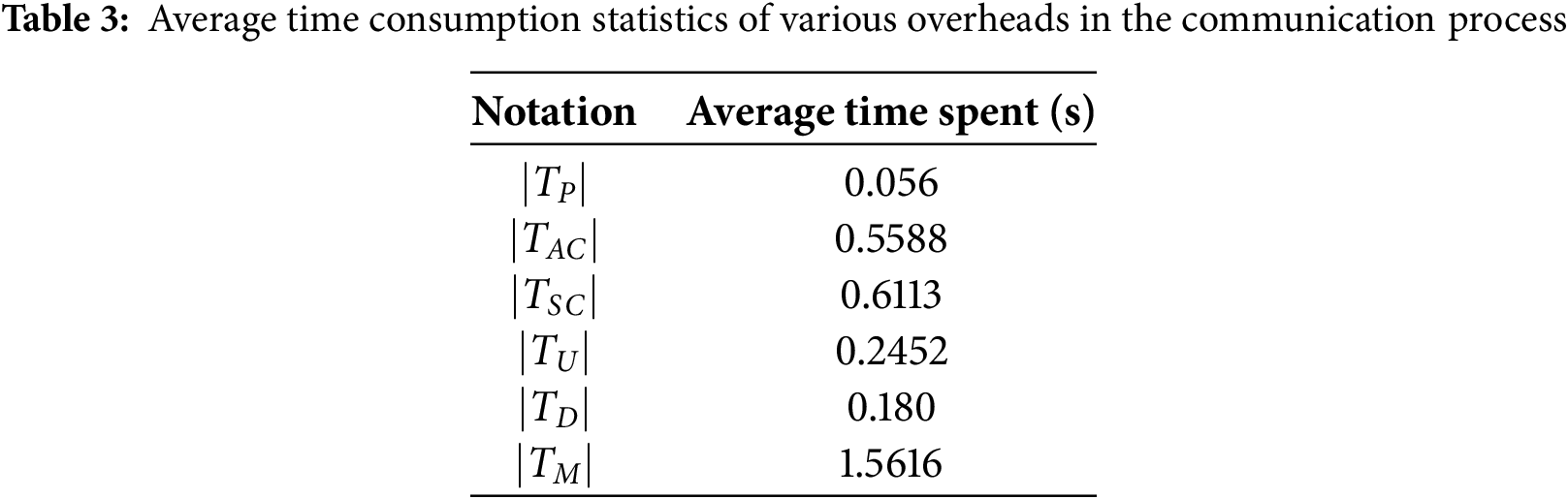
It is assumed that client requests do not always arrive at the blockchain simultaneously in the asynchronous scenario. In each round of training, each client needs to request the global model and upload the local model, with a transmission overhead of
Suppose we consider more specific scenarios, a large number of client requests may simultaneously reach the blockchain at certain moments, a situation more likely to occur when many clients participate in training. Therefore, we need to test the performance of the smart contracts designed in this scheme in high-concurrency scenarios. We set the number of concurrent transactions to be within 1000 and tested the throughput of each smart contract method at intervals of 100. The experimental results are shown in Fig. 12a,b. Based on the experimental results, it can be observed that the throughput of each smart contract method is not significantly affected by the increase in the number of concurrent transactions, indicating that the performance of the smart contracts in this scheme in high-concurrency scenarios can be considered relatively stable.

Figure 12: Throughput of smart contract methods at various levels of concurrency. (a) The throughput of each method in the Access Control smart contract at different levels of concurrency; (b) The throughput of each method in the Model Stor-age smart contract at different levels of concurrency
Table 4 provides a detailed comparison of the implementation of various security measures between this scheme and other federated learning frameworks.
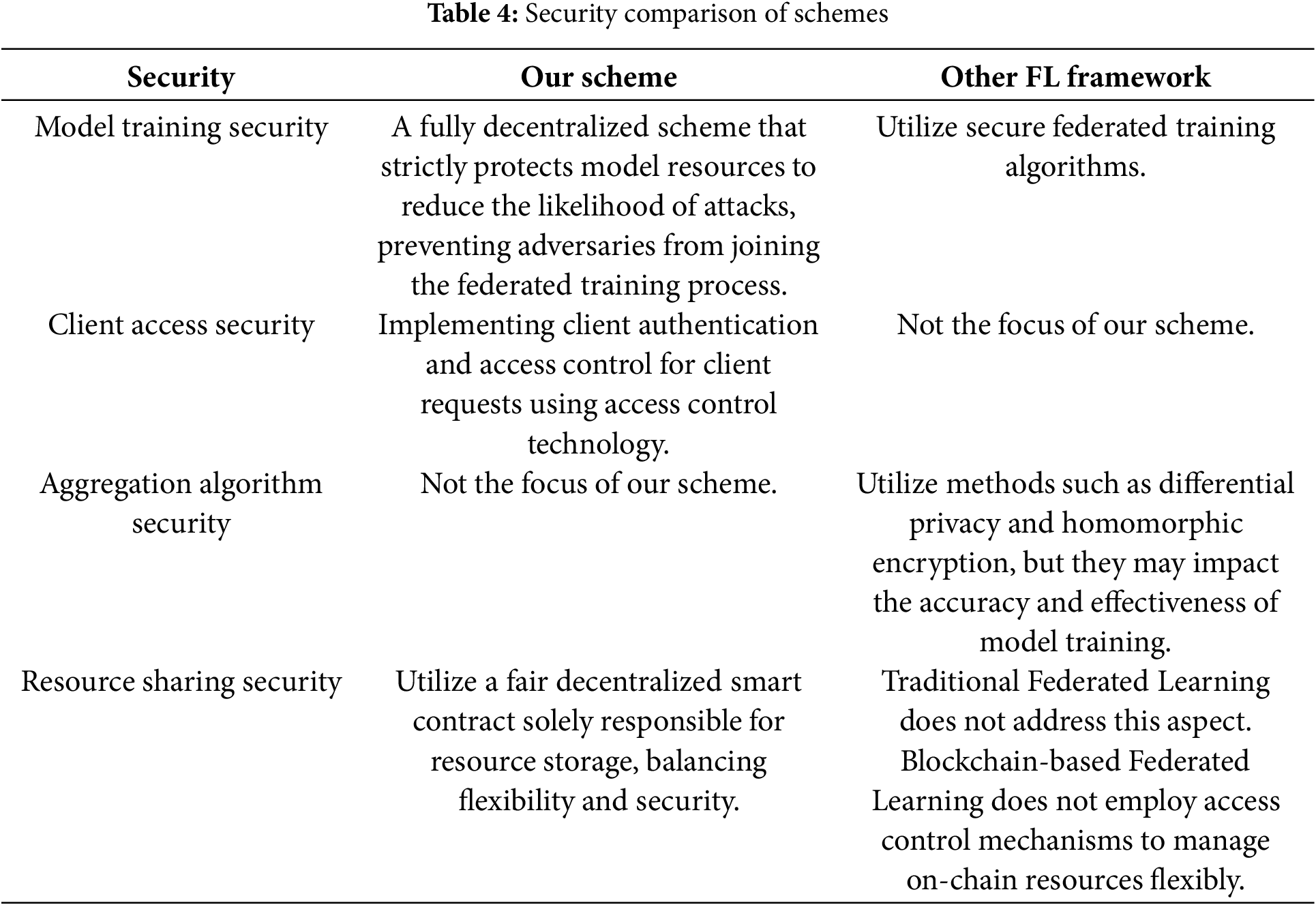
Table 5 comprehensively compare the security aspects of this scheme with other FL frameworks. Table 4 highlights this scheme’s innovative perspectives and approaches towards securing federated training.
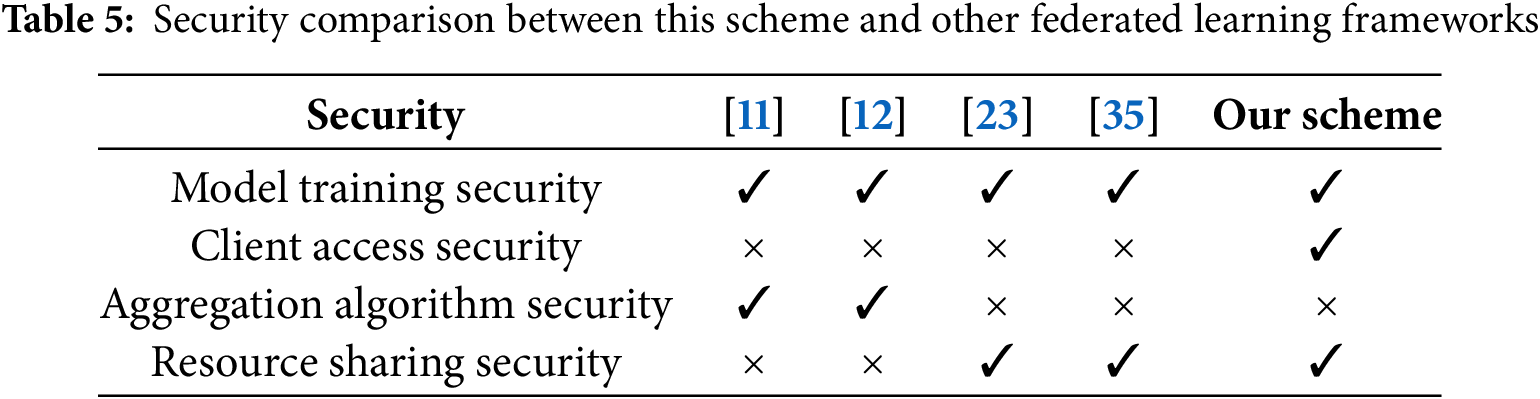
The security requirements met by this program are listed below:
1. Response to threat scenarios assumed by this scheme: The experimental results shown in Figs. 7 and 8 demonstrate that in this experiment, illegal access to resources cannot pass the verification of the access control module, cutting off the attacker’s attack chain at its root, preventing them from accessing any on-chain data sources. Therefore, attacks such as model theft or any attacks based on model parameters during the training process are ineffective against this scheme.
2. Resource anonymity: The true attributes of model resources are hidden in the
3. Traceability: Client requests to the blockchain can be recorded in the blockchain ledger. Expressly, any model resource clients submit will be saved to the blockchain. Blockchain administrators can trace any improper behavior back to any client node based on this information.
4. Data integrity protection: The integrity of on-chain recorded data is maintained by the blockchain’s distributed consensus mechanism, while the integrity of real model resources is maintained by IPFS’s content-based hash verification and distributed storage mechanism.
As mentioned above, the proposed scheme exhibits high storage and communication performance, enabling it to accommodate many clients participating in federated learning. Moreover, this scheme is designed based on blockchain technology, independent of any specific blockchain platform, thus possessing high portability. Additionally, the scheme is fully decentralized, the smart contracts on the blockchain are also pluggable, and clients participating in federated learning can utilize any machine learning model and optimization method. Therefore, the scheme proposed in this paper demonstrates high scalability.
To minimize untrustworthy issues during the federated training process, we propose an asynchronous tiered federated learning storage solution based on blockchain and IPFS. Experiments and analyses conducted on various datasets and settings demonstrate the efficiency, security, and scalability of our scheme. We address security concerns at the central aggregator node and along the path from clients to the aggregator in the federated training process. Leveraging smart contracts on the blockchain network for federated aggregation, the paper achieves a fully decentralized architecture for asynchronous hierarchical federated training. The access control model designed effectively enhances supervision over client access and ensures secure model resource access. Additionally, a hybrid on-chain and off-chain model storage strategy is employed to alleviate storage burdens on the blockchain network and enhance the overall communication efficiency of the solution.
In the future, we plan to incorporate secure federated aggregation algorithms into the scheme to enhance the robustness of models against attack behaviors. Additionally, we will attempt to deploy our scheme in specific scenarios through open-source channels to observe its real-time operation.
Acknowledgement: The authors are grateful to all the editors and anonymous reviewers for their detailed review and insightful advice.
Funding Statement: This research is partially supported by the National Natural Science Foundation of China (Grant No. 52331012), the Natural Science Foundation of Shanghai Municipality (Grant No. 21ZR1426500), and the Program for Cultivation of Graduate Students’ Top-notch Innovative Talents of Shanghai Maritime University (Grant No. 2023YBR007).
Author Contributions: The authors confirm contribution to the paper as follows: conceptualization: Tianyu Li, Dezhi Han, Kuan-Ching Li; methodology and software: Tianyu Li; funding acquisition: Dezhi Han; performance of the analysis: Jiatao Li. All authors reviewed the results and approved the final version of the manuscript.
Availability of Data and Materials: Not applicable.
Ethics Approval: Not applicable.
Conflicts of Interest: The authors declare no conflicts of interest to report regarding the present study.
References
1. McMahan B, Moore E, Ramage D, Hampson S, Arcas B. Communication-efficient learning of deep networks from decentralized data. In: Proceedings of the 20th International Conference on Artificial Intelligence and Statistics (AISTATS); 2017 Apr 20–22; Fort Lauderdale, FL, USA. p. 1273–82. [Google Scholar]
2. Li T, Sahu AK, Zaheer M, Sanjabi M, Talwalkar A, Smith V. Federated optimization in heterogeneous networks. In: Proceedings of Machine Learning and Systems; 2020 Mar 2–4; Austin, TX, USA. p. 429–50. [Google Scholar]
3. Karimireddy SP, Kale S, Mohri M, Reddi S, Stich S, Suresh AT. Scaffold: stochastic controlled averaging for federated learning. In: Proceedings of the 37th International Conference on Machine Learning; 2020 Jul 13–18: Online. p. 5132–43. [cited 2025 Jan 1]. Available from: https://icml.cc/Conferences/2020. [Google Scholar]
4. Xie C, Koyejo S, Gupta I. Asynchronous federated optimization. arXiv:1903.03934. 2019. [Google Scholar]
5. Chen Y, Ning Y, Slawski M, Rangwala H. Asynchronous online federated learning for edge devices with non-IID data. In: 2020 IEEE International Conference on Big Data (Big Data); 2020 Dec 10–13; Atlanta, GA, USA. p. 15–24. doi:10.1109/bigdata50022.2020.9378161. [Google Scholar] [CrossRef]
6. Chai Z, Chen Y, Anwar A, Zhao L, Cheng Y, Rangwala H. FedAT: a high-performance and communication-efficient federated learning system with asynchronous tiers. In: Proceedings of the International Conference for High Performance Computing, Networking, Storage and Analysis; 2021 Nov 14–19; St. Louis, MO, USA. p. 1–16. doi:10.1145/3458817.3476211. [Google Scholar] [CrossRef]
7. Chai Z, Ali A, Zawad S, Truex S, Anwar A, Baracaldo N, et al. TiFL: a tier-based federated learning system. In: Proceedings of the 29th International Symposium on High-Performance Parallel and Distributed Computing; 2020 Jun 23–26; Stockholm, Sweden. p. 125–36. doi:10.1145/3369583.3392686. [Google Scholar] [CrossRef]
8. Lyu L, Li Y, Nandakumar K, Yu J, Ma X. How to democratise and protect AI: fair and differentially private decentralised deep learning. IEEE Trans Dependable Secure Comput. 2022;19(2):1003–17. doi:10.1109/TDSC.2020.3006287. [Google Scholar] [CrossRef]
9. Truex S, Baracaldo N, Anwar A, Steinke T, Ludwig H, Zhang R, et al. A hybrid approach to privacy-preserving federated learning. In: Proceedings of the 12th ACM Workshop on Artificial Intelligence and Security; 2019 Nov 11–19; London, UK. p. 1–11. doi:10.1145/3338501.3357370. [Google Scholar] [CrossRef]
10. Goel A, Agarwal A, Vatsa M, Singh R, Ratha N. DeepRing: protecting deep neural network with blockchain. In: IEEE/CVF Conference on Computer Vision and Pattern Recognition Workshops (CVPRW); 2019 Jun 16–17; Long Beach, CA, USA. p. 2821–8. doi:10.1109/cvprw.2019.00341. [Google Scholar] [CrossRef]
11. Mondal A, Virk H, Gupta D. BEAS: blockchain enabled asynchronous & secure federated machine learning. arXiv:2202.02817. 2022. [Google Scholar]
12. Feng L, Zhao Y, Guo S, Qiu X, Li W, Yu P. BAFL: a blockchain-based asynchronous federated learning framework. IEEE Trans Comput. 2022;71(5):1092–103. doi:10.1109/TC.2021.3072033. [Google Scholar] [CrossRef]
13. Zhou S, Li K, Chen Y, Yang C, Liang W, Zomaya AY. TrustBCFL: mitigating data bias in IoT through blockchain-enabled federated learning. IEEE Internet Things J. 2024;11(15):25648–62. doi:10.1109/JIOT.2024.3379363. [Google Scholar] [CrossRef]
14. Wang X, Garg S, Lin H, Kaddoum G, Hu J, Hossain MS. A secure data aggregation strategy in edge computing and blockchain-empowered internet of things. IEEE Internet Things J. 2022;9(16):14237–46. doi:10.1109/JIOT.2020.3023588. [Google Scholar] [CrossRef]
15. Wang X, Garg S, Lin H, Kaddoum G, Hu J, Hassan MM. Heterogeneous blockchain and AI-driven hierarchical trust evaluation for 5G-enabled intelligent transportation systems. IEEE Trans Intell Transp Syst. 2023;24(2):2074–83. doi:10.1109/TITS.2021.3129417. [Google Scholar] [CrossRef]
16. Sandhu RS, Samarati P. Access control: principle and practice. IEEE Commun Mag. 1994;32(9):40–8. doi:10.1109/35.312842. [Google Scholar] [CrossRef]
17. Li J, Han D, Weng TH, Wu H, Li KC, Castiglione A. A secure data storage and sharing scheme for port supply chain based on blockchain and dynamic searchable encryption. Comput Stand Interfaces. 2025;91:103887. doi:10.1016/j.csi.2024.103887. [Google Scholar] [CrossRef]
18. Liang W, Xie S, Cai J, Wang C, Hong Y, Kui X. Novel private data access control scheme suitable for mobile edge computing. China Commun. 2021;18(11):92–103. doi:10.23919/JCC.2021.11.007. [Google Scholar] [CrossRef]
19. Liu H, Han D, Li D. Fabric-IoT: a blockchain-based access control system in IoT. IEEE Access. 2020;8:18207–18. doi:10.1109/ACCESS.2020.2968492. [Google Scholar] [CrossRef]
20. Han D, Zhu Y, Li D, Liang W, Souri A, Li KC. A blockchain-based auditable access control system for private data in service-centric IoT environments. IEEE Trans Ind Inform. 2022;18(5):3530–40. doi:10.1109/TII.2021.3114621. [Google Scholar] [CrossRef]
21. Li J, Han D, Wu Z, Wang J, Li KC, Castiglione A. A novel system for medical equipment supply chain traceability based on alliance chain and attribute and role access control. Future Gener Comput Syst. 2023;142:195–211. doi:10.1016/j.future.2022.12.037. [Google Scholar] [CrossRef]
22. Jiang R, Li J, Bu W, Shen X. A blockchain-based trustworthy model evaluation framework for deep learning and its application in moving object segmentation. Sensors. 2023;23(14):6492. doi:10.3390/s23146492. [Google Scholar] [PubMed] [CrossRef]
23. Wang T, Du M, Wu X, He T. An analytical framework for trusted machine learning and computer vision running with blockchain. In: 2020 IEEE/CVF Conference on Computer Vision and Pattern Recognition Workshops (CVPRW); 2020 Jun 14–19; Seattle, WA, USA. p. 32–8. doi:10.1109/cvprw50498.2020.00011. [Google Scholar] [CrossRef]
24. Liang W, Xie S, Li KC, Li X, Kui X, Zomaya AY. MC-DSC: a dynamic secure resource configuration scheme based on medical consortium blockchain. IEEE Trans Inf Forensics Secur. 2024;19:3525–38. doi:10.1109/TIFS.2024.3364370. [Google Scholar] [CrossRef]
25. Narayanan A, Bonneau J, Felten E, Miller A, Goldfeder S. Bitcoin and cryptocurrency technologies: a comprehensive introduction. Princeton, NJ, USA: Princeton University Press; 2017. [Google Scholar]
26. Nakamoto S. Bitcoin: a peer-to-peer electronic cash system. Dhaka, Bangladesh: HN Publishing; 2008. doi:10.2139/ssrn.3440802. [Google Scholar] [CrossRef]
27. Androulaki E, Barger A, Bortnikov V, Cachin C, Christidis K, De Caro A, et al. Hyperledger fabric: a distributed operating system for permissioned blockchains. In: Proceedings of the Thirteenth EuroSys Conference; 2018 Apr 23–26; Porto Portugal. p. 1–15. doi:10.1145/3190508.3190538. [Google Scholar] [CrossRef]
28. Hu VC, Kuhn DR, Ferraiolo DF, Voas J. Attribute-based access control. Computer. 2015;48(2):85–8. doi:10.1109/MC.2015.33. [Google Scholar] [CrossRef]
29. Benet J. IPFS—content addressed, versioned, P2P file system. arXiv:1407.3561. 2014. [Google Scholar]
30. Melis L, Song C, De Cristofaro E, Shmatikov V. Exploiting unintended feature leakage in collaborative learning. In: 2019 IEEE Symposium on Security and Privacy (SP); 2019 May 19–23; San Francisco, CA, USA. p. 691–706. doi:10.1109/sp.2019.00029. [Google Scholar] [CrossRef]
31. Clements J, Lao Y. Backdoor attacks on neural network operations. In: 2018 IEEE Global Conference on Signal and Information Processing (GlobalSIP); 2018 Nov 26–29; Anaheim, CA, USA. p. 1154–8. doi:10.1109/GlobalSIP.2018.8646335. [Google Scholar] [CrossRef]
32. Rakin AS, He Z, Fan D. TBT: targeted neural network attack with bit Trojan. In: 2020 IEEE/CVF Conference on Computer Vision and Pattern Recognition (CVPR); 2020 Jun 13–19; Seattle, WA, USA. p. 13195–204. doi:10.1109/cvpr42600.2020.01321. [Google Scholar] [CrossRef]
33. LeCun Y, Cortes C. The mnist database of handwritten digits [Internet]. [cited 2025 Mar 30]. Available from: https://api.semanticscholar.org/CorpusID:60282629. [Google Scholar]
34. Krizhevsky A. Learning multiple layers of features from tiny images [Internet]. [cited 2025 Mar 30]. Available from: https://www.cs.toronto.edu/~kriz/learning-features-2009-TR.pdf. [Google Scholar]
35. Wang X, Zhao Y, Qiu C, Liu Z, Nie J, Leung VCM. InFEDge: a blockchain-based incentive mechanism in hierarchical federated learning for end-edge-cloud communications. IEEE J Sel Areas Commun. 2022;40(12):3325–42. doi:10.1109/JSAC.2022.3213323. [Google Scholar] [CrossRef]
Cite This Article
 Copyright © 2025 The Author(s). Published by Tech Science Press.
This work is licensed under a Creative Commons Attribution 4.0 International License , which permits unrestricted use, distribution, and reproduction in any medium, provided the original work is properly cited.
 Downloads
 Citation Tools
