
 Login
Login Register
 Submit a Paper
 Propose a Special lssue
 Open Access
ARTICLE

Lightweight Multi-Agent Edge Framework for Cybersecurity and Resource Optimization in Mobile Sensor Networks
Department of Computer Science, College of Computer and Information Sciences, Jouf University, Sakaka, 72388, Al Jouf, Saudi Arabia
* Corresponding Author: Fatima Al-Quayed. Email:
Computers, Materials & Continua 2026, 86(1), 1-16. https://doi.org/10.32604/cmc.2025.069102
Received 15 June 2025; Accepted 20 August 2025; Issue published 10 November 2025
 View Full Text
 Download PDF
Abstract
Due to the growth of smart cities, many real-time systems have been developed to support smart cities using Internet of Things (IoT) and emerging technologies. They are formulated to collect the data for environment monitoring and automate the communication process. In recent decades, researchers have made many efforts to propose autonomous systems for manipulating network data and providing on-time responses in critical operations. However, the widespread use of IoT devices in resource-constrained applications and mobile sensor networks introduces significant research challenges for cybersecurity. These systems are vulnerable to a variety of cyberattacks, including unauthorized access, denial-of-service attacks, and data leakage, which compromise the network’s security. Additionally, uneven load balancing between mobile IoT devices, which frequently experience link interferences, compromises the trustworthiness of the system. This paper introduces a Multi-Agent secured framework using lightweight edge computing to enhance cybersecurity for sensor networks, aiming to leverage artificial intelligence for adaptive routing and multi-metric trust evaluation to achieve data privacy and mitigate potential threats. Moreover, it enhances the efficiency of distributed sensors for energy consumption through intelligent data analytics techniques, resulting in highly consistent and low-latency network communication. Using simulations, the proposed framework reveals its significant performance compared to state-of-the-art approaches for energy consumption by 43%, latency by 46%, network throughput by 51%, packet loss rate by 40%, and denial of service attacks by 42%.Keywords
Edge computing and smart devices, combined with the collaborative support of future technologies, drive growth in IoT ecosystems [1,2]. They maintain the information system and enhance communication among connected devices, providing rapid response times and developing real-time applications [3,4]. Future sensing technologies, leveraging 5G/6G, observe targeted areas and ease end-users with rapid data analysis and processing [5–7]. In recent decades, cloud-centric data processing models have struggled to meet the dynamic and real-time requirements of these applications, especially when balancing scalability with sustainability [6,8]. Due to centralized processing and data storage, intelligent systems are vulnerable to data breaches and security threats, including the single path of data transmission, which can facilitate malicious activities and degrade the performance of IoT networks [9,10]. It decreases the scalability of connected devices and provides a lack of resilience in processing network services. Such systems demand a distributed and low-cost communication process with the integration of intelligence [11,12]. Moreover, establishing trust and achieving long-term connectivity among limited-resource devices plays a crucial role in optimizing resources and enhancing network efficiency [13,14]. The enhancement in security for innovative ecosystems provides the most authorized systems for handling intrusion detection against unauthorized access and data integrity [15–17]. These vulnerabilities increase the potential risks of disrupting critical information and lead to retransmission with additional overhead on IoT devices. Adapting robust security measures promotes a fault-tolerant and resilient system against network attacks, guaranteeing a highly protected and trustworthy environment [18,19]. This research aims to develop a Multi-Agent System (MAS)-based secure framework utilizing edge Computing for mobile sensor networks, exploring the application of artificial intelligence. The framework enhances security against cyber attacks, anomaly detection, and adaptive resource management by integrating trust evaluation, dynamic routing, and blockchain-based validation. This approach aims to improve network resilience, scalability, and energy efficiency while ensuring low latency in IoT environments. The main contributions of the proposed framework are as follows.
i. It developed an adaptive IoT routing system and evaluates trust scores using a Multi-Agent System (MAS) to ensure low-latency, secure data transmission against cyber threats in mobile sensor networks.
ii. It designs a trust-aware, lightweight routing protocol to enhance security and optimize routes with efficient energy management in the IoT-edge network. In addition, the trustworthiness of the proposed framework ensures protection against vulnerabilities and mitigates the risks of cyber attacks through a lightweight sensor-driven decision-making system.
iii. A trust model is designed to emphasize anomaly detection by evaluating multiple metrics, thereby maintaining the integrity and enhancing the reliability of the mobile sensor network in the presence of malicious threats.
The remaining sections are organized as follows. Related work is explained in Section 2. Section 3 provides details of the proposed framework. Section 4 describes the analysis of the performance results. Ultimately, Section 5 concludes the research work.
The IoT network enables the seamless collection of sensor data through the integration of wireless systems, allowing for real-time monitoring in unpredictable environments [20,21]. It enhances the development functionalities for a bounded network with efficient infrastructure in terms of cost, leading to the timely delivery of crucial data to connected devices [22,23]. The concept of edge computing, on the other hand, processes the collected data locally, decreasing latency through effective bandwidth utilization in smart cities. They establish a scalable and modern network ecosystem to meet the requirements of applications, leveraging emerging technologies for support [24,25]. An autonomous IoT network with an edge-driven approach not only provides a decision-making system in dynamic conditions but also offers timely data analysis under unsustainable situations. In [26], the authors proposed a connection-quality-based Energy-Efficient routing (LQEER) protocol. It incorporates the energy, link quality, and distance parameters to compute the weight for efficient packet transmission. Moreover, it improved the energy efficiency of the network by decreasing unnecessary updates among devices. The performance results demonstrate superior results to existing solutions for dynamic network factors.
For information-centric wireless sensor networks (ICWSN), Vaiyapuri et al. [27] proposed an IoT-enabled cluster-based routing (CBR) protocol, named CBR-ICWSN. It explored a black widow optimization (BWO)-based clustering approach to select optimal cluster heads with a stable network lifetime. Moreover, the CBR-ICWSN based solution also utilized an oppositional artificial bee colony (OABC) enabled routing process, and enhanced the stability of routing paths. A series of simulations was performed to evaluate the performance of the proposed protocol, and its results demonstrated a significant improvement over existing approaches in several network and communication aspects. To implement Distributed Artificial Intelligence (DAI) using neural networks, authors [28] proposed a novel method that achieves energy efficiency alongside rapid response for intra-cluster communication. The proposed solution offers a novel implementation approach by combining the DAI and Self-Organizing Map (SOM) techniques. The performance results revealed improved solutions for network parameters and computational challenges. Authors [29] introduced a cloud-based SDN solution to improve energy-efficient routing and load balancing in IoT networks. The AI-enabled technique optimizes the clustering of heterogeneous nodes and reduces the additional energy consumption of devices. The high intelligence power of SDN is utilized for the formulation of clusters and effectively manages computational costs. The performance of the proposed approach is validated using simulations that demonstrate its efficacy over existing methods in terms of load balancing and optimization. In [30], the authors proposed a destination-sequenced distance vector (DSDV) framework by exploring deep-Q-learning (DQL). It first modifies the routing information of connected nodes, and later, the next hop count is computed by the DQL method. The Q-values are determined as the distance between linked nodes while accounting for traffic flow. The performance evaluation indicates that DQL-DSDV offers better Quality of Service (QoS) while minimizing packet loss, delay, congestion, and communication costs. From the context of the discussion, it is observed that smart cities face critical research challenges for real-time applications in terms of optimizing and scaling IoT systems with nominal overhead. Moreover, ensuring data trust between constrained devices and adaptive wireless technologies is also demanded for sustainable development with effective cost management. Moreover, scalable and adaptive routing systems are necessary to distribute network traffic evenly among routes and minimize network emissions. Ultimately, it is also evident that reliable solutions are insufficient without effective security policies and edge intelligence to ensure secure data sharing, promoting resilient, fault-tolerant, and sustainable development.
3 Proposed Multi-Agent Based Trust-Aware Framework Using Edge Intelligence
In this section, we present our proposed framework, which introduces a lightweight Blockchain security using multi-agent-enabled collaborative edge intelligence for mobile IoT networks. It enhances resource optimization and trustworthiness in real-time data sharing using reliable network edges. The following subsections explain the details of the proposed framework.
In the proposed framework, IoT or edge nodes are designated as agents that independently monitor network conditions, perform trust computing, and intelligently collaborate to balance resource and load distribution. The devices are interconnected in the form the graph
As edge-IoT networks are constrained in terms of resources, energy efficiency plays a crucial role in optimizing the performance for data gathering and transmission. Eq. (2) computes the overall energy consumed for nodes N by exploring computation energy
Computational Energy
where
Eq. (5) computes the energy overhead
where
where
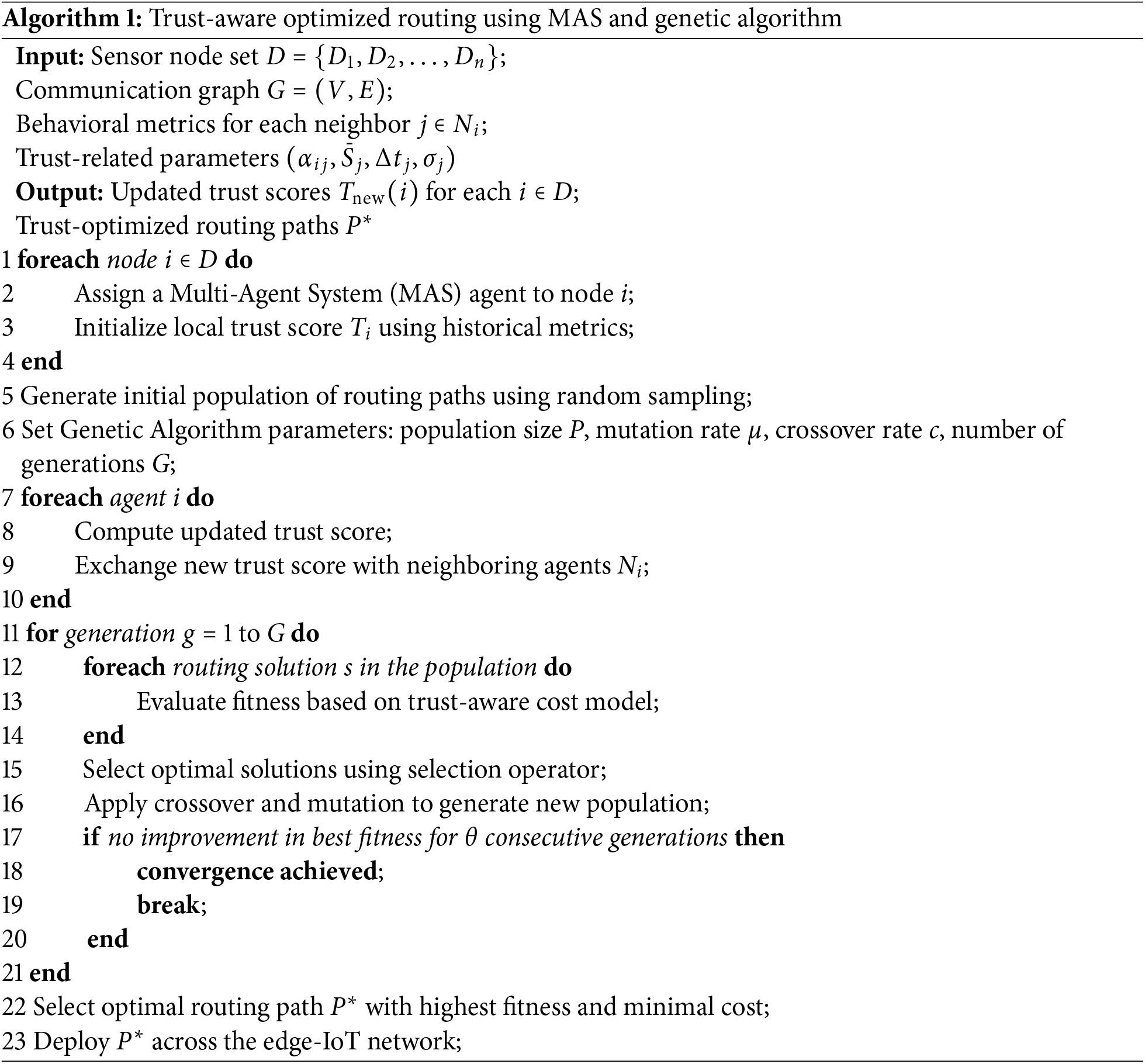
In Algorithm 1, the execution of different logical stages for ensuring multi-agent based routing is depicted.
3.2 Trusted IoT-Edge Resource Optimization and Cybersecurity Using Genetic Algorithm
In this section, the proposed framework utilizes a Genetic Algorithm to optimize the balancing of traffic load in IoT-edge networks, along with effective resource allocation and the inclusion of cybersecurity measures against potential threats. The minimization of network congestion across edge nodes, GA dynamically allocates communication tasks among devices, thereby increasing network intelligence and improving latency and response time. The MAS computes the traffic load at each node
The optimization function for ensuring efficient resource allocation with minimizing communication cost is computed using Eq. (11).
Eq. (12) formulates the optimization criteria for network efficiency by incorporating the communication cost
Ultimately, the proposed framework ensures secure IoT routing through the combination of trust computing, dynamic route selection, and its maintenance. It reduces the likelihood of selecting an untrusted node as a forwarder by utilizing realistic network conditions and maintains the selected route in the IoT-edge environment. The agents compute the updated trust score of device
where
where the weight vector W is represented as
To maintain the routes, MAS agent compute a anomaly score
Algorithm 2 governs the stages of attaining security and routes maintenance in IoT-edge network.
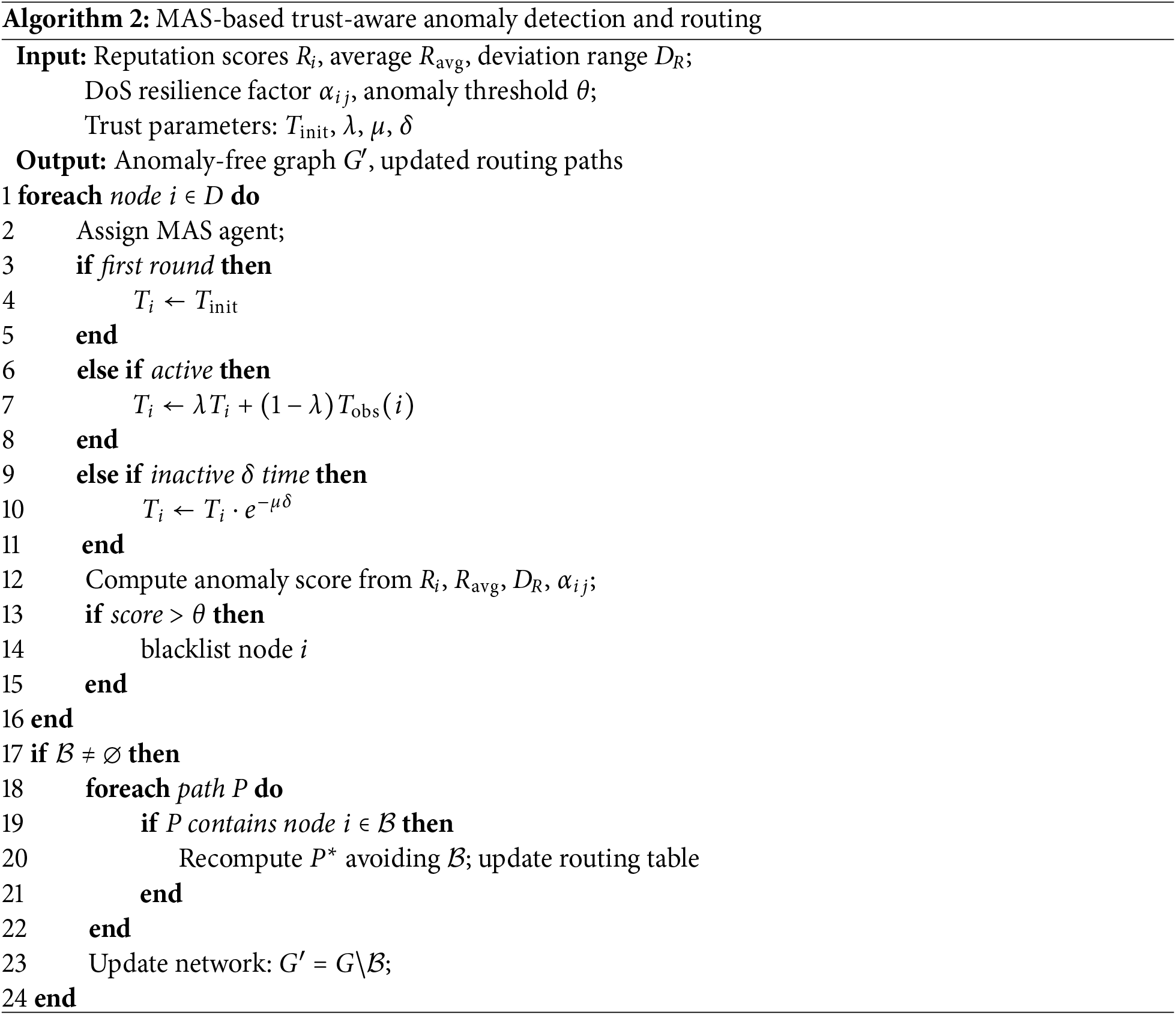
Fig. 1 depicts the architecture design of the proposed agent-based trusted routing framework. It is composed of three main layers. First, IoT devices, edge devices, and gateways are connected to a communication system using a wireless standard to sense and collect the environmental field. The data is initially processed at the device level and then forwarded to the second layer for decision-making using artificial intelligence-driven techniques to determine optimized routes. The forwarders on the selected routes are energy efficient and reliable in terms of bandwidth allocation and congestion management. Their roles are shifted when transmitting data in the IoT-edge network and maintaining the devices’ connectivity for a more extended period. Ultimately, the trust score is computed to enhance system security, and faulty devices are removed from the routing tables. The trust score is recomputed rapidly, making the system more trustworthy and increasing the likelihood of anomaly detection against threats in IoT-edge networks.

Figure 1: Architecture design of the proposed agent based IoT-edge trusted framework
Fig. 2 illustrates the flowchart of the proposed framework, which includes agent-based optimization for routing with trust computing. Its main procedures are network modeling to initiate the communication structure, trust computing, and route selection. The samples of selected routes undergo genetic operations, and if the trust value is less than the threshold, the selected route is removed from the forwarding channels. The new cost values are recomputed using a multi-factor technique with a genetic algorithm, and an alternative route is selected for data transmission. Table 1 outlines a range of security threats considered in our proposed framework and highlights the proposed detection and mitigation mechanisms for the edge-IoT environment.

Figure 2: Working flow of proposed agent-based trust-aware optimized IoT-edge routing framework

In this section, we evaluate the proposed Multi-Agent based trusted routing framework against existing work using simulation in an IoT-edge environment, and compare it against related work. The simulations are performed in the NS-3 simulator, and trace files are maintained to store the statistical records. The network field is fixed at 1000 m
The simulation parameters are depicted in Table 2.

Fig. 3a exhibits that the proposed framework improved energy consumption against varying IoT devices as compared to existing solutions by an average of 45.3% and 58%. This is because it utilizes intelligent methods to determine data routing with the assistance of an authentic and trusted scheme. In the prediction phase, the next hop is selected by exploring the optimal edges while also keeping track of link measurements regarding congestion and load balancing. Such an outcome offers an optimal decision and improves the stability of the smart system. Furthermore, the proposed framework’s distributed processing, combined with the identification of network past behavior, supports a more lightweight mechanism and efficient communication services for resource optimization. Moreover, the timely capture of malicious nodes prevents the transmission of false and flooded data on the network channels, thereby reducing the ratio of overloaded nodes and enhancing the system’s performance, which in turn improves energy efficiency. Fig. 3b depicts the analysis of the proposed framework and existing studies for energy consumption under varying network load. The experimental results revealed that the proposed framework outperforms related studies by 35% and 40.3%. The improvement is attributed to the more effective allocation of resources through the optimization of the Genetic algorithm’s learning pattern and a reduction in the forward load on the devices. The trustworthiness, combined with artificial intelligence-driven intelligence, enhances the security performance of the proposed framework and ensures a tamper-proof IoT-edge communication system. Moreover, despite the flooding of malicious packets, trust computing minimizes data disruption and provides seamless connectivity for real-time network applications.

Figure 3: Performance impact of Proposed Framework, OSRM, CBR-ICWSN for energy consumption (a) varying IoT devices (200–800) and (b) varying network load (20%–100%)
The experimental results of the proposed framework in comparison to the existing solution for packet loss ratio are illustrated in Fig. 4a. Across various IoT devices, it was observed that the proposed framework reduced the packet loss rate by 42.5% and 49.2%. The analysis of multiple criteria, combined with a genetic algorithm, enables the proposed framework to deliver optimal performance from IoT sensors and manage resources effectively, with intelligently controlled network congestion. In addition, selecting several key parameters based on network conditions provides reliable communication links for managing IoT data. Accordingly, the next-hop is more consistent, offers long-run connectivity for continuous data routing, and offers a high-performance maintenance system. In Fig. 4b, the performance analysis depicted improved outcomes of the proposed framework compared to existing studies by 44.5% and 53%. This occurs because routing paths are continuously updated by identifying nearby trustworthy neighbors and extending the lifetime of routes while reducing the traffic load on network-wide devices. The optimizing algorithm not only balances the load on the peer data connection links but also increases the confidence for establishing device trust. Furthermore, routes that are busy in data dissemination are marked as invalid for a particular time, and the source node is informed to formulate an alternative route. The proposed framework ensured fault tolerance while improving the utilization of network resources under dynamic network conditions. As a result, adopting the strategies proposed in the framework enhances the performance of critical IoT deployments in terms of scalability, with uniform traffic distribution, and improves data reception on uncertain IoT wireless channels.

Figure 4: Performance impact of Proposed Framework, OSRM, CBR-ICWSN for packet loss ratio (a) varying IoT devices (200–800) and (b) varying network load (20%–100%)
Fig. 5a illustrates the performance of the proposed framework in comparison to existing solutions, specifically in terms of anomaly detection ratio for varying numbers of IoT devices. It is a process of identifying malicious patterns in the IoT traffic due to the occurrence of communication faults or system failures. The results analysis has shown that the proposed framework improved the anomaly detection by 30.5% and 39.4%, which is due to both the sensors and intermediate devices being involved in maintaining the trust and reliability of the IoT ecosystem. The intelligence of the proposed framework also supports rerouting crucial IoT data to alternative routes by utilizing crossover and mutation operations of the genetic algorithm. Additionally, agents play a vital role in identifying faulty channels based on the multi-factor trust computation. The trust scores are updated at regular intervals. Thus, it is hard for unauthentic devices and brute-force attacks to resend the fake route requests. Fig. 5b shows the performance analysis of the proposed framework for anomaly detection over varying network load. The statistical analysis revealed that the proposed framework improved the anomaly detection ratio by 35% and 46% compared to existing approaches. This is made possible by the integration of artificial intelligence-driven multi-factor analysis, which optimizes decision-making through collaboration with edge devices. In this process, the routing flags in tables are updated rapidly, and the proposed framework effectively manages transmission costs with latency-aware data forwarding. It enables the timely mitigation of potential network vulnerabilities and ensures the privacy of critical data with lightweight computation. Furthermore, the proposed framework’s proactive and reliable routing approach ensures that the IoT-edge system is more suited for real-time applications.

Figure 5: Performance impact of Proposed Framework, OSRM, CBR-ICWSN for Anomaly detection time (a) varying IoT devices (200–800) and (b) varying network load (20%–100%)
Fig. 6a shows the analysis of the proposed framework and existing approaches under varying IoT devices for the false positive rate. It is defined as the number of negative classified samples incorrectly labeled as positive. The performance of the proposed framework was improved for varying IoT devices by 30% and 37% by utilizing a more reliable anomaly detection mechanism. The proposed framework reduces the likelihood of misclassifying regular network traffic as threats by computing trust scores, an adaptive threshold, and pattern analysis in the devices’ communication. In addition, the agents play a vital role in identifying authentic devices while sending real-time data to cloud stations; only verified devices are permitted to be part of the IoT system. It reduces false traffic on communication links and increases the trustworthiness level for innovative and unpredictable technologies. Fig. 6b illustrates the performance analysis of the proposed framework compared to existing studies in terms of false positive rate under varying network load. The proposed framework significantly improved the false positive rate by 37% and 44%, respectively. The intelligent behavior of the proposed framework efficiently classified the network traffic as either malicious or usual. The proposed system ensures that device resources are not misused in false positives and provides reliable decisions for identifying network threats. Due to consistency in coping with inauthentic devices, the proposed framework decreases the ratio of false notifications, thus providing a more robust security mechanism. By exploring the proposed security and alarm mechanism, the framework optimizes decision-making through the allocation of resources and a combination of trust. Fig. 7 depicts the impact of the Proposed Framework with OSRM, and CBR-ICWSN in terms of various security metrics under DoS attacks. The results show that the proposed framework improves the trust recovery rate by approximately 45%, isolation efficiency by 55%, mitigation success by 49%, and reduces attack impact by 43% compared to existing methods. These enhancements result from integrating trust evaluation and intelligent anomaly detection, which enable proactive identification and isolation of malicious nodes. Lightweight MAS agents authenticate each IoT device before edge processing, thereby reducing network congestion and mitigating the effects of malicious traffic. Consequently, compromised routes are effectively penalized, significantly boosting network resilience and cybersecurity in dynamic IoT-edge environments.
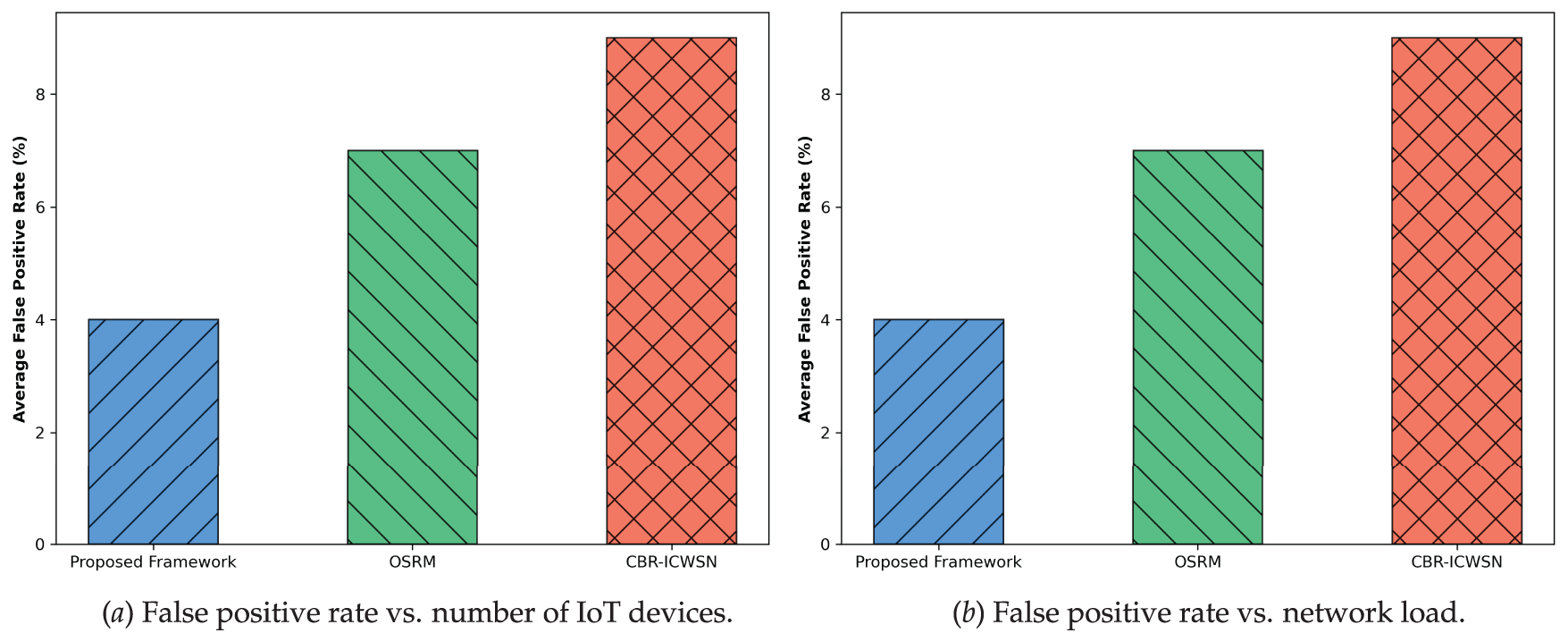
Figure 6: Performance impact of Proposed Framework, OSRM, CBR-ICWSN for False positive rate (a) varying IoT devices (200–800) and (b) varying network load (20%–100%)

Figure 7: Performance impact of Proposed Framework, OSRM, and CBR-ICWSN under DoS attack for key security metrics
The development of sustainable networks has enabled the growth of sensing the real world and processing the demands of connected devices using sensor-driven networks. With the integration of future and advanced technologies, the unpredictable environment is analyzed, and big data is processed through cloud systems. Edge computing provides numerous parallel processing capabilities to enhance scalability and foster growth in automated systems within IoT networks. However, due to the bounded limitations of sensor applications, many existing approaches are insufficient to provide an early response in critical circumstances, posing significant challenges for security and cyber threats. Moreover, deploying in real-world scenarios also presents challenges, such as interoperability among heterogeneous devices, secure data exchange, and dynamic trust management across diverse environments. This work presents an agent-based trusted framework by incorporating multi-metric trust computation and explores artificial intelligence for decision-making. It ensures secure data sharing through lightweight computation between sensors, reducing the likelihood of network anomalies. Additionally, the edge devices perform various local processing services and manage IoT resources by utilizing learning patterns of genetic algorithms. The proposed framework enables efficient energy consumption and reduces latency, facilitating on-time data analysis and effective cybersecurity. However, we aim to implement dynamic strategies for bandwidth allocation to reduce further the computational power required by constrained devices under higher network loads. Such efforts will guarantee more reliable performance in the presence of distributed network threats. In future work, a mobile cloud-based platform can be integrated into the proposed framework to handle on-demand high-power requests for resource management and ensure scalability for the IoT-edge network.
Acknowledgement: This work was funded by the Deanship of Graduate Studies and Scientific Research at Jouf University under grant No. (DGSSR-2025-02-01278).
Funding Statement: This research was supported by the Deanship of Graduate Studies and Scientific Research at Jouf University.
Availability of Data and Materials: Not applicable.
Ethics Approval: Not applicable.
Conflicts of Interest: The author declares no conflicts of interest to report regarding the present study.
References
1. Alahi MEE, Sukkuea A, Tina FW, Nag A, Kurdthongmee W, Suwannarat K, et al. Integration of IoT-enabled technologies and artificial intelligence (AI) for smart city scenario: recent advancements and future trends. Sensors. 2023;23(11):5206. doi:10.3390/s23115206. [Google Scholar] [PubMed] [CrossRef]
2. Hussain I, Elomri A, Kerbache L, El Omri A. Smart city solutions: comparative analysis of waste management models in IoT-enabled environments using multiagent simulation. Sustain Cities Soc. 2024;103(6):105247. doi:10.1016/j.scs.2024.105247. [Google Scholar] [CrossRef]
3. Sneha, Malik P, Sharma R, Ghosh U, Alnumay WS. Internet of Things and long-range antenna’s; challenges, solutions and comparison in next generation systems. Microprocess Microsyst. 2023;103(7):104934. doi:10.1016/j.micpro.2023.104934. [Google Scholar] [CrossRef]
4. Ahmad R, Hämäläinen M, Wazirali R, Abu-Ain T. Digital-care in next generation networks: requirements and future directions. Comput Netw. 2023;224(3):109599. doi:10.1016/j.comnet.2023.109599. [Google Scholar] [CrossRef]
5. Alotaibi A, Barnawi A. Securing massive IoT in 6G: recent solutions, architectures, future directions. Internet Things. 2023;22(1):100715. doi:10.1016/j.iot.2023.100715. [Google Scholar] [CrossRef]
6. Ishteyaq I, Muzaffar K, Shafi N, Alathbah MA. Unleashing the power of tomorrow: exploration of next frontier with 6G networks and cutting edge technologies. IEEE Access. 2024;12(254):29445–63. doi:10.1109/access.2024.3367976. [Google Scholar] [CrossRef]
7. Shayea I, El-Saleh AA, Ergen M, Saoud B, Hartani R, Turan D, et al. Integration of 5G, 6G and IoT with Low Earth Orbit (LEO) networks: opportunity, challenges and future trends. Res Eng. 2024;23(3):102409. doi:10.1016/j.rineng.2024.102409. [Google Scholar] [CrossRef]
8. Hazra A, Rana P, Adhikari M, Amgoth T. Fog computing for next-generation internet of things: fundamental, state-of-the-art and research challenges. Comput Sci Rev. 2023;48(5):100549. doi:10.1016/j.cosrev.2023.100549. [Google Scholar] [CrossRef]
9. Poojara SR, Dehury CK, Jakovits P, Srirama SN. Serverless data pipeline approaches for IoT data in fog and cloud computing. Future Generat Comput Syst. 2022;130(8):91–105. doi:10.1016/j.future.2021.12.012. [Google Scholar] [CrossRef]
10. Abbas G, Mehmood A, Carsten M, Epiphaniou G, Lloret J. Safety, security and privacy in machine learning based internet of things. J Sens Actuator Netw. 2022;11(3):38. doi:10.3390/jsan11030038. [Google Scholar] [CrossRef]
11. Golpayegani F, Chen N, Afraz N, Gyamfi E, Malekjafarian A, Schäfer D, et al. Adaptation in edge computing: a review on design principles and research challenges. ACM Transact Autonom Adapt Syst. 2024;19(3):1–43. doi:10.1145/3664200. [Google Scholar] [CrossRef]
12. Bharany S, Badotra S, Sharma S, Rani S, Alazab M, Jhaveri RH, et al. Energy efficient fault tolerance techniques in green cloud computing: a systematic survey and taxonomy. Sustain Energy Technol Assess. 2022;53(2):102613. doi:10.1016/j.seta.2022.102613. [Google Scholar] [CrossRef]
13. Sharma V, Beniwal R, Kumar V. Multi-level trust-based secure and optimal IoT-WSN routing for environmental monitoring applications. J Supercomput. 2024;80(8):11338–81. doi:10.1007/s11227-023-05875-z. [Google Scholar] [CrossRef]
14. Manogaran N, Nandagopal M, Abi NE, Seerangan K, Balusamy B, Selvarajan S. Integrating meta-heuristic with named data networking for secure edge computing in IoT enabled healthcare monitoring system. Sci Rep. 2024;14(1):21532. doi:10.1038/s41598-024-71506-z. [Google Scholar] [PubMed] [CrossRef]
15. Haque AB, Bhushan B, Dhiman G. Conceptualizing smart city applications: requirements, architecture, security issues, and emerging trends. Expert Syst. 2022;39(5):e12753. doi:10.1111/exsy.12753. [Google Scholar] [CrossRef]
16. Bradbury M, Jhumka A, Watson T. Information management for trust computation on resource-constrained IoT devices. Future Generat Comput Syst. 2022;135(2):348–63. doi:10.1016/j.future.2022.05.004. [Google Scholar] [CrossRef]
17. Wang B, Dabbaghjamanesh M, Kavousi-Fard A, Yue Y. AI-enhanced multi-stage learning-to-learning approach for secure smart cities load management in IoT networks. Ad Hoc Netw. 2024;164(2):103628. doi:10.1016/j.adhoc.2024.103628. [Google Scholar] [CrossRef]
18. Batista AdS, Dos Santos AL. A survey on resilience in information sharing on networks: taxonomy and applied techniques. ACM Comput Surv. 2024;56(12):1–36. doi:10.1145/3659944. [Google Scholar] [CrossRef]
19. Alshudukhi KS, Ashfaq F, Jhanjhi N, Humayun M. Blockchain-enabled federated learning for longitudinal emergency care. IEEE Access. 2024;12(5):137284–94. doi:10.1109/access.2024.3449550. [Google Scholar] [CrossRef]
20. Trigka M, Dritsas E. Wireless sensor networks: from fundamentals and applications to innovations and future trends. IEEE Access. 2025;13(1):96365–99. doi:10.1109/access.2025.3572328. [Google Scholar] [CrossRef]
21. Ficili I, Giacobbe M, Tricomi G, Puliafito A. From sensors to data intelligence: leveraging IoT, cloud, and edge computing with AI. Sensors. 2025;25(6):1763. doi:10.3390/s25061763. [Google Scholar] [PubMed] [CrossRef]
22. Anitha P, Vimala H, Shreyas J. Comprehensive review on congestion detection, alleviation, and control for IoT networks. J Netw Comput Appl. 2024;221(2):103749. doi:10.1016/j.jnca.2023.103749. [Google Scholar] [CrossRef]
23. Nilima SI, Bhuyan MK, Kamruzzaman M, Akter J, Hasan R, Johora FT. Optimizing resource management for IoT devices in constrained environments. J Comput Commun. 2024;12(8):81–98. doi:10.4236/jcc.2024.128005. [Google Scholar] [CrossRef]
24. Alshudukhi KS, Humayun M, Alwakid GN. Integrating edge intelligence with blockchain-driven secured IoT healthcare optimization model. Comput Mater Contin. 2025;83(2):1973–86. doi:10.32604/cmc.2025.063077. [Google Scholar] [CrossRef]
25. Kong L, Tan J, Huang J, Chen G, Wang S, Jin X, et al. Edge-computing-driven internet of things: a survey. ACM Comput Surv. 2022;55(8):1–41. doi:10.1145/3555308. [Google Scholar] [CrossRef]
26. Shahid M, Tariq M, Iqbal Z, Albarakati HM, Fatima N, Khan MA, et al. Link-quality-based energy-efficient routing protocol for WSN in IoT. IEEE Trans Consum Electron. 2024;70(1):4645–53. doi:10.1109/tce.2024.3356195. [Google Scholar] [CrossRef]
27. Vaiyapuri T, Parvathy VS, Manikandan V, Krishnaraj N, Gupta D, Shankar K. A novel hybrid optimization for cluster-based routing protocol in information-centric wireless sensor networks for IoT based mobile edge computing. Wirel Pers Commun. 2022;127(1):39–62. doi:10.1007/s11277-021-08088-w. [Google Scholar] [CrossRef]
28. Goswami P, Mukherjee A, Hazra R, Yang L, Ghosh U, Qi Y, et al. AI based energy efficient routing protocol for intelligent transportation system. IEEE trans Intell Transp Syst. 2021;23(2):1670–9. doi:10.1109/tits.2021.3107527. [Google Scholar] [CrossRef]
29. Udayaprasad P, Shreyas J, Srinidhi N, Kumar SD, Dayananda P, Askar SS, et al. Energy efficient optimized routing technique with distributed SDN-AI to large scale I-IoT networks. IEEE Access. 2024;12:2742–59. doi:10.1109/access.2023.3346679. [Google Scholar] [CrossRef]
30. Adil M, Usman M, Jan MA, Abulkasim H, Farouk A, Jin Z. An improved congestion-controlled routing protocol for IoT applications in extreme environments. IEEE Internet Things J. 2024;11(3):3757–67. doi:10.1109/jiot.2023.3310927. [Google Scholar] [CrossRef]
31. Stoian NA. Machine learning for anomaly detection in IoT networks: Malware analysis on the IoT-23 data set [master’s thesis]. Enschede, the Netherland: University of Twente; 2020. [Google Scholar]
Cite This Article
 Copyright © 2026 The Author(s). Published by Tech Science Press.
This work is licensed under a Creative Commons Attribution 4.0 International License , which permits unrestricted use, distribution, and reproduction in any medium, provided the original work is properly cited.
 Downloads
 Citation Tools
