
 Login
Login Register
 Submit a Paper
 Propose a Special lssue
 Open Access
REVIEW
Cloud-Edge-End Collaborative SC3 System in Smart Manufacturing: A Survey
1 School of Automation and Intelligence, Beijing Jiaotong University, Beijing, China
2 School of Electronics and Information Engineering, Beijing Jiaotong University, Beijing, China
3 School of Computer and Information Technology, Beijing Jiaotong University, Beijing, China
4 Software and Systems Research Department, China Electronic Product Reliability and Environmental Testing Research Institute, Guangzhou, China
5 School of Economics and Management, Beijing Jiaotong University, Beijing, China
* Corresponding Author: Minghao Zhu. Email:
(This article belongs to the Special Issue: Integrating Computing Technology of Cloud-Fog-Edge Environments and its Application)
Computers, Materials & Continua 2026, 87(2), 3 https://doi.org/10.32604/cmc.2026.075426
Received 31 October 2025; Accepted 09 January 2026; Issue published 12 March 2026
 View Full Text
 Download PDF
Abstract
With the deep integration of cloud computing, edge computing and the Internet of Things (IoT) technologies, smart manufacturing systems are undergoing profound changes. Over the past ten years, an extensive body of research on cloud-edge-end systems has been generated. However, challenges such as heterogeneous data fusion, real-time processing and system optimization still exist, and there is a lack of systematic review studies. In this paper, we review a cloud-edge-end collaborative sensing-communication-computing-control (Keywords
Smart manufacturing [1] is the core driver of the fourth industrial revolution. It is reconfiguring the mode of operation of traditional manufacturing systems through the deep integration of Artificial Intelligence (AI) [2], Digital Twins [3] and the Internet of Things (IoT) [4]. The core goal of smart manufacturing is to create a data-driven, fully interconnected, dynamically optimized intelligent system. This system establishes bi-directional mapping and real-time interaction between the physical production space and the digital virtual environment [5,6]. Through these advanced technologies, production processes, resources and equipment can be intelligently managed. Changes in market demand can be responded to in real time and production scheduling can be optimized. Product quality is improved and energy consumption is reduced. Ultimately, an efficient, flexible and adaptive manufacturing environment is created [7].
At the same time, the development of cloud computing, edge computing [8,9], and IoT devices provides unprecedented opportunities to improve the efficiency and sustainability of smart manufacturing systems. Cloud computing, with its powerful computing and storage capabilities, on one hand, allows massive amounts of manufacturing data to be processed and on the other, provides intelligent decision support [10]. However, as the demand for real-time responsiveness in smart manufacturing systems increases, the requirements for low latency and high efficiency can no longer be met by centralized cloud computing [11]. In this case, edge computing is introduced, which transfers data processing capabilities to edge devices closer to the data source. In this way, data transmission latency is greatly reduced and real-time responsiveness is improved [12]. At the same time, IoT devices continuously collect critical data through sensors and actuators [13], which is crucial for precise control and predictive maintenance of smart manufacturing systems.
Facing the increasing complexity of production processes and the diversification of industry needs, traditional production models can no longer meet the requirements of modern production. Especially when faced with the challenge of producing diversified, personalized and customized products, traditional isolated systems and single resource allocation become inadequate to achieve optimal resource scheduling and allocation. As a result, there is a high demand for the innovation for smart manufacturing.
To address these challenges, the Cloud-Edge-End Collaboration Sensing-Communication-Computing-Control (
These challenges show that cross-layer integration not only relies on advanced algorithms, but also requires collaboration between the cloud, edge and end layers to ensure seamless system operation. Particularly with respect to real-time data sensing, processing and decision execution, effective management and optimization of these interactions remains a fundamental challenge for achieving truly autonomous smart manufacturing systems.
As shown in Fig. 1, extensive researches have been carried out in the areas of cloud-edge-end collaboration and
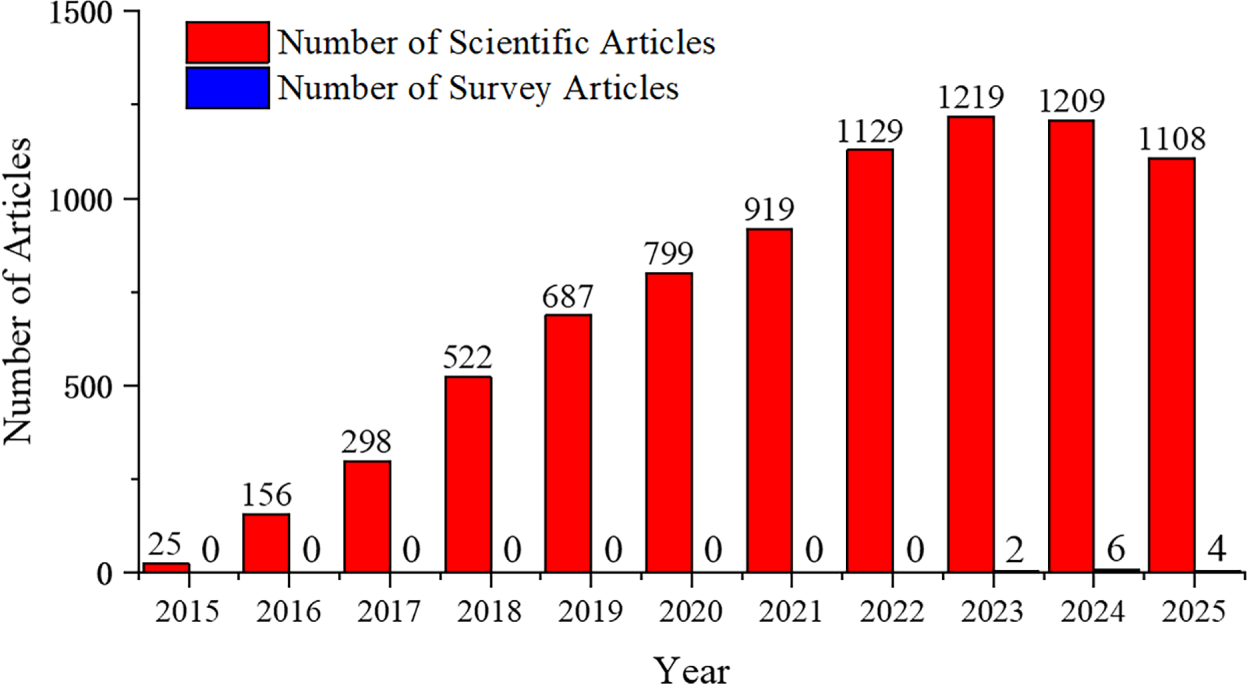
Figure 1: Cloud-edge-end scientific articles and survey articles bar chart
1.1 Contributions of This Survey
To ensure the comprehensiveness, rigor, and cutting-edge nature of this review, we have integrated innovative insights and frontier perspectives from systematic, multi-database literature reviews on the latest
Review a collaborative system: In this paper, a type of collaborative system—cloud-edge-end collaborative
In-depth analysis of key technologies at all layers: This paper describes the methods for each component of this collaborative network in the smart manufacturing system, such as intelligent sensing, data preprocessing, data transfer, task offloading and resource allocation. Meanwhile, the advantages and disadvantages of each method are also analyzed. For each method, the paper provides a detailed technical overview of a comprehensive technical reference for researchers and practitioners. Based on this, the article also discusses system optimization methods to enhance the efficiency and performance of the system.
Analyzing collaborative networking challenges and future directions: The key challenges facing this collaborative network are systematically summarized and several prospective research directions are proposed. This provides a problem-oriented and developmental path for future research, and promotes the development of smart manufacturing towards a smarter, more efficient and greener direction.
Filling existing research gaps and providing a framework for systematic reviews: This paper bridges the lack of a systematic review of cloud-edge-end multidimensional collaborative
The structure of this paper is as follows: Section 1 introduces the background of smart manufacturing and briefly overviews the development of technologies like cloud computing and edge computing. Section 2 presents the Cloud-Edge-End Collaborative
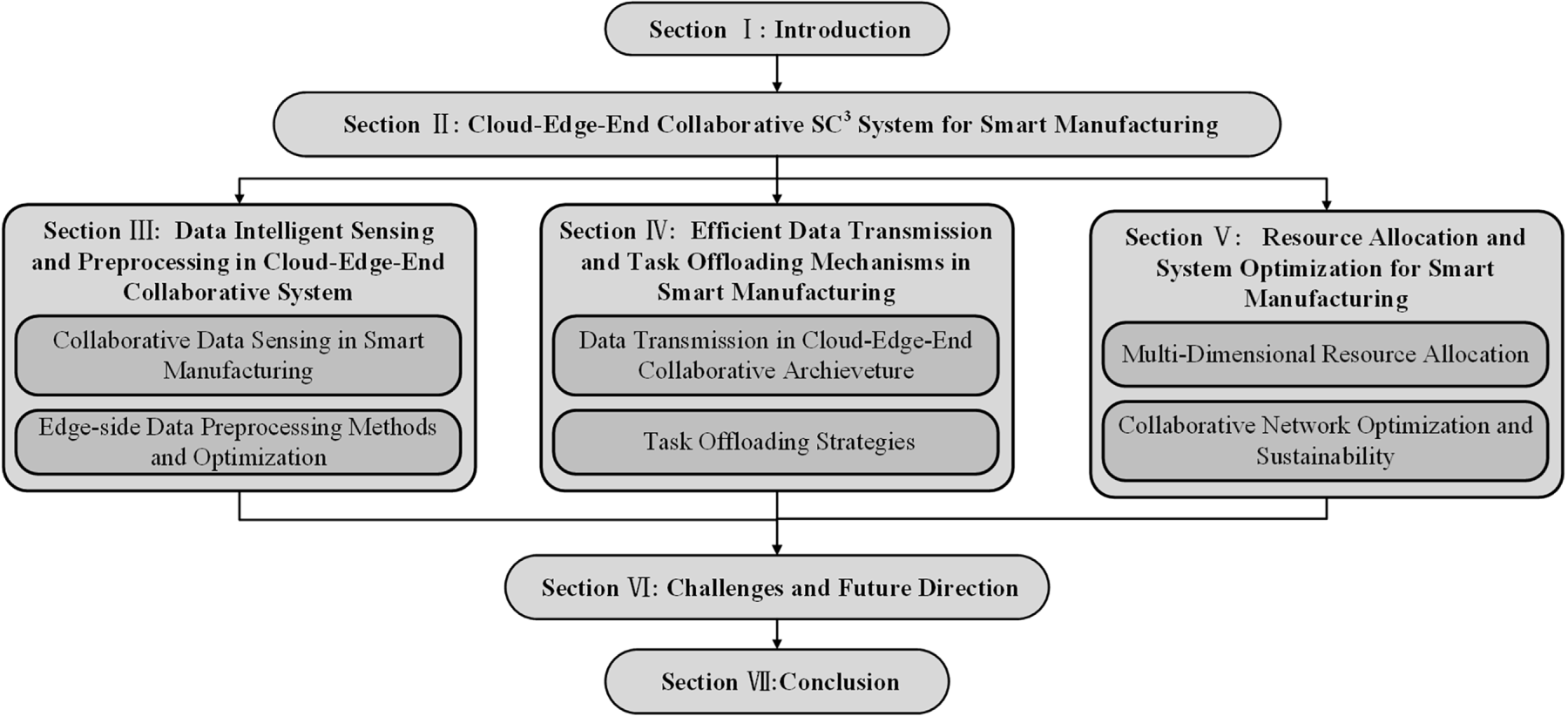
Figure 2: Structure of the survey
2 Cloud-Edge-End Collaborative SC3 System for Smart Manufacturing
This section defines a cloud-edge-end collaborative
2.1 Introduction and Comparison of Different Architectures
2.1.1 Edge Computing Architecture
Edge computing architecture is a distributed framework that deploys computing, storage, and network resources near production equipment at the edge [20,21]. Its core value lies in delivering unparalleled real-time responsiveness to production lines. It shifts computing power from the cloud to the shop floor, deploying it on PLC, gateways, or local servers, enabling critical tasks to be completed locally within millisecond-level latency. This not only safeguards production rhythms from network fluctuations and achieves high availability through offline production continuity, but also keeps sensitive data involving process parameters within the factory, ensuring data sovereignty and privacy security [22].
Therefore, edge computing enables real-time control and local autonomy in smart manufacturing. By performing localized preprocessing and real-time decision-making on massive device data, it effectively filters data uploaded to the cloud, reduces bandwidth costs, and directly drives actuators for precise control. This forms the nerve endings of production-line-level intelligent applications [23]. Typical applications include industrial quality inspection, where edge nodes analyze product defects in real time, and VR/AR remote operations, where edge-side low latency ensures smooth virtual-physical interaction.
2.1.2 Fog Computing Architecture
The fog computing architecture is a three-layer collaborative framework comprising cloud-fog layer-production terminals, centered on interconnecting and coordinating edge nodes across extensive manufacturing regions [20,24]. It covers a broader geographic scope than edge computing. In smart manufacturing, by deploying more powerful fog nodes within factory LANs, it aggregates data from multiple production lines or edge gateways to enable cross-unit, cross-system collaborative analysis and decision-making.
Fog computing delivers regional collaborative intelligence that spans broader areas than edge computing while maintaining greater agility than cloud computing. It handles complex analytical tasks beyond the capacity of individual edge nodes and functions as a data hub, uploading refined high-value insights to the cloud. This approach ensures real-time collaboration at the shop floor level while supporting factory-wide digital management [25,26]. Typical applications include shop floor monitoring in smart factories, where the fog layer enables collaborative analysis of equipment data across multiple workshops, or production resource scheduling across factory campuses.
The Cyber-Physical System (CPS) is a complex intelligent system that deeply integrates physical production entities with information systems [27]. Its core function is to achieve closed-loop coordination through production sensing-information analysis-physical control, essentially serving as an intelligent manufacturing operating system that merges the virtual and physical realms. Within CPS, every physical entity possesses a digital mirror in the information world. Both are deeply interconnected through sensing and communication networks, forming an intelligent closed-loop capable of real-time perception, dynamic analysis, and autonomous decision-making and execution [28].
Its core value lies in driving the transformation of manufacturing systems from automation to intelligence. The key characteristic of CPS is achieving deep integration between the information space and physical processes. Through data sensing, real-time analysis, and closed-loop feedback mechanisms, it constructs production systems with adaptability, self-optimization, and high reliability. This integration manifests not only in bidirectional mapping between physical states and information logic but also emphasizes the system’s autonomous response capability to dynamic environments. For instance, it enables real-time data-driven dynamic adjustments to production parameters or autonomous decision optimization based on predictive modeling, ultimately forming a new intelligent manufacturing paradigm characterized by virtual-physical synergy and continuous evolution [29]. Typical applications include digital twins for smart production lines, which simulate and optimize processes through virtual-physical integration, or closed-loop control systems for autonomous production lines.
2.1.4 Cloud-Edge-End Architecture
The cloud-edge-end collaborative architecture serves as a systematic engineering framework underpinning the implementation of large-scale intelligent manufacturing [9,16]. Through clear hierarchical division of labor, it integrates the strengths of cloud, edge, and device components. Within this architecture, end devices handle data collection and command execution; edge nodes manage real-time control and local decision-making; while the cloud aggregates global data to perform overall scheduling, big data analytics, and AI model training, subsequently deploying optimized algorithmic models back to the edge.
The essence of this architecture lies in achieving a perfect balance between global optimization and local agility. It ensures the most suitable computational resources handle the most appropriate tasks [30]. Typical applications include equipment lifecycle management in smart manufacturing—where terminals collect data, edges process alerts, and clouds analyze operational strategies—or collaborative manufacturing of complex products, enabling the integration of R&D and production resources across multiple regions through cloud-edge-end collaboration.
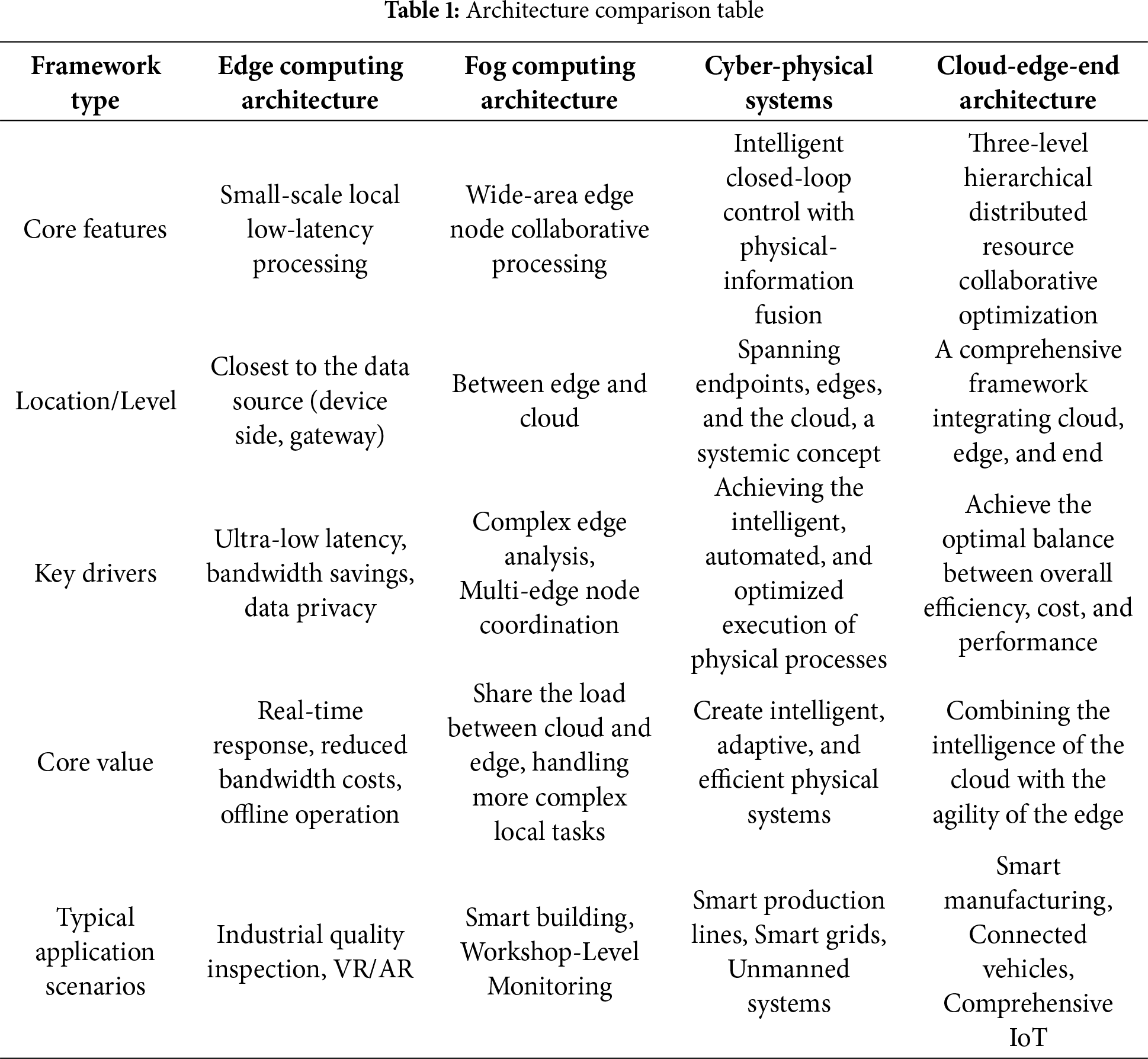
It should be noted that these architectural paradigms are not so distinct but represent the continuous evolution of distributed intelligent systems. The cloud-edge-end architecture can be viewed as a comprehensive integrated framework. Within a clear three-layer system, it operates and integrates key features such as edge computing’s low-latency local processing and fog computing’s cross-node collaboration. Simultaneously, CPS provide a foundational theoretical and methodological perspective for understanding the deep integration of information and physical processes. These systems themselves can be realized and extended through architectures like cloud-edge-end. The comparison table of various architectures is shown in Table 1.
2.2 Conceptual Definition and Systemic Role in Smart Manufacturing
2.2.1 Definition and Connotation of Cloud-Edge-End Collaborative Architecture in Smart Manufacturing
The cloud-edge-end collaboration architecture [9,16] is a distributed computing architecture that deeply integrates cloud computing, edge computing and end devices. It is the core of smart manufacturing to achieve resource optimization, performance enhancement and efficient data processing [31,30] through three-layer collaboration among cloud, edge and end. This builds an efficient, intelligent and scalable industrial system [32].
Cloud computing is widely recognized as a core foundational layer that plays a pivotal role in supporting the operation and development of smart manufacturing systems [33], which provides powerful computing and storage resources for complex global optimization and large-scale data processing [34–36]. Edge computing is used to perform localized processing and real-time decision making, thereby reducing latency and enhancing privacy protection [37,38]. End devices typically serve as important nodes, contributing significantly to on-site data collection and the execution of application tasks tailored to specific scenarios. They are capable of lightweight processing and autonomous operations, ensuring basic functionality even when resources are strained or networks are unstable [39,40].
In smart manufacturing, cloud-edge-end collaborative architecture [41,42] plays a crucial role. The end layer [33] collects real-time data to ensure rapid response at the factory. The edge layer pre-processes and analyses the data in real-time to support predictive maintenance, process parameter optimization and local anomaly detection. The cloud layer [43] aggregates cross-factory data, performs large-scale modelling and coordinates global scheduling to enable optimal allocation of production resources and long-term decision-making. Through this layered collaboration, cloud-edge-end integration [16] not only improves production efficiency and product quality, but also enhances the flexibility and robustness of the entire industrial system, providing important support for building smart factories and Industry 4.0.
2.2.2 Definition and Connotation of SC3 System in Smart Manufacturing
In smart manufacturing, the
The sensing layer [47] is defined as the acquisition of real-time information from equipment, processes and production environments through sensors and monitoring devices. The communication layer ensures timely access to critical information through reliable, low-latency network data transmission. The computing layer [48] generates decisions by using data acquired from the cloud, edge and end points through data processing and analysis. The control layer [49] executes decisions through feedback mechanisms, ensuring precise adjustments to machines to processes and production systems. These four layers work together to form a closed-loop architecture that integrates sensing, transmission, computing and control.
2.2.3 The Collaborative Effect of Cloud–Edge–End Cooperation SC3 System in Smart Manufacturing
Within the cloud-edge-end collaborative
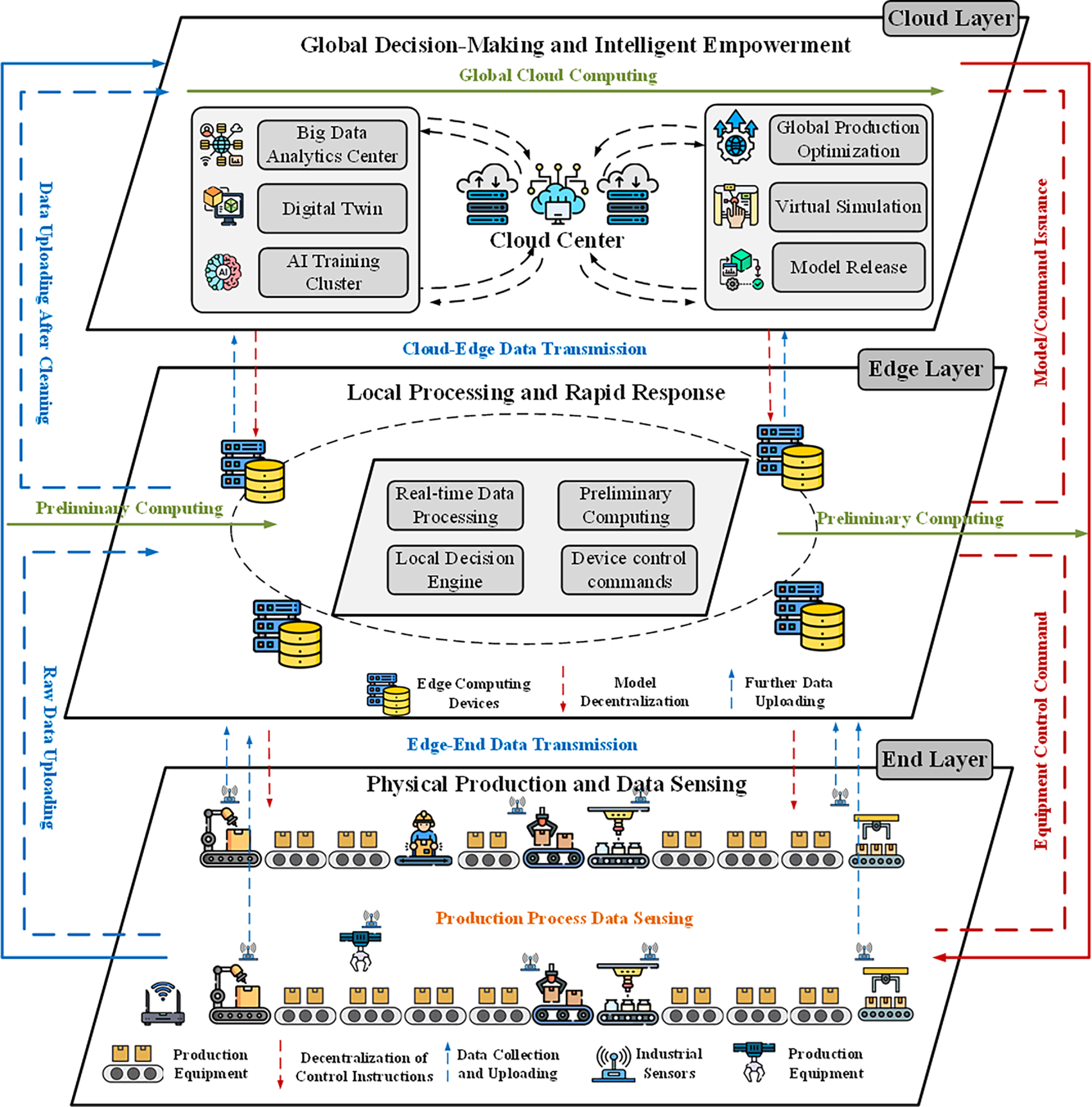
Figure 3: The cloud-edge-end collaboration
The cloud-edge-end collaborative architecture provides a highly efficient data transmission and hierarchical processing platform for the
Instead, the
The cloud-edge-end collaboration
2.3 Literature Review on Cloud-Edge-End Collaborative SC3 System
The following provides a comprehensive review of the development of cloud-edge-end collaborative
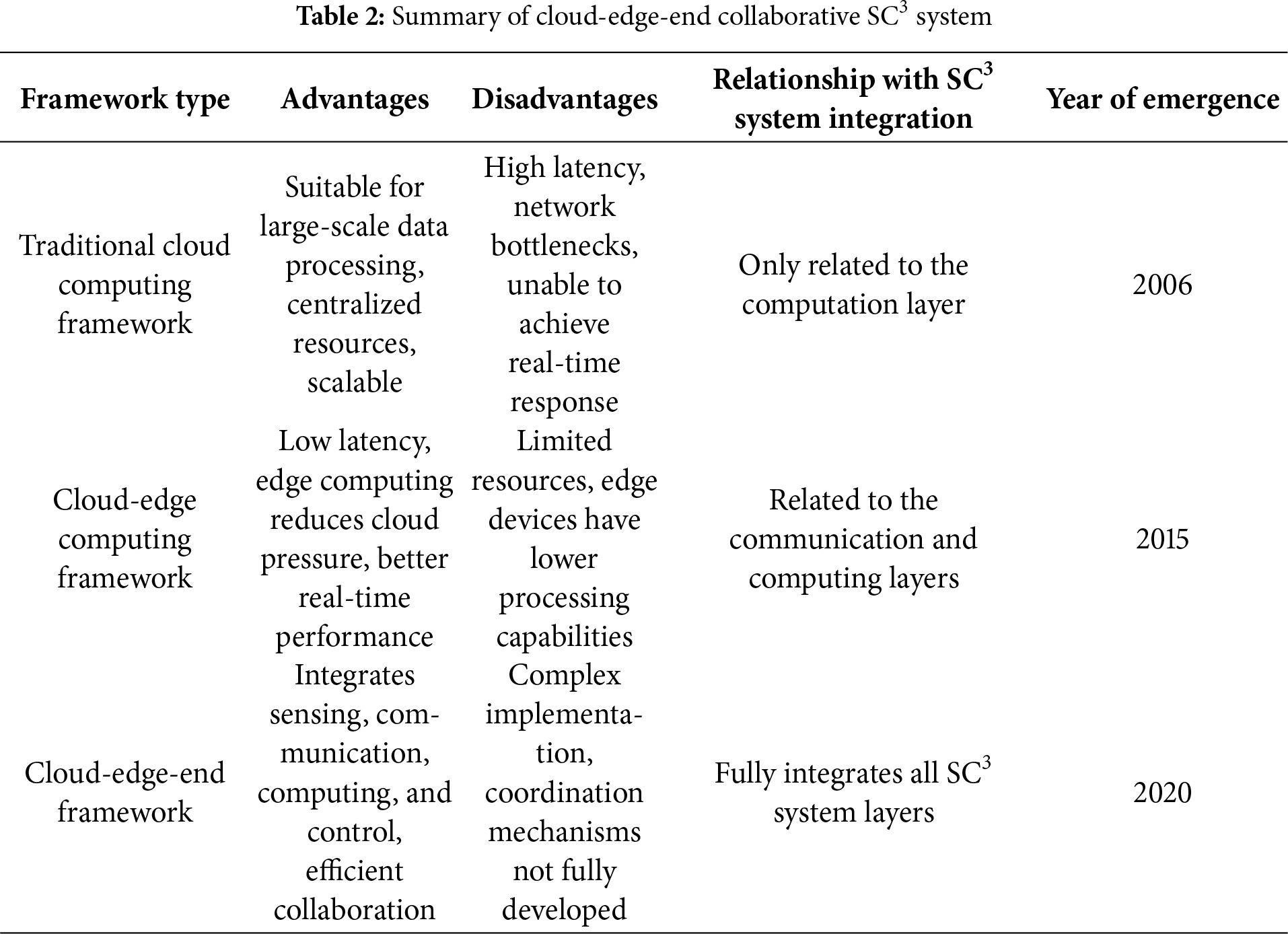
Traditional Cloud Computing Framework was firstly proposed and commercially applied by Google in 2006. Its primary strengths are its aptitude for large-scale data processing, centralized resource management and effective scalability. However, it is evident that this architecture is subject to inherent limitations. In the existing architecture, data must be transmitted to a remote data center for processing, resulting in high latency. Meanwhile, network bandwidth bottles may cause data congestion. Moreover this centralized architecture is difficult to meet the needs of industrial control and other applications with strict real-time requirements. In response to the aforementioned drawbacks, numerous researchers have conducted research in the domains of traditional cloud architecture optimization [53], cloud computing security risk governance [54], and cloud control system performance enhancement [55]. Despite progress in improving cloud computing performance, existing solutions still have significant technical bottlenecks in industrial real-time control, adaptive scheduling, and other areas.
In the face of the limitations of traditional cloud computing with high latency and poor self-adaptation, the cloud-edge architecture has emerged as a predominant architectural framework within the domain of smart manufacturing. The key benefit of this paradigm is the substantial reduction in transmission latency, effective distribution of cloud computing demands, and notable enhancement in real-time responsiveness. However, this architecture is accompanied by certain drawbacks, including constraints in edge node resources, inadequate computing capabilities of edge devices, and the complexity inherent in distributed management. In recognition of these challenges, researchers have conducted research on industrial cloud-edge architecture design [56], optimization of computing and control resource allocation [57], and cloud-edge collaboration performance enhancement, and achieved significant technological breakthroughs. However, it still has obvious deficiencies in terms of device compatibility and distributed management.
Subsequently, the cloud-edge-end architecture further adds end devices to the collaborative system. It has achieved a more profound optimisation of computing, storage, and network resources, as well as collaborative work. It integrates sensing, communication, computing, and control functions to achieve efficient collaboration, which can significantly improve the spontaneity and accuracy of the production process. However, the system still has the drawbacks of complexity in the implementation process, imperfectness of the collaboration mechanism, and difficulty in full integration of all the functions of the sensing, communication, computing, and control layers. To address the above problems, researchers conducted research in the development of a high-precision system for cloud-edge-end collaboration [58], intelligent task scheduling methodology research [16], and cloud-edge-end collaborative real-time control algorithm design. Resultantly, the new system improves the stability, adaptability, and reliability of the cloud-edge-end architecture in intelligent manufacturing. With the development of digital twin technology, adding it to the cloud-edge-end architecture has gradually become an important exploration direction to solve the existing problems of the cloud-edge-end architecture and promote smart manufacturing up to a higher level [59].
The key technologies that promote the efficient and long-term operation of networks in the cloud-edge-end collaborative
3 Data Intelligent Sensing and Preprocessing in Cloud-Edge-End Collaborative System
As illustrated in Fig. 3, intelligent data sensing and preprocessing constitute the foundational data acquisition and preliminary processing layer within the
3.1 Concepts of Intelligent Sensing and Preprocessing in Smart Manufacturing
Data intelligent sensing and pre-processing is the first step in the digital transformation of smart manufacturing and the basis for ensuring stable and efficient plant operation.
Data sensing [60] can be defined as the process of collecting, monitoring and understanding data from various sources. In smart manufacturing, data sensing collects real-time data from production processes, machines and equipment through advanced sensors and artificial intelligence technologies [61]. Data sensing provides accurate and timely information to support decision making, process optimization and quality control [62]. By sensing data from multiple sources, smart manufacturing systems can enable more effective predictive maintenance, detect anomalies and ensure efficient operations.
Data preprocessing [63] involves the cleansing [64], integration [65], and transformation [66] of raw data into a format that facilitates analysis. In smart manufacturing, raw data collected from sensors frequently contains noise, errors, or inconsistencies which can degrade the quality of decisions. Effective data preprocessing techniques has been proved to enhance data quality, making it more reliable and actionable, thereby increasing productivity and ensuring better product quality [67,68].
3.2 Data Sensing in Smart Manufacturing
In the context of smart manufacturing, data sensing represents a pivotal initial stage, ensuring the effective and precise operation of the manufacturing process as a whole. In the early stages of smart manufacturing development, the traditional data sensing refers to the acquisition of real-time data in the production process through various means, including sensors, manual data recording, and industrial control systems. It mainly includes sensor acquisition [69], manual data recording, PLC acquisition [70], SCADA acquisition [71] and so on. Sensors are employed to monitor equipment and environmental parameters through real-time monitoring, PLC and SCADA systems are responsible for collecting industrial equipment operation data, while manual data recording relies on manual entry by operators. Traditional sensing methods have shortcomings such as data silos, poor real-time, complex systems, and poor scalability. With the development of artificial intelligence, cloud computing and other technologies, data collection in smart manufacturing is gradually evolving in the direction of more efficient, real-time and intelligent.
In the field of smart manufacturing, data sensing technology has evolved into a multi-layered, collaborative sensing system comprising three primary layers: the data sensing framework, the mobile data sensing systems, and the data sensing methodologies. The data sensing framework serves as the foundational infrastructure, providing standardized data access through fixed sensor networks. Data sensing systems act as physical carriers, encompassing both fixed nodes and mobile platforms such as drones and automated guided vehicles (AGV) to achieve comprehensive coverage. Data sensing methodologies refer to collection strategies, dynamically optimizing the collection process through AI-driven adaptive approaches. Through cloud-edge-end collaboration, these three components collectively build a comprehensive perception system that supports closed-loop optimization in smart manufacturing.
1. The data sensing framework has the advantages of real-time and accuracy in smart manufacturing, and the disadvantages are high system complexity and low efficiency problems of heterogeneous data optimization. The researchers carried out research on remote data sensing [72], discrete data efficiency optimization [73], and heterogeneous data sensing [74] for intelligent manufacturing, and achieved efficient data acquisition through remote data transmission optimization and heterogeneous data fusion algorithms.
2. The mobile data sensing system aim to enhance the real-time nature, completeness, and reliability of data collection. To overcome the limitations of fixed sensing networks in physical blind spots and flexible inspection requirements, mobile sensing systems have become a critical supplement. These primarily include aerial mobile sensing systems based on unmanned aerial vehicles (UAV) and ground mobile sensing systems based on AGV. UAV [75–77], leveraging their rapid aerial deployment capabilities, are suitable for wide-area tasks such as factory inventory checks and high-altitude inspections; AGV [78,79] perform precise operations like material tracking and equipment proximity inspections on shop floor surfaces. Their core value lies in providing flexible, targeted sensing capabilities for specific, non-continuous scenarios, rather than replacing high-frequency data collection within production lines. Both face common challenges including endurance, communication, and adaptation to dynamic environments. Thus, mobile sensing systems form a vital collaborative and complementary component within smart manufacturing perception architectures, working alongside fixed networks to achieve comprehensive coverage.
3. The data sensing method aim to enhance the real-time nature, completeness, and reliability of data acquisition, yet face challenges such as complex industrial environments and difficulties in integrating multi-source data. Current approaches primarily encompass traditional fixed-rule-based collection and AI-driven adaptive collection. Traditional methods, characterized by inflexible responses and poor adaptability, are gradually being phased out. AI adaptive sensing dynamically adjusts strategies based on real-time operational conditions, offering significant advantages in improving data quality, reducing energy consumption, and minimizing redundancy. However, its drawbacks include the complexity of industrial scenarios, the lack of generalization capability in AI models, and the high costs associated with model training and maintenance. The researchers launched a study to address the aspects of high redundancy of AI model sampling [80], high energy consumption, and complexity of change object data acquisition [81], and achieved significant improvement in data quality, reduced energy consumption, and increased generalizability of AI sampling models.
3.3 Edge-Side Data Preprocessing Methods and Optimization
Edge-side data preprocessing techniques consist of three main steps: data cleansing, data integration and data transformation. Data cleansing removes noise and outliers, data integration merges heterogeneous data from multiple sources, and data transformation standardizes formats and dimensions. These steps serves to enhance the quality of the data.
Data cleansing serves as the core preprocessing step in smart manufacturing data governance, enhancing data quality by removing inaccurate, redundant, or invalid data. This process encompasses error detection and correction: detection identifies and rectifies anomalies to boost system reliability, while correction addresses missing or erroneous data to ensure stable, accurate, and efficient operation of production systems. This establishes a reliable foundation for analysis and decision-making. The researchers have conducted research on automatic error data repair [82,83], data consistency [84], and human-computer collaboration [85] to achieve efficient automatic repair, ensure the trustworthiness of data quality rules, and solve the problem of invalid information by means of graph repair rule semantics and decomposition of connectivity strategies, unified cost model, and crowdsourcing-based CrowdCleaner system. Graph repair rules convert data associations into computable graph models to establish a repair foundation; Unified cost models intelligently select optimal solutions by quantifying scheme metrics; The CrowdCleaner system introduces human-machine collaboration through crowdsourcing to process ambiguous data that machines struggle to judge.
Data integration aims to consolidate multi-source heterogeneous data within smart manufacturing, enhancing its consistency and usability to support precise analysis and decision-making. It primarily comprises two components: multi-source heterogeneous data integration and data augmentation. The former improves data integrity and consistency by merging information from diverse sources. The researchers addressed the computational complexity and data sharing efficiency in multi-source heterogeneous data integration, and achieved improved data fusion efficiency, facilitated real-time data integration and visualization, and improved data quality and integration efficiency through CNN-based lightweight fusion algorithms [86], digital twin-driven cloud-edge-end collaboration architecture [87], and event-driven distributed Kalman filtering algorithms [88]. Among these, the event-driven distributed Kalman filter algorithm achieves significant resource savings through its threshold-triggered mechanism. Data augmentation enhances model generalization capabilities by expanding the dataset, thereby improving the system’s prediction accuracy and robustness. The researchers addressed the data scarcity, noise interference, and data imbalance aspects of multi-data augmentation by using DACMSN data augmentation and composite multiscale network [89], GAN-based two-stage data augmentation method [14], and DGDA-AKDG framework to achieve augmentation of the data quantity and quality [88], to improve the performance of the detection network, and to achieve more efficient resource scheduling and process optimization.
Data transformation converts raw data into a format suitable for analysis and modeling of smart manufacturing systems, improving data consistency and enhancing the effectiveness of data analysis and decision-making. Data transformation typically consists of three main components: digitization [90], discretization [91], and standardization [92]. Digitization refers to the process of converting categorical data into numerical format, enabling machine learning algorithms to process originally non-numeric data. Common digitization methods include One-Hot Encoding [93] and Label Encoding [94]. Discretization involves dividing continuous data into discrete intervals. By discretizing continuous data, it becomes easier to identify patterns and relationships within specific ranges. Standardization ensures that all features have similar scales, which is particularly important when processing data from multiple sources or sensors. Common standardization methods include Min-Max Normalization [95] and Z-score Normalization [96]. By applying data transformation techniques, smart manufacturing systems can analyze data more efficiently and accurately. Data transformation not only helps clean and organize data, but also ensures that models are trained using high-quality, consistent data. In addition, it enables more accurate prediction and optimization, thus improving the performance of intelligent manufacturing systems in real-time decision-making, resource management and production process optimization.
Data cleansing, integration, and transformation serve as foundational core steps for data-driven systems. Within research on cloud-edge-end collaborative architectures, these processes are often simplified or assumed to be optimized, failing to fully highlight their critical value. These steps are not isolated, standalone processes but form a critical technological chain spanning all layers of distributed architectures. Their seamless integration and efficient coordination directly determine system data quality, transmission efficiency, and intelligent decision-making accuracy. They constitute the core prerequisite for ensuring the cloud-edge-end architecture achieves distributed intelligence. The data preprocessing flowchart is shown in Fig. 4.

Figure 4: Data preprocessing flowchart
Within the cloud-edge-end collaborative architecture, each data processing step exhibits an inherent logic of hierarchical adaptation and seamless integration: The end layer focuses on lightweight data cleansing, rapidly filtering noise, outliers, and redundant information from raw data to reduce data transmission pressure on edge nodes; The edge layer handles multi-source data integration, converging diverse data streams from sensors, controllers, and terminal devices through compatible interfaces for heterogeneous equipment. It performs preliminary feature extraction and format standardization. The cloud layer then conducts deep data augmentation and unified format conversion on massive datasets, providing high-quality data support for global model training and complex decision analysis. Each layer’s data processing steps are interconnected and inseparable, forming a complete data flow chain of end preprocessing-edge integration-cloud refinement. This constitutes the core pathway for progressively unlocking data value within a distributed architecture.
In smart manufacturing, data processing must combine scenario adaptability with dynamic scalability to accommodate diverse applications such as the Industrial Internet of Things (IIoT) and smart security. This necessitates establishing unified data processing interface standards to enable compatibility and interoperability across multiple data formats; leveraging edge nodes for real-time, adaptive scenario-specific data processing; and utilizing cloud-based global scheduling to optimize cross-scenario resource collaboration. For instance, in IIoT, data cleansing must filter out noise like equipment vibration, while data integration requires merging industrial bus protocols with wireless sensor protocols. In smart security scenarios, cleansing multi-source data is essential, followed by converting data into formats supporting real-time risk assessment. This strategy enhances resource utilization and processing efficiency, demonstrating the flexibility and scalability of cloud-edge-end architectures for diverse smart manufacturing scenarios.
3.4 Summary and Future Direction
Data intelligent sensing and preprocessing are crucial in ensuring the reliability and effectiveness of data used in smart manufacturing systems. Through advanced sensors and IoT technologies, real-time data can be collected efficiently, while preprocessing methods such as data cleansing, integration, and transformation improve the quality of data. These preprocessing techniques ensure that the data used for decision-making is accurate, reducing errors and enhancing system performance.
In the context of smart manufacturing, data intelligence sensing and preprocessing face multiple practical challenges. Traditional sensing methods suffer from data silos, poor real-time performance, and limited scalability. While novel sensing approaches are gradually being adopted, they still exhibit significant shortcomings: industrial data sensing frameworks are highly complex, with low optimization efficiency for heterogeneous data; AI adaptive data sensing struggles with insufficient model generalization capabilities and high training/maintenance costs due to industrial complexity; The mobile data sensing system faces challenges such as low charging efficiency and high energy consumption for real-time data sensing. In the data preprocessing phase, core steps like data cleansing, integration, and transformation are often simplified or overlooked. The integration between steps across cloud-edge-end layers lacks systematic design, and the lack of adaptation to specific manufacturing scenarios hinders the ability to fully support subsequent intelligent decision-making.
Future efforts should focus on synergistically optimizing data sensing and preprocessing technologies to adapt to smart manufacturing scenarios. At the perception level, fixed and mobile sensing should be integrated, leveraging lightweight edge AI for dynamic strategy adjustments while optimizing drone transmission to reduce energy consumption. The preprocessing layer requires establishing a cloud-edge-end collaborative processing architecture: lightweight cleaning at the device level, heterogeneous integration at the edge, and deep enhancement at the cloud. Concurrently, unified data interface standards and differentiated processing strategies must be developed to enhance data quality and processing efficiency, laying the foundation for end-to-end intelligent decision-making.
4 Efficient Data Transmission and Task Offloading Mechanisms in Smart Manufacturing
With reference to Fig. 3, Data Transmission and Task Offloading are two key interlayer capabilities needed for Cloud-Edge-End integration to work.
4.1 Concepts of Data Transmission and Task Offloading in Smart Manufacturing
In smart manufacturing, data transmission and task offloading represent the ”communication” and ”computing” aspects of
Data transmission [60] usually reliably transmits data from the sensory layer to the edge nodes or cloud platforms via wired or wireless networks for efficient operation of smart manufacturing systems. It facilitates real-time transmission among devices, sensors, and control systems to support cross-layer computation and decision-making [97]. Efficient data transmission allows rapid aggregation of data for analysis, modeling, and control to ensure coordinated system operation in a dynamic environment [98].
Task offloading [99] is the migration of computing tasks from resource-limited endpoints or edge devices to more powerful servers or cloud platforms. It optimizes system performance by efficiently allocating computing resources. In smart manufacturing, offloading resource-heavy tasks (e.g., analysis and optimization) reduces the burden on end devices, improves system scalability, responsiveness, and real-time performance, and provides elastic support for complex manufacturing needs [99].
4.2 Data Transmission in Cloud-Edge-End Collaborative System
Data transfer is a generally acknowledged foundational part of data-driven smart manufacturing. This section focuses on data transmission methods and data transmission networks.
4.2.1 Data Transmission Methods
Data transmission methods refer to the specific ways or strategies by which data is transmitted from the source node to the destination node. Different transmission methods suit different application scenarios and can affect transmission efficiency, response speed, and system reliability. The main data transmission methods in smart manufacturing include:
1. Time-Triggered Data Transmission. Time-triggered data transmission transmits data through predetermined time intervals. It provides predictable latency in smart manufacturing to ensure system periodic scheduling and operational stability [100]. The advantages are reduced transmission delay, improved system stability, and support for timed scheduling, and the disadvantages are that it may lead to wasted bandwidth, difficulty in responding to unexpected events, and may affect real-time performance when the delay is high. It is suitable for transmitting periodic data.
2. Event-Triggered Data Transmission. Event-triggered data transmission [101] is based on specific events triggering data transfer. When an event occurs within the intelligent manufacturing system, the data is immediately sent to the relevant processing unit. This transmission method avoids unnecessary continuous transmission, effectively saves bandwidth, and is suitable for scenarios with large amounts of data but low real-time requirements [102].
3. Real-Time Data Transmission. Real-time data transmission [103] refers to the transmission of data within a time limit to meet real-time requirements. In smart manufacturing, it is commonly used for machine monitoring, fault warning and production control. Advantages include improved efficiency, timely detection of faults, and reduced downtime, while disadvantages include high network and equipment requirements and uncontrollable data delays. The method requires data to be transmitted quickly to the processing system to ensure the stability of the production process.
4. Adaptive Data Transmission. Adaptive data transmission [104,105] dynamically adjusts the data transfer strategy according to current network conditions and task requirements. The advantages are improved transmission efficiency, reduced network load, and optimized resource utilization, while the disadvantages are implementation complexity, potential increase in latency, and dependence on network state. This approach optimizes transmission efficiency and system performance in a dynamically changing manufacturing environment [106].
4.2.2 Data Transmission Networks
A data transmission network is a communication infrastructure used to enable data transmission, supporting various communication protocols and standards. In smart manufacturing, the choice of data transmission network directly affects the reliability, stability and latency of data transmission. The main network types include:
1. WiFi-Based Data Transmission Network. WiFi-based data transmission network [107] is a commonly used wireless communication solution in smart manufacturing. It is flexible in deployment, low cost, and supports high data transmission rates, with the disadvantages of limited signal range, high interference impact, and poor network stability. WiFi-based networks are suitable for small and medium-sized smart manufacturing systems. In smart manufacturing systems, it can be used for local area network connections between devices to support remote monitoring and data transmission. WiFi-based networks are suitable for small and medium-sized smart manufacturing systems, and have become a common choice for data transmission due to their low-power consumption characteristics [108].
2. Ad Hoc-Based Data Transmission Network. Ad hot-based data transmission networks [109] are ad hoc networks that do not require infrastructure support, in which nodes can establish connections and collaborate autonomously. Ad hoc-based networks enable data transfer between devices without a fixed communication infrastructure. The advantages are highly flexible, no infrastructure is required, and can be deployed quickly, the disadvantages are poor network stability, complex node collaboration, and low security. The flexibility and scalability of ad hoc-based networks make them suitable for temporary deployment in emergency or smart production environments [110].
3. Low-Power Wide-Area Network. LPWAN [111] is a low-power wide area network (WAN) A communication network designed for low-power devices, especially for sensor nodes and IoT devices. LPWAN supports long-distance, low-bandwidth data transmission, which is ideal for applications that need to work for long periods of time and have limited power consumption, such as remote monitoring and environmental monitoring systems. The low-power characteristics of LPWAN greatly prolongs the service life of the devices. However, LPWAN has the disadvantages of low bandwidth, slow data transmission rate, and limited coverage.
4. 5G-Based Data Transmission Network. 5G-based data transmission networks [112] have advantages such as high speed, low latency and large capacity. In the field of intelligent manufacturing, 5G networks can realize large-scale and flexible equipment networking, which is especially suitable for high-speed and large-capacity transmission applications, such as automated production lines, remote monitoring and collaborative robots. However, there are shortcomings such as limited coverage, high infrastructure construction costs, and equipment compatibility problems [113].
4.3 Task Offloading Strategies
Task offloading [99] plays a significant role in improving the efficiency of smart manufacturing and is a commonly regarded essential part of “computing” in the
Partial offloading [117] refers to the migration of a portion of computing tasks from end devices in intelligent manufacturing system to an edge platform or cloud platform, thereby reducing the burden of local computing while maintaining real-time data collection and transmission capabilities. It enables effective distribution between local processing and remote computing, maintains low latency and high reliability, and facilitates the upgrading of smart manufacturing systems. This approach optimizes energy consumption and response time and reduces system load. However, it also has drawbacks such as high cost, increased complexity, and uneven resource allocation [118]. Researchers conducted studies on issues such as energy consumption optimization, response time optimization, and cost reduction. The research focused on model classification framework, iterative heuristic algorithms and cost optimization algorithms. The researchers proposed a classification framework based on reinforcement learning [119], an algorithm combining cloud computing and MEC [120], and the GHMWOA algorithm [121], which well solved the problems of energy efficiency bottlenecks, response time delays, and cost optimization, and improved energy efficiency, optimized response time, and reduce total cost.
4.4 Summary and Future Direction
Efficient data transmission and task offloading are essential for the seamless operation of cloud-edge-end collaborative system. These mechanisms ensure low-latency communication, real-time control, and optimized use of computational resources across the network layers. Data transmission methods such as time-triggered, event-triggered, and real-time transmission help maintain the stability and efficiency of manufacturing operations, while task offloading techniques ensure that computationally heavy tasks are offloaded to more powerful cloud or edge resources to enhance system performance.
In smart manufacturing scenarios, the intertwined demands for real-time and non-real-time operations pose significant challenges to data transmission and computational task scheduling. Existing transmission networks and strategies lack dynamic adaptation to business demands, resulting in uneven network resource utilization and latency jitter. Furthermore, task offloading strategies are often static or singular, failing to achieve intelligent, dynamic load balancing across terminal computing power, edge resources, and massive cloud computing capacity. This inability to meet flexible manufacturing’s extreme requirements for system responsiveness and resource efficiency remains a persistent challenge.
Future efforts must integrate the dynamic production characteristics of smart manufacturing to establish a more adaptable and efficient transmission and offloading system. Data transmission should advance the optimization of adaptive transmission technologies. Leveraging the ultra-low latency and massive connectivity features of 6G networks, network slicing technology should allocate dedicated transmission resources to manufacturing tasks of varying priorities, enhancing transmission real-time performance and reliability. Task offloading requires strengthening AI-driven intelligent scheduling. Based on characteristics such as real-time requirements and computational demands of manufacturing tasks, a hybrid strategy of fully and partially offloading with dynamic adjustments should be designed. Simultaneously, a cloud-edge-end collaborative offloading decision framework should be established. Utilizing technologies like reinforcement learning and federated learning to optimize resource allocation will achieve computational load balancing, reduce latency and energy consumption, and support the efficient operation of complex scenarios in smart manufacturing, such as flexible production and remote operations and maintenance.
5 Resource Allocation and System Optimization for Smart Manufacturing
Next, it is examined how resource allocation and system optimization—acting as the foundational regulatory mechanisms for cross-layer synergy and performance enhancement in the SoS-based
This section focuses on Resource Allocation and System Optimization, the core regulatory mechanisms that orchestrate cross-layer synergy in the
5.1 Concepts of Resource Allocation and Collaborative Network Optimization and Sustainability in Smart Manufacturing
In smart manufacturing, resource allocation and system optimization are crucial for the efficient control and long-term development of collaborative networks, which plays a meaningful supporting role in sustaining the stability and scalability of smart manufacturing systems.
Resource allocation [122] is the rational allocation of equipment, materials, personnel, and time under constraints to maximize the efficiency and effectiveness of an intelligent manufacturing system. Resource allocation involves the optimal allocation of various resources. Through accurate resource allocation, cloud, edge, and end systems can operate cooperatively and efficiently, thereby improving the flexibility, responsiveness, and stability of the entire collaboration network [122].
Collaborative Network Optimization and Sustainability [40] is the process of optimizing the interactions between various components of the network such as the cloud, the edge, and end devices to improve system performance, resource utilization, and sustainability. It integrates advanced technologies such as artificial intelligence, machine learning, and real-time data analytics to improve the efficiency, reliability, and adaptability of collaborative systems. Sustainability focuses on reducing energy consumption, minimizing waste, and ensuring the long-term stability and scalability of the network while maintaining high levels of performance and efficiency.
5.2 Multi-Dimensional Resource Allocation
Multi-Dimensional Resource Allocation is a significant functional component of the integrated
1. Digital twin-based allocation methods.
The digital twin-based resource allocation method [123] improves the resource allocation efficiency of smart manufacturing systems by creating a virtual model of the physical system and realizing real-time, data-driven dynamic optimization. It has advantages such as real-time, accuracy, and intelligence. However, it also has disadvantages such as high computational complexity, high energy consumption, and poor system compatibility. To address the challenges of data synchronization, resource allocation, and energy efficiency optimization, this research employs multi-task learning—enabling a single model to handle multiple related tasks through knowledge sharing—alongside dynamic resource allocation mechanisms that adjust computing and communication resources in real-time. The proposed methods, including a digital twin dynamic allocation strategy [124] and an SL-ADTC construction scheme [125], effectively resolve issues in data synchronization, resource scheduling, and low-energy optimization, thereby improving system performance, optimizing resource allocation, and reducing energy consumption.
2. AI-based allocation methods.
AI-based resource allocation methods [126,127] use artificial intelligence algorithms to automatically analyze system demand and resource status to optimize the dynamic scheduling and allocation of resources in the intelligent manufacturing process, and many researchers have focused on artificial intelligence technology to explore system efficiency improvement and resource allocation optimization. Its advantages are automation, intelligence, and adaptability. However, there are also disadvantages such as high computational complexity and high system latency. Aiming at the above and other problems, researchers carried out research in deep reinforcement learning, collaborative decision making, optimization algorithms, etc., and proposed methods such as DGRL intelligent allocation strategy [128] and P-DQN algorithm [129], which solved the problems of resource scheduling optimization, system latency, and computational complexity, and achieved the goals of reducing latency, improving resource utilization, and optimizing multi-objective performance.
3. Blockchain-based allocation methods.
Blockchain-based resource allocation methods [130] ensure transparency, security, and traceability of resource allocation in smart manufacturing through decentralized distributed ledger technology, and many researchers have focused on blockchain technology to explore improvements in trust, accountability, and resource allocation optimization. Its advantages are decentralization, high security, and data traceability. However, there are also disadvantages such as performance bottleneck and high system complexity. To address challenges in security, privacy, and resource allocation optimization, researchers have developed integrated approaches combining blockchain-based strategies, game theory, and deep reinforcement learning (DRL). Blockchain allocation strategies leverage decentralized, immutable, and traceable features to enable automatic, transparent resource distribution while preventing manipulation and fraud. Together with selection mechanisms and DRL optimization algorithms [131], these methods effectively resolve security, privacy, and energy efficiency issues in resource allocation, thereby improving allocation efficiency and enhancing system security [132].
5.3 Collaborative Network Optimization and Sustainability
Collaborative network optimization serves as a vital enabler for cloud-edge-nd collaboration [133] by ensuring efficient resource allocation and minimizing latency across the cloud, edge, and end-device layers. It enables seamless communication and data flow, allowing for real-time decision-making and adaptive control. This optimizes the overall system performance, ensuring that the right resources are allocated at the right time for the optimal operation of each layer. Additionally, sustainability is achieved through dynamic load balancing, energy-efficient resource management, and reduced data transmission requirements [134].
In
In the field of smart manufacturing, collaborative network optimization and sustainability significantly impact production process upgrades and resource management optimization. However, this process involves complex trade-offs, integration challenges, and adaptive constraints, necessitating systematic analysis. As illustrated in Fig. 3, collaborative network optimization must balance multidimensional competing objectives. These include reconciling latency reduction with energy efficiency gains, balancing resource utilization with system scalability, and coordinating local autonomy with global coordination—trade-offs extensively explored in recent research. For instance, prior research [136] indicates that while edge-centric optimization reduces latency, it may induce resource bottlenecks; conversely, cloud-based global optimization enhances resource utilization but risks increased communication overhead. These trade-offs underscore the critical importance of adaptive strategies that dynamically adjust optimization priorities based on real-time system states and application demands.
Integration challenges further exacerbate the complexity of collaborative network optimization, particularly in scenarios where the four-layer functional architecture (sensing, communication, computing, control) of
In smart manufacturing, collaborative network optimization and sustainability are impactful for advancing production processes and resource management. Optimizing the network ensures that resources such as equipment, materials, and energy are used efficiently throughout the manufacturing process [42]. Through the integration of cloud-edge-end networks and
5.4 Summary and Future Direction
Resource allocation and system optimization methods are instrumental to ensuring the efficient operation of smart manufacturing systems. These techniques optimize the use of computational resources, data flow, and task management to improve overall system performance. Approaches based on digital twins, artificial intelligence, and blockchain are gaining traction in achieving more precise resource management and optimization in dynamic manufacturing environments. These methods enable real-time decision-making and enhance the flexibility and scalability of manufacturing systems.
In smart manufacturing, resource allocation and system optimization face multiple challenges. Existing approaches based on digital twins, artificial intelligence, and blockchain each have limitations, suffering from high computational complexity, significant latency, and performance bottlenecks, respectively. Most methods struggle to adapt to dynamic resource changes, leading to a disconnect between allocation and actual demand. At the system level, inadequate cloud-edge-end coordination mechanisms, lack of systematic control over energy consumption and resource waste, and difficulties in balancing efficiency with sustainability further hinder progress. Additionally, insufficient scalability and adaptability constrain large-scale flexible production and overall performance improvements.
Future efforts should focus on advancing the intelligent synergy between resource allocation and system optimization. Resource allocation must integrate the technological strengths of digital twins, artificial intelligence, and blockchain to establish multi-objective optimization models, enabling precise scheduling of equipment, computing power, and energy. System optimization should enhance the efficiency of cloud-edge-end collaborative networks. By implementing dynamic load balancing and energy consumption management, transmission and computational overhead can be reduced while strengthening cross-layer coordination. Incorporating sustainable development principles will achieve synergistic improvements in production efficiency and energy conservation, enhancing system adaptability and scalability to support the transformation of smart manufacturing toward high efficiency, environmental sustainability, and intelligence.
6 Challenges and Future Direction
This section systematically analyzes the core challenges faced by cloud-edge-end collaborative
6.1 Challenges and Strategic Importance
The integration of sensing, communication, computing, and control across cloud-edge-end layers is pivotal for the transformation of smart manufacturing toward autonomy, flexibility, and efficiency. The cloud-edge-end collaborative architecture achieves intelligent closed-loop control throughout the entire production process through layered cooperation: data sensing at the end layer, real-time processing at the edge layer, and global optimization at the cloud layer. However, current systems face challenges such as heterogeneity, real-time requirements, and interoperability during cross-layer integration.
6.1.1 Heterogeneity of Sensing, Communication, Computing, and Control Layers
Challenge Description: The heterogeneity of cloud-edge-end collaborative systems permeates all four functional layers of
Resolving heterogeneity reduces system integration costs and enhances scalability. Modern smart manufacturing demands rapid integration of new devices and adaptation to emerging tasks. Persistent heterogeneity forces repeated interface development for each new device or task, prolonging deployment cycles while creating data silos and resource barriers that prevent holistic system optimization.
Research Gaps:
• Lack of a unified cross-layer interface adaptation framework [144] to effectively coordinate hardware interface and communication protocol differences among devices with varying architectures (e.g., sensors, edge servers, cloud platforms).
• Existing scheduling models fail to fully integrate the dynamic relationship between device performance, protocol characteristics, and task requirements [145], leading to resource allocation mismatches with actual demands.
• Significant performance degradation occurs during heterogeneous data conversion [146,147], with existing methods unable to meet millisecond-level response requirements for data fusion in industrial scenarios.
6.1.2 Real-Time Data Processing and Low-Latency Requirements in SC3 Systems
Challenge Description: Real-time control scenarios in smart manufacturing demand millisecond-level latency for data processing and command execution. The layered cloud-edge-end architecture complicates latency sources: First, transmission latency [148] arises from physical distances and network fluctuations between ends, edges, and clouds, exacerbated by packet loss and retransmissions in wireless communications. Second, processing latency [149] stems from edge devices’ limited hardware resources, which struggle to swiftly handle massive concurrent data, while cloud computing power remains distant. Third, scheduling latency [150] occurs due to inefficient algorithms matching heterogeneous tasks with resources, leading to suboptimal task allocation. The cumulative effect of these delays often exceeds production tolerance thresholds, such as when fault detection tasks are assigned to overloaded nodes.
Low latency is a critical prerequisite for ensuring production safety and enhancing product quality. In scenarios such as high-precision manufacturing and hazardous environment operations, real-time data processing and command execution play a direct and critical role in maintaining production continuity and personnel safety. In these contexts, failure to process data or execute commands promptly may cause production interruptions or even pose safety risks to personnel. Addressing the low-latency challenge enables systems to achieve rapid closed-loop sensing-decision-execution, which is pivotal for smart manufacturing to advance from automation to autonomous operation.
Research Gaps:
• Lack of low-latency mechanisms [151] for coordinated optimization of transmission, processing, and scheduling. Existing approaches primarily optimize individual stages in isolation, neglecting the coupling relationships among various latency sources.
• Edge device computing power allocation algorithms lack sufficient intelligence to dynamically adjust resources based on task real-time requirements, leading to excessive local processing delays [152].
• Absence of dynamic latency compensation strategies adaptable to network fluctuations and task bursts, making it difficult to address uncertainties in complex production environments.
6.1.3 Cross-Layer Interoperability
Challenge Description: As the core enabling capability for cloud-edge-end collaboration, interoperability’s fundamental value lies in achieving seamless information exchange and coordinated operation across different layers. Current interoperability challenges [153,154] manifest across three dimensions: At the device level, inconsistent interface protocols and data specifications among multi-vendor devices create compatibility barriers during system expansion. At the communication level, semantic differences between industrial and IoT protocols result in inefficient cross-protocol data conversion. At the system functionality level, the lack of standardized service interface definitions between layers constrains overall collaborative efficiency. These issues stem from a fragmented industry standards ecosystem, preventing technical components across layers from forming a unified collaborative paradigm.
Interoperability is critical for enhancing system coordination efficiency and reducing maintenance costs. When integrating legacy equipment with new technologies in smart manufacturing systems, insufficient interoperability forces enterprises to invest heavily in system retrofits or even equipment replacement, escalating transformation costs. It also impedes system scalability: when production scales up, difficulties in integrating new edge nodes constrain capacity expansion. In globalized manufacturing, cross-enterprise and cross-regional equipment coordination relies on interoperability to enable resource sharing and collaborative production.
Research Gaps:
• Existing interoperability standards exhibit fragmentation, lacking unified end-to-end specifications covering device access, data exchange, and protocol conversion;
• Cross-protocol communication suffers from conversion delays and information loss, with no lossless conversion solutions supporting real-time industrial control [155];
• Inconsistent interface specifications across functional modules at different layers result in inefficient core collaborative processes such as control command transmission [156].
6.2 Future Directions and Actionable Research Plans
Based on the identified challenges and research gaps, this paper proposes three specific future directions. Each direction addresses an unresolved gap, outlines a clear resolution pathway, and establishes quantifiable objectives for future research:
6.2.1 AI-Driven End-to-End Optimization for SC3 Systems
AI serves as the core capability and performance optimization method for the system. By autonomously learning from dynamic production data and adaptively adjusting system behavior, AI effectively addresses challenges such as heterogeneity, real-time processing, and resource allocation.
Specific Research Plan:
• Develop multi-agent reinforcement learning models for cross-layer collaboration [157]: Train agents representing each layer to collaboratively optimize heterogeneous resource allocation.
• Design a lightweight federated learning framework for edge-to-end collaboration [158]: Supports distributed AI model training between edge and terminal devices without centralizing sensitive data. Focuses on reducing model training latency and communication overhead for resource-constrained devices.
• Integrate large language models to enable semantic understanding of unstructured data [159]: Utilize LLMs to parse heterogeneous data into structured formats suitable for cross-layer processing.
6.2.2 6G-Enabled Collaborative Transmission and Computing for Low-Latency Demands
6G technology features ultra-low latency, high reliability, and massive connectivity, directly addressing the transmission bottlenecks of current 5G systems. Integrating 6G with
Specific Research Plan:
• Designing a Dynamic Task Offloading Protocol for Perceiving 6G Network State [160]: Leveraging 6G’s network slicing and edge computing integration capabilities to allocate dedicated communication resources for critical and non-critical tasks, respectively.
• Developing a 6G-Based Transmission-Computing Joint Optimization Model [161]: Simultaneously optimizing data transmission rate, packet size, and offloading decisions to minimize latency and energy consumption.
• Exploring 6G Positioning and Sensing Capabilities in
6.2.3 Synergistic Network for High Energy Efficiency and Sustainability
Energy efficiency serves as both a constraint for
Specific Research Plan:
• Design dynamic task offloading and resource allocation algorithms for energy-aware systems [163]: Employ multi-objective optimization to balance energy consumption and performance.
• Integrated renewable energy and cross-layer energy scheduling [164]: Coordinates supply with cloud-edge-end computing tasks, prioritizing energy-intensive operations during periods of abundant renewable energy.
This paper provides a systematic review and investigation of the cloud-edge-end collaborative
The primary contributions of this paper are as follows: it systematically elucidates the overall architecture of the cloud-edge-end collaborative
This review fills a gap in existing literature by providing a systematic overview of the cloud-edge-end multidimensional collaborative
Acknowledgement: Thanks to Boyang Zhang, Letian Wang at Beijing Jiaotong University, Beijing.
Funding Statement: This paper is supported by the National Natural Science Foundation of China under Grants 62172033 and 62572042.
Author Contributions: Xueghan Li wrote the first draft of the manuscript; Tao Jing, Bo Gao, Yang Wang and Jing Ai revised the initial manuscript; Minghao Zhu designed the study question and supervised the research. All the authors analyzed the results, discussed this work, and commented on the manuscript. All authors reviewed the results and approved the final version of the manuscript.
Availability of Data and Materials: This is a review article and does not contain data.
Ethics Approval: Not applicable.
Conflicts of Interest: The authors declare no conflicts of interest to report regarding the present study.
References
1. Xu J, Sun Q, Han QL, Tang Y. When embodied AI meets industry 5.0: human-centered smart manufacturing. IEEE/CAA J Automatica Sinica. 2025;12(3):485–501. doi:10.1109/jas.2025.125327. [Google Scholar] [CrossRef]
2. Ahmed I, Jeon G, Piccialli F. From artificial intelligence to explainable artificial intelligence in industry 4.0: a survey on what, how, and where. IEEE Trans Ind Inform. 2022;18(8):5031–42. doi:10.1109/tii.2022.3146552. [Google Scholar] [CrossRef]
3. Maranco M, Sivakumar M, Krishnaraj N, Ivaturi KA, Nidhya R. Digital twin-enabled smart manufacturing. In: Artificial intelligence-enabled digital twin for smart manufacturing. Hoboken, NJ, USA: Wiley; 2024. p. 479–504. doi:10.1002/9781394303601.ch21. [Google Scholar] [CrossRef]
4. Hu Y, Jia Q, Yao Y, Lee Y, Lee M, Wang C, et al. Industrial Internet of Things intelligence empowering smart manufacturing: a literature review. IEEE Internet Things J. 2024;11(11):19143–67. doi:10.1109/jiot.2024.3367692. [Google Scholar] [CrossRef]
5. Leng J, Ye S, Zhou M, Zhao JL, Liu Q, Guo W, et al. Blockchain-secured smart manufacturing in industry 4.0: a survey. IEEE Trans Syst Man Cybern Syst. 2021;51(1):237–52. doi:10.1109/tsmc.2020.3040789. [Google Scholar] [CrossRef]
6. Li X, Jing T, Yu FR, Zhu M, Wang H, Liu Z. Double-layer blockchain and MEC deployment enabled secure and efficient entity interaction framework for the industrial IoT. IEEE Internet Things J. 2025;12(17):35048–64. doi:10.1109/jiot.2025.3549428. [Google Scholar] [CrossRef]
7. Xia D, Han G, Lin C, Li R, Liu M. Quality of service-driven adaptive deployment optimization strategy for edge intelligent networks in discrete manufacturing smart factories. IEEE J Selected Areas Commun. 2025;43(10):3456–71. doi:10.1109/jsac.2025.3574585. [Google Scholar] [CrossRef]
8. Kong X, Wu Y, Wang H, Xia F. Edge computing for internet of everything: a survey. IEEE Internet Things J. 2022;9(23):23472–85. doi:10.1109/jiot.2022.3200431. [Google Scholar] [CrossRef]
9. Wang Y, Yang C, Lan S, Zhu L, Zhang Y. End-edge-cloud collaborative computing for deep learning: a comprehensive survey. IEEE Commun Surv Tutor. 2024;26(4):2647–83. doi:10.1109/comst.2024.3393230. [Google Scholar] [CrossRef]
10. Arthurs P, Gillam L, Krause P, Wang N, Halder K, Mouzakitis A. A taxonomy and survey of edge cloud computing for intelligent transportation systems and connected vehicles. IEEE Trans Intell Transp Syst. 2022;23(7):6206–21. doi:10.1109/tits.2021.3084396. [Google Scholar] [CrossRef]
11. Rosa L, Foschini L, Corradi A. Empowering cloud computing with network acceleration: a survey. IEEE Commun Surv Tutor. 2024;26(4):2729–68. doi:10.1109/comst.2024.3377531. [Google Scholar] [CrossRef]
12. Xia X, Chen F, He Q, Cui G, Grundy J, Abdelrazek M, et al. OL-MEDC: an online approach for cost-effective data caching in mobile edge computing systems. IEEE Trans Mobile Comput. 2023;22(3):1646–58. doi:10.1109/tmc.2021.3107918. [Google Scholar] [CrossRef]
13. Chaabane N, Mahfoudhi S, Belkadhi K. Interpolation-based IoT sensors selection. IEEE Sens J. 2024;24(21):36143–7. doi:10.1109/jsen.2024.3461833. [Google Scholar] [CrossRef]
14. Fang X, Lei C, Feng W, Chen Y, Xiao M, Ge N, et al. Sensing-communication-computing-control closed-loop optimization for 6G digital twin-empowered robotic systems. IEEE J Selected Areas Commun. 2025;43(10):3330–46. doi:10.1109/jsac.2025.3574601. [Google Scholar] [CrossRef]
15. Shi W, Li Q, Yu Q, Wang F, Shen G, Jiang Y, et al. A survey on intelligent solutions for increased video delivery quality in cloud–edge–end networks. IEEE Commun Surv Tutor. 2025;27(2):1363–94. doi:10.1109/comst.2024.3427360. [Google Scholar] [CrossRef]
16. Gu H, Zhao L, Han Z, Zheng G, Song S. AI-enhanced cloud-edge-terminal collaborative network: survey, applications, and future directions. IEEE Commun Surv Tutor. 2024;26(2):1322–85. doi:10.1109/comst.2023.3338153. [Google Scholar] [CrossRef]
17. Hu Y, Ye D, Kang J, Wu M, Yu R. A cloud–edge collaborative architecture for multimodal LLM-based advanced driver assistance systems in IoT networks. IEEE Internet Things J. 2025;12(10):13208–21. doi:10.1109/jiot.2024.3509628. [Google Scholar] [CrossRef]
18. Walia GK, Kumar M, Gill SS. AI-empowered fog/edge resource management for IoT applications: a comprehensive review, research challenges, and future perspectives. IEEE Commun Surv Tutor. 2024;26(1):619–69. doi:10.1109/comst.2023.3338015. [Google Scholar] [CrossRef]
19. Liang H, Zhang Z, Hu C, Gong Y, Cheng D. A survey on spatio-temporal big data analytics ecosystem: resource management, processing platform, and applications. IEEE Trans Big Data. 2024;10(2):174–93. doi:10.1109/tbdata.2023.3342619. [Google Scholar] [CrossRef]
20. Wang H, Liu T, Kim B, Lin CW, Shiraishi S, Xie J, et al. Architectural design alternatives based on cloud/edge/fog computing for connected vehicles. IEEE Commun Surv Tutor. 2020;22(4):2349–77. doi:10.1109/comst.2020.3020854. [Google Scholar] [CrossRef]
21. Qiu T, Chi J, Zhou X, Ning Z, Atiquzzaman M, Wu DO. Edge computing in industrial internet of things: architecture, advances and challenges. IEEE Commun Surv Tutor. 2020;22(4):2462–88. doi:10.1109/comst.2020.3009103. [Google Scholar] [CrossRef]
22. Shirin Abkenar F, Ramezani P, Iranmanesh S, Murali S, Chulerttiyawong D, Wan X, et al. A survey on mobility of edge computing networks in IoT: state-of-the-art, architectures, and challenges. IEEE Commun Surv Tutor. 2022;24(4):2329–65. doi:10.1109/comst.2022.3211462. [Google Scholar] [CrossRef]
23. Tang H, Li D, Wan J, Imran M, Shoaib M. A reconfigurable method for intelligent manufacturing based on industrial cloud and edge intelligence. IEEE Internet Things J. 2020;7(5):4248–59. doi:10.1109/jiot.2019.2950048. [Google Scholar] [CrossRef]
24. Mukherjee M, Shu L, Wang D. Survey of fog computing: fundamental, network applications, and research challenges. IEEE Commun Surv Tutor. 2018;20(3):1826–57. doi:10.1109/comst.2018.2814571. [Google Scholar] [CrossRef]
25. Kaur A, Auluck N, Rana O. Real-time scheduling on hierarchical heterogeneous fog networks. IEEE Trans Serv Comput. 2023;16(2):1358–72. doi:10.1109/tsc.2022.3155783. [Google Scholar] [CrossRef]
26. Wang T, Liang Y, Tian Y, Bhuiyan MZA, Liu A, Asyhari AT. Solving coupling security problem for sustainable sensor-cloud systems based on fog computing. IEEE Trans Sustainable Comput. 2021;6(1):43–53. doi:10.1109/tsusc.2019.2904651. [Google Scholar] [CrossRef]
27. Kim S, Park KJ, Lu C. A survey on network security for cyber–physical systems: from threats to resilient design. IEEE Commun Surv Tutor. 2022;24(3):1534–73. doi:10.1109/comst.2022.3187531. [Google Scholar] [CrossRef]
28. Jiang Y, Wu S, Ma R, Liu M, Luo H, Kaynak O. Monitoring and defense of industrial cyber-physical systems under typical attacks: from a systems and control perspective. IEEE Trans Ind Cyber-Phys Syst. 2023;1:192–207. doi:10.1109/ticps.2023.3317237. [Google Scholar] [CrossRef]
29. Lin WD, Low MYH. Concept design of a system architecture for a manufacturing cyber-physical digital twin system. In: 2020 IEEE International Conference on Industrial Engineering and Engineering Management (IEEM). Piscataway, NJ, USA: IEEE; 2020. p. 1320–4. [Google Scholar]
30. Liu Z, Lin Z, Zhang Y, Chen C, Guo J, Qi B, et al. Joint optimization of computational tasks offloading for efficient and secure manufacturing through cloud-fog-edge-terminal architecture. IEEE Trans Emerg Top Comput Intell. 2024:1–15. doi:10.1109/tetci.2024.3509496. [Google Scholar] [CrossRef]
31. Xue G, Xia Y. A flexible logistics system for intelligent manufacturing workshop. In: 2019 IEEE 10th International Conference on Mechanical and Intelligent Manufacturing Technologies (ICMIMT). Piscataway, NJ, USA: IEEE; 2019. p. 133–7. [Google Scholar]
32. Xiao G. Electronic IoT technology and cloud computing in intelligent manufacturing industry. In: 2024 5th International Conference on Mechatronics Technology and Intelligent Manufacturing (ICMTIM). Piscataway, NJ, USA: IEEE; 2024. p. 664–9. [Google Scholar]
33. Duan S, Wang D, Ren J, Lyu F, Zhang Y, Wu H, et al. Distributed artificial intelligence empowered by end-edge-cloud computing: a survey. IEEE Commun Surv Tutor. 2023;25(1):591–624. doi:10.1109/comst.2022.3218527. [Google Scholar] [CrossRef]
34. Zhao L, Li B, Yuan H. Cloud edge integrated security architecture of new cloud manufacturing system. J Syst Eng Electron. 2024;35(5):1177–89. doi:10.23919/jsee.2024.000112. [Google Scholar] [CrossRef]
35. Pandey S, Laxmi V, Mahapatra RP. Industry 4.0, intelligent manufacturing, internet of things, cloud computing. In: A roadmap for enabling industry 4.0 by artificial intelligence. Hoboken, NJ, USA: Wiley; 2023. p. 17–29. [Google Scholar]
36. Hung MH, Lin YC, Hsiao HC, Chen CC, Lai KC, Hsieh YM, et al. A novel implementation framework of digital twins for intelligent manufacturing based on container technology and cloud manufacturing services. IEEE Trans Autom Sci Eng. 2022;19(3):1614–30. doi:10.1109/tase.2022.3143832. [Google Scholar] [CrossRef]
37. Li X, Jing T, Wang X, Han D, Fan X, Dong H, et al. Two-stage offloading for an enhancing distributed vehicular edge computing and networks: model and algorithm. IEEE Trans Intell Transp Syst. 2024;25(11):17744–61. doi:10.1109/tits.2024.3424852. [Google Scholar] [CrossRef]
38. Li X, Jing T, Li R, Wang X, Yan Y, Fan X, et al. Self-learning based dependable offloading optimization in semi-trusted vehicular edge computing and networks. IEEE Trans Veh Technol. 2025;74(5):8141–57. doi:10.1109/tvt.2025.3526696. [Google Scholar] [CrossRef]
39. Zhang C, Li S, Song Y, Meng Q, Lu L, Zhu H, et al. A lightweight and chip-level reconfigurable architecture for next-generation IoT end devices. IEEE Trans Comput. 2024;73(3):747–63. doi:10.1109/tc.2023.3343094. [Google Scholar] [CrossRef]
40. Imteaj A, Thakker U, Wang S, Li J, Amini MH. A survey on federated learning for resource-constrained IoT devices. IEEE Internet Things J. 2022;9(1):1–24. doi:10.1109/jiot.2021.3095077. [Google Scholar] [CrossRef]
41. Xiong X, Li M, Yu FR, Zhang H, Wang K, Si P. Cloud-edge-end collaborative computing-enabled intelligent sharding blockchain for industrial IoT based on PPO approach. IEEE Trans Mobile Comput. 2025;24(9):8011–24. doi:10.1109/tmc.2025.3554568. [Google Scholar] [CrossRef]
42. Song C, Zheng H, Han G, Zeng P, Liu L. Cloud edge collaborative service composition optimization for intelligent manufacturing. IEEE Trans Ind Inform. 2023;19(5):6849–58. doi:10.1109/tii.2022.3208090. [Google Scholar] [CrossRef]
43. Kar B, Yahya W, Lin YD, Ali A. Offloading using traditional optimization and machine learning in federated cloud–edge–fog systems: a survey. IEEE Commun Surv Tutor. 2023;25(2):1199–226. doi:10.1109/comst.2023.3239579. [Google Scholar] [CrossRef]
44. Liao H, Yan H, Zhou W, Che W, Liu H, Zhou Z, et al. Timeliness-driven integrated sensing, transmission, computing, and control for power-communication coupling smart grid. IEEE J Selected Areas Commun. 2025;43(9):3134–49. doi:10.1109/jsac.2025.3574607. [Google Scholar] [CrossRef]
45. Wen D, Zhou Y, Li X, Shi Y, Huang K, Letaief KB. A survey on integrated sensing, communication, and computation. IEEE Commun Surv Tutor. 2025;27(5):3058–98. doi:10.1109/comst.2024.3521498. [Google Scholar] [CrossRef]
46. Tang Q, Yang Y, Cui J, Xie R, Huang T, Chen T, et al. SeCo4: co-design of sensing, communication, and computing for intelligent control in industrial cyber-physical systems. IEEE J Sel Areas Commun. 2025;43:3362–78. doi:10.1109/jsac.2025.3574623. [Google Scholar] [CrossRef]
47. Wei Z, Jia J, Niu Y, Wang L, Wu H, Yang H, et al. Integrated sensing and communication channel modeling: a survey. IEEE Internet Things J. 2025;12(12):18850–64. doi:10.1109/jiot.2024.3449377. [Google Scholar] [CrossRef]
48. Wang X, Han Y, Leung VCM, Niyato D, Yan X, Chen X. Convergence of edge computing and deep learning: a comprehensive survey. IEEE Commun Surv Tutor. 2020;22(2):869–904. doi:10.1007/978-981-15-6186-3. [Google Scholar] [CrossRef]
49. Kovalenko I, Moyne J, Bi M, Balta EC, Ma W, Qamsane Y, et al. Toward an automated learning control architecture for cyber-physical manufacturing systems. IEEE Access. 2022;10:38755–73. doi:10.1109/access.2022.3165551. [Google Scholar] [CrossRef]
50. Cao K, Weng J, Li K. Reliability-driven end–end–edge collaboration for energy minimization in large-scale cyber-physical systems. IEEE Trans Reliab. 2024;73(1):230–44. doi:10.1109/tr.2023.3297124. [Google Scholar] [CrossRef]
51. Putteti S, Santhi G, Mittoor GR, Nagamani C, Udayaraju P. Intelligent industrial IoT: a data-driven approach for smart manufacturing and predictive maintenance. In: 2025 Third International Conference on Augmented Intelligence and Sustainable Systems (ICAISS). Piscataway, NJ, USA: IEEE; 2025. p. 1032–40. [Google Scholar]
52. Cai J, Liu W, Huang Z, Yu FR. Task decomposition and hierarchical scheduling for collaborative cloud-edge-end computing. IEEE Trans Serv Comput. 2024;17(6):4368–82. doi:10.1109/tsc.2024.3402169. [Google Scholar] [CrossRef]
53. Tao F, Cheng Y, Xu LD, Zhang L, Li BH. CCIoT-CMfg: cloud computing and internet of things-based cloud manufacturing service system. IEEE Trans Ind Inform. 2014;10(2):1435–42. doi:10.1109/tii.2014.2306383. [Google Scholar] [CrossRef]
54. Lyu Q, Li H, Deng Z, Wang J, Ren Y, Zheng N, et al. A2UA: an auditable anonymous user authentication protocol based on blockchain for cloud services. IEEE Trans Cloud Comput. 2023;11(3):2546–61. doi:10.1109/tcc.2022.3216580. [Google Scholar] [CrossRef]
55. Tang X, Liu Y, Zeng Z, Veeravalli B. Service cost effective and reliability aware job scheduling algorithm on cloud computing systems. IEEE Trans Cloud Comput. 2023;11(2):1461–73. doi:10.1109/tcc.2021.3137323. [Google Scholar] [CrossRef]
56. Liu W, Geng J, Zhu Z, Zhao Y, Ji C, Li C, et al. Ace-sniper: cloud–edge collaborative scheduling framework with DNN inference latency modeling on heterogeneous devices. IEEE Trans Comput-Aided Des Integr Circuits Syst. 2024;43(2):534–47. doi:10.1109/tcad.2023.3314388. [Google Scholar] [CrossRef]
57. Zhang W, Zeadally S, Zhou H, Zhang H, Wang N, Leung VCM. Joint service quality control and resource allocation for service reliability maximization in edge computing. IEEE Trans Commun. 2023;71(2):935–48. doi:10.1109/tcomm.2022.3227968. [Google Scholar] [CrossRef]
58. Yu X, Wang D, Yang J, Feng P, Pang C, Karhela TA. A process-traceable high-precision tightening system: system architecture and synchronous control. In: 2022 IEEE International Conference on Industrial Technology (ICIT). Piscataway, NJ, USA: IEEE; 2022. p. 1–6. [Google Scholar]
59. Luo W, Huang K, Liang X, Ren H, Zhou N, Zhang C, et al. Process manufacturing intelligence empowered by industrial metaverse: a survey. IEEE Trans Cybern. 2024;54(11):6679–92. doi:10.1109/tcyb.2024.3420958. [Google Scholar] [PubMed] [CrossRef]
60. Liu G, Wang Y, Liu C, Cui Y. Research on production big data acquisition and transmission system in intelligent jobshop. In: 2021 33rd Chinese Control and Decision Conference (CCDC). Piscataway, NJ, USA: IEEE; 2021. p. 293–8. [Google Scholar]
61. Chen Y, Zhao C, Yang S, Zhao P, Ren X, Han Q, et al. OSE: on-site state-of-health estimation for Li-Ion battery using real-time field data. IEEE Trans Transp Electr. 2025;11(3):7452–62. doi:10.1109/tte.2025.3527967. [Google Scholar] [CrossRef]
62. Zeng Y, Tang J. MEC-assisted real-time data acquisition and processing for UAV with general missions. IEEE Trans Veh Technol. 2023;72(1):1058–72. doi:10.1109/tvt.2022.3203704. [Google Scholar] [CrossRef]
63. Peng S, Sun S, Yao YD. A survey of modulation classification using deep learning: signal representation and data preprocessing. IEEE Trans Neural Netw Learn Syst. 2022;33(12):7020–38. doi:10.1109/TNNLS.2021.3085433. [Google Scholar] [PubMed] [CrossRef]
64. Ding X, Wang H, Li G, Li H, Li Y, Liu Y. IoT data cleaning techniques: a survey. Intell Conv Netw. 2022;3(4):325–39. doi:10.23919/icn.2022.0026. [Google Scholar] [CrossRef]
65. Roh Y, Heo G, Whang SE. A survey on data collection for machine learning: a big data-AI integration perspective. IEEE Trans Knowl Data Eng. 2021;33(4):1328–47. doi:10.1109/tkde.2019.2946162. [Google Scholar] [CrossRef]
66. Kamalov F, Moussa S, Reyes JA. Data transformation in machine learning: empirical analysis. In: 2023 International Conference on Innovation and Intelligence for Informatics, Computing, and Technologies (3ICT). Piscataway, NJ, USA: IEEE; 2023. p. 115–20. [Google Scholar]
67. Guo Y, Bo D, Yang C, Lu Z, Zhang Z, Liu J, et al. Data-centric graph learning: a survey. IEEE Trans Big Data. 2025;11(1):1–20. doi:10.1109/tbdata.2024.3489412. [Google Scholar] [CrossRef]
68. Alghamdi TA, Javaid N. A survey of preprocessing methods used for analysis of big data originated from smart grids. IEEE Access. 2022;10:29149–71. doi:10.1109/access.2022.3157941. [Google Scholar] [CrossRef]
69. IEEE Sensors Council. IEEE recommended practice for inertial sensor test equipment, instrumentation, data acquisition, and analysis. In: IEEE Std 1554-2005; New York, NY, USA: IEEE; 2005. doi:10.1109/IEEESTD.2005.97697. [Google Scholar] [CrossRef]
70. Zhang H, Li M, Yang M, Zhou C. Dual mode data acquisition and analysis based on deep learning for smart home networks. IEEE Internet Things J. 2024;11(5):8052–63. doi:10.1109/jiot.2023.3317416. [Google Scholar] [CrossRef]
71. Zhang W, Zhang H, Fang L, Liu Z, Ge C. A secure revocable fine-grained access control and data sharing scheme for SCADA in IIoT systems. IEEE Internet Things J. 2022;9(3):1976–84. doi:10.1109/jiot.2021.3091760. [Google Scholar] [CrossRef]
72. Singh A, Bruzzone L. SIGAN: spectral index generative adversarial network for data augmentation in multispectral remote sensing images. IEEE Geosci Remote Sens Lett. 2022;19:1–5. doi:10.1109/lgrs.2021.3093238. [Google Scholar] [CrossRef]
73. Ge L, Du T, Xu Z, Hou L, Yan J, Li Y. A fault diagnosis method for smart meters via two-layer stacking ensemble optimization and data augmentation. J Modern Power Syst Clean Energy. 2024;12(4):1272–84. [Google Scholar]
74. Xu L, Lu W, Hu L, Yang H, Jiang Y, Liu C, et al. Ringmo-SenseV2: remote sensing foundation model for spatiotemporal prediction based on multisource heterogeneous time-series data. IEEE Trans Geosci Remote Sens. 2025;63:1–18. doi:10.1109/tgrs.2025.3565203. [Google Scholar] [CrossRef]
75. Jin R, Lin R. Optimizing dual-mode UAV-assisted remote IoT data collection with decentralized DRL in 6G-enabled space-air-ground networks. In: ICASSP 2025-2025 IEEE International Conference on Acoustics, Speech and Signal Processing (ICASSP). Piscataway, NJ, USA: IEEE; 2025. p. 1–5. [Google Scholar]
76. Behera TK, Bakshi S, Khan MA, Albarakati HM. A lightweight multiscale-multiobject deep segmentation architecture for UAV-based consumer applications. IEEE Trans Consum Electron. 2024;70(1):3740–53. doi:10.1109/tce.2024.3367531. [Google Scholar] [CrossRef]
77. Zeng Y, Tang J. Real-time data acquisition and processing under mobile edge computing-assisted UAV system. In: GLOBECOM 2022-2022 IEEE Global Communications Conference. Piscataway, NJ, USA: IEEE; 2022. p. 5680–5. [Google Scholar]
78. Zhu Y, Wang W, Cheng N, Zhou H, Quan W, Li C. AGV-assisted data collection strategies in industrial IoT: a value of information perspective. In: GLOBECOM 2024-2024 IEEE Global Communications Conference. Piscataway, NJ, USA: IEEE; 2024. p. 788–93. [Google Scholar]
79. Zhou Y, Feng Z, Song Z, Wei Z, Ma D, Meng Z, et al. Integrated sensing, communication, and control driven multi-AGV closed-loop control. IEEE Trans Veh Technol. 2025;74(7):10853–68. doi:10.1109/tvt.2025.3546650. [Google Scholar] [CrossRef]
80. Huang W, Zhan J, Sun Y, Han X, An T, Jiang N. Context-aware adaptive sampling for intelligent data acquisition systems using dqn. In: 2025 IEEE 6th International Seminar on Artificial Intelligence, Networking and Information Technology (AINIT). Piscataway, NJ, USA: IEEE; 2025. p. 1–5. doi:10.1109/ainit65432.2025.11035407. [Google Scholar] [CrossRef]
81. Huang R, Wei J, Xing Y, Guo Q. AdaAug+: a reinforcement learning-based adaptive data augmentation for change detection. IEEE Trans Geosci Remote Sens. 2024;62:1–12. doi:10.1109/tgrs.2024.3478218. [Google Scholar] [CrossRef]
82. Cheng Y, Chen L, Yuan Y, Wang G. Rule-based graph repairing: semantic and efficient repairing methods. In: 2018 IEEE 34th International Conference on Data Engineering (ICDE). Piscataway, NJ, USA: IEEE; 2018. p. 773–84. [Google Scholar]
83. Chiang F, Miller RJ. A unified model for data and constraint repair. In: 2011 IEEE 27th International Conference on Data Engineering. Piscataway, NJ, USA: IEEE; 2011. p. 446–57. [Google Scholar]
84. Tong Y, Cao CC, Zhang CJ, Li Y, Chen L. CrowdCleaner: data cleaning for multi-version data on the web via crowdsourcing. In: 2014 IEEE 30th International Conference on Data Engineering. Piscataway, NJ, USA: IEEE; 2014. p. 1182–5. [Google Scholar]
85. Volkovs M, Chiang F, Szlichta J, Miller RJ. Continuous data cleaning. In: 2014 IEEE 30th International Conference on Data Engineering. Piscataway, NJ, USA: IEEE; 2014. p. 244–55. [Google Scholar]
86. Tie R. Lightweight data integration and fusion method based on a convolutional neural network. In: 2021 IEEE International Conference on Industrial Application of Artificial Intelligence (IAAI). Piscataway, NJ, USA: IEEE; 2021. p. 416–21. [Google Scholar]
87. Stadtmann F, Mahalingam HP, Rasheed A. Data integration framework for virtual reality enabled digital twins. In: 2023 IEEE 9th World Forum on Internet of Things (WF-IoT). Piscataway, NJ, USA: IEEE; 2023. p. 1–6. doi:10.1109/wf-iot58464.2023.10539546. [Google Scholar] [CrossRef]
88. Fan P, Dai F, He Y, Zhang Z, Zhu H. Electric power multi-source heterogeneous data fusion model based on edge computing. In: 2024 7th International Conference on Advanced Algorithms and Control Engineering (ICAACE). Kirkland, WA, USA: SPIE; 2024. p. 562–5. [Google Scholar]
89. Wei Y, Xiao Z, Liu S, Schröder KU, Peng H, Sarr AM, et al. A novel data augmentation and composite multiscale network for mechanical fault diagnosis. IEEE Trans Instrum Meas. 2023;72:1–12. doi:10.1109/tim.2023.3301902. [Google Scholar] [CrossRef]
90. Liu L, Lee PKC, Yeung ACL, Cheng TCE, Wang T. An empirical study on digitalization’s impact on operational efficiency and the moderating role of multiple uncertainties. IEEE Trans Eng Manage. 2024;71:11463–78. doi:10.1109/tem.2024.3414831. [Google Scholar] [CrossRef]
91. García S, Luengo J, Sáez JA, López V, Herrera F. A survey of discretization techniques: taxonomy and empirical analysis in supervised learning. IEEE Trans Knowl Data Eng. 2013;25(4):734–50. doi:10.1109/tkde.2012.35. [Google Scholar] [CrossRef]
92. Ji G, Woo J, Lee G, Msigwa C, Bernard D, Yun J. AIoT-based smart healthcare in everyday lives: data collection and standardization from smartphones and smartwatches. IEEE Internet Things J. 2024;11(16):27597–619. doi:10.1109/jiot.2024.3400509. [Google Scholar] [CrossRef]
93. Lee W, Tao J, Chien JSC, Buckwalter JF. A 5.4 mW G-Band phase shifter in 90-nm SiGe HBT with one-hot encoding. IEEE Solid-State Circ Lett. 2023;6:189–92. doi:10.1109/lssc.2023.3294172. [Google Scholar] [CrossRef]
94. Jia BB, Zhang ML. Multi-dimensional classification via decomposed label encoding. IEEE Trans Knowl Data Eng. 2023;35(2):1844–56. doi:10.1109/tkde.2021.3100436. [Google Scholar] [CrossRef]
95. Gajera V, Shubham, Gupta R, Jana PK. An effective multi-objective task scheduling algorithm using min-max normalization in cloud computing. In: 2016 2nd International Conference on Applied and Theoretical Computing and Communication Technology (iCATccT). Piscataway, NJ, USA: IEEE; 2016. p. 812–6. [Google Scholar]
96. Friedman L, Komogortsev OV. Assessment of the effectiveness of seven biometric feature normalization techniques. IEEE Trans Inf Forensic Secur. 2019;14(10):2528–36. doi:10.1109/tifs.2019.2904844. [Google Scholar] [CrossRef]
97. Awad MM, Refaat T, Daoud R, Elsayed HM, Amer HH. Network design for efficient video data transmission with real-time traffic constraints in networked control systems. IEEE Access. 2025;13:54663–71. doi:10.1109/access.2025.3552317. [Google Scholar] [CrossRef]
98. Shevchuk B, Geraimchuk M, Ivakhiv O, Brayko Y. Highly information and energy-efficient monitoring data transmission in IoT networks. J Mob Multimed. 2021;17(4):465–98. doi:10.13052/jmm1550-4646.1741. [Google Scholar] [CrossRef]
99. Zhang S, Yi N, Ma Y. A survey of computation offloading with task types. IEEE Trans Intell Transp Syst. 2024;25(8):8313–33. doi:10.1109/tits.2024.3410896. [Google Scholar] [CrossRef]
100. Wang W, Li S, Wen Q, Li Y, Fu Y, Liang X, et al. A mixed time/event-triggered flow transmission strategy for industrial wireless networks. IEEE Sens J. 2025;25(11):20751–63. doi:10.1109/jsen.2025.3559073. [Google Scholar] [CrossRef]
101. Zhu P, Jin S, Bu X, Hou Z. Improved model-free adaptive control for MIMO nonlinear systems with event-triggered transmission scheme and quantization. IEEE Trans Cybern. 2023;53(9):5867–80. doi:10.1109/tcyb.2022.3203036. [Google Scholar] [PubMed] [CrossRef]
102. Sun HT, Chen X, Zhang Z, Ge X, Peng C. Data-driven event-triggered sliding mode secure control for autonomous vehicles under actuator attacks. IEEE Trans Cybern. 2025;55(1):436–46. doi:10.1109/tcyb.2024.3490656. [Google Scholar] [PubMed] [CrossRef]
103. Pati A, Praharaj A, Swain K, Lenka MR. Real-time incident monitoring for smart cities using IoT. In: 2024 International Conference on Emerging Systems and Intelligent Computing (ESIC). Cham, Switzerland: Springer; 2024. p. 544–9. [Google Scholar]
104. Jiang C, Yang Y, Chen X, Liao J, Song W, Zhang X. A new-dynamic adaptive data rate algorithm of LoRaWAN in harsh environment. IEEE Internet Things J. 2022;9(11):8989–9001. doi:10.1109/jiot.2021.3118051. [Google Scholar] [CrossRef]
105. Nobayashi D, Goto I, Teshiba H, Tsukamoto K, Ikenaga T, Gerla M. Adaptive data transmission control for spatio-temporal data retention over crowds of vehicles. IEEE Trans Mob Comput. 2022;21(11):3822–35. doi:10.1109/tmc.2021.3066438. [Google Scholar] [CrossRef]
106. Lyu L, Qiao Z, Dai Y, Cheng N, Chen C, Guan X, et al. AGV-assisted adaptive cooperative transmission for state estimation in industrial IoT systems. IEEE Trans Veh Technol. 2025;74(2):2390–405. doi:10.1109/tvt.2024.3472030. [Google Scholar] [CrossRef]
107. Feng X, Wen Y, Shao Z, Wang G, Li P, Wang Y, et al. WiSensor: passive sensor data transmission by way of ambient Wi-Fi channels. IEEE Internet Things J. 2023;10(9):7909–21. doi:10.1109/jiot.2022.3230556. [Google Scholar] [CrossRef]
108. Yao J, Liu C, Luo S, Wang L, Zhang T, Wu K. Toward integrated sensing and communication: interference-resistance design for WiFi sensing. IEEE Trans Mob Comput. 2025;24(10):10807–22. doi:10.1109/tmc.2025.3570752. [Google Scholar] [CrossRef]
109. Chen C, Hu J, Qiu T, Atiquzzaman M, Ren Z. CVCG: cooperative V2V-aided transmission scheme based on coalitional game for popular content distribution in vehicular ad-hoc networks. IEEE Trans Mob Comput. 2019;18(12):2811–28. doi:10.1109/tmc.2018.2883312. [Google Scholar] [CrossRef]
110. Xu M, Xie J, Xia Y, Liu W, Luo R, Hu S, et al. Improving traditional routing protocols for flying Ad Hoc Networks: a survey. In: 2020 IEEE 6th International Conference on Computer and Communications (ICCC). Piscataway, NJ, USA: IEEE; 2020. p. 162–6. [Google Scholar]
111. Schoofs A, O’Hare GMP, Ruzzelli AG. Debugging low-power and lossy wireless networks: a survey. IEEE Commun Surv Tutor. 2012;14(2):311–21. doi:10.1109/surv.2011.021111.00098. [Google Scholar] [CrossRef]
112. Lu J, Huang G, Hu D, Kuai W. Multi-path data transmission system based on 5G communication technology. J ICT Stand. 2024;12(1):71–94. doi:10.13052/jicts2245-800x.1214. [Google Scholar] [CrossRef]
113. Tebe PI, Wen G, Li J, Yang Y, Tian W, Chong J, et al. 5G-enabled medical data transmission in mobile hospital systems. IEEE Internet Things J. 2022;9(15):13679–93. doi:10.1109/jiot.2022.3143873. [Google Scholar] [CrossRef]
114. Zhao Z, Zhang H, Wang L, Huang H. A multimodel edge computing offloading framework for deep-learning application based on bayesian optimization. IEEE Internet Things J. 2023;10(20):18387–99. doi:10.1109/jiot.2023.3280162. [Google Scholar] [CrossRef]
115. Liu J, Zhang Y, Ren J, Zhang Y. Auction-based dependent task offloading for IoT users in edge clouds. IEEE Internet Things J. 2023;10(6):4907–21. doi:10.1109/jiot.2022.3221431. [Google Scholar] [CrossRef]
116. Zhang B, Jing T, Gao Q, Li X, Zhu M. D3QN-enabled diversified-task co-offloading for synthetic-expense minimization in industrial internet of things (IIoT). IEEE Trans Ind Inform. 2025;21:9491–502. doi:10.1109/tii.2025.3598495. [Google Scholar] [CrossRef]
117. Sharma A, Diwaker C, Nadiyan M. Analysis of offloading computation in mobile edge computing (MECa survey. In: 2022 Seventh International Conference on Parallel, Distributed and Grid Computing (PDGC). Piscataway, NJ, USA: IEEE; 2022. p. 280–5. [Google Scholar]
118. Ahmad J, Al Awsaf F, Hasan SM, Hossain MS, Islam AKMM. Partial offloading schemes for latency and computation sensitive tasks. In: 2022 IEEE Region 10 Symposium (TENSYMP). Piscataway, NJ, USA: IEEE; 2022. p. 1–6. [Google Scholar]
119. Tian S, Zhu X, Feng B, Zheng Z, Liu H, Li Z. Partial offloading strategy based on deep reinforcement learning in the internet of vehicles. IEEE Trans Mob Comput. 2025;24(7):6517–31. doi:10.1109/tmc.2025.3543976. [Google Scholar] [CrossRef]
120. Su J, Pan J, Ruan X, Zhang X. RVEAPE: an approach to computation offloading for connected autonomous vehicles. IEEE Trans Autom Sci Eng. 2024;21(3):2412–24. doi:10.1109/tase.2023.3330148. [Google Scholar] [CrossRef]
121. Xu B, Ruan Y, Qiu C, He S, Shu F, Kang X, et al. Multilevel and energy-efficient partial computation offloading in heterogeneous edge intelligence. IEEE Internet Things J. 2025;12(11):14993–5007. doi:10.1109/jiot.2025.3529185. [Google Scholar] [CrossRef]
122. Djigal H, Xu J, Liu L, Zhang Y. Machine and deep learning for resource allocation in multi-access edge computing: a survey. IEEE Commun Surv Tutor. 2022;24(4):2449–94. doi:10.1109/comst.2022.3199544. [Google Scholar] [CrossRef]
123. Tang F, Chen X, Rodrigues TK, Zhao M, Kato N. Survey on digital twin edge networks (DITEN) toward 6G. IEEE Open J Commun Soc. 2022;3:1360–81. doi:10.1109/ojcoms.2022.3197811. [Google Scholar] [CrossRef]
124. Guo Q, Tang F, Kato N. Resource allocation for aerial assisted digital twin edge mobile network. IEEE J Selected Area Commun. 2023;41(10):3070–9. doi:10.1109/jsac.2023.3310065. [Google Scholar] [CrossRef]
125. Tang L, Yi Y, Li S, Huang Q, Chen Q. Digital twin construction and resource allocation on internet of vehicles. IEEE Internet Things J. 2025;12(7):9091–106. doi:10.1109/jiot.2024.3507290. [Google Scholar] [CrossRef]
126. Kim D, Jung H, Lee IH. A survey on deep learning-based resource allocation schemes. In: 2023 14th International Conference on Information and Communication Technology Convergence (ICTC). Piscataway, NJ, USA: IEEE; 2023. p. 1014–6. [Google Scholar]
127. Ho MC, Cho S. Deep reinforcement learning-assisted resource allocation for fluid antenna system: overview, research challenges and future trends. In: 2025 International Conference on Artificial Intelligence in Information and Communication (ICAIIC). Piscataway, NJ, USA: IEEE; 2025. p. 0148–50. [Google Scholar]
128. Wang D, Bai Y, Huang G, Song B, Yu FR. Cache-aided MEC for IoT: resource allocation using deep graph reinforcement learning. IEEE Internet Things J. 2023;10(13):11486–96. doi:10.1109/jiot.2023.3244909. [Google Scholar] [CrossRef]
129. Ma R, Zhou J, Wang R, Chen HH, Liu G. Computation offloading and resource allocation in vehicular MEC—a parameterized deep reinforcement learning approach. IEEE Trans Veh Technol. 2025;74:17879–93. doi:10.1109/tvt.2025.3574783. [Google Scholar] [CrossRef]
130. Boamah SA, Louis JD, McNair J, Gilbert JE. A survey for blockchain-enabled resource management in edge networks. IEEE Access. 2025;13:77252–77. doi:10.1109/access.2025.3562126. [Google Scholar] [CrossRef]
131. Zhang J, Liu Y, Qin X, Xu X, Zhang P. Adaptive resource allocation for blockchain-based federated learning in internet of things. IEEE Internet Things J. 2023;10(12):10621–35. doi:10.1109/jiot.2023.3241318. [Google Scholar] [CrossRef]
132. Wang Z, Hu Q, Li R, Xu M, Xiong Z. Incentive mechanism design for joint resource allocation in blockchain-based federated learning. IEEE Trans Parallel Distrib Syst. 2023;34(5):1536–47. doi:10.1109/tpds.2023.3253604. [Google Scholar] [CrossRef]
133. Liu J, Zhang J, Yang H, Bao Z, Zhan F, Liu Z. Multi-objective optimization scheme for energy systems in distribution networks based on cloud-edge-device collaborative framework. In: 2025 IEEE 5th International Conference on Power, Electronics and Computer Applications (ICPECA). Piscataway, NJ, USA: IEEE; 2025. p. 829–34. [Google Scholar]
134. Wang XB. A cloud-edge collaborative computing framework for model partitioning based on genetic algorithm and reinforcement learning. In: 2024 21st International Computer Conference on Wavelet Active Media Technology and Information Processing (ICCWAMTIP). Cham, Switzerland: Springer; 2024. p. 1–7. [Google Scholar]
135. Zhao H, Luan M, Liyanage M, Chang Z. Joint optimization of sensing, communication, computing for collaborative multi-UAV edge computing system. IEEE Trans Wirel Commun. 2025;25:1272–86. doi:10.1109/twc.2025.3590253. [Google Scholar] [CrossRef]
136. Kashyap PK, Kumar S, Jaiswal A, Kaiwartya O, Kumar M, Dohare U, et al. DECENT: deep learning enabled green computation for edge centric 6G networks. IEEE Trans Netw Serv Manag. 2022;19(3):2163–77. doi:10.1109/tnsm.2022.3145056. [Google Scholar] [CrossRef]
137. Martínez-Gutiérrez A, Díez-González J, Verde P, Ferrero-Guillén R, Perez H. Hyperconnectivity proposal for smart manufacturing. IEEE Access. 2023;11:70947–59. doi:10.1109/access.2023.3294308. [Google Scholar] [CrossRef]
138. Kabir MR, Ray S. Digital twin tools for smart manufacturing: a paradigm shift for industry 4.0. IEEE Open J Ind Electron Soc. 2025;6:1756–70. doi:10.1109/ojies.2025.3628531. [Google Scholar] [CrossRef]
139. Ravivarman G, Cajla P, M. J, Mishra M, Vedantan K, Deshmukh V. The role of AI in flexible and collaborative intelligent manufacturing systems. In: 2024 IEEE 2nd International Conference on Innovations in High Speed Communication and Signal Processing (IHCSP). Piscataway, NJ, USA: IEEE; 2024. p. 1–6. [Google Scholar]
140. Mafamane R, Ouadou M, Hassani ATJ, Minaoui K. Study of the heterogeneity problem in the Internet of Things and cloud computing integration. In: 2020 10th International Symposium on Signal, Image, Video and Communications (ISIVC). Piscataway, NJ, USA: IEEE; 2021. p. 1–6. [Google Scholar]
141. Wang J, Cao C, Wang J, Lu K, Jukan A, Zhao W. Optimal task allocation and coding design for secure edge computing with heterogeneous edge devices. IEEE Trans Cloud Comput. 2022;10(4):2817–33. doi:10.1109/icdcs.2019.00111. [Google Scholar] [CrossRef]
142. Al-Masri E, Kalyanam KR, Batts J, Kim J, Singh S, Vo T, et al. Investigating messaging protocols for the internet of things (IoT). IEEE Access. 2020;8:94880–911. doi:10.1109/access.2020.2993363. [Google Scholar] [CrossRef]
143. Zhu B, Wang X. Hypergraph-aided task-resource matching for maximizing value of task completion in collaborative IoT systems. IEEE Trans Mob Comput. 2024;23(12):12247–61. doi:10.1109/tmc.2024.3408425. [Google Scholar] [CrossRef]
144. Kafetzis D, Vassilaras S, Vardoulias G, Koutsopoulos I. Software-defined networking meets software-defined radio in mobile ad hoc networks: state of the art and future directions. IEEE Access. 2022;10:9989–10014. doi:10.1109/access.2022.3144072. [Google Scholar] [CrossRef]
145. Ding J, Wang Y, Dong M, Ota K. Multi-antenna information fusion-based indoor localization using signals reflections. IEEE Commun Lett. 2023;27(12):3220–4. doi:10.1109/lcomm.2023.3300953. [Google Scholar] [CrossRef]
146. Zhou K, Gao F, Hou Z, Meng X. Power conversion internet of things: architecture, key technologies and prospects. IEEE Trans Ind Inform. 2024;20(8):10587–98. doi:10.1109/tii.2024.3396559. [Google Scholar] [CrossRef]
147. Narayanan R, Murthy CSR. A probabilistic framework for protocol conversions in IIoT networks with heterogeneous gateways. IEEE Commun Lett. 2017;21(11):2456–9. doi:10.1109/lcomm.2017.2730859. [Google Scholar] [CrossRef]
148. Lai CC, Chen YL, Liu BX, Liu CM. Edge-assisted parallel uncertain skyline processing for low-latency IoE analysis. IEEE Internet Things J. 2025;12(21):44594–611. doi:10.1109/jiot.2025.3597142. [Google Scholar] [CrossRef]
149. Ren J, Yu G, He Y, Li GY. Collaborative cloud and edge computing for latency minimization. IEEE Trans Veh Technol. 2019;68(5):5031–44. doi:10.1109/tvt.2019.2904244. [Google Scholar] [CrossRef]
150. Fu X, Pan L, Liu S. A DRL-based real-time video processing framework in cloud–edge systems. IEEE Internet Things J. 2024;11(24):40547–58. doi:10.1109/jiot.2024.3451496. [Google Scholar] [CrossRef]
151. Austad H, Mathisen G. Time-sensitive networking in low latency cyber-physical systems. IEEE Embed Syst Lett. 2025;17(2):123–6. doi:10.1109/les.2024.3463545. [Google Scholar] [CrossRef]
152. Xu W, Chen J, Zheng P, Yi X, Tian T, Zhu W, et al. Deploying foundation model powered agent services: a survey. IEEE Commun Surv Tutor. 2025;28:1483–519. doi:10.1109/comst.2025.3580745. [Google Scholar] [CrossRef]
153. Penthong T, Ginocchi M, Ahmadifar A, Ponci F, Monti A. IEC 61850-based protection scheme for multiple feeder faults and hardware-in-the-loop platform for interoperability testing. IEEE Access. 2023;11:65181–96. doi:10.1109/access.2023.3280128. [Google Scholar] [CrossRef]
154. Martinez A, Yannuzzi M, López V, López D, Ramírez W, Serral-Gracià R, et al. Network management challenges and trends in multi-layer and multi-vendor settings for carrier-grade networks. IEEE Commun Surv Tutor. 2014;16(4):2207–30. doi:10.1109/comst.2014.2327754. [Google Scholar] [CrossRef]
155. Pontarolli RP, Gaffurini M, Godoy EP, Ferrari P. Analyzing microservice communication performance in industrial edge platform. IEEE Access. 2025;13:167744–55. doi:10.1109/access.2025.3612701. [Google Scholar] [CrossRef]
156. Bachoumis A, Andriopoulos N, Plakas K, Magklaras A, Alefragis P, Goulas G, et al. Cloud-edge interoperability for demand response-enabled fast frequency response service provision. IEEE Trans Cloud Comput. 2022;10(1):123–33. doi:10.1109/tcc.2021.3117717. [Google Scholar] [CrossRef]
157. Basit A, Kaddoum G, Mourad A. Learning resilient distributed channel access policies in V2I networks under intelligent jamming. IEEE Internet Things J. 2025;12(13):24570–85. doi:10.1109/jiot.2025.3555546. [Google Scholar] [CrossRef]
158. Lu S, Li D, Li X, Wang Y, Huang Q. A real-time big data-driven cloud-edge-end fault localization method for converter stations. In: 2025 IEEE 3rd International Conference on Image Processing and Computer Applications (ICIPCA). Piscataway, NJ, USA: IEEE; 2025. p. 145–50. [Google Scholar]
159. Wang Q, Li C, Liu Y, Zhu Q, Song J, Shen T. An adaptive framework embedded with LLM for knowledge graph construction. IEEE Trans Multimed. 2025;27:2912–23. doi:10.1109/tmm.2025.3557717. [Google Scholar] [CrossRef]
160. Von Mankowski J, Durmaz E, Papa A, Vijayaraghavan H, Kellerer W. Aerial-aided multiaccess edge computing: dynamic and joint optimization of task and service placement and routing in multilayer networks. IEEE Trans Aerospace Electron Syst. 2023;59(3):2593–607. doi:10.1109/taes.2022.3217430. [Google Scholar] [CrossRef]
161. Khan LU, Tun YK, Alsenwi M, Imran M, Han Z, Hong CS. A dispersed federated learning framework for 6G-enabled autonomous driving cars. IEEE Trans Netw Sci Eng. 2024;11(6):5656–67. doi:10.1109/tnse.2022.3188571. [Google Scholar] [CrossRef]
162. Guo X, Shi Q, Zhang S, Xing C, Liu L. User equipment assisted localization for 6G integrated sensing and communication. IEEE Trans Commun. 2025;73(11):12593–607. doi:10.1109/tcomm.2025.3583640. [Google Scholar] [CrossRef]
163. Ke H, Wang J, Wang H, Ge Y. Joint optimization of data offloading and resource allocation with renewable energy aware for IoT devices: a deep reinforcement learning approach. IEEE Access. 2022;7:179349–63. doi:10.1109/access.2019.2959348. [Google Scholar] [CrossRef]
164. Albashir O, Wu R, Qi B, Guo H, Wang J, Gao J. Hybrid evolutionary–reinforcement learning approach for multi-stage optimization in SWIPT-enabled wireless sensor networks. IEEE Internet Things J. 2025:1. doi:10.1109/jiot.2025.3632931. [Google Scholar] [CrossRef]
Cite This Article
 Copyright © 2026 The Author(s). Published by Tech Science Press.
This work is licensed under a Creative Commons Attribution 4.0 International License , which permits unrestricted use, distribution, and reproduction in any medium, provided the original work is properly cited.
 Downloads
 Citation Tools
