
 Login
Login Register
 Submit a Paper
 Propose a Special lssue
 Open Access
ARTICLE

Trustworthy Personalized Federated Recommender System with Blockchain-Assisted Decentralized Reward Management
1 Department of Computer Science, College of Science, Mathematics and Technology, Wenzhou-Kean University, Wenzhou, China
2 Department of Computer Engineering, College of Computer Science and Engineering, Prince Sattam Bin Abdulaziz University, Al Kharj, Saudi Arabia
3 Department of Computer Science, The University of Lahore, Lahore, Pakistan
4 Shenzhen Institute of Advanced Study, University of Electronic Science and Technology of China, Shenzhen, China
5 Sichuan Artificial Intelligence Research Institute, Yibin, China
* Corresponding Author: Jie Shao. Email:
(This article belongs to the Special Issue: Next-Generation Recommender Systems: Multimodality, Generative Models, and Trustworthy Personalization)
Computers, Materials & Continua 2026, 87(3), 78 https://doi.org/10.32604/cmc.2026.078599
Received 04 January 2026; Accepted 17 February 2026; Issue published 09 April 2026
 View Full Text
 Download PDF
Abstract
Federated recommender systems (FedRS) enable collaborative model training while preserving user privacy, yet they remain vulnerable to adversarial attacks, unreliable client updates, and misaligned incentives in decentralized environments. Existing approaches struggle to jointly preserve personalization, robustness, and trust when user data are highly non-IID and recommendation quality is governed by ranking-oriented objectives. To address these challenges, we propose a Trustworthy Federated Recommender System (T-FedRS) that extends federated neural collaborative filtering by integrating a ranking-aware reputation mechanism and a lightweight blockchain layer for transparent incentive allocation. Personalization is preserved through locally maintained user embeddings, while item parameters are aggregated using reputation-weighted fusion to suppress malicious updates. Decentralized reputation scores are derived from top-K ranking metrics evaluated on a public probe set and recorded on-chain, enabling verifiable and tamper-resistant reward settlement without exposing raw data or full model updates. Extensive experiments on multiple benchmark datasets demonstrate that T-FedRS consistently outperforms state-of-the-art federated recommender baselines in recommendation accuracy, maintains stable convergence under non-IID data, and remains robust against a high fraction of shilling and model poisoning clients. These findings establish T-FedRS as a practical and effective solution for building trustworthy and personalized FedRS in decentralized settings.Keywords
Recommender systems (RS) have become a fundamental component of modern intelligent services, supporting personalized content delivery in domains such as e-commerce, media streaming, smart healthcare, and mobile applications [1,2]. These systems rely heavily on large-scale user interaction data to infer individual preferences and generate accurate recommendations. However, the centralized collection and processing of such data raise serious concerns regarding user privacy, regulatory compliance, and data ownership [3]. In response, federated learning (FL) has emerged as a promising paradigm that enables collaborative model training while keeping raw user data localized on client devices [4,5]. By design, FL aligns well with privacy-preserving requirements and distributed deployment environments. Despite its advantages, directly applying federated learning to recommender systems remains challenging [6]. Recommendation tasks are inherently personalized, data distributions across users are highly non-IID, and evaluation is dominated by ranking-oriented objectives rather than simple prediction accuracy. Existing FedRS often struggle to maintain personalization quality while ensuring stable convergence under heterogeneous client behavior [7,8]. More critically, most approaches implicitly assume honest participation, rendering them vulnerable to shilling attacks, model poisoning, and free-riding behavior, particularly in open or cross-organizational federated environments. Recent studies have shown that these vulnerabilities are exacerbated in recommendation scenarios, where malicious updates can subtly manipulate item rankings without significantly affecting global loss values [3,6,9,10]. Blockchain-assisted FL has therefore attracted increasing attention as a means to enhance trust, transparency, and incentive alignment [11–13]. Pang et al. [9] demonstrated that reputation-driven aggregation combined with blockchain-based accountability can effectively suppress adversarial behavior in generic federated learning tasks. However, such frameworks are primarily designed for classification or regression settings and do not consider the unique structural and evaluative characteristics of recommender systems.
Federated recommender systems introduce additional complexities that are not adequately addressed by existing blockchain-FL solutions [14,15]. First, contribution quality in RS is best measured through top-K ranking metrics such as NDCG or Hit Ratio, rather than loss reduction. Second, personalization requires careful separation between global collaborative knowledge and user-specific representations. Third, naive reputation assignment or uniform reward allocation may distort learning dynamics, leading to overfitting to dominant clients or marginalization of sparse-data participants. As highlighted by Cai et al. [10], effective trust mechanisms for federated recommendation must be explicitly ranking-aware and resistant to strategic manipulation.
Several recent studies have explored the integration of trust, privacy, and decentralization in RS through different architectural choices [6,14]. Existing decentralized and privacy-preserving approaches highlight the importance of secure aggregation, robustness, and identity management in distributed recommendation settings. However, most of these methods either depend on centralized trust assumptions or treat federated learning as a generic optimization process, without explicitly accounting for personalization, ranking-oriented objectives, and incentive alignment. As a result, a key gap remains in current FedRS research: the lack of a unified, domain-aware framework that jointly supports personalized modeling, ranking-aware contribution assessment, robustness against adversarial clients, and decentralized reward management. Addressing this gap requires redesigning both the learning and incentive layers of FedRS with recommendation-specific trust signals rather than relying on generic federated abstractions.
In this paper, we propose T-FedRS, a Trustworthy Personalized Federated Recommender System with Blockchain-Assisted Decentralized Reward Management. The proposed framework extends FedNCF [16] by integrating a ranking-aware reputation mechanism and a blockchain-backed incentive layer. Personalization is preserved through locally maintained user embeddings, while (global) item interaction parameters are learned collaboratively. Unlike conventional federated aggregation, client contributions are evaluated via peer-based ranking metrics on a public probe set, ensuring that reputation reflects true recommendation utility rather than raw update magnitude.
To enforce transparency and incentive alignment, T-FedRS employs a lightweight blockchain layer that records cryptographic commitments, reputation evidence, and reward allocations in a tamper-resistant manner. Reputation-weighted aggregation suppresses low-quality or malicious updates, while decentralized reward settlement incentivizes sustained honest participation. Importantly, only compact metadata are stored on-chain, ensuring scalability and avoiding excessive communication overhead. Collectively, our work brought the following key contributions:
• We propose T-FedRS, a unified framework for trustworthy FedRS that extends federated neural collaborative filtering with a decentralized incentive mechanisms, enabling personalized recommendation under non-IID data while preserving data locality and scalability.
• We introduce a ranking-aware decentralized reputation mechanism tailored to FedRS, where client contributions are evaluated via top-K ranking metrics, allowing reliable differentiation between high-quality and adversarial updates beyond loss- or gradient-based criteria.
• We design a decentralized reward management scheme that binds contribution evidence, reputation evolution, and incentive allocation in a tamper-resistant manner, ensuring long-term incentive compatibility and discouraging shilling and model poisoning behaviors.
• Through extensive experiments, we empirically demonstrate superior recommendation performance, maintains stable convergence with moderate communication overhead, and remains robust against a high fraction of malicious clients, while producing stable and meaningful reputation dynamics aligned with true contribution quality.
This work intersects three primary research directions: federated recommender systems, trust and robustness in federated learning, and blockchain-assisted decentralized learning with incentives for RS and FedRS. We review these areas and highlight how the proposed T-FedRS advances beyond existing studies.
Federated Recommender Systems. Federated recommender systems extend federated learning to collaborative filtering by enabling decentralized model training while preserving user privacy. Early efforts focused on adapting matrix factorization and neural collaborative filtering to the federated setting, primarily by partitioning users across clients and aggregating shared item representations. Perifanis and Efraimidis [16] introduced Federated Neural Collaborative Filtering (FedNCF), demonstrating that separating user embeddings from globally shared item factors can preserve personalization under privacy constraints. However, most existing FedRSs assume benign clients and rely on uniform or data-volume-based aggregation. As a result, they are highly susceptible to shilling attacks and malicious model updates, particularly in open or cross-domain deployments [6,8]. Recent surveys have emphasized that robustness and trust remain largely underexplored in federated recommendation, especially when ranking-oriented objectives dominate evaluation [14,17].
Robust and Trust-Aware Federated Learning. Robust federated learning has been extensively studied in the context of classification and regression tasks. Techniques such as trimmed mean, median aggregation, and Byzantine-resilient optimization aim to mitigate the influence of adversarial updates without relying on explicit trust modeling [18–20]. While effective in certain settings, these methods operate purely at the parameter level and are agnostic to task semantics. Such generic defenses may fail to detect subtle attacks that preserve loss values while manipulating task-specific outputs, such as item rankings. In addition, several studies propose accuracy-based or loss-based contribution evaluation to guide aggregation [19,21]. Nevertheless, these approaches are ill-suited for RS, where small parameter changes can lead to large ranking shifts.
Blockchain-Assisted FL and Incentives. Blockchain-assisted FL has emerged as a promising direction for addressing trust, auditability, and incentive alignment in decentralized learning environments. Lo et al. [22] and Yang et al. [20] explored blockchain-based aggregation and secure logging of model updates, demonstrating improved transparency and resistance to tampering. Other works incorporated token-based incentives to encourage participation and discourage free-riding behavior [23]. Despite these advances, most blockchain-FL frameworks do not account for personalization, ranking-based evaluation, or the structural properties of recommender models. Furthermore, on-chain storage of model updates often incurs prohibitive overhead. In contrast, T-FedRS stores only compact cryptographic commitments and reputation evidence on-chain, while keeping all high-dimensional updates off-chain, achieving a practical balance between transparency and efficiency.
Compared with existing FedRS, T-FedRS is a unique framework to jointly integrate personalized FedNCF, ranking-aware decentralized reputation measurement, and blockchain-assisted reward management. Unlike robust aggregation methods that blindly integrate outliers, our reputation mechanism evaluates updates based on their observable impact on recommendation quality. Unlike prior general blockchain-FL approaches, our incentive design is explicitly aligned with ranking performance. This unified design enables T-FedRS to simultaneously preserve personalization, enhance robustness against adversarial behavior, and ensure fair, decentralized incentive allocation, addressing key limitations of prior work.
This section presents the design of T-FedRS. We integrate FedNCF with decentralized reputation-driven aggregation and blockchain-based reward settlement to ensure personalization, robustness against adversarial behaviors, and verifiable contributor incentives.
We consider a distributed recommendation environment with a set of clients
The proposed architecture operates over a set of clients
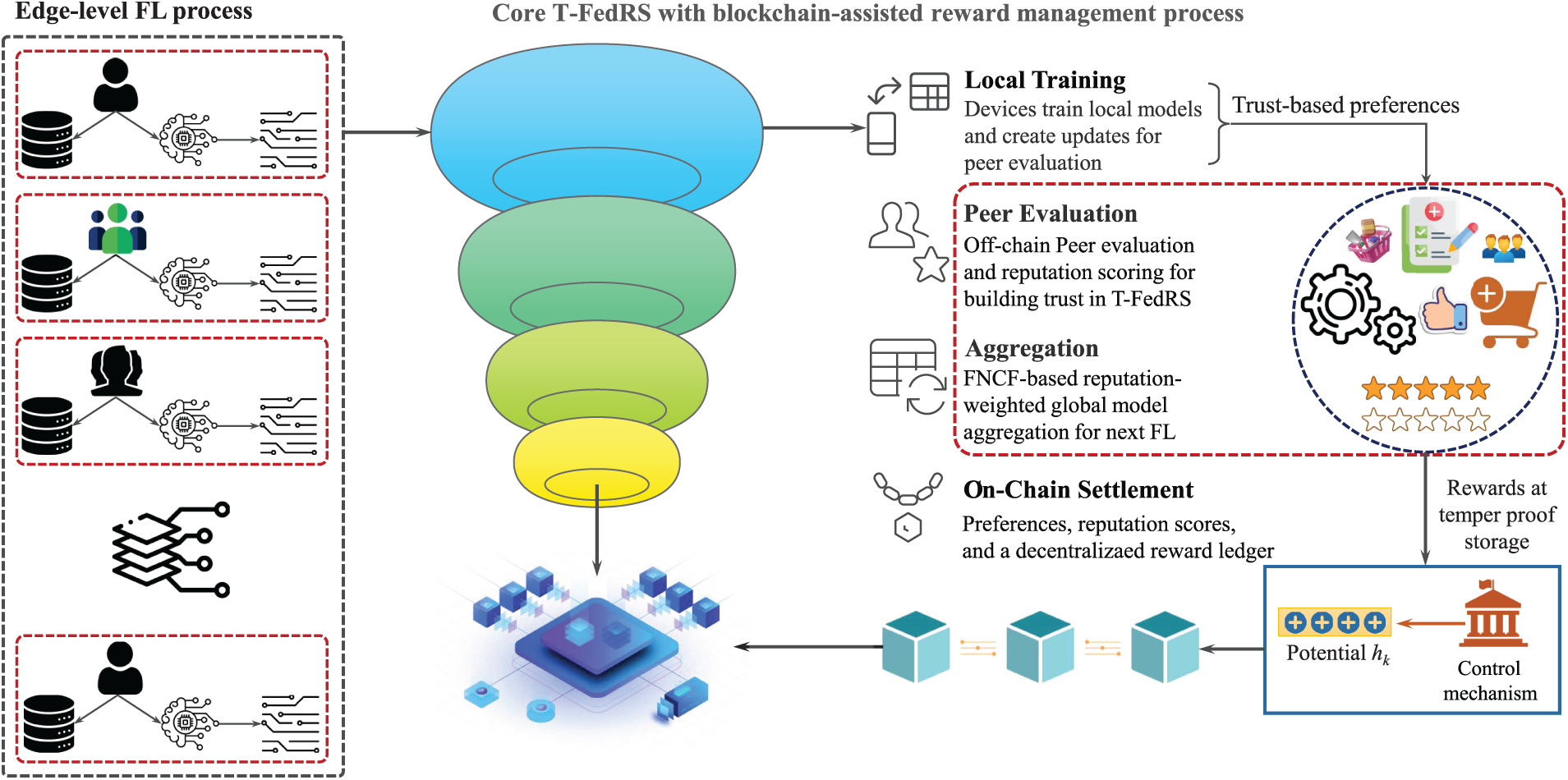
Figure 1: System architecture of the proposed T-FedRS framework. Clients perform personalized federated training and submit compressed updates with cryptographic commitments. Ranking-aware decentralized reputation drives weighted aggregation of global model parameters, while a lightweight blockchain records reputations and reward allocations to ensure transparent and tamper-resistant incentive management.
During the off-chain phase, each client
In the on-chain phase, clients submit commitments together with succinct proofs of evaluation to a blockchain ledger
To instantiate personalized recommendation within the proposed framework, we adopt a federated variant of neural collaborative filtering in which each client maintains local user embeddings while collaboratively learning global item representations and interaction parameters. The underlying model consists of three components: a user embedding matrix
In order to maintain consistency of latent factors and reduce interference among heterogeneous client updates, we adopt the decomposition strategy introduced in FedNCF [16], separating the aggregation of embedding matrices from that of neural parameters. Item-embedding updates are fused through a factor-aware rule that considers exposure frequencies and reputation weights, ensuring that shared item factors evolve coherently across clients. In contrast, the dense interaction parameters are aggregated through reputation-weighted federated averaging, which is more suitable for neural components with smooth loss landscapes. This decomposition avoids the instability that arises from mixing sparse embedding deltas with dense parameter updates and improves convergence behavior in federated settings.
The federated recommendation setting requires preserving individual preference patterns while benefiting from shared collaborative signals [12,13,24]. Building on the decomposed FedNCF architecture, personalization is primarily achieved by retaining user-specific embeddings
where
3.5 Decentralized Reputation Measurement
In FedRS, contribution quality must reflect ranking performance rather than predictive loss. Each client update
where
where
3.6 Decentralized Reward Management
Reputation scores are coupled with a blockchain-based reward mechanism to ensure transparent and incentive-aligned collaboration. In each round
where
The decentralized federated recommendation setting requires strong privacy protection to prevent leakage of sensitive user preferences while preserving collaborative utility [11]. This risk is amplified in embedding-based models, where user and item representations may implicitly encode fine-grained behavioral signals. To address this, we adopt a secure aggregation strategy aligned with the decomposed structure of federated neural collaborative filtering. Specifically, aggregation is performed separately for item embeddings and neural interaction parameters, ensuring that only aggregated updates are revealed and no individual client updates can be inspected by the coordinator or colluding participants. Inspired from recent protection strategies [13,24] against inference attacks, differential privacy is incorporated into the update pipeline using an importance-aware noise mechanism. Let
where the noise variance
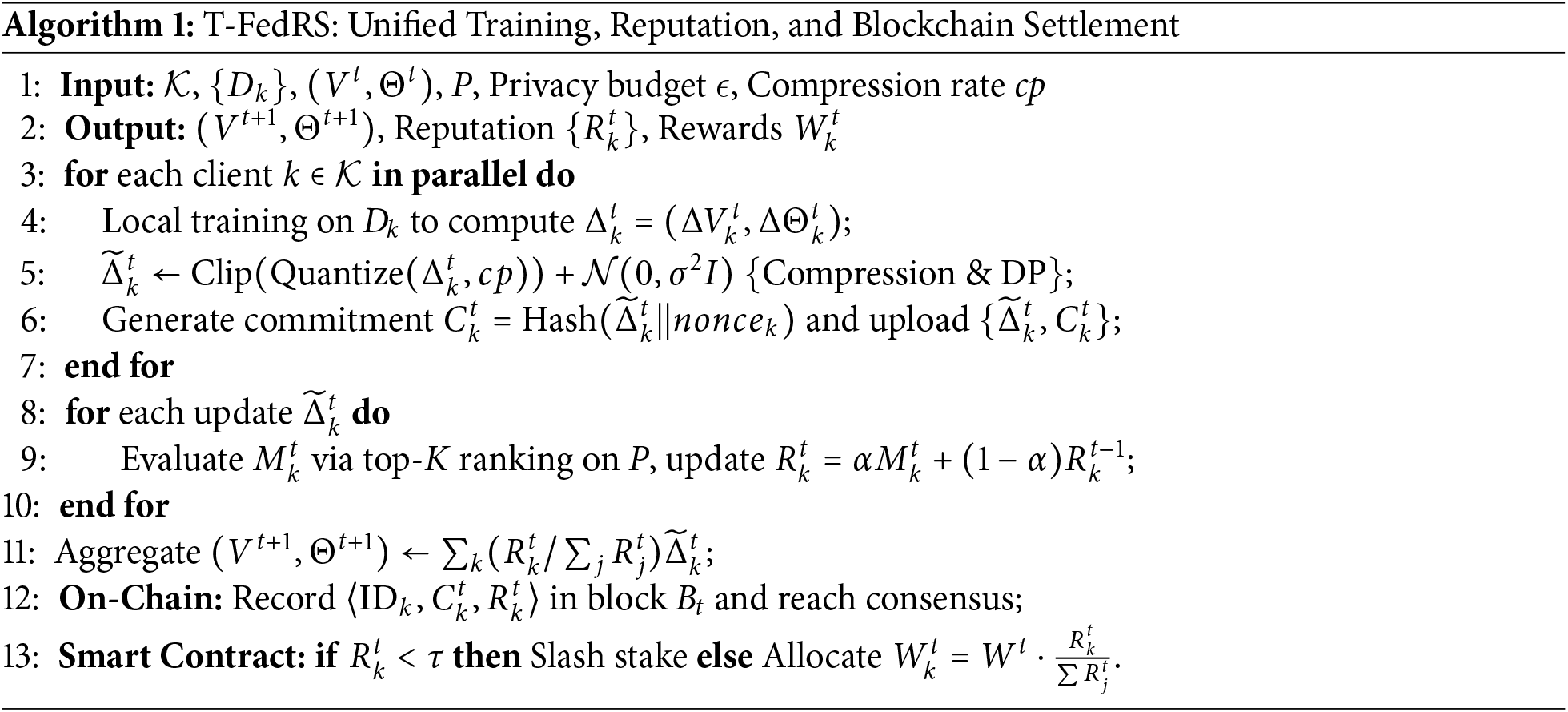
Algorithm 1 jointly defines the off-chain learning and on-chain settlement workflow. Reputation-weighted aggregation suppresses low-utility updates, while blockchain-backed incentives enforce accountability with constant-size on-chain overhead.
We provide a high-level theoretical justification of the proposed framework focusing on three core properties: convergence under reputation-weighted federated optimization, bounded impact of malicious updates, and incentive compatibility of decentralized rewards (motivated through [1,25–27]). The analysis targets ranking-oriented learning objectives, which are more appropriate for recommender systems than pointwise prediction losses. Let
where
where
where
implying that improving ranking performance on the public probe strictly increases long-term reward. This analysis is witnessed by three recent studies [14,23], and [28]. Further detailed proofs and extensions can be found in relevant studies.
In this section, we empirically evaluate the proposed T-FedRS model. The experiments are designed to assess effectiveness under personalization, robustness against adversarial behaviors, and the reliability of proposed decentralized mechanism in FedRS settings.
The evaluation is structured around three objectives. First, we evaluate whether T-FedRS can achieve competitive ranking performance while preserving client-level personalization under non-IID data distributions. Second, we assess the robustness of the proposed reputation-weighted aggregation when a fraction of clients behave maliciously. Third, we examine whether the ranking-aware reputation mechanism reliably reflects true contribution. Together, these goals validate the effectiveness, trustworthiness, and practical suitability of the proposed framework.
Dataset Description. We conduct experiments on 3 widely used benchmarks employed in diverse RS studies [29,30]. MovieLens 1M (ML-1M)1contains one million user–movie interactions and represents a moderately sparse recommendation scenario with rich collaborative signals. Amazon Appliances (Amazon)2is a domain-specific subset of the Amazon reviews dataset, characterized by extreme sparsity and highly skewed item popularity, posing significant challenges for federated recommenders. FilmTrust3is a smaller but denser dataset commonly used to evaluate trust-aware recommendation methods. Together, these datasets enable a systematic evaluation of T-FedRS under varying sparsity levels, popularity bias, and trust conditions that commonly arise in real-world federated settings. Statistics for the selected datasets are given in Table 1.

Evaluation Metrics. We adopt standard ranking-based metrics suitable for implicit-feedback recommendation. Hit Ratio at K(HR@K) measures whether the ground-truth item appears in the top-K list. Normalized Discounted Cumulative Gain at K(NDCG@K) accounts for the position of the relevant item, assigning higher weight to higher-ranked hits. Mean Average Precision (MAP) evaluates the average precision across users, reflecting overall ranking quality. In all experiments, K is set to 5 or 10 and we follow commonly adopted metrics calculation settings [1,8].
Baselines Studies: We compare T-FedRS against five representative baselines, selected to align with our evaluation goals.
• Local NCF [31]: Standard neural collaborative filtering trained independently at each client, serving as a lower bound that highlights the benefit of collaborative learning.
• Centralized NCF [31]: Aggregates all data into a single model and provides an upper bound on achievable accuracy without privacy or decentralization constraints.
• FedNCF [16]: A state-of-the-art federated recommender baseline that supports personalized learning under non-IID data but does not incorporate trust, robustness, or incentive mechanisms.
• Robust-FedAvg [7]: A blockchain-enabled federated learning framework designed for secure and privacy-preserving personalized recommendations. This baseline is included to assess the effectiveness of generic robustness and blockchain-based protection mechanisms that are not explicitly tailored to ranking-oriented recommender objectives.
• T-BFL [20]: A representative trustworthy federated learning framework that integrates blockchain-based reputation and incentive management. We include this baseline to evaluate the advantage of designing trust and reward mechanisms specifically for federated recommender systems rather than general-purpose federated learning.
Implementation Details. All models are implemented in PyTorch and optimized using Adam. Experiments are conducted on a workstation equipped with NVIDIA RTX 3090 GPU and a multi-core CPU, which are used to simulate parallel client execution rather than representing actual client hardware. Federated training follows a standard cross-device simulation protocol, where clients hold disjoint user partitions and communicate with a central coordinator responsible for aggregation. Blockchain-assisted reputation and reward management is implemented via a lightweight ledger simulation module that records cryptographic commitments, reputation values, and reward allocations. Consensus latency and full smart-contract execution are abstracted, consistent with prior blockchain-assisted federated learning studies, allowing the evaluation to focus on learning dynamics, trust modeling, and incentive mechanisms. Communication cost is measured by the volume of transmitted model parameters per round, while computation cost is quantified by local training time and decentralized evaluation overhead.
4.2 Recommendation Performance
We evaluated the recommendation performance under standard federated settings and examine whether the proposed framework achieves effective personalization. We compare our method against Centralized NCF, which represents an accuracy upper bound without privacy constraints, and FedNCF with standard federated averaging, which serves as the strongest personalized federated baseline without trust or reputation mechanisms. Performance is evaluated on Ml-1M, Amazon, and FilmTrust using HR@10 and NDCG@10.
The outcomes in Table 2 demonstrate that T-FedRS consistently outperforms FedNCF across all datasets and, notably, achieves performance comparable to or exceeding centralized training. The improvement (highlighted as bold in Table 2) is particularly evident on sparse datasets such as Amazon Appliances and FilmTrust, where classical federated averaging struggles to preserve personalization under limited local interactions. These gains indicate that T-FedRS does not merely aggregate updates, but selectively emphasizes high-quality contributions through reputation-weighted learning.

Furthermore, the proposed decentralized reward management mechanism induces a clear structural separation between trustworthy and non-trustworthy contributors during federated optimization. As illustrated in Fig. 2, reputation-aware filtering produces well-separated clusters in the embedding space, where high-reputation clients dominate effective aggregation while low-reputation or biased clients are naturally isolated. We further visualize the embedding spaces of three randomly selected users, which remain well aligned with the trustworthy global representation, indicating that personalization is preserved rather than overridden by federation. This selective trust propagation explains the consistent ranking improvements and confirms the role of decentralized reward management in jointly enhancing robustness and personalization.
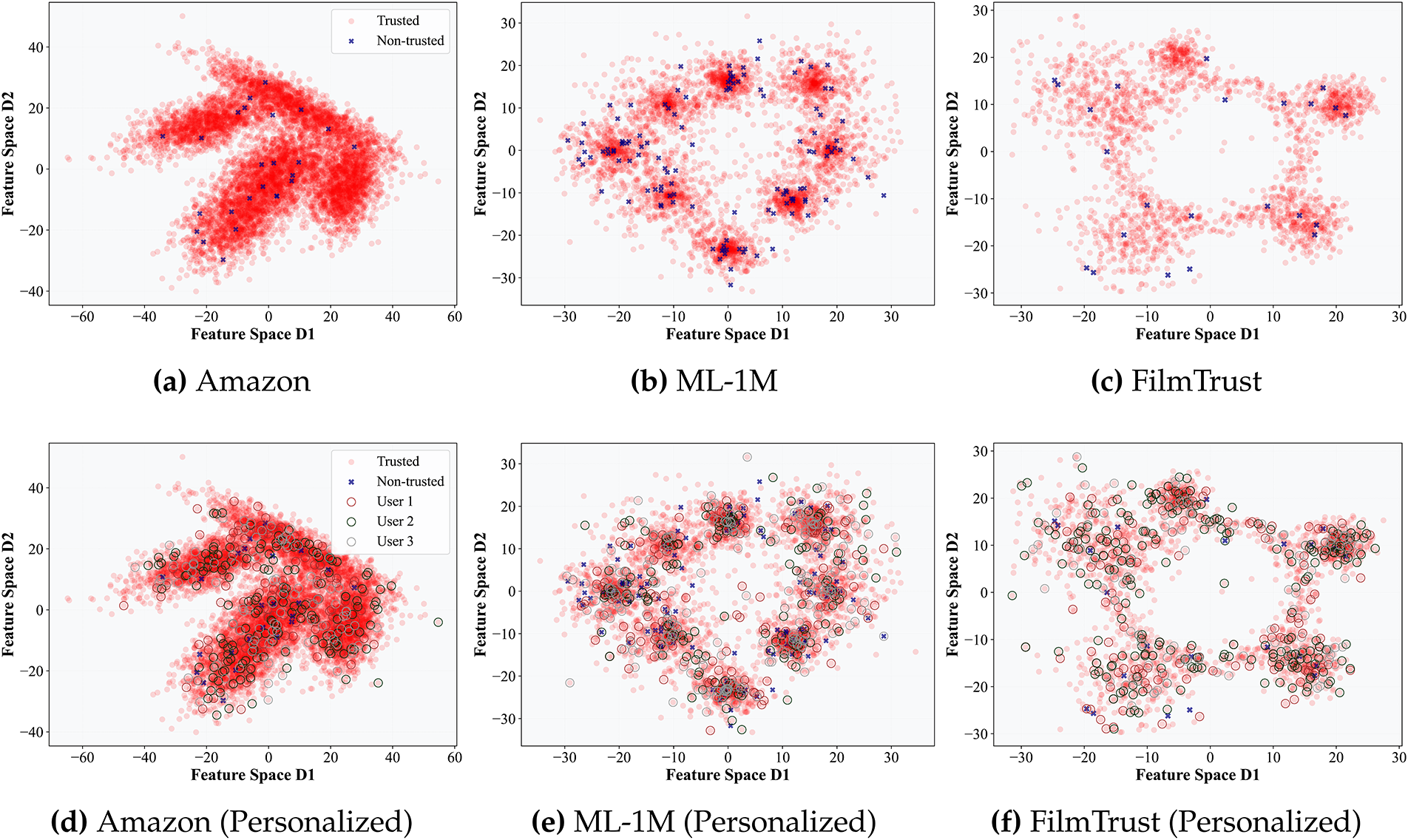
Figure 2: t-SNE visualizations of learned embedding spaces under the proposed T-FedRS framework.
4.3 Robustness against Adversarial Clients
This section evaluates robustness against targeted shilling attacks. As shown in Table 3, increasing the malicious client ratio from 10% to 40% causes severe degradation in FedNCF, with NDCG@10 dropping by 45%–55% across datasets. In contrast, the proposed T-FedRS remains stable on Ml-1M, and NDCG@10 decreases only from 0.447 to 0.429 even under 40% attacks. Consistent trends across
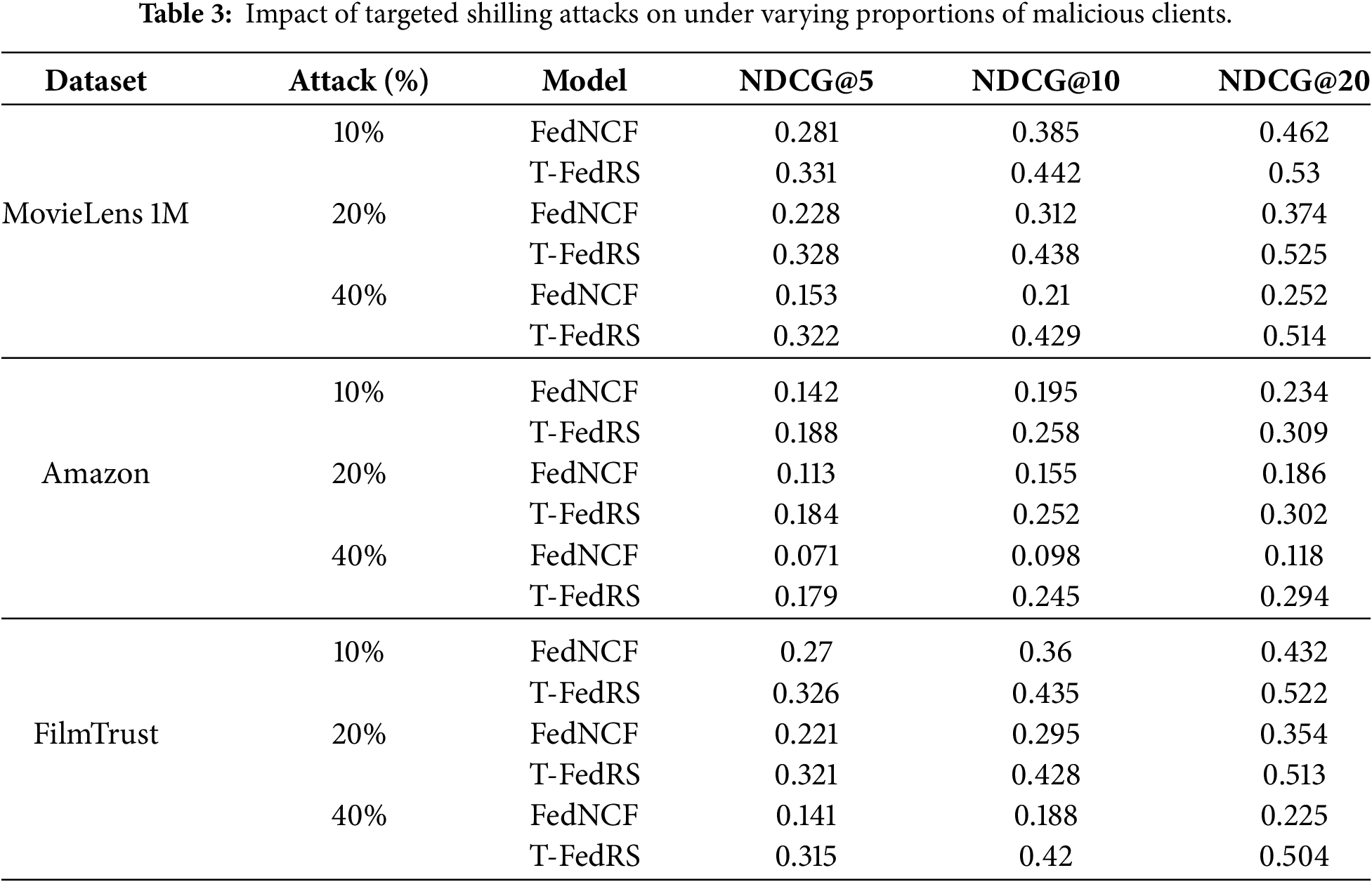
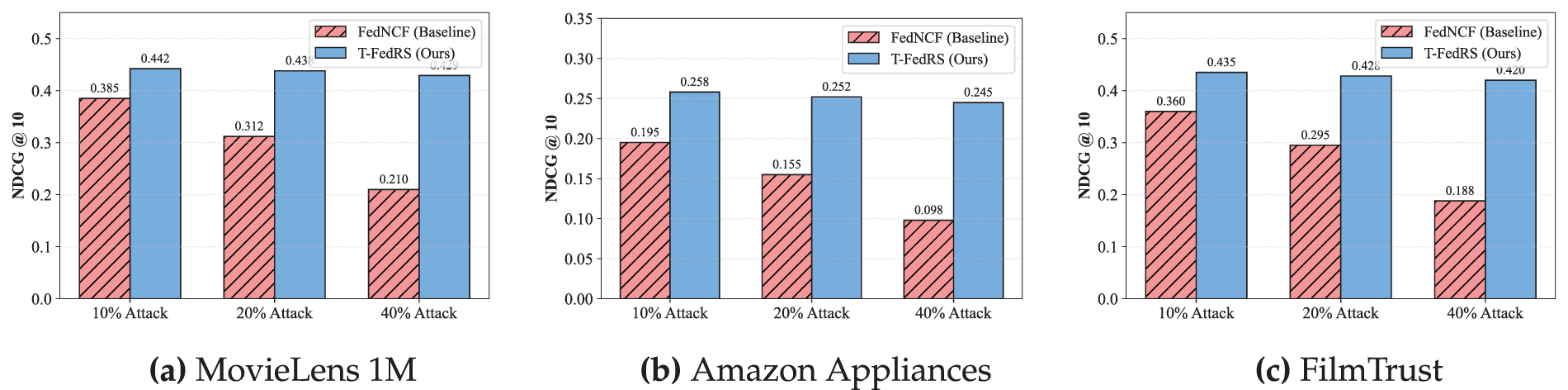
Figure 3: Robustness analysis against targeted shilling attacks. Comparison of NDCG@10 stability of T-FedRS against standard FedNCF across three datasets as the percentage of malicious clients increases.
Extensive empirical evaluations across three benchmark datasets confirm that T-FedRS consistently outperforms standard federated architectures in both recommendation accuracy and adversarial robustness. While the current framework achieves superior results within the neural collaborative filtering paradigm, future extensions could incorporate graph-based architectures to capture even more complex, high-order user-item interactions. Additionally, we aim to explore the integration of lightweight cryptographic primitives, such as zero-knowledge proofs, to further enhance the privacy of the reputation verification process in resource-constrained recommendation environments.
In this paper, we addressed the dual challenges of data poisoning and personalization in decentralized recommendation environment. We integrated FedNCF with a blockchain-assisted decentralized reward management mechanism, and the framework simultaneously preserves personalized recommendation quality and autonomously identifies and mitigates adversarial client influence. Extensive experiments on three benchmark datasets (MovieLens 1M, Amazon Appliances, and FilmTrust) demonstrate that T-FedRS consistently outperforms standard federated baselines, maintaining high NDCG@K and HR@K scores even when up to 40% of participants are malicious. These results confirm that blockchain-backed reputation serves as an effective proxy for model quality, bridging decentralized security and recommendation accuracy. While T-FedRS establishes a strong foundation for secure federated recommendation, several research directions remain. Future work will explore graph-based architectures to model higher-order user-item interactions and the integration of lightweight cryptographic primitives, such as zero-knowledge proofs, to further enhance privacy in resource-constrained environments. Overall, this work represents a step toward more resilient and user-centric intelligent systems in decentralized settings.
Acknowledgement: None.
Funding Statement: This work was supported by the Wenzhou-Kean University Internal Start-up Research Grant under Grant No. ISRG2024005.
Author Contributions: The authors confirm contribution to the paper as follows: Conceptualization, Waqar Ali, May Altulyan and Siyuan Li; methodology, Waqar Ali, Ghulam Farooque and Jie Shao; software, Waqar Ali, Ghulam Farooque and May Altulyan; validation, May Altulyan and Ghulam Farooque; formal analysis, Waqar Ali and Siyuan Li; resources, Waqar Ali and Jie Shao; writing—original draft preparation, Waqar Ali and Jie Shao; writing—review and editing, May Altulyan, Ghulam Farooque and Siyuan Li; funding acquisition, Waqar Ali. All authors reviewed and approved the final version of the manuscript.
Availability of Data and Materials: The data that support the findings of this study are openly available. Specifically, we used the MovieLens 1M (ML-1M) (https://grouplens.org/datasets/movielens/), Amazon Appliances (https://jmcauley.ucsd.edu/data/amazon/), and FilmTrust (https://guoguibing.github.io/librec/datasets.html) datasets for evaluation.
Ethics Approval: Not applicable.
Conflicts of Interest: The authors declare no conflicts of interest.
1https://grouplens.org/datasets/movielens/
2https://jmcauley.ucsd.edu/data/amazon/
3https://guoguibing.github.io/librec/datasets.html
References
1. Zhang H, Tian H, Chen C, Tian C, Dou W. A blockchain-assisted federated learning method for recommendation systems. In: IEEE International Symposium on Parallel and Distributed Processing with Applications, ISPA 2024; 2024 Oct 30–Nov 2; Kaifeng, China. p. 58–65. [Google Scholar]
2. Ali Z, Qi G, Ullah I, Mohammed AAQ, Kefalas P, Muhammad K. GLAMOR: graph-based language model embedding for citation recommendation. In: Proceedings of the 18th ACM Conference on Recommender Systems, RecSys 2024; 2024 Oct 14–18; Bari, Italy. p. 929–33. [Google Scholar]
3. Ali Z, Qi G, Muhammad K, Kefalas P, Khusro S. Global citation recommendation employing generative adversarial network. Expert Syst Appl. 2021;180:114888. doi:10.1016/j.eswa.2021.114888. [Google Scholar] [CrossRef]
4. Ali W, Kumar R, Deng Z, Wang Y, Shao J. A federated learning approach for privacy protection in context-aware recommender systems. Comput J. 2021;64(7):1016–27. doi:10.1093/comjnl/bxab025. [Google Scholar] [CrossRef]
5. Yuan W, Qu L, Cui L, Tong Y, Zhou X, Yin H. HeteFedRec: frecommender systems with model heterogeneity. In: 40th IEEE International Conference on Data Engineering, ICDE 2024; 2024 May 13–16; Utrecht, The Netherlands. p. 1324–37. [Google Scholar]
6. Ali W, Zhou X, Shao J. Privacy-preserved and responsible recommenders: from conventional defense to federated learning and blockchain. ACM Comput Surv. 2025;57(5):119:1–119:35. [Google Scholar]
7. Gupta BB, Gaurav A, Arya V. Secure and privacy-preserving decentralized federated learning for personalized recommendations in consumer electronics using blockchain and homomorphic encryption. IEEE Trans Consumer Electron. 2024;70(1):2546–56. doi:10.1109/tce.2023.3329480. [Google Scholar] [CrossRef]
8. Ali W, Kumar R, Zhou X, Shao J. Responsible recommendation services with blockchain empowered asynchronous federated learning. ACM Trans Intell Syst Technol. 2024;15(4):78:1–78:24. doi:10.1145/3633520. [Google Scholar] [CrossRef]
9. Pang S, Fan Z, Gui H, He X, Lu Z, Zhao S, et al. Reputation-based federated learning and blockchain for trustworthy service recommendations in edge computing. Clust Comput. 2025;28(11):687. [Google Scholar]
10. Cai Z, Tang T, Yu S, Xiao Y, Xia F. Marking the pace: a blockchain-enhanced privacy-traceable strategy for federated recommender systems. IEEE Internet Things J. 2024;11(6):10384–97. [Google Scholar]
11. Liu P, Jia L, Xiao Y. Participant selection for efficient and trusted federated learning in blockchain-assisted hierarchical federated learning architectures. Future Internet. 2025;17(2):75. doi:10.3390/fi17020075. [Google Scholar] [CrossRef]
12. Liu B, Tang Q. Secure data sharing in federated learning through blockchain-based aggregation. Future Internet. 2024;16(4):133. doi:10.3390/fi16040133. [Google Scholar] [CrossRef]
13. Rezaei H, Golmaryami M, Rezaei H, Palmieri F. A lightweight blockchain-based defense method for federated self-supervised learning. Future Gener Comput Syst. 2026;175(4):108092. doi:10.1016/j.future.2025.108092. [Google Scholar] [CrossRef]
14. Chen J, Wu Y, Rong D, Yu G, Jiang L, Liu Z, et al. Blockchain-based federated recommendation with incentive mechanism. In: First Conference on Blockchain and Web3.0 Technology Innovation and Application, BWTAC 2024. Singapore: Springer; 2024. p. 202–13. [Google Scholar]
15. Patni S, Lee J. EdgeGuard: decentralized medical resource orchestration via blockchain-secured federated learning in IoMT networks. Future Internet. 2024;17(1):2. doi:10.3390/fi17010002. [Google Scholar] [CrossRef]
16. Perifanis V, Efraimidis PS. Federated neural collaborative filtering. Knowl Based Syst. 2022;242(3):108441. doi:10.1016/j.knosys.2022.108441. [Google Scholar] [CrossRef]
17. Yuan W, Yang C, Qu L, Ye G, Nguyen QVH, Yin H. Robust federated contrastive recommender system against targeted model poisoning attack. Sci China Inf Sci. 2025;68(4):140103. doi:10.1007/s11432-024-4272-y. [Google Scholar] [CrossRef]
18. Tong Z, Wang J, Hou X, Chen J, Jiao Z, Liu J. Blockchain-based trustworthy and efficient hierarchical federated learning for UAV-enabled IoT networks. IEEE Internet Things J. 2024;11(21):34270–82. doi:10.1109/jiot.2024.3370964. [Google Scholar] [CrossRef]
19. Zhou S, Li K, Chen Y, Yang C, Liang W, Zomaya AY. TrustBCFL: mitigating data bias in IoT through blockchain-enabled federated learning. IEEE Internet Things J. 2024;11(15):25648–62. [Google Scholar]
20. Yang Z, Shi Y, Zhou Y, Wang Z, Yang K. Trustworthy federated learning via blockchain. IEEE Internet Things J. 2023;10(1):92–109. doi:10.1109/jiot.2022.3201117. [Google Scholar] [CrossRef]
21. Xiong R, Ren W, Zhao S, He J, Ren Y, Choo KR, et al. CoPiFL: a collusion-resistant and privacy-preserving federated learning crowdsourcing scheme using blockchain and homomorphic encryption. Future Gener Comput Syst. 2024;156:95–104. [Google Scholar]
22. Lo SK, Liu Y, Lu Q, Wang C, Xu X, Paik H, et al. Toward trustworthy AI: blockchain-based architecture design for accountability and fairness of federated learning systems. IEEE Internet Things J. 2023;10(4):3276–84. [Google Scholar]
23. Zhang F, Guo S, Qiu X, Xu S, Qi F, Wang Z. Federated learning meets blockchain: state channel-based distributed data-sharing trust supervision mechanism. IEEE Internet Things J. 2023;10(14):12066–76. [Google Scholar]
24. Zhang Y, Peng X, Xian H. pFedBASC: personalized federated learning with blockchain-assisted semi-centralized framework. Future Internet. 2024;16(5):164. doi:10.3390/fi16050164. [Google Scholar] [CrossRef]
25. Wang B, Tian Z, Liu X, Xia Y, She W, Liu W. A multi-center federated learning mechanism based on consortium blockchain for data secure sharing. Knowl Based Syst. 2025;310(23):112962. doi:10.1016/j.knosys.2025.112962. [Google Scholar] [CrossRef]
26. Wu B, Seneviratne O. Blockchain-based framework for scalable and incentivized federated learning. In: Companion Proceedings of the ACM on Web Conference 2025, WWW 2025; 2025 Apr 28–May 2; Sydney, NSW, Australia. p. 1761–7. [Google Scholar]
27. Qin Z, Yan X, Zhou M, Deng S. BlockDFL: a blockchain-based fully decentralized peer-to-peer federated learning framework. In: Proceedings of the ACM on Web Conference 2024, WWW 2024; 2024 May 13–17; Singapore. p. 2914–25. [Google Scholar]
28. Cheng Z, Liu Y, Wu C, Pan Y, Zhao L, Deng X, et al. Decentralized IoT data sharing: a blockchain-based federated learning approach with joint optimizations for efficiency and privacy. Future Gener Comput Syst. 2024;160:547–63. [Google Scholar]
29. Waqar A, Shao J, Aman KA, Saifullah T. Context-aware recommender systems: challenges and opportunities. J Univ Electron Sci Technol China. 2019;48(5):655–73. [Google Scholar]
30. Kefalas P, Symeonidis P, Manolopoulos Y. Recommendations based on a heterogeneous spatio-temporal social network. World Wide Web. 2018;21(2):345–71. doi:10.1007/s11280-017-0454-0. [Google Scholar] [CrossRef]
31. He X, Liao L, Zhang H, Nie L, Hu X, Chua T. Neural collaborative filtering. In: 26th International Conference on World Wide Web, WWW 2017; 2017 Apr 3–7; Perth, Australia. p. 173–82. [Google Scholar]
Cite This Article
 Copyright © 2026 The Author(s). Published by Tech Science Press.
This work is licensed under a Creative Commons Attribution 4.0 International License , which permits unrestricted use, distribution, and reproduction in any medium, provided the original work is properly cited.
 Downloads
 Citation Tools
