Guest Editor(s)
Dr. Pavlos Kefalas
Email: pavloskefalas@gmail.com
Affiliation: Department of Informatics, Aristotle University of Thessaloniki, Thessaloniki, 54124, Greece; Dashub, Thessaloniki, Greece
Homepage:
Research Interests: recommender systems, machine learning, artificial intelligence, data science, databases, information retrieval, spatiotemporal databases, etc.

Dr. Zafar Ali
Email: zafar_ali@seu.edu.cn
Affiliation: School of Computer Science and Engineering, Southeast University, Nanjing, 211189, China
Homepage:
Research Interests: recommender systems, machine learning, multimodal reasoning, neural networks, artificial intelligence

Dr. Shahab Saquib Sohail
Email: shahabssohail@jamiahamdard.ac.in
Affiliation: Department of Computer Science and Engineering, School of Engineering Science and Technology, Jamia Hamdard, India
Homepage:
Research Interests: AI, machine learning, recommender systems, social media analytics, privacy and security in AI, large language models, generative AI

Dr. Abdul Shahid
Email: abdul.shahid@setu.ie
Affiliation: School of Business, South East Technological University (SETU), Waterford, Ireland
Homepage:
Research Interests: AI, machine learning, recommender systems, social media analytics, privacy and security in AI, large language models, generative AI

Summary
Recommender systems are at a pivotal moment: advances in multimodal representation learning, the rapid maturation of large generative models, and increasing deployment in privacy-sensitive, resource-limited environments are reshaping what personalization can and should be. At the same time, concerns about fairness, transparency, robustness, and user agency are driving new evaluation criteria and system designs, making recommendation research more crucial and interdisciplinary than ever.
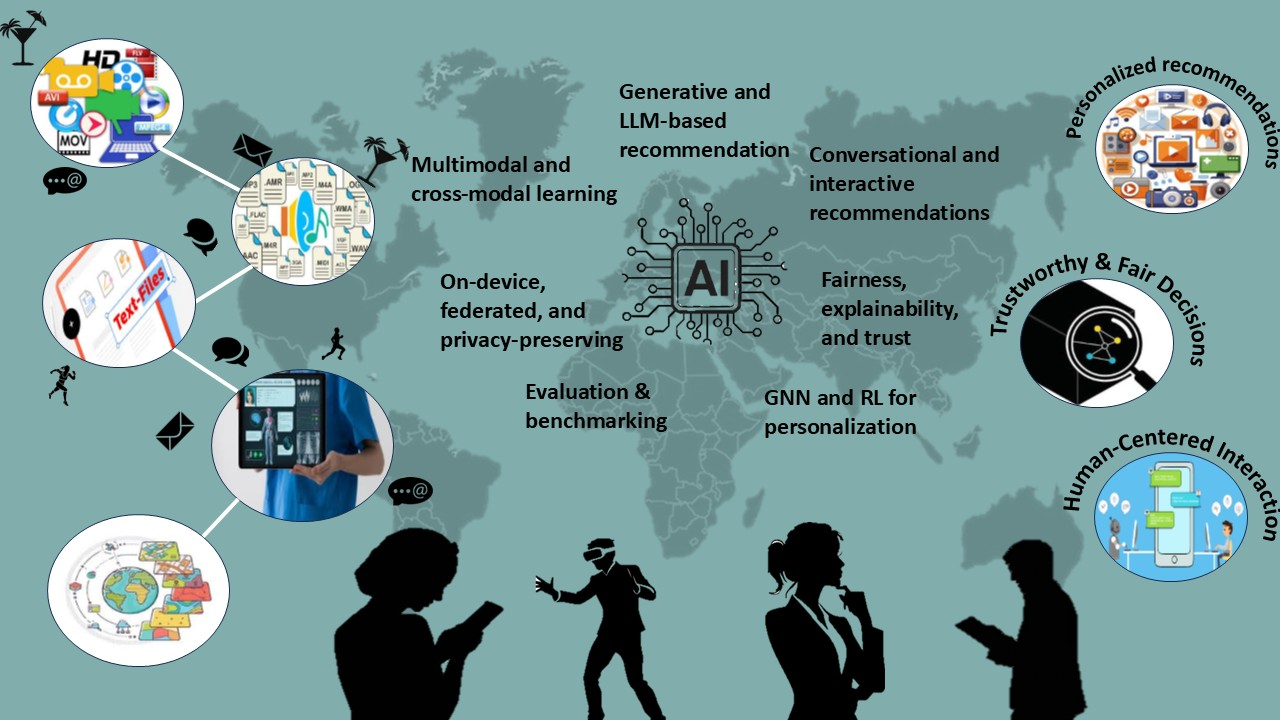
This special issue aims to present cutting-edge research that redefines the foundations and applications of recommender systems across modeling, deployment, and trustworthiness dimensions. It welcomes contributions that explore novel architectures (multimodal, graph-based, and generative/LLM-enhanced recommenders), real-world deployment strategies (on-device and federated learning), and methods that advance fairness, explainability, privacy, and robustness.
Therefore, this special issue focuses on Next-Generation Recommender Systems: Multimodality, Generative Models, and Trustworthy Personalization. The following subtopics are of particular interest, including but not limited to:
• Multimodal and cross-modal learning for recommendation
• Generative and LLM-based recommendation frameworks
• On-device, federated, and privacy-preserving recommendation
• Conversational and interactive recommender architectures
• Fairness, explainability, and trust in recommender systems
• Graph neural networks and reinforcement learning for personalization
• Evaluation methodologies and real-world benchmarking
Graphic Abstract
Keywords
recommender systems; multimodal learning; generative models; large language models; federated learning; trustworthy AI; fairness and explainability; graph neural networks; conversational recommendation; privacy preservation.
Published Papers

 Login
Login Register
 Submit a Paper
 Propose a Special lssue