
 Login
Login Register
 Submit a Paper
 Propose a Special lssue
 Open Access
ARTICLE
A Hybrid Physics-Informed and Data-Driven Feature Framework with Explicit Correlation-Structure Embeddings for Early-Life Prognostics of Lithium-Ion Batteries
Department of Industrial Engineering, Sungkyunkwan University, Suwon, Republic of Korea
* Corresponding Authors: Dong-Hee Lee. Email: ; Dae-Il Kwon. Email:
(This article belongs to the Special Issue: AI-Enabled Prognostics and Health Management: Advanced Methodologies, Intelligent Systems, and Field Applications)
Computers, Materials & Continua 2026, 88(2), 51 https://doi.org/10.32604/cmc.2026.081667
Received 06 March 2026; Accepted 22 April 2026; Issue published 15 June 2026
 View Full Text
 Download PDF
Abstract
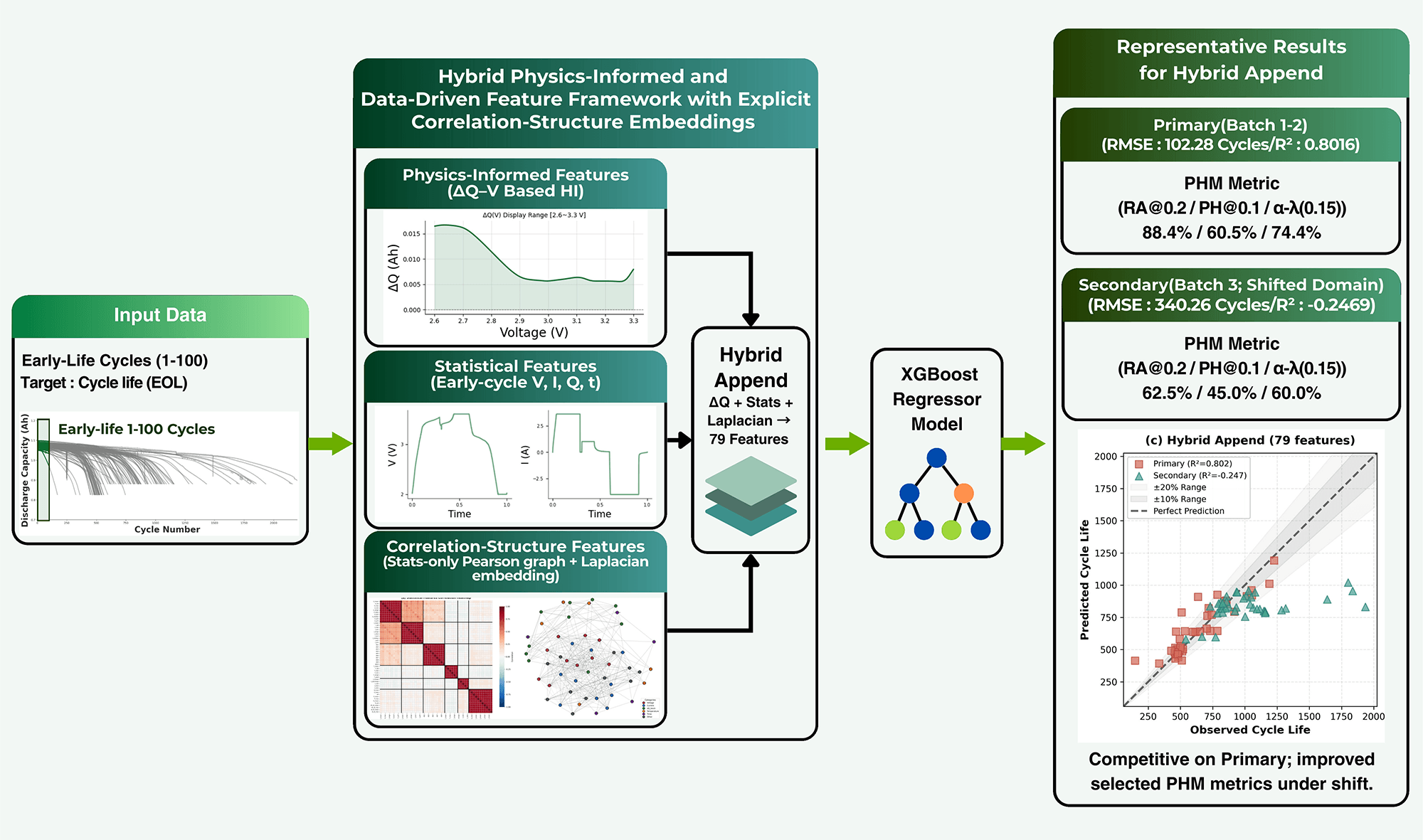
Early-life cycle-life prediction for lithium-ion batteries—estimating end-of-life from initial cycles—is valuable for rapid cell screening and battery health management. We investigate whether an explicit correlation-structure descriptor can complement physics-informed ΔQ-based indicators and generic early-cycle statistical features on the Severson 124-cell benchmark. We develop a lightweight hybrid framework that combines ΔQ-based health indicators, data-driven statistical features, and Laplacian Eigenmaps embeddings derived from a Pearson-correlation feature graph, with XGBoost used as the predictor. Across five feature configurations (ΔQ Only, ΔQ + Statistics, Hybrid Append, VIF + Laplacian, and Integrated Laplacian), we evaluate pointwise regression accuracy using RMSE and R2 together with PHM-style error-band measures RA@0.2, PH@0.1, and α-λ(0.15), computed on implied RUL trajectories induced by the early-life cycle-life estimate. On the Primary test domain, all four non-baseline configurations improved over ΔQ Only; Integrated Laplacian achieved the strongest RMSE/R2 pair (97.00 cycles, 0.8215), while Hybrid Append remained competitive (102.28 cycles, 0.8016) and improved RA@0.2 and PH@0.1 relative to ΔQ + Statistics. On the shifted Secondary domain, ΔQ Only gave the most favorable RMSE/R2 pair (267.82 cycles, 0.2275), whereas Hybrid Append and VIF + Laplacian improved selected error-band metrics. In an additional comparison against PCA, Random Projection, and Truncated SVD conducted at a matched 79-feature scale, with all transforms estimated from the training cells only, the graph-derived embedding remained competitive, but its margin over simpler reductions varied across splits. Taken together, these results support Hybrid Append as the main appended-structure configuration in this study, while indicating that the benefit of the correlation-structure descriptor is more visible in selected PHM-style error-band metrics than in uniformly improved pointwise accuracy.Graphic Abstract
Keywords
Cite This Article
 Copyright © 2026 The Author(s). Published by Tech Science Press.
This work is licensed under a Creative Commons Attribution 4.0 International License , which permits unrestricted use, distribution, and reproduction in any medium, provided the original work is properly cited.
 Downloads
 Citation Tools
