Home / Journals / CMC / Vol.88, No.2, 2026
Special Issues
Table of Content
cover

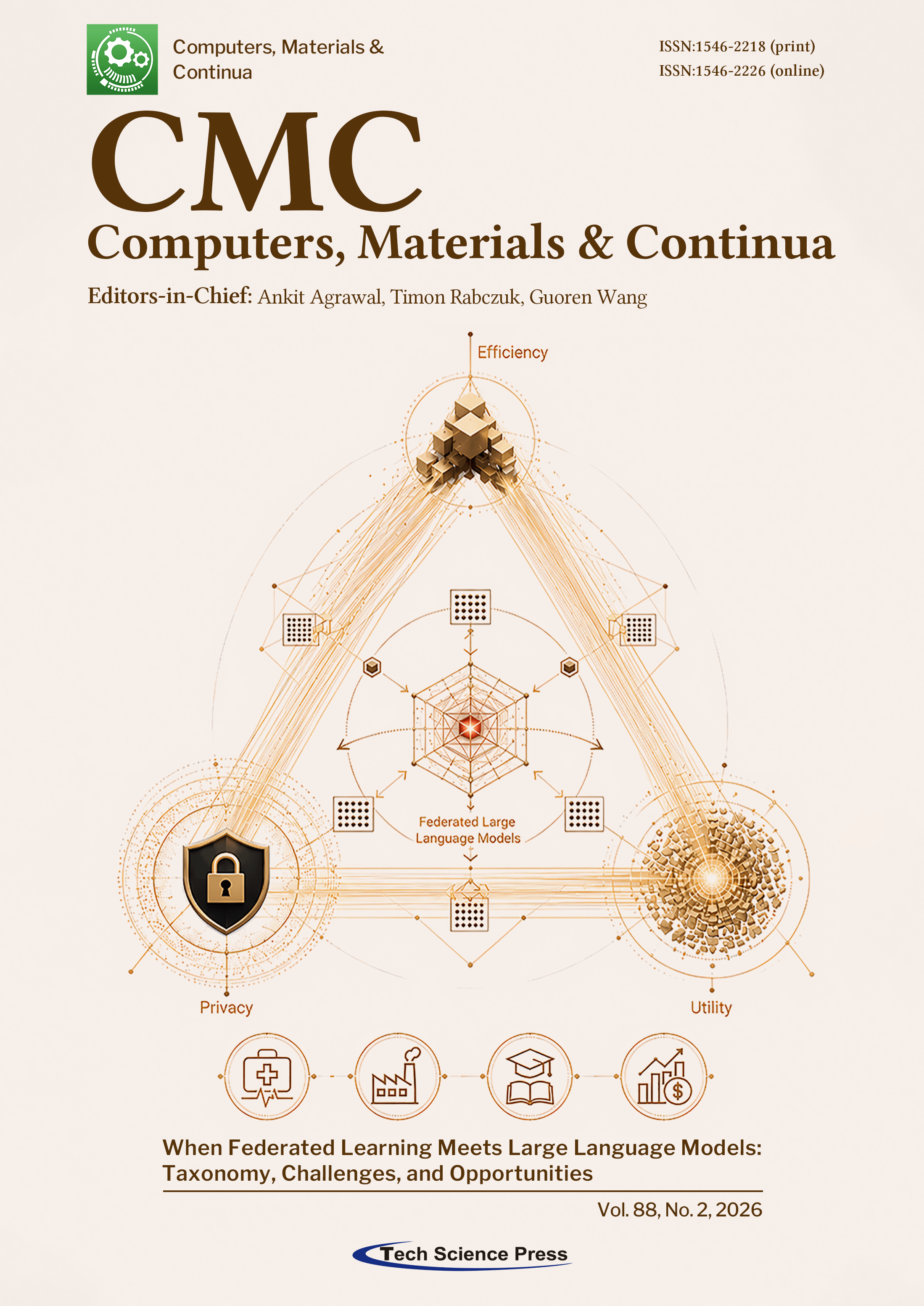
On the Cover

This survey offers a structured overview of the federated LLM ecosystem. We present a comprehensive taxonomy encompassing system architectures, advanced data strategies for addressing heterogeneity, and retrieval-augmented generation in federated contexts. Additionally, we review efficient adaptation methods that enable LLM tuning on resource-constrained clients and analyze data security and privacy concerns. We conclude by summarizing emerging applications in healthcare, industry, software engineering, and finance, and by outlining open problems and research opportunities for scalable, secure, and responsible federated LLM deployment.
The cover image was created with AI-generated content via GPT-Image-2, and it contains no copyrighted elements or misleading representations.

View this paper

  • Open AccessOpen Access

    REVIEW

    When Federated Learning Meets Large Language Models: Taxonomy, Challenges, and Opportunities

    Shan Jiang1, Wenxin You2, Haoran Zhang3, Shichang Xuan3,*, Jiaxing Shen4
    CMC-Computers, Materials & Continua, Vol.88, No.2, 2026, DOI:10.32604/cmc.2026.079321 - 15 June 2026
    Abstract Large Language Models (LLMs) have been playing a transformative role in natural language understanding and generation, yet adapting LLMs to domain-specific and privacy-sensitive data remains challenging under centralized training. Federated Learning (FL) provides a promising alternative by enabling training LLMs collaboratively without sharing raw data. However, integrating FL and LLMs introduces new challenges, including model size, device heterogeneity, non-IID data, and alignment requirements. This survey offers a structured overview of the federated LLM ecosystem. We present a comprehensive taxonomy encompassing system architectures, advanced data strategies for addressing heterogeneity, and retrieval-augmented generation in federated contexts. Additionally, More >

  • Open AccessOpen Access

    REVIEW

    A Review of the Application of Machine Learning in Additive Manufacturing

    Yuyin Ma1, Yufang Liu1, Yijun Lu2, Zhen Tian3, Fujiang Yuan4, Yanhong Peng4,*
    CMC-Computers, Materials & Continua, Vol.88, No.2, 2026, DOI:10.32604/cmc.2026.080309 - 15 June 2026
    (This article belongs to the Special Issue: Computational Materials Design and Intelligent Processing for Advanced Alloys and Manufacturing Systems)
    Abstract Additive manufacturing (AM) has emerged as a transformative technology in modern manufacturing, offering unprecedented capabilities for producing complex geometries and customized components. However, the widespread adoption of AM is hindered by insufficient quality control, stemming from the multi-factor coupling characteristics of the manufacturing process. Machine learning (ML) presents a promising solution by enabling data-driven approaches to process optimization, quality prediction, and defect detection. This review examines the application landscape of ML techniques in AM through comprehensive analysis of recent literature. The study categorizes ML applications into four primary domains: real-time process monitoring and control, process… More >

  • Open AccessOpen Access

    REVIEW

    Three-Level Taxonomy of RL Self-Healing for Energy, Latency, and Security Constrained Edge IoT Networks: A Review

    Hitesh Mohapatra*
    CMC-Computers, Materials & Continua, Vol.88, No.2, 2026, DOI:10.32604/cmc.2026.080961 - 15 June 2026
    (This article belongs to the Special Issue: AI-Driven Optimization for Secure and Sustainable Edge IoT Services)
    Abstract This review systematically analyzes Reinforcement Learning approaches for self-healing in energy-constrained secure edge IoT networks across 82 studies from 2020 to 2026. Unlike existing surveys that focus on general RL applications, the proposed review focuses on a three-level taxonomy that uniquely addresses edge IoT deployment realities through formulation-scope-hardware mapping. The work develops a novel three-level taxonomy classifying recovery scope (node, link, service, network), RL formulations (tabular, deep, multi-agent, model-based), and constraint integration (energy, latency, security, hybrid), revealing service migration dominance at 30% coverage and node recovery achieving 38% maximum energy savings. Normalized performance baselines establish More >

  • Open AccessOpen Access

    REVIEW

    Data-Driven Materials Science Using Machine Learning and Computational Modeling

    Manjodh Kaur1, Princy Randhawa2,*, Jitendra Jaiswal2, Deepak Dubal3, Ravindra N. Bulakhe4,5, Deepanraj Balakrishnan6, Nithesh Naik7,*
    CMC-Computers, Materials & Continua, Vol.88, No.2, 2026, DOI:10.32604/cmc.2026.079503 - 15 June 2026
    Abstract This review emphasizes the growing role of artificial intelligence (AI) in transforming the materials discovery process into a data-driven and autonomous approach. It systematically traces the evolution of scientific paradigms in materials science and examines how machine learning, generative models, and AI agents are revolutionizing the design, screening, and optimization of materials. A key contribution is a detailed, step-by-step machine learning framework that guides researchers through data collection, preprocessing, feature engineering, model development, and validation, utilizing publicly available materials databases and computational tools. Additionally, the review discusses the latest advances in generative AI and autonomous More >

  • Open AccessOpen Access

    REVIEW

    A Survey of Surface Defect Detection in Machine Vision: Addressing Core Challenges, Methodologies, and Dataset Analysis

    Langyue Zhao1,2, Yubin Yuan3,*, Yiquan Wu2,*
    CMC-Computers, Materials & Continua, Vol.88, No.2, 2026, DOI:10.32604/cmc.2026.080232 - 15 June 2026
    Abstract This paper presents a systematic survey of machine vision-based surface defect detection technologies, focusing on five core challenges in the field: interference from complex backgrounds, small object detection, class imbalance, dynamic scene modeling, and cross-scenario generalization. It reviews key technical approaches corresponding to these challenges over the past five years. Furthermore, a dataset characterization analysis framework is established around these challenges, summarizing and comparing the characteristics of over 40 publicly available datasets across more than ten scenarios, including PCB, photovoltaic, metal, and pavement surfaces. Quantitative selection metrics (such as the small target coefficient and texture More >

  • Open AccessOpen Access

    REVIEW

    Monitoring and Observability in Edge Computing Systems: Taxonomy, Comparative Analysis, and Research Directions

    Hamza Ahmed1, Hassan Jamil Syed2,*, Aqsa Aslam1, Sehar Zehra1, Ummay Faseeha1, Nurzati Iwani Othman2
    CMC-Computers, Materials & Continua, Vol.88, No.2, 2026, DOI:10.32604/cmc.2026.080115 - 15 June 2026
    (This article belongs to the Special Issue: Integrating Computing Technology of Cloud-Fog-Edge Environments and its Application)
    Abstract Edge computing is an emerging model for latency-sensitive and distributed applications. However, the observability of edge computing systems in heterogeneous environments remains a challenge, as most existing approaches are limited to only the system, service, application, and network layers. This paper surveys state-of-the-art solutions for edge observability and monitoring. The paper further introduces a thematic taxonomy that groups the state-of-the-art edge observability and monitoring literature based on monitoring intent, telemetry indicators, observability scope, architectural layers, deployment environments, and observability toolchains. Finally, we compare representative solutions in terms of latency, system overhead, bandwidth consumption, and detection More >

  • Open AccessOpen Access

    REVIEW

    Machine Learning-Driven Materials Design and Performance Prediction in Organic Solar Cells Emphasizing Ensemble Learning Models

    Shafidah Shafian1,*, Azlan Ismail2,3
    CMC-Computers, Materials & Continua, Vol.88, No.2, 2026, DOI:10.32604/cmc.2026.080623 - 15 June 2026
    Abstract Organic solar cells (OSCs) have progressed rapidly in recent years, driven by advances in donor polymers, non-fullerene acceptors, and increasingly complex binary and multicomponent blend architectures. Despite these achievements, device performance remains governed by strongly coupled molecular, morphological, and processing variables, making materials optimization inherently multidimensional and difficult to navigate using conventional trial-and-error approaches. The growing availability of experimental data and computational descriptors has therefore encouraged the integration of machine learning (ML) techniques into OSC research as a complementary strategy for accelerating materials discovery and device optimization. Among the available ML strategies, ensemble learning has… More >

  • Open AccessOpen Access

    REVIEW

    Physics-Based Modelling of Plasma-Material Interactions and Phase Transformations in Electrical Discharge Machining: A Computational Materials Perspective

    Kamlesh Paswan1, Rajnish Singh2, Vivekanand Singh3, Brihaspati Singh4, Ankur Saxena5, Chandrmani Yadav6,*
    CMC-Computers, Materials & Continua, Vol.88, No.2, 2026, DOI:10.32604/cmc.2026.080581 - 15 June 2026
    (This article belongs to the Special Issue: Mechanical Behavior of Materials with Advanced Modeling and Characterization)
    Abstract Electrical Discharge Machining (EDM) is governed by highly coupled, nonlinear electro-thermal-mechanical phenomena involving plasma-mediated energy transfer, rapid heat conduction, phase transformation, and resolidification over micro to nanosecond time scales. From a computational materials science perspective, EDM serves as a prototypical problem of extreme, localised energy–matter interaction, where predictive modelling requires rigorous treatment of multiphysics coupling and scale bridging. This review presents a critical synthesis of theoretical and numerical frameworks for modelling advanced EDM configurations, including vibration-assisted and turning-based EDM, powder- and nano-additive-assisted EDM, and alternative dielectric environments. The review consolidates continuum-based formulations that describe the… More >

  • Open AccessOpen Access

    REVIEW

    Emergence of Agentic AI: A Review on Evolution, Background, Working Principles, Applications, Adoption Factors, and Future Research Directions

    AKM Bahalul Haque1,*, Al Amin Islam Ridoy2, Mohammad Rayhan3, Ivan Porres1
    CMC-Computers, Materials & Continua, Vol.88, No.2, 2026, DOI:10.32604/cmc.2026.079525 - 15 June 2026
    Abstract Agentic AI is gaining new insights and advancements in the field of Artificial Intelligence, fostering significant potential to enable rapid transformation across various domains. This rapid advancement and the potential to revolutionize various domains advocate the need for a deeper understanding and firm grasp of the technology. Moreover, an investigation into state-of-the-art research directions in agentic AI needs to be conducted to comprehensively assess the potential scope for improvement and application. Therefore, to address these objectives, a comprehensive review can provide researchers and practitioners with valuable insights into the current state and future research scopes… More >

  • Open AccessOpen Access

    REVIEW

    Auditable LLM Autonomy for Operational Decision-Making: Big Data Evidence and Decision Traces

    Leonidas Theodorakopoulos, Alexandra Theodoropoulou*
    CMC-Computers, Materials & Continua, Vol.88, No.2, 2026, DOI:10.32604/cmc.2026.082270 - 15 June 2026
    Abstract Auditable autonomy is becoming a practical requirement for deploying large language model (LLM) agents in operational workflows where recommendations can trigger consequential actions. Many autonomy claims remain hard to evaluate because studies emphasize task completion or fluent explanations while underreporting tool privileges, verification conditions, rollback feasibility, and trace completeness. This review develops a decision-making–centered framework that treats autonomy as an auditable engineering property. It introduces a three-plane big data foundation: an evidence plane with provenance and freshness constraints; a decision-trace plane that records retrieval identifiers, tool invocations, intermediate checks, and policy evaluations; and an outcomes More >

  • Open AccessOpen Access

    REVIEW

    Inductive Wireless Power Transfer for Autonomous Underwater Vehicles: A Review of Coupler Design, Misalignment Challenges, and Eddy Current Loss Mitigation

    Sajid Ullah Khan*
    CMC-Computers, Materials & Continua, Vol.88, No.2, 2026, DOI:10.32604/cmc.2026.082458 - 15 June 2026
    Abstract Autonomous underwater vehicles (AUVs) play a crucial role in oceanographic research, monitoring the environment, and exploring resources in the ocean. Nevertheless, the operational efficiency of these devices is frequently constrained by the limited battery capacity and the requirement for charging while connected to a power source. Wireless power transfer (WPT) offers a non-contact alternative to conventional wet-mate electrical connectors, with inductive coupling receiving particular attention because of its relatively high efficiency, safety, and suitability for underwater charging over short transfer gaps. However, it is limited by the transfer distance, coil misalignment, coupler design constraints, and… More >

  • Open AccessOpen Access

    REVIEW

    Attention-Based Medical Image Analysis: Architectures, Applications, and Future Directions

    Xinjie Yao1, Junjie Zhu2, Tao Hong3,4, Dengyu Zhao5, Weikai Liu6, Guangsheng Xie7,*
    CMC-Computers, Materials & Continua, Vol.88, No.2, 2026, DOI:10.32604/cmc.2026.075316 - 15 June 2026
    (This article belongs to the Special Issue: Attention Mechanism-based Complex System Pattern Intelligent Recognition and Accurate Prediction)
    Abstract The attention mechanism, as a key technology for enhancing the performance of deep learning, is gaining increasingly widespread attention in medical image analysis due to its ability to focus on critical features and suppress redundant information. In recent years, the continuous evolution of attention methods has significantly improved their accuracy and robustness in key medical tasks such as lesion detection, tissue segmentation, and multimodal fusion, providing crucial support for building reliable clinical decision support systems. This paper systematically reviews the advances in attention-based methods for medical image analysis, comparing their performance with mainstream models like… More >

  • Open AccessOpen Access

    ARTICLE

    Energy-Efficient Data Dissemination Approach Using Multiple-Criteria Decision Modeling for Internet of Things Environments

    Ambreen Memon1, Aaron Bere1, Muhammad Nadeem Ali2, Byung-Seo Kim2,*
    CMC-Computers, Materials & Continua, Vol.88, No.2, 2026, DOI:10.32604/cmc.2026.078988 - 15 June 2026
    Abstract The modern internet infrastructure has enabled numerous applications by providing a seamless connectivity experience across each mode of connectivity. Infrastructure-based connectivity and device-to-device (D2D) are well-known connectivity modes for internet-based applications. The selection of the underlying communication medium significantly affects energy consumption during data transfer. This study proposes an Energy-Efficient Data Dissemination Approach (EEDDA) that integrates encounter prediction with a multi-criteria decision-making (MCDM) framework to reduce infrastructure-based energy consumption in IoT mobility environments. Unlike traditional optimization approaches that focus on single-objective routing or static network models, the proposed framework dynamically selects between Device-to-Device (D2D) and More >

  • Open AccessOpen Access

    ARTICLE

    Towards Threat Identification for the BACnet Protocol Using Large Language Models

    Hsuan-Chih Ku1, Jyun-Kai Yang1, Pang-Wei Tsai1, Shih-Hsiung Lee2,*
    CMC-Computers, Materials & Continua, Vol.88, No.2, 2026, DOI:10.32604/cmc.2026.079318 - 15 June 2026
    Abstract With the rapid proliferation of the Industrial Internet of Things (IIoT), Building Automation Systems (BAS) and Industrial Control Systems (ICS) are increasingly exposed to sophisticated cyber threats. Conventional Intrusion Detection Systems (IDS) often encounter significant limitations when addressing emerging or hybrid attack patterns, primarily due to delayed signature updates and high false-positive rates. Meanwhile, existing anomaly detection approaches frequently lack sufficient awareness of the physical domain, making them ineffective in identifying falsification attacks that comply with communication protocol specifications while violating underlying physical laws. To address these challenges, this study proposes a hybrid threat detection… More >

  • Open AccessOpen Access

    ARTICLE

    Analysis of Metaheuristic, Sampling-Based, Potential Field, and Predictive Control Methods for Path Planning in Simulated Underwater Settings

    Rubina Castro1,2, Bruno Silva1,3, Luiz Guerreiro Lopes1,4, Fábio Mendonça1,2,*
    CMC-Computers, Materials & Continua, Vol.88, No.2, 2026, DOI:10.32604/cmc.2026.079979 - 15 June 2026
    (This article belongs to the Special Issue: Advances in Nature-Inspired and Metaheuristic Optimization Algorithms: Theory, Applications, and Emerging Trends)
    Abstract Path planning for autonomous underwater vehicles requires reliable and computationally efficient methods, particularly in cluttered environments. This work presents a comparative evaluation of representative approaches, including metaheuristic optimization methods (continuous genetic algorithm, particle swarm optimization, gray wolf optimizer, and Jaya), a sampling-based method (probabilistic roadmap with genetic refinement), a reactive strategy (artificial potential fields), and a control-based approach (model predictive control with control barrier functions). The algorithms are assessed in a controlled two-dimensional simulated workspace with randomly generated obstacles and systematically increasing obstacle density. Each configuration is evaluated across multiple independent trials using metrics such… More >

  • Open AccessOpen Access

    ARTICLE

    Spatio-Temporal Graph Neural Networks for Cyberattack Detection in Battery Energy Storage Systems

    Danilo Greco*
    CMC-Computers, Materials & Continua, Vol.88, No.2, 2026, DOI:10.32604/cmc.2026.082708 - 15 June 2026
    Abstract The Enhanced Graph Neural Network Autoencoder (Enhanced GNN-AE), recently proposed for unsupervised cybersecurity monitoring in battery energy storage systems (BESSs), builds a multiscale k-nearest neighbour graph over measurement samples and learns compact latent representations via manifold-regularised training. Its spatial encoder, however, employs the original Graph Attention Network (GAT), which has been formally shown to compute a rank-1 attention function equivalent to graph convolutional networks on many graph structures. This work investigates whether replacing the GAT encoder with the strictly more expressive GATv2 formulation—which applies the attention vector after a joint, asymmetric linear transformation of source… More >

  • Open AccessOpen Access

    ARTICLE

    Satellite Failure Prognosis with Cascaded Temporal Convolution and Transformer Network for Multi-Scale Features

    Yu Shi1, Yunfeng Dong1,*, Lu Tian2,3
    CMC-Computers, Materials & Continua, Vol.88, No.2, 2026, DOI:10.32604/cmc.2026.080577 - 15 June 2026
    Abstract Failure prognosis provides critical decision-making support for Integrated System Health Management (ISHM), ensuring the operational safety of satellites in orbit. Temporal Convolutional Networks (TCNs), known for their capability in processing time-series data, have become an important approach for failure prognosis. The gradual performance degradation of satellites, combined with multi-physics coupling effects, gives rise to multi-scale features. However, existing TCN based failure prognosis methods remain limited in their ability to simultaneously capture both local and global features, posing challenges when processing such multi-scale features. To address this issue, a Cascaded Temporal Convolution and Transformer Network (CTCTN)… More >

  • Open AccessOpen Access

    ARTICLE

    Effects of Graphene Defects on Evolution of Dislocations and Pores in Graphene/Al Composites: A Molecular Dynamics Study

    Junzhe Zhao1,2, Wencan Zhu1,3, Qiang Wang1, Hui Chen2, Yan Liu2, Kaihong Zheng3, Zhibo Zhang2,3,*
    CMC-Computers, Materials & Continua, Vol.88, No.2, 2026, DOI:10.32604/cmc.2026.078880 - 15 June 2026
    Abstract Vacancy defects in graphene are inevitably introduced during the fabrication of graphene-reinforced metal matrix composites through mechanical processing, chemical reactions, or in-service environmental exposure. Despite their prevalence, the precise atomic-scale impact of these vacancies on dislocation motion, strengthening mechanisms, and failure behavior remains incompletely understood. To address this gap, we employ molecular dynamics simulations to construct aluminum-graphene interface models featuring systematically varied vacancy defect concentrations, enabling a detailed investigation of dislocation–interface interactions and the underlying reinforcement and failure mechanisms under shear deformation. Compared to pristine graphene, interfaces containing vacancy defects exhibit significantly enhanced out-of-plane buckling… More >

  • Open AccessOpen Access

    ARTICLE

    Effect of Cross Linking on Molecular Structure of Polydimethylsiloxane/Hydroxyapatite: Molecular Dynamics Simulation

    Chellaiah Ayyanar, Sumit Pramanik*
    CMC-Computers, Materials & Continua, Vol.88, No.2, 2026, DOI:10.32604/cmc.2026.079080 - 15 June 2026
    (This article belongs to the Special Issue: Mechanical Behavior of Materials with Advanced Modeling and Characterization)
    Abstract The potential of nontoxic elastomers like polydimethylsiloxane (PDMS) and bioceramic hydroxyapatite (HA) crystals has been demonstrated in numerous advanced applications. However, their crosslinking behavior in a composite system has not yet been modeled through simulation. Therefore, we employed a simulation-based approach to construct initial unit cell models of PDMS and HA, and for the first time, created PDMS-HA molecular structures using Materials Studio (MS) software. Molecular dynamics (MD) methods were applied to gain deeper insight into the structural framework and physical properties of PDMS, HA, and PDMS-HA composite. Equilibrium state via Forcite, physical, chemical, and thermal… More >

  • Open AccessOpen Access

    ARTICLE

    Machine Learning for Density Prediction and Process Development of Large Layer Thickness LPBF 304L Stainless Steel and Its Mechanical Impacts

    Zhen Yan1, Jiani Huang1, Yanlin Gu1, Qingqing Xu1, Yuyu Guo1, Kun Lin2, Juan Hou1,*
    CMC-Computers, Materials & Continua, Vol.88, No.2, 2026, DOI:10.32604/cmc.2026.079204 - 15 June 2026
    (This article belongs to the Special Issue: Mechanical Behavior of Materials with Advanced Modeling and Characterization)
    Abstract This study addresses the challenge of balancing “high deposition efficiency with large layer thickness” and “component mechanical integrity” in Laser Powder Bed Fusion (LPBF) additive manufacturing. Using 304L stainless steel as an example, a hybrid modeling strategy combining physical mechanism models and residual machine learning was proposed, achieving accurate prediction of densification at H = 60, 90, and 120 μm (test set R2 = 0.833, MAE = 0.104). Within the Doehlert matrix experimental design framework, the coupled effects of laser power, scanning speed, and scanning spacing on densification behavior, microstructure evolution, and mechanical response at different… More >

  • Open AccessOpen Access

    ARTICLE

    Data-Driven Screening of High-Performance Interconnect Materials: Integrating Graph Learning with Engineering Safety Constraints

    Jiayi Tang1, Liang Cao2,*, Guanghui Xu1, Manqi Dong2, Ming Li3
    CMC-Computers, Materials & Continua, Vol.88, No.2, 2026, DOI:10.32604/cmc.2026.081488 - 15 June 2026
    (This article belongs to the Special Issue: M5S: Multiphysics Modelling of Multiscale and Multifunctional Materials and Structures)
    Abstract The accelerated design of next-generation semiconductor interconnects faces a critical “applicability gap”. Purely data-driven models effectively navigate vast chemical spaces, but they often yield candidates that are theoretically performant yet violate practical manufacturing constraints. To bridge this disconnect, this study proposes a neuro-symbolic decision support framework that systematically integrates inductive graph learning with deductive engineering logic for Safe-by-Design material screening. The framework operates through a hierarchical dual-stream architecture. First, an inductive Graph Neural Network (GNN) engine transforms 3D crystal structures into topological graph representations to predict thermodynamic stability and metallicity with high discriminative power (AUC… More >

  • Open AccessOpen Access

    ARTICLE

    Tunable Optoelectronic and Thermoelectric Properties of Ag/Ga-Doped PbS Surfaces: A DFT Study on Doping and Surface Engineering

    Muhammad Jawad1, Muhammad Mudassir Ahmad Alwi2,*, Akbar Niaz2, Monaf Hodhod3, Noor ul Amin4, Fiaz Hussain5,*
    CMC-Computers, Materials & Continua, Vol.88, No.2, 2026, DOI:10.32604/cmc.2026.079905 - 15 June 2026
    Abstract Lead sulfide (PbS) is a narrow bandgap IV–VI semiconductor with important applications in infrared optoelectronics and thermoelectric energy conversion. Surface engineering and controlled doping provide effective strategies for tuning its electronic and optical properties. In this work, the structural, electronic, optical, and thermoelectric properties of bulk PbS, pristine PbS (110) surfaces, and Ga- and Ag-doped PbS (110) surfaces are systematically investigated using density functional theory within the full-potential linearized augmented plane wave framework. The calculated lattice constant of bulk PbS is 5.88 Å, which agrees well with experimental data. Electronic structure calculations show that bulk… More >

  • Open AccessOpen Access

    ARTICLE

    Halide-Driven Bandgap Engineering and SLME-Based Photovoltaic Performance of Ba3PX3 Compounds: A First-Principles Study

    Peeyush Kumar Kamlesh1,*, Himanshi Sharma2, Shrikant Verma1, Ajay Singh Verma3,4, Reena Saxena5, Dinesh C. Sharma6
    CMC-Computers, Materials & Continua, Vol.88, No.2, 2026, DOI:10.32604/cmc.2026.081382 - 15 June 2026
    Abstract In the present work, Ba3PX3 (X = F, Cl, Br, I) all-inorganic and lead-free halide compositions have been studied as possible replacements for hybrid perovskites using first-principles calculations. All the considered materials were found to exhibit direct band gaps at the Γ-point, decreasing from 2.37 eV (Ba3PF3) to 1.48 eV (Ba3PI3). The optical calculations reveal strong absorption in the visible and near-UV regions, with the static dielectric constants ranging from 2.75 to 4.35 in the halide series. All the compounds are mechanically stable and have tuneable ductility and stiffness properties. Lattice stability is confirmed by thermodynamic analysis More >

  • Open AccessOpen Access

    ARTICLE

    Unveiling the Electronic and Optoelectronic Properties of Pure, Point-Defective, and Isovalent Ru-Doped OsI2 Monolayer: Defect Recovery from First Principles

    Vipin Kumar (विपिन कुमार)1,*, Pushpendra Kumar2
    CMC-Computers, Materials & Continua, Vol.88, No.2, 2026, DOI:10.32604/cmc.2026.081791 - 15 June 2026
    (This article belongs to the Special Issue: Alliance between First Principles Calculation and Machine Learning: Materials Discovery, Properties, and Applications)
    Abstract In this paper, we report the effects of point defects and doping on the physical properties of the two-dimensional OsI2 monolayer. A point defect was created by removing a single Os/I atom from the perfect crystal lattice of the OsI2 monolayer. For doping, we use an isovalent Ru element from the transition-metal family. Point defects and doping alter the band structure by creating new localized electronic states within the gap. Moreover, the electronic bands show a shift due to point defects. However, changes in the bandgap due to point defects and doping are not remarkable. This… More >

  • Open AccessOpen Access

    ARTICLE

    A Game-Theoretic Framework for Strategic Machine Unlearning in Backdoor Mitigation

    Xiaolei Ding, Wenjian Liu*
    CMC-Computers, Materials & Continua, Vol.88, No.2, 2026, DOI:10.32604/cmc.2025.072458 - 15 June 2026
    Abstract Backdoor attacks pose a critical threat to the reliability and trustworthiness of machine learning models, as they allow adversaries to manipulate model behavior through the injection of malicious patterns during training. Existing defenses, such as data filtering, fine-tuning, and model pruning, often lack provable guarantees or require retraining from scratch, resulting in significant computational costs. In this work, we propose GTMU (Game-Theoretic Machine Unlearning), a novel backdoor removal framework that formulates the unlearning process as a repeated game between the defender and a virtual attacker. The defender aims to strategically remove poisoned contributions while preserving benign… More >

  • Open AccessOpen Access

    ARTICLE

    DSGF-Net: A Dense-SE Gated-Fusion Architecture for High-Accuracy Small Object Detection in UAV Imagery

    Changzhu Shi, Hongmei Liu*
    CMC-Computers, Materials & Continua, Vol.88, No.2, 2026, DOI:10.32604/cmc.2026.074281 - 15 June 2026
    Abstract To address the critical challenges of small object detection in UAV imagery, this paper proposes DSGF-Net (Dense-SE Gated-Fusion Network), an enhanced architecture built upon YOLOv10. It integrates a Dense SE Network (DSENet) backbone, an Adaptive Gated Fusion (AGF) module, and a Channel-Spatial Attention (CSA) mechanism. Extensive experiments on VisDrone2019-DET and CODrone demonstrate that DSGF-Net achieves substantial mAP@0.5 improvements of 5.12% and 2.36% over the YOLOv10n baseline. More >

  • Open AccessOpen Access

    ARTICLE

    A Unified API-Driven IPAM Framework with LSTM-Based Anomaly Detection for Hybrid Cloud Environments

    Mohammed Saad Javeed1, MD AL Rafi2, Arifa Akter Eva3, Muhammad Firoz Mridha3, Qiangfu Zhao4,*, Jungpil Shin4,*
    CMC-Computers, Materials & Continua, Vol.88, No.2, 2026, DOI:10.32604/cmc.2026.076825 - 15 June 2026
    (This article belongs to the Special Issue: Advances in Machine Learning and Artificial Intelligence for Intrusion Detection Systems)
    Abstract Hybrid and multi-cloud infrastructures make IP address management (IPAM) difficult, especially when IP and Domain Name System (DNS) records must stay consistent across on-premises networks and cloud platforms. Traditional IPAM tools often lack deep automation and cross-platform visibility, which leads to DNS drift, IP conflicts, and configuration errors. This paper proposes a unified, Application Programming Interface (API)-driven IPAM framework that integrates Infoblox Network Identity Operating System (NIOS) with Amazon Web Services (AWS) Route53 and Azure DNS using Infrastructure-as-Code and CI/CD pipelines. We generate an IPAM event log from Infoblox API simulations and fuse it with More >

  • Open AccessOpen Access

    ARTICLE

    ADS: Adaptive Dataset Selection for Fine-Tuning in Anomalous Text

    Xiaoyong Zhao1, Jiamin Wu2,*, Lei Wang2
    CMC-Computers, Materials & Continua, Vol.88, No.2, 2026, DOI:10.32604/cmc.2026.077179 - 15 June 2026
    Abstract With the continuous improvement of the performance of large language models, how to further enhance their ability in complex tasks has become a key issue. The task of abnormal text detection poses a challenge to the model in identifying non-standard semantics due to its semantic complexity and high-risk features. However, existing fine-tuning methods rely heavily on static data selection strategies, making it difficult to adapt to the dynamic evolution of model capabilities, resulting in low training efficiency. This article proposes ADS (Adaptive Dataset Selection), an adaptive framework for selecting data in anomaly text detection. ADS… More >

  • Open AccessOpen Access

    ARTICLE

    iPAFAR: An Adaptive Pareto-Based NS-AAA Energy-Stable Fuzzy Clustering and Routing Framework for Smart City IoT-Enabled WSNs

    Bhanu Talwar1,*, Puneet Thapar1, Tahani Alsubait2, Mai Alduailij3, Ateeq Ur Rehman4,*, Salil Bharany5
    CMC-Computers, Materials & Continua, Vol.88, No.2, 2026, DOI:10.32604/cmc.2026.080977 - 15 June 2026
    (This article belongs to the Special Issue: Advanced Localization and Multi-Sensor Fusion in WSN, IoT & VANET)
    Abstract Wireless Sensor Networks (WSNs) play a vital role in smart city Internet of Things (IoT) applications, including environmental monitoring, intelligent transportation, and infrastructure management. However, limited battery capacity, uneven energy consumption, and inefficient clustering and routing mechanisms significantly reduce network lifetime, reliability, and scalability, especially in large-scale IoT deployments. Traditional routing protocols often rely on single-objective optimization or static clustering strategies, which fail to maintain long-term energy balance and stable communication performance. To address these challenges, this paper proposes iPAFAR, a Pareto-based multi-objective clustering and routing framework designed for IoT-enabled WSNs. The proposed model formulates… More >

  • Open AccessOpen Access

    ARTICLE

    BFROU: A Reconfigurable Operation Unit Design Approach Using NPN Equivalence and Reed-Muller Logic Unit for Boolean Functions in Stream Ciphers

    Zhaoxu Zhou, Yanjiang Liu, Zibin Dai*, Junwei Li
    CMC-Computers, Materials & Continua, Vol.88, No.2, 2026, DOI:10.32604/cmc.2026.080072 - 15 June 2026
    Abstract Stream ciphers are simple to implement and fast at encrypting and decrypting data, making them very important in information security. Boolean functions are a core part of stream ciphers. However, their mainstream hardware implementations face two main problems, including wasted area resources and excessive critical path delay. These issues limit the energy efficiency and integration level of stream cipher chips. To address these problems, this paper proposes an energy-efficient design method for a 64-bit Boolean function reconfigurable operation unit (BFROU), aiming to improve the computational efficiency of Boolean functions in stream ciphers. To optimize the… More >

  • Open AccessOpen Access

    ARTICLE

    Exploring the Temporal Degradation and Drift of AS Path Inference

    Xionglve Li1, Changsheng Hou2,*, Yuzhou Huang3, Zhenyu Qiu1, Gang Hu1, Bingnan Hou1, Wei Dong1, Zhiping Cai1
    CMC-Computers, Materials & Continua, Vol.88, No.2, 2026, DOI:10.32604/cmc.2026.080452 - 15 June 2026
    Abstract The Internet inter-domain paths, i.e., the AS paths, are important for network management, traffic engineering, and security. Due to business confidentiality, security, and privacy, the AS path information is non-public. Due to limited measurement resources, obtaining AS path information by measurement-based approaches is not scalable. Therefore, path inference approaches are proposed to broaden the availability of path information. These approaches assume that AS paths remain stable over a certain period of time, yet conflicting research findings question this assumption. Furthermore, the duration of the “certain period of time” is not clearly defined. Thus, we aim… More >

  • Open AccessOpen Access

    ARTICLE

    AI Model Compression Methods: A Distribution-Aware Residual Entropy Quantization

    Nikita Sakovich1, Dmitry Aksenov1, Ekaterina Pleshakova1,*, Sergey Gataullin1,2
    CMC-Computers, Materials & Continua, Vol.88, No.2, 2026, DOI:10.32604/cmc.2026.079522 - 15 June 2026
    Abstract We introduce the DARE-Q (Distribution-Aware Residual Entropy Quantization) method—a post-training quantization method for neural network weights designed to reduce bit-width with minimal degradation of model quality. Unlike traditional approaches that solely optimize the mean squared error of weight approximation, DARE-Q additionally considers the entropy of the quantization residual, allowing for control over the statistical properties of the resulting error. The method is based on channel-wise symmetric uniform quantization with scaling based on a combined loss function that includes L2 distortion and entropy regularization. The DARE-Q method is implemented as a compact DAREQuantLinear module which can… More >

  • Open AccessOpen Access

    ARTICLE

    Cascading Failure Dynamics and Edge-Intelligent Defense in Space-Air-Ground Integrated Networks for Internet of Things

    Peiying Zhang1,2, Yihong Yu1,2, Lizhuang Tan3,4,*, Shuqing He5, Jian Wang6, Ameer El-Sayed7
    CMC-Computers, Materials & Continua, Vol.88, No.2, 2026, DOI:10.32604/cmc.2026.081224 - 15 June 2026
    (This article belongs to the Special Issue: Advanced Edge Computing and Artificial Intelligence in Smart Environment)
    Abstract As a core information infrastructure in the 6G era, the Space-Air-Ground Integrated Network (SAGIN) integrates space-based, air-based, and ground-based network resources to achieve seamless communication across all domains. However, its characteristics such as heterogeneous node coupling and dynamic topology changes make it prone to cascading failures, severely threatening critical business continuity in Internet of Things (IoT) applications spanning smart cities, healthcare, transportation, and industrial automation. This paper conducts systematic research addressing challenges including modeling difficulties in SAGIN cascading failure propagation, insufficient coordination of defense strategies, and poor resource adaptability. First, a multi-factor coupled dynamic model… More >

  • Open AccessOpen Access

    ARTICLE

    HiFraud: Hierarchical Privacy-Preserving Federated Learning with Star-Chain Knowledge Transfer for Cross-Institutional Fraud Detection

    Zhihao Zhang1,#, Zhuodong Liu1,#, Xiangyu Li2, Lei Zhang1,*
    CMC-Computers, Materials & Continua, Vol.88, No.2, 2026, DOI:10.32604/cmc.2026.081922 - 15 June 2026
    (This article belongs to the Special Issue: Recent Advances in Malware Detection)
    Abstract Financial fraud detection across institutions faces a fundamental tension between the need for diverse training data and regulatory prohibitions on sharing sensitive records. Existing federated learning approaches suffer from performance degradation under non-IID distributions and substantial utility losses when uniform differential privacy is applied to inherently sparse fraud signals. To this end, this paper proposes HiFraud, a hierarchical federated framework featuring three key components: fraud-aware dynamic clustering with complementarity regularization to group institutions by fraud pattern similarity while preserving rare-type representation; star-chain knowledge transfer augmented by not-true-class distillation to propagate novel fraud patterns rapidly within… More >

  • Open AccessOpen Access

    ARTICLE

    UniModal-LSR: A Unified Multimodal Framework for Joint Lip Reading and Sign Language Recognition in Video Sequences

    Vinh Truong Hoang*, Nghia Dinh, Luu Quang Phuong, Kiet Tran-Trung, Ha Duong Thi Hong, Bay Nguyen Van, Hau Nguyen Trung, Thien Ho Huong
    CMC-Computers, Materials & Continua, Vol.88, No.2, 2026, DOI:10.32604/cmc.2026.078743 - 15 June 2026
    (This article belongs to the Special Issue: Attention Mechanism-based Complex System Pattern Intelligent Recognition and Accurate Prediction)
    Abstract Visual speech recognition is a central problem in computer vision, encompassing both lip reading (visual speech recognition) and sign language recognition. Although substantial progress has been achieved independently on each task, their complementary characteristics have rarely been explored jointly. In this work we propose UniModal-LSR (Unified Multimodal Lip and Sign Recognition), a novel deep learning framework that jointly addresses lip reading and sign language recognition within a single multimodal architecture. By exploiting shared properties of visual communication channels, namely temporal dynamics, spatial articulation structure, and contextual dependencies, the proposed model enables bidirectional transfer of knowledge… More >

  • Open AccessOpen Access

    ARTICLE

    Privacy-Preserving Federated Malware Detection Using Memory and Behavioral Features

    Ammar Odeh*, Osama Alhaj Hassan, Anas Abu Taleb
    CMC-Computers, Materials & Continua, Vol.88, No.2, 2026, DOI:10.32604/cmc.2026.080940 - 15 June 2026
    Abstract The rapid growth of sophisticated malware and the increasing diversity of computing environments have exposed critical limitations in traditional centralized malware detection systems, particularly in data privacy, scalability, and adaptability. This study proposes a privacy-preserving, collaborative malware-detection framework that leverages federated learning to improve detection accuracy while keeping sensitive data local to participating devices. The objective is to address emerging malware threats by combining behavioral and memory-based analysis within a decentralized learning paradigm. The proposed framework employs federated learning to train a global malware detection model without transferring raw data. Each client locally extracts discriminative… More >

  • Open AccessOpen Access

    ARTICLE

    Blockchain-Based Transparent Certificateless Data Integrity Auditing with Enhanced Tag Security

    Chao Zhang1, Weidong Zhong1, Xu An Wang1, Weiwei Jiang2,*, Ziteng Wang2, Miao Tian1, Jianhong Ling1, Hangjiang Du1, Yunhui Duan1
    CMC-Computers, Materials & Continua, Vol.88, No.2, 2026, DOI:10.32604/cmc.2026.081399 - 15 June 2026
    Abstract The integrity risks posed by data outsourcing in cloud storage have driven the development of remote data integrity auditing (RDIA) technologies. However, traditional schemes rely on trusted third-party auditors (TPAs), leading to potential collusion and single-point failure vulnerabilities. The integration of blockchain alleviates these issues through decentralization and transparency, yet existing blockchain-based certificateless auditing schemes still suffer from security flaws in the tag generation phase. Addressing the tag forgery vulnerability in Miao et al.’s scheme, which stems from the absence of random parameters in the hash function input, this paper proposes a lightweight enhancement mechanism: More >

  • Open AccessOpen Access

    ARTICLE

    Mining High-Quantitative Periodic Frequent Patterns across Multiple Sequences

    Yan Ge1, Zhenzhou Zhang2, Chien-Ming Chen3,*
    CMC-Computers, Materials & Continua, Vol.88, No.2, 2026, DOI:10.32604/cmc.2026.077790 - 15 June 2026
    Abstract Periodic pattern mining plays an important role in revealing recurring behavioral regularities from temporal sequence data. Most existing approaches, however, are developed for single-sequence settings and rarely account for quantitative information or sequence-level constraints when patterns recur across multiple sequences. This limits their usefulness in practical scenarios, where a pattern is expected to be not only periodic but also quantitatively significant in a sufficiently large portion of sequences. In this work, we formulate the problem of mining High-Quantitative Periodic Frequent Patterns (HQPFPS) from multi-sequence databases and propose an efficient algorithm, termed MHQPFPS. The proposed method… More >

  • Open AccessOpen Access

    ARTICLE

    CF2-SLAM: Conformal-Calibrated Foundation-Factor Graph SLAM across Modalities and Domains

    Xiangqin Chen*
    CMC-Computers, Materials & Continua, Vol.88, No.2, 2026, DOI:10.32604/cmc.2026.079663 - 15 June 2026
    Abstract Simultaneous localization and mapping (SLAM) must remain reliable when sensing suites and operating conditions vary across platforms and deployments. Beyond correspondence degradation, a dominant deployment failure mode is misweighted constraints: under distribution shift, uncertainty estimates can become miscalibrated, allowing a small set of overconfident factors to dominate iterative optimization and destabilize inference. This article presents conformal-calibrated foundation-factor graph SLAM (CF2-SLAM), a sensor-agnostic framework that combines frozen foundation representations with lightweight probabilistic factor heads that emit explicit residuals and covariances, and a classical factor-graph back-end for principled multi-modal fusion. To mitigate systematic misweighting under shift, More >

  • Open AccessOpen Access

    ARTICLE

    Global-Local Embedding Gating Network for Part-Wise Text-to-Motion Generation

    Chanyoung Kim, Jion Kim, Byeong-Seok Shin*
    CMC-Computers, Materials & Continua, Vol.88, No.2, 2026, DOI:10.32604/cmc.2026.080992 - 15 June 2026
    Abstract Diffusion-based methods have substantially improved the performance of full-body Text-to-Motion (T2M) generation from natural language descriptions. Despite this progress, accurately capturing the fine-grained semantics of composite prompts remains challenging. Approaches that rely solely on a single global text condition often fail to retain part-specific semantic cues, leading to deviations in the motions of certain body parts from the intended descriptions. Recent methods have attempted to address this by incorporating both global and local conditions, yet these are typically combined using fixed ratios or applied in separate stages, which restricts their adaptability to evolving semantic requirements… More >

    Graphic Abstract

    Global-Local Embedding Gating Network for Part-Wise Text-to-Motion Generation

  • Open AccessOpen Access

    ARTICLE

    IRL-TP: Deep Inverse Reinforcement Learning-Based Trajectory Planning for UAVs in Complex and Interference-Constrained Environments

    Xuan-Thuc Nguyen1, Le-Minh Nguyen1, Ngoc-Quynh Nguyen1, Nhu-Nghia Bui2, Dinh-Quy Vu3,*, Thai-Viet Dang2,*
    CMC-Computers, Materials & Continua, Vol.88, No.2, 2026, DOI:10.32604/cmc.2026.080008 - 15 June 2026
    (This article belongs to the Special Issue: Aerial Innovation Spectrum: All-Domain Research in UAV Communication, Navigation, and Autonomy)
    Abstract The development of unmanned automated vehicles (UAVs) has become a key focus in aerial robotics, fueling the need for navigation systems capable of performing complex and delicate tasks with speed and precision. However, the end-to-end path tracking process often encounters challenges in learning efficiency, generalization, and varying environmental conditions. In this paper, we propose the novel IRL-TP framework for learning-based UAVs’ trajectory planning that employs a deep inverse reinforcement learning (IRL) approach. Firstly, the RL-based path planner must develop a reward function that effectively captures flight safety, collision avoidance, trajectory smoothness, and navigation efficiency within… More >

  • Open AccessOpen Access

    ARTICLE

    VulSCP: Automated Code Vulnerability Detection via Sequential Convolution and Parallel Attention Mechanism

    Zhe Wang1, Yu Yan2, Junqi Tong1, Yijun Lin1, Dechun Yin1,*, Xiaoliang Zhao1
    CMC-Computers, Materials & Continua, Vol.88, No.2, 2026, DOI:10.32604/cmc.2026.081155 - 15 June 2026
    Abstract As software applications grow increasingly large and complex, traditional code vulnerability detection methods struggle with performance and efficiency. Although code visualization-based algorithms have demonstrated effectiveness in capturing sparse features and complex workflows in large-scale source code, their capacity to extract global semantic information and intricate long-range dependencies remains limited. Recent large language model (LLM)-based approaches have shown promising accuracy by leveraging rich contextual information, but their high computational cost often limits practical efficiency. To address these challenges, we propose VulSCP, a new framework that integrates sequential convolution with a parallel attention mechanism. Specifically, VulSCP first… More >

  • Open AccessOpen Access

    ARTICLE

    LRT-BF: A Lightweight and Robust Blind Beamforming Method for High-Dynamic UAV Communications

    Zheng Xu1,2, Zihao Pan1, Ning Yang1, Daoxing Guo1,*
    CMC-Computers, Materials & Continua, Vol.88, No.2, 2026, DOI:10.32604/cmc.2026.080559 - 15 June 2026
    (This article belongs to the Special Issue: Aerial Innovation Spectrum: All-Domain Research in UAV Communication, Navigation, and Autonomy)
    Abstract Unmanned Aerial Vehicle (UAV) communications in complex electromagnetic environments face challenges such as strong interference, high dynamic Doppler shifts, and limited onboard computing power. In these scenarios, traditional blind beamforming algorithms suffer from slow convergence and difficulty in handling Gaussian-like signals (e.g., Orthogonal Frequency Division Multiplexing (OFDM)). To address these issues, this paper proposes a Lightweight Robust Transfer learning-based Blind Beam Forming method (LRT-BF). This method constructs a self-supervised optimization framework centered on a pre-trained signal classifier and innovatively introduces a joint loss function combining classification confidence guidance with output power minimization, achieving fully blind… More >

  • Open AccessOpen Access

    ARTICLE

    An Intelligent Thermal Monitoring Platform for Manufacturing Workshop Power Distribution Systems

    Junyi Wang1, Jianghai Geng1,*, Jiaqi Liu2, Haibin Zhu3
    CMC-Computers, Materials & Continua, Vol.88, No.2, 2026, DOI:10.32604/cmc.2026.080895 - 15 June 2026
    Abstract In intelligent manufacturing and remanufacturing systems, the thermal safety of the power distribution infrastructure is crucial for ensuring production continuity, equipment reliability, and operational resilience. Traditional temperature monitoring methods often have problems such as high deployment costs, strong environmental sensitivity, or limited physical interpretability in distributed workshop environments. To address these limitations, this study proposes a physically information-driven intelligent thermal color-changing fault identification framework. Based on thermochromic experiments, irreversible color-changing coatings are selected, which are combined with a visual-based computing pipeline for autonomous overheating detection. The framework proposes a thermal fault temperature identification algorithm based… More >

  • Open AccessOpen Access

    ARTICLE

    Evaluating Ontology-Based Function Definitions for MCP Invocation Accuracy in LLM Agent-Based HPC Systems

    Yejin Kwon1, Jeongcheol Lee1, Youngbom Park2,*
    CMC-Computers, Materials & Continua, Vol.88, No.2, 2026, DOI:10.32604/cmc.2026.080249 - 15 June 2026
    Abstract The web-based High-Performance Computing (HPC) platform provides a simulation environment that enables users to perform computational science and engineering tasks through web services, thereby eliminating the need for complex terminal-based environments. Notwithstanding the aforementioned advantages, extant platforms frequently necessitate a considerable degree of user expertise, whilst the intricacy of simulation configuration and execution engenders limitations in terms of accessibility and usability. Furthermore, while Retrieval-Augmented Generation (RAG)-based systems are effective for information retrieval, they are insufficient for accurately constructing and invoking executable service tools. In order to address these limitations, this study proposes a user agent… More >

  • Open AccessOpen Access

    ARTICLE

    Generative AI for Efficient and Secure Authentication in UAV-Enabled Smart City Transportation Systems

    Akmalbek Abdusalomov1, Kudratjon Zohirov2, Sojida Ochilova2, Jakhongir Oramov3, Zafar Ruziyev3, Malika Rustamova4, Gulrukh Sherboboyeva5, Komil Tashev6,7, Young Im Cho1,*
    CMC-Computers, Materials & Continua, Vol.88, No.2, 2026, DOI:10.32604/cmc.2026.081292 - 15 June 2026
    (This article belongs to the Special Issue: Integrating Generative AI with UAVs for Autonomous Navigation and Decision Making)
    Abstract Unmanned aerial vehicles (UAVs) are also increasingly becoming more often in the transportation infrastructure of smart cities, so that they can successfully achieve real-time observation of traffic, emergency coordination, and two-way communication relaying. However, the security and privacy risks arising in open, highly mobile intelligent transportation systems (ITS) enabled by UAVs are critical, as they pose threats of impersonation, replay, Sybil, and tracking attacks. Secondly, standard static authentication mechanisms are unable to support dynamic risk environments and excessive resource consumption on UAV platforms with limited capacity. To address these challenges, this study introduces a Generative-AI-assisted… More >

  • Open AccessOpen Access

    ARTICLE

    Truth-Anchored Evidence-Sensitive Training for Multimodal Radiology LLMs via Dual-Extractor Disagreement and Deterministic Counterfactual Constraints

    Xiong Luo*
    CMC-Computers, Materials & Continua, Vol.88, No.2, 2026, DOI:10.32604/cmc.2026.081416 - 15 June 2026
    Abstract Large multimodal models (LMMs) can produce fluent radiology reports, yet two clinically important error modes remain common: unsupported assertions and missed findings. Optimizing both under open supervision remains difficult because many pipelines still rely on overlapping parser families during training and evaluation. This paper introduces Truth-Anchored Dual-Extractor Counterfactual-Constrained Training (TA-DECT), which combines an ontology-derived atomic finding interface with four coupled objectives: structured prediction, dual-extractor minimax consistency on generated reports, deterministic counterfactual selectivity under evidence removal, and label-anchored completeness. In matched-path internal comparisons across chest radiographs (CheXpert, MIMIC-CXR, MIMIC-CXR-JPG) and chest computed tomography (CT; CT-RATE), TA-DECT More >

  • Open AccessOpen Access

    ARTICLE

    Adversarial Example Transfer Method for Vision-Language Pre-Training Models Based on Negative Sample Feature Perturbation

    Zhichao Pei, Ou Ye*, Panyu Yang, Kaiwen He
    CMC-Computers, Materials & Continua, Vol.88, No.2, 2026, DOI:10.32604/cmc.2026.081490 - 15 June 2026
    Abstract To address the issue of insufficient transferability of existing adversarial example generation methods for vision-language pre-training (VLP) models, this paper proposes an adversarial example transfer method for VLP models based on negative sample feature perturbation. First, a novel cross-modal collaborative perturbation strategy is constructed. By introducing negative samples into the cross-modal perturbation mechanism, the strategy explores more perturbation directions, breaks the original modal alignment constraints and avoids the local focus of adversarial perturbations. Then, to reduce the computational cost, a dynamic threshold attack strategy is built to measure the modal similarity of the generated adversarial… More >

  • Open AccessOpen Access

    ARTICLE

    Scale-Robust Cross-Scale Representation Learning for Aerial Crop Pest Recognition

    Kemeng Zhu1, Dingju Zhu1,2,*, Shihua Mao1, Jinchen Wu3, Depeng Kong4, Kaileung Yung5, Andrew W. H. Ip6
    CMC-Computers, Materials & Continua, Vol.88, No.2, 2026, DOI:10.32604/cmc.2026.082431 - 15 June 2026
    Abstract Unmanned aerial vehicles (UAVs) have become an increasingly important platform for agricultural remote sensing, yet the accurate recognition of pests and diseases is frequently compromised by drastic scale variability and complex environmental backgrounds. To address these challenges, this study introduces a novel attention-driven approach centered on a Multi-Scale Grouped Channel–Spatial Dual Attention (MS-GCDA) mechanism. The MS-GCDA module achieves robust feature calibration by decoupling and jointly modeling multi-scale spatial contexts and grouped channel dependencies, which significantly enhances the model’s sensitivity to fine-grained disease symptoms while suppressing background clutter. This core mechanism is integrated into Augmented EfficientNet… More >

  • Open AccessOpen Access

    ARTICLE

    DGRDet: Dynamic Gaussian Receptive Field Encoding-Based Spiking Neural Networks for Remote Sensing Object Detection

    Li Chen1, Fan Zhang2,*, Guangwei Xie3, Yanzhao Gao1, Xiaofeng Qi1, Mingqian Sun2
    CMC-Computers, Materials & Continua, Vol.88, No.2, 2026, DOI:10.32604/cmc.2026.078314 - 15 June 2026
    Abstract Remote sensing object detection aims to identify and localize specific targets in satellite or aerial imagery. Spiking Neural Networks (SNNs), benefiting from their implicit feedback-based and event-driven brain-inspired dynamics, offer a promising solution to alleviate the high energy consumption of conventional ANN-based detection models. However, existing SNN-based approaches for remote sensing object detection—particularly for small, arbitrarily rotated objects—are still in their infancy and suffer from a substantial performance gap compared with ANN counterparts. In this work, we draw inspiration from the hierarchical sparse perception mechanisms of biological vision and integrate dynamic receptive field modulation into… More >

Per Page:

Share Link
