Guest Editor(s)
Dr. Kaleem Arshid
Email: kaleem.arshid@edu.unige.it
Affiliation: University of Genoa, Genoa, 16100, Italy
Homepage:
Research Interests: UAV communication systems (A2G, A2A, 5G/6G-enabled networks)
Wireless networking and flying ad hoc networks (FANETs)
UAV navigation, guidance, and autonomous flight control
AI- and ML-driven UAV decision-making and perception
Multi-UAV coordination, swarming, and collaborative missions
Sensor fusion, localization, and UAV-based remote sensing
Security, privacy, and reliability in UAV systems
UAV applications in monitoring, smart cities, agriculture, and disaster management
Summary
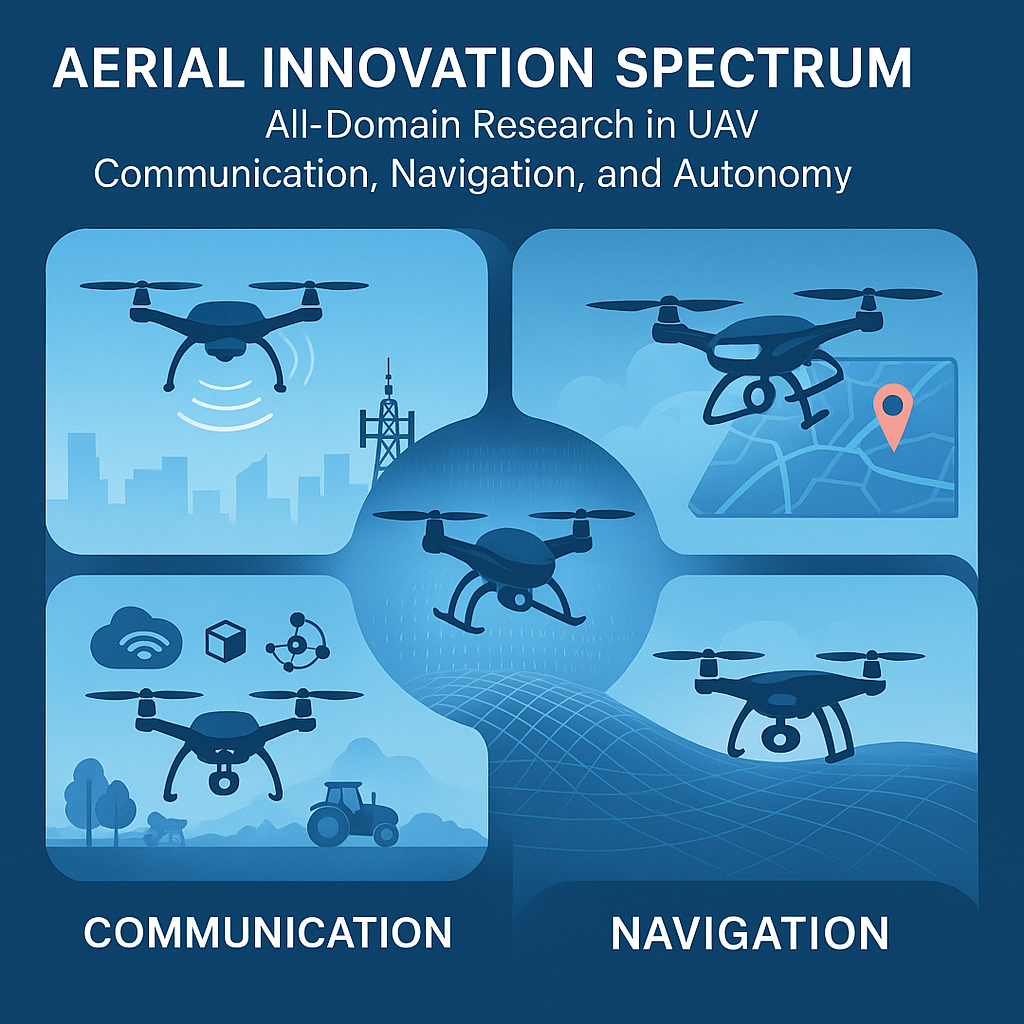
Aerial Innovation Spectrum: All-Domain Research in UAV Communication, Navigation, and Autonomy.
1) Issue Introduction
Unmanned Aerial Vehicles (UAVs) have rapidly evolved into essential components of modern communication, sensing, and autonomous systems. With breakthroughs in wireless technologies, AI-driven control, and multi-domain applications, comprehensive research in UAV communication, navigation, and autonomy has become increasingly important for future intelligent and connected systems.
2) Aim and Scope
This Special Issue aims to bring together cutting-edge research innovations that advance the development, operation, and integration of UAV systems across communication, navigation, and autonomous intelligence. It welcomes original contributions addressing foundational technologies, analytical models, algorithms, system prototypes, and emerging applications of UAVs. Topics include communication frameworks, autonomous decision-making, swarm coordination, sensing technologies, AI-driven control, and security challenges. The Special Issue particularly encourages interdisciplinary studies that bridge theory and real-world deployment, enabling UAVs to play a transformative role in smart cities, environmental monitoring, industrial inspection, logistics, and future intelligent networks.
3) Suggested Themes
1. UAV Communication and Network Architectures
2. Autonomous Navigation, Guidance, and Control Algorithms
3. AI-Driven UAV Intelligence and Multi-UAV Coordination
4. Sensing, Perception, and UAV-Based Monitoring Systems
5. Security, Privacy, and Trust in UAV Operations
6. UAV Applications in Industry, Environment, and Smart Cities
7. Emerging Cross-Domain UAV Technologies and System Integration
Graphic Abstract
Keywords
UAV Communication, Autonomous Navigation, UAV Autonomy, Flying Ad Hoc Networks (FANETs), Multi-UAV Coordination, UAV Sensing and Perception, AI-Driven Control, 5G/6G-Enabled UAV Systems, UAV Security and Privacy, Intelligent Aerial Systems
Published Papers

 Login
Login Register
 Submit a Paper
 Propose a Special lssue