
 Login
Login Register
 Submit a Paper
 Propose a Special lssue
 Open Access
ARTICLE

A Multi-Approach Hybrid Chaos-Based Image Encryption and Steganography Algorithm Using LSB Embedding
1 Department of Computer Engineering, Faculty of Engineering, The Hashemite University, Zarqa, Jordan
2 College of Engineering and Technology, American University of the Middle East, Egaila, Kuwait
3 Computer Architecture Department, Universitat Politècnica de Catalunya, Barcelona, Spain
* Corresponding Author: Islam T. Almalkawi. Email:
Computers, Materials & Continua 2026, 89(1), 57 https://doi.org/10.32604/cmc.2026.077025
Received 01 December 2025; Accepted 16 March 2026; Issue published 13 August 2026
 View Full Text
 Download PDF
Abstract
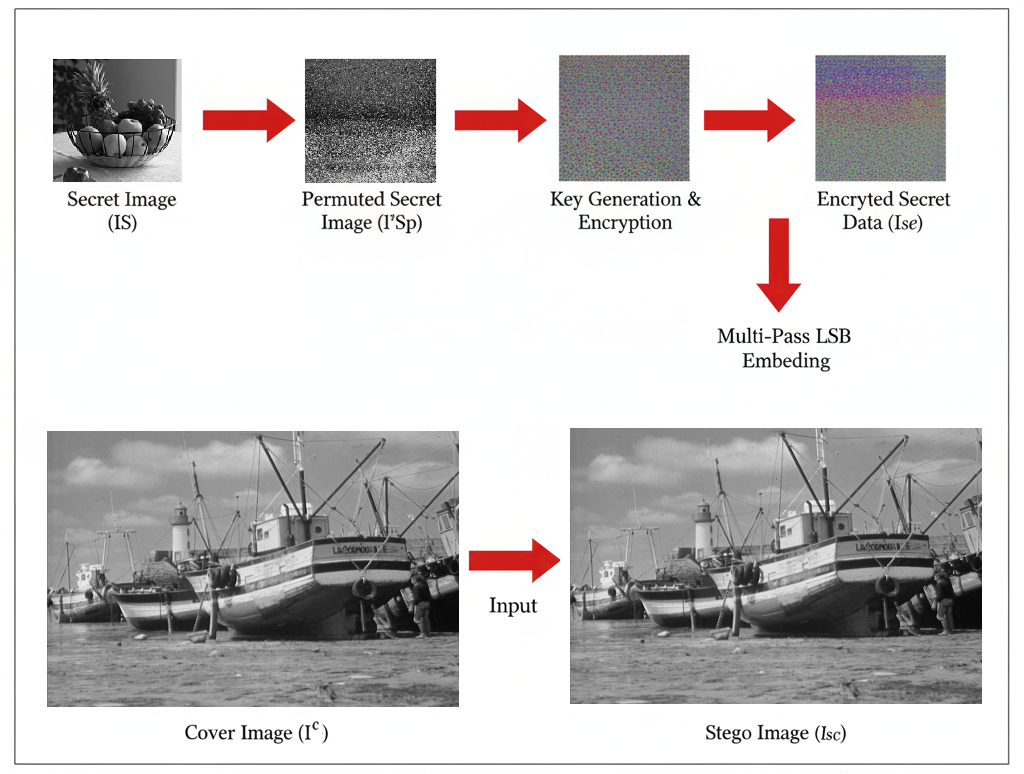
Current image steganography methods often struggle to balance security, payload capacity, and computational efficiency, with many spatial-domain techniques vulnerable to statistical steganalysis and complex methods incurring high overhead. To address persistent challenges in secure data communication, this paper introduces a novel hybrid chaotic-based multi-layered image security and steganography scheme to enhance resistance against detection while offering adaptable performance. The proposed scheme first integrates Fisher-Yates permutation driven by a Logistic Map PRNG, followed by stream cipher encryption using a Hénon Map-generated keystream to secure the secret image. Embedding is then performed via a unique three-pass chaotic LSB approach that utilizes chaotic-pseudo-random block selection and optimizes embedding based on bit-matching scores to enhance imperceptibility. This modular process enables a user-defined balance between computational load and image security/fidelity. Comprehensive analysis validates the scheme’s effectiveness and resistance against steganalysis attacks, and performance results demonstrate that the proposed method achieves high payload capacity and superior imperceptibility, outperforming several contemporary methods. We additionally provide initial undetectability baselines using SRM and a lightweight CNN holdout detector.Graphic Abstract
Keywords
Cite This Article
 Copyright © 2026 The Author(s). Published by Tech Science Press.
This work is licensed under a Creative Commons Attribution 4.0 International License , which permits unrestricted use, distribution, and reproduction in any medium, provided the original work is properly cited.
 Downloads
 Citation Tools
