
 Login
Login Register
 Submit a Paper
 Propose a Special lssue
 Open Access
ARTICLE

A Multi-Approach Hybrid Chaos-Based Image Encryption and Steganography Algorithm Using LSB Embedding
1 Department of Computer Engineering, Faculty of Engineering, The Hashemite University, Zarqa, Jordan
2 College of Engineering and Technology, American University of the Middle East, Egaila, Kuwait
3 Computer Architecture Department, Universitat Politècnica de Catalunya, Barcelona, Spain
* Corresponding Author: Islam T. Almalkawi. Email:
Computers, Materials & Continua 2026, 89(1), 57 https://doi.org/10.32604/cmc.2026.077025
Received 01 December 2025; Accepted 16 March 2026; Issue published 13 August 2026
 View Full Text
 Download PDF
Abstract
Current image steganography methods often struggle to balance security, payload capacity, and computational efficiency, with many spatial-domain techniques vulnerable to statistical steganalysis and complex methods incurring high overhead. To address persistent challenges in secure data communication, this paper introduces a novel hybrid chaotic-based multi-layered image security and steganography scheme to enhance resistance against detection while offering adaptable performance. The proposed scheme first integrates Fisher-Yates permutation driven by a Logistic Map PRNG, followed by stream cipher encryption using a Hénon Map-generated keystream to secure the secret image. Embedding is then performed via a unique three-pass chaotic LSB approach that utilizes chaotic-pseudo-random block selection and optimizes embedding based on bit-matching scores to enhance imperceptibility. This modular process enables a user-defined balance between computational load and image security/fidelity. Comprehensive analysis validates the scheme’s effectiveness and resistance against steganalysis attacks, and performance results demonstrate that the proposed method achieves high payload capacity and superior imperceptibility, outperforming several contemporary methods. We additionally provide initial undetectability baselines using SRM and a lightweight CNN holdout detector.Graphic Abstract
Keywords
In this modern age of digital communication, safeguarding sensitive information remains of utmost importance. As data transmission and storage technologies advance, so do techniques to intercept and exploit these data. Encryption serves as a fundamental tool in counteracting this. Encryption transforms plaintext data into unintelligible ciphertext, rendering it indecipherable to unauthorized parties without the corresponding decryption key; with hundreds of algorithms and schemes available for use, it is only logical for it to be the dominant information hiding method. However, as technology grows, so does the computational power; what took years to break an encryption scheme two decades ago now only takes hours. Traditional encryption methods, while robust, may be the main target of malicious parties due to their limitations, particularly as quantum computing enters the scene. In response to these challenges, researchers and practitioners have turned to innovative approaches, such as chaotic encryption algorithms, to enhance the security of digital communication and storage.
Chaotic systems, which are derived from Chaos Theory [1]; characterized by sensitivity to initial conditions and a deterministic but unpredictable behavior, offer a promising avenue for encryption. Leveraging the inherent complexity and unpredictability of chaotic dynamics, chaotic encryption algorithms can generate cryptographic keys and scramble data in a manner that follows the same principles of traditional technology combined with the randomness of Chaos Theory [2]. Moreover, the integration of chaotic encryption with image steganography presents a compelling strategy to conceal sensitive information within digital images [3,4].
Steganography, the science of hidden communication, enables the embedding of secret messages or data within innocuous cover media, such as images [5]. By combining chaotic encryption with image steganography, practitioners can achieve a multilayered approach to data security, where sensitive information is not only encrypted but also concealed within visual content, further fortifying its confidentiality [6,7]. Steganography techniques are classified into spatial and frequency domain methods. Spatial methods directly alter pixel values to embed secret data. These techniques offer high embedding capacity, but are vulnerable to statistical analysis and image manipulations. Key embedding techniques include the Least Significant Bit (LSB), Pixel Value Difference (PVD), Exploiting Modification Direction (EMD), and Pixel Indicator Technique (PIT) [8,9].
Least Significant Bit (LSB) steganography is a steganography method that involves replacing the least significant bits of the cover image with the most significant (or all) bits of the secret image, thus embedding secret data without noticeably altering its overall appearance or quality [10]. By replacing these insignificant bits with the bits of the hidden message, LSB steganography allows for the seamless concealment of information within the cover media. Spatial methods are often favored for their computational efficiency and strong imperceptibility [11]. In contrast, frequency-domain techniques involve transforming image pixels to the frequency domain and embedding information by adjusting the transformed coefficients, resulting in better resistance against statistical attacks at the cost of lower embedding capacity. Frequency techniques include Discrete Cosine Transform (DCT), Discrete Wavelet Transform (DWT), and Continuous Wavelet Transform (CWT) [12,13]. Hybrid methods are often used to achieve a balance capacity, invisibility, and security.
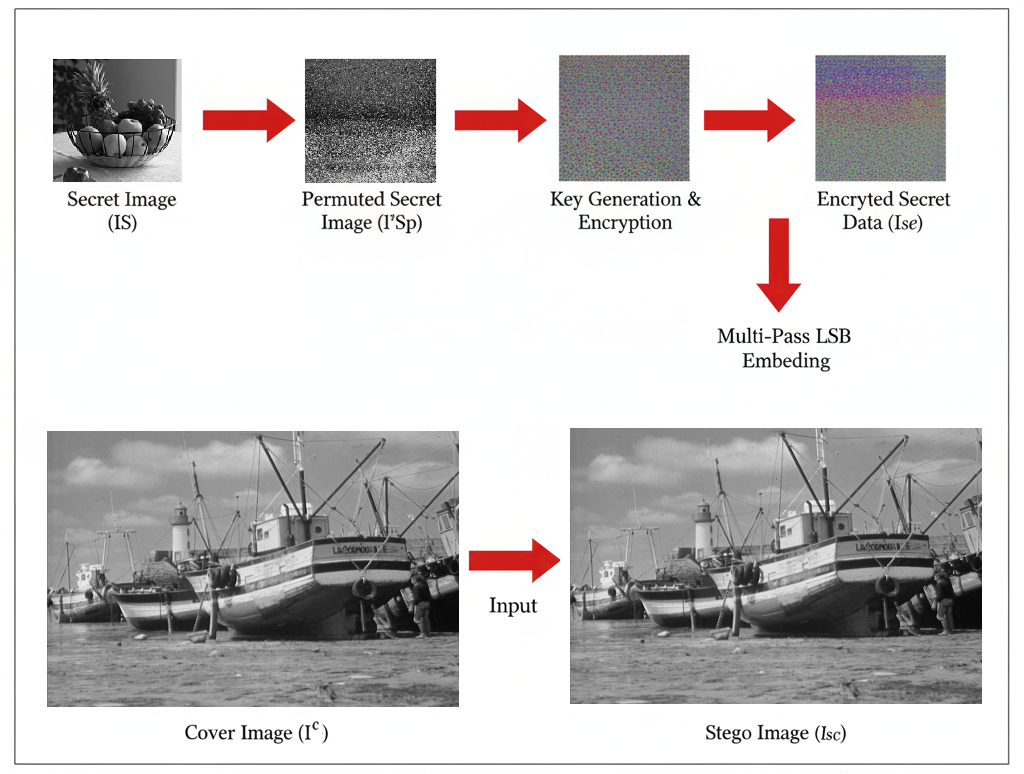
A review of existing image steganography techniques reveals significant limitations in the trade-off between imperceptibility, security, and payload capacity. Many traditional spatial-domain methods, such as naïve LSB substitution, achieve high capacity but remain highly vulnerable to statistical steganalysis (e.g., RS and Chi-square attacks) due to their predictable embedding patterns [14,15]. Conversely, while more complex approaches in the transform domain (e.g., DWT-SVD [16] or DCT [17]) or those utilizing Generative Adversarial Networks (GANs) [18] can offer improved security, they often introduce high computational overhead and may still be susceptible to targeted attacks. Furthermore, many current methods lack a robust, flexible framework, offering a static level of security and relying on simplistic key management that is insufficient for modern security demands. To address these deficiencies, this paper introduces a novel, multi-approach security algorithm that integrates chaos-based cryptography with chaos-based LSB steganography, as summarized in Fig. 1, building upon the established security enhancements provided by chaos theory [19]. Multiple chaotic map algorithms, such as the Logistic Map and Hénon Map, are utilized to ensure randomness and sensitivity to input values. The proposed method adopts the usage of metadata, produced alongside the steganographic image, and contains information used throughout the algorithm, to ensure security and correctness of data extraction on the receiver’s side.

Figure 1: Complete end-to-end hybrid image steganography scheme (public stego channel + secure metadata channel).
Why combine cryptography with steganography? Steganography aims to reduce the probability of detection, but it does not guarantee confidentiality if extraction occurs. Therefore, encrypting the payload provides a second protection layer: even if an attacker detects or partially extracts embedded bits, the recovered content remains unintelligible without the keying information. This layered design is particularly relevant in realistic interception scenarios where communication channels may be monitored or logged.
Threat model and rationale for cryptographic coupling. We consider an adversary who may (i) intercept the transmitted stego-image, (ii) apply basic statistical analysis or steganalysis to suspect hidden content, and (iii) attempt to extract or tamper with the embedded payload. In such a setting, steganography alone does not guarantee confidentiality once the embedding channel is discovered. Therefore, we couple steganography with encryption so that, even under partial exposure of the embedding mechanism or successful payload extraction, the recovered data remains computationally unintelligible without the secret key(s). This layered design targets two complementary goals: (1) concealment of the very existence of communication (steganography), and (2) confidentiality of the secret content if concealment fails (cryptography). We further assume that the auxiliary metadata required for synchronization (e.g., pairing indices and chaos parameters) is delivered via a separate secure channel; the impact of metadata exposure is discussed in the limitations and future directions.
In more detail, the contribution of our paper combines:
• Chaotic-Based Encryption: A stream cipher using a Hénon Map-generated keystream to thoroughly encrypt the secret data.
• Chaotic-Based Permutation: A Fisher-Yates permutation driven by a Logistic Map to shuffle pixel data, further enhancing security.
• A Multi-Pass LSB Embedding Strategy: A unique three-stage embedding process (First Pass, Chaotic Second Pass, and Tertiary Full Pass) significantly enhances imperceptibility and resistance to statistical attacks. The proposed algorithm can be tuned to prioritize either computational efficiency or maximum security, making it suitable for various application requirements.
• Three-pass LSB embedding (FP/CSP/TFP): The hiding stage operates on 8-bit cover-LSB blocks and proceeds in three passes. FP produces an initial chaotic pairing between secret bytes and candidate blocks. CSP then reconsiders low-score pairs and searches for alternatives with higher bit agreement, which reduces the expected number of LSB flips. Finally, TFP applies a full refinement pass for the remaining difficult cases. This staged design allows a transparent trade-off between computational cost and flip minimization (FP only, FP + CSP, or FP + CSP + TFP).
• A secure Metadata: To ensure data integrity and correct image extraction on the receiver’s end, the proposed scheme generates the essential metadata required for the retrieval.
The rest of the paper is organized as follows. Section 2 reviews the background and related work. Section 3 explains the proposed multi-layered steganography scheme. Section 4 showcases the results and performance. Section 5 concludes the paper.
This section outlines a selection of recent techniques introduced in the literature to implement image steganography. It concludes with a comparative analysis of some methods presented in Table 1, highlighting their main strengths and limitations in embedding secret information within images.

NSKA-LSB is a key adaptive Least Significant Bit (LSB) scheme presented in [14]. The scheme consisted of four phases of operation, namely pixel identification, secret key collection, secret embedding, and secret extraction. Pixel selection is carried out using the Knight Tour (KT) and the Hénon Map. Additionally, Run-Length Encoding (RLE) and Bernoulli’s Map (BM) were used to compress and encrypt the message. In order to enhance the embedding process, direct and inverse embedding of secret bits were suggested.
Particle Swarm Optimization (PSO) is commonly used in image steganography to optimize the parameters related to embedding secret information, such as the substitution matrix. However, PSO has a premature convergence problem leading to a suboptimal solution. Jaradat et al. [20] proposed a solution for this problem by integrating the Logistic chaotic map with PSO to optimally conceal the secret data in the cover image. In this technique, the particle’s speed and position were initialized using the Logistic map instead of random initialization. In addition, the cover and secret images were divided into four blocks to enhance the embedding capacity. The experimental results showed that this scheme had better Peak Signal-Noise Ratio (PSNR) and Structural Similarity Index (SSIM) compared to existing PSO-based methods.
The authors in [21] proposed an adaptive method to select the optimal pattern to minimize error during message embedding. Using the inverted LSB substitution method, they tested different patterns on the message and container image bits, selecting the one with the minimum error rate. The results improved imperceptibility in inverted LSB image steganography. More recently, imperceptibility has also been optimized using edge-aware strategies; for instance, graded fuzzy edge detection was used to guide embedding decisions with the aim of reducing visible artifacts [22].
An image steganography approach based on LSB and Pixel Value Differencing (PVD) is proposed in [15]. The primary objective of this scheme was to prevent distortion of the carrier image, thereby allowing 100% recovery of secret data during the extraction phase. The process of pixel differencing utilized the intensities of a neighboring pixel and was applied to non-overlapping pixel blocks. Performance evaluation showed the ability of the proposed scheme to increase embedding capacity while maintaining image visual quality.
A steganographic algorithm for encrypted images is presented in [23]. The proposed algorithm aimed to tackle the problem of low security in traditional schemes by providing an encryption algorithm that was based on a chaotic system. It ensured uniform distribution of image pixel grayscale value by integrating a double scrambling operation for the pixel position of the carrier image. The authors showed that the embedding capacity of their scheme had been improved while ensuring information security and image quality.
A fragile watermarking technique for image authentication and integrity verification based on the Logistic map is presented in [24]. This technique aimed to detect and localize tampered regions in images while balancing perceptual transparency, embedding capacity, and robustness. The watermark bits were embedded into the LSBs using a logical XOR operation, achieving a high peak signal-to-noise ratio (PSNR). The proposed pixel-wise indirect watermark embedding technique improved on previous methods by embedding watermark bits in each pixel, enhancing imperceptibility and robustness. The technique showed high accuracy in identifying tampered regions with low false positive/negative rates.
CHASE [18] is an image steganography method designed to hide multiple secret images within a single cover image. The method incorporated image scrambling, encoding, and decoding processes within the same network and used Haar wavelet transforms for better visual quality preservation. It used the Logistic map for image permutation and utilizes Generative Adversarial Networks (GANs) to enhance image fidelity. The model allowed for embedding color images in grayscale images, improving resistance to steganalysis, and ensuring good invisibility of hidden images. The training process involved a two-stage strategy, first reconstructing the secret image without a GAN and then aligning the distribution of reconstructed images with the original ones using a discriminator. The simulation results showed competitive PSNR and SSIM values. More broadly, recent AI-powered steganography research increasingly reports perceptual and distribution-level metrics (e.g., LPIPS and FID) alongside classical PSNR/SSIM, as summarized in recent survey [25].
The paper in [26] presented an image encryption scheme using the chaotic Hénon chaotic system that employed chaotic sequences for pixel rearrangement, bit replacement, and value diffusion to improve security. The evaluation result showed enhanced entropy and strong resistance to shear and noise attacks.
CIEST [27] combined cryptography and steganography with DNA encoding for enhanced digital image security. The scheme modified the cover image and used chaotic maps to improve randomness and resistance to attacks. The scheme offered high embedding capacity, low correlation, and strong security, with low Mean Square Error (MSE), high PSNR, and a large key space, making it resistant to brute-force attacks. Recent literature has also highlighted the growing interest in compression-combined image encryption as a practical direction to reduce transmission and storage overhead while maintaining confidentiality. Lin et al. provide a comprehensive and up-to-date review of this line of work, covering current techniques and open challenges in compression-aware encryption pipelines [28].
Table 1 lists the strengths and weaknesses of the different related research works.
Here, we discuss the proposed method, which employs gray-scale images for both encryption and embedding with a flexible bit-per-pixel (BPP) offering different possible bit capacity limits. The section is split into the following parts, each describing a processing stage in our method:
1. Permutation
2. Key Generation and Encryption
3. Embedding
4. Extraction and Decryption/De-permutation
The proposed method introduces a steganographic method operating on two images: a Secret Image and a Cover Image. The methodology involves two stages: (1) The Secret Image is pre-processed via permutation and encryption; (2) The resulting secured data is embedded into the Cover Image. This embedding process generates a Stego-Image, which is perceptually identical to the original Cover Image, and the associated metadata required to retrieve the hidden information. Each stage is accompanied by figures to illustrate how each stage affects the data. The image example uses Fig. 2a (Fruits) as the Secret image and Fig. 2b (Baboon) as the Cover image.

Figure 2: Input images.
In the first stage, the proposed method introduces diffusion to the secret image of size (
The shuffling process begins by positioning a pointer at the

Figure 3: Permutation effect.

3.2 Stage 2: Key Generation and Encryption
During the encryption stage, the proposed method achieves confusion within the secret image of size
The keystream of length
Parameter ranges and selection. For the Logistic map

In our experiments,
Finite-precision considerations. Chaotic maps are implemented with finite precision, which may introduce short periods or deviations from ideal real-valued dynamics. In our implementation, we use double-precision arithmetic and restrict parameters to validated chaotic ranges. An optional burn-in segment can be applied (when needed) by discarding initial iterations before sampling the keystream. A deeper treatment of quantization-induced periodicity and parameter sensitivity is left for future work.
When the key stream is generated, the proposed method encrypts the secret image using the key stream and an XOR function. This ensures that the pixel values of the secret image are effectively obscured, as shown in Fig. 4, contributing to the overall security of the encryption process. Algorithm 2 shows the generation of the secret key, and the encryption process of our proposed scheme is described in Algorithm 3.

Figure 4: Encryption effect.


In this section, the different phases of our proposed image steganography scheme are explained in detail.
Block-wise embedding unit. The embedding unit is an 8-bit block (one byte): each secret pixel value is represented by 8 bits and embedded into the LSB-bitmap as one block, i.e., one secret byte per 8 cover pixels. Accordingly, each pairing address
3.3.1 Illustrative Block Calculation (Score and Flips)
To clarify block-wise embedding, consider a single secret byte represented by 8 bits embedded into the LSBs of one 8-pixel cover block. Let the secret bits be
3.3.2 First Pass Embedding (FP)
The proposed method facilitates the selection of pixels from the encrypted secret image of size
When the inputs have been prepared, the algorithm proceeds with the pairing of secret data pixels to appropriate locations within the cover image for embedding. The proposed method begins with an iteration of the Hénon Map function, multiplying the resulting output by
3.3.3 Chaotic Second Pass Embedding (CSP)
To produce better Steganography image quality and imperceptibility, the proposed method implements a secondary position selection and embedding procedure referred to as the “Chaotic Second Pass” (CSP). CSP begins with a bitwise comparison function, characterized by Eq. (1), which evaluates each secret data pixel against its corresponding cover bitmap block, yielding the number of matching bits between them, referred to “matching score”. The function is defined as follows:

After calculating the matching scores for all secret pixels, the method identifies the worst-performing 50%, those being the pixels with the lowest matching scores, to find better positions for them. This results in a subset of size

3.3.4 The Tertiary Full Pass (TFP)
To further enhance the output image quality, the proposed method includes an optional tertiary procedure named the Tertiary Full Pass (TFP). The TFP possesses a structure similar to the CSP but differs in two key aspects, as shown in Algorithm 6: (1) it employs a linear search mechanism and (2) it executes a full fixing procedure for any secret pixel that yields a matching score below 8. The effect of this optional stage on embedding quality and computational complexity is evaluated in the Experimental Results Section. Fig. 5 shows the flow diagram of our proposed image steganography method. Fig. 6 shows the cover image after hiding the secret data using the proposed (FP, CSP, and TFP) embedding phases.

Figure 5: Flowchart of our proposed method.

Figure 6: Embedding effect (FP + CSP + TFP).

After the proposed method generates the steganographic image, the method will generate a file alongside the stego-image that contains important information employed in the algorithm; the file is referred to as “metadata” [35]. Metadata for the proposed method consists of the following:
1. Initial values of the chaotic algorithms used in the permutation, encryption, and embedding stage.
2. Pixel pairing pattern produced in the embedding stage.
Similar to symmetric keys used in encryption algorithms such as AES (Advanced Encryption Standard) [36], which are shared through advanced key exchange protocols [37], the metadata in the proposed method is also sent through a different, preferably secure, channel than the one used to send the stego-image. To facilitate efficient distribution, Similar to symmetric keys used in encryption algorithms such as AES (Advanced Encryption Standard) [36], which are shared through advanced key exchange protocols [37], the metadata in the proposed method is also sent through a different, preferably secure, channel than the one used to send the stego-image. To facilitate efficient distribution, we compress only the metadata file using the Lempel-Ziv-Markov (LZMA2) algorithm [38]. This step is applied exclusively to the side information (e.g., chaotic parameters and pairing pattern), and is not applied to the cover image, the stego-image, or the encrypted payload. LZMA2 can provide substantial size reduction depending on the metadata structure, thereby reducing the transmission overhead of the auxiliary file. During the extraction phase, the compressed metadata is decompressed to recover the original information required for the Extraction, Decryption, and De-permutation of the stego-image. We treat secure transmission of metadata (e.g., via an authenticated and encrypted channel) as a practical system assumption; a full treatment of key exchange and compression internals is outside the scope of this paper and will not be discussed in further detail.
3.3.5 Quantitative Metadata Overhead and Exposure Implications
Our stego construction produces a stego image accompanied by auxiliary information required for correct extraction. In our implementation, the embedding stage returns a metadata dictionary that includes: the secret dimensions
Metadata size as a function of payload
In our reference implementation, the addressing list
where

Does metadata growth become combinatorial?
The size of transmitted metadata is linear because we serialize and transmit an explicit list of
Security implications under metadata exposure
To avoid ambiguity, we explicitly separate:
• Extraction side-information:
• Confidentiality-critical key material: the secret seeds/keys used to generate the permutation and keystream for payload encryption.
If an attacker obtains only the extraction side-information (e.g.,
Implementation-grounded summary
In short: (i) metadata size scales as

To extract the secret image, the initial values and pairing pattern are first extracted from the decompressed metadata; this will include:
1. Initial values for the Logistic Map for de-permutation
2. Initial values for the Hénon Maps in the decryption and extraction
3. Size of the expected secret image
4. Pairing pattern for extraction
Threat model for metadata exposure. Our extraction procedure relies on auxiliary metadata (e.g., chaotic seeds and the pairing pattern). If this metadata is disclosed to an adversary, recoverability may be compromised and confidentiality may degrade depending on the configuration. Accordingly, we assume that metadata is transmitted over an authenticated and encrypted channel (e.g., a secure out-of-band session). A complete key-management design is beyond the scope of this work; we state this assumption to delimit the threat model.
Metadata size reduction. Metadata compression is applied only to the side information (chaotic seeds and the address list), not to the cover image nor the payload. Table 3 reports raw vs. compressed metadata sizes (bytes) under each configuration.
The sequence of secret bits is then extracted from the stego-image


The detailed performance comparison between the proposed approach and some existing schemes is presented in this section. We analyzed the impact of different embedding procedures on the performance of the proposed technique. The embedding and extracting simulations were conducted using the USC-SIPI [39] standard image database. The image dataset contains uncompressed colored images with various textures and resolutions (512

Figure 7: Examples of cover images.
In this subsection, the histogram figures of the images are presented. The histogram distribution shows the frequency of pixel intensities in the image, where 0 represents black and 255 represents white. An attacker (frequency attacks) can use this statistical information to find the content of the image. Fig. 8 shows the histogram analysis of the secret image, Fruits, before and after the “Permutation” and “Encryption” stages. The pre-steganography process aims to flatten the image histogram into a uniform distribution.

Figure 8: Histograms of the secret image before and after encryption.
In addition, the primary goal of our image steganography is imperceptibility. Therefore, the histogram of the “Stego Image” should look statistically indistinguishable from the “Cover Image” and prevent histogram attacks. Fig. 9 compares (a) the histogram of the “Baboon” cover image with (b) the histogram of the “Baboon” stego image. As evident from the histogram data shown, the proposed steganography scheme not only maintains perceptual similarity between the cover and stego images but also has successfully hidden the secret image without destroying the global statistical properties of the cover image. Fig. 9c shows the difference histogram (Stego-Cover) with minor fluctuations, centered around zero, which confirms negligible statistical distortion and proves good resistance to statistical attacks (like Chi-square).

Figure 9: Histogram analysis of the cover and stego images.
4.2 Simulation and Image Quality Metric Result Analysis
We evaluate below the simulation results of the proposed algorithm and compare it with other innovative chaotic steganography methods. An important performance metric to measure is the Bit Capacity, the amount of bits embedded into the cover image. This is dependent on both the number of bits embedded per pixel (BPP) [40] and the resolution of the secret image. The actual quality of the results can be measured using several metrics, such as PSNR (Peak Signal-Noise Ratio) and SSIM (Structural Similarity Index), and other metrics like Pixel Change Rate (NPCR) and Averaged Changing Intensity (UACI).
The Peak Signal-to-Noise Ratio (PSNR) compares the quality of the images by measuring the average difference between their pixel values and those of the originals [41]. Characterized by Eq. (4), PSNR leverages another metric called Mean Square Error (MSE), which measures the average squared difference between the original and processed images [42]. MSE and PSNR have an inverse relation; a lower MSE, characterized by Eq. (5), results in a higher PSNR, and that in turn means less distortion and better stego-image quality.
where
The Structural Similarity Index Measure (SSIM) measures the similarity between two images by evaluating things like contrast, structural information, and luminance [43]. With values ranging between 0 and 1, where 1 means near-identical images, SSIM is characterized in Eq. (6) as follows:
where
NPCR and UACI, defined in Eqs. (7) and (8), are related image quality metrics that measure the change in pixel values after a small change in the key or steganography, the addition of secret pixels. Where NPCR measures it as a percentage, with lower percentages suggesting minimal change in the image, and UACI measures it as an absolute difference, where lower values mean minimal distortion [44].
where
The performance and quality metrics of the proposed method are first evaluated across several factors discussed above.
The results in Table 4 were produced by running the proposed methods with all embedding procedures (FP, CSP, TFP). The cover images had the resolution of (512

The performance of the proposed method using all three embedding procedures (FP + CSP + TFP) and a secret image of size (220


4.2.1 Ablation Study of the Multi-Pass Embedding Stages (FP/CSP/TFP)
To quantify the contribution of each embedding stage, we evaluate three configurations: FP, FP + CSP, and FP + CSP + TFP. We report results (i) without encryption to isolate embedding behavior, and (ii) with encryption enabled to reflect the full pipeline. For fair reference, we also include a naive sequential LSB baseline (no chaotic addressing and no refinement).
Overall, CSP and TFP reduce the embedded-region bit-flip rate, which correspondingly lowers MSE and increases PSNR/SSIM, at the cost of additional runtime. To reduce any potential cherry-picking, we also report worst-case outcomes under the same protocol (Section 4.2.2).
Additionally, we report learned perceptual similarity (LPIPS) and distribution-level quality (FID). As shown in Tables 7–9, CSP/TFP consistently reduce perceptual distortion (LPIPS) and improve set-level fidelity (FID), consistent with the reduced embedded-region bit-flip rates.


4.2.2 Worst-Case Analysis (Anti-Cherry-Picking)
In addition to mean results, we report worst-case outcomes across all executed runs (covers
4.2.3 Why Very High PSNR can Occur in LSB-Based Embedding
Our embedding modifies only the least significant bit (LSB) of selected pixels. Therefore, each modified pixel changes by at most 1 gray level. If a fraction
4.2.4 Bit-Flip Distribution (Anti-Cherry-Picking)
In addition to mean values, we report the distribution of the embedded-region bit-flip rate across all executed runs. Fig. 10 shows that the refinement stages (CSP/TFP) shift the distribution towards lower flip rates compared to FP, confirming that multi-pass score optimization reduces the expected number of LSB modifications. Table 10 provides a quantitative summary of this distribution (min, quartiles, median, and max) to complement the visual analysis and avoid cherry-picking based on averages alone.

Figure 10: Embedded-region bit-flip rate distribution (boxplot) across all runs for FP variants, with/without encryption. The box spans Q1–Q3, the orange line is the median, whiskers show the non-outlier range (1.5

4.2.5 Payload Scaling and Runtime Growth
Table 11 provides the full payload-scaling summary across all settings.

4.2.6 Robustness under Common Image Operations
We additionally evaluate robustness under common channel operations, including JPEG compression (Q95/Q85/Q75), Gaussian blur (radius 0.5/1.0), and resizing (0.75

4.2.7 Chaotic Parameter Ranges and Validation
For the Logistic map

Figure 11: Lyapunov exponent of the logistic map vs.
4.2.8 Finite-Precision Clarification and Implementation Precision
Chaotic maps are known to be sensitive to numerical precision. We use IEEE-754 double-precision floating-point arithmetic (64-bit), which provides 52 effective mantissa bits per independent real-valued seed. For clarity, all chaotic-map computations and validations reported in this work were executed using IEEE-754 double-precision arithmetic (Python/NumPy default floating-point). In particular, our empirical validation computes the Lyapunov exponent for the Logistic map over the interval
Lyapunov exponent (Logistic map). For
after discarding an initial burn-in period. A positive
4.3 Computational Complexity Analysis of Embedding Stages
Analysis of the embedding stage runtime reveals a clear computational trade-off dictated by the choice of procedures. The initial First Pass (FP) pairing exhibits linear time complexity,
4.4 Steganalysis Attacks Resistance Analysis
The security of our proposed image steganography scheme is evaluated against common steganalysis attacks, considering the cumulative effects of chaos-based permutation and encryption, chaotic FP LSB mapping, and embedding optimization (CSP and TFP).
Visual Attacks: The proposed method exhibits high resistance to visual attacks. Standard LSB substitution introduces minimal perceptual distortion. This is further enhanced by the Chaotic Second Pass (CSP) and Tertiary Full Pass (TFP) embedding phases, which actively seek embedding locations that minimize bit flips by optimizing for higher matching scores, thereby preserving the cover image’s visual fidelity. The initial permutation and encryption phases solely affect the secret data and do not alter the appearance of the cover image.
Statistical Attacks (Spatial Domain): Resistance to traditional statistical attacks is significantly improved compared to naïve LSB methods.
• Chi-Square and PoV Attacks: These attacks often rely on deviations from expected pixel value frequencies or LSB pair statistics caused by sequential embedding. The utilization of Hénon and Logistic maps to pseudo-randomly distribute embedding blocks across the cover image disrupts this sequential assumption, rendering basic Chi-Square and Pairs of Values (PoV) analyses less effective.
• RS Steganalysis: Regular Singular pairs analysis (RS) detects embedding by measuring changes in image regularity/smoothness based on pixel group flippability. While chaotic selection provides some randomization, the score optimization in CSP and TFP directly reduces the number of LSB flips. Minimizing flips inherently decreases the disturbance to image regularity statistics, thus providing resistance against RS attacks, superior to standard LSB replacement or the First Pass embedding alone.
• SPA/PDH Attacks: The Sample Pair Analysis (SPA) and Pixel Difference Histogram (PDH) methods analyze correlations between adjacent pixel values or differences. The proposed chaotic-based method mitigates assumptions based on strict adjacency, and the flip reduction by CSP/TFP helps preserve original difference statistics. Therefore, it provides good resistance by reducing the subtle effects of LSB modification that can be detected by these attacks.
4.4.1 Undetectability Evaluation: SRM-Based Steganalysis Baseline (Small-Scale)
To provide an initial undetectability baseline, we evaluated a classical Spatial Rich Model (SRM) feature pipeline on a balanced set of Portable Gray Map (PGM) images, producing a feature matrix of size
SRM feature dimensionality. The SRM extractor used in our MATLAB pipeline corresponds to the standard SRM rich model (106 submodels), whose total feature dimensionality is
The dataset contains 39 cover and 39 stego images (stego images generated using our embedding procedure under the same experimental settings used in the main evaluation).
Protocol. To avoid data leakage, we used stratified 5-fold cross-validation with a fixed Random number generator (RNG) seed, set in MATLAB as rng(7).
Run count. This small-scale baseline reports one stratified 5-fold CV run under a fixed seed (rng(7)), i.e., five held-out evaluations (one per fold).
Pairing integrity (anti-mixing). Before feature extraction, we enforce strict one-to-one pairing between cover and stego samples by matching filenames. The cover file list is sorted deterministically, and the pipeline verifies that each cover has a corresponding stego image with the exact same filename; otherwise the run aborts. SRM features for cover and stego are then extracted using this shared ordered list, ensuring row-aligned feature matrices and preventing any cover/stego mixing.
All experiments were run in MATLAB R2025b on a 13th Gen Intel Core i7-13650HX machine with 24 GB RAM. Within each fold, features were standardized using the mean and standard deviation computed on the training split only, and the same transformation was applied to the corresponding test split.
Leakage control (implementation-aligned). We enforce a strict no-leakage protocol in MATLAB. Stratified 5-fold splits are created by shuffling cover and stego indices independently under a fixed seed (rng(7)) and distributing each class evenly across folds. Within each outer fold, feature standardization uses training statistics only: the mean and standard deviation are computed on the outer-training split and then applied to both outer-training and outer-test data. The regularization strength
Classifier. As a lightweight baseline classifier, we trained an
Results. Across the five folds, the mean accuracy was

Figure 12: ROC curve of the SRM-based steganalysis baseline using
ROC/AUC computation. To compute the ROC curve, we pool the continuous decision scores obtained on the held-out outer-test split of each fold and aggregate them across the five folds (see Algorithm 10). The ROC curve is then obtained by sweeping the decision threshold over these pooled scores, and the AUC is computed using trapezoidal integration of the

4.4.2 Deep-Learning-Based Steganalysis Baseline (Small-Scale)
To complement the SRM-based detector with a learning-based reference, we conducted a small-scale CNN steganalysis experiment using a lightweight residual-oriented architecture (fixed high-pass prefilter followed by a shallow convolutional trunk). We followed a strict holdout protocol aligned with our dataset splits: the detector is trained on TRN, the best epoch is selected on VAL, and final performance is reported on the unseen TST split (balanced cover/stego, filename-paired (one-to-one) and balanced cover/stego splits). The experiment uses the same stego generation setting as in our SRM undetectability baseline (same embedding configuration and payload setting for the evaluated subset). Using crop size

Figure 13: ROC curve of the lightweight CNN steganalysis baseline under the holdout protocol (Train on TRN, select on VAL, report on TST). The test AUC is
Scope note. CNN steganalyzers such as SRNet-style architectures typically require (i) training and evaluation on standardized steganalysis benchmarks (e.g., BOSSBase/ALASKA-like protocols) to ensure comparability, and (ii) substantially larger-scale training with carefully tuned schedules and preprocessing to obtain stable, reproducible performance. Reproducing a comparable SRNet-level evaluation (including cross-dataset testing) is therefore beyond the computational and dataset scope of this paper. We plan this as a separate extended study on standard benchmarks and cross-dataset protocols.
4.5 Analysis of Brute Force Attack Resilience
In our threat model, the stego image is transmitted over a public channel, while the metadata (seeds and address-selection information) is transmitted via a secure side channel. Without the metadata, a brute-force adversary must jointly guess the keystream seeds and the block-addressing sequence, which becomes computationally prohibitive as the payload and image size grow.
Key space estimation. In deployment, the secret key comprises the chaotic initial conditions used for keystream generation and the embedding address-selection sequence (and optionally the map parameters). Beyond the chaotic seed space, the block-wise addressing stage introduces a combinatorial selection space by choosing
Finite-precision note. Since chaotic maps are realized under finite precision, we use double-precision arithmetic and validated chaotic ranges; optionally, a burn-in stage discards initial iterations prior to keystream sampling.
4.5.1 Explicit Key-Space Lower Bound (in Bits) and Security Thresholds
To express the key space in cryptographic terms, we derive a conservative lower bound from the actual confidentiality-critical parameters used in our implementation. In the encryption stage, a keystream is generated by the Hénon map using two real-valued seeds
Assuming IEEE-754 double-precision arithmetic, each independent real-valued seed provides approximately 52 effective mantissa bits. Therefore, a conservative lower bound on the effective key space is:
where
Concrete size. This corresponds to at least
Meeting 128-bit thresholds. While
Addressing space vs. key space. The addressing list
Meeting 128-bit thresholds. Achieving
This paper presented a hybrid chaos-based image security framework for the secure transmission of secret images. The methodology follows a two-phase protocol: (i) a hybrid permutation stage integrating Fisher-Yates with the Logistic map, and (ii) a Hénon-map-driven PRNG stream-cipher encryption stage.
A key contribution lies in the three-stage, configurable embedding strategy (FP, CSP, and TFP). Specifically, embedding operates at the byte level, where each secret byte is mapped into an 8-pixel cover block (one LSB per pixel). CSP and TFP then refine block placements by maximizing bit matching, thereby reducing the expected number of LSB modifications. Experimental results and the ablation analysis confirm that the full FP + CSP + TFP execution achieves the best imperceptibility (PSNR/SSIM/MSE) with reduced embedded-region bit flips, at the cost of increased runtime, while also enabling practical trade-offs when faster configurations are desired.
The current framework remains constrained by the inherent fragility of spatial-domain LSB embedding under lossy or resampling operations, and by the limited scale of the present undetectability evaluation (classical tests, a small-scale SRM baseline, and a lightweight CNN holdout reference rather than a state-of-the-art steganalyzer).
Future work will prioritize improving robustness under lossy channels, expanding undetectability evaluation to stronger learning-based baselines (e.g., SRNet-like) under standardized within-/cross-dataset protocols and established benchmarks, optimizing runtime through reduced candidate search while preserving fidelity, and extending the approach to color images with channel-aware or transform-domain variants.
Acknowledgement: Not applicable.
Funding Statement: The authors received no specific funding for this study.
Author Contributions: The authors confirm contribution to the paper as follows: Islam T. Almalkawi: Conceptualization, methodology, overall supervision, and project administration; coordinated the revision process; writing: review & editing; corresponding author responsibilities. Samer Khasawneh: Methodology refinement, experimental design review, and validation; writing: review & editing. Hamza M. Alkhatib: Software implementation, experiments execution, data preparation/curation, and results documentation; writing: original draft (technical sections). Sabya Shtaiwi: Major contribution to the revision and resubmission; performed additional analyses/experiments requested during peer review; prepared and consolidated the complete point-by-point rebuttal and revision log; writing: review & editing. Rami Halloush: Technical review of the approach and results, supported interpretation and presentation improvements; writing: review & editing. Manel Guerrero Zapata: Formal analysis and critical technical feedback; contributed to strengthening the evaluation narrative; writing: review & editing. All authors reviewed and approved the final version of the manuscript.
Availability of Data and Materials: The cover images used in this study were obtained from the publicly available USC-SIPI Image Database [39]. The stego images and related experimental outputs were generated during the execution of the proposed embedding algorithm described in this manuscript. Therefore, the experimental data can be reproduced from the USC-SIPI dataset and the methodology reported in this paper.
Ethics Approval: Not applicable.
Conflicts of Interest: The authors declare no conflicts of interest.
References
1. Lorenzelli F. The essence of chaos. Raton, FL, USA: CRC Press; 2014. [Google Scholar]
2. Zolfaghari B, Koshiba T. Chaotic image encryption: state-of-the-art, ecosystem, and future roadmap. App Syst Innovat. 2022;5(3):57. doi:10.3390/asi5030057. [Google Scholar] [CrossRef]
3. Zaidan BB, Zaidan AA, Al-Frajat AK, Jalab HA. On the differences between hiding information and cryptography techniques: an overview. J Appl Sci. 2010;10(15):1650–5. doi:10.3923/jas.2010.1650.1655. [Google Scholar] [CrossRef]
4. Sheela S, Sathyanarayana SV. Application of chaos theory in data security-a survey. ACCENTS Trans Inform Secur. 2017;2(5):1–15. doi:10.19101/tis.2017.25001. [Google Scholar] [CrossRef]
5. Morkel T, Eloff JHP, Olivier MS. An overview of image steganography. In: Proceedings of the Fifth Annual Information Security South Africa Conference; 2005 Jun 29–Jul 1; Balalaika Hotel, Sandton, South Africa. p. 1–11. [Google Scholar]
6. Singh AK, Singh J, Singh HV. Steganography in images using LSB technique. Int J Latest Tren Eng Technol (IJLTET). 2015;5(1):426–30. [Google Scholar]
7. Zaidan AA, Zaidan BB, Al-Frajat AK, Jalab HA. Investigate the capability of applying hidden data in text file: an overview. J Appl Sci. 2010;10(17):1916–22. doi:10.3923/jas.2010.1916.1922. [Google Scholar] [CrossRef]
8. Duan X, Nao L, Mengxiao G, Yue D, Xie Z, Ma Y, et al. High-capacity image steganography based on improved FC-DenseNet. IEEE Access. 2020;8:170174–82. doi:10.1109/access.2020.3024193. [Google Scholar] [CrossRef]
9. Konyar MZ, Solak S. Efficient data hiding method for videos based on adaptive inverted LSB332 and secure frame selection with enhanced Vigenere cipher. J Inf Secur Appl. 2021;63(1):103037. doi:10.1016/j.jisa.2021.103037. [Google Scholar] [CrossRef]
10. Reddy VL, Subramanyam A, Reddy PC. Implementation of LSB steganography and its evaluation for various file formats. Int J Adv Netw Appl. 2011;2(5):868–72. [Google Scholar]
11. Solak S, Altınışık U. Image steganography based on LSB substitution and encryption method: adaptive LSB+ 3. J Electron Imaging. 2019;28(4):043025. doi:10.1117/1.jei.28.4.043025. [Google Scholar] [CrossRef]
12. Sahu AK, Sahu M. Digital image steganography and steganalysis: a journey of the past three decades. Open Comput Sci. 2020;10(1):296–342. [Google Scholar]
13. Yadav P, Dutta M. A overview of various steganographic domains and its applications. Int J Eng Trends Technol. 2017;52(3):137–41. [Google Scholar]
14. Abdulwahed MN. An effective and secure digital image steganography scheme using two random function and chaotic map. J Theor Appl Inform Technol. 2020;98(1):96–105. [Google Scholar]
15. Hussain M, Riaz Q, Saleem S, Ghafoor A, Jung KH. Enhanced adaptive data hiding method using LSB and pixel value differencing. Multim Tools Appl. 2021;80(23):20381–401. doi:10.1007/s11042-022-14326-5. [Google Scholar] [CrossRef]
16. Durafe A, Patidar V. Image steganography using fractal cover and combined chaos-DNA based encryption. Ann Data Sci. 2024;11(3):855–85. doi:10.1007/s40745-022-00457-x. [Google Scholar] [CrossRef]
17. Manzar MA, Al-Ahmadi S, Hazzazi MM. A novel chaotic steganography method with three approaches for color and grayscale images based on FIS and DCT with flexible capacity. Multim Tools Appl. 2020;79(19):13693–724. doi:10.1007/s11042-019-08415-1. [Google Scholar] [CrossRef]
18. Huo L, Chen R, Wei J, Huang L. A high-capacity and high-security image steganography network based on chaotic mapping and generative adversarial networks. Appl Sci. 2024;14(3):1225. doi:10.3390/app14031225. [Google Scholar] [CrossRef]
19. Almalkawi IT, Halloush R, Alsarhan A, Al-Dubai A, Al-karaki JN. A lightweight and efficient digital image encryption using hybrid chaotic systems for wireless network applications. J Inf Secur Appl. 2019;49(7):102384. doi:10.1016/j.jisa.2019.102384. [Google Scholar] [CrossRef]
20. Jaradat A, Taqieddin E, Mowafi M. A high-capacity image steganography method using chaotic particle swarm optimization. Secur Commun Netw. 2021;2021:6679284. doi:10.1155/2021/6679284. [Google Scholar] [CrossRef]
21. Rustad S, Syukur A, Andono PN. Inverted LSB image steganography using adaptive pattern to improve imperceptibility. J King Saud Univ-Comput Inform Sci. 2022;34(6):3559–68. doi:10.1016/j.jksuci.2020.12.017. [Google Scholar] [CrossRef]
22. Setiadi DRIM, Rustad S, Andono PN, Shidik GF. Graded fuzzy edge detection for imperceptibility optimization of image steganography. Imag Sci J. 2024;72(6):693–705. doi:10.1080/13682199.2023.2219880. [Google Scholar] [CrossRef]
23. Ye H, Su K, Cheng X, Huang S. Research on reversible image steganography of encrypted image based on image interpolation and difference histogram shift. IET Image Process. 2022;16(7):1959–72. doi:10.1049/ipr2.12461. [Google Scholar] [CrossRef]
24. Sahu AK. A logistic map based blind and fragile watermarking for tamper detection and localization in images. J Ambient Intell Human Comput. 2022;13(8):3869–81. doi:10.1007/s12652-021-03365-9. [Google Scholar] [CrossRef]
25. Setiadi DRIM, Ghosal SK, Sahu AK. AI-powered steganography: advances in image, linguistic, and 3D mesh data hiding—a survey. J Future Artif Intell Technol. 2025;2(1):1–23. [Google Scholar]
26. Luo H, Ge B. Image encryption based on Hénon chaotic system with nonlinear term. Multim Tools Appl. 2019;78(24):34323–52. doi:10.1007/s11042-019-08072-4. [Google Scholar] [CrossRef]
27. Aparna H, Madhumitha J. Combined image encryption and steganography technique for enhanced security using multiple chaotic maps. Comput Elect Eng. 2023;110(1):108824. doi:10.1016/j.compeleceng.2023.108824. [Google Scholar] [CrossRef]
28. Lin Y, Yang Y, Li P. Development and future of compression-combined digital image encryption: a literature review. Digit Signal Process. 2025;158(2):104908. doi:10.1016/j.dsp.2024.104908. [Google Scholar] [CrossRef]
29. Khalil N, Sarhan A, Alshewimy MA. A secure image steganography based on LSB technique and 2D chaotic maps. Comput Elect Eng. 2024;119:109566. doi:10.1016/j.compeleceng.2024.109566. [Google Scholar] [CrossRef]
30. Abdulhammed OY. A robust image steganography based on a novel technique by using improved DNA and modified chaotic approach. J Supercomput. 2024;80(1):226–48. doi:10.1007/s11227-023-05459-x. [Google Scholar] [CrossRef]
31. Eberl M. Fisher–Yates shuffle. Archive of Formal Proofs [online]. 2016 Sep 19. Available from: https://isa-afp.org/entries/Fisher_Yates.html. [Google Scholar]
32. Phatak SC, Rao SS. Logistic map: a possible random-number generator. Phys Rev E. 1995;51(4):3670–8. [Google Scholar]
33. Weisstein EW. Hénon map;. from MathWorld–a wolfram web resource. [cited 2026 Mar 15]. Available from: https://mathworld.wolfram.com/HenonMap.html. [Google Scholar]
34. Al-Hyari A, Obimbo C, Abu-Faraj MM, Al-Taharwa I. Generating powerful encryption keys for image cryptography with chaotic maps by incorporating collatz conjecture. IEEE Access. 2024;12(5):4825–44. doi:10.1109/access.2024.3349470. [Google Scholar] [CrossRef]
35. Riley J. Understanding metadata. Washington, DC, USA: National Information Standards Organization (NISO); 2017. [Google Scholar]
36. Heron S. Advanced encryption standard (AES). Netw Secur. 2009;2009(12):8–12. [Google Scholar]
37. Harn L, Lin C. Authenticated group key transfer protocol based on secret sharing. IEEE Trans Comput. 2010;59(6):842–6. doi:10.1109/tc.2010.40. [Google Scholar] [CrossRef]
38. Gastegger M. A performance comparison of 7z/LZMA and 7z/bzip2/tar. Graz, Austria: Graz University of Technology; 2007. [Google Scholar]
39. University of Southern California, Signal and Image Processing Institute. The USC-SIPI image database. [cited 2025 Dec 2]. Available from: https://sipi.usc.edu/database/. [Google Scholar]
40. Zhang Y, Jiang J, Zha Y, Zhang H, Zhao S. Research on embedding capacity and efficiency of information hiding based on digital images. In: Proceedings of the 2013 International Conference on Computer Sciences and Applications (CSA 2013). Lancaster, PA, USA: DEStech Publications, Inc.; 2013. p. 441–5. [Google Scholar]
41. Fardo FA, Conforto VH, de Oliveira FC, Rodrigues PS. A formal evaluation of PSNR as quality measurement parameter for image segmentation algorithms. arXiv:1605.07116. 2016. [Google Scholar]
42. Schluchter MD. Mean square error. In: Wiley StatsRef: statistics reference online. Hoboken, NJ, USA: John Wiley & Sons, Inc.; 2014. [Google Scholar]
43. Nilsson J, Akenine-Möller T. Understanding SSIM. arXiv:2006.13846. 2020. [Google Scholar]
44. Wu Y, Noonan JP, Agaian S. NPCR and UACI randomness tests for image encryption. Cyber journals: multidisciplinary journals in science and technology. J Select Areas Telecommun (JSAT). 2011;1(2):31–8. [Google Scholar]
Cite This Article
 Copyright © 2026 The Author(s). Published by Tech Science Press.
This work is licensed under a Creative Commons Attribution 4.0 International License , which permits unrestricted use, distribution, and reproduction in any medium, provided the original work is properly cited.
 Downloads
 Citation Tools
