
 Login
Login Register
 Submit a Paper
 Propose a Special lssue
 Open Access
ARTICLE

YOLO-MARALight: Detection Algorithm for Small Ship Targets in Complex Scenes in Remote Sensing Images
1 School of Information Science and Engineering, Shenyang Ligong University, Shenyang, China
2 School of Computer Science and Engineering, Northeastern University, Shenyang, China
* Corresponding Author: Fang Liu. Email:
Computers, Materials & Continua 2026, 89(1), 54 https://doi.org/10.32604/cmc.2026.085708
Received 16 May 2026; Accepted 02 July 2026; Issue published 13 August 2026
 View Full Text
 Download PDF
Abstract
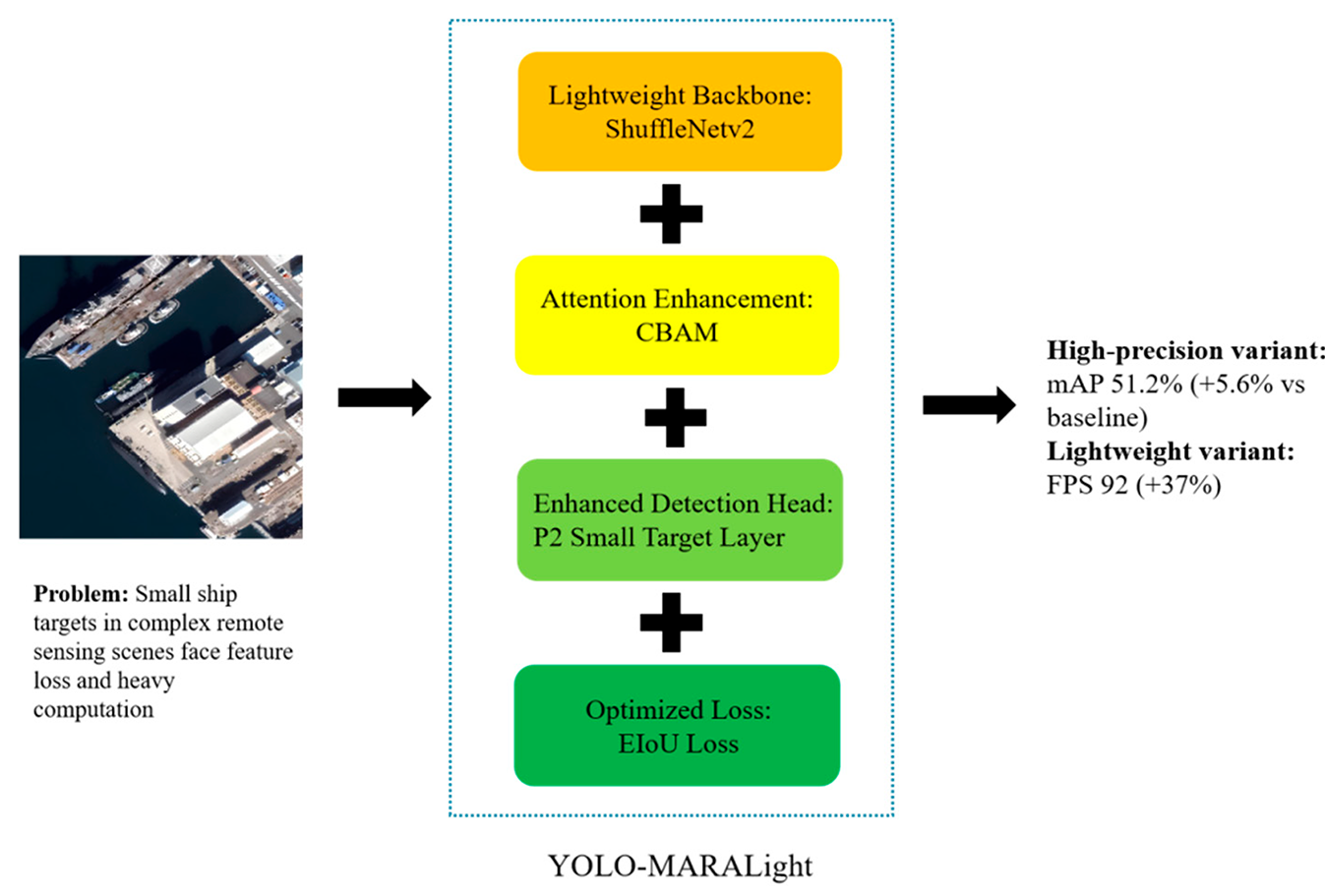
Ship detection is an effective way of sea area supervision, which has important research value in both military and civil fields. For small ship targets in the sea scene, the deep feature map is difficult to effectively capture their subtle features, resulting in the decline of small target detection accuracy and the increase of the missing detection rate. To solve this problem, this paper proposes a detection algorithm called YOLO-MARALight, which adds a small target detection layer in the head network, uses a larger scale feature map to retain the details, and improves the discrimination ability of the model for small targets; Adding CBAM attention mechanism can focus more accurately on the effective area of the target object, selectively strengthen the task related feature expression, reduce background interference, and effectively improve the robustness and generalization ability of the model; The EIoU loss function is introduced to accelerate the convergence speed of the target detection algorithm and improve the detection accuracy; The backbone network adopts ShuffleNetv2 structure, which greatly reduces the amount of calculation and parameters. Training and testing on datasets. Ablation and comparative experiments yield two performance-complementary variants: (1) The high-precision variant (integrating P2 small target detection layer, CBAM attention and EIoU loss) achieves a mAP of 51.2%, 5.6 percentage points higher than the YOLOv8 baseline; (2) The proposed lightweight YOLO-MARALight further incorporates ShuffleNetv2 backbone, boosting precision from 44.6% to 53.5% (significantly reducing false positives), increasing inference speed by 37% from 67 to 92 FPS, and cutting GFLOPs by 22%. Although its mAP slightly drops to 47.4% vs. the high-precision variant, YOLO-MARALight strikes an optimal balance between detection performance and computational efficiency, making it ideal for real-time remote sensing ship detection on resource-constrained edge devices.Graphic Abstract
Keywords
Ship detection; small target detection layer; CBAM attention mechanism; ShuffleNetv2; EIoU loss function
Cite This Article
APA Style
Wang, Y., Shang, J., Liu, F., Liu, J. (2026). YOLO-MARALight: Detection Algorithm for Small Ship Targets in Complex Scenes in Remote Sensing Images. Computers, Materials & Continua, 89(1), 54. https://doi.org/10.32604/cmc.2026.085708
Vancouver Style
Wang Y, Shang J, Liu F, Liu J. YOLO-MARALight: Detection Algorithm for Small Ship Targets in Complex Scenes in Remote Sensing Images. Comput Mater Contin. 2026;89(1):54. https://doi.org/10.32604/cmc.2026.085708
IEEE Style
Y. Wang, J. Shang, F. Liu, and J. Liu, “YOLO-MARALight: Detection Algorithm for Small Ship Targets in Complex Scenes in Remote Sensing Images,” Comput. Mater. Contin., vol. 89, no. 1, pp. 54, 2026. https://doi.org/10.32604/cmc.2026.085708
 Copyright © 2026 The Author(s). Published by Tech Science Press.
This work is licensed under a Creative Commons Attribution 4.0 International License , which permits unrestricted use, distribution, and reproduction in any medium, provided the original work is properly cited.
 Downloads
 Citation Tools
