
 Login
Login Register
 Submit a Paper
 Propose a Special lssue
 Open Access
ARTICLE
SAM-ADPFL: A Geometry-Aware Adaptive Framework for Privacy-Preserving Federated Learning Systems
College of Computer, Zhongyuan University of Technology, Zhengzhou, China
* Corresponding Authors: Fangfang Shan. Email: ; Yuhang Liu. Email:
Computers, Materials & Continua 2026, 89(2), 25 https://doi.org/10.32604/cmc.2026.085467
Received 11 May 2026; Accepted 08 July 2026; Issue published 15 September 2026
 View Full Text
 Download PDF
Abstract
The engineering of Federated Learning (FL) systems faces significant challenges in balancing two critical non-functional requirements: ensuring robust system utility and maintaining high privacy protection standards under non-independent and identically distributed (Non-IID) data environments. Existing software architectures often struggle to achieve an optimal trade-off between these competing demands. This paper proposes SAM-ADPFL, a novel architectural framework designed to improve the engineering and management of privacy-preserving distributed machine learning systems. First, we design a geometry-aware adaptive aggregation component that dynamically reallocates aggregation weights based on local landscape properties, guiding the global model to effectively suppress model drift. Second, we propose a sharpness-guided dynamic differential privacy mechanism to handle security requirements, adaptively managing the privacy budget through refined gradient clipping and noise injection. Through empirical studies on standard benchmark datasets, we demonstrate that SAM-ADPFL exhibits superior robustness in extreme heterogeneous scenarios. By achieving a superior trade-off between system utility and privacy protection, this research contributes reusable architectural patterns and engineering practices for the design, optimization, and evaluation of privacy-preserving distributed software systems.Keywords
Federated Learning (FL) has emerged as a critical architectural pattern for distributed software systems, enabling collaborative model training across decentralized clients while keeping data localized. By exchanging only model parameters or gradients without sharing raw data, FL effectively addresses the “data silos” problem [1,2] and provides a privacy-preserving engineering solution for distributed machine learning applications. However, in actual large-scale deployments, managing FL systems presents two fundamental software engineering challenges that urgently need to be addressed: maintaining high system utility (reliability) under statistical data heterogeneity, and satisfying strict non-functional requirements for privacy and security [3].
First, since the local data distributions of clients often exhibit a high degree of heterogeneity, this distribution shift leads to inconsistencies between local optimization objectives and the global objective. This triggers severe “model drift”, causing the global model to converge slowly or fail to converge, thereby significantly compromising generalization performance. Second, although FL avoids the direct transmission of raw data, attackers can still analyze uploaded gradients or model parameters to reconstruct raw training data via gradient inversion attacks, or infer sample presence via membership inference attacks [4–6]. To resist such attacks, multiple studies [6–8] point out that injecting appropriate differential privacy (DP) noise into gradients before iterative updates can significantly reduce the risk of training data leakage. Consequently, gradient-level noise injection is regarded as a preferred scheme for privacy protection. However, injecting noise inevitably destroys the precision of gradients, resulting in degraded model utility.
Addressing the model drift problem caused by Non-IID data, algorithms such as FedProx [9] and SCAFFOLD [10] attempt to correct local updates through local regularization terms or control variates. To improve theoretical convergence performance, some studies [11] have introduced server-side extrapolation, while FedDA [12] proposed resource-adaptive split models and aggregation strategies that align parameter feature spaces and output spaces. Additionally, FedNova [13] eliminates the impact of heterogeneous update steps through normalized aggregation weights, and MOON [14] improves local training objectives by introducing model contrastive loss. Although these methods mitigate the negative impact of Non-IID to a certain extent, their effectiveness remains limited in extreme heterogeneous scenarios. Progress was made in [15] by learning aggregation weights on the server side, which significantly enhanced model utility; however, its heavy reliance on the assumption of proxy data raises risks regarding privacy leakage and distribution shifts.
In terms of privacy protection, due to the severe impact of injecting fixed noise into model parameters or gradients on model utility in DP-FedAvg [16,17], recent research has increasingly explored adaptive differential privacy. Adaptive differential privacy balances privacy protection and model performance by dynamically adjusting noise magnitude. Some works [18–22] reduce noise interference via adaptive strategies by calculating the importance of local model parameters or injecting noise adaptively based on data attributes, thereby safeguarding model performance under privacy security conditions. However, these methods ignore the intrinsic differences in client data. Recent works have attempted to introduce Sharpness-Aware Minimization (SAM) [23–25] to enhance model robustness against noise [26], they have failed to establish a connection between sharpness and privacy budget allocation, and thus have not broken through the limitations of static noise.
Facing the aforementioned limitations, this paper proposes a new perspective by deeply analyzing the geometric characteristics of the loss landscape in Sharpness-Aware Minimization: the “sharpness” of the loss landscape can serve as a bridge connecting “model generalization” and “data privacy”.
Our core insight for this system design is based on the following two theoretical findings:
• Sharpness is negatively correlated with generalization: Models that converge to flat minima possess wide and gentle loss function landscapes and are insensitive to minute perturbations in parameters.
• Sharpness is positively correlated with sensitivity: Higher sharpness (steeper landscape) implies that variations in a single data point will cause drastic changes in gradients, indicating higher data sensitivity.
Based on this, our contributions are as follows:
(1) We design a collaborative optimization framework, SAM-ADPFL, based on the dual efficacy of the Sharpness-Aware Minimization algorithm.
(2) We propose a novel sharpness-aware adaptive aggregation framework. It dynamically reallocates weights based on local loss landscape geometry, assigning higher weights to flat regions and lower weights to sharp ones. Combined with global weight shrinkage, it guides the global model to flat minima, overcoming data heterogeneity and improving accuracy and robustness.
(3) We propose, for the first time, a method utilizing sharpness information to dynamically quantify the privacy sensitivity of each client, thereby achieving adaptive noise allocation and effectively balancing privacy protection with model utility.
(4) Experimental results demonstrate that our method exhibits superior robustness in non-independent and identically distributed (Non-IID) environments. Furthermore, it significantly outperforms existing differential privacy federated learning schemes in balancing model utility and privacy protection.
To intuitively demonstrate the validity of the core insights mentioned above and to provide empirical support for the methodology proposed in this paper, we conducted two sets of exploratory experiments.
(1) Visualization of Loss Landscapes: We compared the global loss landscapes after convergence of DP-FedAvg and our proposed method, SAM-ADPFL, using the CIFAR-10 dataset and a VGG-like convolutional network adapted for CIFAR-10 [27].
As shown in Fig. 1, the loss landscape of DP-FedAvg exhibits high curvature, where minute shifts in model parameters cause a sharp increase in loss function values. In contrast, the loss surface of our proposed method is relatively flat with smaller curvature. Even if parameters fluctuate within a certain range, the loss function value remains at a lower level.
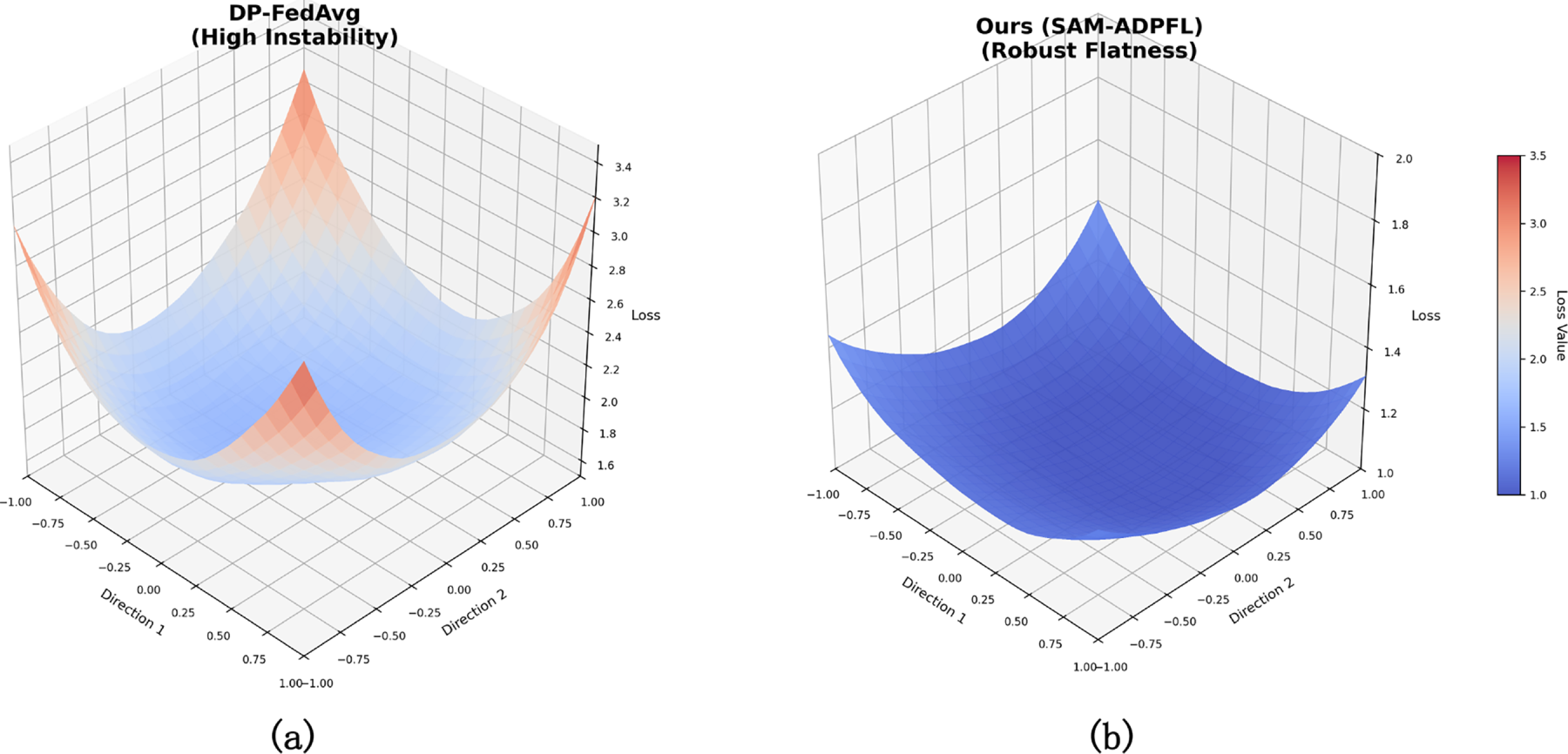
Figure 1: Visualization of loss landscapes. (a) DP-FedAvg exhibits a sharp, high-instability loss surface; (b) Our proposed SAM-ADPFL yields a robust, flat loss landscape.
(2) As shown in Fig. 2, the strong linear correlation between exact sharpness and local gradient norm (Spearman
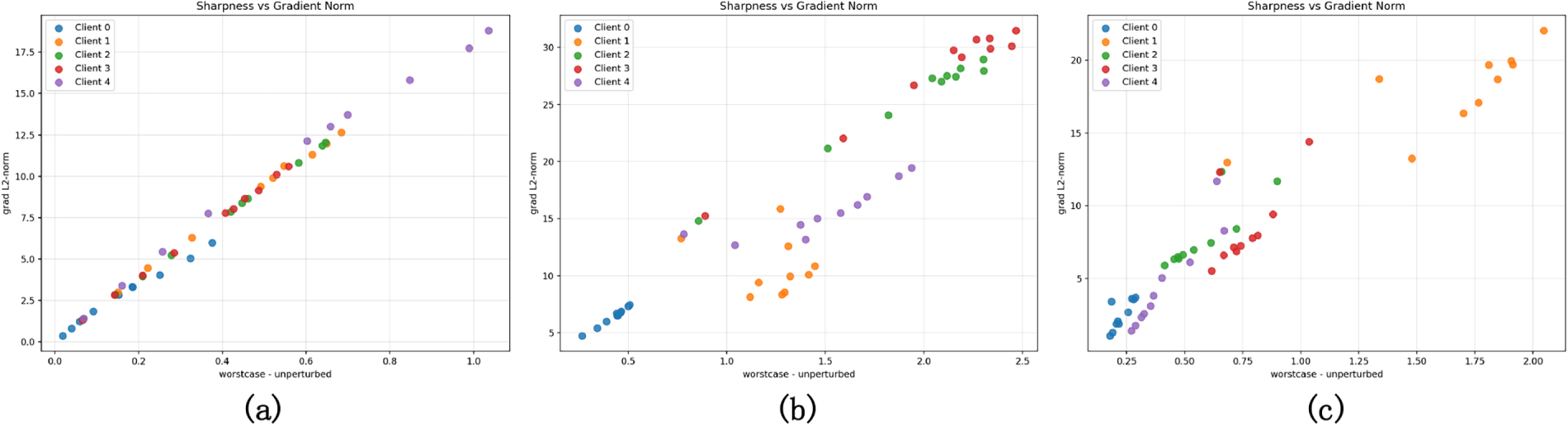
Figure 2: Scatter plots of sharpness vs. gradient norm on three benchmark datasets. (a) MNIST; (b) FMNIST; (c) CIFAR-10.
The remainder of this paper is organized as follows: Section 2 presents related work. Section 3 introduces preliminaries and theoretical foundations. In Section 4, we detail our method. Section 5 provides experimental results and relevant analysis. Section 6 concludes the paper.
This section reviews research progress in related fields from three dimensions: weighted aggregation strategies in Federated Learning, loss landscape theory in deep learning, and dynamic allocation mechanisms in differential privacy.
2.1 Utility-Based Federated Aggregation Strategies
Traditional FedAvg [28] adopts a weighting strategy based on sample size, which often leads the global model to be biased towards clients with more data but singular data distributions in Non-IID scenarios. To alleviate this issue, researchers have explored various utility-based weighted aggregation schemes [29]. One class of methods is contribution-based weighting, which allocates weights by assessing the marginal contribution of local models to global model performance. Study [30] proposed an adaptive client weighting mechanism based on Shapley values; however, calculating Shapley values typically requires exponential computational overhead, making it difficult to deploy in large-scale federated networks. Another class of methods is based on attention mechanism aggregation [31,32]. By calculating the layer-wise correlation or distance between the server model and client models, these methods automatically assign higher weights to clients that are more consistent with the global direction. However, they are easily susceptible to interference from parameter magnitude differences and directional noise. Some works attempt to use loss values or accuracy on a validation set as the basis for weighting, but this inevitably necessitates reliance on auxiliary data at the server side [15]. In contrast, our method utilizes geometric attributes during the local training process as the basis for aggregation.
2.2 Flat Minima and Generalization Theory in Deep Learning
The generalization capability of deep neural networks depends not only on finding a feasible solution with low loss but, more critically, on the geometric morphology of that solution within the loss landscape. If parameters are located in a wide, flat basin with small curvature, they exhibit stronger tolerance to small perturbations, random noise, or data distribution shifts, thereby performing stably on actual test data. Conversely, if located in sharp, narrow minima, minute parameter fluctuations can cause a sharp rise in loss, significantly degrading generalization performance.
The close relationship between the generalization capability of deep neural networks and the geometric structure of their convergence points can be traced back to the research of. Hochreiter and Schmidhuber [33]. Extensive theoretical and empirical studies [34–36] indicate that models converging to “flat minima” usually possess better generalization capabilities than those converging to “sharp minima.” This is because, in flat regions, slight shifts in test data distribution do not lead to drastic fluctuations in loss values. To seek flat minima, the SAM algorithm proposed by Foret et al. explicitly minimizes the neighborhood maximum of the loss value by solving a Min-Max optimization problem in each iteration [23]. Subsequently, Adaptive SAM [37] further introduced the concept of adaptively adjusting the perturbation radius to accommodate the anisotropy of different parameter scales. Although flatness theory has matured in centralized training, existing Federated Learning works mostly employ SAM merely as a local optimizer for clients [26,38,39], aiming to enhance the robustness of single clients.
2.3 Refined Budget Management in Differential Privacy
To achieve a better balance between privacy protection and model utility, researchers are gradually shifting from static noise to more refined privacy budget management mechanisms. Based on dynamic factors such as local data volume, sample importance, user privacy preferences, and training stages, differentiated privacy budgets are allocated to different clients, layers, rounds, or even parameters, injecting noise on demand. Considering the varying contributions of different neural network layers (e.g., convolutional layers vs. fully connected layers) to feature extraction, some studies propose applying stronger noise to feature extraction layers and weaker noise to classification heads, or performing layer-wise noise injection based on parameter sparsity [40,41]. Another class of methods focuses on differences in user privacy protection needs, allowing different clients to set different clipping thresholds [42] or noise multipliers based on their own privacy preferences. In [19], Fisher information is proposed to measure parameter sensitivity, applying personalized differential privacy constraints to local parameters with high Fisher values. Currently, mainstream adaptive methods mainly dynamically adjust clipping thresholds based on parameter importance or data attributes [18–22]. Although these methods improve the privacy-utility trade-off to a certain extent, they are mainly adjusted based on statistics, ignoring the geometric sensitivity of data distribution. A large gradient does not completely equate to the model being in a vulnerable state; only by combining the curvature information of the loss landscape can one truly judge the model’s tolerance to noise.
This section formally defines the core theories and mathematical models involved in this paper, including the Federated Learning framework, Differential Privacy, and Sharpness-Aware Minimization.
3.1 Federated Learning Framework
FL aims to collaboratively train a global model across multiple clients while keeping data stored locally. Assume there are
where
• Broadcast: The server sends the current global model
• Local Update: Client
• Aggregation: The server collects updates from clients and computes the weighted average to generate the global model for the next round:
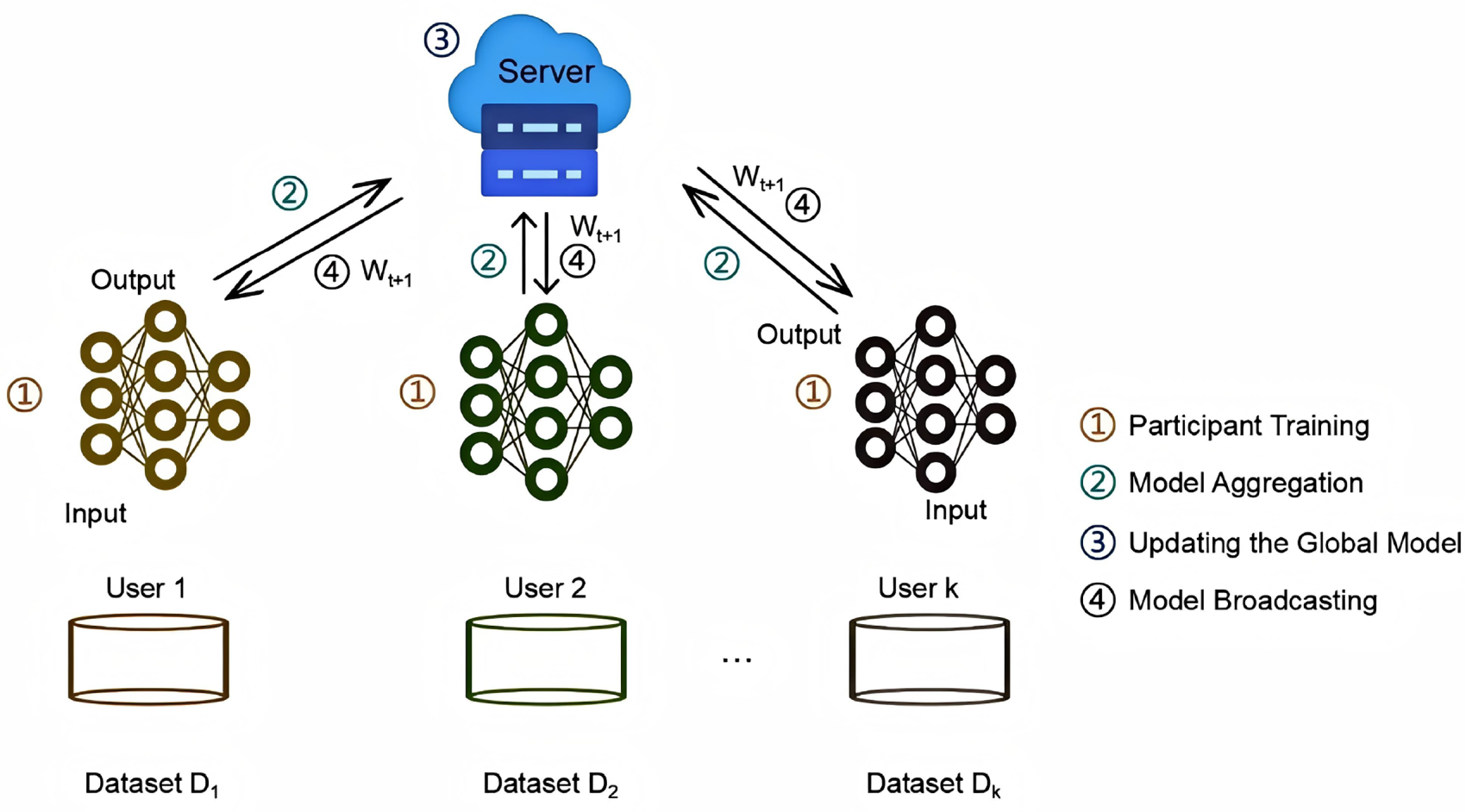
Figure 3: Federated learning framework diagram.
In real-world scenarios, data often exhibits Non-Independent and Identically Distributed (Non-IID) characteristics, meaning the data distribution varies across clients:
3.2 Differential Privacy Mechanism
To prevent attackers from reconstructing original data by analyzing uploaded model parameters or gradients, Differential Privacy (DP) is widely applied in Federated Learning. DP introduces randomness into the output, making it impossible for attackers to distinguish whether the calculation result comes from a dataset containing a target sample or one without it.
Definition 1 ((
where
The core of implementing differential privacy lies in adding noise based on the sensitivity of the function.
Definition 2 (
In deep learning, the Gaussian Mechanism is commonly used. Privacy protection is achieved by adding noise following a Gaussian distribution to the function output, where the standard deviation of the noise
It can be seen that sensitivity directly determines the magnitude of the noise required. In Federated Learning, since the gradient norm may be unbounded, gradients are usually clipped first to limit the upper bound of sensitivity, followed by noise injection. However, fixed noise levels often fail to adapt to the data characteristics of different clients, causing unnecessary loss of model utility.
3.3 Sharpness-Aware Minimization
Traditional Empirical Risk Minimization (ERM) focuses only on reducing the training loss value, easily leading to convergence to sharp minima [44]. Studies indicate [33,35] that models at sharp minima possess poor generalization capabilities and are extremely sensitive to parameter perturbations (such as DP noise).
The Loss Landscape characterizes the geometric morphology of the loss function in high-dimensional parameter space. If the optimal point is located in a wide, flat region (flat minimum), small perturbations in parameters cause almost no increase in loss, making the model more robust and generalizable. Conversely, if it is in a steep region (sharp minimum), minute changes can cause a sharp increase in loss, leading to degraded generalization performance. Fig. 4 illustrates the geometric robustness comparison between flat and sharp minima.
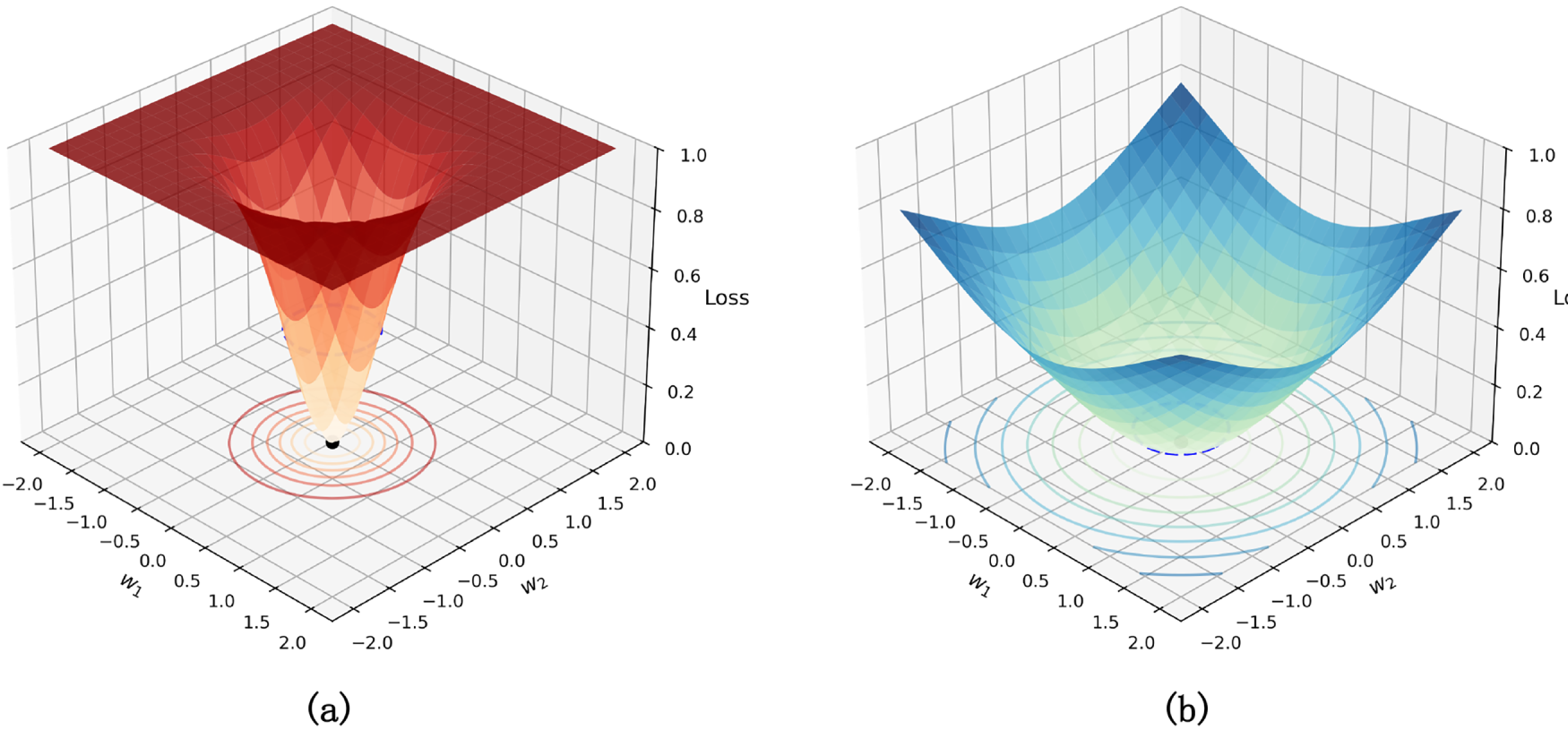
Figure 4: Schematic comparison of geometric robustness between sharp and flat minima. (a) A sharp minimum exhibits high sensitivity to parameter perturbations; (b) A flat minimum shows greater robustness against parameter perturbations.
The Sharpness-Aware Minimization (SAM) algorithm aims to minimize both the training loss value and the sharpness of the loss landscape simultaneously. Its core idea is to find a neighborhood such that the maximum loss value within that neighborhood is minimized. The optimization objective of SAM can be formalized as the following Min-Max problem:
where
To solve the inner maximization problem, SAM uses a first-order Taylor expansion to approximate the optimal perturbation vector:
The final model update is performed based on the gradient at this perturbed point:
Fig. 5 shows the comparison of optimization trajectories between traditional SGD [45,46] and the SAM algorithm. Through this mechanism, SAM can guide the model to avoid steep valleys and converge to wide flat regions, whereas SGD tends to converge directly to the nearest local optimum along the direction of steepest descent, easily falling into sharp minima regions with poor generalization and high sensitivity to parameter perturbations.
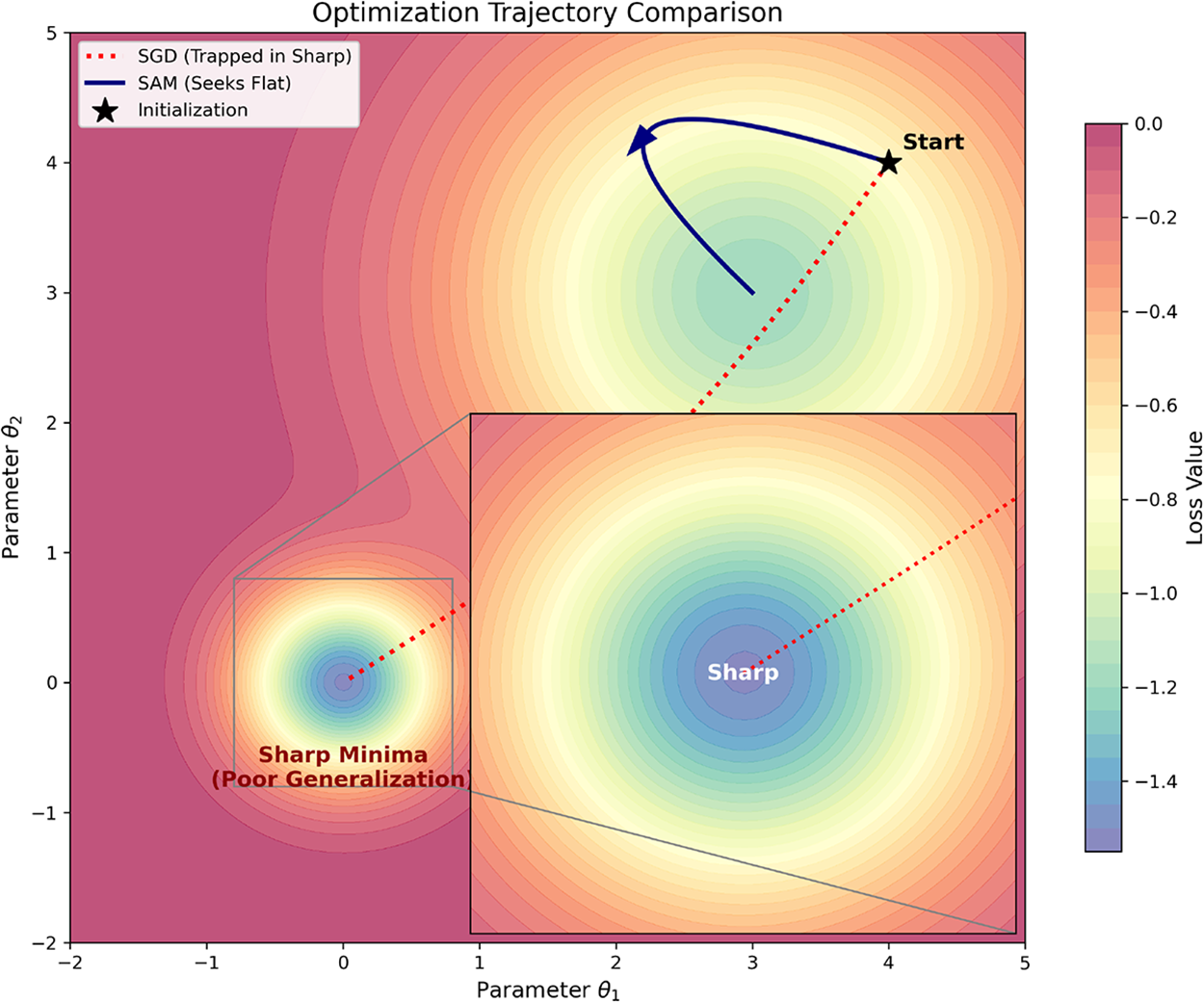
Figure 5: Comparison of optimization trajectories between traditional SGD and SAM algorithm.
To address the issues of model drift caused by data heterogeneity in Federated Learning and the utility loss resulting from traditional static noise strategies in Differential Privacy, this section proposes a novel framework named SAM-ADPFL. This framework aims to better balance the relationship between privacy and utility. The core idea is to utilize the geometric “sharpness” of the loss landscape as a bridge connecting model generalization capability with data privacy sensitivity. As shown in Fig. 6, SAM-ADPFL consists of three collaborative modules:
• Local Sharpness-Aware Update: Clients utilize the SAM algorithm instead of SGD for local updates. While seeking flat minima, they compute a sharpness score that characterizes the local data distribution properties.
• Geometry-Aware Adaptive Aggregation: Weights are dynamically reallocated based on the geometric characteristics of the local loss landscape. Higher aggregation weights are assigned to models in flat regions, while weights for models in sharp regions are reduced. Combined with a global weight shrinkage strategy, this effectively guides the global model to converge towards flat minima.
• Sharpness-Guided Dynamic Privacy Protection: The sensitivity of local data is dynamically quantified using the sharpness score. Based on this, the clipping threshold and noise injection intensity are adaptively adjusted to generate protected gradients that satisfy differential privacy requirements.
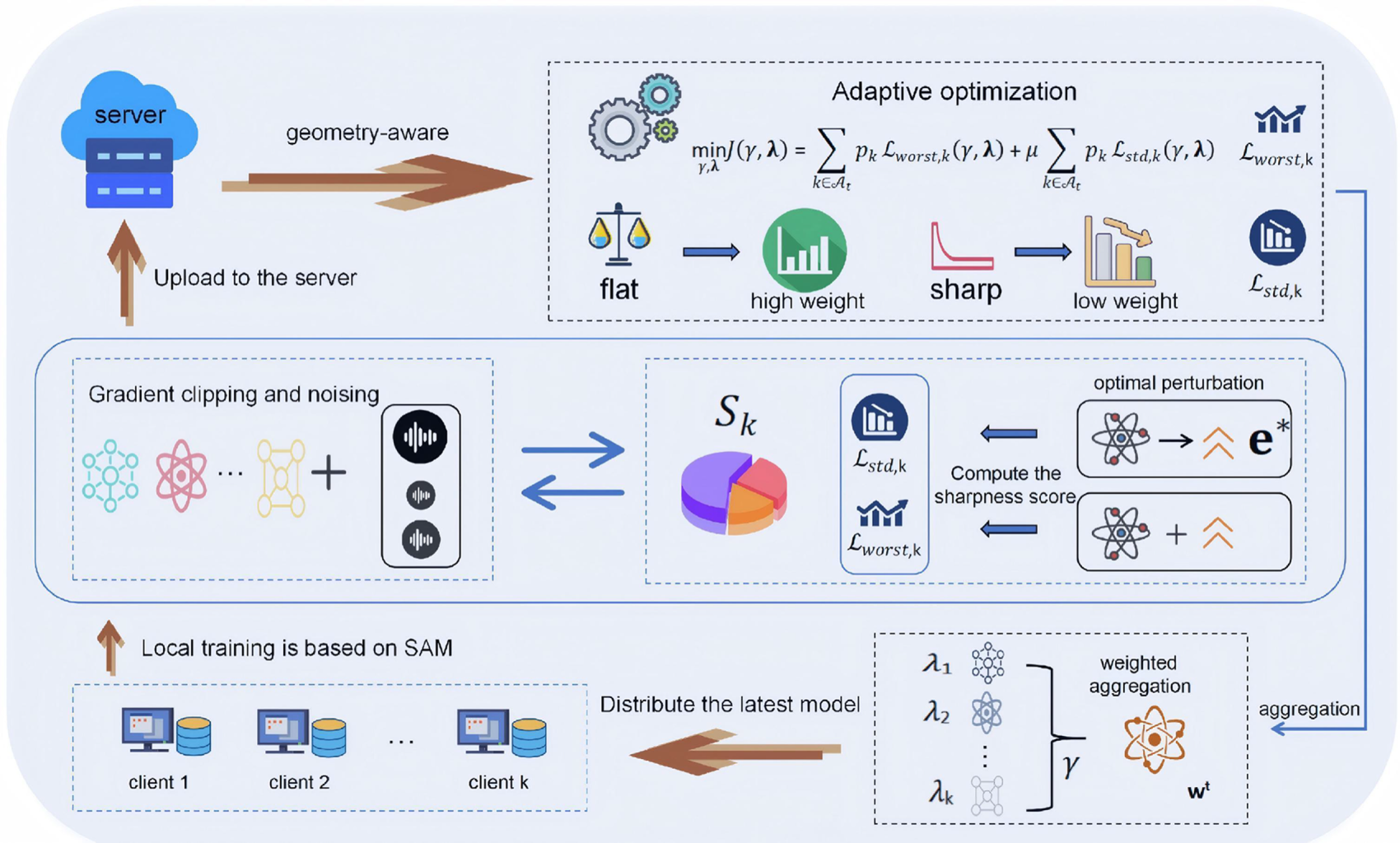
Figure 6: SAM-ADPFL framework diagram.
4.2 Local Sharpness Calculation and Measurement
To accurately quantify the data heterogeneity of each client while preserving privacy, we need an indicator that reflects the geometric characteristics of the local data distribution. We propose defining “sharpness” using the geometry of the loss landscape during training. Unlike the traditional perspective that focuses solely on the absolute value of the loss function, sharpness focuses on the rate of change of the loss function within a parameter neighborhood.
For the
Definition 3 (Sharpness Score): The difference between the maximum loss value achievable within a preset neighborhood radius
where
Proposition 1. Assuming the local loss function
Since clients need to compute gradients to solve for the perturbation direction when executing SAM optimization updates, the calculation of
4.3 Geometry-Aware Adaptive Aggregation Mechanism
To prevent global model drift caused by local models overfitting to sharp minima in heterogeneous settings, we propose sharpness-guided weight redistribution. Instead of passive averaging, the server actively determines the optimal relative weight vector through a deterministic, closed-form calculation using client losses. In the
To guide the global model towards flat minima without server-side validation or iterative optimization, we employ a deterministic, closed-form weighting mechanism. The adaptive weight
Remark 1 (Server-Side Complexity): Computing (Eq. (12)) incurs a strictly linear complexity of
Where
4.4 Sharpness-Guided Dynamic Differential Privacy Mechanism
According to our analysis, high sharpness is usually accompanied by a high gradient norm. Therefore, for high-sharpness clients, we should appropriately loosen the clipping threshold to preserve more valuable gradient information; conversely, the threshold should be tightened to reduce the base of noise injection.
To prevent invalid negative bounds under extreme landscape deviations, the adaptive clipping threshold
where
To satisfy differential privacy, larger clipping bounds necessitate proportionally larger noise. We link the Gaussian noise standard deviation
where
Prevention of Scalar Leakage: To strictly close the side-channel privacy leakage associated with the uploaded variables, clients first clip the sharpness and loss values to predefined maximum bounds
Theorem 1. For any target privacy parameter
where
To intuitively explain the internal logic of sharpness and privacy budget allocation, we compare two typical local geometric scenarios in Fig. 7. As shown in Fig. 7a, when the client model is located in a high-sharpness region (red terrain), the loss function is extremely steep, leading to a significant increase in the gradient
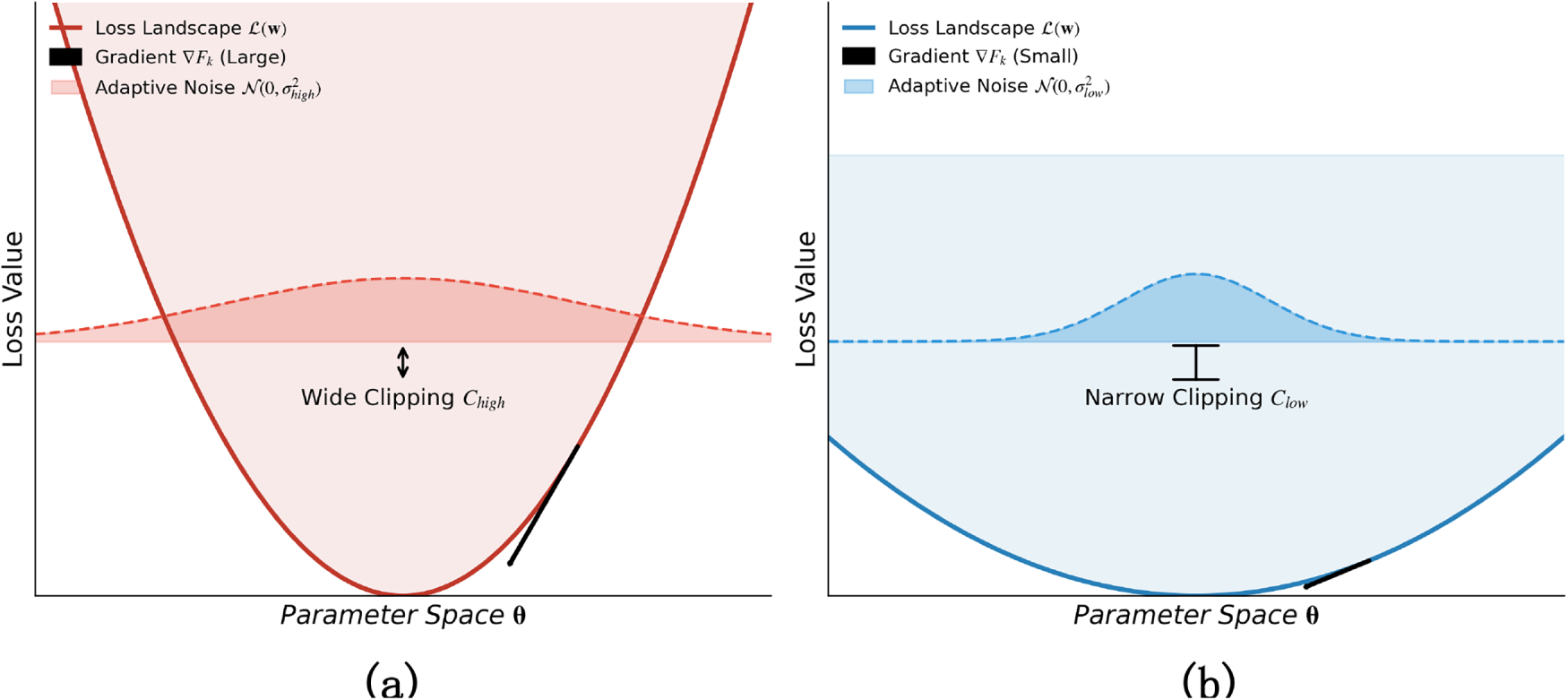
Figure 7: Schematic diagram of sharpness-guided adaptive differential privacy mechanism. (a) High-sharpness scenario with large gradient, wide clipping bound, and strong noise injection; (b) Low-sharpness scenario with small gradient, narrow clipping bound, and weak noise injection.
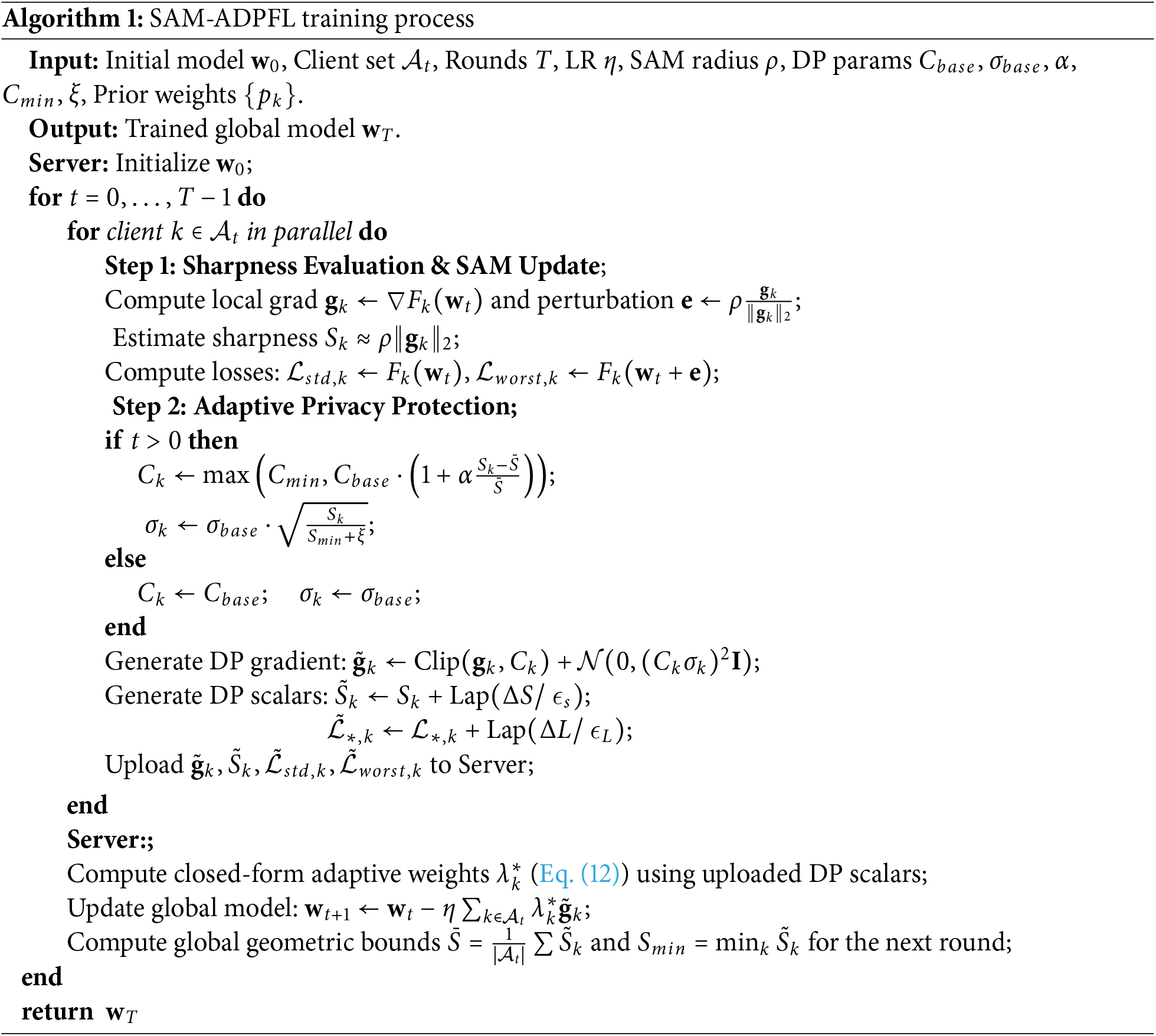
In this section, we conducted extensive experiments on three datasets to evaluate the high utility of the proposed SAM-ADPFL and its superior balance between privacy protection and model utility. We divide the experimental evaluation into two independent but progressive stages: Phase 1: Validation of the effectiveness of the geometry-aware aggregation strategy (non-differential privacy scenario), and Phase 2: Evaluation of sharpness-guided adaptive privacy protection performance (differential privacy scenario).
Datasets: MNIST [47], Fashion-MNIST, and CIFAR-10 [48].
Data Partitioning: To simulate Non-IID data heterogeneity, we partition client datasets using a Dirichlet distribution. The concentration parameter
For MNIST and Fashion-MNIST, we adopt an improved LeNet-5 comprising two convolutional layers (
Hyperparameters and Reproducibility: We use
We compare SAM-ADPFL with the following mainstream Federated Learning algorithms:
• FedAvg [28]: As the standard baseline method for Federated Learning, used to measure basic performance.
• FedProx [9]: Introduces a proximal term in the local objective function to restrict local updates from deviating, representing a classic regularization method for solving Non-IID problems.
• SCAFFOLD [10]: Uses control variates to correct local gradient directions, representing one of the advanced methods for solving model drift.
• FedLAW [15]: Optimizes aggregation weights via a server-side validation set. In particular, we focus on comparing the performance of our method with FedLAW to demonstrate that SAM-ADPFL can achieve or even surpass aggregation effects dependent on auxiliary data using only sharpness information, without relying on any server-side proxy data.
• DP-FedAvg [16]: A classic differential privacy Federated Learning algorithm employing fixed clipping thresholds and fixed noise standard deviations, serving as a benchmark for static noise strategies.
• DP-FedSAM [26]: Applies static differential privacy noise on top of FedSAM.
• DP-SCAFFOLD [10]: A differentially private variant of the SCAFFOLD algorithm, serving as a robust structural baseline designed to handle Non-IID data distributions under strict privacy constraints.
All experiments in this paper were run on a workstation equipped with a 12th Gen Intel(R) Core(TM) i9-12900K CPU and an NVIDIA RTX A5000 GPU.
5.2 Performance Evaluation of Geometry-Aware Adaptive Aggregation (Noise-Free Scenario)
To isolate the impact of differential privacy and purely evaluate our “Geometry-Aware Adaptive Aggregation” against data heterogeneity, we introduce its non-DP variant, SAM-AFL. Before comparing baselines, we first optimize the perturbation radius
We conducted sensitivity tests for
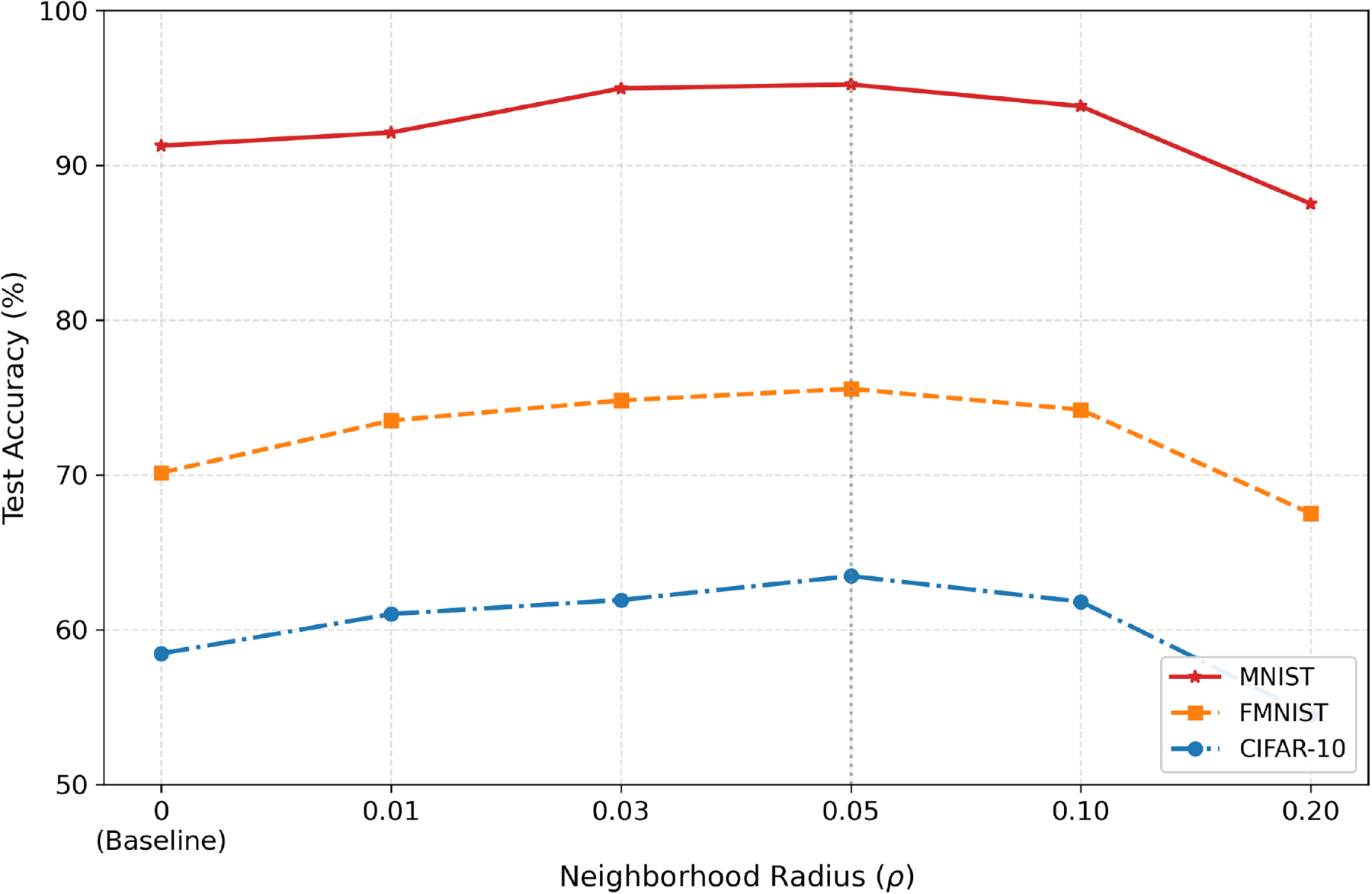
Figure 8: Sensitivity analysis of neighborhood radius.
Table 1 summarizes test accuracies across the MNIST, FMNIST, and CIFAR-10 datasets under varying heterogeneity (
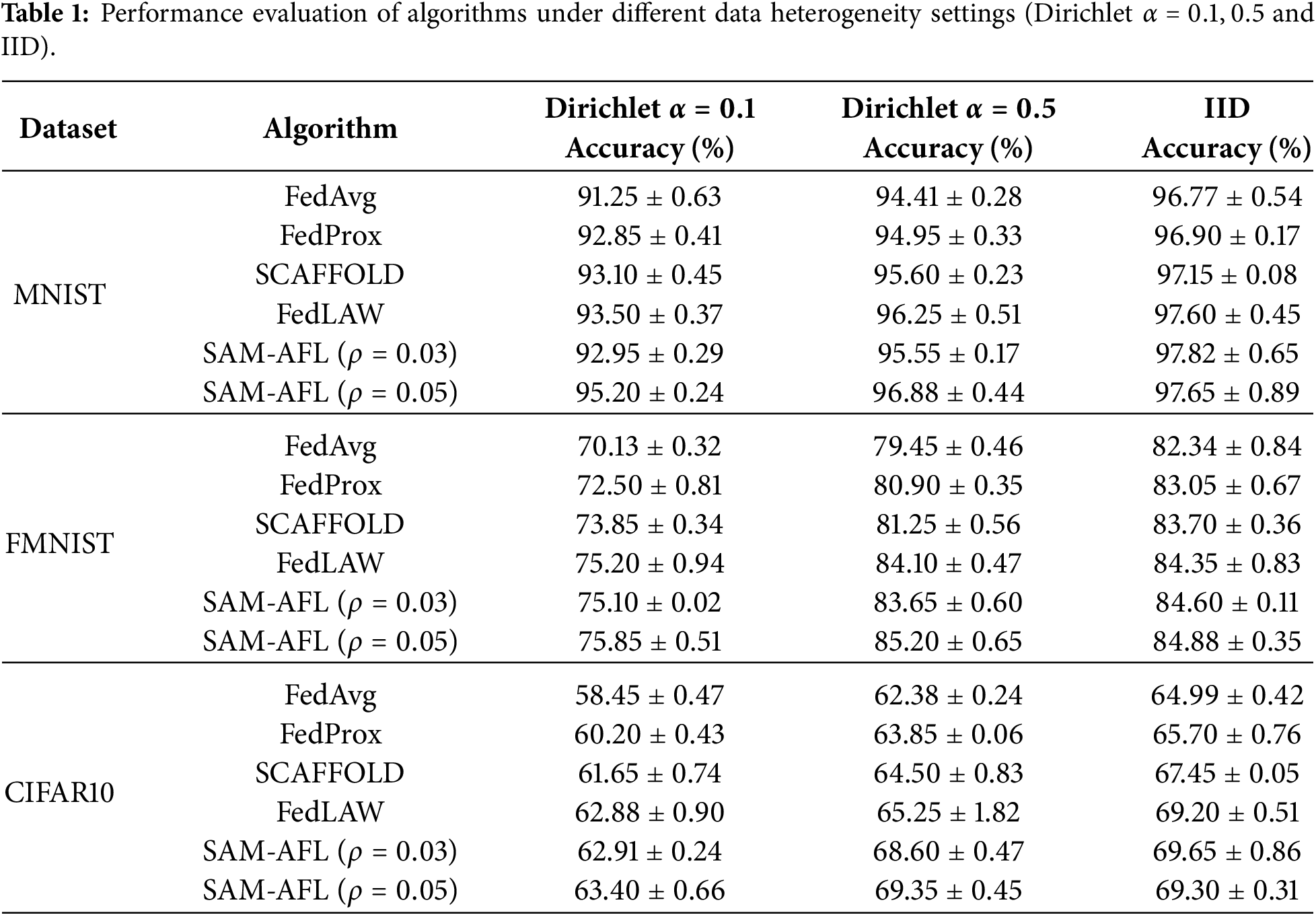
Fig. 9 shows the impact of client number
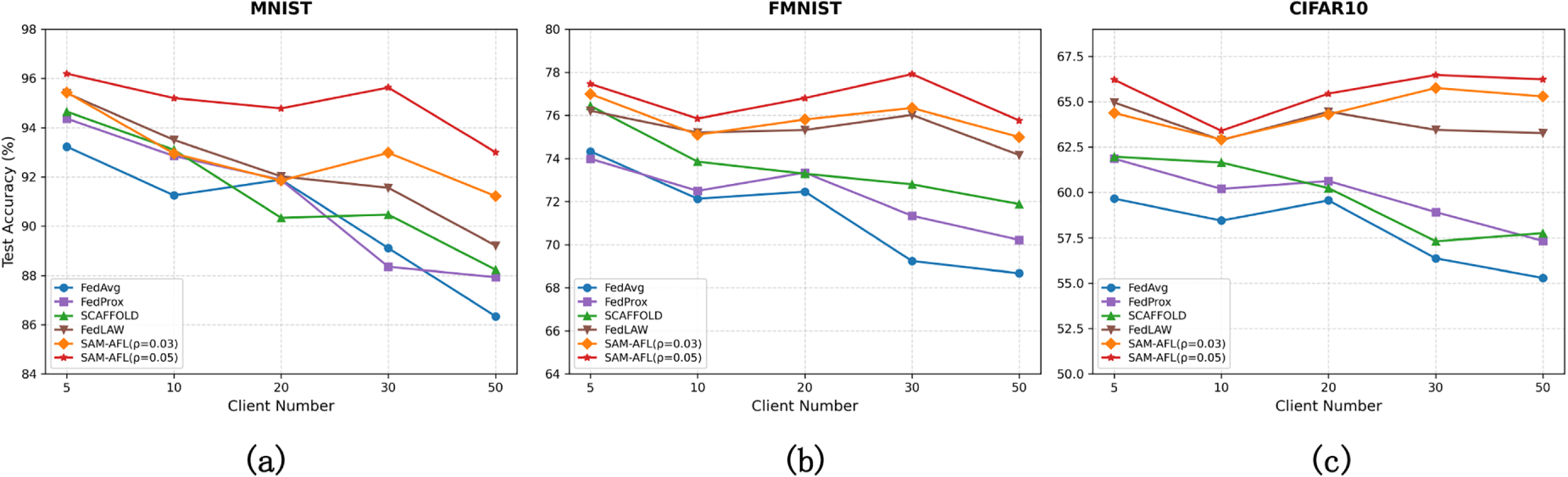
Figure 9: Accuracy comparison under different numbers of clients. (a) Results on the MNIST dataset; (b) Results on the FMNIST dataset; (c) Results on the CIFAR-10 dataset.
Fig. 10 evaluates the ability of each algorithm to combat model drift by setting local training epochs
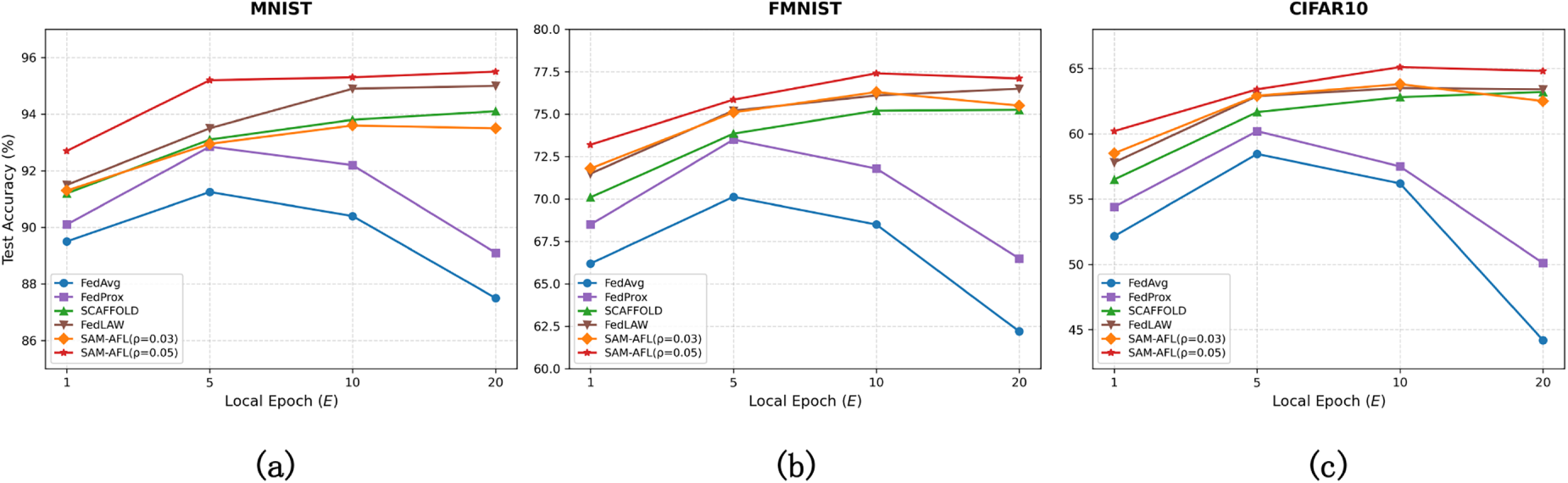
Figure 10: Accuracy comparison under different local training epochs. (a) Results on the MNIST dataset; (b) Results on the FMNIST dataset; (c) Results on the CIFAR-10 dataset.
5.3 Performance Evaluation of Sharpness-Guided Adaptive Privacy Protection (Noise Scenario)
To comprehensively evaluate SAM-ADPFL under strict privacy constraints and extreme data heterogeneity (Dirichlet
As shown in Fig. 11, all fixed-threshold baselines exhibit a distinct inverted-U trend across the three datasets, confirming the severe utility degradation caused by either excessive gradient truncation (small
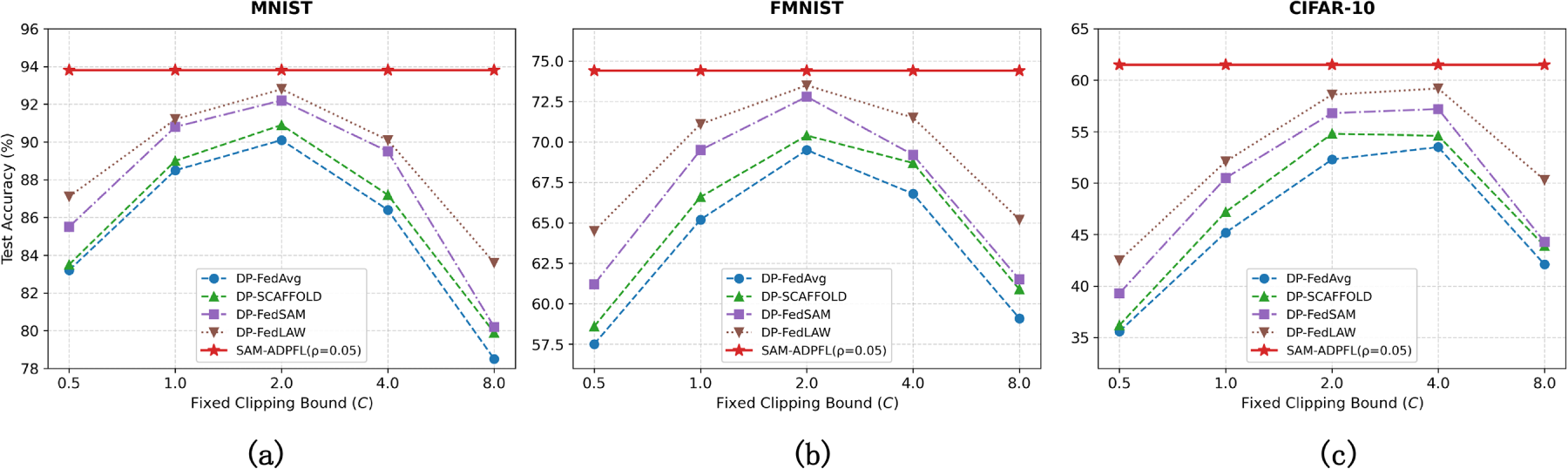
Figure 11: Accuracy comparison under different clipping thresholds. (a) Results on the MNIST dataset; (b) Results on the FMNIST dataset; (c) Results on the CIFAR-10 dataset.
Based on the results in Fig. 11, to ensure the rigor of subsequent comparisons, in the next phase of privacy budget experiments, we selected the best-performing fixed clipping threshold from Fig. 12 for all baseline methods (
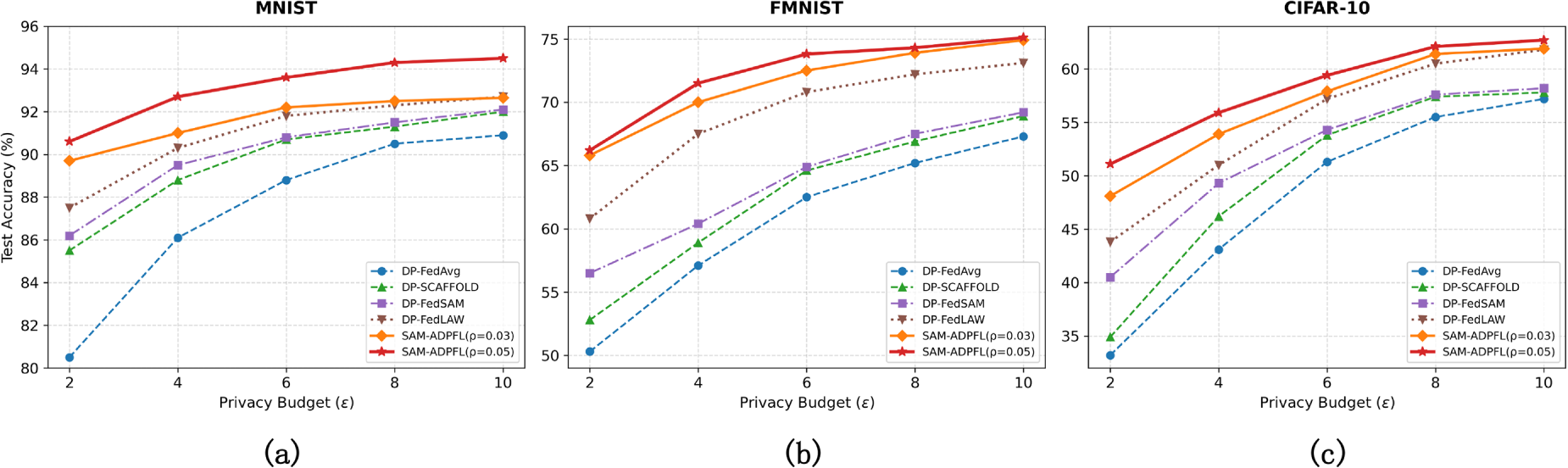
Figure 12: Accuracy comparison under different privacy budgets. (a) Results on the MNIST dataset; (b) Results on the FMNIST dataset; (c) Results on the CIFAR-10 dataset.
Fig. 12 illustrates the privacy-utility trade-off across varying privacy budgets (
To evaluate communication efficiency, Table 2 records the rounds required to reach target accuracies under a fixed privacy budget (

Table 3 reports the total running time required for convergence. Although the SAM optimizer doubles local gradient computations per step, the massive reduction in communication rounds entirely offsets this overhead. On CIFAR-10, SAM-ADPFL converges in just 1996.17s, reducing total time by 47.4% against DP-FedAvg, 42.7% against DP-SCAFFOLD, and 28.0% against DP-FedSAM. This confirms that our geometry-aware adaptive strategy not only enhances noise resilience but also significantly accelerates the end-to-end efficiency of the federated system.

To evaluate the individual contributions of local SAM training, geometry-aware aggregation, and adaptive DP, we designed four configurations: Config A replaces our aggregation with standard FedAvg; Config B replaces local SAM with SGD; Config C replaces adaptive DP with fixed noise; and Config D is the full SAM-ADPFL. Table 4 presents the ablation results on CIFAR-10 under extreme heterogeneity (Dirichlet

The results confirm that all three components are highly synergistic and indispensable. Replacing SAM with SGD (Config B) yields the lowest accuracy, proving that searching for flat minima is foundational for geometric noise tolerance. Removing the geometry-aware aggregation (Config A) fails to suppress severe client drift in Non-IID settings. Furthermore, reverting to fixed DP noise (Config C) noticeably degrades utility, highlighting that our sharpness-guided dynamic DP effectively minimizes unnecessary noise in flat regions. Ultimately, the full SAM-ADPFL (Config D) achieves the highest accuracy and fastest convergence, validating our integrated architectural design.
This paper introduces SAM-ADPFL, an adaptive software framework for federated learning systems operating under statistical heterogeneity and strict privacy constraints. The proposed geometry-aware aggregation mechanism and sharpness-guided dynamic privacy module collectively address model drift and privacy-utility trade-offs through principled engineering of loss landscape geometry. Comprehensive experiments confirm superior performance in accuracy, noise robustness, and convergence speed. These findings provide empirical evidence and design patterns for developing quality-assured, privacy-preserving distributed software systems.
In future work, we plan to extend this algorithmic foundation into more complex real-world distributed software systems, explicitly addressing practical system-level challenges such as asynchronous updates, large-scale partial participation, and dynamic client dropouts.
Acknowledgement: The authors would like to express their sincere gratitude to all individuals who provided valuable assistance and support to this research.
Funding Statement: This work is jointly supported by the National Natural Science Foundation of China (Grant No. 62302540, author Fangfang Shan; https://www.nsfc.gov.cn), the Key Research and Development Program of Henan Province (Grant No. 251111212000, author Fangfang Shan; http://xt.hnkjt.gov.cn/data/), and the Industry-University-Research Innovation Fund of Chinese Universities (Special Project on AI+ Cybersecurity Governance Technology) (Grant No. 2025SE052, author Fangfang Shan; https://www.cutech.edu.cn).
Author Contributions: The authors confirm contribution to the paper as follows: Fangfang Shan conducted conceptualization, formal analysis and schematic design, and was responsible for manuscript review, editing and project supervision; Yuhang Liu performed the experiments and completed relevant investigation, as well as drafting the original manuscript; Lulu Fan participated in the investigation, wrote the original draft, and revised and edited the manuscript; Yifan Mao took charge of software development, visualization production and manuscript revision; Zhuo Chen finished the experimental writing and participated in manuscript review and editing; Peixue Wang engaged in manuscript review and editing and co-supervised this research. All authors reviewed and approved the final version of the manuscript.
Availability of Data and Materials: The data that support the findings of this study are openly available from the public repositories: MNIST (http://yann.lecun.com/exdb/mnist/), Fashion-MNIST (https://github.com/zalandoresearch/fashion-mnist), and CIFAR-10 (https://www.cs.toronto.edu/~kriz/cifar.html).
Ethics Approval: Not applicable.
Conflicts of Interest: The authors declare no conflicts of interest.
Appendix A Proof of Theorem 1
To explicitly address the coupling of the dynamically changing clipping threshold
In any communication round
This calculation elegantly cancels out the dynamic clipping bound
To account for the complete training process, we utilize the RDP Sequential Composition Theorem. Because the training spans
Finally, applying the standard RDP-to-
References
1. Bharati S, Mondal MRH, Podder P, Prasath VS. Federated learning: applications, challenges and future directions. Int J Hybrid Intell Syst. 2022;18(1–2):19–35. [Google Scholar]
2. Yin X, Zhu Y, Hu J. A comprehensive survey of privacy-preserving federated learning: a taxonomy, review, and future directions. ACM Comput Surv. 2021;54(6):1–36. doi:10.1145/3460427. [Google Scholar] [CrossRef]
3. Zhang J, Li M, Zeng S, Xie B, Zhao D. A survey on security and privacy threats to federated learning. In: Proceedings of the 2021 International Conference on Networking and Network Applications (NaNA); 2021 Oct 29–Nov 1; Lijiang, China. p. 319–26. [Google Scholar]
4. Al-Rubaie M, Chang JM. Reconstruction attacks against mobile-based continuous authentication systems in the cloud. IEEE Trans Inf Forensics Secur. 2016;11(12):2648–63. doi:10.1109/tifs.2016.2594132. [Google Scholar] [CrossRef]
5. Shokri R, Stronati M, Song C, Shmatikov V. Membership inference attacks against machine learning models. In: Proceedings of the 2017 IEEE Symposium on Security and Privacy (SP); 2017 May 22–26; San Jose, CA, USA. p. 3–18. [Google Scholar]
6. Shokri R, Shmatikov V. Privacy-preserving deep learning. In: Proceedings of the 22nd ACM SIGSAC Conference on Computer and Communications Security; 2015 Oct 12–16; Denver, CO, USA. p. 1310–21. [Google Scholar]
7. Jayaraman B, Evans D. Evaluating differentially private machine learning in practice. In: Proceedings of the 28th USENIX Security Symposium (USENIX Security 19); 2019 Aug 14–16; Santa Clara, CA, USA. p. 1895–912. [Google Scholar]
8. Xiang L, Yang J, Li B. Differentially-private deep learning from an optimization perspective. In: Proceedings of the IEEE INFOCOM 2019-IEEE Conference on Computer Communications; 2019 Apr 29–May 2; Paris, France. p. 559–67. [Google Scholar]
9. Li T, Sahu AK, Zaheer M, Sanjabi M, Talwalkar A, Smith V. Federated optimization in heterogeneous networks. Proc Mach Learn Syst. 2020;2:429–50. doi:10.48550/arxiv.1812.06127. [Google Scholar] [CrossRef]
10. Karimireddy SP, Kale S, Mohri M, Reddi S, Stich S, Suresh AT. SCAFFOLD: stochastic controlled averaging for federated learning. In: Proceedings of the 37th International Conference on Machine Learning; 2020 Jul 13–18; Virtual. p. 5132–43. [Google Scholar]
11. Jhunjhunwala D, Wang S, Joshi G. Fedexp: speeding up federated averaging via extrapolation. arXiv:2301.09604. 2023. [Google Scholar]
12. Cao S, Wu H, Wu X, Ma R, Wang D, Han Z, et al. FedDA: resource-adaptive federated learning with dual-alignment aggregation optimization for heterogeneous edge devices. Future Gener Comput Syst. 2025;163:107551. [Google Scholar]
13. Wang J, Liu Q, Liang H, Joshi G, Poor HV. Tackling the objective inconsistency problem in heterogeneous federated optimization. Adv Neural Inf Process Syst. 2020;33:7611–23. doi:10.48550/arxiv.2007.07481. [Google Scholar] [CrossRef]
14. Li Q, He B, Song D. Model-contrastive federated learning. In: Proceedings of the IEEE/CVF Conference on Computer Vision and Pattern Recognition; 2021 Jun 20–25; Nashville, TN, USA. p. 10713–22. [Google Scholar]
15. Li Z, Lin T, Shang X, Wu C. Revisiting weighted aggregation in federated learning with neural networks. In: Proceedings of the 40th International Conference on Machine Learning; 2023 Jul 23–29; Honolulu, HI, USA. p. 19767–88. [Google Scholar]
16. Geyer RC, Klein T, Nabi M. Differentially private federated learning: a client level perspective. In: Proceedings of the 7th International Conference on Learning Representations; 2017 May 6–9; New Orleans, LA, USA. [Google Scholar]
17. McMahan HB, Ramage D, Talwar K, Zhang L. Learning differentially private recurrent language models. In: Proceedings of the 6th International Conference on Learning Representations; 2018 Apr 30–May 3; Vancouver, BC, Canada. [Google Scholar]
18. Talaei M, Izadi I. Adaptive differential privacy in federated learning: a priority-based approach. arXiv:2401.02453. 2024. [Google Scholar]
19. Yang X, Huang W, Ye M. Dynamic personalized federated learning with adaptive differential privacy. Adv Neural Inf Process Syst. 2023;36:72181–92. doi:10.52202/075280-3160. [Google Scholar] [CrossRef]
20. Yuan H, Wang H. Tailoring noise to fit: an adaptive noise optimization mechanism against gradient leakage. In: Blockchain and Web3 Technology Innovation and Application Exchange Conference. Singapore: Springer Nature Singapore; 2024. p. 25–36. [Google Scholar]
21. Errounda FZ, Liu Y. Adaptive differential privacy in vertical federated learning for mobility forecasting. Future Gener Comput Syst. 2023;149(2):531–46. doi:10.1016/j.future.2023.07.033. [Google Scholar] [CrossRef]
22. Jiang S, Wang X, Que Y, Fed-MPS L H. Federated learning with local differential privacy using model parameter selection for resource-constrained CPS. J Syst Archit. 2024;150(1):103108. doi:10.1016/j.sysarc.2024.103108. [Google Scholar] [CrossRef]
23. Foret P, Kleiner A, Mobahi H, Neyshabur B. Sharpness-aware minimization for efficiently improving generalization. arXiv:2010.01412. 2020. [Google Scholar]
24. Andriushchenko M, Flammarion N. Towards understanding sharpness-aware minimization. In: Proceedings of the 39th International Conference on Machine Learning; 2022 Jul 17–23; Baltimore, MD, USA. p. 639–68. [Google Scholar]
25. Wen K, Ma T, Li Z. How does sharpness-aware minimization minimize sharpness? arXiv:2211.05729. 2022. [Google Scholar]
26. Shi Y, Liu Y, Wei K, Shen L, Wang X, Tao D. Make landscape flatter in differentially private federated learning. In: Proceedings of the 2023 IEEE/CVF Conference on Computer Vision and Pattern Recognition; 2023 Jun 17–24; Vancouver, BC, Canada. p. 24552–62. [Google Scholar]
27. Li H, Xu Z, Taylor G, Studer C, Goldstein T. Visualizing the loss landscape of neural nets. Adv Neural Inf Process Syst. 2018;31:6391–401. doi:10.48550/arxiv.1712.09913. [Google Scholar] [CrossRef]
28. McMahan B, Moore E, Ramage D, Hampson S, Arcas BA. Communication-efficient learning of deep networks from decentralized data. In: Proceedings of the 20th International Conference on Artificial Intelligence and Statistics (AISTATS) 2017; 2017 Apr 20–22; Fort Lauderdale, FL, USA. p. 1273–82. [Google Scholar]
29. Qi P, Chiaro D, Guzzo A, Ianni M, Fortino G, Piccialli F. Model aggregation techniques in federated learning: A comprehensive survey. Future Gener Comput Syst. 2024;150(6245):272–93. doi:10.1016/j.future.2023.09.008. [Google Scholar] [CrossRef]
30. Sun Q, Li X, Zhang J, Xiong L, Liu W, Liu J, et al. ShapleyFL: robust federated learning based on shapley value. In: Proceedings of the 29th ACM SIGKDD Conference on Knowledge Discovery and Data Mining; 2023 Aug 6–10; Long Beach, CA, USA. p. 2096–108. [Google Scholar]
31. Ji S, Pan S, Long G, Li X, Jiang J, Huang Z. Learning private neural language modeling with attentive aggregation. In: Proceedings of the 2019 International Joint Conference on Neural Networks (IJCNN); 2019 Jul 14–19; Budapest, Hungary. p. 1–8. [Google Scholar]
32. Huang Y, Chu L, Zhou Z, Wang L, Liu J, Pei J, et al. Personalized cross-silo federated learning on Non-IID data. Proceedings of The AAAI Conference on Artificial Intelligence. 2021;35(9):7865–73. doi:10.1609/aaai.v35i9.16960. [Google Scholar] [CrossRef]
33. Hochreiter S, Schmidhuber J. Flat minima. Neural Comput. 1997;9(1):1–42. doi:10.1162/neco.1997.9.1.1. [Google Scholar] [PubMed] [CrossRef]
34. Keskar NS, Mudigere D, Nocedal J, Smelyanskiy M, Tang PTP. On large-batch training for deep learning: generalization gap and sharp minima. arXiv:1609.04836. 2016. [Google Scholar]
35. Chaudhari P, Choromanska A, Soatto S, LeCun Y, Baldassi C, Borgs C, et al. Entropy-SGD: biasing gradient descent into wide valleys. J Stat Mech Theory Exp. 2019;2019(12):124018. [Google Scholar]
36. Caldarola D, Caputo B, Ciccone M. Improving generalization in federated learning by seeking flat minima. In: European Conference on Computer Vision. Cham, Switzerland: Springer Nature; 2022. p. 654–72. [Google Scholar]
37. Kwon J, Kim J, Park H, Choi IK. ASAM: adaptive sharpness-aware minimization for scale-invariant learning of deep neural networks. In: Proceedings of the 38th International Conference on Machine Learning; 2021 Jul 18–24; Virtual. p. 5905–14. [Google Scholar]
38. Qu Z, Li X, Duan R, Liu Y, Tang B, Lu Z. Generalized federated learning via sharpness aware minimization. In: Proceedings of the 39th International Conference on Machine Learning; 2022 Jul 17–23; Baltimore, MD, USA. p. 18250–80. [Google Scholar]
39. Dai R, Yang X, Sun Y, Shen L, Tian X, Wang M, et al. FedGAMMA: federated learning with global sharpness-aware minimization. IEEE Trans Neural Netw Learn Syst. 2024;35(12):17479–92. [Google Scholar] [PubMed]
40. Tan Q, Yang S, Ren X, Zhang Y. Rethinking layer-wise gaussian noise injection: bridging implicit objectives and privacy budget allocation. arXiv:2509.04232. 2025. [Google Scholar]
41. Fan K, Wang Z, FedANC YG. Adaptive sparse noise scheduling for federated differential privacy. In: The Fourteenth International Conference on Learning Representations; 2026 Apr 23–27. Rio de Janeiro, Brazil. [Google Scholar]
42. Shan F, Lu Y, Li S, Mao S, Li Y, Wang X. Efficient adaptive defense scheme for differential privacy in federated learning. J Inf Secur Appl. 2025;89(12):103992. doi:10.1016/j.jisa.2025.103992. [Google Scholar] [CrossRef]
43. Shi Y, Zhang Y, Xiao Y, Niu L. Optimization strategies for client drift in federated learning: A review. Procedia Comput Sci. 2022;214(1):1168–73. doi:10.1016/j.procs.2022.11.292. [Google Scholar] [CrossRef]
44. Montanari A, Saeed BN. Universality of empirical risk minimization. In: Proceedings of the Thirty Fifth Conference on Learning Theory; 2022 Jul 2–5; London, UK. p. 4310–2. [Google Scholar]
45. Bottou L, Curtis FE, Nocedal J. Optimization methods for large-scale machine learning. SIAM Rev. 2018;60(2):223–311. doi:10.1137/16m1080173. [Google Scholar] [CrossRef]
46. Tian Y, Zhang Y, Zhang H. Recent advances in stochastic gradient descent in deep learning. IMathematics. 2023;11(3):682. doi:10.3390/math11030682. [Google Scholar] [CrossRef]
47. LeCun Y. The MNIST database of handwritten digits [Internet]. 1998 [cited 2026 Jun 16]. Available from: http://yann.lecun.com/exdb/mnist/. [Google Scholar]
48. Krizhevsky A, Hinton G. Learning multiple layers of features from tiny images [master’s thesis]. Toronto, ON, Canada: University of Toronto; 2009. [Google Scholar]
Cite This Article
 Copyright © 2026 The Author(s). Published by Tech Science Press.
This work is licensed under a Creative Commons Attribution 4.0 International License , which permits unrestricted use, distribution, and reproduction in any medium, provided the original work is properly cited.
 Downloads
 Citation Tools
