
 Login
Login Register
 Submit a Paper
 Propose a Special lssue
 Open Access
ARTICLE
A Cost-Sensitive Transformer-Based Network for Small Defect Detection in Power Transmission Line
1 Department of Computer, North China Electric Power University, Baoding, China
2 Engineering Research Center of Intelligent Computing for Complex Energy Systems, Ministry of Education, Baoding, China
3 Hebei Key Laboratory of Knowledge Computing for Energy & Power, Baoding, China
4 College of Artificial Intelligence, Nankai University, Tianjin, China
* Corresponding Author: Jiaqi Mi. Email:
Computers, Materials & Continua 2026, 89(2), 74 https://doi.org/10.32604/cmc.2026.085854
Received 19 May 2026; Accepted 06 August 2026; Issue published 15 September 2026
 View Full Text
 Download PDF
Abstract
Small object detection is a common and challenging task in transmission line inspection scenarios. Existing one-stage and two-stage object detection methods in this scenario are still constrained by extremely small object scale and limited feature representation capability, resulting in suboptimal performance in small object detection. To address these issues, this paper proposes a Cost-Sensitive Transformer-based Network for small object detection. First, a Transformer-based backbone is designed, coupled with a neck that integrates Feature Pyramid and Path Aggregation structures, enabling enhanced multi-scale feature extraction and fusion. Second, a hybrid-domain attention-based decoupled detection head is proposed, where an independent localization confidence branch enhances bounding box precision for small objects and reduces missed detections. Third, a cost-sensitive loss is designed to mitigate multi-dimensional imbalance in small object detection tasks. Extensive experiments are conducted on a proprietary transmission line inspection dataset and the COCO benchmark. The proposed method achieves a mean Average Precision (mAP) of 92.7% on the proprietary dataset, outperforming the state-of-the-art by 0.7%, and attains an APS of 35.9% on COCO, showing a significant improvement over the baseline. These results demonstrate the effectiveness and generalization capability of the proposed method for small object detection in transmission line inspection tasks.Keywords
Object detection is a fundamental task in computer vision, aiming to accurately recognize and localize objects in images or videos [1]. Despite significant advances in deep learning, small object detection remains challenging due to weak feature representation, strict localization requirements, and severe class imbalance, resulting in substantial performance degradation [2]. Nevertheless, small object detection plays an indispensable role in critical applications such as public security surveillance [3], industrial precision inspection [4], medical image analysis [5], and defense-related remote sensing [6], highlighting its significant research value.
In transmission line inspection scenarios, the challenge of small object detection is particularly prominent. Common defects such as insulator damage, missing vibration dampers, and bird nests may lead to severe consequences, including line faults and even large-scale power outages. However, these defects typically occupy only a very small number of pixels in inspection images. Therefore, accurate detection of such small defects is of critical importance for ensuring the safety and reliability of power infrastructure.
Existing methods for small defects detection in power transmission line can be broadly categorized into one-stage, two-stage, and emerging Transformer-based methods. One-stage detectors prioritize efficiency, while two-stage detectors improve localization via region proposals; however, both remain limited in small object scenarios. Transformer-based methods provide an effective alternative by leveraging self-attention mechanisms to capture global representations and cross-region dependencies that are difficult to obtain using conventional local feature extraction schemes. However, their direct application to transmission line inspection is still suboptimal, as small defects often exhibit weak feature responses and are easily overwhelmed by dominant background clutter in highly imbalanced scenes.
To overcome the aforementioned challenges, we develop a Cost-Sensitive Transformer-based Network for Small Defect Detection (CSTD). The major contributions of this study are summarized as follows:
(1) To address the challenge of limited information in small defects, a Transformer-based backbone is introduced to enhance discriminative feature extraction. Meanwhile, the Feature Pyramid Network (FPN) and Path Aggregation Network (PAN) are employed for multi-scale feature fusion, improving the interaction between fine-grained details and semantic context.
(2) To alleviate the sensitivity of small objects to localization errors, a decoupled detection head based on a hybrid-domain attention mechanism is designed. In addition, an independent localization confidence prediction branch is introduced to improve bounding box localization accuracy and reduce missed and false detections of small objects.
(3) To address the imbalance between foreground and background samples as well as the uneven distribution of objects at different scales, a cost-sensitive loss function is proposed to guide the model to focus more on small-object regions, thereby improving the detection performance of small-scale defect targets.
(4) Extensive experiments are conducted on a proprietary transmission line inspection dataset and the public COCO dataset. Specifically, the proposed method achieves 92.7% mAP on the inspection dataset, outperforming existing state-of-the-art methods by 0.7%. On the COCO dataset, the proposed method achieves an APS of 35.9%, showing a significant improvement over the baseline model.
The remainder of this paper is organized as follows. Section 2 reviews related work. Section 3 describes the proposed method in detail. Section 4 presents the experimental settings and result analysis. Section 6 concludes the paper with discussion and conclusions.
This section reviews related work on general object detection methods, covering conventional two-stage and one-stage detectors, followed by a discussion of recent developments in transmission line defect detection.
2.1 Two-Stage Object Detection Methods
Two-stage detectors typically adopt a proposal-based detection paradigm, where potential object regions are first generated and subsequently refined through region-wise feature extraction and prediction. Based on this framework, the final object categories and bounding boxes are obtained through classification and regression operations [7]. Representative methods include Faster R-CNN [8], Mask R-CNN [9], Cascade R-CNN [10], ViT-FRCNN [11], and Dynamic R-CNN [12]. Sparse R-CNN [13] further introduces a sparse detection paradigm with learnable proposals and dynamic convolution, improving both efficiency and accuracy.
By explicitly separating foreground and background through region proposals, two-stage methods mitigate class imbalance to some extent [14]. However, the decoupled proposal generation and per-region processing lead to redundant feature computation, resulting in higher model complexity and slower inference.
2.2 One-Stage Object Detection Methods
One-stage detectors directly perform object localization and classification from feature representations in a unified manner, avoiding the intermediate proposal generation process. Representative methods include the YOLO series [15], SSD [16], RetinaNet [14], and FCOS [17], as well as recent variants such as Focus DETR [18] and Salience DETR [19].
Recent advances in Transformer-based architectures have further expanded one-stage detection paradigms. DETR [20] introduces an end-to-end framework that eliminates post-processing steps such as NMS, thereby simplifying the detection pipeline. Swin Transformer [21] enhances representation capacity while maintaining efficiency through a hierarchical design and shifted window mechanism. DINO [22] improves DETR by incorporating denoising training, hybrid query initialization, and a two-stage optimization strategy, significantly boosting performance. DRFNet [23] introduces a dynamic receptive field module that mimics adaptive visual perception, integrating global and local information to improve small object detection. Recent studies [24] have demonstrated that hybrid CNN-Transformer architectures can effectively combine local representation and global dependency modeling. Tian et al. [25] verified its effectiveness in image denoising by integrating CNN-based features with Transformer-based long-range dependencies. In general, one-stage detectors provide advantages in terms of computational efficiency and deployment simplicity. Nevertheless, their detection performance may still degrade when facing challenging scenarios involving small targets, complex backgrounds, and limited visual information.
2.3 Defect Detection for Transmission Line Inspection
With the increasing adoption of UAV inspection and intelligent maintenance technologies in power systems, vision-based transmission line defect detection has received growing research interest. Existing approaches mainly focus on addressing challenges such as complex environmental interference, small defect scales, and real-time deployment requirements.
For instance, Xu and Tang proposed MAP-YOLOv8 [26] for insulator defect detection, which improves feature fusion in the neck network and introduces attention mechanisms, achieving enhanced accuracy while maintaining real-time performance and model compactness. Yang et al. proposed STDISNet [27] based on Swin Transformer for UAV-based transmission line inspection, by incorporating hierarchical multi-scale modeling and a lightweight feature fusion module, the method achieves strong robustness under occlusion, cluttered backgrounds, and low-contrast conditions. To further improve real-time performance and deployment efficiency, More and Bansode proposed FCN-YOLOS [28], which integrates the strong feature representation capability of Faster R-CNN with the high-speed inference of YOLOv8, and employs neural architecture search (NAS) for balanced hyperparameter optimization, achieving a trade-off between accuracy and efficiency. In addition, Conv-DDLSTM [29] introduces model compression strategies including pruning, quantization, and knowledge distillation, significantly reducing computational cost and energy consumption while maintaining competitive detection performance, making it suitable for resource-constrained edge devices.
Small defect detection in transmission line inspection remains challenging due to the extremely small object scale, limited discriminative features, and severe data imbalance. Small defects usually occupy only a few pixels in inspection images, making their feature representations vulnerable to information loss during deep feature extraction. Meanwhile, significant imbalance among positive and negative samples as well as objects of different scales prevents conventional loss functions from adequately focusing on difficult small-object samples. To address these challenges, this paper proposes a Cost-Sensitive Transformer-based Network for Small Defect Detection. The proposed framework improves small object detection from three complementary perspectives: feature representation, detection head design, and optimization objective.
Fig. 1 illustrates the overall architecture of the proposed CSTD model. Swin-T is adopted as the backbone network for feature extraction. The window attention mechanism enhances local detail representation for small objects, while the shifted window strategy facilitates cross-window contextual interaction, thereby improving small-object feature modeling capability. In the neck, an FPN and PAN-based structure is designed for multi-scale feature fusion. Its fundamental building blocks include several key convolutional modules which are derived from the YOLO series [30]. These modules facilitate hierarchical feature fusion and improve the representation capability of small defects. Specifically, Convolution-Batch Normalization-SiLU (CBS) serves as the basic convolutional unit for feature extraction and nonlinear representation; Efficient Layer Aggregation Network (ELAN) enhances multi-level feature aggregation; Max Pooling (MP) enlarges the receptive field by downsampling; and Spatial Pyramid Pooling (SPP) captures multi-scale contextual information through spatial pyramid pooling. Finally, three detection heads are constructed on multi-scale feature maps for objects of different sizes. High-resolution feature maps preserve richer detail information and help reduce missed detections of small objects.
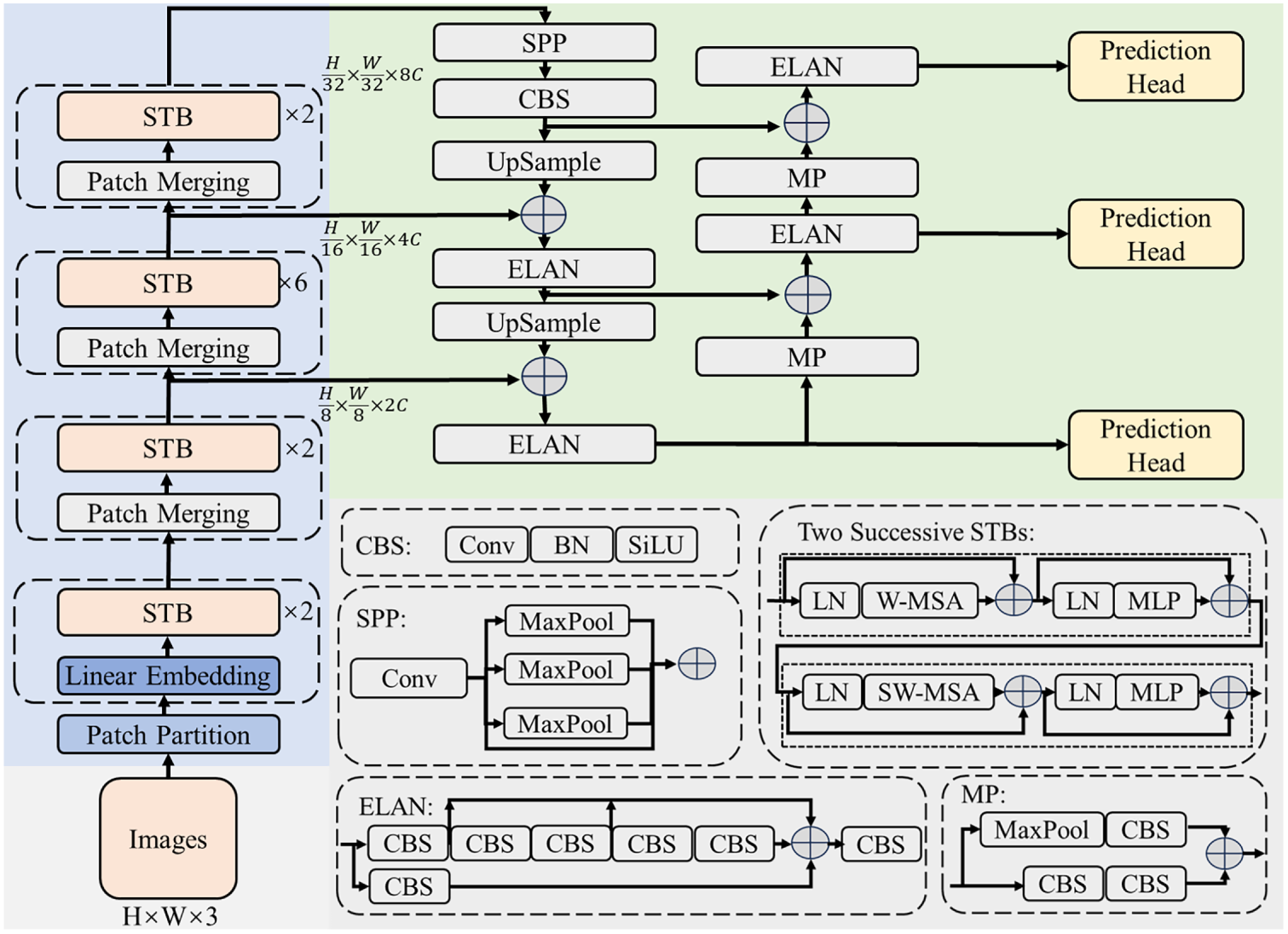
Figure 1: Overall architecture of the CSTD model. The Swin Transformer Block (STB), including Layer Normalization (LN), Multilayer Perceptron (MLP), Window-based Multi-Head Self-Attention (W-MSA), and Shifted Window-based Multi-Head Self-Attention (SW-MSA), is adopted from the Swin Transformer architecture [21]. Copyright 2021 IEEE.
The data flow of the proposed framework can be summarized as follows. Given an input image, multi-scale features are first extracted by the Transformer backbone and subsequently fused through the neck network. The fused features are then fed into the decoupled detection head for classification, localization, and localization confidence prediction. Finally, the proposed cost-sensitive loss function jointly optimizes the entire network for accurate small defect detection in transmission line inspection scenarios.
It should be noted that although Transformer-based backbones exhibit superior feature representation capability due to the self-attention mechanism, the proposed method differs from DETR-style frameworks that formulate object detection as a sequence-to-sequence learning task. Instead, traditional detection components, including anchor-based mechanisms, one-to-many label assignment, multi-scale feature map detection, and proposal generation, are retained. These strategies effectively enhance localization and classification performance, particularly for small-object detection. The main contributions of this work lie in the proposed Hybrid-Domain Attention Decoupled Detection Head and the Cost-Sensitive Loss Function, which are described in detail in Sections 3.2 and 3.3, respectively.
3.2 Decoupled Detection Head with Hybrid-Domain Attention
A decoupled detection head based on a hybrid-domain attention mechanism is designed, as illustrated in Fig. 2. Each detection head consists of three decoupled branches for object classification, bounding box regression, and localization confidence prediction, respectively. An additional localization confidence branch is introduced to improve bounding box localization accuracy and reduce missed detections of small objects [31]. Furthermore, a hybrid-domain attention mechanism is incorporated into the detection head to enhance contextual feature representation around target regions, enabling the model to focus adaptively on informative regions and discriminative features.
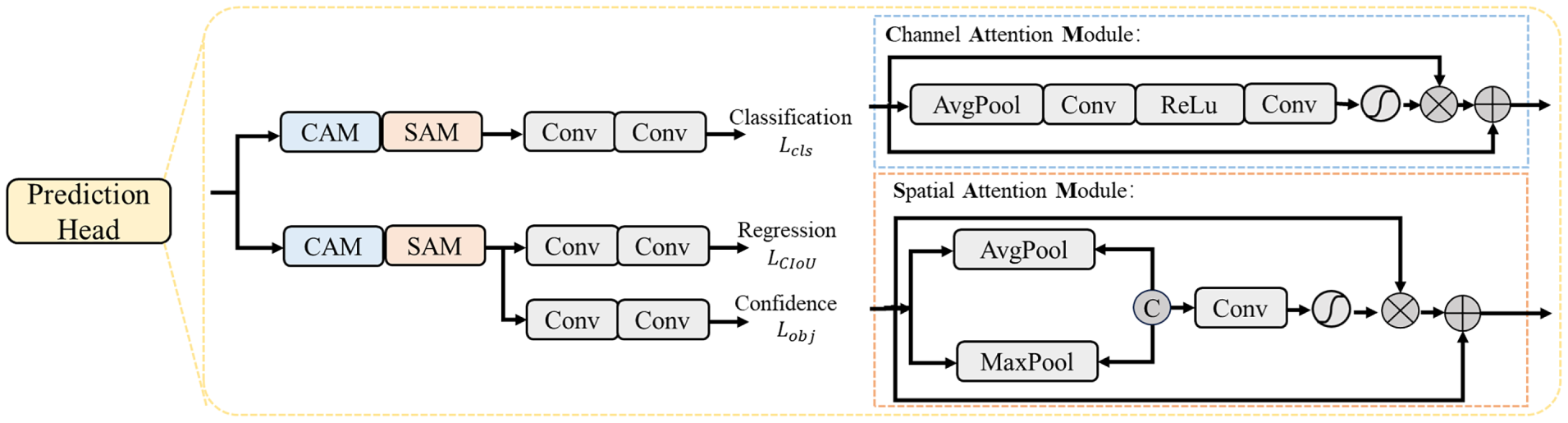
Figure 2: The decoupled detection head.
Specifically, the Channel Attention Module (CAM) first applies global average pooling to the input feature map to generate a 1
3.3 Cost-Sensitive Loss Function
A cost-sensitive loss function is designed for the proposed CSTD model to improve localization accuracy and alleviate multi-dimensional imbalance in small-object detection. In addition, an enhanced localization confidence loss is introduced to reduce missed detections of small objects. The overall loss function consists of three components: regression loss
Here,
The bounding box regression loss adopts the CIoU loss [32], which jointly considers overlap ratio, center distance, and aspect ratio consistency between predicted and ground-truth boxes. It provides comprehensive bounding box optimization and is particularly effective for small-object localization.
where
and the balancing coefficient is
where
Based on Focal Loss [14], a cost-sensitive factor is introduced to increase the contribution of small objects during optimization. The classification loss is formulated as
where
The cost-sensitive factor is defined as:
where
By design, the cost-sensitive factor assigns larger weights to smaller objects, thereby increasing the penalty for misclassification of small targets and improving detection performance in small-object scenarios.
To further improve the confidence prediction branch, a cost-sensitive confidence loss is introduced to enhance the model’s sensitivity to small-scale objects, reduce missed detections, and improve overall detection performance. Based on the standard binary cross-entropy confidence loss, a cost-sensitive factor is incorporated to increase the response of the model to small-object predictions, thereby mitigating false negatives for small targets.
The confidence loss is formulated as:
where
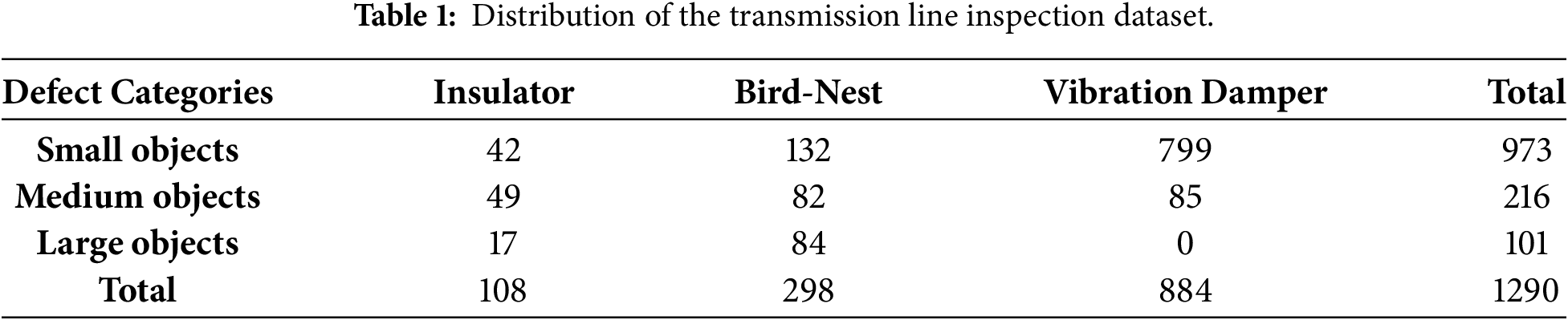
To validate the effectiveness and generalization capability of the proposed CSTD for small-object defect detection in transmission line inspection scenarios, experiments were conducted on both a transmission line inspection dataset and the public COCO [33] dataset. The transmission line inspection dataset contains 800 images covering three representative defect categories: insulator self-shattering defects, bird-nest foreign-object defects, and vibration damper detachment defects. Following the object-scale definition strategy of the COCO dataset and considering the characteristics of transmission line inspection images, objects with pixel areas smaller than 0.5% of the image area are defined as small objects, objects larger than 2% are defined as large objects, and the remaining objects are categorized as medium objects. The datasat distribution is presented in Table 1. Among all annotated objects, 973 are small-scale targets, accounting for approximately 75% of the dataset, indicating a significant small-object distribution characteristic. The dataset is divided into training and testing sets with a ratio of 8:2.
Considering the differences between the transmission line inspection dataset and the large-scale generic COCO dataset in terms of dataset scale, task characteristics, and evaluation objectives, different evaluation protocols are adopted in this study. For the COCO dataset, the official evaluation protocol of the dataset is adopted, including metrics such as
All reported results are obtained using 5-fold cross-validation, and the final performance is calculated as the average over all folds.
All experiments were conducted on an NVIDIA GeForce RTX 3060 Ti GPU with 8 GB of memory. The GPU features a memory clock of 14 GHz and a 256-bit memory interface. The system is equipped with an Intel Core i7-12700K CPU and 32 GB of RAM, running on Windows 10. The model was implemented using the PyTorch framework. PyCharm was adopted as the integrated development environment (IDE), and Python was used as the primary programming language.
In the experimental setup, the loss function weights
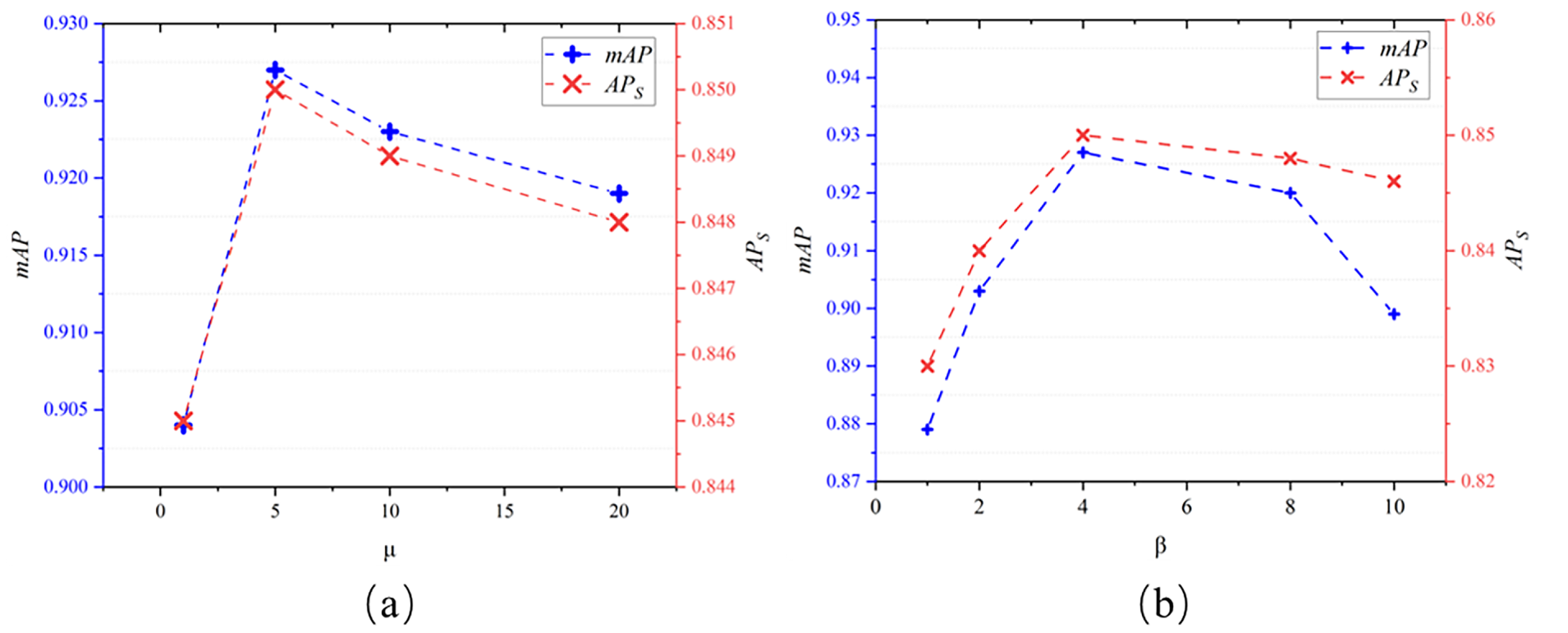
Figure 3: Results of hyperparameter tuning.
Hyperparameter
Hyperparameter
4.5 Training and Implementation Details
Data Augmentation Strategy. To mitigate overfitting caused by the limited size of the training dataset, an online data augmentation strategy is adopted in this study. Specifically, the proposed augmentation pipeline includes random horizontal flipping (with a probability of 0.5), color jittering (including random variations in brightness, contrast, and saturation), random scaling, and Mosaic augmentation (with a probability of 0.5). Furthermore, all augmented images are resized to 640
Transfer Learning Strategy. Specifically, the proposed CSTD model is first pre-trained on the PASCAL VOC2012 dataset. During pre-training, the input resolution follows the same resizing strategy as data augmentation, while maintaining a uniform batch-wise scale with a batch size of 16. The model is trained for 20 epochs with an initial learning rate of
Label Assignment Strategy. An anchor-based one-to-many label assignment strategy is adopted in this work. All input images are resized to
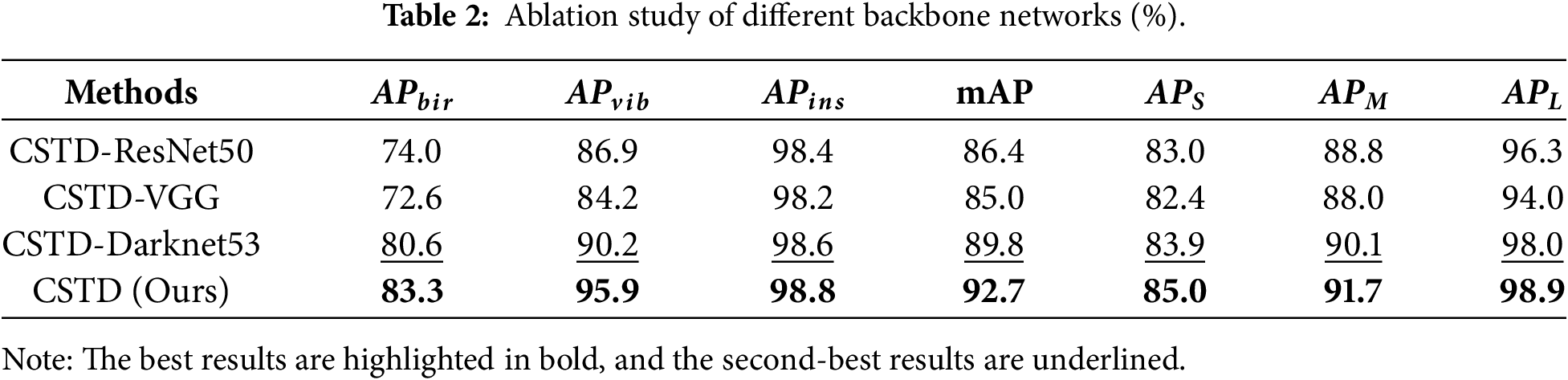
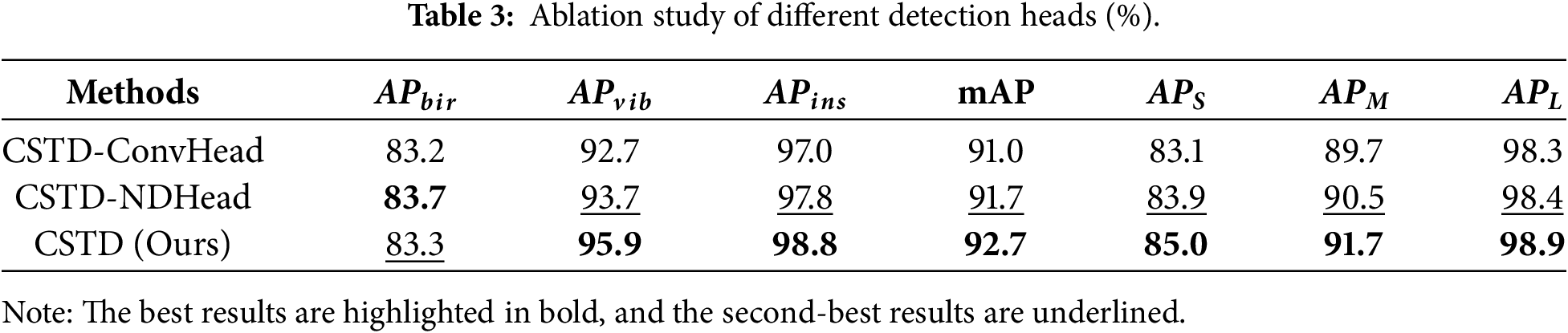
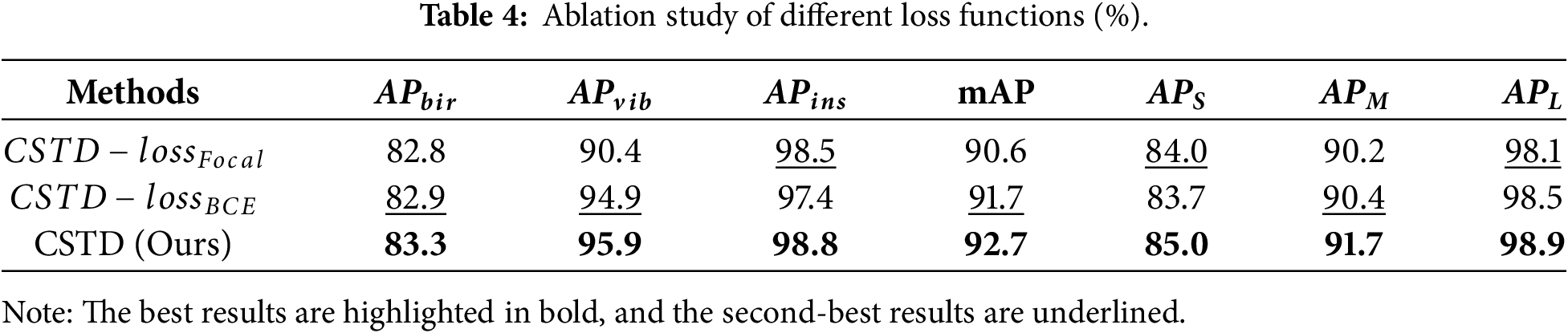
Three groups of ablation experiments are conducted to evaluate the effectiveness of different components in the proposed CSTD model.
To investigate the influence of backbone networks, ResNet50, VGG, and Darknet53 are adopted as feature extraction backbones within the CSTD framework and compared with the complete CSTD model. The results are presented in Table 2. Compared with the baseline backbone networks, the adopted backbone improves
To analyze the influence of different detection heads, a hybrid-attention decoupled head, a conventional convolution-based decoupled head, and a non-decoupled head are evaluated, as shown in Table 3. Compared with the convolution-based decoupled head, the proposed detection head improves
The influence of different loss functions on model performance is reported in Table 4. Specifically,
The proposed CSTD model is compared with seven representative object detection methods on the transmission line inspection dataset, and the results are presented in Table 5. As shown in Table 5, the proposed CSTD achieves the best overall detection performance among all compared methods. Compared with the second-best YOLOv8 model, CSTD improves
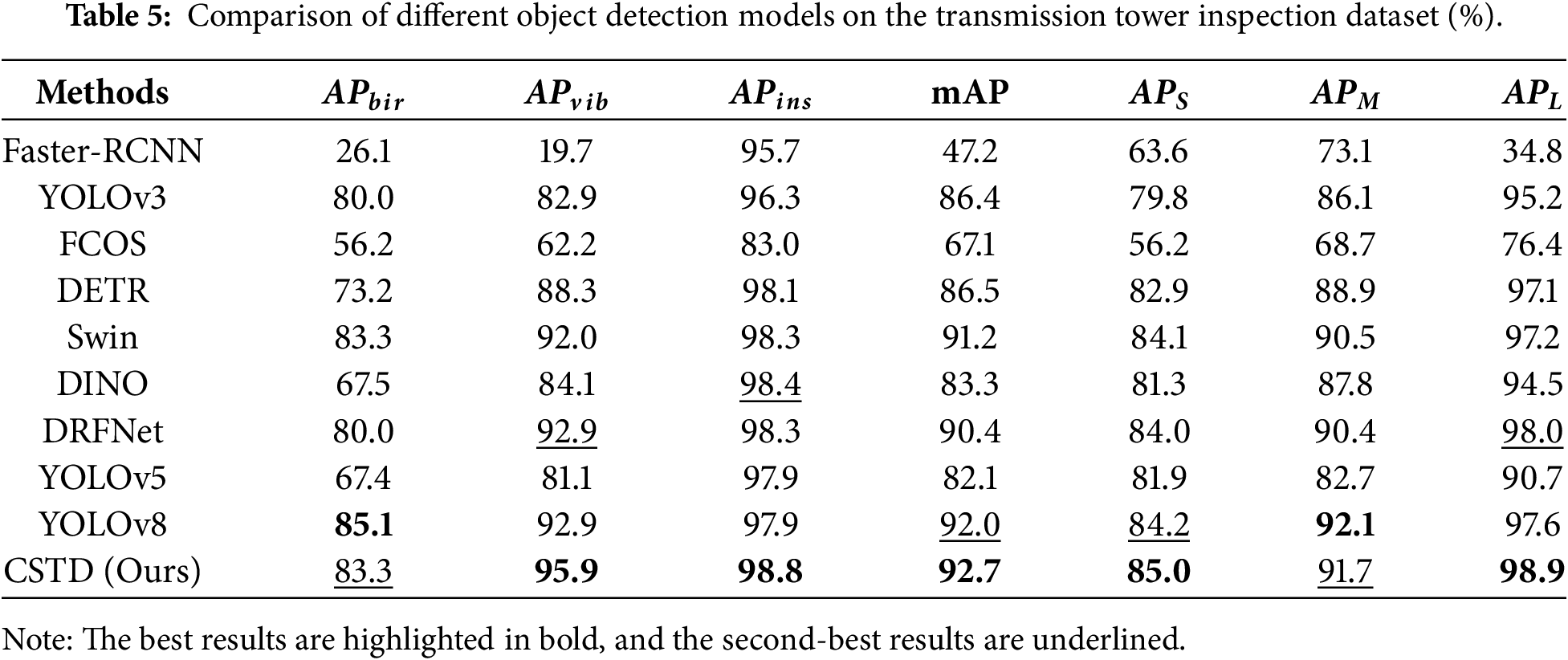
Fig. 4 further illustrates the localization accuracy on an insulator instance. The top-left image shows the original image with ground truth annotations, while the remaining subfigures present zoomed-in comparisons between different methods and the proposed CSTD. In the visualization, green boxes denote ground truth, red boxes denote predictions from CSTD, and blue boxes denote predictions from comparison methods. The corresponding confidence scores are also reported in the figure.
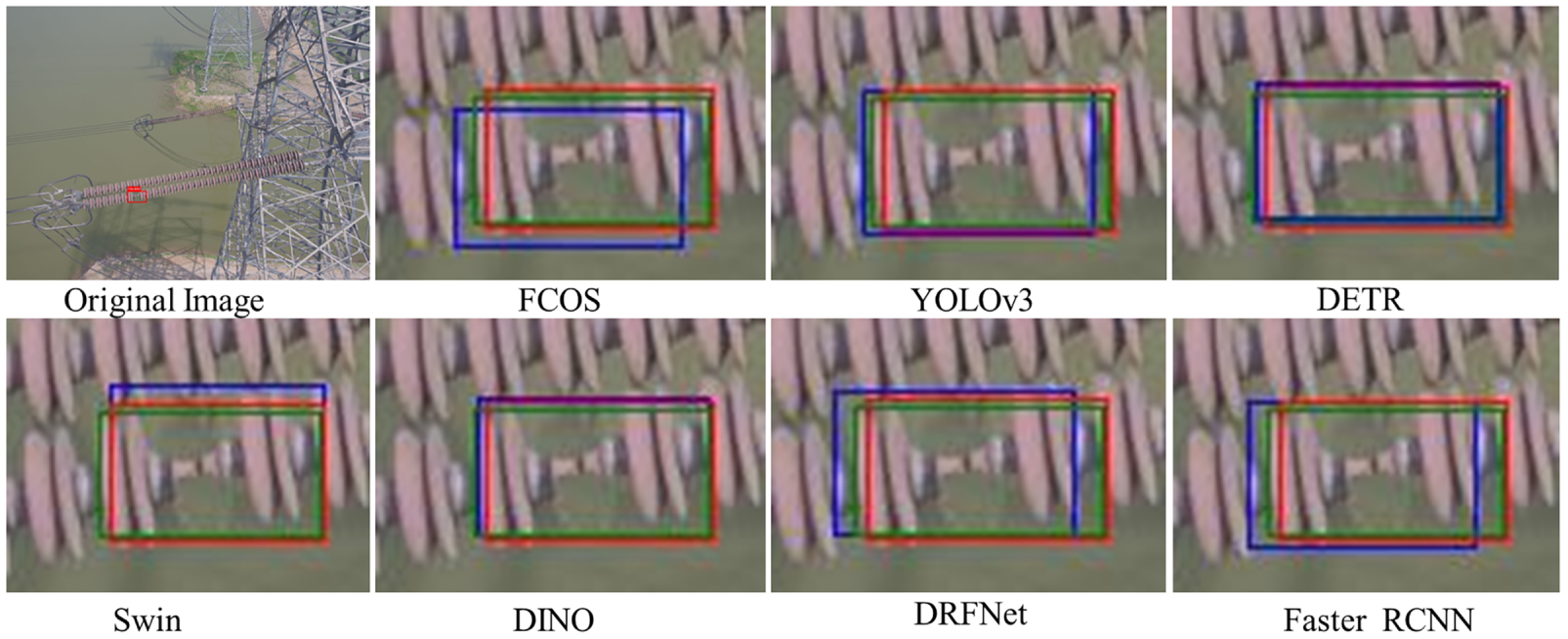
Figure 4: Visualization of localization accuracy of different models for insulator defects in transmission line. The confidence scores of the predicted bounding boxes generated by different methods are as follows: CSTD = 0.82, FCOS = 0.72, YOLOv3 = 0.87, DETR = 0.78, Swin = 0.74, DINO = 0.80, DRFNet = 0.74, Faster RCNN = 0.77.
Fig. 5 presents a qualitative comparison between the proposed CSTD and several representative methods on the transmission line inspection dataset, providing visual evidence of the model’s superiority in reducing missed detections of small objects. According to the ground truth (GT) annotations, the original image contains 12 vibration damper instances. As shown in the results, both CSTD and Swin achieve the best performance on small-object detection, each missing only one object. DINO misses two objects, DETR and DRFNet each miss three objects, while Faster R-CNN and YOLOv3 exhibit the poorest performance, each missing five objects. These results demonstrate the superior small-object detection capability of the proposed CSTD model. Despite the strong performance of CSTD, failure cases still occur for extremely small and low-contrast objects due to weak feature representation and background interference, suggesting the need for more robust fine-grained feature enhancement in future work.
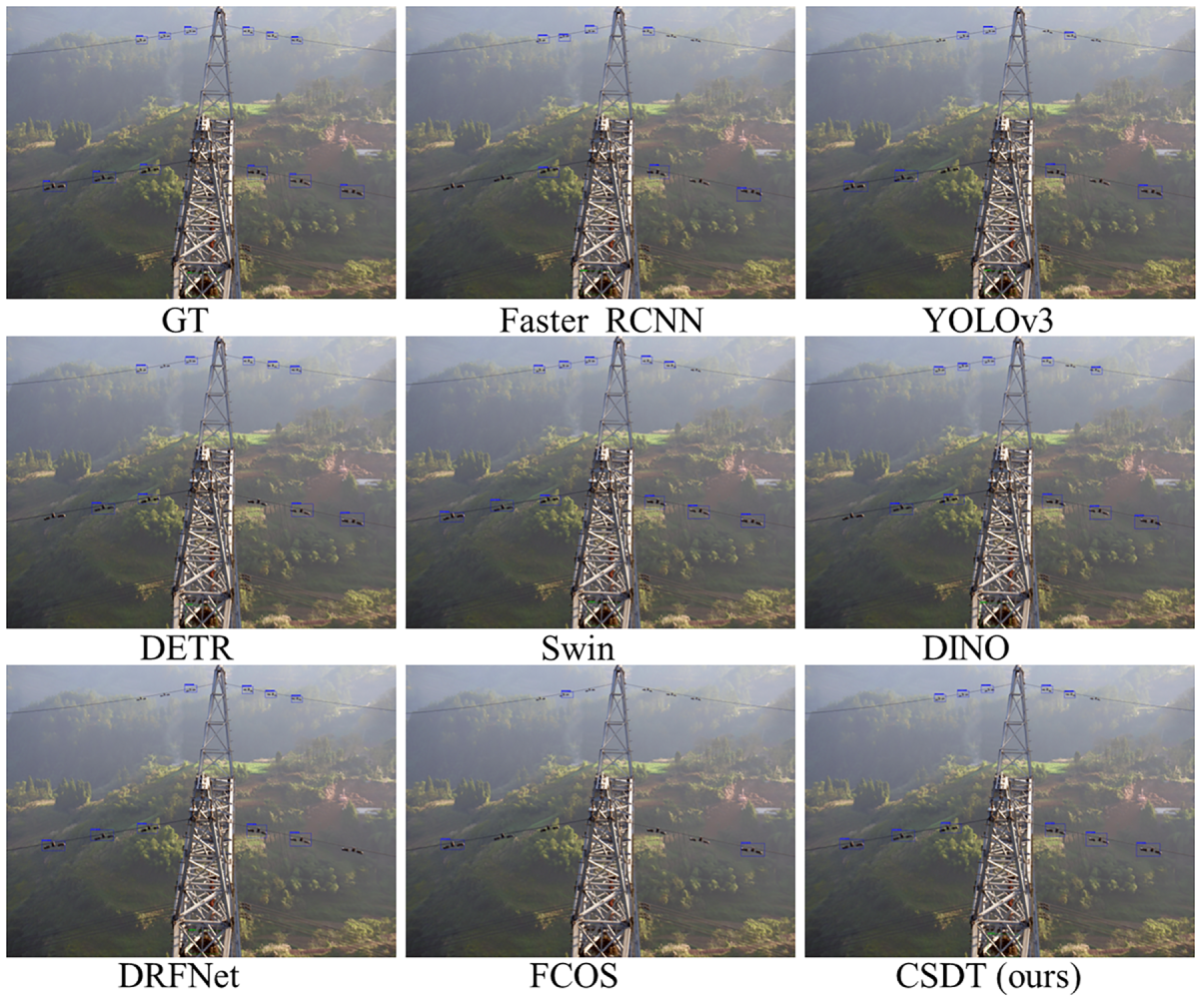
Figure 5: Visualization of small-object detection results of different models.
Overall, the visualization results and confidence analysis indicate that CSTD achieves higher localization accuracy and confidence levels on insulator detection, outperforming competing methods and further validating its effectiveness.
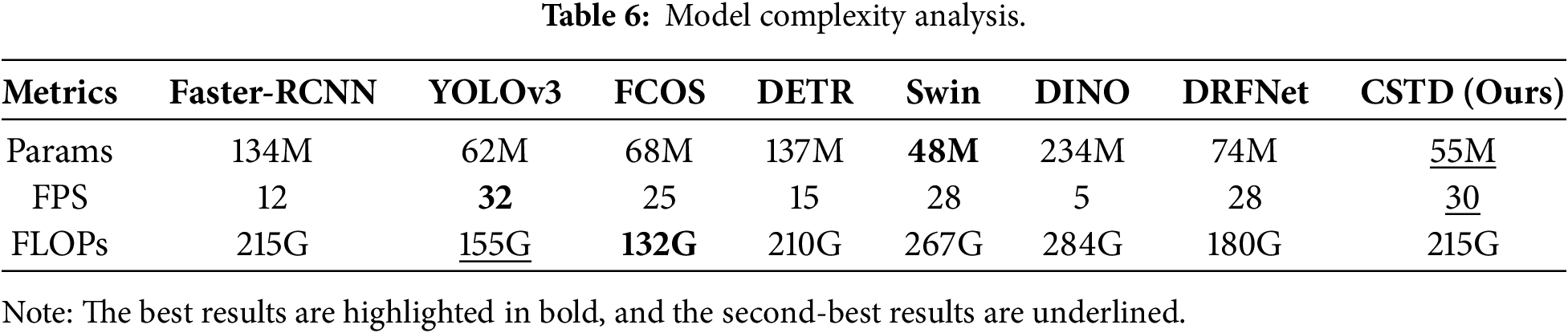
Table 6 shows that CSTD achieves a good balance between accuracy and efficiency. It maintains moderate parameter size and computational cost while achieving real-time inference speed (30 FPS), outperforming most Transformer-based detectors in efficiency. Overall, the proposed method provides a favorable trade-off between detection performance and computational complexity.
5.3 Generalization Experiments
The generalization performance of the proposed method is evaluated on the COCO benchmark, and the results are reported in Table 7.
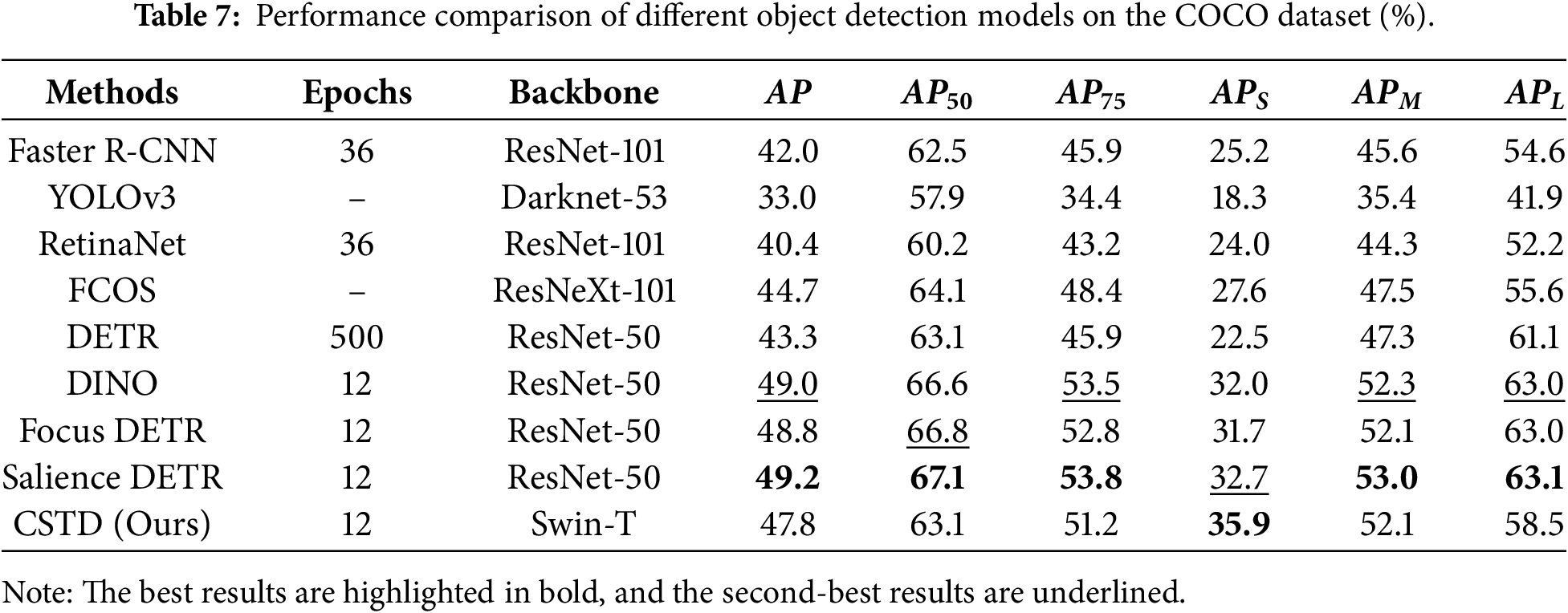
As shown in the results, Salience DETR achieves the best overall performance on the COCO dataset, with an
Notably, CSTD achieves the best performance on small-object detection, reaching the highest
However, the overall performance of CSTD on the COCO dataset still leaves room for improvement. The performance degradation on medium and large objects may be attributed to the limited model capacity or its design bias toward small-object modeling, which restricts its ability to represent large-scale objects. Future work will focus on enhancing multi-scale feature modeling to further improve the general detection performance and adaptability of the proposed model.
Small-object defect detection in transmission line inspection remains a challenging problem due to weak feature representation, scale variation, and complex backgrounds. To address this issue, we propose a Cost-Sensitive Transformer-based Detector (CSTD) with the hybrid-domain attention decoupled head and a cost-sensitive optimization strategy. Extensive experiments on a self-built dataset and the COCO benchmark demonstrate that the proposed method achieves consistently superior performance in small-object detection, particularly in terms of
Acknowledgement: Not applicable.
Funding Statement: This research was supported by the Fundamental Research Funds for the Central Universities (Grant No. 2026MS183), the Open Fund of the Engineering Research Center of Intelligent Computing for Complex Energy Systems, Ministry of Education (Grant No. ESIC202503), and the National Natural Science Foundation of China (Grant No. 62371188). The authors gratefully acknowledge the financial support from these funding agencies.
Author Contributions: The authors confirm contribution to the paper as follows: conceptualization, methodology, supervision, data collection, dataset construction, model design and implementation, Congcong Ma and Jiaqi Mi; experimental validation and result analysis, Feifei Fu; visualization, Wenqing Zhao; writing—original draft preparation, Congcong Ma; writing—review and editing, Jiaqi Mi. All authors reviewed and approved the final version of the manuscript.
Availability of Data and Materials: The COCO dataset used in this study is publicly available and can be accessed from the official COCO dataset website. The transmission line inspection dataset is not publicly available due to data privacy and security restrictions associated with industrial inspection scenarios. The data were collected and annotated for research purposes and are not permitted for public release. Reasonable requests for further information may be directed to the corresponding author.
Ethics Approval: Not applicable.
Conflicts of Interest: The authors declare no conflicts of interest.
References
1. Nikouei M, Baroutian B, Nabavi S, Taraghi F, Aghaei A, Sajedi A, et al. Small object detection: a comprehensive survey on challenges, techniques and real-world applications. Intell Syst Appl. 2025;27(1):200561. doi:10.1016/j.iswa.2025.200561. [Google Scholar] [CrossRef]
2. Mukundan A, Karmakar R, Gupta D, Wang HC. Deep learning-based toolkit inspection: object detection and segmentation in assembly lines. Comput Mater Contin. 2026;86(1):1–23. doi:10.32604/cmc.2025.069646. [Google Scholar] [CrossRef]
3. Yuan X, Chakravarty A, Lichtenberg EM, Gu L, Wei Z, Chen T. An empirical analysis of deep learning methods for small object detection from satellite imagery. Expert Syst Appl. 2026;307(11):131061. doi:10.1016/j.eswa.2025.131061. [Google Scholar] [CrossRef]
4. Wang G, Hao Z, Cao W, Mei H. YOLO-EPDS: a small object detection algorithm for power transmission line nut spacing looseness. IET Image Process. 2026;20(1):e70279. doi:10.1049/ipr2.70279. [Google Scholar] [CrossRef]
5. He W, Zhang Y, Xu T, An T, Liang Y, Zhang B. Object detection for medical image analysis: insights from the RT-DETR model. In: Proceedings of the 2025 International Conference on Artificial Intelligence and Computational Intelligence; 2025 Feb 14–16; Kuala Lumpur, Malaysia. p. 415–20. doi:10.1145/3730436.3730506. [Google Scholar] [CrossRef]
6. Song J, Zhou M, Luo J, Pu H, Feng Y, Wei X, et al. Boundary-aware feature fusion with dual-stream attention for remote sensing small object detection. IEEE Trans Geosci Remote Sens. 2025;63:5600213. doi:10.1109/TGRS.2024.3514376. [Google Scholar] [CrossRef]
7. Girshick R, Donahue J, Darrell T, Malik J. Rich feature hierarchies for accurate object detection and semantic segmentation. In: Proceedings of the 2014 IEEE Conference on Computer Vision and Pattern Recognition; 2014 Jun 23–28; Columbus, OH, USA. p. 580–7. doi:10.1109/CVPR.2014.81. [Google Scholar] [CrossRef]
8. Ren S, He K, Girshick R, Sun J. Faster R-CNN: towards real-time object detection with region proposal networks. IEEE Trans Pattern Anal Mach Intell. 2017;39(6):1137–49. doi:10.1109/TPAMI.2016.2577031. [Google Scholar] [CrossRef]
9. He K, Gkioxari G, Dollar P, Girshick R. Mask R-CNN. In: Proceedings of the 2017 IEEE International Conference on Computer Vision (ICCV); 2017 Oct 22–29; Venice, Italy. p. 2980–8. doi:10.1109/iccv.2017.322. [Google Scholar] [CrossRef]
10. Cai Z, Vasconcelos N. Cascade R-CNN: delving into high quality object detection. In: Proceedings of the 2018 IEEE/CVF Conference on Computer Vision and Pattern Recognition; 2018 Jun 18–23; Salt Lake City, UT, USA. p. 6154–62. doi:10.1109/CVPR.2018.00644. [Google Scholar] [CrossRef]
11. Beal J, Kim E, Tzeng E, Park DH, Zhai A, Kislyuk D. Toward transformer-based object detection. arXiv:2012.09958. 2020. [Google Scholar]
12. Zhang H, Chang H, Ma B, Wang N, Chen X. Dynamic R-CNN: towards high quality object detection via dynamic training. In: Computer vision–ECCV 2020. Cham, Switzerland: Springer International Publishing; 2020. p. 260–75. doi:10.1007/978-3-030-58555-6_16. [Google Scholar] [CrossRef]
13. Sun P, Zhang R, Jiang Y, Kong T, Xu C, Zhan W, et al. Sparse R-CNN: end-to-end object detection with learnable proposals. In: Proceedings of the 2021 IEEE/CVF Conference on Computer Vision and Pattern Recognition (CVPR); 2021 Jun 20–25; Nashville, TN, USA. p. 14449–58. doi:10.1109/cvpr46437.2021.01422. [Google Scholar] [CrossRef]
14. Lin TY, Goyal P, Girshick R, He K, Dollár P. Focal loss for dense object detection. In: Proceedings of the 2017 IEEE International Conference on Computer Vision (ICCV); 2017 Oct 22–29; Venice, Italy. p. 2999–3007. doi:10.1109/ICCV.2017.324. [Google Scholar] [CrossRef]
15. Redmon J, Farhadi A. YOLOv3: an incremental improvement. arXiv:1804.02767. 2018. [Google Scholar]
16. Liu W, Anguelov D, Erhan D, Szegedy C, Reed S, Fu CY, et al. SSD: single shot MultiBox detector. In: Computer vision–ECCV 2016. Cham, Switzerland: Springer International Publishing; 2016. p. 21–37. doi:10.1007/978-3-319-46448-0_2. [Google Scholar] [CrossRef]
17. Tian Z, Shen C, Chen H, He T. FCOS: fully convolutional one-stage object detection. In: Proceedings of the 2019 IEEE/CVF International Conference on Computer Vision (ICCV); 2019 Oct 27–Nov 2; Seoul, Republic of Korea. p. 9626–35. doi:10.1109/iccv.2019.00972. [Google Scholar] [CrossRef]
18. Zheng D, Dong W, Hu H, Chen X, Wang Y. Less is more: focus attention for efficient DETR. In: Proceedings of the 2023 IEEE/CVF International Conference on Computer Vision (ICCV); 2023 Oct 1–6; Paris, France. p. 6651–60. doi:10.1109/ICCV51070.2023.00614. [Google Scholar] [CrossRef]
19. Hou X, Liu M, Zhang S, Wei P, Chen B. Salience DETR: enhancing detection transformer with hierarchical salience filtering refinement. In: Proceedings of the 2024 IEEE/CVF Conference on Computer Vision and Pattern Recognition (CVPR); 2024 Jun 16–22; Seattle, WA, USA. p. 17574–83. doi:10.1109/CVPR52733.2024.01664. [Google Scholar] [CrossRef]
20. Carion N, Massa F, Synnaeve G, Usunier N, Kirillov A, Zagoruyko S. End-to-end object detection with transformers. In: Computer vision–ECCV 2020. Cham, Switzerland: Springer International Publishing; 2020. p. 213–29. doi:10.1007/978-3-030-58452-8_13. [Google Scholar] [CrossRef]
21. Liu Z, Lin Y, Cao Y, Hu H, Wei Y, Zhang Z, et al. Swin transformer: hierarchical vision transformer using shifted windows. In: Proceedings of the 2021 IEEE/CVF International Conference on Computer Vision (ICCV); 2021 Oct 10–17; Montreal, QC, Canada. p. 9992–10002. doi:10.1109/ICCV48922.2021.00986. [Google Scholar] [CrossRef]
22. Zhang H, Li F, Liu S, Zhang L, Su H, Zhu J, et al. DINO: DETR with improved DeNoising anchor boxes for end-to-end object detection. arXiv:2203.03605. 2022. [Google Scholar]
23. Tan M, Yuan X, Liang B, Han S. DRFnet: dynamic receptive field network for object detection and image recognition. Front Neurorobot. 2023;16:1100697. doi:10.3389/fnbot.2022.1100697. [Google Scholar] [CrossRef]
24. Miri Rekavandi A, Rashidi S, Boussaid F, Hoefs S, Akbas E, Bennamoun M. Transformers in small object detection: a benchmark and survey of state-of-the-art. ACM Comput Surv. 2026;58(3):1–33. doi:10.1145/3758090. [Google Scholar] [CrossRef]
25. Tian C, Cheng T, Ma Y, Zhu Q, Zhang B, Zhang D. A heterogeneous CNN with transformers for image denoising. IEEE Trans Consum Electron. 2026;72(2):2658–67. doi:10.1109/TCE.2026.3665312. [Google Scholar] [CrossRef]
26. Xu ZY, Tang X. Transmission line insulator defect detection algorithm based on MAP-YOLOv8. Sci Rep. 2025;15(1):10288. doi:10.1038/s41598-025-92445-3. [Google Scholar] [CrossRef]
27. Yang X, Liu K, Guan R, Yu J, Liu Y. Transformer-based detection of hidden hazards in power transmission lines for UAV inspection. IEEE Access. 2025;13(1):150992–1000. doi:10.1109/ACCESS.2025.3603163. [Google Scholar] [CrossRef]
28. More SS, Bansode R. FCN-YOLOS: an effective deep-learning model for real-time object detection. J Field Robot. 2025;42(8):4053–74. doi:10.1002/rob.70001. [Google Scholar] [CrossRef]
29. More SS, Bansode R, Upadhyay GM, Akashe S. Optimized duo directed LSTM for efficient object detection on resource constrained edge devices. Discov Internet Things. 2026;6(1):66. doi:10.1007/s43926-026-00318-6. [Google Scholar] [CrossRef]
30. Wang CY, Bochkovskiy A, Liao HM. YOLOv7: trainable bag-of-freebies sets new state-of-the-art for real-time object detectors. In: Proceedings of the 2023 IEEE/CVF Conference on Computer Vision and Pattern Recognition (CVPR); 2023 Jun 17–24; Vancouver, BC, Canada. p. 7464–75. doi:10.1109/CVPR52729.2023.00721. [Google Scholar] [CrossRef]
31. Li X, Wang W, Wu L, Chen S, Hu X, Li J, et al. Generalized focal loss: learning qualified and distributed bounding boxes for dense object detection. Adv Neural Inf Process Syst. 2020;33:21002–21012. [Google Scholar]
32. Zheng Z, Wang P, Liu W, Li J, Ye R, Ren D. Distance-IoU loss: faster and better learning for bounding box regression. Proc AAAI Conf Artif Intell. 2020;34(7):12993–3000. doi:10.1609/aaai.v34i07.6999. [Google Scholar] [CrossRef]
33. Lin TY, Maire M, Belongie S, Hays J, Perona P, Ramanan D, et al. Microsoft COCO: common objects in context. In: Computer vision–ECCV 2014. Cham, Switzerland: Springer International Publishing; 2014. p. 740–55. doi:10.1007/978-3-319-10602-1_48. [Google Scholar] [CrossRef]
Cite This Article
 Copyright © 2026 The Author(s). Published by Tech Science Press.
This work is licensed under a Creative Commons Attribution 4.0 International License , which permits unrestricted use, distribution, and reproduction in any medium, provided the original work is properly cited.
 Downloads
 Citation Tools
