
 Login
Login Register
 Submit a Paper
 Propose a Special lssue
 Open Access
REVIEW
Recent Advances in Artificial Intelligence for Smart Vehicles and Intelligent Transportation Systems
1 Department of Computer Engineering, Gachon University, Sujeong-gu, Seongnam, Republic of Korea
2 Department of Computer Science, Qurtuba University of Science & IT, Peshawar, Pakistan
3 Department of Networks and Cybersecurity, Hourani Center for Applied Scientific Research, Al-Ahliyya Amman University, Amman, Jordan
4 School of Computing, Horizon University College, Ajman, United Arab Emirates
* Corresponding Author: Chang Choi. Email:
Computers, Materials & Continua 2026, 89(2), 1 https://doi.org/10.32604/cmc.2026.086072
Received 23 May 2026; Accepted 10 July 2026; Issue published 15 September 2026
 View Full Text
 Download PDF
Abstract
The growing need for intelligent, information-based, and automated transportation systems has been brought about by the rapid progress of intelligent vehicles and Intelligent Transportation Systems (ITS). Artificial Intelligence (AI) has emerged as an indispensable asset for the challenges and opportunities of today’s transportation, improving decision-making, flexibility, and system efficiency. This survey examines breakthroughs in AI techniques applied to smart vehicles and ITS between 2019 and 2026, focusing on Machine Learning (ML), Deep Learning (DL), Reinforcement Learning (RL), Federated Learning (FL), and Computer Vision. The survey also includes the integration of AI with enabling technologies, such as the Internet of Things (IoT), edge computing, and cloud computing, in this instance, to create real-time distributed intelligence in transportation networks. Also, the application fields of autonomous driving, intelligent traffic control, Advanced Driver Assistance Systems (ADAS), intelligent parking, and Vehicle-to-Everything (V2X) communication are covered. The survey showed that other key challenges stemming from data heterogeneity, scale, latency, security, privacy, and model interpretability would need to be resolved for stable deployment. Lastly, AI-fueled Smart Cities, 5G/6G-powered transportation, Digital Twins, and Explainable Artificial Intelligence (XAI) are briefly mentioned as future research directions and novelties. This survey offers a comprehensive overview of AI-based transportation systems and will be of interest to researchers in the field.Keywords
Transportation is evolving at a fast pace due to urbanization, growing levels of traffic, and the need for safer, cleaner, and more effective transport. Next generation transportation has become a reality in that aspect, by means of smart vehicles and Intelligent Transportation Systems (ITS) [1,2]. Smart vehicles rely on sensing, computing, and communication capabilities, while ITS relies on information, communication, and control technologies to improve the effectiveness, safety, reliability, and sustainability of traffic. Their combinations constitute the blocks of interconnected, automated, and information-driven transportation systems [3]. The conventional methods of transport are no longer able to manage the dynamism of traffic, unforeseen circumstances, and the real-time volume of information. The frequent use of fixed, rule-based control and slow human intervention leads to congestion, inefficient routing, higher fuel consumption, and a higher likelihood of accidents [4,5]. The need to ease transportation requirements has driven strong demand for multifunctional, intelligent transport devices.
Artificial Intelligence (AI) improves vehicles, infrastructure, and traffic control systems by enabling learning, pattern recognition, prediction, optimization, and autonomous decision-making [6]. Machine Learning (ML), Deep Learning (DL), Reinforcement Learning (RL), Federated Learning (FL), and computer vision are mentioned as techniques increasingly used in traffic forecasting, route planning, object detection, dynamic signal control, and autonomous driving. One of the strengths of AI in smart vehicles and ITS is its ability to provide intelligence and automation in real time [7,8]. Transportation is an extremely time-sensitive system, and AI will help process data from cameras, LiDAR, radar, GPS, and integrated infrastructure in a short amount of time. This enhances responsiveness, minimizes human error, and promotes safer and more efficient movements [9]. Other areas where AI is contributing include safety, efficiency, and sustainability, with assistance for drivers, reduced congestion, and eco-friendly transportation.
At the same time, AI-based transport systems will face serious challenges, including data heterogeneity, latency, limited computational resources, cybersecurity, privacy, and explainability [10,11]. With the support of other enabling technologies such as the Internet of Things (IoT), edge computing, cloud computing, or Vehicle-to-Everything (V2X) networking, the presence of AI also increases the system’s capabilities and complexity. This survey will be motivated by the recent importance of AI in intelligent and connected transportation, as well as the absence of continuity in current studies. Most literature concentrates on a single problem, such as autonomous driving, traffic prediction, and lacks a holistic view of AI techniques, applications, problems, and infrastructure. The main advantages of cloud computing, the core AI strategies and their relation with IoT, the main areas where they can be applied to smart vehicles and ITS, the most prominent challenges, and future research directions will be systematically reviewed within the context of new trends in AI in smart vehicles and ITS.
The increasing complexity of transportation networks and the rapid acceleration of urbanization have made it imperative to develop smarter, more responsive, and data-driven mobility services. This application, like traffic management, accident management, environmental conditions, and optimal resource utilization, is not applicable in traditional transport systems; therefore, the use of AI in smart vehicles and ITS is required.
The most crucial need is smart traffic control, which cannot be handled by old traffic control systems, as they are unable to adapt to real-world situations. By using AI, traffic and congestion can be minimized by predicting and managing traffic in real time. Another area of progress AI is making is the development of autonomous, networked vehicles. These are vehicles that can perceive, decide and coordinate with other vehicles using V2X communication. The massive amount of IoT and vehicular data is generated exponentially and can be processed by AI to make real-time transportation predictions and detect abnormalities. Moreover, their interest in safety and sustainability supports the use of AI to reduce accidents, cut energy use, and propel the shift towards sustainable modes of transportation.
Edge computing, distributed architecture, and AI have to make decisions and automate in a dynamic, real-time context. Moreover, the interaction between AI and novel technologies, including IoT, edge/cloud computing, and 5G/6G networks, supports the design of better ITS. In general, this information suggests that much research is needed on current trends in AI-assisted smart vehicles and ITS, gaps in research, and innovations in smart transport systems.
This section presents a description of the systematic approach to gathering, analyzing, and synthesizing available literature on AI in smart vehicles and ITS. Like any other survey frame, this one is too well organized to accomplish coverage, relevance, and completeness in the study under review. The proposed method will address important research questions, describe key technological trends, propose solutions to the problem, and address research gaps in AI-driven transport systems.
The specified survey is quite limited, as it focuses on the use of AI methods in the field of smart vehicles and ITS. In particular, it covers ML, DL, RL, FL, and computer vision used in transportation, including traffic forecasting, autonomous vehicles, intelligent traffic control, and connected vehicles. Moreover, the survey also concerns information on the incorporation of AI and enabling technologies, i.e., the IoT, edge computing, cloud computing, and vehicle communication networks (e.g., V2X). The exercise will focus on demonstrating a holistic picture of the role of the AI application in improving transportation intelligence, efficiency, and safety. To lead the survey and give a systematic analysis, it is mentioned that the following research questions will be answered:
• RQ1: What are the most common AI methods in smart vehicles and ITS?
• RQ2: What role does AI play in enhancing the efficiency, safety, and automation of transportation systems?
• RQ3: What are the main problems and restrictions related to the smart transport systems based on AI?
• RQ4: What are the current trends and future research directions of AI-driven ITS?
The following research questions serve as the basis for the structure of the literature review and for an assessment of the contributions in the field.
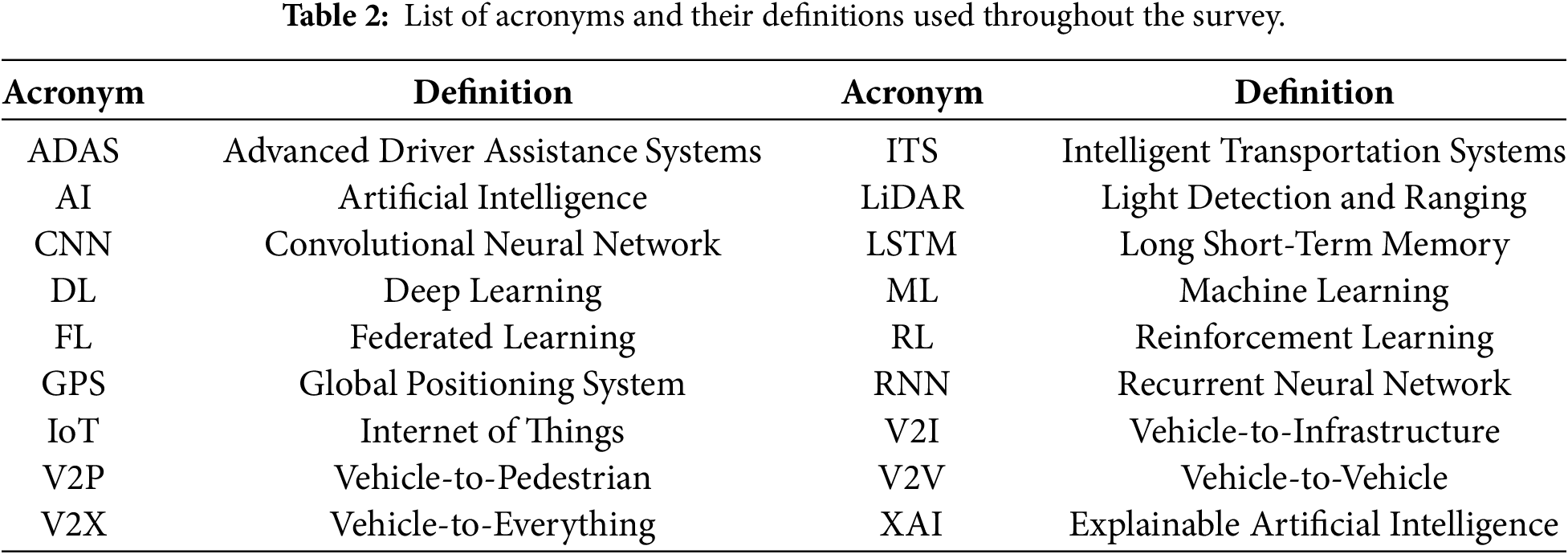
The literature search process was well-structured and reproducible, and was performed using literature from 2019 to 2026, while also considering earlier years that were essential for ITS, autonomous driving, or AI-based traffic management. IEEE Xplore, ScienceDirect, SpringerLink, ACM Digital Library, MDPI, Wiley Online Library, Taylor & Francis, SAGE, Emerald Insight, and Google Scholar were selected for collecting literature, and this is summarised in Table 1. Every search term was grouped under AI Transportation, Smart Vehicle, ITS and its variants, ML/DL/RL/FL-related transportation methods, V2X Communication, Edge AI, and AI Transportation Control. A high-impact study in this survey is one of the publications, including papers from peer-reviewed journals, conference proceedings, and recent review publications that exhibit good methodological quality, technical contribution, and are clearly relevant to the domain of AI query for smart vehicles and ITS. Studies on AI techniques, ITS applications, enabling technologies, security and privacy problems, and future trends were included, while studies were excluded if they duplicated another study, were non-technical articles, did not focus on AI transport, or lacked methodological information. For consistency throughout the survey, key acronyms are provided in Table 2.

To strengthen transparency, the PRISMA approach was applied to the screening process, as shown in Fig. 1. Overall, 486 copies were initially retrieved, 92 of which seem to be duplicate records, and 394 records were screened by title and abstract. Of these, 176 were excluded because they were out of scope, non-technical, or not directly related to AI-based smart vehicles and ITS. Of these last 218 papers, 79 were excluded because they featured few links to AI techniques, ITS applications, or system integration, had a limited focus on security or trends, or lacked relevance. Finally, 139 studies were selected for detailed analysis and synthesis. Next, these studies were organized by their themes, which are AI techniques, application areas, enabling technologies, security/privacy concerns, key challenges, and future research directions, paving the way for qualitative and comparative analysis of AI paradigms, deployment trade-offs, real-world limitations, and research gaps.
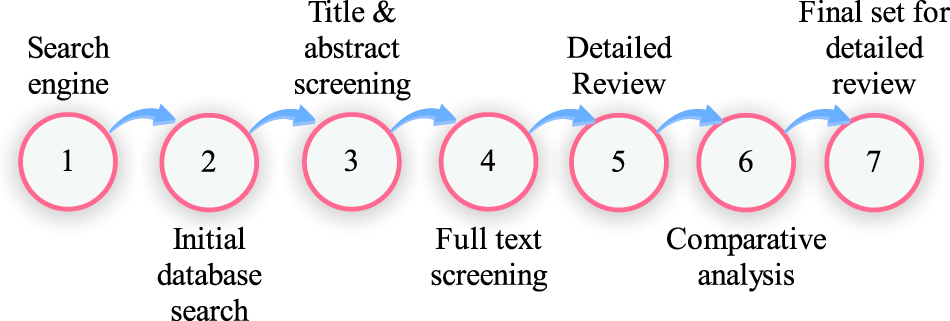
Figure 1: PRISMA-style workflow of the literature review process. A total of 486 records were identified, 92 duplicates were removed, 394 records were screened by title and abstract, 218 full-text articles were assessed for eligibility, and 139 studies were finally selected for detailed review and synthesis.
The studies were carefully selected using a multi-step process to guarantee relevance, quality, and reproducibility. Keyword-based searches were used to identify relevant studies, and the selected papers were then analyzed to extract information on AI techniques, ITS applications, enabling technologies, performance concerns, challenges, and future developments. The selected papers were then analyzed to identify information related to the AI approach, ITS applications, enabling technologies, performance issues, issues and future directions. For qualitative and comparative analysis a thematic coding framework has been developed and the studies were coded under the following categories: (i) AI technique: ML, DL, RL, FL, computer vision, and hybrid AI; (ii) ITS application domain: autonomous driving, traffic management, ADAS, smart parking, accident detection, V2X, and route optimization; (iii) enabling infrastructure: IoT, edge computing, cloud computing, 5G/6G, and vehicular networks; (iv) performance focus: accuracy, latency, scalability, robustness, privacy, energy efficiency, and real-time responsiveness; (v) security and trust issues: privacy leakage, adversarial attacks, model poisoning, authentication, and trust management; and (vi) future research direction: XAI, digital twins, green mobility, smart cities, and edge intelligence. This survey is a narrative and comparative review; therefore, no formative interrater reliability test was conducted. However, consensus was reached by employing the same categories for all studies included in the review and by rescreening each study against the research questions, inclusion criteria, and thematic categories. It enabled a more systematic comparison of models, applications, deployment considerations, technology integration, and performance benefits across different transportation contexts.
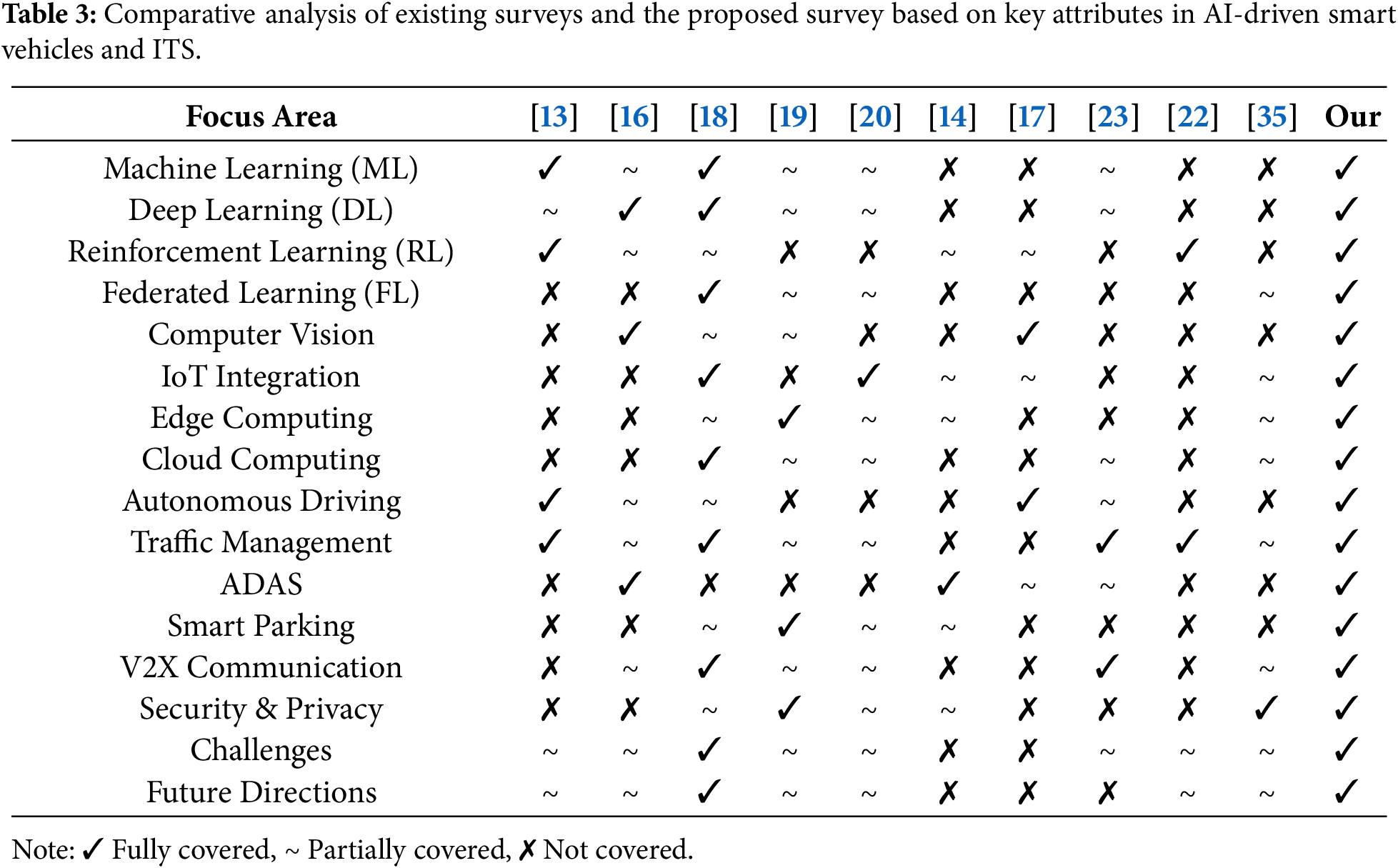
To ensure transparency in the comparative assessment, the coverage ratings used in Table 3 were assigned using predefined qualitative criteria. A “✓” rating was given when a topic was treated as a major theme with technical discussion and clear relevance to ITS applications or deployment issues. A “
This survey is a critical and system-level review of recent AI improvements for smart vehicles and ITS. This work differs from previous surveys, which primarily focused on a single aspect of transportation intelligence, such as autonomous driving, traffic prediction, IoT for mobility, or the relationship between different aspects and security. Furthermore, it relates these AI paradigms to IoT, edge, and cloud computing, as well as to V2X communication, to demonstrate the interwoven aspects of sensing, communication, computation, privacy, security, and decision-making on which real-world ITS depends. Moreover, this survey compares and analyzes different AI techniques based on accuracy, latency, privacy, scalability, interpretability, communication cost, and deployment considerations. Therefore, its key strength is that it combines taxonomy, comparison, and a deployment-centric account of how complementary or limiting the various types of AI can be to overall deployment opportunities. The main contributions made by this work are:
• This survey systematically reviews the major AI paradigms used in smart vehicles and ITS, including ML, DL, RL, FL, and computer vision, and explains how they support intelligent perception, prediction, automation, and decision-making.
• The survey examines the integration of AI with enabling technologies such as IoT, edge computing, cloud computing, vehicular communication, and V2X, highlighting their role in connected, distributed, and real-time transportation intelligence.
• The survey analyses practical AI applications in transportation, including autonomous driving, intelligent traffic management, ADAS, smart parking, accident detection, emergency response, and V2X-supported mobility systems.
• The survey critically discusses major deployment challenges in AI-based ITS, including data heterogeneity, real-time processing constraints, scalability, model interpretability, reliability, safety, legacy system integration, data privacy, cybersecurity threats, adversarial attacks, and trust management.
• The survey introduces a unified taxonomy that connects AI techniques to enabling communication/computing technologies, practical ITS applications, security/privacy/trust requirements, key deployment challenges, and future research directions within a single framework.
• The survey adds a critical comparative perspective by discussing real-world trade-offs, including centralized vs. FL, cloud vs. edge intelligence, accuracy vs. latency, privacy vs. data utility, and model complexity vs. explainability.
1.4 Analytical Framework: AI-Enabled Transportation Intelligence Chain
In this survey, AI was simply considered as smart vehicles and ITS as a chain of transportation intelligence including perception, prediction, decision making, control, communication, deployment and security. The perception stage entails receiving multimodal data from cameras, LiDAR, RADAR, GPS, vehicular sensors, roadside units and IoT devices. Computer vision applications include object detection, lane detection, traffic sign recognition, pedestrian detection, and scene understanding, among others, all of which are assisted by data from perceived scenes using Deep Learning methods. Historical and real-time data is utilized to enable predictions of traffic flow, travel time, congestion, accidents risk, parking availability and mobility patterns during the prediction stage.
The perception and prediction results are then used by the decision-making and control stages to generate operational decisions such as adaptive signal timing, route planning, lane changing, speed regulation, cooperative driving, etc. These are such sequential and dynamic tasks where reinforcement learning is particularly relevant. The communication stage covers the networks, infrastructure, road users, and edge nodes involved in vehicular networks and the cloud platform, and their interactions through V2X, IoT, and vehicular networks to achieve coordinated mobility and cooperative perception. Whether AI functions are fulfilled on-board, at the roadside edge, or in the cloud depends on the deployment stage and takes into account factors such as latency, resource availability, reliability, and scalability.
Security and trust permeate the chain, from data collection to the final control decision; privacy leakage, adversarial attacks, model poisoning, authentication, explainability, and trust management pose threats. Thus, in addition to the algorithmic accuracy, latency, communication cost, scalability, privacy preservation, robustness, safety, interpretability and real-world deployability should be taken into consideration when evaluating AI-based ITS.
The rest of this paper is structured as follows. Section 2 reviews relevant work and identifies gaps in the research. In Section 3, the researchers identify important AI technologies in smart vehicles and ITS. Section 4 concerns combining AI with IoT, edge, and cloud computing. Section 5 discusses notable AI uses in the transport systems. Section 6 addresses the problems of security, privacy, and trust. Section 7 identifies major issues of concern, and Section 8 outlines future research directions. Lastly, the paper concluded with Section 9, which summarizes the main findings. The overall structure and taxonomy of the survey are presented in Fig. 2.
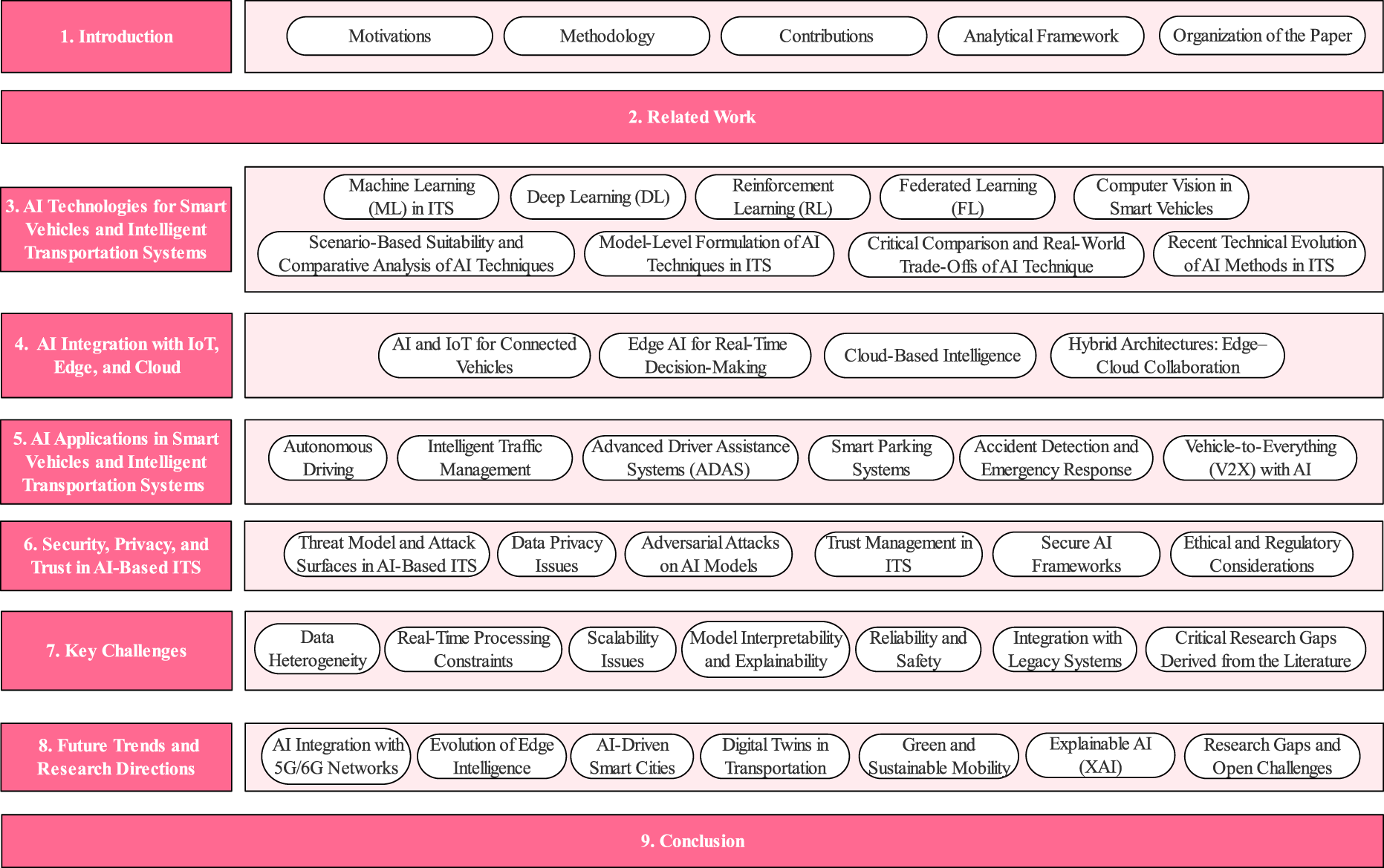
Figure 2: Overall taxonomy and organization of the survey, covering AI technologies, system integration, applications, challenges, and future directions.
AI usage in smart vehicles and ITS has experienced a surge of research interest over the last several years, and a number of studies have been conducted on web domains related to traffic forecasting, self-driving, connected vehicles, and mobility tied to IoT. The survey [12] explored the usefulness of ML algorithms, initially in traffic flow prediction and congestion studies, and revealed that data-driven methods can enhance the efficiency of transport. Similarly, the survey in [13] also illustrates the advantages of predictive analytics in recruiting AI to optimize the route and predict traffic. However, these studies primarily focus on specific algorithms and datasets, while limited attention has been given to large-scale system integration and real-world practical implementation.
The study of autonomous vehicles has also been widely conducted. DL and computer vision are used in [14] to detect objects, identify lanes, and perceive the environment, which are the basis for perception systems in autonomous vehicles. In addition, the survey in [15] analyzes the sensor fusion and decision-making processes with regard to autonomous navigation. Although they may provide in-depth information about intelligence at the vehicle level, these works usually do not consider the integration with the system-wide ITS, communication with the infrastructure, or deployment impediments. As presented in [16], the truth of safety and real-world adaptability are significant concerns that need to be investigated further. Additionally, recent survey [17] discusses the research of IoT-based smart mobility, which emphasizes that the interconnected gadgets, sensors, and vehicular networks are essential to support real-time data gathering and communication. The combination of AI and IoT [18] has demonstrated promising outcomes, including smart parking, traffic tracking, and environmental sensors. However, numerous such surveys focus mainly on connectivity and data collection, but little is done to address the use of more advanced AI models, distributed intelligence, and data privacy methods such as FL. FL is proposed as a solution to seek decentralized learning in vehicular networks in [19], but the problems of communication efficiency and model consistency are poorly covered.
Adaptive traffic control and intelligent decision-making are other areas that have come under the wide study of RL. In [20], the authors suggest using RL to optimize traffic signal operation and reduce congestion, whereas in [21], the approach is extended to a multi-agent system for optimizing traffic signal operation. Although these methods have immense potential, the existing literature is often not critically reviewed with respect to scalability, computational cost, and applicability. Also, the issue of security and privacy of AI-powered transportation systems has been discussed in a number of literature. In [22], the authors discuss privacy and secure communication in vehicle networks, and in [23], the authors consider adversarial attacks on AI models and their effects on self-driving systems. Furthermore, ref. [24] focuses on the significance of trust management and secure systems in ITS. Despite these contributions, the concepts of security and privacy are often treated separately rather than combined in a unified system-level architecture.
While extensive literature exists on the concept of smart vehicles enabled by AI and ITS, there are still several gaps that exist in the research. Firstly, many of the existing surveys focus on a single AI paradigm, for instance on ML or DL or RL or FL or computer vision without considering the whole application in a unified ITS setting. Second, only limited attention is paid to the connection between the AI techniques and the enabling technologies, such as IoT, edge computing, cloud computing, V2X or 5G/6G networks, which are also a key part for real-time and scalable deployment. Third, there are many deployment concerns like latency, interoperability, infrastructure compatibility and also privacy, security and trust issues that are discussed separately and not as inter-related constraints for the system revealed by an analysis.
The present survey addresses these limitations by providing a system-level and deployment-oriented review of AI-based smart transportation. It integrates ML, DL, RL, FL, and computer vision with enabling technologies and major ITS applications, while also examining security, privacy, trust, and future research directions. As shown in Table 3, existing surveys are compared using three coverage levels: “✓” indicates full coverage, where the topic is discussed in detail and linked to ITS applications or deployment issues; “
The comparison suggests that previous surveys tend to focus on more limited areas, such as traffic forecasting, self-driving vehicles, IoT-based mobility, or transportation security. This survey, on the other hand, explores the interaction among AI paradigms, considering infrastructure, applications, security and privacy concerns, and deployment concerns within a common framework centered on the ITS. This more general framework facilitates a more comparative and implementation-oriented perspective on AI-based smart vehicles and ITS.
3 AI Technologies for Smart Vehicles and Intelligent Transportation Systems
AI is essential for enabling smart automation, smart vehicles, and ITS through decision-making and flexibility [25]. The combination of the dynamic and complex nature of transportation environments demands state-of-the-art computational models capable of processing large amounts of heterogeneous data, performing pattern learning, and enabling real-time decision-making [26]. In this regard, paradigms of AI such as ML, DL, RL, FL, and in computer vision have been widely implemented to solve various transportation system problems [27]. This section offers the overall concept of all these important AI technologies, outlines their principles, uses, pros, and cons in intelligent vehicles and ITS.
3.1 Machine Learning (ML) in ITS
AI-driven transportation systems are based on the concept of ML. It allows models to predict and make decisions based on historical and real-time data [28]. ML techniques have been extensively utilized in ITS for traffic flow prediction, travel time estimation, route optimization, and anomaly detection. Regression models, decision trees, support vector machines, and ensemble techniques are typical supervised methods for predicting traffic state based on historical data, while typical unsupervised methods include clustering and dimensionality reduction, which identify concealed trends and outliers, such as accidents or abnormal traffic congestion [29]. The most commonly used representative datasets for ML studies in the field of ITS include METR-LA, PEMS-BAY, Caltrans Performance Measurement System (PeMS), NGSIM and TaxiBJ. These datasets are commonly used for traffic flow prediction, speed forecasting, travel-time estimation, and mobility-pattern analysis [30]. Compared with fixed rule-based systems, which rely on a fixed set of rules to regulate traffic, ML algorithms such as support vector regression, random forests, gradient boosting, and ensemble learning have demonstrated significantly greater adaptability in traffic prediction by learning from past and real-time traffic data. However, their performance is highly dependent on the dataset and may suffer from sudden changes in traffic conditions, such as accidents, weather conditions, or road closures. Also, semi-supervised and online learning methods are widely used to process ever-changing transportation data. ML-based models make traffic control more proactive by leveraging factors such as traffic density, vehicle speed, and congestion levels, and also optimize routes, considering real-world conditions and user preferences [31]. Moreover, the concept of anomaly detectors is crucial for detecting incidents, system malfunctions, and outlier-driven behaviours [32]. Although a few of them are successful, classic ML models have difficulty characterizing nonlinear relationships among many features in large datasets, require extensive feature engineering, and generally struggle to generalize in highly dynamic environments.
ML, and more specifically DL, has been particularly significant in rendering transportation systems intelligent because it enables the extraction of features and the automatic learning of high-level representations of complex data, including images, videos, and time-series signals [33]. One of the widely used AI applications in intelligent vehicles is Convolutional Neural Networks (CNNs), which are used for perception, object recognition, pedestrian recognition, traffic sign identification, and lane recognition, and are useful for autonomous driving and Advanced Driver Assistance Systems (ADAS). Moreover, Recurrent Neural Networks (RNNs), namely Long Short-Term Memory (LSTM) networks, are used to predict traffic and analyze sequential data via recording the temporal relationship within traffic patterns [34]. DL techniques also support multimodal data fusion; the methods are able to perform all of the cameras, LiDAR, radar, and GPS data at once and produce a more accurate perception and decision [35]. Autonomous systems based on DL might also be used to support end-to-end learning systems that combine direct control actions with sensory inputs to move in real time. The DL models are computationally costly and sensitive to large labeled datasets, with poor interpretability, robustness, and generalization, particularly in the context of transportation safety [36].
3.3 Reinforcement Learning (RL)
RL is a more advanced AI paradigm that allows the system to develop optimal decision-making strategies through repeated interaction with the environment, and makes it especially suitable for the dynamic and sequential resource issues in transport systems [37]. The application of RL agents in improving the timing of traffic lights at any given time with respect to the current traffic conditions to reduce the delays and congestion of traffic is one of its applications in the ITS through the adaptive traffic signal control application [38]. Multi-agent RL builds on this to a significant degree as well, or just the capacity to coordinate a great number of intersections to expedite traffic on large-scale networks [39,40]. Furthermore, RL has been used to perform lane shifting, speed regulation, and route planning, among other tasks, enabling vehicles to adapt to dynamic, complex driving situations [41]. RL-based ITS solutions, however, have some practical limitations. Second, either an RL agent typically requires a large number of interactions with the environment before learning a stable policy, or the real-world training process is simply unsafe for live traffic systems. Second, under some conditions, such as having a rapidly changing traffic demand, multiple agents learning at the same time, or a poorly-designed reward function, convergence can be problematic. Third, most studies on RL traffic signal control and autonomous driving use simulation platforms such as SUMO, CARLA, VISSIM, and CityFlow prior to deployment to avoid potential increases in delays, congestion, and safety concerns when testing exploratory actions in actual traffic [42]. Thus, to translate RL to real-world applications, safe transfer from simulation to reality, robust reward design, and validation under various traffic conditions need to be considered [43]. Moreover, there are still issues with practical implementation because it is not only unsafe but also necessary to ensure stable operation in conditions that are both unknown and highly dynamic.
FL has become a promising approach for realizing distributed, privacy-guaranteed AIs in intelligent vehicles and ITS. Compared with centralized learning, FL enables collaboration across multiple devices, including vehicles and edge nodes, to jointly learn a common model without exchanging raw data [44]. This is also useful when there is confidential information in a system like transport, such as vehicle paths, driver behaviour, and positioning, among other details that need to be secured. FL maximizes privacy by isolating data on a local device, reducing communication overhead to only model updates [45]. It facilitates distributed intelligence across all vehicles and infrastructure, enabling use in various applications, including collaborative traffic prediction, decentralized anomaly detection, and cooperative autonomous driving, and it works well with edge computing [46]. However, FL raises issues related to communication efficiency, model synchronization, data heterogeneity, and security threats, including poisoning attacks, which is why the creation of stable and scalable FL-based ITS remains an area of research.
In vehicular environments, these limitations become more complex because FL clients are highly mobile and may not remain connected throughout the training process. Vehicles can enter or leave the communication range of roadside units or edge servers, causing frequent client dropout and incomplete local update transmission. Intermittent connectivity also leads to asynchronous participation, where some vehicles send delayed or stale model updates while others participate in more recent aggregation rounds. This can reduce convergence stability, weaken global model consistency, and increase the risk of biased learning when only well-connected vehicles dominate the training process. Therefore, vehicular FL requires mobility-aware client selection, asynchronous aggregation, hierarchical edge-assisted coordination, and dropout-resilient training mechanisms to maintain model reliability under dynamic network conditions.
3.5 Computer Vision in Smart Vehicles
In the field of AI, one emerging area is computer vision, which enables systems to perceive and interpret their surroundings [47]. In the context of autonomous driving and ITS, perception plays a very crucial role. The fundamental functions include object detection, lane detection, and traffic sign recognition for real-time processing, which typically require complex algorithms such as YOLO, Faster R-CNN, or a semantic segmentation network [48,49]. Mainly, vision-based systems may be augmented by other sensors (e.g., LiDAR and radar) to improve accuracy and robustness [50]. Computer vision will significantly improve object optical recognition, as vehicles could sense road conditions, navigate, and control the driving process around obstacles [51]. However, there are still problems, such as sensitivity to environmental factors (e.g., lighting and weather), high computational requirements, large amounts of annotated data, and reliability and safety across a wide range of real-world conditions.
3.6 Scenario-Based Suitability and Comparative Analysis of AI Techniques
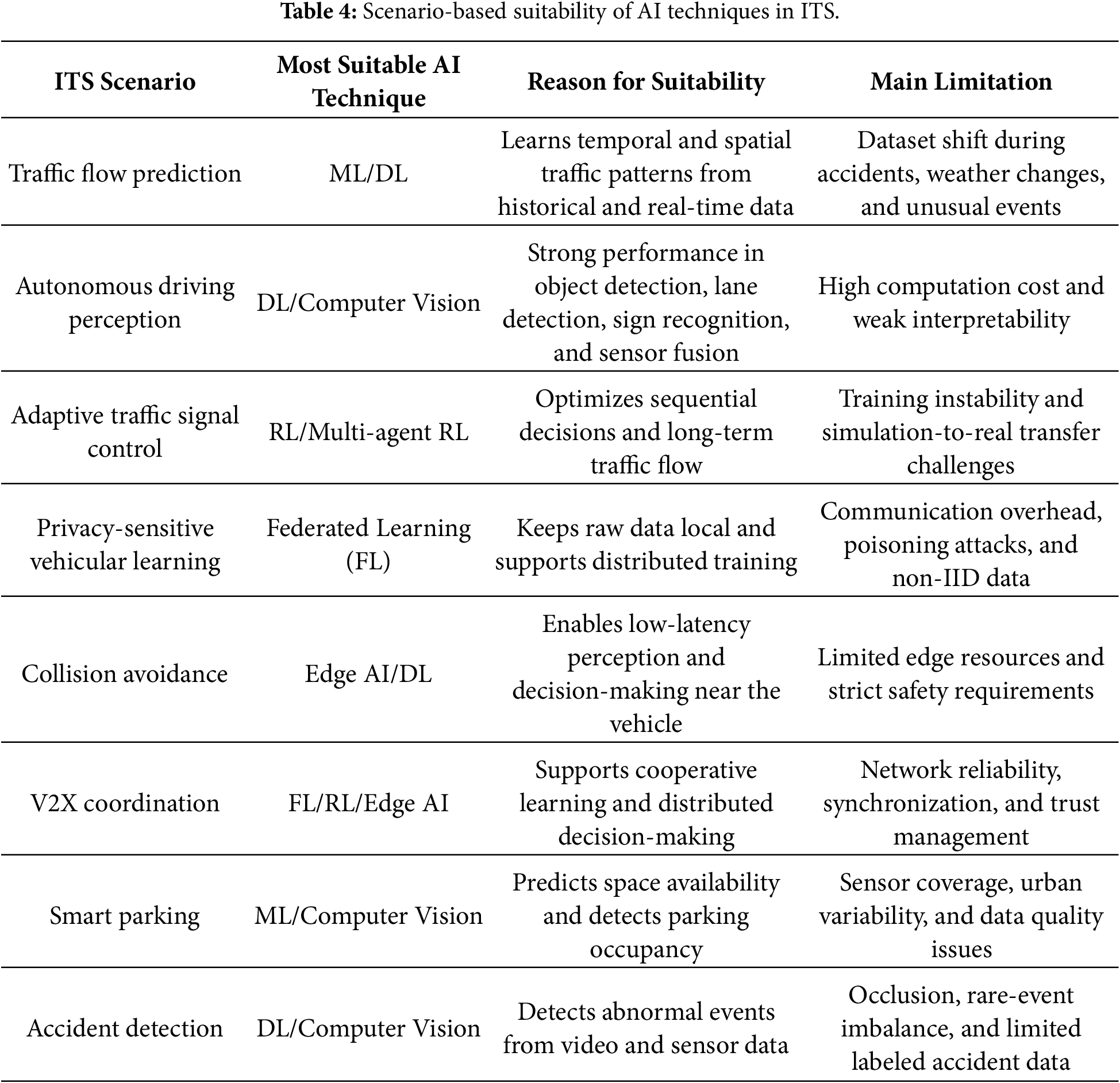
The applicability of AI techniques in the context of smart vehicles and ITS highly depends on the operational scenarios considered. Although classical ML and DL-based models are both useful tools for predicting traffic flow and estimating travel times, these models exhibit distinct advantages and disadvantages. Given this intuition, ML models are relatively simple to train and understand, whereas DL models require extensive traffic sensor data and intricate spatiotemporal relationships. Computer Vision and DL are more appropriate for autonomous driving perception, as they can process data from cameras, LiDAR, radar, and other multimodal sensors. These models are, however, expensive due to the size of the labeled datasets and the computational resources required. Because it is a sequential decision-making problem, RL is better suited for adaptive traffic signal control than conventional supervised learning. It is not only a question of predicting traffic state; the system must make timely decisions and optimize the network’s long-term performance. In real traffic, however, it is hard to deploy RL, as unsafe actions could lead to additional congestion or more accidents. Hence, simulation-based training and validation procedures are typically needed before introducing an RL-based ITS.
FL also offers a great alternative to centralized learning for privacy-sensitive connected vehicle scenarios, as raw vehicle data can be stored on local vehicles, roadside units, and edge devices. This is crucial for safeguarding location data, driver behavior, and flight information. However, FL may also adversely affect training efficiency due to the need to share model updates across distributed devices, and non-IID data may undermine model stability. Thus, FL will make the most sense where privacy takes precedence over the convenience of clustered training. A key observation is that no AI technique is universally superior. Hybrid architectures are the most feasible ITS architectures; for instance, DL can be employed for perception, RL for decision-making, FL for privacy-preserving model training, and edge computing for low-latency prediction. The greatest difficulty is not just the choice of algorithm; it is the design of the entire architecture, balanced among accuracy, latency, privacy, interpretability, and safety. The suitability of the various AI techniques for ITS is summarised in Table 4, which also details their main advantages and limitations.
3.7 Model-Level Formulation of AI Techniques in ITS
To provide a clearer technical grounding, the main AI paradigms used in ITS can be represented through their basic optimization objectives. For supervised ML and DL-based traffic prediction, the objective is generally to learn a function
where
where
In practical ITS applications such as traffic signal control, the state typically includes queue length, waiting time, traffic density, and signal phase, while actions correspond to signal switching or phase duration adjustments. The reward function is usually designed to minimize delay, congestion, queue length, or emissions. For FL, the global model is trained across
where
For safety-critical ITS applications such as collision avoidance, emergency braking, and accident detection, the total latency
3.8 Critical Comparison and Real-World Trade-Offs of AI Techniques
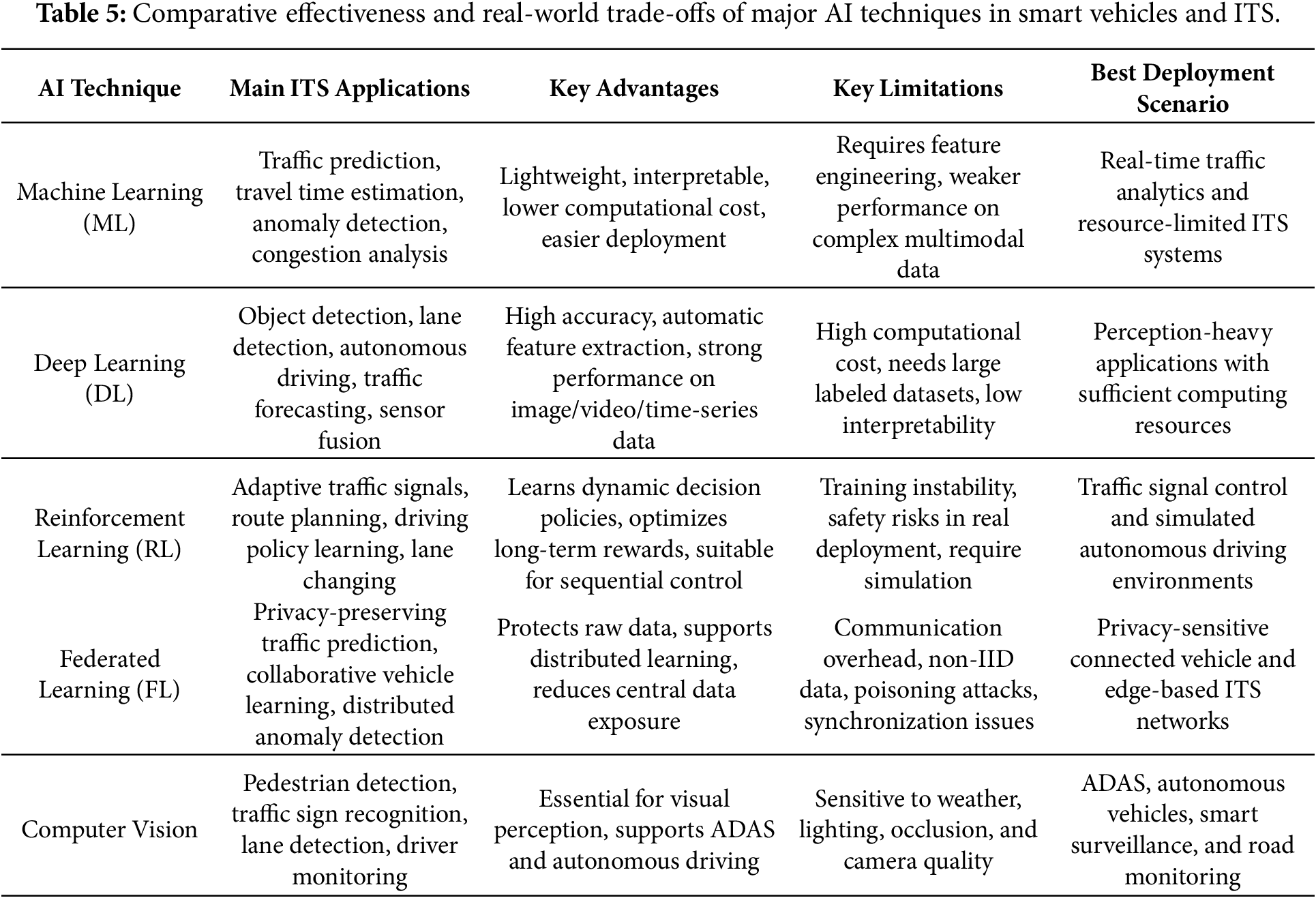
While all of ML, DL, RL, FL, and Computer Vision enable smart vehicles and ITS, their true utility in a specific application depends on the scenario, data type, compute capability, latency, privacy, and safety constraints. Thus, it is crucial to consider factors other than prediction accuracy when choosing an AI technique for deployment, such as deployment cost, interpretability, communication overhead, robustness, and real-time responsiveness. However, ML can provide a relatively lightweight, interpretable solution for tasks such as traffic prediction, travel-time estimation, congestion detection, and anomaly detection, but it relies on handcrafted features and may be less effective with complex data with multiple modes [52]. DL and Computer Vision are suitable for perception-embedded tasks such as object detection, lane detection, autonomous driving, and traffic forecasting based on sensor readings, but the algorithms are data-driven, require enormous labeled datasets and extensive computing resources, and may not be explainable in safety-related applications.
RL can be applied to sequential decision-making applications such as autonomous driving policies, lane changing, route planning, and adaptive traffic signal control; however, because of the potential for unsafe, unstable, and computationally costly experiments, a high-fidelity simulator may be required. While FL allows for privacy-preserving distributed learning by keeping raw data locally with the vehicle and driver, it comes with challenges, including communication overhead, non-IID data, synchronization issues, and poisoning risks. So, there is no one AI technique that is best for all ITS purposes. When deploying, there are considerations to make for centralized vs. FL, edge vs. cloud intelligence, accuracy vs. latency, privacy vs. data utility, and model complexity vs. explainability. Apparently, hybrid AI frameworks are more realistic and viable since they separate the different roles of different AI technologies, such as ML for interpretable analytics, DL and Computer Vision for perception, RL for control decisions, and FL for privacy-aware collaboration. The major AI techniques, their applications, advantages, and limitations, and their suitability for deployment in smart vehicles and ITS are presented in Table 5. At last, the use of these AI paradigms offers the fundamental intellectual energy to assist in growing safety, effectiveness, and automation in ITS, greater solutions to challenges in scalability, reliability, interpretability, and security are still required for large-scale implementation.
3.9 Recent Technical Evolution of AI Methods in ITS
AI-based ITS research has, over the last few years, become increasingly interested in transportation-specific architectures to model road topology, co-operative perception, adversarial behaviour, and temporal dynamics in testbed deployments, shifting away from generic prediction and classification models. Various deep learning architectures, such as conventional CNNs, RNNs, and LSTMs, are being enhanced by Graph Neural Networks (GNNs), spatiotemporal graph convolutions, graph attention, and dynamic graph learning for traffic prediction. These approaches comprise models for traffic networks as non-Euclidean networks where there are nodes, typically represented by a traffic sensor, an intersection, or a road segment or region, and edges, which represent dependency between different subsets of the networks. ASTGCN connects spatiotemporal attention with graph convolution to capture traffic patterns from recent, daily, and weekly updates [53], and Graph WaveNet introduces learning of adaptive dependency matrices that highlight unknown spatial dependencies to supplement road topology. GMAN also enhances dependency encoding with graph multi-attention approaches [54], and spatiotemporal Transformer models have adopted the same spirit, successfully modelling longer-range dependencies and dynamics in traffic compared to traditional recurrent models [55].
For autonomous driving, recent advances have focused on switching from perception-only modules towards perception-prediction-planning systems. Bird’s-eye view (BEV) perception is critical because it can serve as a common spatial representation for tasks such as 3D object detection, map segmentation, occupancy prediction, motion forecasting, and planning. For instance, BEVFusion combines the ability of the camera and LiDAR into a single BEV space for multi-task 3D perception [56]. Multimodal fusion is also at the heart, as cameras give semantic information, LiDAR gives geometry, radar offers robustness in bad weather, and GPS/IMU can aid localization. Other frameworks, like UniAD, which are geared towards planning, further fuse into a single solution the various aspects of perception, prediction and planning with the ultimate goal of safe driving, minimizing error propagation between individual modules [57]. However, there are still challenges to address for these unified systems, including interpretability, safety verification, failure diagnosis, and regulatory acceptance.
With V2X enabled ITS the focus is no longer only on exchanging messages, it is also about cooperative perception and distributed intelligence. Objects, intermediate features, occupancy maps, or driving intentions of vehicles can be exchanged with roadside units and edge infrastructure to extend sensing beyond the local sensor range. This is handy in crowded urban situations, at intersections, in platooning, and in emergency situations. Some of the recently published literature on cooperative perception indicates that sharing perception can help increase situational awareness, but it also highlights issues with agent selection, feature fusion, data alignment, communication latency, and reliability [58]. Thus, the reliability of communications and edge-cloud scheduling plays an important role in the deployment of V2X. While cloud platforms can be used for fleet analytics, long-term traffic optimization, and learning models for a large number of vehicles, on-board and roadside edge processing should be considered for safety-critical tasks such as collision avoidance or emergency braking.
From simple privacy-preserving learning as in FedAvg [59], federated learning has evolved into designs suitable for vehicular FL, accounting for heterogeneous vehicles, non-IID data, intermittent connectivity and variable computational capability, mobility-induced dropouts, and asynchrony in participation. These types of FL studies for ITS highlight the need for learning frameworks that account for mobility and communication limitations in traffic prediction, vehicular edge computing, and traffic target recognition [60]. Asynchronous and hierarchical FL can decrease delays thanks to slow or disconnected clients by having roadside units or edge servers accumulate client updates locally before transmitting them to the cloud. Nevertheless, FL continues to be susceptible to model poisoning, backdoor attacks, malicious updates, and unreliable participants. Even Byzantine-robust aggregation rules can be violated with judiciously picked local model updates, as shown by the previous work [61]. Thus, strong aggregation, anomaly detection, reputation based selection of clients, secure aggregation, differential privacy and poisoning-resilient aggregation of updates are essential for vehicular FL to remain a trusted approach.
Recent transportation-specific AI architectures are commonly evaluated using task-oriented performance metrics that reflect both algorithmic accuracy and deployment feasibility. For traffic prediction models based on graph neural networks (GNNs), spatiotemporal graph convolution, graph attention, and Transformer-based temporal modelling, frequently reported metrics include mean absolute error (MAE), root mean square error (RMSE), mean absolute percentage error (MAPE), prediction horizon, and inference latency. In autonomous driving, perception architectures such as BEVFusion and planning-oriented frameworks such as UniAD are typically assessed using 3D object detection accuracy, mean average precision (mAP), planning error, collision rate, inference time per frame, and computational cost [62]. These metrics provide a more comprehensive evaluation of model performance, since high prediction or detection accuracy alone does not guarantee suitability for real-time deployment under the latency constraints of autonomous driving and roadside decision-making.
Recent DRL-based studies have further expanded AI applications in smart vehicles by addressing communication efficiency and resource management in IoV environments. DRL-based optimization for Age of Information (AoI) and energy consumption in C-V2X-enabled IoV jointly optimizes information freshness and energy efficiency under dynamic vehicular communication conditions [63]. Similarly, resource allocation for twin maintenance and task processing in vehicular edge computing networks demonstrates the importance of jointly optimizing digital twin synchronization, task-processing delay, and resource utilization in distributed vehicular systems [64]. Moreover, DRL-based resource allocation for motion-blur-resistant federated self-supervised learning in IoV addresses latency and energy consumption while improving the robustness of federated model training under dynamic driving conditions [65]. Collectively, these studies demonstrate that AI-enabled ITS should be evaluated using a combination of prediction accuracy, detection precision, Age of Information, end-to-end latency, communication overhead, energy consumption, task-processing delay, and resource utilization, thereby providing a more comprehensive assessment of practical deployment performance.
Recent developments in the applications of AI technology for smart vehicles and ITS indicate a trend towards a transportation-aware, integrated system architecture. They are based on a multi-layered structure that includes graph-based traffic modelling, Transformer-based temporal reasoning, BEV-based multi-modal perception, planning-oriented autonomous driving, cooperative V2X perception, edge-cloud deployment, and secure federated learning. Thus, the performance of future ITSs should be evaluated in terms of prediction accuracy and detection precision, in addition to latency, communication cost, scalability, robustness, privacy, safety, and real-world deployability.
4 AI Integration with IoT, Edge, and Cloud
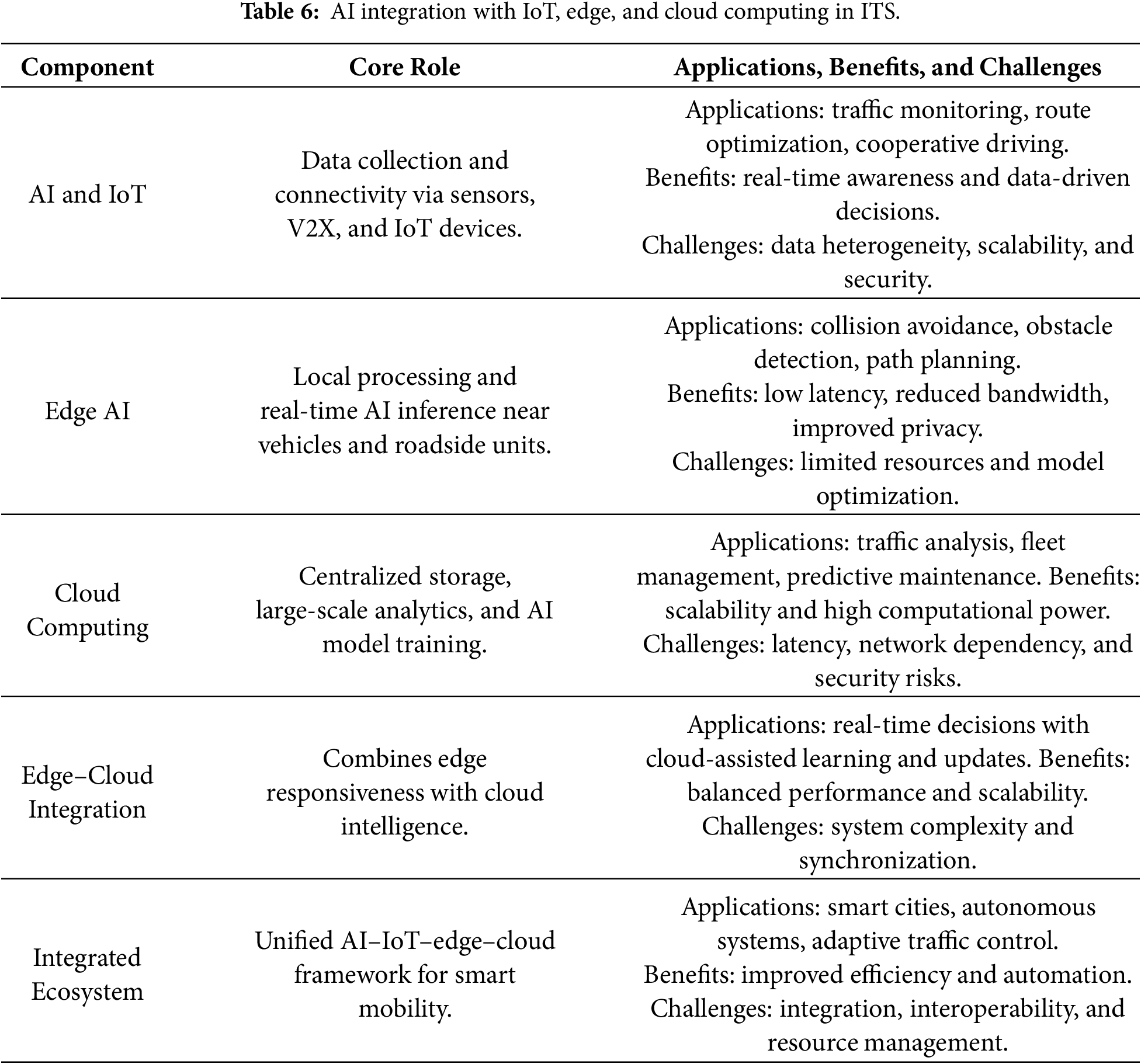
AI is becoming more effective in smart vehicles and ITS through the integration of other technologies such as IoT, edge computing, and cloud computing. AI in ITS can be summarized together with IoT, Edge and cloud Computing as presented in Table 6. All these technologies create a distributed, interconnected ecosystem that enables the acquisition and processing of real-time data and supports intelligent decision-making. The combination of AI and interest can enable scalable, low-latency analysis of context transport that is needed in the modern mobility environment due to its complexity.
4.1 AI and IoT for Connected Vehicles
The IoT is well-suited to linking vehicles and objects to other objects on the road to enable continuous collection of large volumes of data from sensors, cameras, GPS modules, and roadside units [66]. AI uses this information to uncover valuable insights and support intelligent decision-making in transportation systems [67]. As an example, AI applications can use data collected by IoT devices to identify traffic congestion, accidents, driver behaviour, and route optimization. IoT communication is also possible in connected vehicle environments, which use V2X technologies and support interaction among vehicles (V2V), infrastructure (V2I), pedestrians (V2P), and networks [68]. The combination of AI and IoT enables real-time situational awareness, which is essential for autonomous driving, intelligent traffic control, and cooperative driving [69]. However, data heterogeneity, scalability, and security issues are also of great concern to the full potential of AI-enabled IoT systems in the transportation industry.
4.2 Edge AI for Real-Time Decision-Making
Edge computing has become the solution to overcome the data processing latency and bandwidth issues of centralized solutions, enabling data processing and AI inference to occur closer to the source, such as inside vehicles, roadside units, or local edge servers [70]. This has been used to enable real-time decision-making in time-sensitive transportation applications such as collision avoidance, obstacle detection, and path planning through autonomous vehicles. Edge AI is highly responsive, as processing data locally minimizes communication delays and enhances overall system responsiveness [71]. It also reduces the load on the network by decreasing the raw data transmitted to the cloud and improving data security through the localization of sensitive information. Edge AI is a useful technology, especially in dynamic environments with limited connectivity [72]. However, other aspects, such as the lack of computational capabilities, energy usage, and optimal model optimization, are complex issues; therefore, the edge/cloud computing balance is a critical research question.
Cloud computing has become an integral part of AI-based ITS, providing vast storage capacity, substantial computing power, and centralized control of information. It is primarily used for training general-purpose AI models and for merging diverse data and scaling analytics [73]. Examples of applications to which cloud platforms are applicable in the transportation sector include global traffic, fleet management, predictive maintenance, and long-term planning. The deployment of cloud-trained AI models can be achieved on edge devices to enable real-time predictions, which supports an edge cloud/edge architecture [74]. Cloud computing can also promote vertical integration and information exchange between regions and systems, and facilitate the massive implementation of ITS and the development of smart cities [75]. However, the deployment of cloud infrastructure has issues related to latency, reliance on network connections, and potential security vulnerabilities.
4.4 Hybrid Architectures: Edge-Cloud Collaboration
Hybrid edge and cloud computing architectures have been developed to leverage the capabilities of the two paradigms above by integrating local computation with the central intelligence [76,77]. Time-sensitive operations in such systems are performed at the edge to achieve low latencies, while computationally intensive workloads are performed in the cloud, e.g., model training and large-scale data analysis [78]. The strategy will contribute to better resource utilization, scalability, and system performance [79]. For example, real-time sensor data can be processed by edge devices to make immediate decisions, and AI models are continually updated with aggregated data transmitted from various sources to the cloud [80]. In addition, hybrid architectures can support advanced capabilities such as FL, which trains models in a distributed way without data breaches, as well as enable seamless communication with IoT/V2X systems that enable coordinated, intelligent transportation.
The modern smart transportation system is based on a combination of AI, IoT, edge, and cloud computing. IoT provides connectivity for our data, edge computing enables real-time intelligence, and cloud computing enables model training and large-scale analytics [81]. These technologies are integrated to create a synergistic ecosystem that enhances the performance, scalability, and reliability of the AI-powered ITS [82]. However, to succeed in an integration, it is imperative to overcome difficulties in system architecture design, data management, interoperability, security, and resource optimization. Future research will also focus on creating effective, flexible frameworks that facilitate a seamless integration of AI, IoT, edge, and cloud computing within the context of smart mobility.
5 AI Applications in Smart Vehicles and Intelligent Transportation Systems
AI has enabled a broad range of capabilities in intelligent vehicles and ITS to transform basic transportation into intelligent, responsive, and independent mobility systems [83]. These applications can improve safety, efficiency, reliability, and user experience across different transport fields with the help of AI. In this section, the key application domains in which AI plays a vital role are discussed. As illustrated in Fig. 3, AI enables a wide range of applications in smart vehicles and ITS.
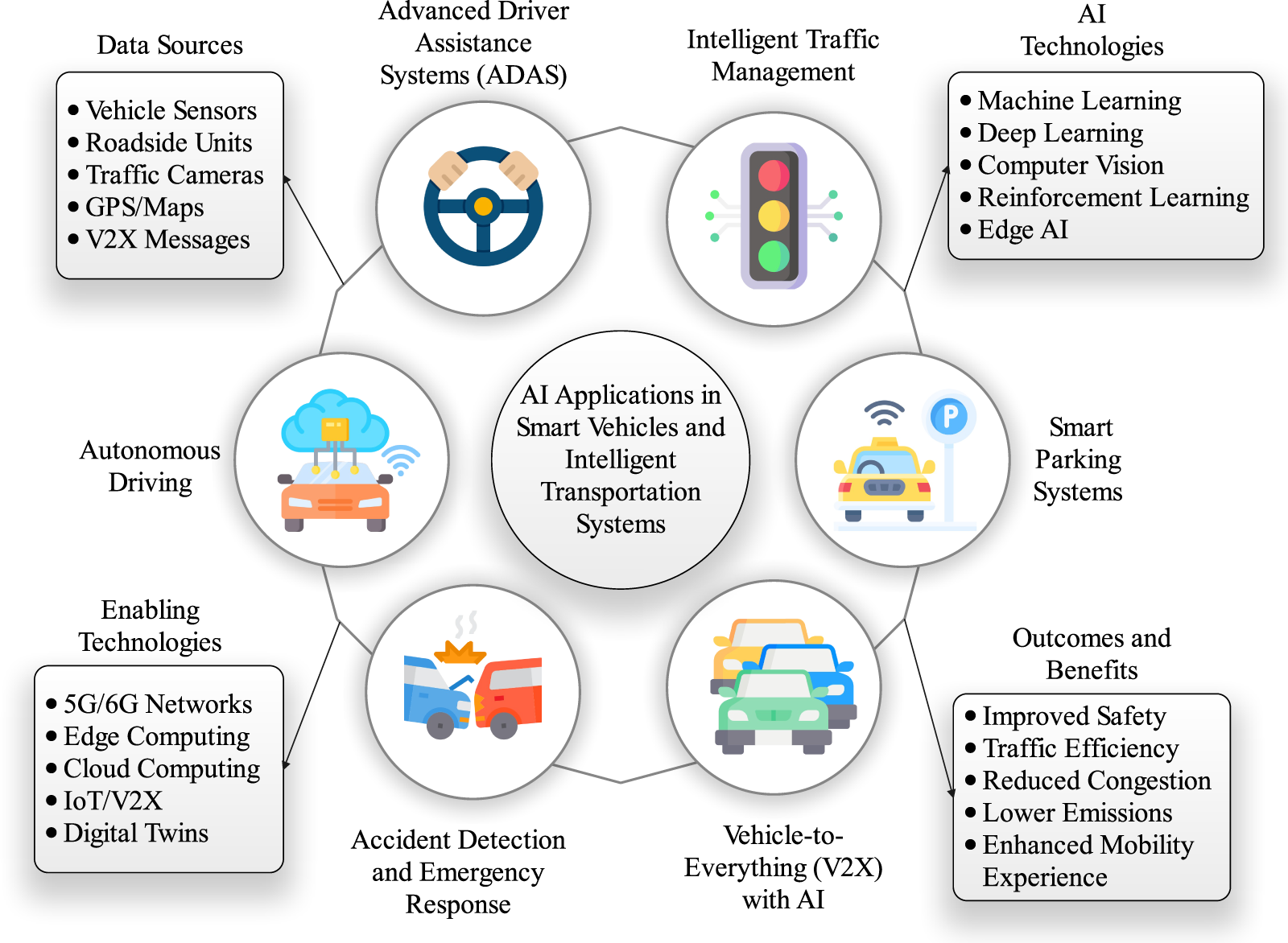
Figure 3: Key AI applications in smart vehicles and intelligent transportation systems, including autonomous driving, intelligent traffic management, ADAS, smart parking, accident detection, and V2X communication. It also highlighted the key data sources, enabling technologies, AI techniques, and the expected outcomes.
One of the most evident applications of AI in smart vehicles is autonomous driving, as vehicles can sense and communicate with their environment using cameras, LiDAR, and radar [84]. Tasks that machines perform with the help of AI, in particular DL and Computer Vision, include object detection, traffic sign recognition, lane detection, and scene understanding. The capabilities enable vehicles to make informed decisions for path planning, obstacle avoidance, and motion control [85]. RL also has the advantage of improving decision-making by teaching systems the best strategies to use in a dynamically changing environment, and sensor fusion techniques enhance accuracy by combining data from multiple sensors. However, the huge developments, security concerns, structural integrity, and generalization in real-life scenarios, especially in big cities, are important issues.
5.2 Intelligent Traffic Management
AI has helped traffic management systems through the introduction of data-driven and adaptive control measures. The prediction of traffic flow, identification of congestion, and determination of travel time are popular applications of ML and DL models based on historical and real-time data [86]. RL-based approaches further enhance intelligent traffic management by allowing traffic signal timing to adapt dynamically to real-time traffic conditions, thereby reducing congestion, queue length, and vehicle delay. Multi-agent systems bring this feature to the extent that they coordinate multiple intersections across the network in order to optimize the whole network. Moreover, AI-generated systems will be able to recognize accidents or road blockages in real time, thus having a faster reaction and increasing resilience in traffic as a whole [87].
5.3 Advanced Driver Assistance Systems (ADAS)
Advanced Driver Assistance Systems (ADAS) are systems that utilize AI in order to enhance the safety and comfort of drivers through the performance of multiple driving functions [88]. These systems are fitted with features such as adaptive cruise control, lane-keeping assistance, automatic emergency braking, blind-spot detection, and driver monitoring. Visual data is analyzed using AI methods, especially computer vision and DL, to detect potential hazards, and the vehicle’s surroundings are monitored using sensor-based systems. AI algorithms constantly analyze driving conditions and provide real-time feedback or trigger automated actions as required by the driver [89]. ADAS is one of the final milestones in the development of fully autonomous driving, as it will reduce the risk to humans and improve driving performance.
Smart parking systems based on AI can maximize the use of parking resources and save time in the process of locating an empty parking space through the real-time monitoring of sensors, cameras, and the IoT [90]. ML algorithms analyze parking trends to forecast the availability of parking spaces, whereas a mobile application displays the location of available parking spaces to the driver. Computer Vision techniques can also identify available parking spaces from camera feeds, improving the system’s accuracy [91]. Such solutions allow better use of traffic, enhance user convenience, and make urban mobility more efficient.
5.5 Accident Detection and Emergency Response
AI is critical to improving vehicle road safety through real-time accident detection and emergency response systems [92]. The ML and DL models take into account data from sensors, cameras, and vehicular networks to identify behaviour and accidents [93]. There are several public datasets used to test the detection of accidents, traffic incident recognition, and understanding of road scenes. Some of the datasets, including DOTA, UA-DETRAC, BDD100K, AI City Challenge, and CADP, are useful resources for vehicle detection, accident localization, traffic monitoring, and abnormal-event recognition in vision-based road event analysis [94]. The DOTA and BDD100K datasets are useful for object detection in aerial and traffic scenes, and the AI City Challenge is useful for large-scale driving-scene perception and traffic video analytics [95]. The accuracy of accident detection should not be viewed as a universal value; it depends on the camera angle, weather conditions, occlusion, accident severity, object size, and model architecture. In the event of an incident, AI systems will automatically alert emergency services, providing correct information on the location and structured responses. Also, high-tech models can be used to identify high-risk areas and potential accidents, and to take precautionary measures [96]. The capabilities save a great deal of time in responding to and managing emergencies, and also improve overall road safety.
5.6 Vehicle-to-Everything (V2X) with AI
V2X transportation systems are built on connected transportation systems, in which vehicles communicate with other vehicles, the infrastructure, and pedestrians via messages [97]. AI is another technology that enhances V2X by enabling these parties to process and make decisions, as well as coordinate data. V2X applications are powered by AI and include cooperative driving, collision avoidance, traffic coordination, and platooning, enabling vehicles to share real-time data on road conditions and accidents to improve safety and efficiency [98]. AI and V2X communication are vital for making transportation systems more interconnected, collaborative, and intelligent, as well as for improving situational awareness.
In smart vehicles and ITS, the potential of AI changing the existing transportation system can be traced. Smart, safe, and efficient transportation processes can be made AI-assisted by autonomous driving, traffic management, safety systems, and connected mobility [99]. However, the real-world application of such applications has to overcome challenges in system reliability, scalability, data confidentiality, and compatibility. The future of autonomous transportation systems will require ongoing research and development.
6 Security, Privacy, and Trust in AI-Based ITS
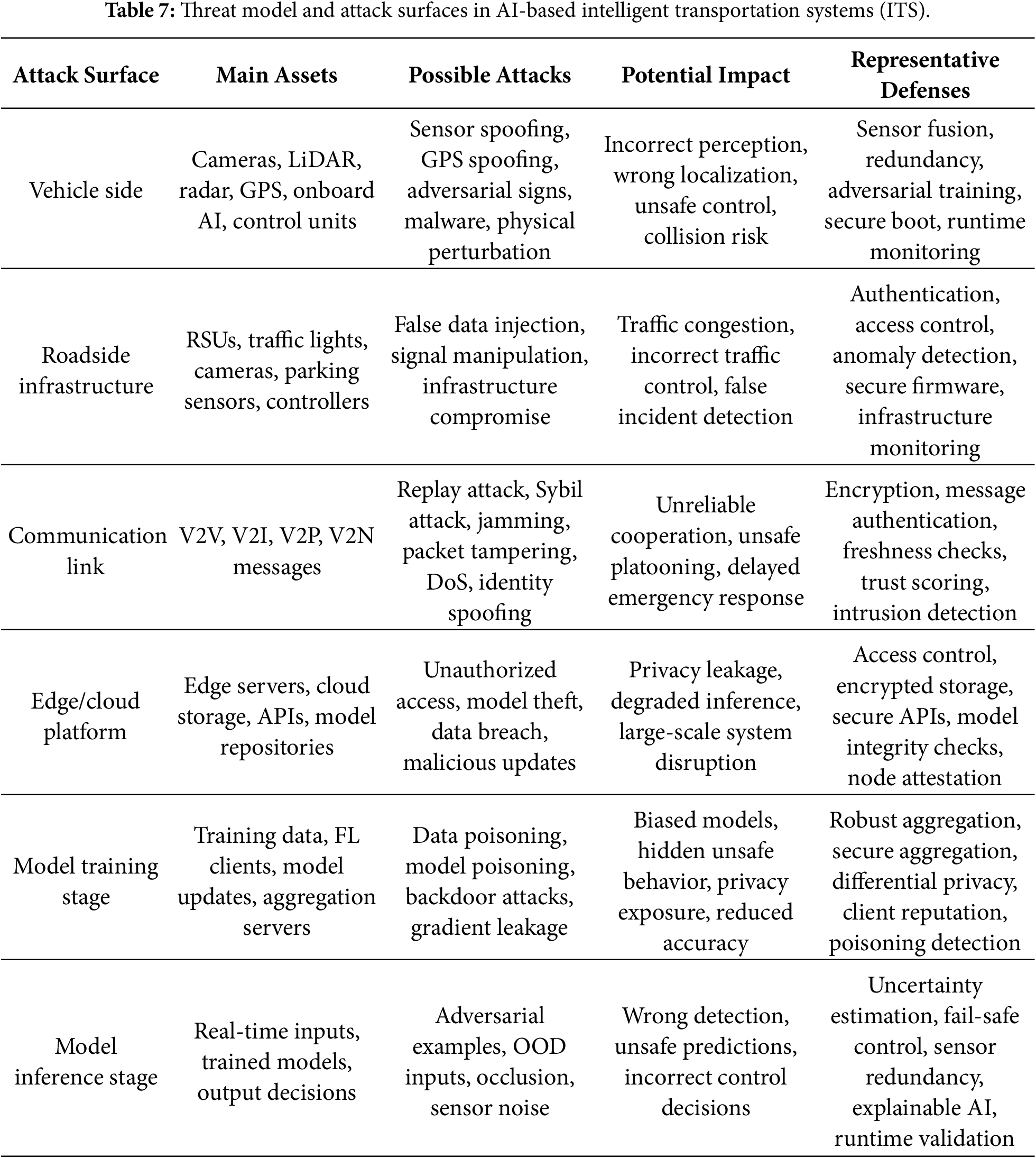
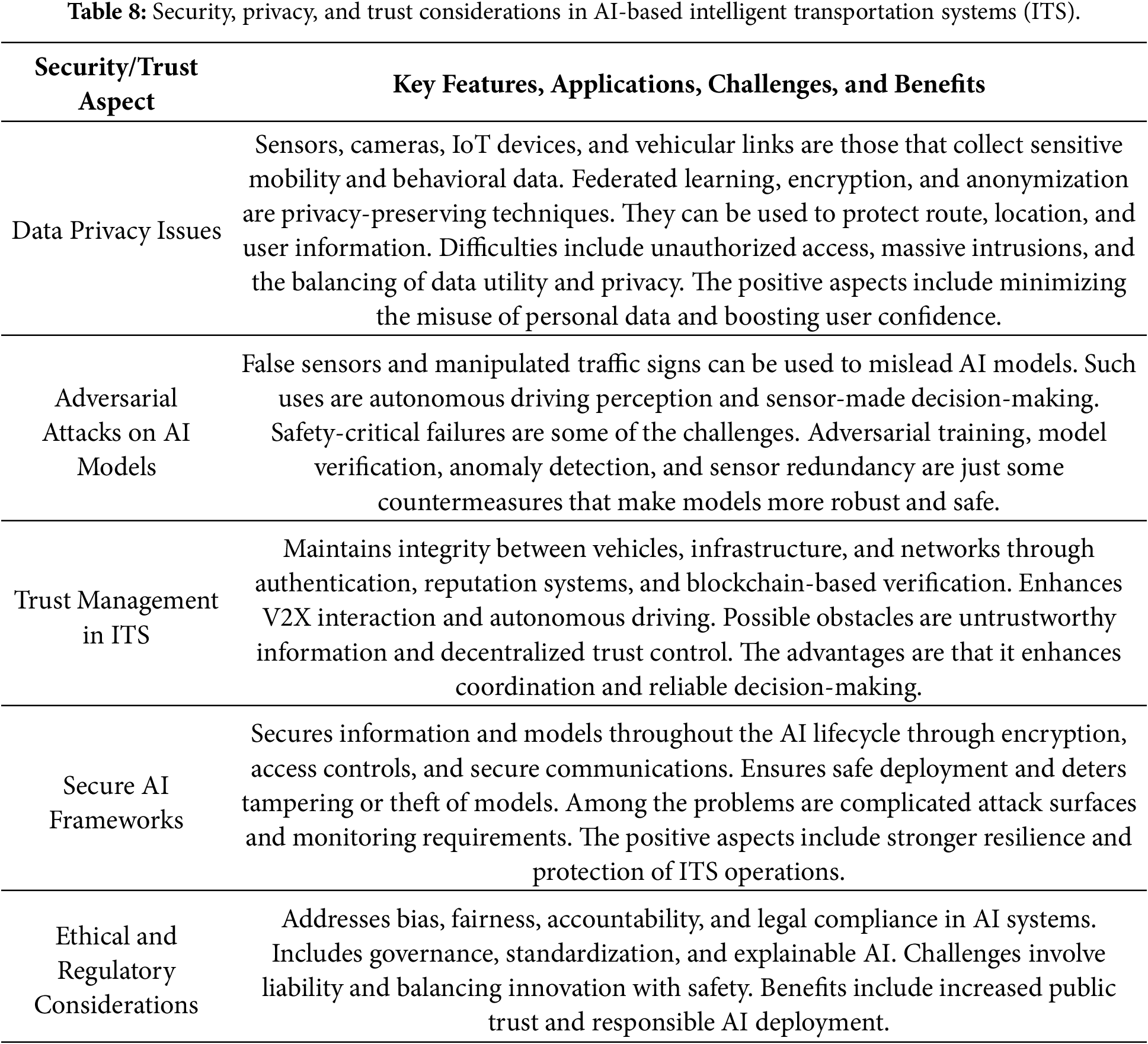
With the growing role of AI in intelligent vehicles and ITS, the issues of security, privacy, and trust are taking on a more central role in the sector [100,101]. Transportation systems with high automation levels rely on the continuous exchange of information, distributed intelligence, and fast decisions, and are susceptible to cyber threats, data breaches, and attacks at the level of the system. AI-based ITS can be safely and acceptably used only when its operations are secure and privacy-protecting, as well as trusted. While Table 7 defines the attack surfaces and threat model, Table 8 summarizes the broader security, privacy, and trust considerations that support mitigation across these attack surfaces.
6.1 Threat Model and Attack Surfaces in AI-Based ITS
The security issues with AI-based ITS aren’t just algorithmic; they exist at multiple layers of the transportation system, and a structured threat model is needed to address these risks. This survey examines six major attack surfaces: Vehicle systems, roadside infrastructure, Communication links, Edge/Cloud platforms, Model training, and Model inference. Various layers have distinct assets, vulnerabilities, and adversarial goals, including traffic management decisions, control commands, AI models, and V2X messages [102]. Attackers could use various means to tamper with inputs, interfere with communication, contaminate learning systems, or subvert the decision-making pipeline.
Vehicles are susceptible to attacks on onboard sensors and computing units such as spoofing, adversarial perturbations, and malware injection, impacting the perception, localization, and control functions. Information on the roadside can be tampered with to alter the status reported by roadside sensors or the information reported to or by a traffic sign, leading to incorrect traffic decisions. Communication is exposed to attacks such as message tampering, replay attacks, jamming, Sybil attacks, and denial-of-service attacks, which may affect the perception of cooperation and/or V2X reliability. Security requirements thus concern not only the confidence in the information, but also its authenticity, integrity, freshness, and availability.
Edge and cloud platforms pose risks of unauthorized access, model theft, potential denial of service, and potential malicious updates. Compromised nodes can introduce wrong analytics or control signals in real time and broadcast them to the whole system, if they are used for real-time system processing and large-scale system processing, it is necessary to carry out strict access accounting and anomaly detection. During the model training phase, especially in federated and distributed learning environments, poisonous attack, backdoor, and malicious update may reduce the reliability of the model, and cause hidden vulnerabilities. Strong aggregation, differential privacy, and client selection based on their reputation, are important defence mechanisms to ensure. Adversarial inputs, sensor noise and environmental uncertainty during the actual use can still result in wrong predictions and therefore monitoring and uncertainty estimation and fail-safe mechanisms are crucial for safe operation.
AI-based ITS security is not individual threats; it should be understood as a system-level property. It is necessary in an ITS to acknowledge and develop a unified threat model that brings together attack surfaces, assets, vulnerabilities and impacts, thereby emphasizing the interdependence of privacy, trust, adversarial robustness and secure deployment.
Transportation systems based on AI handle a huge amount of confidential data about vehicle routes, user positions, driver habits, and other factors, such as environmental conditions, gathered by sensors, cameras, IoT devices, and vehicular links [103]. This makes privacy an important issue because unauthorized access is likely to result in the misuse of data, the threat of being monitored, and the revelation of personal information, including the user’s habits and movement patterns [104]. Also, centralized cloud storage makes it more probable to experience a data breach at a wide scale. The above concerns have led to the use of privacy-preserving methods such as data anonymization, encryption, and FL, which allow users to train a model without exchanging raw data [105]. However, the trade-off between data utility and high privacy levels is a difficult dilemma in transportation systems with AI.
6.3 Adversarial Attacks on AI Models
Automated systems in transportation have applications in safety-critical scenarios, including self-driving vehicles; in these contexts, however, AI models can be misled by carefully designed inputs and pose significant risks, a phenomenon known as adversarial attacks [106]. However, even a small alteration to road signs or markings can cause Computer Vision systems to interpret it as another road sign, leading to an incorrect decision [107]. Similarly, attackers could exploit sensor data or inject false information into vehicular networks, thereby affecting system operations [108]. The challenges require leveraging advanced AI models, secure training plans, and real-time anomaly detection, including adversarial training, model verification, and sensor redundancy, to bolster system resilience.
Trust is one of the most important requirements for the successful implementation of ITS with AI, particularly when more than two parties interact, such as vehicles, infrastructures, and communication networks [109]. Trust management ensures that information exchanged among vehicles, infrastructure, and networks is credible, authenticated, and reliable. It supports secure V2X communication, cooperative perception, and autonomous decision-making through mechanisms such as authentication, reputation scoring, blockchain-assisted verification, and anomaly detection. Vehicles in V2X use data from each other to make decisions; incorrect or unreliable information can compromise the safety and efficiency of the system [110]. In response, the management of trust uses methods of reputation systems, authentication protocols, and blockchain-based identity verification to verify data sources. Furthermore, trust in AI systems should be built through transparency and explainability, which allows users and operators to interpret and confirm AI-based decisions, particularly in safety-critical systems.
ITS requires secure AI systems that ensure network safety against cyberattacks and efficient operation. Secure AI includes the safety of data and models throughout the data lifecycle, e.g., data collection, model training, deployment, and inference. It involves implementing high-level security controls, such as encryption, access controls, and secure data transmission, to limit unauthorized access [111]. In addition, model security is important for thwarting threats such as model theft, tampering, and reverse engineering. The system-level security also ensures that it employs powerful communication protocols and a robust network architecture to thwart any form of attack. Continuous surveillance systems should also be in place to observe any abnormalities and unlawful actions [112]. The resilience and reliability of ITS at large will be enhanced by preventing threats and providing proactive intervention through the integration of AI with new IT-based cybersecurity solutions, thereby making the systems more resilient and reliable.
6.6 Ethical and Regulatory Considerations
The growing importance of AI in the transport sector poses serious ethical and legal concerns that warrant examination [113]. Ethical considerations related to AI systems, decision-making in critical situations, and possible bias in algorithmic decision-making. These are just a few reasons that prove AI design and implementation must be responsible [114]. The AI-based transportation system needs to be conducted in a safe and transparent manner. Other topics, such as data governance, liability, data standardization, and compliance with privacy regulations, may be addressed within such frameworks [115]. Furthermore, explainable AI (XAI) has emerged as a key factor in enhancing user acceptance and building trust, since AI decisions can be explained and understood, particularly in self-driving vehicles.
The most important foundations for the successful implementation of AI-based smart vehicles and ITS are security, privacy, and trust. While AI offers extensive benefits in Intelligence and Automation, it also exacerbates vulnerabilities and increases the attack surface [116]. A multidisciplinary approach that involves AI, cybersecurity, communication protocols, and regulatory patterns is required to address these challenges. Future investigations should be directed toward the design of robust, secure, and resilient AI systems that can handle the dynamic and unsteady nature of the transportation landscape while ensuring the systems and users’ privacy and integrity are maintained.
Despite the successful use of AI in previous years in the field of intelligent vehicles and ITS in an experimental setting, multiple issues prevent large-scale application and practice [117]. These challenges are all caused by the complexity of the transportation environment, the heterogeneity of data sources, the extreme need to work in real time, and the reliability and security of system functioning. The next section shows the major concerns concerning AI-based ITS. The main issues related to AI-based ITS are summarized in Fig. 4.
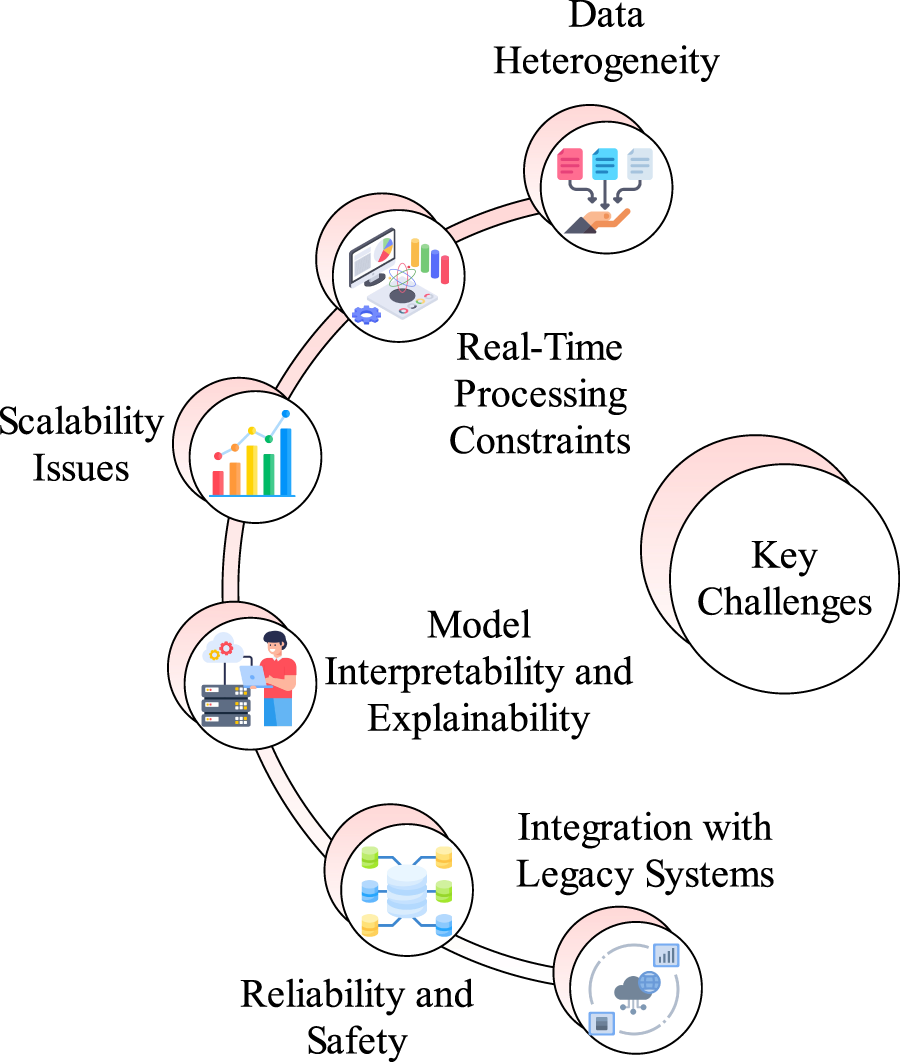
Figure 4: Major challenges in AI-based intelligent transportation systems, including data heterogeneity, real-time constraints, scalability, interpretability, reliability, and legacy system integration.
Data heterogeneity is one of the most significant problems in AI-oriented transportation, as smart vehicles and ITS systems receive data from different sources: LiDAR, radar, cameras, GPS, IoT nodes, and vehicular communication systems. Such data is not in a comparable format, arrangement, scale, or quality, and therefore integrating and digesting it in a single framework is highly intricate [118]. The multimodal data should be able to be successfully merged with multimodal models without affecting performance or causing poor accuracy. Further, inconsistencies, missing data, and noise can have a major impact on the model’s performance [119]. A solution to the above challenges will be to develop effective methods for preprocessing and combining data, and to use standardized data formats to ensure reliability and accuracy in the system’s operation.
7.2 Real-Time Processing Constraints
One of the critical features of an ITS is time-sensitive processing, and applications such as collision avoidance, traffic regulation, and autonomous driving must be handled with timely responses in the shortest possible time. On the safe side, AI models can operate under minimal latency on a large volume of data [120]. With that said, most advanced techniques, particularly DL models, are expensive and cannot meet very strict latency requirements, especially in resource-constrained scenarios [121]. To achieve real-time performance, one can conclude that an ideal model design, hardware acceleration, and effective joint implementation of edge computing solutions are required.
Scalability is also a significant issue in the deployment of ITS using AI applications in large and complex networks. The volume of information and computation is increasing as networks of interconnected vehicles, sensors, and infrastructure devices grow [122]. There is no easy way to ensure the scalability of AI models and system architectures without compromising performance. With the help of distributed computing, FL, and edge-cloud collaboration, the problem can be solved, though they create new issues related to coordination, communication overhead, and resource management.
7.4 Model Interpretability and Explainability
The other important issue is that models in AI-based transportation systems are interpretable and explicable to customers, and most advanced paradigms, including deep models, are black boxes with very low transparency. Finally, because it relies on uninterpretable features, it can undermine users’ trust in the system and complicate its use in safety-related contexts, e.g., in autonomous driving [123]. It should be possible to argue about the manner in which AI has reached all decisions, to check, diagnose, and correct adherence to regulations. Explainable AI (XAI) approaches are developed to make AI more transparent by presenting information about model behaviour, but balancing high performance and interpretability remains a research problem.
One of the most important needs in an AI-based transportation system is reliability and safety, because shortcomings in these areas can have dire consequences. The AI models should be able to operate in diverse and unpredictable environments, including changes in weather, lighting, traffic congestion, and road conditions [124]. System integrity is ensured by making systems robust to sensor failures, anomalous data, and adversarial circumstances. Moreover, this requires close testing, validation, and certification to meet safety requirements [125]. The paramount importance of ITS reliability and safety is also the creation of fail-safe systems and redundancy to introduce better systems.
7.6 Integration with Legacy Systems
Legacy system integration is also a major obstacle towards implementing AI-powered transportation systems since current infrastructure is not always tailored to accommodate new AI-related capabilities [126]. The result is technical and operational challenges, such as incompatibility, lack of standardization, and high deployment costs. The process must be properly planned to achieve a smooth integration; interoperable frameworks must be developed; and the system must be upgraded incrementally in a continuous manner, gradually adding the benefits of advanced intelligent features.
7.7 Critical Research Gaps Derived from the Literature
The literature review has revealed that key gaps with AI-based ITS are not stand-alone, but interconnected deployment barriers. These gaps can be grouped into four broad categories. The first is that algorithms do not always translate into the real world. While a number of studies report positive results on certain datasets or simulations, fewer studies can validate under mixed weather, occlusion, sensor failure, unusual congestion, road works, or adversarial conditions. This reduces the capabilities of AI systems in real transportation situations.
Second, there is a trade-off between accuracy and latency. Though larger DL and vision models may achieve higher detection or prediction accuracy, they may be more computationally demanding and unsuitable for time-critical applications unless compressed, accelerated, or deployed via edge computing. This implies that future research on ITS should present not only the accuracy but also the inference time, communication delay, energy consumption, and hardware requirements. Third, the fields of privacy-preserving learning and sound distributed training are unmatched. While FL mitigates the need for raw data sharing, it introduces non-IID data, communication overhead, poisoning attacks, and inconsistent local model updates. More research focused on secure mode aggregation, anomaly detection in model updates, lightweight FL protocols, and robust training under heterogeneous vehicles and infrastructures.
Fourth, there is a lack of explainability and safety certification. Permitting many AI-based ITS models to remain black-box systems. This is bad for several reasons, as autonomy, ADAS, and Traffic Control are reliant on trust, accountability, and regulation. Future research should consider multiple performance metrics for explainable AI, uncertainty estimation, formal verification, and safety validation, rather than accuracy alone. The gaps highlight the need to shift the focus of future AI-driven ITS research from stand-alone algorithm development towards system design, with focus on deployable, secure, explainable, and latency-aware systems.
The above challenges demonstrate that integrating AI into smart vehicles and ITS is difficult. The fundamental problems associated with the deployment of AI-based transportation systems include data heterogeneity, real-time processing, scalability, interpretability, reliability, and system integration, all of which must be addressed to ensure success. Further investigations are needed into how to develop stronger, scalable, and interpretable AI that yield effective system architectures stable in real-life setups. It is these challenges that must be addressed to bring out the best in ITS.
8 Future Trends and Research Directions
The future of smart vehicles and ITS is determined by the rapid development of AI and new forms of communication and computing technologies. Despite the field of smart mobility already evolving and being enhanced to some extent, new trends and research streams continue to shape the sphere. This segment outlines the majority of trends likely to shape the future generation of AI-driven transportation systems. Fig. 5 highlights the key emerging trends, in accordance with which the use of AI-driven transportation will evolve in the future. Table 9 is an overview of the major future trends, future research, and technology enabling smart vehicles and ITS through AI. The future directions in AI-based ITS should not just be categorized as technology names, as their usefulness is determined by their solutions to specific technical problems. For instance, 5G/6G integration is relevant not only to communicate at higher speeds, but also to enable ultra-low-latency V2X coordination, cooperative perception, and distributed model updates. Similarly, digital twins can only be useful if they are viewed as a means to realistic simulation, safety testing, scenario generation, and sim-to-real transfer of AI models. Beyond transparency, XAI plays a crucial role in the development and deployment of safety-critical systems, including debugging, certification, liability analysis, and user trust. Thus, it is recommended that future research link each emerging technology to measurable ITS requirements, such as latency, throughput, and robustness, as well as to privacy, energy efficiency, and safety validation.
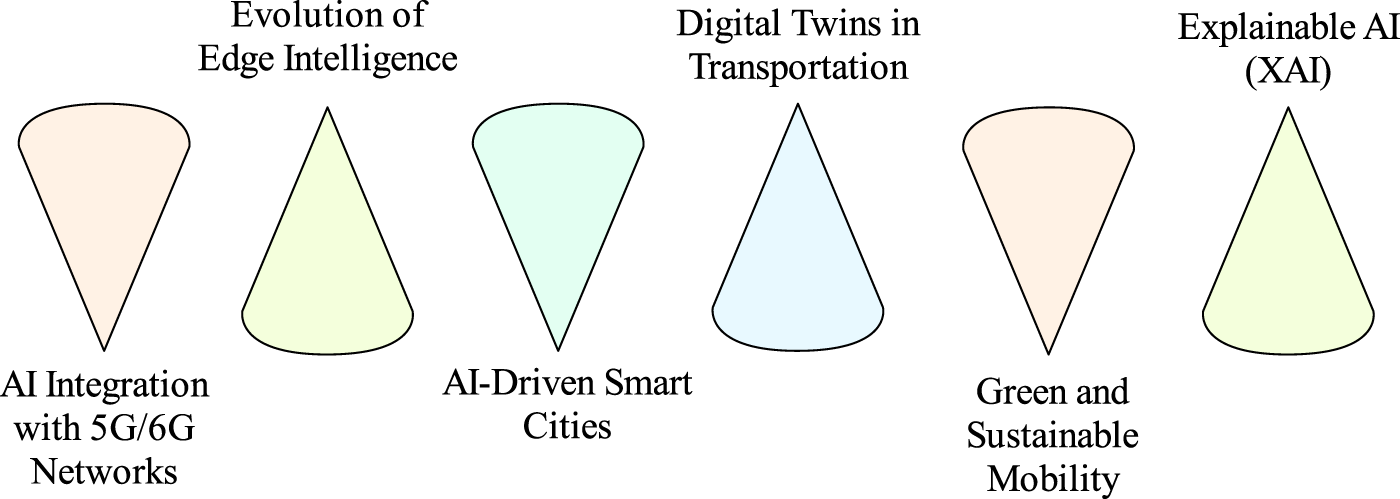
Figure 5: Emerging trends and future research directions in AI-driven intelligent transportation systems, including 5G/6G integration, edge intelligence, digital twins, smart cities, sustainable mobility, and explainable AI.
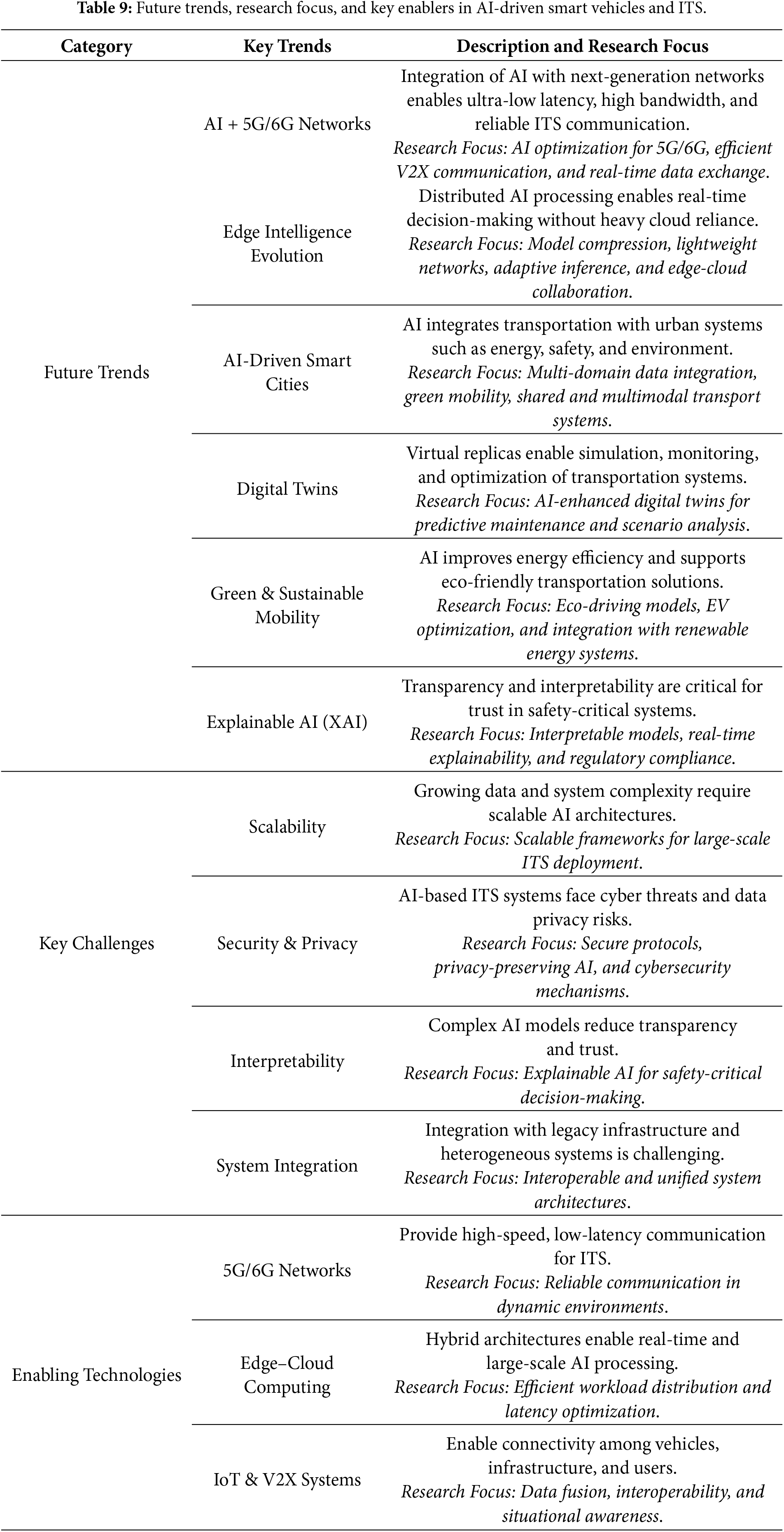
8.1 AI Integration with 5G/6G Networks
AI combined with new 5G and 6G networks would take ITS to the next level, enabling networks with the lowest latency and highest bandwidth, with assured connections [127]. The features are required to support current applications such as self-driving vehicles, vehicle coordination, and intelligent traffic control [128]. The superior networks that AI can develop to accelerate data transfer between vehicles, the infrastructure, and the cloud can improve the precision of the data used in decision-making and the system’s reactivity [129]. Optimization of AI models in the next-generation communication environment will further involve studies aimed at ensuring the efficient development of smooth V2X communication and the creation of a reliable, stable network in cases where transport is the most dynamic [130].
8.2 Evolution of Edge Intelligence
The utilization of edge intelligence should be an important part of the future transportation system, as it will enable distributed AI processing and bring it closer to data sources [131]. As edge devices advance, more sophisticated AI models will be supported, eliminating the need to rely on centralized cloud infrastructure [132]. The next generation will be built on effective model deployment, resource management, and smooth interaction between the edge and cloud environments. Some techniques, including model compression, lightweight neural networks, and adaptive inference, will be required to achieve real-time performance on constrained devices.
The use of AI will be central to empowering smart city ecosystems, which will incorporate transportation networks and integrate with urban environments, including energy management, public safety, and environmental control. Smart infrastructure will communicate with smart devices in transportation to achieve higher mobility and a better quality of life [133]. Future studies will focus on creating integrated platforms using transportation data and other city-scale information to enable holistic, data-driven decision-making [134]. Also, smart cities powered by AI will focus on green mobility, such as shared transport systems, electric vehicles, and multimodal transportation.
8.4 Digital Twins in Transportation
Digital twins are becoming an effective way to model, simulate, and optimize transportation systems. A digital twin is the virtual representation of the real system that is continuously updated with real-time information [135]. Digital twins can be used in ITS to simulate traffic conditions, analyze system operation, and test AI programs in controlled conditions [136]. This facilitates predictive maintenance, scenario analysis, and active decision-making. The next research undertaking will focus on incorporating AI into digital twins to enhance the system’s intelligence, flexibility, and efficiency.
8.5 Green and Sustainable Mobility
The issue of modern transportation is sustainability and its development under the influence of the need to reduce environmental impact and energy use [137]. AI could help individuals use their vehicles more efficiently, contributing to green mobility: smoother traffic, less fuel and electricity use, and shared-vehicle models [138]. The upcoming generation of work will focus at developing AI models that shape eco-driving behaviour, improve the energy efficiency of electric vehicles, and support sustainable city planning. Another important factor for achieving environmentally sustainable transport systems is interconnection with renewable energy systems and smart grids.
The notions of transparency and interpretability have become relevant with the advent of more advanced systems of AI and their increased application in safety-oriented processes. The vision is explained as explainable AI (XAI), which aims at ensuring the transparency and credibility of AI models by understanding their decision-making processes. XAI plays a crucial role in enhancing accountability, regulatory compliance, and user confidence in transportation systems [139]. Future studies will entail developing ways to explain complex AI models in a non-performance-based manner and introducing explainability into real-time decision-making systems.
Smart vehicles and ITS will have the opportunity to become more interconnected and distributed through AI and its interactions with new technologies. ITS will be significantly improved by innovations in 5G/6G networks, edge computing, smart city infrastructure, digital twins, and sustainable mobility. Simultaneously, issues pertaining to scalability, security, interpretability, and system integration will be important to address in the future. Further studies and development would be critical to the creation of the next generation of AI-based transportation systems.
8.7 Research Gaps and Open Challenges Toward Deployable AI-Enabled ITS
While the need and opportunity for 5G/6G communication, edge intelligence, digital twins, smart cities, green mobility, and explainable AI are acknowledged as the main routes in ITS, significant challenges remain in deploying these concepts. Future research should focus on moving away from technology-centric development toward measurable, system-level objectives and standardized goals and benchmarks, grounded in realistic operating conditions and reproducible evaluation frameworks. A summary of the important open research problems, evaluation metrics, and deployment obstacles in key future directions of AI-enabled ITS is presented in Table 10.
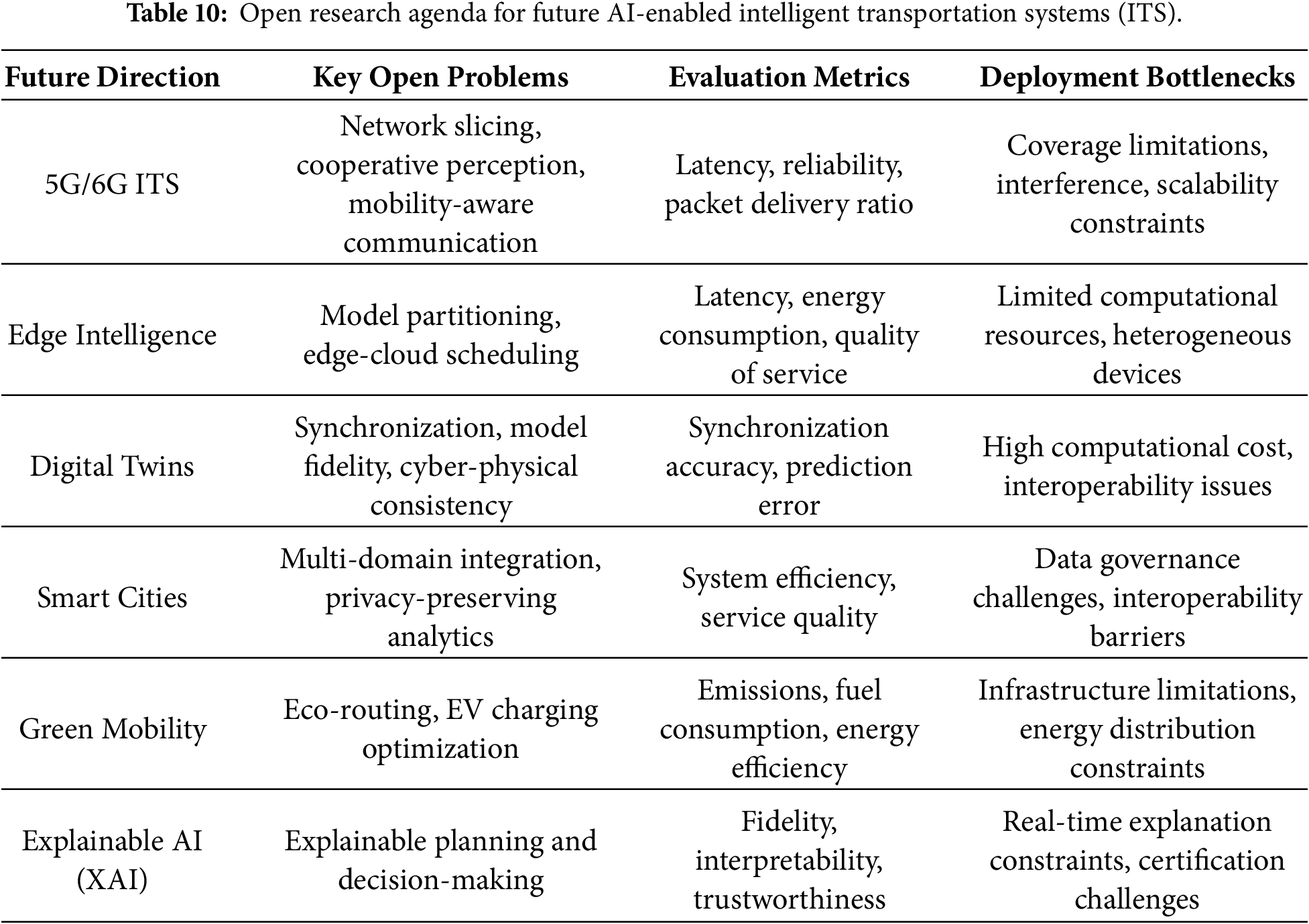
In the context of 5G/6G-enabled ITS, the biggest hurdle is not just high bandwidth but also ensuring ultra-reliable and low-latency transmission for safety-critical functions like cooperative perception, platooning, remote driving and emergency response. Some of the key metrics for assessing the critical values are end-to-end latency, reliability, packet delivery ratio, communication overhead and robustness under high and dynamically changing traffic loads. Efficient network slicing, mobility-aware resource allocation, and close cooperation with V2X-based cooperative perception remain open challenges. The key problem with edge intelligence systems is striking a balance between real-time inference and limited computing and energy resources. Studies are required for adaptive model partitioning, dynamic edge-cloud scheduling and energy-efficient distributed inference. Latency, energy consumption, bandwidth usage, and quality of service under mobility constraints are key metrics used for evaluation. Reproducibility is also limited by the lack of common metrics that encompass mobility, networking, and edge computation.
Digital twins can help simulate the ITS with high fidelity and make predictions, yet it is difficult to achieve synchronization between the physical and virtual environments. The challenges addressed are model fidelity, uncertainty propagation, scalability, and consistency across the cyber and physical domains. There is also a lack of large-scale standardized datasets and interoperable simulation platforms to drive progress. In fact, it’s not enough to optimize only domain-specific aspects in a smart city transportation system; these systems must be integrated as one. Future architectures need to enable cross-domain data fusion, distributed decision-making, and privacy-preserving data analysis. Introducing the above factors into large-scale deployments poses major challenges as regards interoperability, governance frameworks and data ownership.
Green mobility research can no longer focus solely on traffic efficiency but must explicitly address environmental goals related to emissions and energy use. Some of the main directions are eco-routing, optimization of charging times for electric vehicles, and energy monitoring on traffic lights. When assessing mobility performance, it is important to take into account its effects on the environment as well and to view both in relation to the dynamically changing urban environment. In safety-critical ITS applications, black-box models are not accepted or trusted by regulators – this is where explainable AI becomes more important. Future research will involve the study of interpretable models for perception, prediction, and decision-making, and a systematic study of the fidelity, robustness, and human trust of the explanations. Certification, accountability, and the limitations of real-time explainability are still being addressed.
The next generation of ITS research needs to shift the emphasis from stand alone model performance to deployability. These are different global metrics, realistic datasets, unified evaluation procedures, and system design strategies which need to be developed considering the interdependence of latency, scalability, robustness, interpretability, privacy, security, and energy-efficiency.
This survey examined recent advancements of the use of AI in smart vehicles and ITS, focusing on ML, DL, RL, FL, CV, IoT, edge computing, cloud computing, V2X communication, security, privacy, and future research directions. The primary discovery is that while AI is now a key driver of transportation intelligence, its implementation is far from straightforward and relies on effective application, not just on accurate algorithms. The review findings indicate that various AI techniques offer solutions to various components of the ITS problem. Lightweight prediction with ML, interpretable analytics with ML, perception and complex pattern recognition with DL, sequential decision making and adaptive control with RL, privacy-preserving distributed analytics with FL, and visual scene understanding with Computer Vision. But there are also advantages and disadvantages to these methods. A high-accuracy model can come with high latency; a privacy-preserving model can incur high communication overhead; and a complex, high-accuracy model can compromise Explainability and Trust.
The review also indicates that the research of ITSs is required in the future to advance beyond simple algorithmic advances. Real-world validation, latency-driven model design, secure and resilient FL, explainable decision making, edge-cloud coordination, adversarial resilience, and safety certification are the focus areas of attention. The impact of new technologies such as 5G/6G, digital twins, edge intelligence, XAI, and smart-city integration needs to be assessed using concrete deployment benchmarks, rather than as a general trend. In conclusion, future generations of ITS based on AI technologies must be integrated, secure, explainable, and real-time. Most importantly, research will be influential if it can relate AI model performance with practical deployment concerns such as privacy, latency, reliability, scalability, interoperability, and safety.
Acknowledgement: Not applicable.
Funding Statement: This work was supported by the IITP (Institute of Information & Communications Technology Planning & Evaluation)-ITRC (Information Technology Research Center) grant funded by the Korea government (Ministry of Science and ICT) (IITP-2026-RS-2023-00259004), and by the National Research Foundation of Korea (NRF) grant funded by the Korea government (MSIT) (RS-2025-00559546).
Author Contributions: The authors confirm contribution to the paper as follows: Conceptualization, Inam Ullah and Zeeshan Ali Haider; methodology, Inam Ullah; software, Inam Ullah and Zeeshan Ali Haider; validation, Omar Almomani and Karamath Ateeq; formal analysis, Chang Choi; investigation, Omar Almomani; resources, Karamath Ateeq; data curation, Omar Almomani and Karamath Ateeq; writing—original draft preparation, Inam Ullah and Zeeshan Ali Haider; writing—review and editing, Inam Ullah and Zeeshan Ali Haider: visualization, Chang Choi; supervision, Chang Choi; project administration, Chang Choi; funding acquisition, Inam Ullah and Chang Choi. All authors reviewed and approved the final version of the manuscript.
Availability of Data and Materials: Data will be available on request from the authors.
Ethics Approval: Not applicable.
Conflicts of Interest: The authors declare no conflicts of interest.
References
1. Bharadiya JP. Artificial intelligence in transportation systems: a critical review. Am J Comput Eng. 2023;6(1):35–45. doi:10.47672/ajce.1487. [Google Scholar] [CrossRef]
2. Jagatheesaperumal SK, Bibri SE, Huang J, Rajapandian J, Parthiban B. Artificial intelligence of things for smart cities: advanced solutions for enhancing transportation safety. Comput Urban Sci. 2024;4(1):10. doi:10.1007/s43762-024-00120-6. [Google Scholar] [CrossRef]
3. Sun G, Song L, Yu H, Chang V, Du X, Guizani M. V2V routing in a VANET based on the autoregressive integrated moving average model. IEEE Trans Veh Technol. 2019;68(1):908–22. doi:10.1109/tvt.2018.2884525. [Google Scholar] [CrossRef]
4. Zemmouchi-Ghomari L. Artificial intelligence in intelligent transportation systems. J Intell Manuf Spec Equip. 2025;6(1):26–42. [Google Scholar]
5. Hamza MA, Alshahrani HM, Al-Wesabi FN, Duhayyim MA, Hilal AM, Mahgoub H. Artificial intelligence based clustering with routing protocol for Internet of vehicles. Comput Mater Contin. 2022;70(3):5835–53. doi:10.32604/cmc.2022.021059. [Google Scholar] [CrossRef]
6. Luo J, Wang G, Li G, Pesce G. Transport infrastructure connectivity and conflict resolution: a machine learning analysis. Neural Comput Appl. 2022;34(9):6585–601. doi:10.1007/s00521-021-06015-5. [Google Scholar] [CrossRef]
7. Taj S, Javed MD, Khan R, Hassan H, Khan ZU. Quantifying risk with AI: models and frameworks. ICCK Trans Adv Comput Syst. 2025;1(4):222–37. doi:10.62762/tacs.2025.142506. [Google Scholar] [CrossRef]
8. Wang Y, Zhang Y, Zhang Y, Ma J. Dynamic real-time high-capacity ride-sharing model with subsequent information. IET Intell Transp Syst. 2020;14(7):742–52. doi:10.1049/iet-its.2019.0641. [Google Scholar] [CrossRef]
9. Xiao Z, Fang H, Jiang H, Bai J, Havyarimana V, Chen H, et al. Understanding private car aggregation effect via spatio-temporal analysis of trajectory data. IEEE Trans Cybern. 2023;53(4):2346–57. doi:10.1109/tcyb.2021.3117705. [Google Scholar] [CrossRef]
10. Zhu B, Cao X, Zhang P, Zhao J, Han J, Tang R. High-fidelity ultrasonic radar in-the-loop accelerated test for automatic parking systems. IEEE Trans Intell Transp Syst. 2025;26(10):17055–67. doi:10.1109/tits.2025.3574505. [Google Scholar] [CrossRef]
11. Zhao J, Li W, Zhu B, Zhang P, Tang R. A tachograph-based approach to restoring accident scenarios from the vehicle perspective for autonomous vehicle testing. IEEE Trans Intell Transp Syst. 2025;26(9):13909–26. doi:10.1109/tits.2025.3569850. [Google Scholar] [PubMed] [CrossRef]
12. Das R, Zhou L, Bi S, Wang T, Hou T. Towards the safety of intelligent transportation: a survey on the security challenges and mitigations in Internet of vehicles (IoV). ACM Trans Sens Netw. 2026;22(3):1–44. doi:10.1145/3786592. [Google Scholar] [CrossRef]
13. Reddy KR, Muralidhar A. Machine learning-based road safety prediction strategies for Internet of vehicles (IoV) enabled vehicles: a systematic literature review. IEEE Access. 2023;11:112108–22. doi:10.1109/access.2023.3315852. [Google Scholar] [CrossRef]
14. Zhou Z, Wang Y, Liu R, Wei C, Du H, Yin C. Short-term lateral behavior reasoning for target vehicles considering driver preview characteristic. IEEE Trans Intell Transp Syst. 2022;23(8):11801–10. doi:10.1109/tits.2021.3107310. [Google Scholar] [CrossRef]
15. Shah K, Chadotra S, Tanwar S, Gupta R, Kumar N. Blockchain for IoV in 6G environment: review, solutions and challenges. Clust Comput. 2022;25(3):1927–55. doi:10.1007/s10586-021-03492-0. [Google Scholar] [CrossRef]
16. Almehdhar M, Albaseer A, Khan MA, Abdallah M, Menouar H, Al-Kuwari S, et al. Deep learning in the fast lane: a survey on advanced intrusion detection systems for intelligent vehicle networks. IEEE Open J Veh Technol. 2024;5:869–906. doi:10.1109/ojvt.2024.3422253. [Google Scholar] [CrossRef]
17. Taher YH, Mandeep JS, Marhoon HA, Al-Jamimi HA, Luqman H, Azzedin F, et al. Traffic congestion estimation and control: a comprehensive review of the applied computational intelligence models. Arch Comput Methods Eng. 2026;33(1):339–400. doi:10.1007/s11831-025-10311-x. [Google Scholar] [CrossRef]
18. Huang C, Fang S, Wu H, Wang Y, Yang Y. Low-altitude intelligent transportation: system architecture, infrastructure, and key technologies. J Ind Inf Integr. 2024;42:100694. doi:10.1016/j.jii.2024.100694. [Google Scholar] [CrossRef]
19. Del-Coco M, Carcagnì P, Oliver ST, Iskandaryan D, Leo M. The role of AI in smart mobility: a comprehensive survey. Electronics. 2025;14(9):1801. doi:10.3390/electronics14091801. [Google Scholar] [CrossRef]
20. Creß C, Bing Z, Knoll AC. Intelligent transportation systems using roadside infrastructure: a literature survey. IEEE Trans Intell Transp Syst. 2023;25(7):6309–27. doi:10.1109/tits.2023.3343434. [Google Scholar] [CrossRef]
21. Mahmoudi I, Boubiche DE, Athmani S, Toral-Cruz H, Chan-Puc FI. Toward generative AI-based intrusion detection systems for the Internet of vehicles (IoV). Future Internet. 2025;17(7):310. doi:10.3390/fi17070310. [Google Scholar] [CrossRef]
22. Tran CN, Tat TTH, Tam VW, Tran DH. Factors affecting intelligent transport systems towards a smart city: a critical review. Int J Constr Manag. 2023;23(12):1982–98. doi:10.1080/15623599.2022.2029680. [Google Scholar] [CrossRef]
23. Tirumalasetti R, Singh SK, Roy PK, Mishra S. A systematic review of VANET routing protocols for intelligent transport systems (ITSs). J Adv Transp. 2026;2026(1):7999623. doi:10.1155/atr/7999623. [Google Scholar] [CrossRef]
24. Zhang X, Li J, Zhou J, Zhang S, Wang J, Yuan Y, et al. Vehicle-to-everything communication in intelligent connected vehicles: a survey and taxonomy. Automot Innov. 2025;8(1):13–45. doi:10.1007/s42154-024-00310-2. [Google Scholar] [CrossRef]
25. Zhou X, Liang W, Kawai A, Fueda K, She J, Wang KIK. Adaptive segmentation enhanced asynchronous federated learning for sustainable intelligent transportation systems. IEEE Trans Intell Transp Syst. 2024;25(7):6658–66. doi:10.1109/tits.2024.3362058. [Google Scholar] [CrossRef]
26. Luan Z, Xu K, Zhao W, Wang C. An event-triggered steering angle collaborative control strategy for the four-wheel independent steering system. IEEE Trans Veh Technol. 2025;74(5):7468–82. doi:10.1109/tvt.2024.3524438. [Google Scholar] [CrossRef]
27. Zhao C, Lv Y, Jin J, Tian Y, Wang J, Wang FY. DeCAST in TransVerse for parallel intelligent transportation systems and smart cities: three decades and beyond. IEEE Intell Transp Syst Mag. 2022;14(6):6–17. doi:10.1109/mits.2022.3199557. [Google Scholar] [CrossRef]
28. Luan Z, Zhao W, Wang C. Coordinated tracking control of the integrated wheel-end system based on generalized instantaneous steering center constraint. IEEE Trans Transp Electrif. 2025;11(3):8271–81. doi:10.1109/tte.2025.3538892. [Google Scholar] [CrossRef]
29. Xu GJW, Guo K, Park SH, Sun PZH, Song A. Bio-inspired vision mimetics toward next-generation collision-avoidance automation. Innovation. 2023;4(1):100368. doi:10.1016/j.xinn.2022.100368. [Google Scholar] [CrossRef]
30. Gao W, Mao S, Geng J, Li W, Sun H. DictRoadNet: a dictionary-based RNN with road network module for GPS trajectory completion. IEEE Trans Intell Transp Syst. 2026;27(1):1371–87. doi:10.1109/tits.2025.3627445. [Google Scholar] [CrossRef]
31. Dong J, Yassine A, Armitage A, Hossain MS. Multi-agent reinforcement learning for intelligent V2G integration in future transportation systems. IEEE Trans Intell Transp Syst. 2023;24(12):15974–83. doi:10.1109/tits.2023.3284756. [Google Scholar] [CrossRef]
32. Wang J, Wang H, Song J, Chen X, Guo J, Li K, et al. Knowledge-guided self-learning control strategy for mixed vehicle platoons with delays. Nat Commun. 2025;16(1):7705. doi:10.1038/s41467-025-62597-x. [Google Scholar] [CrossRef]
33. Alohali MA, Alahmari S, Aljebreen M, Asiri MM, Miled AB, Albouq SS, et al. Two stage malware detection model in Internet of vehicles (IoV) using deep learning-based explainable artificial intelligence with optimization algorithms. Sci Rep. 2025;15(1):20615. doi:10.1038/s41598-025-00269-y. [Google Scholar] [CrossRef]
34. Nawaz MH, Ahsan A, Khan IU, Wang Y, Ahmad M, Akhtar MS. Mitigating message injection attacks in Internet of vehicles using deep learning based intrusion detection system. ICCK Trans Adv Comput Syst. 2025;1(4):208–21. doi:10.62762/tacs.2025.560376. [Google Scholar] [CrossRef]
35. Yan D, Li R, Xiong W, Huang X. Sensor selection strategy and multimodal layout optimization for autonomous vehicles: a review. Measurement. 2026;297(4):121225. doi:10.1016/j.measurement.2026.121225. [Google Scholar] [CrossRef]
36. Janbi NF. AI-driven intrusion detection in IoV communication: insights from CICIoV2024 dataset. Int J Adv Comput Sci Appl. 2025;16(3):272–82. doi:10.14569/ijacsa.2025.0160327. [Google Scholar] [CrossRef]
37. Guo W, Liu J, Qin W, Lan X, Bai H, Li X. Robust adaptive dynamic programming for morphing air-breathing hypersonic vehicles under unmatched uncertainty. Sci China Inf Sci. 2026;69(2):122205. doi:10.1007/s11432-024-4386-4. [Google Scholar] [CrossRef]
38. Zhou H, Wang X, Li X, Cui N. Trajectory planning for reusable launch vehicle with multisolution-based maximum entropy reinforcement learning. IEEE Trans Aerosp Electron Syst. 2025;61(5):11613–27. doi:10.1109/taes.2025.3568421. [Google Scholar] [CrossRef]
39. Zhang P, Zheng J, Lin H, Liu C, Zhao Z, Li C. Vehicle trajectory data mining for artificial intelligence and real-time traffic information extraction. IEEE Trans Intell Transp Syst. 2023;24(11):13088–98. doi:10.1109/tits.2022.3178182. [Google Scholar] [CrossRef]
40. Shi T, ElSamadisy O, Abdulhai B. CoopSECRM2D: a safe, efficient, and comfortable multi-agent reinforcement learning model for cooperative on-ramp merging. IET Intell Transp Syst. 2026;20(1):e70256. doi:10.1049/itr2.70256. [Google Scholar] [CrossRef]
41. Song D, Zhu B, Zhao J, Han J. Modeling lane-changing spatiotemporal features based on the driving behavior generation mechanism of human drivers. Expert Syst Appl. 2025;284(10):127974. doi:10.1016/j.eswa.2025.127974. [Google Scholar] [CrossRef]
42. Shi T, Smirnov I, ElSamadisy O, Abdulhai B. SECRM-2D: RL-based efficient and comfortable route-following autonomous driving with analytic safety guarantees. IET Intell Transp Syst. 2025;19(1):e70013. [Google Scholar]
43. Liu X, Wang Y, Zhou Z, Nam K, Wei C, Yin C. Trajectory prediction of preceding target vehicles based on lane crossing and final points generation model considering driving styles. IEEE Trans Veh Technol. 2021;70(9):8720–30. doi:10.1109/tvt.2021.3098429. [Google Scholar] [CrossRef]
44. Du P, He X, Cao H, Garg S, Kaddoum G, Hassan MM. AI-based energy-efficient path planning of multiple logistics UAVs in intelligent transportation systems. Comput Commun. 2023;207(21):46–55. doi:10.1016/j.comcom.2023.04.032. [Google Scholar] [CrossRef]
45. Panigrahy SK, Emany H. A survey and tutorial on network optimization for intelligent transport system using the Internet of vehicles. Sensors. 2023;23(1):555. doi:10.3390/s23010555. [Google Scholar] [CrossRef]
46. He D, Yang Z, Mu J, Li Y. Distributed model predictive platooning control of heterogenous CAVs under Markovian switching communication topologies. IEEE Trans Veh Technol. 2026;75(1):145–55. doi:10.1109/tvt.2025.3592526. [Google Scholar] [CrossRef]
47. Dafhalla AKY, Ahmed AET, Sid Ahmed NMO, Filali A, Alhomed LS, Ali FAE, et al. High-performance data throughput analysis in wireless ad hoc networks for smart vehicle interconnection. Computers. 2025;14(2):56. doi:10.3390/computers14020056. [Google Scholar] [CrossRef]
48. Liu J, Zhang L, Li C, Bai J, Lv H, Lv Z. Blockchain-based secure communication of intelligent transportation digital twins system. IEEE Trans Intell Transp Syst. 2022;23(11):22630–40. doi:10.1109/tits.2022.3183379. [Google Scholar] [CrossRef]
49. Alshehri M, Xue T, Mujtaba G, AlQahtani Y, Almujally NA, Jalal A, et al. Integrated neural network framework for multi-object detection and recognition using UAV imagery. Front Neurorobot. 2025;19:1643011. doi:10.3389/fnbot.2025.1643011. [Google Scholar] [CrossRef]
50. Sun R, Sheng Q, Cheng Q, Shang X, Ochieng WY. 3D grid-based resilient pseudorange error prediction for adaptive GNSS/IMU integrated navigation in urban areas. IEEE Internet Things J. 2025;12(12):19264–79. doi:10.1109/jiot.2025.3533077. [Google Scholar] [CrossRef]
51. Sojitra M, Jadav NK, Gupta R, Patel U, Patel J, Tanwar S, et al. Interplay of ML and blockchain for secure Internet of military vehicles communication underlying 5G. Ad Hoc Netw. 2025;178(23):103968. doi:10.1016/j.adhoc.2025.103968. [Google Scholar] [CrossRef]
52. Qureshi KN, Jeon G, Hassan MM, Hassan MR, Kaur K. Blockchain-based privacy-preserving authentication model intelligent transportation systems. IEEE Trans Intell Transp Syst. 2022;24(7):7435–43. doi:10.1109/tits.2022.3158320. [Google Scholar] [CrossRef]
53. Guo S, Lin Y, Feng N, Song C, Wan H. Attention based spatial-temporal graph convolutional networks for traffic flow forecasting. Proc AAAI Conf Artif Intell. 2019;33(1):922–9. doi:10.1609/aaai.v33i01.3301922. [Google Scholar] [CrossRef]
54. Zheng C, Fan X, Wang C, Qi J. GMAN: a graph multi-attention network for traffic prediction. Proc AAAI Conf Artif Intell. 2020;34(1):1234–41. [Google Scholar]
55. Chen L, Chen L, Wang H. A hybrid spatio-temporal transformer with temporal aggregation and spatial memory for traffic flow prediction. J Big Data. 2026;13(1):74. doi:10.1186/s40537-026-01383-y. [Google Scholar] [CrossRef]
56. Qian H, Wang M, Zhu M, Wang H. A review of multi-sensor fusion in autonomous driving. Sensors. 2025;25(19):6033. doi:10.3390/s25196033. [Google Scholar] [CrossRef]
57. Hu J, Wang Y, Cheng S, Xu J, Wang N, Fu B, et al. A survey of decision-making and planning methods for self-driving vehicles. Front Neurorobot. 2025;19:1451923. doi:10.3389/fnbot.2025.1451923. [Google Scholar] [CrossRef]
58. Bai Z, Wu G, Barth MJ, Liu Y, Sisbot EA, Oguchi K, et al. A survey and framework of cooperative perception: from heterogeneous singleton to hierarchical cooperation. IEEE Trans Intell Transp Syst. 2024;25(11):15191–209. [Google Scholar]
59. Liu Z, Guo J, Yang W, Fan J, Lam KY, Zhao J. Privacy-preserving aggregation in federated learning: a survey. IEEE Trans Big Data. 2022. doi:10.1109/tbdata.2022.3190835. [Google Scholar] [CrossRef]
60. Zhang S, Li J, Shi L, Ding M, Nguyen DC, Tan W, et al. Federated learning in intelligent transportation systems: recent applications and open problems. IEEE Trans Intell Transp Syst. 2023;25(5):3259–85. [Google Scholar]
61. Wu Z, Chen T, Ling Q. Byzantine-resilient decentralized stochastic optimization with robust aggregation rules. IEEE Trans Signal Process. 2023;71:3179–95. doi:10.1109/tsp.2023.3300629. [Google Scholar] [CrossRef]
62. Hu Q, Peng Y, U K, Chen J. The infrared-visible multimodal detection algorithm for urban traffic and safety perception. Meas Sci Technol. 2026;37(10):105404. doi:10.1088/1361-6501/ae4d6c. [Google Scholar] [CrossRef]
63. Zhang Z, Wu Q, Fan P, Cheng N, Chen W, Letaief KB. DRL-based optimization for AoI and energy consumption in C-V2X enabled IoV. IEEE Trans Green Commun Netw. 2025;9(4):2144–59. doi:10.1109/tgcn.2025.3531902. [Google Scholar] [CrossRef]
64. Xie J, Wu G, Zhou X, Deng S. Future perspectives on Internet of vehicles resource management: digital twin-enabled edge computing frameworks. J Eng Appl Sci. 2025;72(1):119. doi:10.1186/s44147-025-00692-y. [Google Scholar] [CrossRef]
65. Zhao J, Quan H, Xia M, Wang D. Adaptive resource allocation for mobile edge computing in Internet of vehicles: a deep reinforcement learning approach. IEEE Trans Veh Technol. 2023;73(4):5834–48. doi:10.1109/tvt.2023.3335663. [Google Scholar] [CrossRef]
66. Albinhamad H, Alotibi A, Alagnam A, Almaiah M, Salloum S. Vehicular ad-hoc networks (VANETsa key enabler for smart transportation systems and challenges. Jordan J Inform Comput. 2025;2025(1):4–15. doi:10.63180/jjic.thestap.2025.1.2. [Google Scholar] [CrossRef]
67. Ren Y, Wang L, Li M, Jiang H, Cui Z, Yang M, et al. RM2Occ: re-projection multi-task multi-sensor fusion for autonomous driving 3D object detection and occupancy perception. IEEE Trans Intell Transp Syst. 2025;26(11):20864–81. [Google Scholar]
68. Ryu D, Kang Y, Jeong M, Batzorig M, Yim K. Edge AI in vehicle modules using heterogeneous networks: research trends and future directions. In: Innovative mobile and Internet services in ubiquitous computing. Cham, Switzerland: Springer Nature; 2025. p. 314–24. [Google Scholar]
69. Zhou Z, Wang Y, Zhou G, Nam K, Ji Z, Yin C. A twisted Gaussian risk model considering target vehicle longitudinal-lateral motion states for host vehicle trajectory planning. IEEE Trans Intell Transp Syst. 2023;24(12):13685–97. doi:10.1109/tits.2023.3298110. [Google Scholar] [CrossRef]
70. Ji T, Wang S, Wang J, Zhang J. Beyond technology: role of technology-organization-environment-human factors in autonomous driving adoption for new energy vehicles. J Retail Consum Serv. 2026;88(24):104552. doi:10.1016/j.jretconser.2025.104552. [Google Scholar] [CrossRef]
71. Gong T, Zhu L, Yu FR, Tang T. Edge intelligence in intelligent transportation systems: a survey. IEEE Trans Intell Transp Syst. 2023;24(9):8919–44. doi:10.1109/tits.2023.3275741. [Google Scholar] [CrossRef]
72. Yang S, Tan J, Lei T, Linares-Barranco B. Smart traffic navigation system for fault-tolerant edge computing of Internet of vehicle in intelligent transportation gateway. IEEE Trans Intell Transp Syst. 2023;24(11):13011–22. doi:10.1109/tits.2022.3232231. [Google Scholar] [CrossRef]
73. Cheng Q, Chen W, Wang J, Mi X, Yang Y, Sun R. Multi-constellation instantaneous single difference triple-carrier ambiguity resolution in urban environments. GPS Solut. 2025;29(4):186. doi:10.1007/s10291-025-01946-1. [Google Scholar] [CrossRef]
74. Liu B, Li T, Xiao Z, Chen W, Hei Y, Ding J, et al. A multi-granularity self-guiding graph diffusion model for predicting private car activity. IEEE Trans Intell Transp Syst. 2026;27(6):7172–86. doi:10.1109/tits.2026.3659102. [Google Scholar] [CrossRef]
75. Yuan T, da Rocha Neto W, Rothenberg CE, Obraczka K, Barakat C, Turletti T. Machine learning for next-generation intelligent transportation systems: a survey. Trans Emerg Telecommun Technol. 2022;33(4):e4427. doi:10.1002/ett.4427. [Google Scholar] [CrossRef]
76. Chen G, Zhang JW. Intelligent transportation systems: machine learning approaches for urban mobility in smart cities. Sustain Cities Soc. 2024;107(11):105369. doi:10.1016/j.scs.2024.105369. [Google Scholar] [CrossRef]
77. He X, Yang Y, Yang Z, Gao Y, Yin C, Chen S. Agent-based network architecture and resource management for vehicle-road-cloud collaboration. IEEE Commun Mag. 2026;64(4):34–41. doi:10.1109/mcom.001.2500421. [Google Scholar] [CrossRef]
78. Xin Q, Alazab M, Crespo RG, Montenegro-Marin CE. AI-based quality of service optimization for multimedia transmission on Internet of vehicles (IoV) systems. Sustain Energy Technol Assess. 2022;52(7):102055. doi:10.1016/j.seta.2022.102055. [Google Scholar] [CrossRef]
79. Peng X, Song S, Zhang X, Dong M, Ota K, Xu L. 2FDP-BRL: a new framework of distributed task offloading for IoAV in extreme weather scenarios. IEEE Trans Mob Comput. 2026;25(2):1697–713. doi:10.1109/tmc.2025.3604461. [Google Scholar] [CrossRef]
80. Ahmadi AE, Abdoun O, Haimoudi EK. Using artificial intelligence (AI) methods on the Internet of vehicles (IoVoverview and future opportunities. In: Artificial intelligence, data science and applications. Cham, Switzerland: Springer Nature; 2023. p. 193–201. [Google Scholar]
81. Ullah F, Srivastava G, Mostarda L, Raza U. ZTID-IoV: zero-trust intrusion detection in IoV using neurosymbolic AI approach with federated meta-learning. IEEE Trans Consum Electron. 2025;71(4):12037–46. doi:10.1109/tce.2025.3625081. [Google Scholar] [CrossRef]
82. Khan FM, Haider ZA, Khan MO, Ullah A, Khan MS, Fayaz M, et al. Intelligent cyber-attack detection for autonomous vehicles using advanced deep learning models. ICCK Trans Adv Comput Syst. 2025;1(3):180–92. doi:10.62762/tacs.2025.952297. [Google Scholar] [CrossRef]
83. Fan Y, Chen J, Xu W, Peng W. DADiffNet: delay-aware diffusion networks with adaptive subgraphs for large scale traffic forecasting. Neural Netw. 2026;200(3):108756. doi:10.1016/j.neunet.2026.108756. [Google Scholar] [CrossRef]
84. Zhou X, Wu Y, Lin J, Xu Y, Woo S. A stacked machine learning-based intrusion detection system for internal and external networks in smart connected vehicles. Symmetry. 2025;17(6):874. doi:10.3390/sym17060874. [Google Scholar] [CrossRef]
85. Bhattacharya DC, Saha HN. AI’s evolution in the Internet of vehicles: a retrospective study. In: Internet of vehicles: scope and application of artificial intelligence-based technologies. Singapore: Springer; 2026. p. 55–79. [Google Scholar]
86. Wang Q, Chen J, Song Y, Li X, Xu W. Fusing visual quantified features for heterogeneous traffic flow prediction. Promet Traffic Transp. 2024;36(6):1068–77. doi:10.7307/ptt.v36i6.667. [Google Scholar] [CrossRef]
87. Xu F, Zhai X, Chen C, Ma K, Wu Q, Zhang X. Highway camera calibration and vehicle speed estimation using multilayered lane-line keypoints. IEEE Trans Circuits Syst Video Technol. 2026;36(5):6022–36. doi:10.1109/tcsvt.2025.3645130. [Google Scholar] [CrossRef]
88. Chaurasia BK, Rishiwal V, Yadav M, Shukla MM, Yadav P. Blockchain enabled vehicle NFT and key management for IoV networks in fog computing environment. Int J Ad Hoc Ubiquitous Comput. 2025;49(3):202–13. doi:10.1504/ijahuc.2024.10069167. [Google Scholar] [CrossRef]
89. Lin S, Li L, Chen J, Cong P, Wang T, Zhou J. IATS: information-age aware task scheduling for vehicle-road-cloud cooperative systems. J Syst Archit. 2025;167(1):103480. doi:10.1016/j.sysarc.2025.103480. [Google Scholar] [CrossRef]
90. El Madani S, Motahhir S, El Ghzizal A. Combination between Internet of vehicles and advanced driver assistance systems: overview and description. Multimed Tools Appl. 2025;84(27):32295–312. doi:10.1007/s11042-024-20486-3. [Google Scholar] [CrossRef]
91. Liu S, Huang S, Xu X, Lloret J, Muhammad K. Efficient visual tracking based on fuzzy inference for intelligent transportation systems. IEEE Trans Intell Transp Syst. 2023;24(12):15795–806. doi:10.1109/tits.2022.3232242. [Google Scholar] [CrossRef]
92. Susmitha M, Santhoshini R, Mahalakshmi SB, Rajesh Kanna R. Security and privacy in Internet of vehicles (IoV) using machine learning/deep learning. In: Internet of vehicles: scope and application of artificial intelligence-based technologies. Singapore: Springer Nature; 2026. p. 81–109. [Google Scholar]
93. Zhao Z, Zhang Y, Zhang Y, Ji K, Qi H. Neural-network-based dynamic distribution model of parking space under sharing and non-sharing modes. Sustainability. 2020;12(12):4864. doi:10.3390/su12124864. [Google Scholar] [CrossRef]
94. Mujtaba G, Liu W, Alshehri M, AlQahtani Y, Almujally NA, Liu H. Aerial images for intelligent vehicle detection and classification via YOLOv11 and deep learner. Comput Mater Contin. 2026;86(1):1. doi:10.32604/cmc.2025.067895. [Google Scholar] [CrossRef]
95. Alshehri M, Wu T, Almujally NA, AlQahtani Y, Hanzla M, Jalal A, et al. UAV-based intelligent traffic surveillance using recurrent neural networks and Swin transformer for dynamic environments. Front Neurorobot. 2025;19:1681341. doi:10.3389/fnbot.2025.1681341. [Google Scholar] [CrossRef]
96. Wang T, Chen J, Lü J, Liu K, Zhu A, Snoussi H, et al. Synchronous spatiotemporal graph transformer: a new framework for traffic data prediction. IEEE Trans Neural Netw Learn Syst. 2023;34(12):10589–99. doi:10.1109/tnnls.2022.3169488. [Google Scholar] [CrossRef]
97. Sun G, Zhang Y, Liao D, Yu H, Du X, Guizani M. Bus-trajectory-based street-centric routing for message delivery in urban vehicular ad hoc networks. IEEE Trans Veh Technol. 2018;67(8):7550–63. doi:10.1109/tvt.2018.2828651. [Google Scholar] [CrossRef]
98. Chen J, Ye H, Ying Z, Sun Y, Xu W. Dynamic trend fusion module for traffic flow prediction. Appl Soft Comput. 2025;174(1):112979. doi:10.1016/j.asoc.2025.112979. [Google Scholar] [CrossRef]
99. Wang X, He C, Jiang W, Wang W, Liu X. Generative AI based dependency-aware task offloading and resource allocation for UAV-assisted IoV. IEEE Open J Commun Soc. 2025;6:3932–49. doi:10.1109/ojcoms.2025.3562720. [Google Scholar] [CrossRef]
100. Shankar A, Maple C, Epiphaniou G. A study on analyzing the security and privacy implications of existing and emerging sensors in autonomous electric vehicles. Tsinghua Sci Technol. 2025;30(4):1401–20. doi:10.26599/tst.2023.9010132. [Google Scholar] [CrossRef]
101. Mun H, Han K, Damiani E, Kim TY, Yeun HK, Puthal D, et al. Privacy enhanced data aggregation based on federated learning in Internet of vehicles (IoV). Comput Commun. 2024;223:15–25. doi:10.2139/ssrn.4563841. [Google Scholar] [CrossRef]
102. Guembe B, Azeta A, Misra S, Osamor VC, Fernandez-Sanz L, Pospelova V. The emerging threat of AI-driven cyber attacks: a review. Appl Artif Intell. 2022;36(1):2037254. doi:10.1080/08839514.2022.2037254. [Google Scholar] [CrossRef]
103. Zhang D, Shi W, St-Hilaire M. The permissioned blockchain-based quantum-inspired edge intelligence approach for the services of future Internet of vehicles. IEEE Trans Intell Transp Syst. 2025;26(5):6171–85. doi:10.1109/tits.2025.3553403. [Google Scholar] [CrossRef]
104. Men H, Cao L, Zheng G, Chen L. A PUF-based lightweight identity authentication protocol for Internet of vehicles. Comput Electr Eng. 2025;123:110210. doi:10.2139/ssrn.5009686. [Google Scholar] [CrossRef]
105. Zhou Z, Abawajy J. Reinforcement learning-based edge server placement in the intelligent Internet of vehicles environment. IEEE Trans Intell Transp Syst. 2025. doi:10.1109/tits.2025.3557259. [Google Scholar] [CrossRef]
106. He C, Jiang W, Wang X, Wang W, Xie X. Generative AI-enhanced task offloading strategy for the IoV: an RSU-RSU load-balancing perspective. IEEE Netw Lett. 2025;7(3):161–5. doi:10.1109/lnet.2025.3542094. [Google Scholar] [CrossRef]
107. Etemesi AB, Megahed TF, Kanaya H, Mansour DEA. IoT based energy management of smart microgrid considering electric vehicle integration. Energy. 2025;329(5):136405. doi:10.1016/j.energy.2025.136405. [Google Scholar] [CrossRef]
108. Louati A, Louati H, Kariri E, Neifar W, Hassan MK, Khairi MH, et al. Sustainable smart cities through multi-agent reinforcement learning-based cooperative autonomous vehicles. Sustainability. 2024;16(5):1779. doi:10.3390/su16051779. [Google Scholar] [CrossRef]
109. Dhanasekaran S, Gopal D, Logeshwaran J, Ramya N, Salau AO. Multi-model traffic forecasting in smart cities using graph neural networks and transformer-based multi-source visual fusion for intelligent transportation management. Int J Intell Transp Syst Res. 2024;22(3):518–41. doi:10.1007/s13177-024-00413-4. [Google Scholar] [CrossRef]
110. Zhao Y, Wang X, Cao S, Huang Z. Zero-shot automatic modulation recognition using a large vision-language model. IEEE Trans Commun. 2025;12:73. doi:10.1109/tcomm.2025.3611710. [Google Scholar] [CrossRef]
111. Qi Z, Wang Y, Liu Z, Chao Z, Dong Z, Wang H. Real-time vehicle-induced response identification via crowdsourced labeling for high-frequency unlabeled sensor data. Eng Appl Artif Intell. 2026;167(22):113789. doi:10.1016/j.engappai.2026.113789. [Google Scholar] [CrossRef]
112. Dui H, Zhang S, Liu M, Dong X, Bai G. IoT-enabled real-time traffic monitoring and control management for intelligent transportation systems. IEEE Internet Things J. 2024;11(9):15842–54. doi:10.1109/jiot.2024.3351908. [Google Scholar] [CrossRef]
113. Ma W, Wu J, Song D, Chen Z, Huang T. HVAE-DC: a hierarchical variational autoencoder-based deep clustering model for multi-level driving behavior. Expert Syst Appl. 2026;305:130882. doi:10.1016/j.eswa.2025.130882. [Google Scholar] [CrossRef]
114. Lu Z, Zhang X, Cao X, Hou J, Yuan X. SFEP-YOLO: a track obstacle detection model for autonomous electric locomotives in underground mine. IEEE Trans Veh Technol. 2026;75(6):9687–700. doi:10.1109/tvt.2026.3651888. [Google Scholar] [CrossRef]
115. O’Brien D, Christaras V, Kounelis I, Fovino IN, Fontaras G. Blockchain-enabled road vehicle emissions monitoring: a secure, scalable and private framework. Internet Things. 2025;32(4):101628. doi:10.1016/j.iot.2025.101628. [Google Scholar] [CrossRef]
116. Senouci O. Enhancing routing and quality of service using AI-driven technique for Internet of vehicles contexts. Int J Comput Appl. 2024;46(8):628–40. doi:10.1080/1206212x.2024.2380653. [Google Scholar] [CrossRef]
117. Ali R, Ali A, Naeem HMY, Asad M, Alsarhan T, Heyat BB. A comprehensive survey of deep learning-based traffic flow prediction models for intelligent transportation systems. ICCK Trans Adv Comput Syst. 2024;1(3):117–37. doi:10.62762/tacs.2025.795448. [Google Scholar] [CrossRef]
118. Singh AK, Pamula R, Akhter N, Battula SK, Naha R, Chowdhury A, et al. Intelligent transportation system for automated medical services during pandemic. Future Gener Comput Syst. 2025;163(4):107515. doi:10.1016/j.future.2024.107515. [Google Scholar] [CrossRef]
119. Yao Y, Shu F, Cheng X, Liu H, Miao P, Wu L. Automotive radar optimization design in a spectrally crowded V2I communication environment. IEEE Trans Intell Transp Syst. 2023;24(8):8253–63. doi:10.1109/tits.2023.3264507. [Google Scholar] [CrossRef]
120. Singh AR, Ashraf MWA, Ganesh D, Rathore RS, Hewage CT, Bashir AK. Quantum-inspired metaheuristic algorithms for trust-based privacy agreements and secure access in the Internet of vehicles. IEEE Trans Intell Transp Syst. 2025. doi:10.1109/tits.2025.3591936. [Google Scholar] [CrossRef]
121. Alymani M, Almoqhem LA, Alabdulwahab DA, Alghamdi AA, Alshahrani H, Raza K. Enabling smart parking for smart cities using Internet of things (IoT) and machine learning. PeerJ Comput Sci. 2025;11(21):e2544. doi:10.7717/peerj-cs.2544. [Google Scholar] [CrossRef]
122. Bektache D, Ghoualmi-Zine N. An artificial intelligence-based approach for avoiding traffic congestion in connected autonomous vehicles. Int J Veh Auton Syst. 2025;18(1):81–103. doi:10.1504/ijvas.2025.143029. [Google Scholar] [CrossRef]
123. Hakim SB, Adil M, Ali A, Farouk A, Song HH. Internet of vehicles security threats, countermeasures, open challenges with future research directions. IEEE Internet Things J. 2025;12(22):46347–74. doi:10.1109/jiot.2025.3605066. [Google Scholar] [CrossRef]
124. Yang X, Luo X, Liu R, Li S, Yao K. Certificateless aggregate signcryption scheme with multi-ciphertext equality test for the Internet of vehicles. PLoS One. 2025;20(5):e0322185. doi:10.1371/journal.pone.0322185. [Google Scholar] [CrossRef]
125. Husnain G, Anwar S, Shahzad F. An enhanced AI-enabled routing optimization algorithm for Internet of vehicles (IoV). Wirel Pers Commun. 2023;130(4):2623–43. doi:10.1007/s11277-023-10394-4. [Google Scholar] [CrossRef]
126. Haider ZA, Rahman MM, Khan MA, Sohail Q. Optimizing collaborative task allocation in Internet of vehicles (IoV) through blockchain-enabled incentive mechanisms. ICCK Trans Sens Commun Control. 2025;2(3):147–67. doi:10.62762/tscc.2025.962030. [Google Scholar] [CrossRef]
127. Hou Q, Yang Y, Liang J, Huo X, Leng J. A deep transfer learning approach for real-time traffic conflict prediction with trajectory data. Accid Anal Prev. 2025;214(2):107966. doi:10.1016/j.aap.2025.107966. [Google Scholar] [CrossRef]
128. Jha AV, Appasani B, Khan MS, Zeadally S, Katib I. 6G for intelligent transportation systems: standards, technologies, and challenges. Telecommun Syst. 2024;86(2):241–68. doi:10.1007/s11235-024-01126-5. [Google Scholar] [CrossRef]
129. Tandon R, Sharma N. DBASC: decentralized blockchain-based architecture with integration of smart contracts for secure communication in VANETs. J Netw Comput Appl. 2025;243(3):104294. doi:10.1016/j.jnca.2025.104294. [Google Scholar] [CrossRef]
130. He X, Yang Z, Li D, Zeng J, Jiang T, Chen S. Dual-stage reinforcement learning-based beam tracking for integrated sensing and communications in V2I scenarios. IEEE Trans Wirel Commun. 2026;25:10759–74. doi:10.1109/twc.2026.3654423. [Google Scholar] [CrossRef]
131. Wang D, Zhang X, Wu H, Liu J, Chen X, Zhou M. Mobility-aware reputation-based hierarchical federated learning for Internet of vehicles. IEEE Trans Veh Technol. 2026;75(3):4785–96. doi:10.1109/tvt.2025.3609341. [Google Scholar] [CrossRef]
132. Danba S, Bao J, Han G, Guleng S, Wu C. Toward collaborative intelligence in IoV systems: recent advances and open issues. Sensors. 2022;22(18):6995. [Google Scholar]
133. Zhang T, Tang X, Kang J, Xu C. AI-driven moving target defense framework for SD-IoV: roadside unit mutation via proximal policy optimization. In: Moving target defense based on artificial intelligence. Singapore: Springer Nature; 2025. p. 59–79. [Google Scholar]
134. Li Y, Wang S, Chang T. Differentially private federated stochastic primal-dual learning for Internet of vehicles. IEEE Internet Things J. 2025;12(11):17034–50. doi:10.1109/jiot.2025.3534982. [Google Scholar] [CrossRef]
135. Alam S, Jameel A, Parveen Z, Alnfrawy E, Ashraf A, Uddin R, et al. DAIRE: a lightweight AI model for real-time detection of controller area network attacks in the Internet of vehicles. Mach Learn Appl. 2026;23(1):100859. doi:10.1016/j.mlwa.2026.100859. [Google Scholar] [CrossRef]
136. Jiang H, Guo J, Xiao Z, Yang J, Yang K, Min G. Cooperative content caching in vehicular edge computing networks: a two-stage deep reinforcement learning approach. IEEE Trans Mob Comput. 2026;25(7):10557–76. doi:10.1109/tmc.2026.3664597. [Google Scholar] [CrossRef]
137. Varone A, Porruvecchio G, Romanino A. Smart charge management of electric vehicle fleets from renewable energy through innovative deferring strategies. Energy Convers Manag. 2026;350(7):120957. doi:10.1016/j.enconman.2025.120957. [Google Scholar] [CrossRef]
138. Peelam MS, Chamola V, Chaurasia BK. Blockchain-enabled intrusion detection systems for real-time vehicle monitoring. Veh Commun. 2025;55:100961. doi:10.1016/j.vehcom.2025.100961. [Google Scholar] [CrossRef]
139. Feng X, Zhang B. Reputation evaluation scheme based on PUF and blockchain with channel congestion mitigation in the Internet of vehicles. IEEE Internet Things J. 2025;12(11):17487–98. doi:10.1109/jiot.2025.3538984. [Google Scholar] [CrossRef]
Cite This Article
 Copyright © 2026 The Author(s). Published by Tech Science Press.
This work is licensed under a Creative Commons Attribution 4.0 International License , which permits unrestricted use, distribution, and reproduction in any medium, provided the original work is properly cited.
 Downloads
 Citation Tools
