
 Login
Login Register
 Submit a Paper
 Propose a Special lssue
 Open Access
ARTICLE
The Method of Malicious Traffic Detection for Internet of Things Based on Lightweight Graph Neural Networks
1 School of Computer Science and Artificial Intelligence (College of Software), Lanzhou University of Technology, Lanzhou, China
2 School of Petrochemical Engineering, Lanzhou University of Technology, Lanzhou, China
* Corresponding Author: Yongbo Jiang. Email:
Computers, Materials & Continua 2026, 89(2), 90 https://doi.org/10.32604/cmc.2026.086743
Received 05 June 2026; Accepted 11 August 2026; Issue published 15 September 2026
 View Full Text
 Download PDF
Abstract
With the sustained expansion of complex Internet of Things (IoT) ecosystems, malicious traffic detection has become critical for maintaining both cyber security and operational continuity. Modern IoT deployments contain heterogeneous devices, ubiquitous sensing layers, edge services, and autonomous assets, so abnormal communication may affect not only data confidentiality but also physical operations. To address the limitations of independent flow-level detection and heavy graph propagation, this paper proposes a Lightweight Graph-Attentive Network for Traffic Detection (LGNT). LGNT constructs a directed traffic-interaction graph from NetFlow records, where communication entities are represented as nodes and traffic sessions are represented as edges. Communication-strength-based auxiliary node supervision provides an activity-aware structural signal, while a compact backbone combining topology adaptive graph convolution (TAGConv) and graph attention v2 convolution (GATv2Conv) captures local topological dependencies and key communication relations. A structure-significance pruning strategy is further introduced to reduce the message-passing edge set and graph computation overhead. Experiments on NetFlow BoT-IoT (NF-BoT-IoT) and NetFlow ToN-IoT (NF-ToN-IoT) show that LGNT obtains effective results in both binary and multi-class detection tasks. Specifically, it achieves 94.28% accuracy, 97.36% area under the curve (AUC), and 86.88% F1 on NF-BoT-IoT, and 99.93% accuracy, 99.95% AUC, and 69.05% weighted F1 on NF-ToN-IoT. The per-class analysis further shows that long-tailed minority categories remain challenging in fine-grained NF-ToN-IoT recognition. Overall, LGNT improves the balance between traffic-interaction modeling, detection performance, and deployment efficiency while keeping the parameter scale at 0.236 million.Keywords
The Internet of Things (IoT) has become a common infrastructure for smart homes, industrial control systems, intelligent transportation, smart-city services, and ubiquitous sensing environments [1]. Modern IoT ecosystems are increasingly deployed as heterogeneous cyber-physical infrastructures in which distributed sensors, edge devices, logistics assets, industrial controllers, and autonomous vehicles continuously exchange operational states and control-related messages. In such environments, malicious traffic is not only a source of data leakage or network congestion; abnormal communication may interrupt sensing feedback, disrupt supply-chain coordination, mislead autonomous assets, and even halt physical operations. The security challenges of IoT are amplified by resource-constrained devices, heterogeneous protocols, decentralized connectivity, and large attack surfaces, which have been identified as persistent obstacles for secure IoT deployment [2]. Recent ubiquitous supply-chain systems with autonomous vehicles further show that emerging IoT applications rely on trusted and timely communication among sensing layers, edge nodes, blockchain-based coordination mechanisms, and mobile assets [3]. Recent LLM-enabled zero-day IoT threat detection also indicates that heterogeneous IoT traces require context-aware reasoning beyond simple rule matching [4]. Therefore, IoT malicious traffic detection should be considered a critical component for maintaining both cyber security and operational continuity in modern connected environments. NetFlow-based datasets provide a useful basis for this line of research because they organize traffic behavior into compact flow records that are easier to use in machine-learning-based detection pipelines [5]. Standard feature-set studies have further shown that flow-level representations are helpful for improving generalizability and interpretability across different intrusion detection datasets [6].
Compared with conventional enterprise networks, IoT traffic is more heterogeneous and behaviorally uneven because devices differ in protocol, sampling frequency, computational capability, and communication role. Many malicious behaviors are not obvious from a single flow record; instead, they appear through cross-host or cross-session interaction patterns, such as repeated scanning, lateral movement, abnormal device-to-device communication, cross-domain propagation, and coordinated high-frequency connections. Graph neural networks (GNNs) provide a natural modeling tool for this setting because network flows can be transformed into a graph in which hosts are represented as nodes, communication sessions are represented as edges, and edge attributes describe flow-level behavior. E-GraphSAGE demonstrates that flow-based NIDS data can be represented in graph form and that GNNs can jointly capture edge features and topological information for IoT intrusion detection [7]. Anomal-E further shows that edge features and graph topology are useful for learning network behavior in self-supervised intrusion and anomaly detection [8]. Bilot et al. reviewed GNN-based intrusion detection and emphasized graph construction and deployment as two major research issues [9]. Yagmur et al. systematically reviewed graph neural networks and graph autoencoders for intrusion detection systems and summarized taxonomy, comparative evaluation, and practical research gaps [10]. Edge-featured multi-hop attention further indicates that edge attributes are important for flow-level intrusion detection [11]. BS-GAT extends graph attention to edge-computing scenarios and highlights the need for deployable graph-based detectors [12].
Nevertheless, existing graph-based intrusion detection methods still face a trade-off between representation capacity and deployment cost. Models with stronger structural modeling ability often require more parameters, more message-passing operations, and longer inference time. This issue is particularly important for resource-constrained IoT scenarios. For flow-centric detection, edge direction, communication intensity, and protocol variation often provide useful evidence, but an overly dense graph may also introduce redundant relations and propagate noise.
The main challenge addressed in this study is not only to improve classification accuracy, but also to jointly satisfy three practical requirements in IoT malicious traffic detection: capturing interaction-level traffic dependencies across hosts and sessions, maintaining effective detection under imbalanced attack distributions, and reducing graph computation cost for resource-constrained deployment. Existing graph-based detectors show the value of structural traffic modeling, but their graph construction, auxiliary supervision, and efficiency-control mechanisms are often considered separately. Therefore, a compact framework that integrates traffic graph modeling, edge-level classification, auxiliary activity supervision, and structural compression is still needed. To address this challenge, we propose LGNT, a lightweight graph-attentive network for edge-level IoT malicious traffic detection. The main contributions are summarized as follows:
(1) We construct a directed traffic interaction graph from NetFlow records and formulate IoT malicious traffic detection as an edge-level classification task, which preserves cross-device and cross-session communication patterns.
(2) We design a compact graph encoding backbone by combining shallow multi-hop TAGConv aggregation and local GATv2-based attention, so that topology-aware representation learning can be retained under a restrained parameter budget.
(3) We introduce communication-strength-based auxiliary node supervision to provide activity-aware structural guidance for edge-level traffic classification, and we further analyze its effect through ablation and sensitivity evaluation.
(4) We apply structure-significance pruning to compress the message-passing edge set and evaluate the proposed method on NF-BoT-IoT and NF-ToN-IoT under binary and multi-class settings.
The remainder of this paper is organized as follows. Section 2 reviews related work. Section 3 presents the proposed method. Section 4 reports the experiments and discusses the results. Section 5 concludes the paper and outlines future work.
2.1 IoT Malicious Traffic Detection
Early IoT malicious traffic detection mainly relied on handcrafted features and conventional classifiers. As datasets became larger and attack behaviors became more complex, deep learning models were increasingly adopted to learn traffic representations automatically. Yang et al. combined data purification with separable convolution to reduce redundant computation in an IoT intrusion detection model [13]. Li and Yao proposed a two-stage lightweight framework that integrates self-supervised contrastive learning and self-distillation [14]. Wang et al. compressed an IoT intrusion detector through an improved BERT-of-Theseus design [15]. Azimjonov and Kim pursued lightweight detection through fine-tuned linear support vector machine (SVM) and feature selection [16]. Misrak and Melaku combined improved feature engineering with dynamic quantization to reduce inference cost in IoT intrusion detection [17]. Together, these studies make clear that lightweight design is no longer a secondary consideration in IoT intrusion detection. Their common weakness is that many still learn from isolated flow samples. This simplification is easy to implement, but it leaves part of the attack context outside the model, especially for multi-stage behavior, lateral movement, and coordinated bursts of abnormal sessions.
2.2 GNN-Based Intrusion Detection
Graph-based intrusion detection treats network events as relations among hosts, services, flows, or system entities, rather than as independent tabular samples. Bilot et al. reviewed GNN-based intrusion detection and emphasized graph construction and deployment as two major research issues [9]. A concatenated multigraph model has been used to represent repeated interactions between IoT communication entities [18]. Centrality-enhanced graph learning has shown that topological indicators can improve IoT intrusion detection [19]. Edge-featured multi-hop attention further indicates that edge attributes are important for flow-level intrusion detection [11]. BS-GAT extends graph attention to edge-computing scenarios and highlights the need for deployable graph-based detectors [12]. Related work published in Computers, Materials & Continua also indicates that current intrusion detection research is moving toward hybrid representation learning for imbalanced attack traffic [20]. In particular, provenance-graph analysis for advanced persistent threat detection shows that graph-structured security data can expose causal dependencies that are difficult to observe in linear event sequences [21]. These studies support the use of traffic graphs, but they also reveal the need for a compact architecture that can retain relational information without introducing excessive graph propagation cost.
Compared with representative GNN-based intrusion detection frameworks, the proposed LGNT emphasizes a different design objective. E-GraphSAGE demonstrates that flow-based IoT intrusion detection data can be represented as graphs and that both edge features and graph topology are useful for classification, but it does not focus on auxiliary node-level activity supervision or structure-aware pruning [7]. Anomal-E further exploits edge features and graph topology in a self-supervised process, whereas its main objective is anomaly representation learning rather than lightweight supervised edge classification [8]. Recent multigraph and provenance-graph methods also show that repeated interactions and causal dependencies can expose attack behaviors that are difficult to identify from isolated records; however, these methods often pay less attention to controlling message-passing cost for edge deployment. In contrast, LGNT integrates edge-level traffic graph construction, communication-strength auxiliary supervision, a compact TAGConv-GATv2 encoder, and structural pruning into a unified lightweight detection framework.
2.3 Self-Supervised Graph Learning and Lightweight Optimization
Self-supervised learning is increasingly used to improve graph representation learning when labels are scarce or unevenly distributed. HeGCL shows that self-supervised signals can strengthen heterogeneous graph-level representations [22]. Automated self-supervised learning for graph anomaly detection further shows that task construction and hyperparameter selection may strongly affect unsupervised detection performance [23]. In intrusion detection, graph features have also been combined with transformer-based autoencoders and contrastive learning [24]. ResACAG improves graph-based intrusion detection through residual and adaptive context-aware modeling [25]. RHNN-IoT introduces reinforced hypergraph representation learning to capture high-order relations among IoT entities [26]. Most lightweight intrusion detection methods reduce feature dimensions, compress parameters, or quantize neural layers. Less attention has been given to redundancy in the graph structure itself. This observation motivates the proposed design, in which traffic interaction modeling is combined with a compact graph encoder and structure-aware pruning.
The overall pipeline of LGNT is shown in Fig. 1. Starting from NetFlow records, the method builds a directed traffic interaction graph, generates auxiliary node-attribute labels, applies lightweight graph encoding and structural pruning, and finally outputs edge-level malicious traffic predictions.
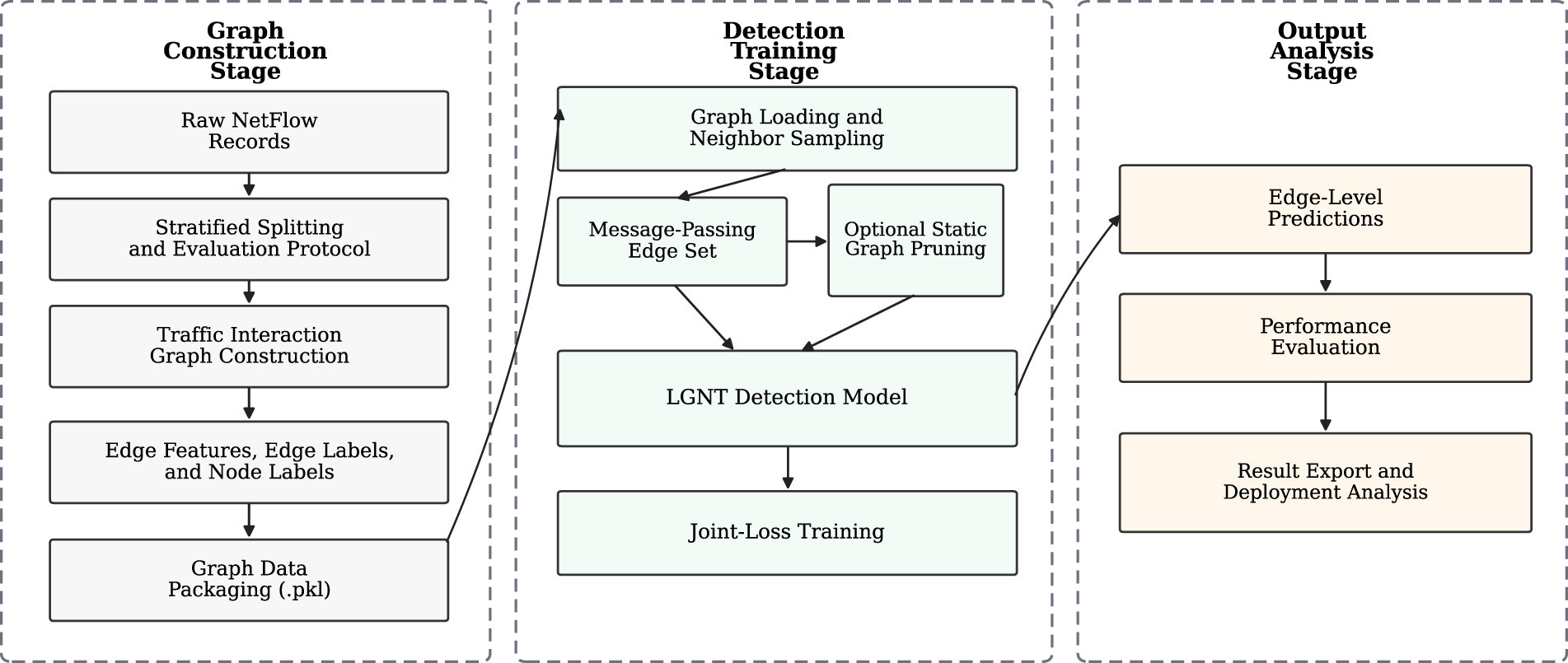
Figure 1: Overall framework of the proposed LGNT pipeline. NetFlow records are first converted into a traffic interaction graph, and edge-level malicious traffic detection is then performed through graph encoding, pruning, and classification. Note: LGNT, Lightweight Graph-Attentive Network for Traffic Detection.
3.1 Traffic Interaction Graph Construction
To model interactions among communicating entities more faithfully, each NetFlow record is not treated as an isolated sample. Instead, all records are organized into a directed attributed graph. This representation preserves both statistical traffic features and communication topology, thereby providing structured input for graph neural modeling.
Let the original NetFlow record set be
where
where
Collecting all directed edges yields the edge-index matrix
Under this formulation, IoT malicious traffic detection is modeled as an edge-classification problem.
3.2 Edge Attributes, Labels, and Auxiliary Node Labels
Each edge uses a fixed eight-dimensional NetFlow feature vector
To characterize communication activity, an auxiliary node label is introduced as a binary activity-level label rather than an attack-category label. Let
where
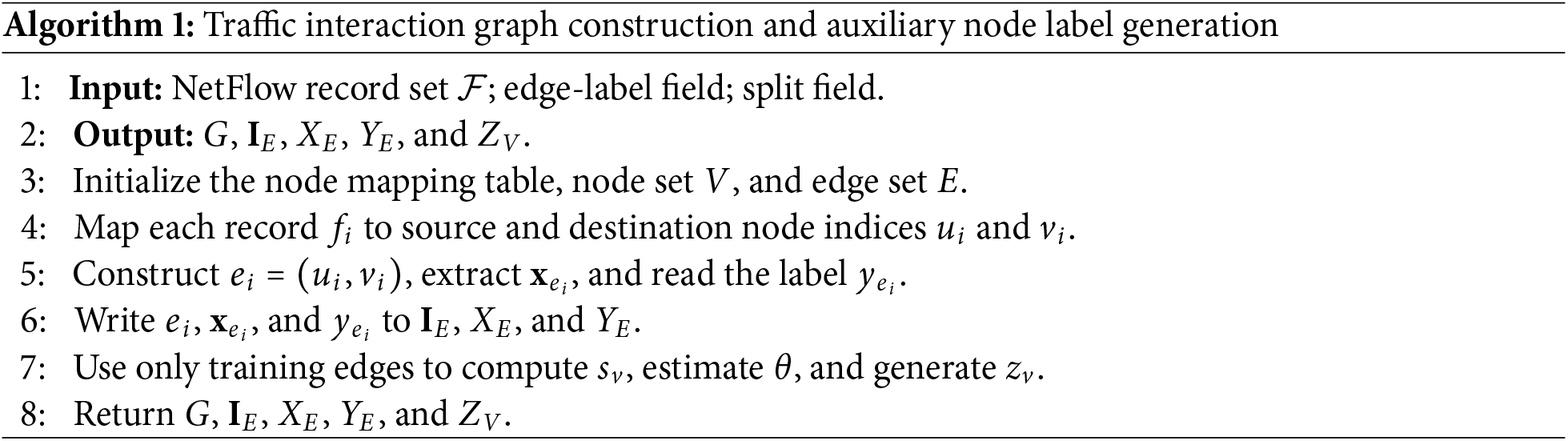
Algorithm 1 gives the complete construction process. The algorithm also clarifies that node auxiliary labels are calculated only from the training partition, which avoids information leakage from validation and test edges.
3.3 Data Generation and Experimental Splits
After graph structure and attributes are defined, the original CSV records are converted into graph files. Stratified splitting preserves class ratios across training, validation, and test subsets. The main evaluation protocol is five-fold stratified cross-validation with a 60%/20%/20% split in each fold. A fixed split is also retained for debugging, pruning analysis, and reproducibility comparison.
Large traffic interaction graphs often contain far more edges than nodes. Running message passing and attention directly on the complete graph increases computational cost and may diffuse noise. Therefore, a static graph-pruning step is applied before forward propagation.
Two pruning modes are considered. The first is random pruning, which uniformly samples a subset of edges from the complete edge set and is used as a non-structure-aware baseline. The second is structure-significance pruning based on node degree. For an edge
where
This pruning scheme is static rather than learnable. Although it is less flexible than adaptive pruning, it is simple, inexpensive, and consistent with the lightweight deployment goal of this study. Fig. 2 presents the internal architecture of LGNT. The model uses a graph encoder to learn node representations, an edge readout module to recover edge-level representations, and a classifier to predict traffic labels.
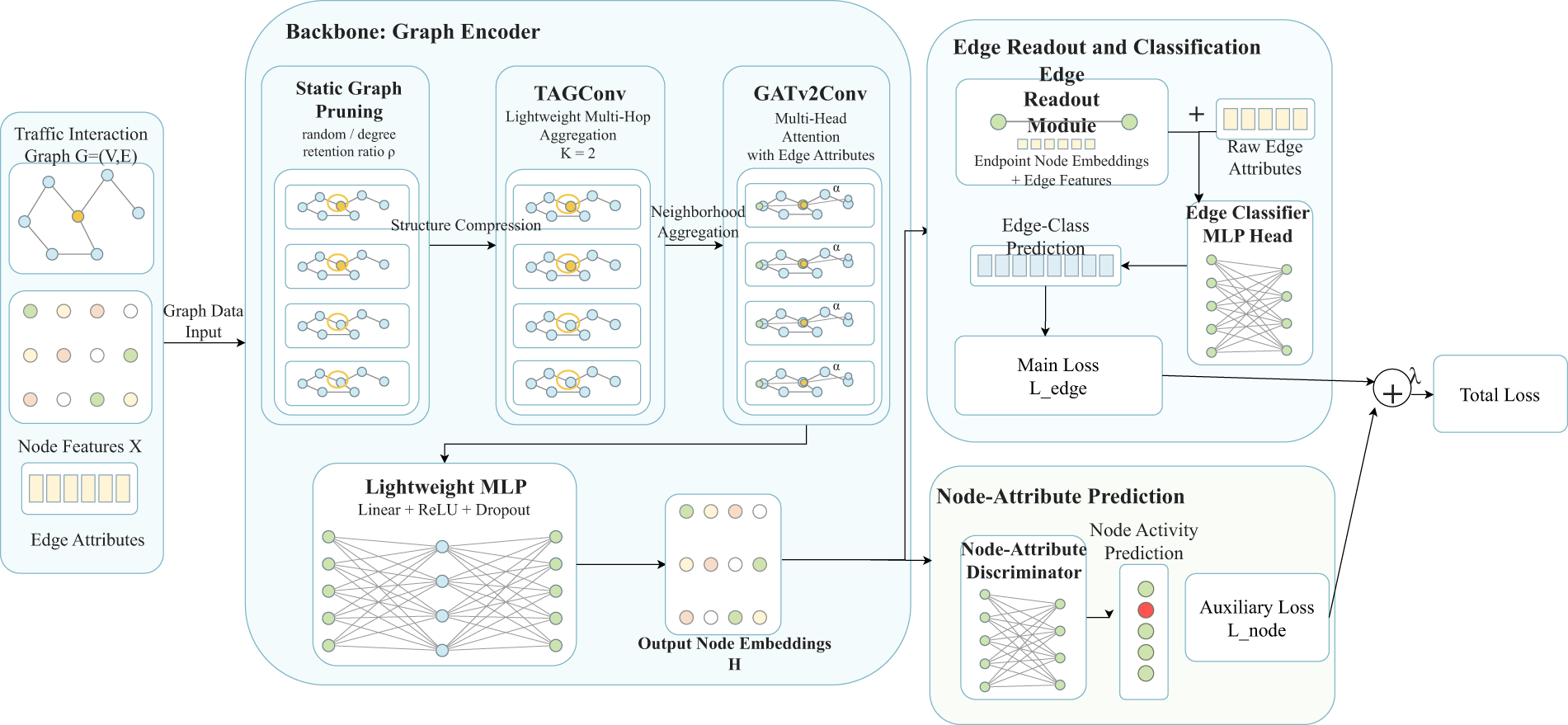
Figure 2: Architecture of the LGNT model. The model learns node embeddings from the pruned traffic interaction graph, constructs edge representations from endpoint embeddings and edge attributes, and predicts malicious traffic labels through an edge classifier. Note: LGNT, Lightweight Graph-Attentive Network for Traffic Detection; TAGConv, topology adaptive graph convolution; GATv2, graph attention v2 convolution.
Let the input node-feature matrix be
where
The TAGConv output is then passed to graph attention v2 convolution (GATv2Conv) for local attention enhancement. GATv2 was introduced to address the static attention limitation of the original graph attention mechanism [28]. For edge
where
where
3.5.1 Edge Readout and Classification
Because the detection target is an edge rather than a node, LGNT constructs an edge representation after node embeddings are obtained. For edge
where
3.5.2 Auxiliary Node-Attribute Branch and Joint Loss
To stabilize node representations under class imbalance and noisy supervision, an auxiliary branch predicts whether node
where
where
The total loss is
where
The experiments use two public NetFlow datasets, NF-BoT-IoT and NF-ToN-IoT. Both datasets provide binary labels and multi-class labels, which makes it possible to evaluate both coarse-grained attack detection and fine-grained attack-type recognition. Table 1 reports the class statistics and the fixed split sizes used in the single-split analysis. The main evaluation protocol is five-fold stratified cross-validation, and each fold uses a 60%/20%/20% split for training, validation, and testing.
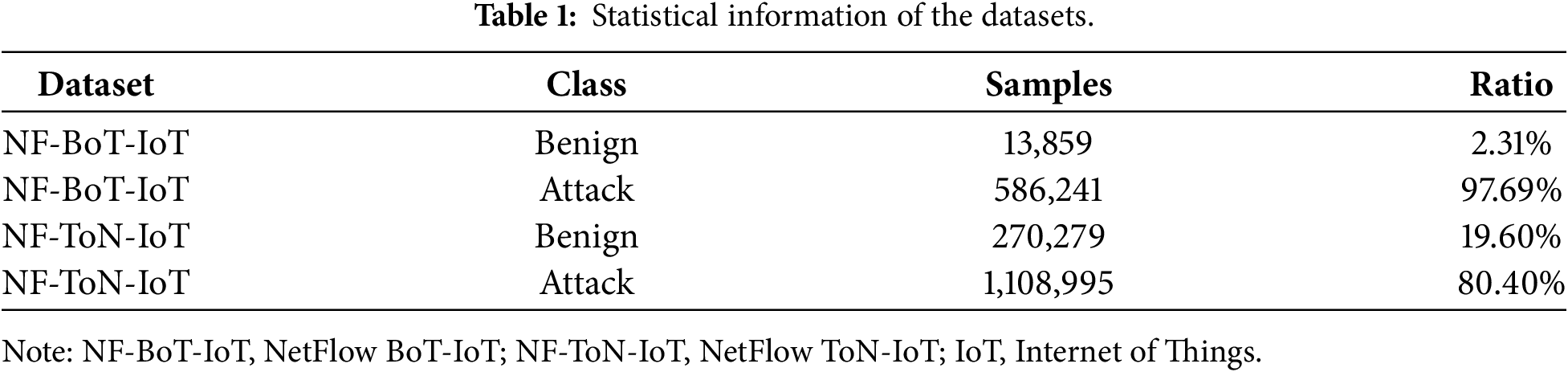
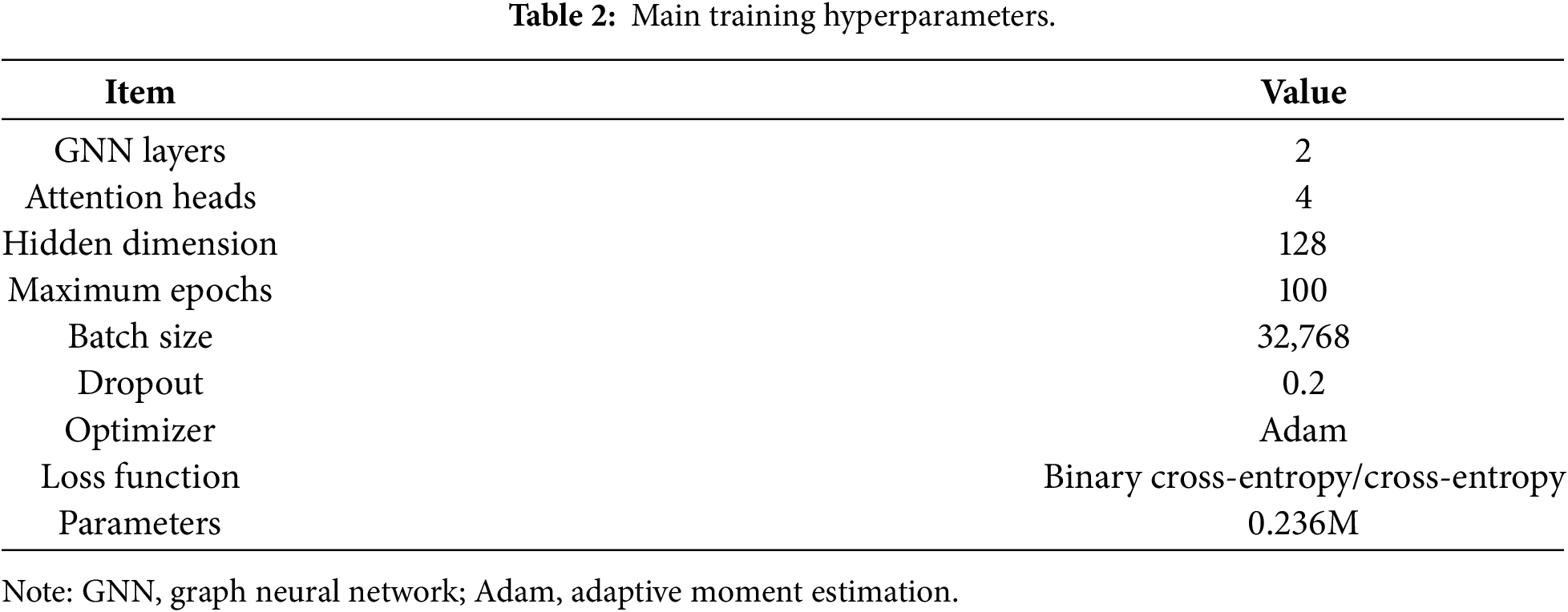
Table 2 lists the main training configuration. All experiments are conducted on Ubuntu 20.04 using an Intel Xeon Gold 6330 CPU at 2.00 GHz, 755 GiB of memory, and an NVIDIA GeForce RTX 3090 GPU with 24 GB memory under CUDA 11.3. The software stack includes Python 3.9.15, PyTorch 1.13.0, PyTorch Geometric 2.1.0, PyTorch Lightning 1.7.7, and Scikit-learn 1.0.2.
The main evaluation metrics are accuracy, AUC, precision, recall, and F1. Macro-F1 is additionally used in the pruning and ablation analysis because it better reflects minority-class behavior under imbalanced class distributions. XGBoost is included as a strong tree-based baseline for flow-level classification [29]. E-GraphSAGE is included as a representative graph neural baseline for IoT intrusion detection [7]. Anomal-E is included as a self-supervised graph-based intrusion detection baseline [8].
4.2 Binary Classification Results
Fig. 3 shows the binary classification results on NF-BoT-IoT. LGNT obtains the best overall binary-classification performance on this dataset. Compared with LGNT-noAux, the full model improves AUC by 0.45 percentage points and F1 by 0.67 percentage points. This indicates that the auxiliary node-attribute branch stabilizes representation learning under heavy class imbalance. E-GraphSAGE and Anomal-E are weaker than XGBoost and LGNT in this setting, which suggests that simple graph embeddings or self-supervised graph representations are not always sufficient for edge-level IoT flow classification.
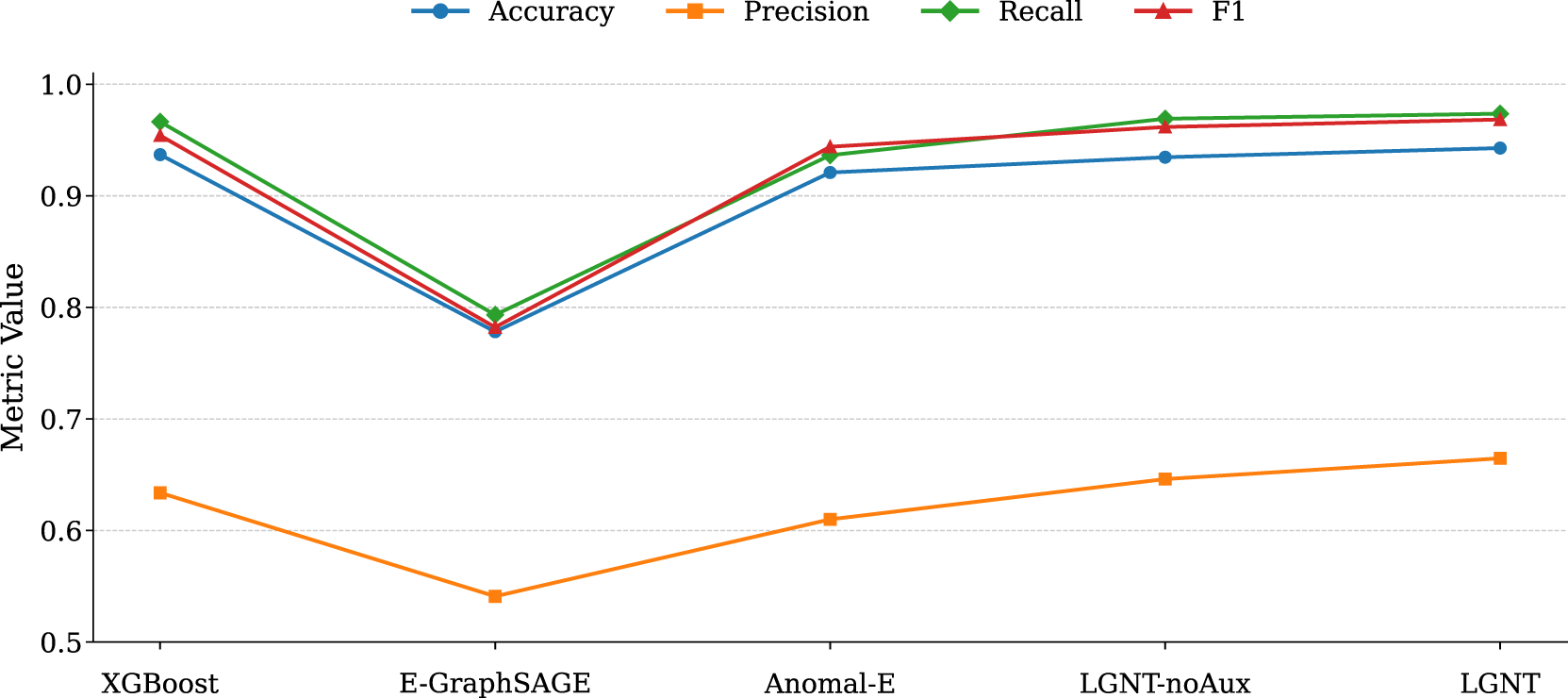
Figure 3: Binary classification results on NF-BoT-IoT. Accuracy, AUC, Precision, Recall, and F1 are compared across XGBoost, E-GraphSAGE, Anomal-E, LGNT-noAux, and LGNT. Note: NF-BoT-IoT, NetFlow BoT-IoT; AUC, area under the curve; XGBoost, Extreme Gradient Boosting; LGNT, Lightweight Graph-Attentive Network for Traffic Detection; LGNT-noAux, LGNT without auxiliary node supervision.
Fig. 4 reports the binary classification results on NF-ToN-IoT. This task is close to saturation, but LGNT still remains ahead on the main indicators. Compared with LGNT-noAux, the complete model improves AUC by 0.04 percentage points and F1 by 0.02 percentage points. XGBoost remains competitive on this dataset, which means that raw NetFlow features already provide a clear decision boundary. Even so, the additional graph context allows LGNT to classify difficult samples more steadily.
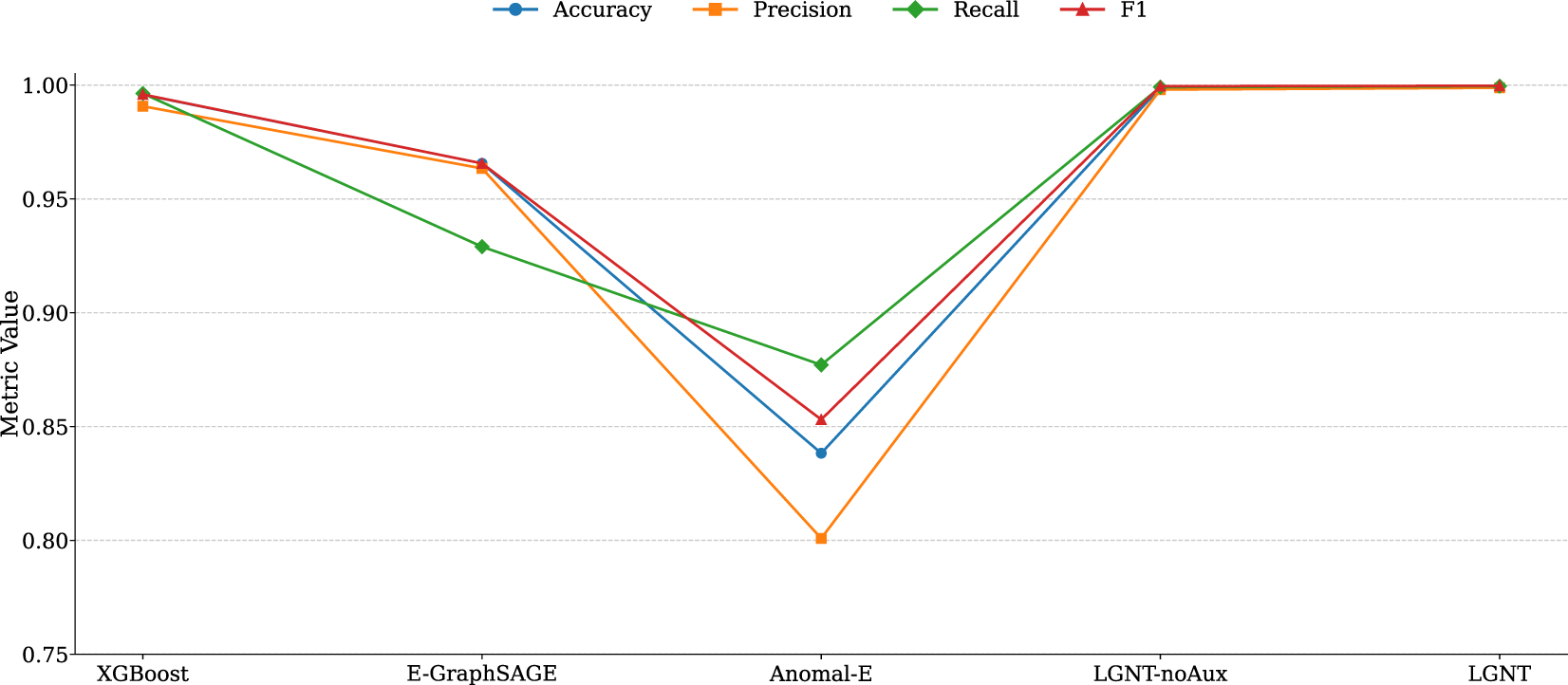
Figure 4: Binary classification results on NF-ToN-IoT. Accuracy, AUC, Precision, Recall, and F1 are compared across the baseline models and LGNT variants. Note: NF-ToN-IoT, NetFlow ToN-IoT; AUC, area under the curve; LGNT, Lightweight Graph-Attentive Network for Traffic Detection.
4.3 Multi-Class Classification Results
Multi-class classification is more difficult because the model must distinguish fine-grained attack behaviors. Fig. 5 shows that LGNT improves weighted F1 from 0.8411 to 0.8688 on NF-BoT-IoT and from 0.6433 to 0.6905 on NF-ToN-IoT.
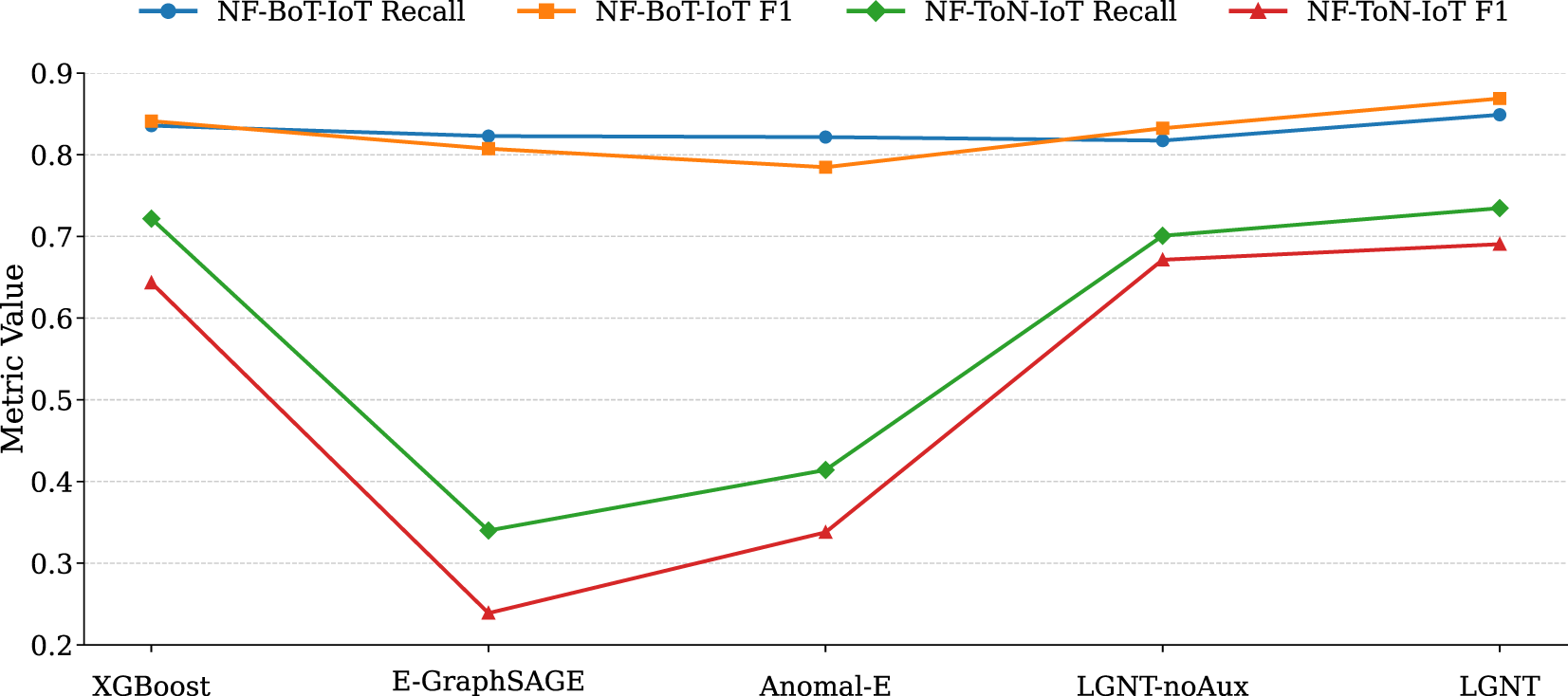
Figure 5: Overall multi-class classification results. The weighted recall and weighted F1 scores are reported for NF-BoT-IoT and NF-ToN-IoT. Note: NF-BoT-IoT, NetFlow BoT-IoT; NF-ToN-IoT, NetFlow ToN-IoT; F1, F1-score.
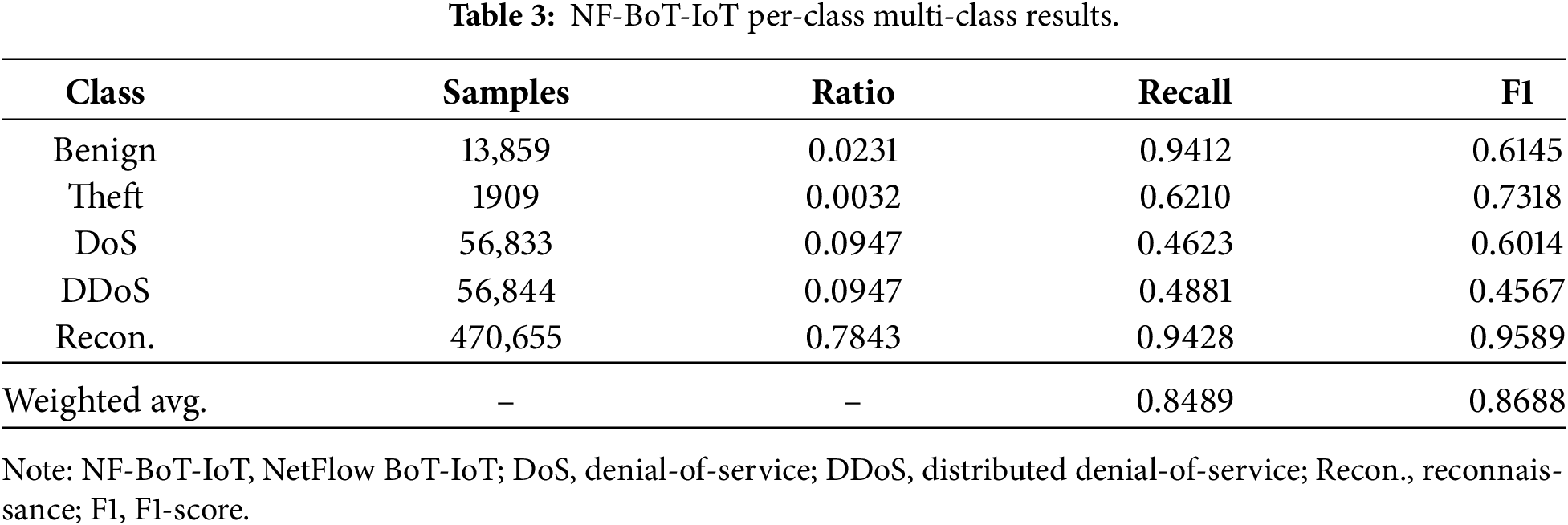
Table 3 gives the per-class results on NF-BoT-IoT. LGNT maintains strong recall and F1 on the dominant Reconnaissance class, indicating that the model captures high-frequency scanning and reconnaissance patterns. Theft, DoS, and DDoS remain more difficult because their class proportions are lower. The Benign class also has a relatively low F1 score, which is consistent with the severe imbalance of the dataset.
Although the NF-ToN-IoT results show relatively high accuracy and AUC, these overall metrics alone are insufficient for evaluating fine-grained multi-class malicious traffic detection under severe class imbalance. Therefore, Table 4 further reports per-class precision, recall, F1-score, and support for the NF-ToN-IoT multi-class task. Macro, micro, and weighted averages are also included to provide a more complete evaluation of both minority-class recognition and overall sample-level performance.
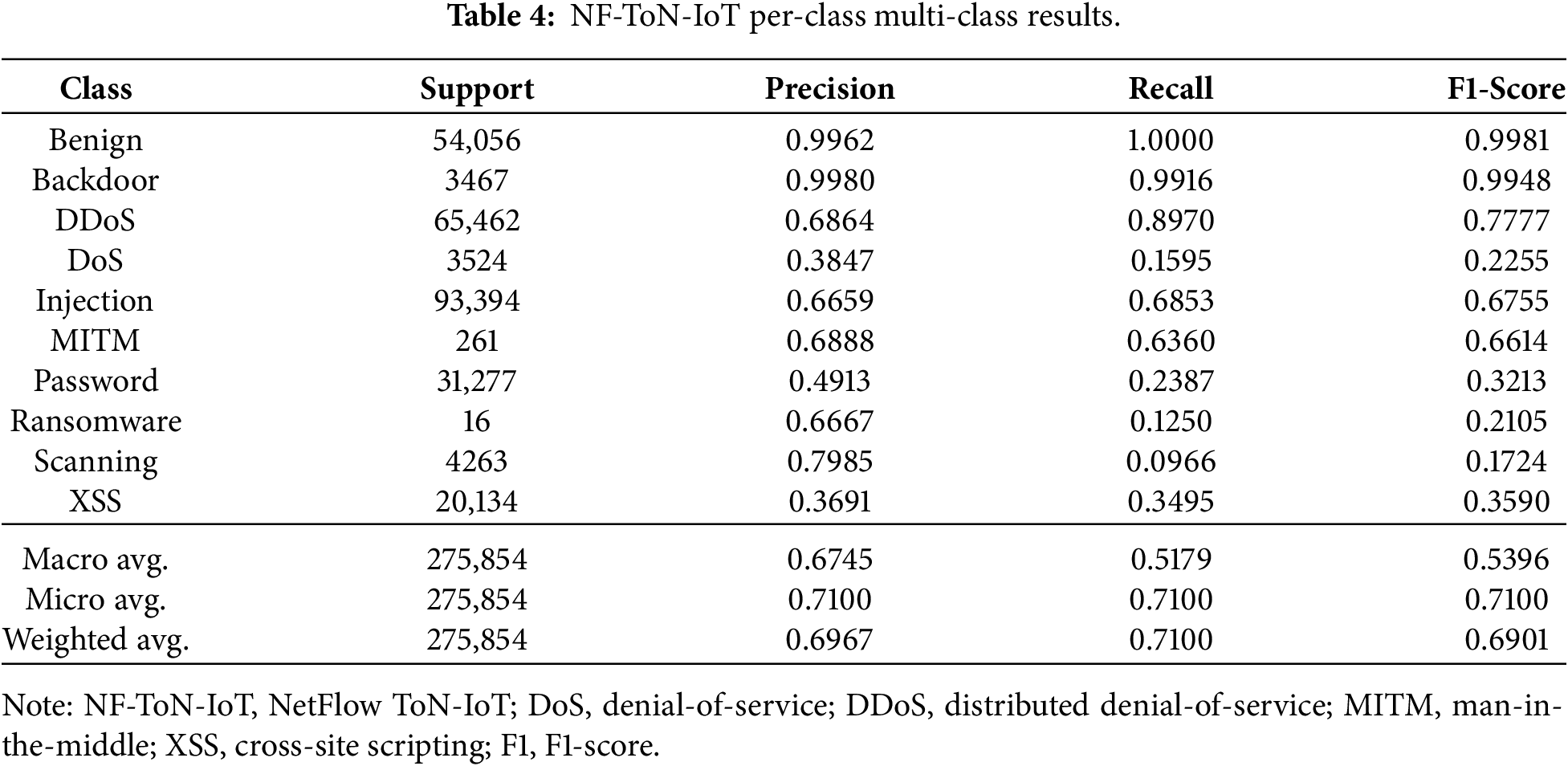
As shown in Table 4, the weighted-F1 score is 0.6901, whereas the macro-F1 score is lower at 0.5396. This gap indicates that the overall weighted performance is mainly supported by dominant or more separable classes such as Benign, DDoS, and Injection. In contrast, minority or behaviorally similar attack categories, including DoS, Password, Ransomware, Scanning, and XSS, still show lower recall and F1-scores. The row-normalized confusion matrix in Fig. 6 further illustrates the source of this inconsistency: DoS traffic is frequently confused with DDoS, and XSS and Password samples are often confused with Injection or DDoS. Therefore, the high accuracy and AUC should be interpreted together with per-class and macro-average metrics.
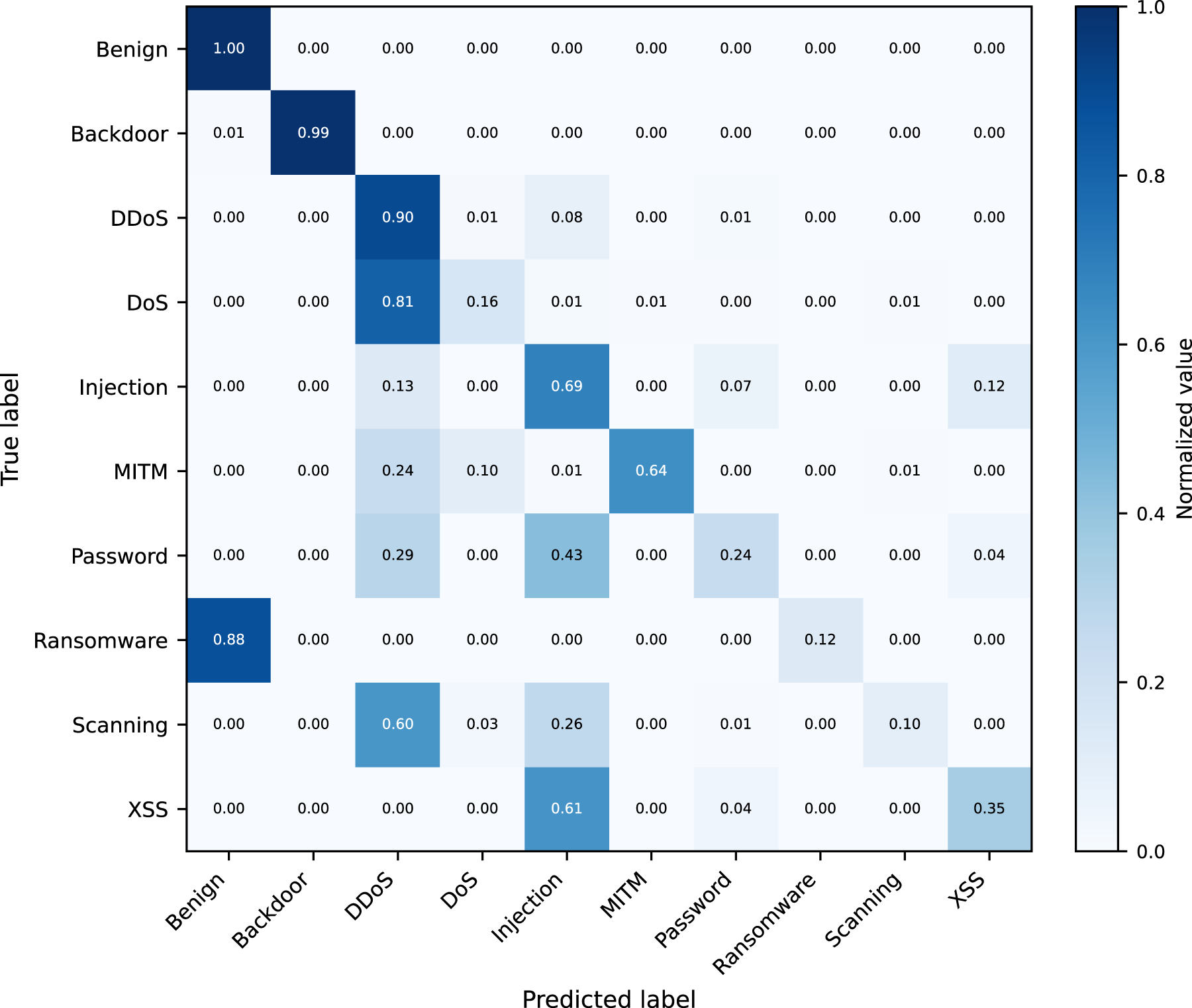
Figure 6: Row-normalized confusion matrix on NF-ToN-IoT. Note: NF-ToN-IoT, NetFlow ToN-IoT; DoS, denial-of-service; DDoS, distributed denial-of-service; MITM, man-in-the-middle; XSS, cross-site scripting.
To further discuss the generalization behavior of LGNT, we compare its performance across NF-BoT-IoT and NF-ToN-IoT under both binary and multi-class settings. The results indicate that LGNT maintains stable performance on binary detection tasks, suggesting that the proposed traffic-interaction graph and lightweight graph encoder can capture discriminative malicious-flow patterns across different IoT traffic sources. However, the multi-class results show larger performance variation, especially on NF-ToN-IoT, where several minority attack categories remain difficult to distinguish. This phenomenon indicates that cross-dataset generalization is affected not only by the graph encoder, but also by dataset-specific traffic composition, attack-type overlap, and long-tailed class distributions.
To evaluate the effect of graph pruning, Table 5 compares the unpruned model with pruning variants under not-CV and CV settings. The reported values are Accuracy/Macro-F1. The table explicitly keeps the retained-edge ratios so that the pruning settings can be traced during reproduction.
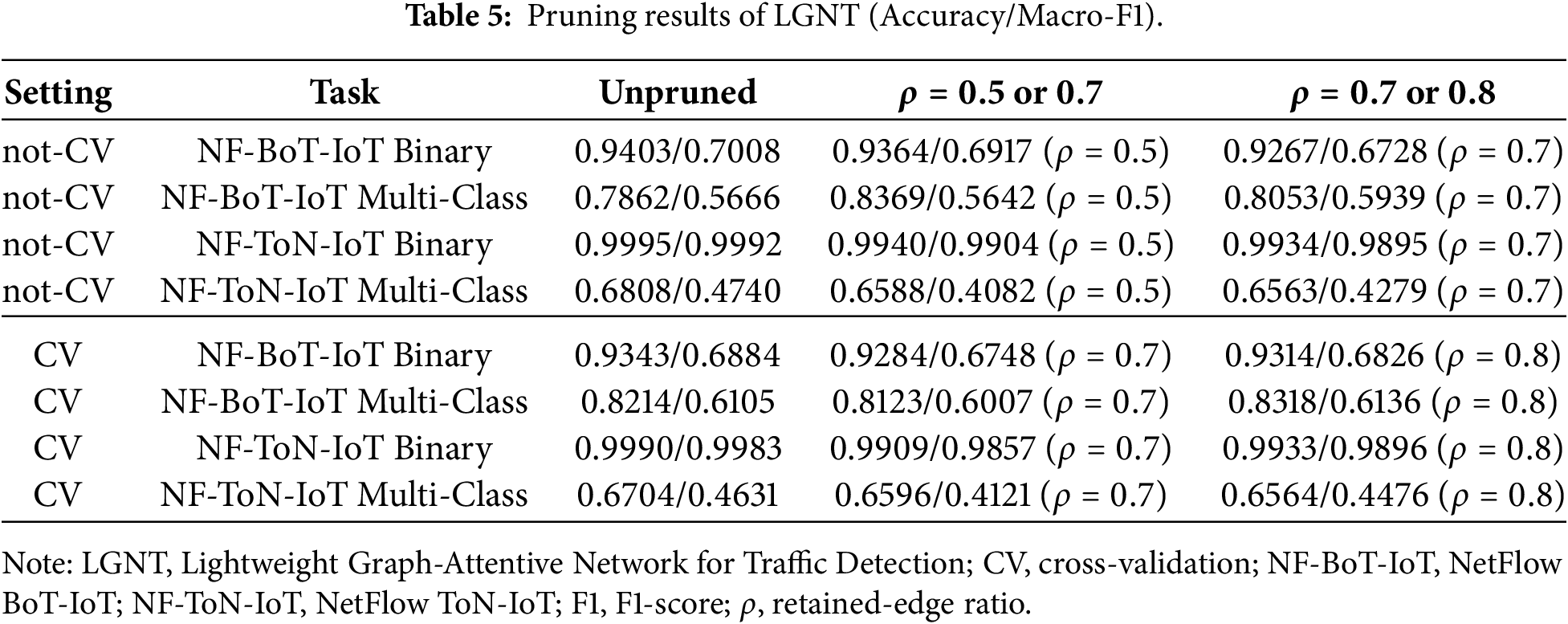
Table 5 shows that pruning is strongly dataset- and task-dependent. On NF-BoT-IoT multi-class classification, moderate pruning can improve Macro-F1. In the not-CV setting,
4.5 Ablation and Lightweight Analysis
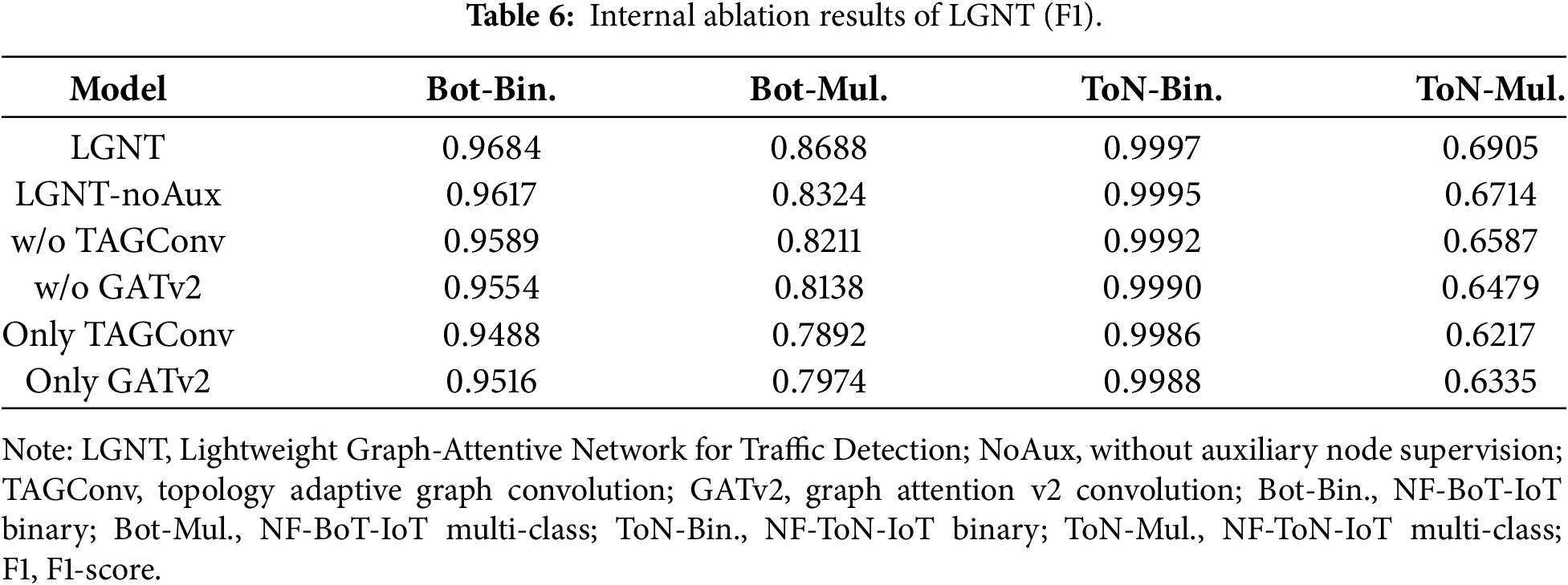
Table 6 summarizes the internal ablation results. Removing the auxiliary branch reduces multi-class F1 from 0.8688 to 0.8324 on NF-BoT-IoT and from 0.6905 to 0.6714 on NF-ToN-IoT. Removing TAGConv or GATv2 also weakens performance. This confirms that the final performance does not come from a single component, but from the combination of multi-hop aggregation, local attention, and node-attribute auxiliary supervision.
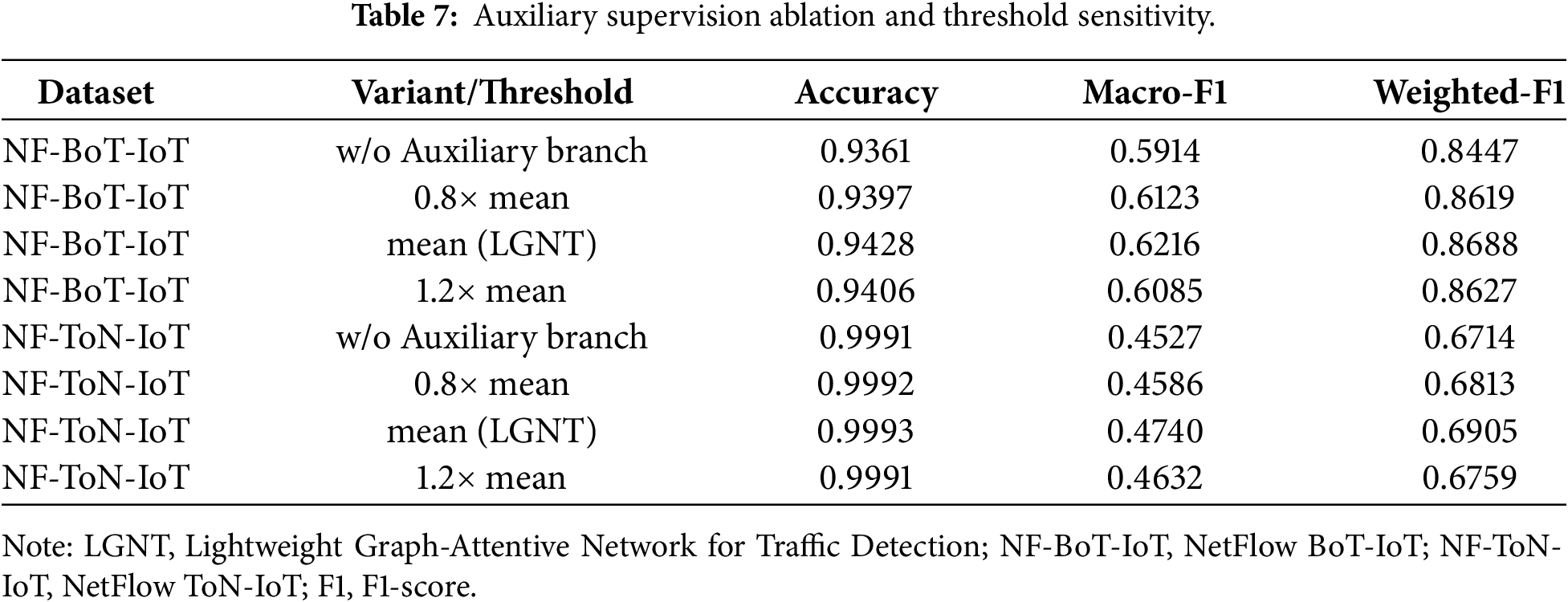
To further evaluate the auxiliary node-supervision branch, Table 7 compares the full model with a variant that removes the auxiliary branch and reports threshold sensitivity. Removing the branch reduces Macro-F1 and Weighted-F1, while moderate threshold changes around the mean cause limited fluctuations.
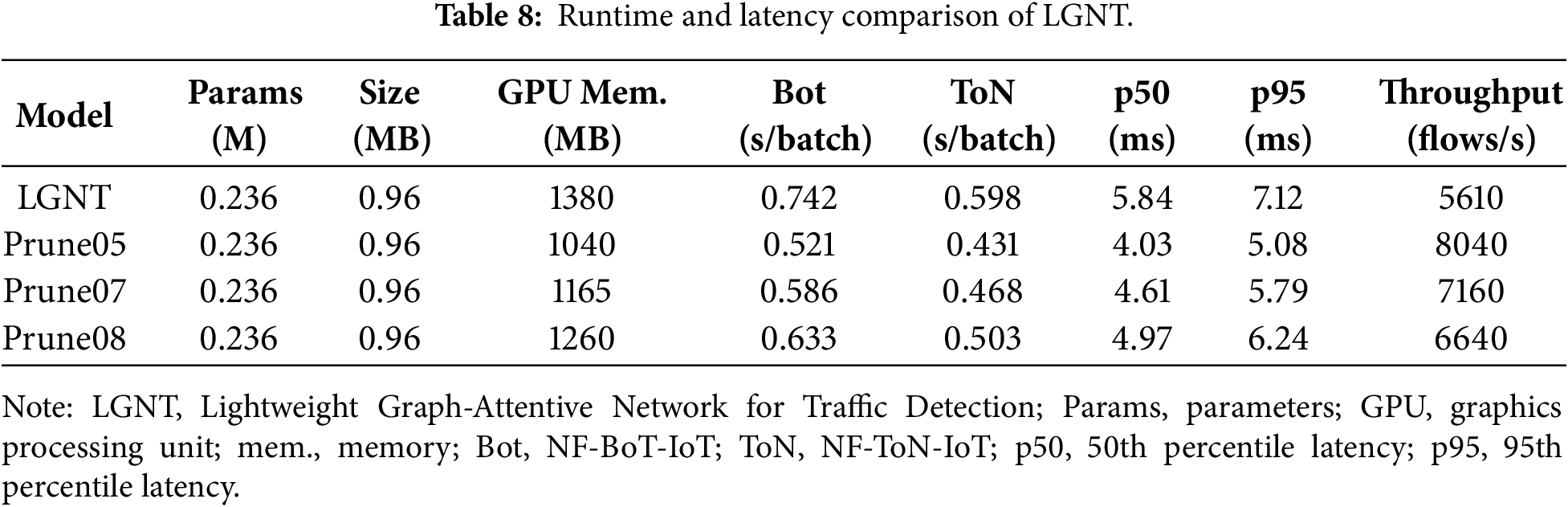
To further support the lightweight design of LGNT, we expanded the efficiency evaluation beyond parameter count. Because sparse graph operations are affected by graph density, retained-edge ratio, and sampling behavior, theoretical operation counts alone may not fully reflect the actual deployment cost. Therefore, we report parameter number, model size, peak GPU memory consumption, batch runtime, inference latency, throughput, and theoretical graph complexity under the same hardware environment. Runtime was measured in inference mode on the same RTX 3090 GPU, with model.eval() enabled and gradient computation disabled; 10 warm-up batches were excluded, and the reported latency values were averaged over 100 timed batches using CUDA synchronization.
As shown in Table 8, graph pruning does not change the parameter number or model size because the model weights remain unchanged. Instead, it reduces the retained message-passing edge set, which lowers peak GPU memory consumption, shortens batch runtime, reduces inference latency, and improves throughput. For example, Prune05 reduces peak GPU memory from 1380 to 1040 MB and improves throughput from 5610 to 8040 flows/s. These results show that the lightweight design of LGNT is reflected not only by the small parameter scale, but also by practical deployment indicators such as memory consumption, inference latency, and throughput.
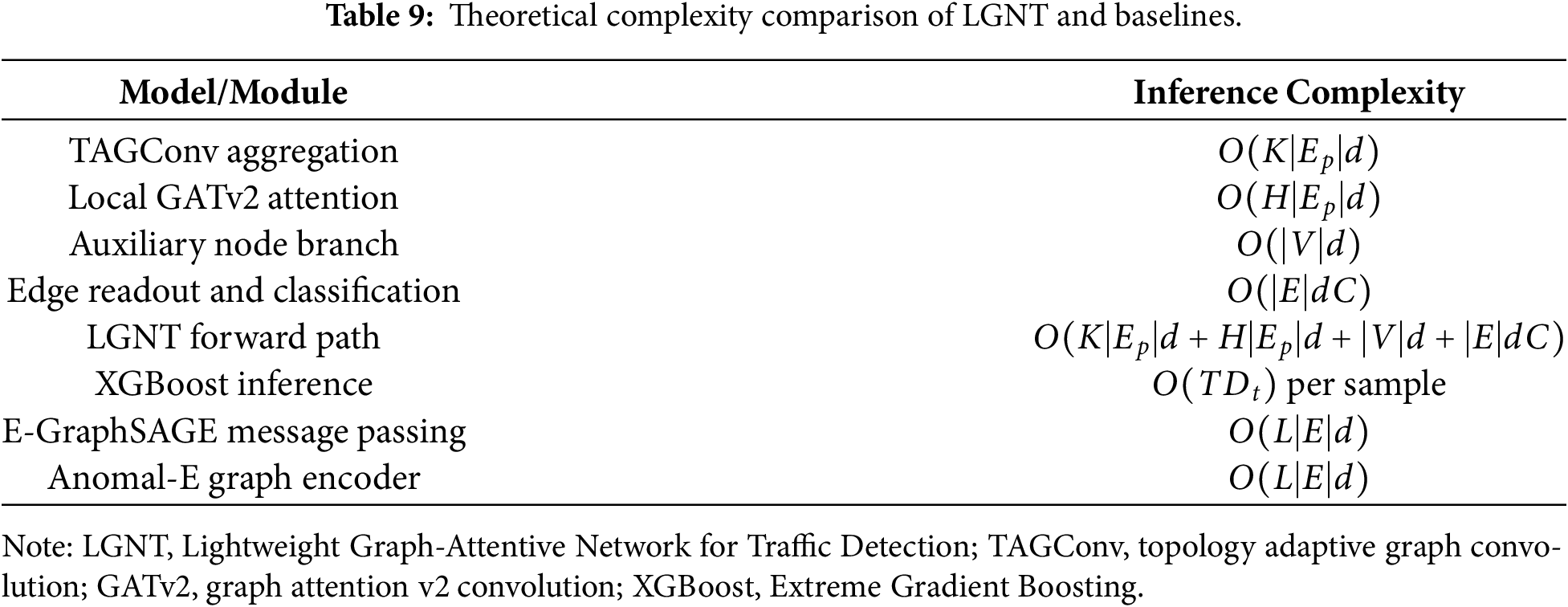
In addition to measured runtime indicators, Table 9 provides a theoretical complexity comparison between LGNT and baseline models. The main computational cost of LGNT comes from TAGConv aggregation and GATv2-based graph attention over the retained message-passing edge set. In this table,
Overall, the experimental results indicate that LGNT improves edge-level malicious traffic detection while keeping the parameter scale low. The advantage is clearer in multi-class classification, where class imbalance and fine-grained attack similarity make the task harder. The pruning results also show that structural compression is useful, but it should be treated as a dataset-dependent strategy rather than a universally beneficial configuration.
This paper presented LGNT, a Lightweight Graph-Attentive Network for Traffic Detection in IoT environments. Instead of treating each NetFlow record as a separate tabular instance, LGNT organizes records into a directed traffic interaction graph. The final model combines TAGConv, GATv2-based local graph attention, auxiliary node-attribute supervision, and static graph pruning to obtain a compact detector.
Experiments on NF-BoT-IoT and NF-ToN-IoT show that LGNT is effective in both binary and multi-class settings. The per-class analysis and normalized confusion matrix also show that fine-grained recognition of minority attack categories remains challenging under severe class imbalance. The pruning and efficiency analyses further suggest that lightweight deployment can be improved through structure compression, although the benefit depends on the underlying dataset.
Future work will evaluate LGNT on live operational traffic, explore adaptive pruning, and incorporate richer sources such as protocol semantics, logs, and threat intelligence. Attention visualization and key-edge analysis may also improve interpretability in security monitoring and attack tracing scenarios.
Acknowledgement: Not applicable.
Funding Statement: This research was funded by the 2026 Young Teachers Interdisciplinary Scientific Research Training Program of Lanzhou University of Technology, grant number LUTXKJC-26003, and the Lanzhou University of Technology Doctoral Talent Research Start-up Fund Project (14/062402).
Author Contributions: The authors confirm contribution to the paper as follows: conceptualization, Baofeng Duan and Xinghai Yu; methodology, Xinghai Yu and Baofeng Duan; software, Xinghai Yu; validation, Baofeng Duan and Xinghai Yu; formal analysis, Xinghai Yu; investigation, Xinghai Yu; resources, Baofeng Duan; data curation, Xinghai Yu; writing—original draft preparation, Xinghai Yu; writing—review and editing, Baofeng Duan, Xinghai Yu, Peng Wang, Tao Feng and Yongbo Jiang; visualization, Xinghai Yu; supervision, Baofeng Duan and Yongbo Jiang; project administration, Baofeng Duan; funding acquisition, Baofeng Duan. All authors reviewed and approved the final version of the manuscript.
Availability of Data and Materials: This study used publicly available NetFlow intrusion detection datasets described in Sarhan et al. [5]. The source code is available from the corresponding author upon reasonable request.
Ethics Approval: Not applicable.
Conflicts of Interest: The authors declare no conflicts of interest.
References
1. Zanella A, Bui N, Castellani A, Vangelista L, Zorzi M. Internet of Things for smart cities. IEEE Internet Things J. 2014;1(1):22–32. doi:10.1109/JIOT.2014.2306328. [Google Scholar] [CrossRef]
2. Khan MA, Salah K. IoT security: review, blockchain solutions, and open challenges. Future Gener Comput Syst. 2018;82(15):395–411. doi:10.1016/j.future.2017.11.022. [Google Scholar] [CrossRef]
3. Caballero-Gil C, Molina-Gil J, Hernandez-Goya C, Diaz-Santos S, Burmester M. Design of a blockchain-based ubiquitous system for the supply chain with autonomous vehicles. Electronics. 2025;14(23):4744. doi:10.3390/electronics14234744. [Google Scholar] [CrossRef]
4. Yang J, Ali MU, Kumar G, Khan MA, Shaikh ZA, Govindarajan V, et al. LLMEdgeSec: LLM-enabled log reasoning for zero-day IoT threat detection. IEEE Internet Things J. 2026;13(15):32546–55. doi:10.1109/JIOT.2026.3686053. [Google Scholar] [CrossRef]
5. Sarhan M, Layeghy S, Moustafa N, Portmann M. NetFlow datasets for machine learning-based network intrusion detection systems. In: Big data technologies and applications. Cham, Switzerland: Springer; 2021. p. 117–35. doi:10.1007/978-3-030-72802-1_9. [Google Scholar] [CrossRef]
6. Sarhan M, Layeghy S, Portmann M. Evaluating standard feature sets towards increased generalisability and explainability of ML-based network intrusion detection. Big Data Res. 2022;30(3):100359. doi:10.1016/j.bdr.2022.100359. [Google Scholar] [CrossRef]
7. Lo WW, Layeghy S, Sarhan M, Gallagher M, Portmann M. E-GraphSAGE: a graph neural network based intrusion detection system for IoT. In: Proceedings of the NOMS 2022-2022 IEEE/IFIP Network Operations and Management Symposium; 2022 Apr 25–29; Budapest, Hungary. p. 1–9. doi:10.1109/NOMS54207.2022.9789878. [Google Scholar] [CrossRef]
8. Caville E, Lo WW, Layeghy S, Portmann M. Anomal-E: a self-supervised network intrusion detection system based on graph neural networks. Knowl-Based Syst. 2022;258(1):110030. doi:10.1016/j.knosys.2022.110030. [Google Scholar] [CrossRef]
9. Bilot T, El Madhoun N, Al Agha K, Zouaoui A. Graph neural networks for intrusion detection: a survey. IEEE Access. 2023;11:49114–39. doi:10.1109/ACCESS.2023.3275789. [Google Scholar] [CrossRef]
10. Yagmur E, Kocak C, Keles A. Graph neural networks and graph autoencoders for intrusion detection systems: a systematic review, taxonomy and comparative analysis. Comput Netw. 2026;288:112598. doi:10.1016/j.comnet.2026.112598. [Google Scholar] [CrossRef]
11. Deng P, Huang Y. Edge-featured multi-hop attention graph neural network for intrusion detection system. Comput Secur. 2025;148(4):104132. doi:10.1016/j.cose.2024.104132. [Google Scholar] [CrossRef]
12. Wang Y, Han Z, Du Y, Li J, He X. BS-GAT: a network intrusion detection system based on graph neural network for edge computing. Cybersecurity. 2025;8(1):27. doi:10.1186/s42400-024-00296-8. [Google Scholar] [CrossRef]
13. Yang T, Chen JC, Deng H, He B. A lightweight intrusion detection algorithm for IoT based on data purification and a separable convolution improved CNN. Knowl-Based Syst. 2024;304(23):112473. doi:10.1016/j.knosys.2024.112473. [Google Scholar] [CrossRef]
14. Li Z, Yao W. A two stage lightweight approach for intrusion detection in Internet of Things. Expert Syst Appl. 2024;257(11):124965. doi:10.1016/j.eswa.2024.124965. [Google Scholar] [CrossRef]
15. Wang Z, Li J, Yang S, Luo X, Li D, Mahmoodi S. A lightweight IoT intrusion detection model based on improved BERT-of-Theseus. Expert Syst Appl. 2024;238(3):122045. doi:10.1016/j.eswa.2023.122045. [Google Scholar] [CrossRef]
16. Azimjonov J, Kim T. Designing accurate lightweight intrusion detection systems for IoT networks using fine-tuned linear SVM and feature selectors. Comput Secur. 2024;137:103598. doi:10.1016/j.cose.2023.103598. [Google Scholar] [CrossRef]
17. Misrak SF, Melaku HM. Lightweight intrusion detection system for IoT with improved feature engineering and advanced dynamic quantization. Discov Internet Things. 2025;5(1):97. doi:10.1007/s43926-025-00203-8. [Google Scholar] [CrossRef]
18. Altaf T, Wang X, Ni W, Yu Q, Liu F, Braun R. A new concatenated multigraph neural network for IoT intrusion detection. Internet Things. 2023;22(1):100818. doi:10.1016/j.iot.2023.100818. [Google Scholar] [CrossRef]
19. Termos M, Ghalmane Z, Brahmia MA, Fadlallah A, Jaber A, Zghal M. GDLC: a new graph deep learning framework based on centrality measures for intrusion detection in IoT networks. Internet Things. 2024;26(19):101214. doi:10.1016/j.iot.2024.101214. [Google Scholar] [CrossRef]
20. Wang L, Wu J, Wang L. ATC-FusionNet: a hybrid deep learning ensemble for network intrusion detection systems. Comput Mater Contin. 2026;88(1):42–10. doi:10.32604/cmc.2026.078591. [Google Scholar] [CrossRef]
21. Albahar MA. A hybrid self-supervised learning framework for advanced persistent threat detection. Comput Mater Contin. 2026;88(1):91. doi:10.32604/cmc.2026.079941. [Google Scholar] [CrossRef]
22. Shi G, Zhu Y, Liu JK, Li X. HeGCL: advance self-supervised learning in heterogeneous graph-level representation. IEEE Trans Neural Netw Learn Syst. 2024;35(10):13914–25. doi:10.1109/TNNLS.2023.3273255. [Google Scholar] [CrossRef]
23. Li Z, Wang Y, van Leeuwen M. Towards automated self-supervised learning for truly unsupervised graph anomaly detection. Data Min Knowl Discov. 2025;39(5):44. doi:10.1007/s10618-025-01115-5. [Google Scholar] [CrossRef]
24. Govindarajan V, Muzamal JH. Advanced cloud intrusion detection framework using graph based features transformers and contrastive learning. Sci Rep. 2025;15(1):20511. doi:10.1038/s41598-025-07956-w. [Google Scholar] [CrossRef]
25. Zhang A, Zhao Y, Zhou C, Zhang T. ResACAG: a graph neural network based intrusion detection. Comput Electr Eng. 2025;122(1):109956. doi:10.1016/j.compeleceng.2024.109956. [Google Scholar] [CrossRef]
26. Li F, Zhang W, Tang H. RHNN-IoT: a robust IoT intrusion detection framework based on reinforced hypergraph representation learning. Future Gener Comput Syst. 2026;176(1):108212. doi:10.1016/j.future.2025.108212. [Google Scholar] [CrossRef]
27. Du J, Zhang S, Wu G, Moura JMF, Kar S. Topology adaptive graph convolutional networks. arXiv:1710.10370. 2017. doi:10.48550/arxiv.1710.10370. [Google Scholar] [CrossRef]
28. Brody S, Alon U, Yahav E. How attentive are graph attention networks? arXiv:2105.14491. 2022. doi:10.48550/arxiv.2105.14491. [Google Scholar] [CrossRef]
29. Chen T, Guestrin C. XGBoost: a scalable tree boosting system. In: Proceedings of the 22nd ACM SIGKDD International Conference on Knowledge Discovery and Data Mining; 2016 Aug 13–17; San Francisco, CA, USA. p. 785–94. doi:10.1145/2939672.2939785. [Google Scholar] [CrossRef]
Cite This Article
 Copyright © 2026 The Author(s). Published by Tech Science Press.
This work is licensed under a Creative Commons Attribution 4.0 International License , which permits unrestricted use, distribution, and reproduction in any medium, provided the original work is properly cited.
 Downloads
 Citation Tools
