
 Login
Login Register
 Submit a Paper
 Propose a Special lssue
 Open Access
ARTICLE
Experimental Assessment of Net Zero Energy Office under Natural and Forced Ventilation by Rooftop Solar Chimney
1 Department of Mechanical Engineering, College of Engineering, University of Kerbala, Karbala, Iraq
2 Affiliation Department of Mechanical and Energy Engineering, Erbil Technical Engineering College, Erbil Polytechnic University, Erbil, Iraq
3 College of Engineering Technologies, University of Hillah, Hillah, Iraq
4 Department of Petroleum Engineering, University of Kerbala, Karbala, Iraq
5 Air Conditioning and Refrigeration Techniques Engineering Department, University of Warith Al-Anbiyaa, Karbala, Iraq
* Corresponding Author: Ali M. Tukkee. Email:
(This article belongs to the Special Issue: Advancements in Energy Resources and Their Processes, Systems, Materials and Policies for Affordable Energy Sustainability)
Energy Engineering 2026, 123(5), 9 https://doi.org/10.32604/ee.2026.076252
Received 17 November 2025; Accepted 27 January 2026; Issue published 27 April 2026
 View Full Text
 Download PDF
Abstract
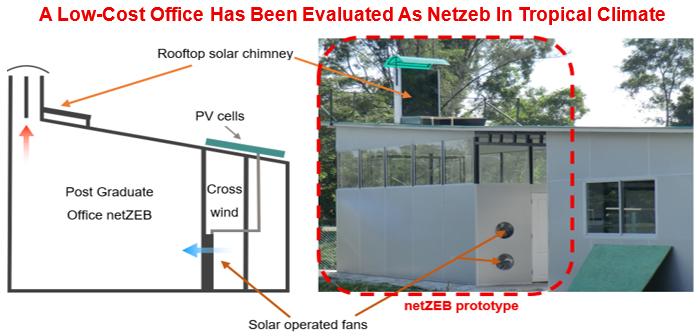
Energy supply and ventilation for isolated offices in rural areas are strongly recommended to be powered by renewable or standalone energy systems under the concept of net-zero-energy building (netZEB). A rooftop solar chimney is one of the adopted methods for space ventilation to improve thermal comfort. This approach has not been investigated under forced convection to support the netZEB. The objective of the current work is to experimentally assess the effectiveness of natural and forced ventilation methods for a prototype net-zero-energy office with a rooftop solar chimney. The prototype is a low-cost office constructed in the solar research site at University Teknologi PETRONAS, Malaysia. The weather is typical of a tropical climate. Three cases have been investigated. Case-1 with closed-door natural ventilation, Case-2 with open-door natural ventilation, and Case-3 with forced ventilation. Many ventilation parameters have been evaluated to compare the three ventilation cases. The measurement results show that, whether natural or forced, the installed chimney created a stack effect that reduced the temperature inside the office, but not to the required comfortable ventilation temperature. The mean measured indoor temperatures are higher than the proposed ventilation comfort temperatures, with differences of 6, 5.2, and 3.35°C for Case-1, Case-2, and Case-3, respectively. In natural ventilation, Case-2 reduced the indoor-to-outdoor temperature ratio by 2.7% and improved thermal comfort by 32.4% compared to Case-1. With forced ventilation, Case-3 reduced the indoor-to-outdoor temperature ratio by 27.3% and improved thermal comfort by 65.2% compared to Case-1. The large, unshaded glass windows have a significant negative effect on ventilation, and it is recommended to avoid such a design for netZEB in the tropical climate.Graphic Abstract
Keywords
Cite This Article
 Copyright © 2026 The Author(s). Published by Tech Science Press.
This work is licensed under a Creative Commons Attribution 4.0 International License , which permits unrestricted use, distribution, and reproduction in any medium, provided the original work is properly cited.
 Downloads
 Citation Tools
