
 Login
Login Register
 Submit a Paper
 Propose a Special lssue
 Open Access
ARTICLE
Mechanical Modelling of Positive Electrode in All-Solid-State Battery Cells
1 AVL-AST d.o.o., Zagreb, Croatia
2 AVL List GmbH, Graz, Austria
3 Faculty of Mechanical Engineering and Naval Architecture, University of Zagreb, Zagreb, Croatia
* Corresponding Author: Danijel Pavković. Email:
(This article belongs to the Special Issue: Selected Papers from the SDEWES 2025 Conference on Sustainable Development of Energy, Water and Environment Systems)
Energy Engineering 2026, 123(5), 25 https://doi.org/10.32604/ee.2026.077842
Received 18 December 2025; Accepted 17 March 2026; Issue published 27 April 2026
 View Full Text
 Download PDF
Abstract
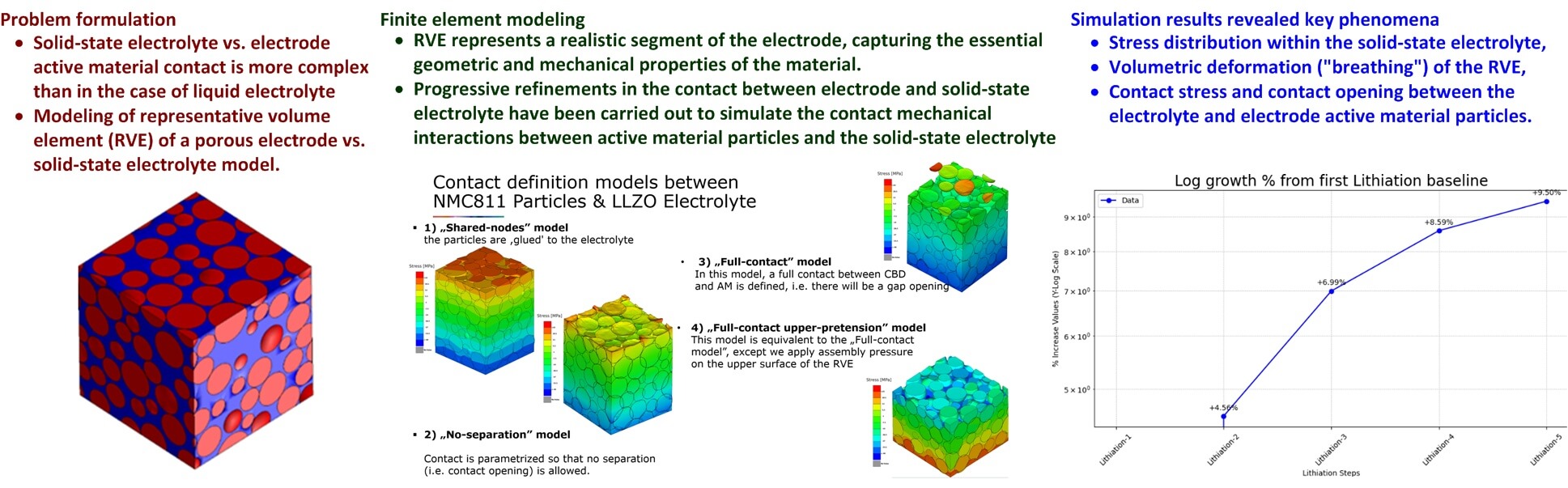
All-solid-state lithium-based batteries represent a critical evolution in energy storage, offering enhanced safety, higher energy density, and superior fast-charging capabilities. However, the integration of solid-state electrolytes introduces complex mechanical interactions at the electrode-electrolyte interface that significantly impact performance and longevity. This study introduces a cyclic plastic hardening model for ceramic electrolytes, moving beyond traditional brittle or linear-elastic assumptions. It presents a Finite Element Method (FEM) analysis of a positive electrode representative volume element (RVE), consisting of spherical Nickel-Manganese-Cobalt (NMC811) active material particles embedded in an Li7La3Zr2O12 (LLZO) solid-state electrolyte matrix, with Gaussian-distribution of particle sizes aimed to capture the stochastic heterogeneity of electrode microstructures. The simulation results illustrate the volumetric expansion and contraction of active material during lithiation and de-lithiation (electrochemical loading) cycles using a thermal expansion analogy. Due to the scarcity of cyclic plasticity data for ceramic electrolytes, the plastic hardening behavior of LLZO is approximated using a proxy material model (SiMo5 steel at 700°C) to qualitatively capture strain hardening effects. The study analyzes stress distribution, volumetric deformation, and contact evolution over five charge-discharge cycles under a uniform assembly external pressure of 10 MPa. Results indicate progressive strain hardening in the solid electrolyte, characterized by increasing tensile stresses and stabilizing volumetric deformation. Furthermore, the analysis reveals cyclic contact loss during de-lithiation, which poses risks for increased interfacial resistance. These findings provide theoretical insights into the mechanical degradation mechanisms of ASSBs, emphasizing the key role of stack pressure and material hardening in their long-term stability.Graphic Abstract
Keywords
Cite This Article
 Copyright © 2026 The Author(s). Published by Tech Science Press.
This work is licensed under a Creative Commons Attribution 4.0 International License , which permits unrestricted use, distribution, and reproduction in any medium, provided the original work is properly cited.
 Downloads
 Citation Tools
