
 Login
Login Register
 Submit a Paper
 Propose a Special lssue
 Open Access
ARTICLE
Risk-Based Qualimetric Assessment for Managing Power Unit Operation Using a Graph-Based Model
1 Department of Automation, Metrology and Energy Efficient Technologies, V. N. Karazin Kharkiv National University, 4 Svobody Sq., Kharkiv, Ukraine
2 Interregional Academy of Personnel Management, Kyiv, Ukraine
3 National University of Water and Environmental Engineering, Rivne, Ukraine
4 Pryazovskyi State Technical University, Dnipro, Ukraine
5 Kharkiv National Automobile and Highway University, Kharkiv, Ukraine
* Corresponding Author: Hanna Hrinchenko. Email:
(This article belongs to the Special Issue: Circular Energy Systems and Sustainable Pathways for Decarbonization)
Energy Engineering 2026, 123(10), 3 https://doi.org/10.32604/ee.2026.084705
Received 28 April 2026; Accepted 28 May 2026; Issue published 30 August 2026
 View Full Text
 Download PDF
Abstract
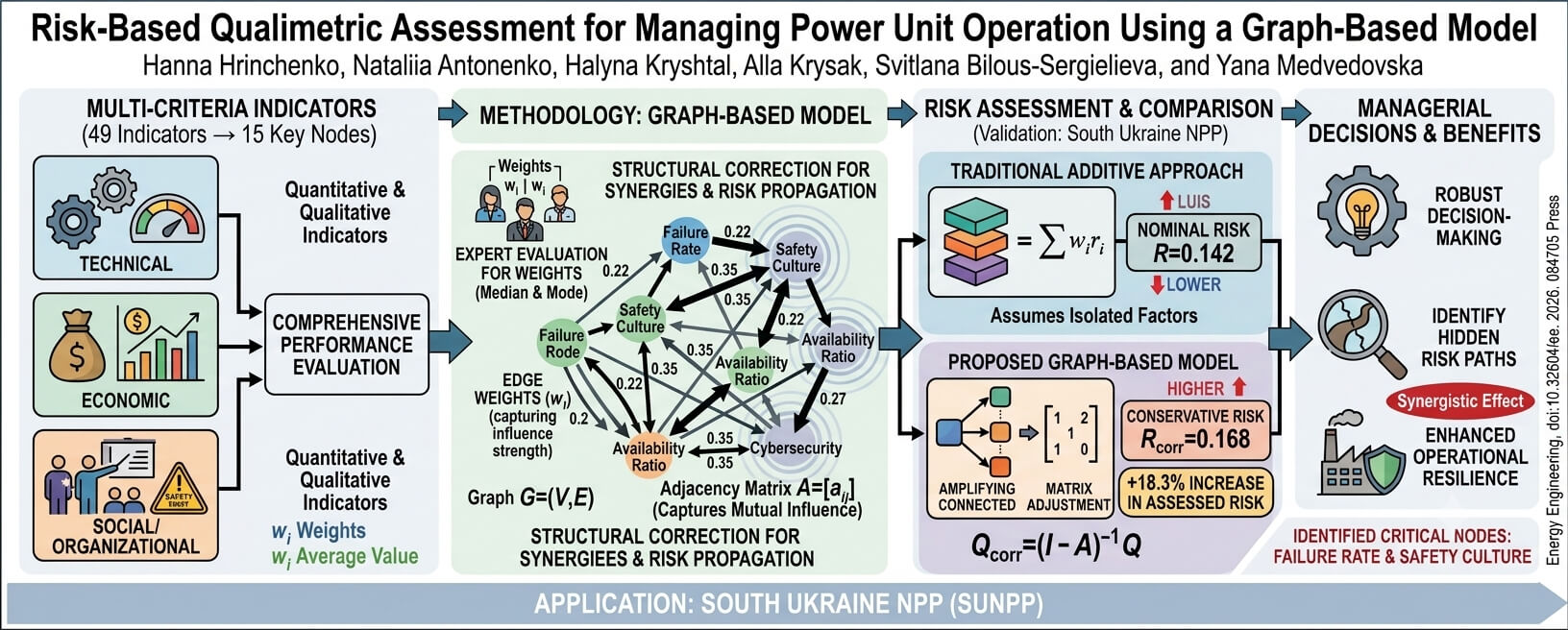
The transition towards long-term operation and increasing safety standards for nuclear power plant (NPP) units necessitates a fundamental shift from isolated technical monitoring to integrated, risk-oriented performance evaluation. The increasing complexity, safety requirements, and extended operation of nuclear power plant (NPP) units necessitate advanced approaches for assessing their functional performance. This study aims to develop a risk-oriented qualimetric (integrated multi-criteria quality assessment) methodology for comprehensive evaluation of NPP unit operation, integrating both quantitative and qualitative indicators while accounting for their interdependencies. This study develops a novel risk-oriented qualimetric methodology for the holistic assessment of NPP operation, synthesizing 49 indicators across technical, organizational, and social domains into a unified framework. The methodology includes the determination of weighting coefficients using expert evaluation supported by robust statistical measures (median and mode), ensuring consistency and reducing subjectivity. The core innovation lies in the application of a graph-based structural model that utilizes an adjacency matrix to quantify synergistic interdependencies between indicators. Unlike traditional additive models, this approach captures how technical degradations propagate through organizational subsystems, providing a more conservative risk estimate. Validation using empirical data from the South Ukraine NPP demonstrates that accounting for these structural links increases the assessed integral risk by 18.3%, reaching a value of R = 0.168. The findings identify the failure rate and safety culture as critical nodes in the system’s risk structure. The proposed model provides a robust analytical basis for managerial decision-making, enabling the identification of hidden risk propagation paths and enhancing the overall operational resilience of complex energy facilities.Graphic Abstract
Keywords
Cite This Article
 Copyright © 2026 The Author(s). Published by Tech Science Press.
This work is licensed under a Creative Commons Attribution 4.0 International License , which permits unrestricted use, distribution, and reproduction in any medium, provided the original work is properly cited.
 Downloads
 Citation Tools
