
 Login
Login Register
 Submit a Paper
 Propose a Special lssue
 Open Access
ARTICLE

Risk-Based Qualimetric Assessment for Managing Power Unit Operation Using a Graph-Based Model
1 Department of Automation, Metrology and Energy Efficient Technologies, V. N. Karazin Kharkiv National University, 4 Svobody Sq., Kharkiv, Ukraine
2 Interregional Academy of Personnel Management, Kyiv, Ukraine
3 National University of Water and Environmental Engineering, Rivne, Ukraine
4 Pryazovskyi State Technical University, Dnipro, Ukraine
5 Kharkiv National Automobile and Highway University, Kharkiv, Ukraine
* Corresponding Author: Hanna Hrinchenko. Email:
(This article belongs to the Special Issue: Circular Energy Systems and Sustainable Pathways for Decarbonization)
Energy Engineering 2026, 123(10), 3 https://doi.org/10.32604/ee.2026.084705
Received 28 April 2026; Accepted 28 May 2026; Issue published 30 August 2026
 View Full Text
 Download PDF
Abstract
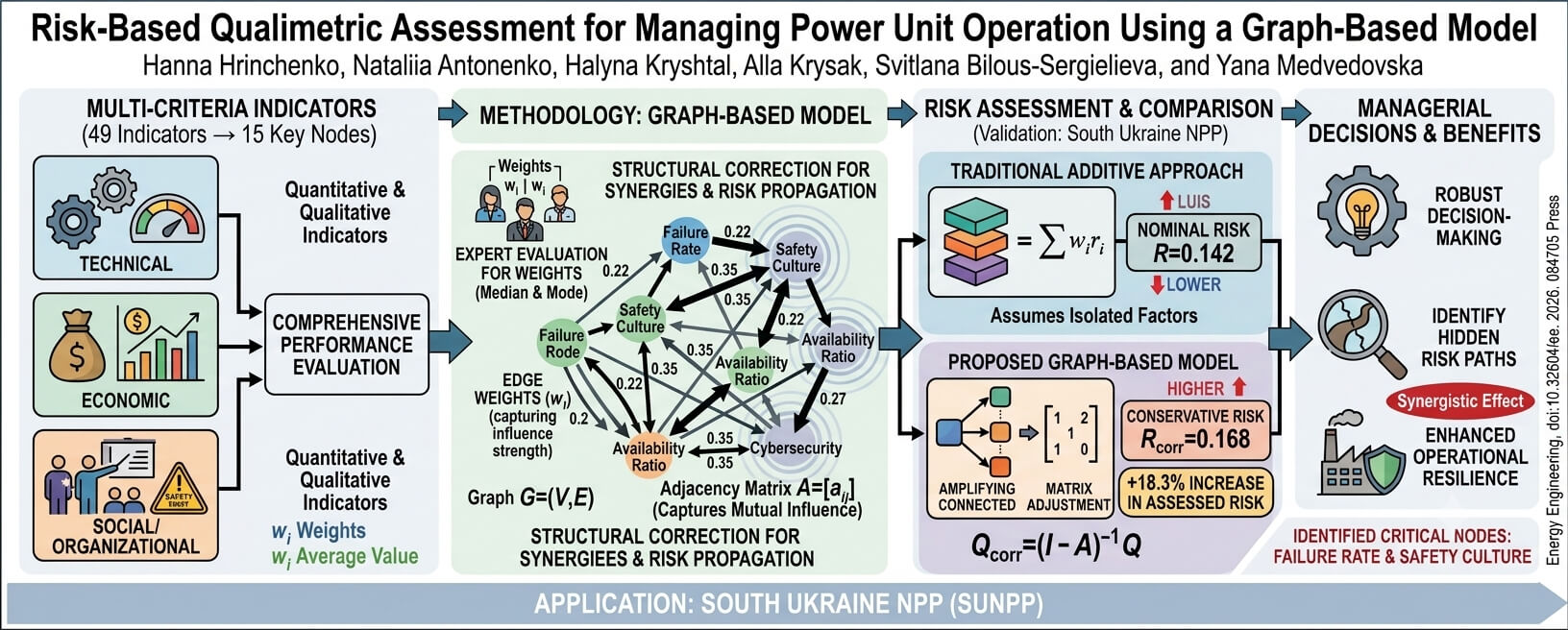
The transition towards long-term operation and increasing safety standards for nuclear power plant (NPP) units necessitates a fundamental shift from isolated technical monitoring to integrated, risk-oriented performance evaluation. The increasing complexity, safety requirements, and extended operation of nuclear power plant (NPP) units necessitate advanced approaches for assessing their functional performance. This study aims to develop a risk-oriented qualimetric (integrated multi-criteria quality assessment) methodology for comprehensive evaluation of NPP unit operation, integrating both quantitative and qualitative indicators while accounting for their interdependencies. This study develops a novel risk-oriented qualimetric methodology for the holistic assessment of NPP operation, synthesizing 49 indicators across technical, organizational, and social domains into a unified framework. The methodology includes the determination of weighting coefficients using expert evaluation supported by robust statistical measures (median and mode), ensuring consistency and reducing subjectivity. The core innovation lies in the application of a graph-based structural model that utilizes an adjacency matrix to quantify synergistic interdependencies between indicators. Unlike traditional additive models, this approach captures how technical degradations propagate through organizational subsystems, providing a more conservative risk estimate. Validation using empirical data from the South Ukraine NPP demonstrates that accounting for these structural links increases the assessed integral risk by 18.3%, reaching a value of R = 0.168. The findings identify the failure rate and safety culture as critical nodes in the system’s risk structure. The proposed model provides a robust analytical basis for managerial decision-making, enabling the identification of hidden risk propagation paths and enhancing the overall operational resilience of complex energy facilities.Graphic Abstract
Keywords
The current stage of development in the energy sector is characterised by increasing demands on the reliability, safety and operational efficiency of complex technical systems, in particular the power units of nuclear power plants (NPPs). Against a backdrop of heightened man-made risks, stringent regulatory requirements and the need to ensure the sustainable development of the energy sector, the implementation of scientifically sound approaches to assessing the operational quality of such facilities takes on particular significance. This is accompanied by a range of factors, both external and internal, which must be taken into account when planning a strategy for managing NPP power units.
Current approaches to assessing the operational quality of NPP power units in Ukraine are predominantly based on the use of individual technical-economic or operational indicators that characterise the technical condition and operational stability of specific equipment, determine the criteria and objects of monitoring during modernisation and the re-determination of service life, take into account a limited list of indicators that directly affect the safety of NPP operation, and focus on energy efficiency as the primary performance indicator, etc. [1–5]. Such approaches meet the regulatory requirements set by international nuclear regulatory organisations, national standards in the field of energy safety, and internal documents on the conduct of work and safety at nuclear power plants, but at the same time do not allow for the full consideration of the multifactorial nature of their operation and often fail to integrate risk indicators, which are critically important for high-risk facilities; taking these into account is particularly important when developing effective power unit management mechanisms from the perspective of a complex technical system.
Assessing the operational performance of power units using criteria such as energy efficiency, operational reliability or availability factor, with a view to effective management, is actively explored in recent studies, particularly through the application of blockchain technologies [6–8], the development of digital twins for predicting technical condition [9,10], the implementation of machine learning algorithms to optimise load profiles, the effective implementation of predictive digital models for turbogenerators, and the transition to condition-based maintenance based on an online risk assessment system and the adjustment of power system operation based on stability indices [11], as well as the application of fuzzy logic and multi-criteria analysis methods to assess system resilience under conditions of unstable demand [12].
A comprehensive review of contemporary research, including recent studies focused on the quantitative and qualitative analysis of safety parameters in nuclear power plants [13], underscores that while technical reliability and probabilistic safety goals are extensively documented, a critical gap remains in the holistic integration of heterogeneous indicators. Most existing frameworks treat technical, organizational, and social factors as independent variables, which often leads to an underestimation of complex operational risks. This research addresses this limitation by proposing a novel graph-based qualimetric model that bridges the gap between diverse safety dimensions. Unlike traditional methods, the proposed approach unifies 15 distinct indicators, which were ranging from technical failure rates to safety culture and ethical compliance into a single evaluative framework. The primary contribution of this work lies in the use of a structural adjacency matrix to capture and quantify the ‘synergistic’ interdependencies between these factors, providing a more conservative and realistic risk assessment. By validating this methodology with empirical data from the South Ukraine Nuclear Power Plant, the study offers a practical tool for identifying hidden risk propagation paths that are frequently overlooked by conventional additive assessment techniques.
For the development of effective mechanisms for managing a nuclear power plant unit, a promising direction is the application of qualimetric methods (often referred to as multi-criteria quality assessment in engineering literature), which allow for a comprehensive assessment of the quality of technical systems’ operation by forming integrated indicators based on a set of partial criteria. At the same time, current trends in the development of technical systems management envisage the active implementation of a risk-oriented approach, which is based on the identification, analysis and consideration of potential threats and uncertainties. Combining the qualimetric approach with risk management principles opens up new opportunities for enhancing the objectivity, reliability and practical significance of assessing the operational quality of NPP power units, allowing not only the current state of the system to be assessed, but also potential risks to its operation to be taken into account, which is crucial for making informed management decisions.
2 An Analysis of Approaches to Assessing the Operational Performance of Energy Facilities for Effective Management
The issue of assessing the efficiency and sustainability of energy systems, particularly with regard to risks, is actively explored in contemporary scientific literature. One of the key areas of research is the development of multi-criteria approaches to the assessment of energy systems, which allow for the integration of technical, economic, environmental and social aspects. In particular, works [14–16] analyse and propose an integrated multi-criteria approach to assessing the energy transition in EU countries, based on the use of a wide range of indicators and weighting methods, which takes into account contemporary challenges caused by climate change, global warming, greenhouse gas emissions and other factors that have prompted countries around the world to transition to low-carbon energy systems. As a result of a systematic literature review, the authors identified seventeen challenges, which were classified into five groups: economic, institutional, technical, social and environmental. Subsequently, fifty-three indicators were selected to measure the EU’s effectiveness in addressing these challenges. Furthermore, to determine the subjective weight of the identified challenges, Fermat’s ‘Stepwise Analysis of Weighting Coefficients’ method was applied, whilst a method based on the effects of removing criteria was used to determine the objective weight of the selected indicators. The ‘Technique for Determining the Order of Preferences Based on Similarity to the Ideal Solution’ was then applied to assess the effectiveness of EU actions in addressing the challenges of the transition to a low-carbon energy system in 2015 and 2020. The results showed that energy justice, mitigation costs, land use and lack of infrastructure are the most significant social, economic, environmental, institutional and technical challenges. This approach yielded interesting results in the assessment of countries, provided a more accurate picture of the current situation and prospects for the further development of the energy sector, and could serve as a basis for evaluating the operational performance of nuclear power plant units.
A similar approach to assessing countries’ readiness for the energy transition can be seen in a number of recent studies, notably in [17,18], which employ multi-criteria decision-making (MCDM) tools. These studies emphasise the comprehensive consideration of diverse factors that determine the effectiveness of the transition to a low-carbon economy. In particular, Ref. [17] presents a cross-sectoral approach to sustainability assessment that integrates the energy and agricultural sectors and justifies the use of MCDM as a key tool for shaping circular economy policies and a socially just transition. The developed integrated index allows for the consideration of technological, economic, social and institutional drivers of decarbonisation. A similar approach was implemented in study [18], where a system of indicators and an integrated index of readiness for the energy transition were developed using AHP and TOPSIS methods, enabling cross-country comparisons and the identification of key barriers to transformation. Further development of this scientific paradigm can be seen in [19], which proposes an approach to assessing the energy and climate sustainability of EU countries based on multi-criteria analysis and emphasises the need to integrate economic, environmental and social indicators to formulate a balanced policy for the development of energy systems. The study [20] develops a fuzzy MCDM methodology for selecting optimal scenarios for the development of renewable energy. The work demonstrates that taking behavioural factors and uncertainty into account enhances the soundness of strategic decisions in the field of the energy transition. Unlike traditional Multi-Criteria Decision Analysis (MCDA) or Bayesian-based reliability models, which often treat safety variables as independent, our approach explicitly addresses the structural synergy between indicators. This comparative advantage allows for a more sensitive detection of risk accumulation paths that remain latent in standard technical assessments.
A significant contribution to the development of assessment tools is made by the study [21], which proposes a new decarbonisation index (DCI) designed to evaluate countries’ progress towards achieving carbon neutrality targets, thereby enabling the analysis of energy transition trajectories and the complexity of achieving climate goals. Furthermore, studies [22,23] examine the role of multi-criteria models in investment decision-making regarding ‘green’ energy projects. The authors demonstrate that the effectiveness of the low-carbon transition depends to a significant extent on the optimal allocation of investments, taking into account risks, political factors and market conditions.
Particular mention should be made of the studies [24,25], where MCDM approaches are applied to justify sustainable development financing strategies and it is demonstrated that effective management of ‘green’ investments is a key factor in accelerating the energy transition. Overall, contemporary research confirms that the energy transition is a complex, multidimensional process requiring a balance between the objectives of energy security, affordability and sustainability. In particular, international analytical reports also emphasise the need to simultaneously consider these three dimensions when formulating energy transition policies. Thus, an analysis of the current literature demonstrates that the application of MCDM methods and integrated indices is one of the most promising approaches to assessing readiness for low-carbon development. At the same time, the task of further refining these approaches through the integration of risk-oriented models remains relevant, as this will allow for a more adequate consideration of the uncertainty and dynamism of transformational processes in the global energy sector [26].
The planning and assessment of technical systems using risk-based approaches is widely applied in practice and scientific research, and forms part of quality management systems in accordance with international standards [27,28], thereby creating a favourable basis for the active implementation of these approaches in enterprises and organisations at various levels. At the same time, considerable attention in scientific works is devoted to the application of risk-oriented approaches in the planning and assessment of energy systems, and it has been shown that risks in these systems are multidimensional in nature and include technical, economic, political and social components, and both quantitative methods (stochastic modelling, Monte Carlo) and semi-quantitative methods (multi-criteria analysis, scenario-based approaches) are used to assess them [29–33]. At the same time, contemporary research also emphasises the need to integrate different groups of indicators into unified assessment systems. In particular, studies on the sustainability assessment of energy technologies emphasise that traditional approaches (e.g., LCA) do not fully account for all aspects of sustainability, which necessitates the development of integrated assessment methodologies [34–36].
A separate area of research concerns the use of multi-criteria decision analysis (MCDA) for the evaluation of energy systems; MCDA allows for the effective integration of diverse indicators and the formulation of comprehensive assessments, yet the selection of indicators and weighting methods remains a complex scientific challenge [37–39]. Thus, in the paper [37] outlines the areas of application for the multi-criteria decision-making method and confirms the effectiveness of this method in supporting decision-making in the energy sector and in assessing the sustainability of energy technologies and systems within the Helmholtz Association—a network of German research centres addressing important topics ranging from cancer research to polar science. However, a significant drawback of the multi-criteria decision-making method is the lack of clear recommendations regarding the selection of the most appropriate approach to defining criteria, namely the ranking, sorting, selection and clustering of alternatives (e.g., technologies or scenarios) to be assessed [38,39]. In order to apply the multi-criteria analysis method, the authors [39] highlight the need for a clear explanation of how to select and define criteria and indicators, which interpretation methods to use, how to determine weighting coefficients, and the need to manage uncertainty, resolve issues of incompatibility, and address the conflict between criteria; that is, the review highlights the need to enhance methodological transparency, for example, by providing information on how alternatives, criteria and indicators were selected and why certain methods are chosen over others. Furthermore, it is recommended that, when conducting multi-criteria assessments, interpretation methods be used that account for the incompatibility or weak compatibility of criteria, with the aim of upholding the pluralism of sustainable development values and adhering to the concept of strong sustainable development. The selection of weighting coefficients is a separate issue addressed in some studies; for instance, in [40], an approach to assessing the risks of energy systems based on combined weighting coefficients (the entropy method, CRITIC) and the TOPSIS method is proposed, which allows for greater objectivity in the assessment results.
Recent studies also emphasise the importance of taking risks into account when ensuring energy security and the reliability of systems; specifically, that the development of a system of energy security indicators should be based on a comprehensive assessment of the threats and uncertainties affecting the operation of energy systems [41]. The authors present a methodology for assessing energy security in terms of the energy system’s resilience to disturbances, which serves as a comprehensive basis for energy security assessment. The proposed model expands the capabilities of traditional energy system modelling tools by adding the ability to model the energy system under conditions of stochastic disruptions and proposes an energy security indicator, the primary purpose of which is to quantitatively assess energy security for future development scenarios or pathways of the energy system in terms of its resilience.
In contemporary scientific literature, energy security is viewed not only as the state of protection of the energy system, but also as its dynamic capacity to adapt and recover in the face of stochastic disturbances. Study [42] systematises approaches to assessing energy security, taking into account uncertainty and risks, which allows a shift from static indicators to adaptive models. Further development of this concept is presented in [43,44], namely, updated approaches where energy security is interpreted through the category of ‘resilience’, which includes stability, adaptability and the speed of system recovery following disturbances. In this context, works combining the modelling of energy systems with risk-oriented approaches are of significant scientific interest. In particular, studies [45,46] emphasise that the integration of RES increases the level of uncertainty in the operation of power systems, which requires the use of stochastic models and scenario analysis.
Particular attention is drawn to studies that utilise open-type energy models, notably OSeMOSYS, for analysing the stability of energy systems. For instance, in [47,48], the feasibility of using OSeMOSYS as a tool for modelling long-term scenarios for the development of energy systems, taking into account uncertainty, risks and political factors, is substantiated. Furthermore, more recent studies [49,50] emphasise the integration of stochastic approaches into energy planning models, specifically the transition from deterministic models to approaches that account for deep uncertainty and the multiplicity of possible development scenarios. In this context, particular attention is paid to the quantitative assessment of energy security, taking into account political, technological and climate risks [51–53].
Beyond MCDM, other sophisticated modeling techniques such as Bayesian Networks (BN) and System Dynamics (SD) are widely applied in nuclear engineering. Bayesian Networks are particularly effective for updating reliability data under uncertainty, as demonstrated in the research regarding emergency diesel generators at the Daya Bay Nuclear Power Plant [54]. While BNs excel in probabilistic forecasting, they often face challenges in parameterizing a wide array of qualitative ‘qualimetric’ indicators where expert-defined structural links are more direct. Similarly, while System Dynamics models are superior for capturing temporal feedback loops, our proposed graph-based qualimetric approach provides a more streamlined structural correction of indicators, allowing for a realistic assessment of integral risk as a static yet complex ‘snapshot’ of the power unit’s condition. This makes it particularly suitable for integrating heterogeneous factors (e.g., organizational, ethical, and technical) into a unified safety management framework.
At the same time, an analysis of the scientific literature shows that, despite significant progress in multi-criteria and risk-based approaches, a number of unresolved issues remain, namely the lack of a unified methodology for integrating qualimetric approaches and risk analysis, insufficiently developed approaches to the formation of integrated indicators of the operational quality of complex technical systems, in particular nuclear power plant units, limited consideration of the impact of risks on generalised quality indicators, and the problem of justifying weighting coefficients and ensuring the reproducibility of results. Thus, there is an objective need to develop a scientifically sound approach to the qualimetric assessment of the operational quality of nuclear power plant units, taking into account risk-oriented principles, which determines the relevance of this study. Consequently, the aim of the study is to develop and justify a scientific methodological approach to the qualimetric assessment of the operational quality of a nuclear power plant power unit based on a risk-oriented approach, which involves the formation of an integrated quality indicator taking into account technical, operational and risk factors to enhance the soundness of management decisions in the operation of energy facilities.
3 Methods and Models for the Qualimetric Assessment of a Nuclear Power Plant Power Unit Based on a Risk-Oriented Approach
A nuclear power plant power unit is a complex technical system with a high level of potential risk, the operation of which is determined by a combination of interrelated technical, organisational, economic, environmental, social, informational and ethical factors. A distinctive feature of such systems is their multi-level structure, the presence of a significant number of internal and external links, as well as their sensitivity to the impact of uncertainties and risks of various kinds. Existing approaches to assessing the operation of power units are generally based on the analysis of individual technical or economic indicators, which does not adequately reflect the complexity of the processes occurring within the system. Furthermore, such approaches take limited account of the non-linear nature of the interaction between factors, their synergistic effect, and the impact of risks arising both from internal deviations in the system’s operation and from external factors. In this context, it is appropriate to apply a qualimetric approach (aimed at forming an integrated performance index), which involves a systematic assessment of the quality of an object’s functioning based on a combination of quantitative and qualitative indicators. Unlike classical methods, qualimetry allows for the integration of heterogeneous characteristics, the incorporation of expert assessments, and the formalisation of loosely structured parameters, such as organisational effectiveness, safety culture, or the level of information provision.
At the same time, the specific nature of nuclear power facilities necessitates that risks be taken into account when assessing their operation. In this context, the risks are complex in nature and include technical failures, human error, organisational shortcomings, cyber threats and external influences. An important feature is that these risks are not independent but interact in complex ways, which can lead to amplifying effects or, conversely, partial mutual compensation.
Thus, the quality of a nuclear power plant power unit’s operation should be viewed as the result of the interaction between two key components: the current state of the system, described by a set of indicators, and the risks affecting the stability and safety of its operation. In general terms, this can be represented as a functional relationship:
where
Unlike simplified models, in the proposed approach, the set
The proposed approach allows for a comprehensive consideration of diverse factors affecting the operation of a power unit, the integration of quantitative and qualitative indicators into a single assessment system, the consideration of the impact of both internal and external risks, the analysis of interrelationships and synergistic effects between indicators, and improve the soundness of management decisions regarding the operation of NPP power units.
3.1 Development of a System of Indicators for Assessing the Operational Performance of a Power Unit
To implement the proposed approach, it is necessary to develop a multi-level system of indicators that comprehensively reflects the operational characteristics of a nuclear power plant unit, taking into account its technical complexity, potential hazards and the influence of a wide range of internal and external factors.
The resulting system of indicators is adaptive in nature and may vary depending on the operating conditions of the facility. In particular, it takes into account:
- internal factors (equipment modernisation, changes in operating modes, rescheduling of maintenance, personnel changes, introduction of new technologies, etc.);
- external factors (changes in the regulatory environment, market conditions, geopolitical risks, environmental requirements, cyber threats, etc.).
This approach ensures the flexibility of the assessment system and its ability to be updated in line with the actual operating conditions of the power unit. Given the multi-parameter nature of the subject under study, the indicators have been grouped into the following main categories: technical, economic, social, organisational, ethical, informational and environmental (Table 1).

The developed system of indicators is not rigidly fixed and may be expanded or modified depending on the research objectives, data availability and the specific characteristics of a particular power unit or energy facility. In particular, indicators characterising, for example, innovative development, the level of automation or resilience to extreme conditions may be added to it. At the same time, when developing the system of indicators, it is advisable to avoid duplication or redundancy; that is, during analysis, some indicators may be excluded or aggregated if they are components of others or have a high level of correlation. For example, the ‘overall operational efficiency’ indicator may include components such as the capacity utilisation ratio and maintenance costs, whilst the ‘level of digitalisation’ partly reflects characteristics of information integration and data processing speed. A general qualitative indicator such as ‘safety culture’ may summarise indicators of regulatory compliance, staff training levels and organisational discipline, which can also be excluded to eliminate unnecessary duplication. Thus, the proposed system of indicators is flexible, scalable and adaptable, enabling an adequate representation of the complex structure of factors determining the quality of a nuclear power plant unit’s operation, whilst also providing a basis for further analysis of their interrelationships and impact on risks.
3.2 Determination of Weighting Coefficients for Indicators of Power Unit Performance
The next stage, following the identification and analysis of the system of indicators with a view to fully accounting for all possible aspects of a power unit’s operation and eliminating duplicated or redundant characteristics is to determine the weighting of each indicator within the overall evaluation system. Given the multi-parameter nature of the object under study, the heterogeneity of the indicators (quantitative and qualitative), and the complexity of formalising some of them, it is appropriate to use an expert method to determine the weighting coefficients. A distinctive feature of the proposed approach is the formation of separate expert groups for each area of assessment, corresponding to the structure of the indicator system (Table 1). This organisation ensures a more in-depth and well-founded assessment, as each expert group works within its own professional competence, taking into account the specifics of technical, economic, social, organisational, ethical, informational and environmental aspects. Within each group, the weighting of all relevant indicators is assessed, taking into account their impact on operational performance and risk level. This approach allows for the incorporation of the experience, knowledge and professional judgements of specialists in the fields of operation, safety and management of NPP power units. When forming an expert group, it is advisable to include specialists from various fields: maintenance and operations; nuclear and radiation safety; energy economics; human resources management; information technology and cybersecurity. This ensures the interdisciplinary nature of the assessment and allows for a more comprehensive consideration of the specific characteristics of each set of indicators.
Each expert is asked to assess the importance of each indicator
where
For each quality indicator determining the operation of the power unit, the average value is calculated as


Figure 1: A visual representation of the graph and the relationships between the indicators used to assess the operational quality of a power unit.
For quality indicators, the medians
In this case, the quality assessment indicators for which the inequality
where m0—the number of decisive quality indicators.
The use of the median is justified in cases where: there may be significant discrepancies in expert assessments; subjective or vague criteria are present; and it is necessary to ensure the robustness of the results.
In order to reflect the distribution of expert judgements more fully, the mode is additionally determined as the value that occurs most frequently in the set of assessments:
Combining the median and the mode not only provides a robust measure of the central tendency, but also takes into account the most typical level of significance of the indicator, which is particularly important where expert opinions are clustered; it also provides a deeper understanding of the structure of the assessments and enhances the informative value of the results. At the same time, the mode can be used as an additional indicator for analysing the stability of assessments and identifying possible discrepancies between experts. To assess the consistency of expert judgements, it is advisable to use statistical indicators, in particular the concordance coefficient, which allows the degree of agreement in the ranking of indicators to be determined. If a low level of consistency is identified, a repeat expert assessment may be conducted or the wording of the indicators may be clarified. The practical implementation of calculations related to determining the median, mode, normalisation of weighting coefficients and assessment of the consistency of expert evaluations can be carried out using specialised statistical analysis software [55], which ensures the automation of calculations increases the accuracy of results and enables their subsequent visualisation [56–58].
The proposed approach to determining weighting coefficients allows for the interdisciplinary nature of the indicator system to be taken into account, reduces the influence of subjective factors, and ensures the model’s adaptability to changes in the operating conditions of the power unit. This provides the necessary basis for further analysis of the interrelationships between indicators and risk assessment based on the established weighting system.
3.3 Modelling Correlations between Indicators Using a Graph-Based Approach
Given that the operation of a nuclear power plant unit is determined not only by a set of individual parameters but also by the nature of their interaction, an important stage of the research involves modelling the interrelationships between them. Under real operating conditions, the influence of individual factors is not isolated: a change in one indicator can cause cascading effects that manifest themselves through other system parameters, forming a complex network of dependencies. To formalise such interrelationships, it is advisable to apply a graph-based approach, which allows the structure of influences between indicators to be represented and their synergistic nature to be taken into account.
The system of indicators is represented as a directed graph:
where
The presence of an edge between vertices
The graph model is formalised as an adjacency matrix:
where
A value of
To account for such effects, a generalised representation of the influences is used:
where
The resulting vector
The normalization of indicators is performed by transforming initial values into a dimensionless range [0, 1] based on their deviation from target safety levels, which subsequently serves as the input for the graph-based risk calculation.
The proposed approach makes it possible to identify key indicators that have the greatest influence on others, to determine the critical elements of the system that give rise to the main risks, to assess the degree of interdependence between different groups of factors, and to take into account the effects of the propagation of influences within the system. In particular, indicators with high values of total initial impact can be regarded as critical control points, as changes to them can significantly affect the overall state of the system. At the same time, the practical implementation of the graph model involves creating a matrix of interrelationships based on expert assessments, the possibility of using a scale (e.g., weak, moderate, strong influence) with subsequent quantitative interpretation, and allows for periodic updating of the graph structure in the event of changes in operating conditions. An important advantage of this approach is its flexibility and adaptability: the structure of interrelationships can change depending on the power unit’s operating mode, load level, technical condition and external conditions. Thus, the use of the graph-based approach allows a shift from an isolated analysis of indicators to a systematic consideration of their interactions, which is of fundamental importance for high-risk facilities, to which NPP power units belong. The results obtained form the basis for further risk assessment, taking into account the complex structure of interrelationships between factors.
4 Assessment of the Operational Risks of a Nuclear Power Plant Unit, Taking into Account a System of Indicators and Their Interrelationships
The assessment of risks associated with the operation of a nuclear power plant unit under the proposed approach is based on the integration of three interrelated components: a system of indicators, their weighting coefficients, and the structure of the relationships between them. This approach allows a shift from a simplified analysis of individual factors to a comprehensive consideration of the system’s multi-parameter nature, its internal dynamics and potential synergistic effects. Typically, risk is viewed as a function of individual independent variables, whereas in this case it is formed as a result of the interaction of indicators that may reinforce or mitigate each other’s influence, which is particularly important for high-risk facilities where even minor deviations in several subsystems can lead to a significant increase in the overall level of risk.
Formally, it is proposed to define the operational risk of a power unit as a function of the adjusted values of indicators, taking into account their interrelationships:
where
Taking into account the weighting coefficients obtained in the previous stage, the risk assessment can be expressed as a weighted sum:
where
The partial risk
where
In this context, partial risks are determined not only on the basis of individual indicators, but also by taking into account their mutual influence. The adjusted values of
For qualitative indicators, a scale of verbal assessments (e.g., ‘low’, ‘medium’, ‘high risk’) is used, followed by their quantitative interpretation. The resulting risk value can be interpreted according to levels characterising the operational status of the power unit, for example: acceptable level; elevated level; critical level. The boundaries of these levels may be established on the basis of regulatory requirements, statistical data or expert assessments. An important advantage of this approach is the ability to break down the results, i.e., to determine the contribution of individual groups of indicators to the overall risk, identify the most critical factors, define priority management areas, and justify risk mitigation measures that will form part of the management strategy for the power unit and the NPP as a whole. Changes in the values of indicators, their weights or the structure of interrelationships lead to an automatic update of the risk assessment, ensuring the relevance of the results under dynamic operating conditions.
Thus, the proposed approach to risk assessment takes into account the complex nature of a nuclear power plant unit’s operation, integrates quantitative and qualitative characteristics, and captures the synergistic effects of the factors that determine the overall level of safety and reliability of the system.
To validate the proposed model, it was utilized operational data from the South Ukraine Nuclear Power Plant (SUNPP), specifically focused on the performance of VVER-1000 units. The input parameters (Table 3) reflect a realistic operational state, where technical indicators (Availability ratio, Failure rate) are combined with organizational and social factors. Applying Formula (10), we calculated partial risks for 15 key indicators. The transition from a simple weighted sum (Formula (9)) to a graph-adjusted risk assessment (Formula (8)) revealed a synergistic effect of risk accumulation.

To account for the mutual influence of indicators as per Formula (8), a structural adjacency matrix
To verify the objectivity of the established weighting coefficients (
Since the full

Based on the data from Table 3 and the interaction matrix
Additive Assessment (Formula (9)): Without considering interdependencies, the weighted sum of partial risks yielded:
This value represents a “nominal” risk level, assuming all factors are isolated.
Graph-Adjusted Assessment (Formula (8)): Applying the structural correction
The transition to the graph-based model resulted in a 18.3% increase in the assessed risk level. This “synergistic effect” highlights that risks in a nuclear power plant are not merely additive. For instance, the combination of “Equipment aging” (7) and a moderate “Safety culture” (4) creates a compounding effect that the standard additive model fails to capture. This justifies the use of the qualimetric graph-based approach for more conservative and reliable safety management at the South Ukraine NPP.
The constructed graph illustrates the structure of interrelationships between the selected indicators and enables the visualisation of the nature and intensity of their mutual influence within the context of assessing the operational risk of a power unit. Each vertex of the graph corresponds to a separate indicator characterising a specific aspect of the system’s operation, whilst the directed edges between the vertices reflect the direction of influence of one indicator on another. Thus, an arrow from one node to another indicates that a change in the first indicator leads to a change in the second, forming a cause-and-effect relationship within the system. The quantitative interpretation of the strength of such an influence is determined by weighting coefficients, which are labelled on the corresponding edges of the graph. The higher the coefficient value, the more significant the influence of one indicator on another, which allows not only to record the very fact of interdependence, but also to assess its intensity. The result is a weighted network of interactions, in which individual links can play a decisive role in determining the overall level of risk. Analysis of the graph’s structure reveals an uneven distribution of influences among the indicators. Some of them primarily act as ‘sources’ of influence, others as ‘receivers’, whilst individual nodes combine both functions, acting as key elements of the system. In particular, the indicator characterising the failure rate occupies a central position in the graph’s structure, as it has a significant number of both outgoing and incoming links. This means that it not only directly influences other system parameters, but is itself sensitive to changes in them. This suggests that it plays a critical role in determining the overall level of risk.
An important feature of the constructed graph (Fig. 1) is the presence of closed loops of influence, which reflect potential cyclical dependencies between indicators. In such cases, a change in one parameter may indirectly feed back to it via a chain of other influences, amplifying or attenuating the initial effect. This creates the conditions for synergistic effects to arise, where the combined impact of several factors exceeds their individual contributions. Thus, the graph model allows for a transition from a linear view of the system to a network-based interpretation of its functioning, in which risk is formed as a result of the complex interaction of indicators.
Visualizing such connections not only enhances the clarity of the analysis but also provides a basis for identifying critical nodes in the system, where targeted interventions can ensure the most effective reduction in the overall level of risk. After accounting for the structural correlations using the formula

The next step is to calculate the overall integrated risk using Formula (8). The calculated value
Contribution analysis (Table 5) shows that the Failure Rate (2) is the dominant contributor to the overall risk. Its influence is twofold: on the one hand, it shows significant variance; on the other, it occupies a central position in the interrelationship matrix. This leads to a multiplier effect, whereby its negative impact spreads to other system indicators, particularly Safety Culture (4) and the Cybersecurity Level (5). Thus, even a local deterioration in the technical condition of the power unit can trigger cascading changes in social and organizational subsystems.
It is important to emphasize that if a traditional additive approach were applied, the value of the integral risk would be significantly lower (0.142). This proves that classical methods may underestimate the actual level of risk at NPPs because they do not account for amplification effects caused by the system’s structure. Particular attention should be paid to the closed loops in the graph (e.g., between equipment aging, failure rate, and maintenance costs), which form potential areas of instability. The presence of such loops means that the system may exhibit non-linear behavior, where minor changes in individual parameters lead to disproportionately large changes in overall risk. Furthermore, indicators from the social and information groups, although having smaller initial deviations, are significantly amplified due to their links with technical parameters. This confirms the interdisciplinary nature of risk and the need for a comprehensive approach that goes beyond purely technical analysis.
From a practical perspective, the results obtained for the South Ukraine NPP provide a robust foundation for formulating integrated risk management priorities that transcend isolated technical assessments. Initially, management efforts should focus on targeted technical interventions aimed at reducing the failure rate of key system nodes, which serves to break the primary paths of risk propagation identified within the graph structure. This technical focus must be complemented by structural modifications designed to weaken the critical links that generate synergistic risk effects, such as implementing redundant automation systems or optimizing informational feedback loops. Furthermore, enhancing overall system resilience necessitates a strategic focus on “risk transmitters”—specifically personnel training and emergency preparedness—to ensure that local disturbances do not escalate into cascading failures across the power unit’s various subsystems.
Ultimately, the application of this qualimetric graph-based model significantly shifts the perception of operational risk by moving beyond static, additive evaluations toward a dynamic analysis of the system’s complex internal interactions. By establishing a comprehensive analytical framework for managerial decision-making, the proposed approach provides a more conservative and realistic quantitative assessment of the overall risk level. It enables a fundamental shift in safety management, allowing operators to isolate and influence the specific critical elements where intervention yields the maximum effect in reducing risk and ensuring the stable, long-term operation of the power unit.
As a result of this research, a risk-oriented qualimetric methodology for the integrated assessment of nuclear power plant (NPP) unit operation was developed and validated, based on the application of graph-based interaction models. The transition from a theoretical framework to practical implementation, utilizing real operational data from the South Ukraine Nuclear Power Plant (specifically VVER-1000 units) and expanding the system to 15 key indicators, confirmed the robustness and sensitivity of the proposed approach. The primary scientific contribution of this study is the quantification of the synergistic risk accumulation effect, which is typically overlooked by traditional linear additive models. The calculations demonstrated that accounting for structural interdependencies between technical, social, and organizational factors leads to an 18.3% increase in the integrated risk index rising from an additive 0.142 to a graph-adjusted 0.168, thereby providing a more conservative and realistic safety assessment.
The structural analysis of the weighted graph identified the “failure rate” as the central risk transmitter, exerting the most significant influence on overall system stability through a cascading impact on safety culture and cybersecurity levels. From a practical perspective, this provides an analytical framework for managerial decision-making, allowing NPP operators to move beyond surface-level monitoring and isolate hidden risk propagation paths. The methodology enables a fundamental shift from static evaluation to predictive operational management within the concept of Long-Term Operation.
Future research directions are focused on the automation of the interdependency matrix updating process through machine learning algorithms and the integration of this qualimetric model into Digital Twin environments for real-time safety monitoring. Furthermore, adapting the methodology to assess environmental risks during the decommissioning of nuclear facilities represents a promising avenue for expanding the scope of graph-based qualimetric modeling in the energy sector, ensuring that safety management remains adaptive to the complex life cycles of nuclear assets.
Acknowledgement: Not applicable.
Funding Statement: The authors received no specific funding for this study.
Author Contributions: The authors confirm contribution to the paper as follows: Conceptualization, Hanna Hrinchenko and Nataliia Antonenko; methodology, Hanna Hrinchenko and Halyna Kryshtal; software, Halyna Kryshtal; validation, Svitlana Bilous-Sergieieva, Alla Krysak and Nataliia Antonenko; formal analysis, Yana Medvedovska; investigation, Svitlana Bilous-Sergieieva; resources, Svitlana Bilous-Sergieieva and Alla Krysak; data curation, Yana Medvedovska and Alla Krysak; writing—original draft preparation, Hanna Hrinchenko; writing—review and editing, Nataliia Antonenko and Halyna Kryshtal; visualization, Svitlana Bilous-Sergieieva; supervision, Hanna Hrinchenko; project administration, Svitlana Bilous-Sergieieva; funding acquisition, Yana Medvedovska. All authors reviewed and approved the final version of the manuscript.
Availability of Data and Materials: Data available on request from the authors.
Ethics Approval: Not applicable.
Conflicts of Interest: The authors declare no conflicts of interest.
Abbreviations
The following abbreviations are used in this manuscript:
| NPP | Nuclear power plant |
| MCDM | Multi-criteria decision-making |
| MCDA | Multi-criteria decision analysis |
| EU | European Union |
References
1. Hrinchenko H, Antonenko N, Khomenko V, Artiukh S. Assessment of power equipment operational safety in the sustainable management of residual lifespan. Econ Ecol Socium. 2024;8(3):78–91. doi:10.61954/2616-7107/2024.8.3-7. [Google Scholar] [CrossRef]
2. Popov OO, Iatsyshyn AV, Deineha MA, Novak TS, Taraduda DV. Perspectives of nuclear energy development in Ukraine on the global trends basis. IOP Conf Ser Earth Environ Sci. 2023;1254(1):012108. doi:10.1088/1755-1315/1254/1/012108. [Google Scholar] [CrossRef]
3. Hrinchenko H, Udovychenko V, Generalov O, Parfentieva О, Neskhodovskyi I, Kopacz M. Sustainability assurance optimization-based approach to energy infrastructure diagnostics in energy systems management. Polityka Energ. 2024;27(3):109–32. doi:10.33223/epj/190811. [Google Scholar] [CrossRef]
4. Kanjuk G, Mezerya A, Viter V, Maliuta V, Nasyrov S. Analysis of quality indicators of power plants during modernization. Engineering. 2024;(34):72–81. doi:10.26565/2079-1747-2024-34-07. [Google Scholar] [CrossRef]
5. Skalozubov V, Kozlov I, Chulkin O, Komarov Y, Piontkovskyi O. Analysis of reliability-critical hydraulic impact conditions at WWER-1000 NPP active safety systems. Nucl and Rad Safe. 2019;1(81):42–5. doi:10.32918/nrs.2019.1(81).07. [Google Scholar] [CrossRef]
6. Liu H, Sun W, Bao S, Xiao L, Jiang L. Research on key technology of wind turbine drive train fault diagnosis system based on digital twin. Appl Sci. 2024;14(14):5991. doi:10.3390/app14145991. [Google Scholar] [CrossRef]
7. Di Silvestre ML, Gallo P, Guerrero JM, Musca R, Riva Sanseverino E, Sciumè G, et al. Blockchain for power systems: current trends and future applications. Renew Sustain Energy Rev. 2020;119(12):109585. doi:10.1016/j.rser.2019.109585. [Google Scholar] [CrossRef]
8. Andoni M, Robu V, Flynn D, Abram S, Geach D, Jenkins D, et al. Blockchain technology in the energy sector: a systematic review of challenges and opportunities. Renew Sustain Energy Rev. 2019;100(C):143–74. doi:10.1016/j.rser.2018.10.014. [Google Scholar] [CrossRef]
9. Kasper L, Birkelbach F, Schwarzmayr P, Steindl G, Ramsauer D, Hofmann R. Toward a practical digital twin platform tailored to the requirements of industrial energy systems. Appl Sci. 2022;12(14):6981. doi:10.3390/app12146981. [Google Scholar] [CrossRef]
10. Ba L, Tangour F, El Abbassi I, Absi R. Analysis of digital twin applications in energy efficiency: a systematic review. Sustainability. 2025;17(8):3560. doi:10.3390/su17083560. [Google Scholar] [CrossRef]
11. Zhou B, Xu Y, Sun X, Ye X, Wang Y, Dai H, et al. Multiple stability margin indexes-oriented online risk evaluation and adjustment of power system based on digital twin. Energies. 2025;18(18):4804. doi:10.3390/en18184804. [Google Scholar] [CrossRef]
12. Li X, Liu C, Guo P, Liu S, Ning J. Deep learning-based transient stability assessment framework for large-scale modern power system. Int J Electr Power Energy Syst. 2022;139(6):108010. doi:10.1016/j.ijepes.2022.108010. [Google Scholar] [CrossRef]
13. Zubair M, Ahmed R, Heo G. Quantitative and qualitative analysis of safety parameters in nuclear power plants. Int J Energy Res. 2014;38(6):755–64. doi:10.1002/er.3080. [Google Scholar] [CrossRef]
14. Kamali Saraji M, Streimikiene D. A novel multicriteria assessment framework for evaluating EU low-carbon transition. Sustain Environ Res. 2024;34(1):6. doi:10.1186/s42834-024-00211-3. [Google Scholar] [CrossRef]
15. Das S, Dutta R, De S, De S. Review of multi-criteria decision-making for sustainable decentralized hybrid energy systems. Renew Sustain Energy Rev. 2024;202:114676. doi:10.1016/j.rser.2024.114676. [Google Scholar] [CrossRef]
16. Sadeghi A, Maleki A, Ahmadi MH, Kiani AH. Comparative evaluation of renewable energy investments: a multi-criteria decision-making approach. Energy Convers Manag X. 2025;28(3):101190. doi:10.1016/j.ecmx.2025.101190. [Google Scholar] [CrossRef]
17. Streimikis J. Multi-criteria sustainability assessment in energy and agricultural systems: challenges and pathways for low-carbon transition. Energies. 2026;19(2):436. doi:10.3390/en19020436. [Google Scholar] [CrossRef]
18. Neofytou H, Nikas A, Doukas H. Sustainable energy transition readiness: a multicriteria assessment index. Renew Sustain Energy Rev. 2020;131(1):109988. doi:10.1016/j.rser.2020.109988. [Google Scholar] [CrossRef]
19. Brodny J, Tutak M. Assessing energy and climate sustainability of EU states. Smart Cities. 2023;6(1):339–67. doi:10.3390/smartcities6010017. [Google Scholar] [CrossRef]
20. Li T, Wang H, Lin Y. Selection of renewable energy development path using fuzzy MCDM. Sci Rep. 2024;14(1):15082. doi:10.1038/s41598-024-65982-6. [Google Scholar] [CrossRef]
21. Qi Y, Lu J, Liu T. Measuring energy transition away from fossil fuels: a new index. Renew Sustain Energy Rev. 2024;200(7):114546. doi:10.1016/j.rser.2024.114546. [Google Scholar] [CrossRef]
22. Karakosta C, Papathanasiou J. Climate-driven sustainable energy investments. Energies. 2024;17(21):5515. doi:10.3390/en17215515. [Google Scholar] [CrossRef]
23. Papapostolou A, Karakosta C, Apostolidis G, Doukas H. An AHP-SWOT-fuzzy TOPSIS approach for achieving a cross-border RES cooperation. Sustainability. 2020;12(7):2886. doi:10.3390/su12072886. [Google Scholar] [CrossRef]
24. Ristanović V, Primorac D, Dorić B. The importance of green investments in developed economies—MCDM models for achieving adequate green investments. Sustainability. 2024;16(15):6341. doi:10.3390/su16156341. [Google Scholar] [CrossRef]
25. Batrancea L, Pop MC, Rathnaswamy MM, Batrancea I, Rus MI. An empirical investigation on the transition process toward a green economy. Sustainability. 2021;13(23):13151. doi:10.3390/su132313151. [Google Scholar] [CrossRef]
26. World Economic Forum. Fostering effective energy transition 2024 [Internet]. 2024[cited 2026 Apr 19]. Available from: https://www3.weforum.org/docs/WEF_Fostering_Effective_Energy_Transition_2024.pdf. [Google Scholar]
27. ISO 31000:2018. Risk management-guidelines. Geneva, Switzerland: ISO; 2018. [Google Scholar]
28. ISO 9001:2015. Quality management systems-Requirements. Geneva, Switzerland: ISO; 2015. [Google Scholar]
29. Ioannou A, Angus A, Brennan F. Risk-based methods for sustainable energy system planning: a review. Renew Sustain Energy Rev. 2017;74:602–15. doi:10.1016/j.rser.2017.02.082. [Google Scholar] [CrossRef]
30. Arnold U, Yildiz Ö. Economic risk analysis of renewable energy infrastructures. Renew Energy. 2015;77:227–39. doi:10.1016/j.renene.2014.11.059. [Google Scholar] [CrossRef]
31. Rocchetta R, Li YF, Zio E. Risk assessment and risk-cost optimization of distributed power generation systems considering extreme weather conditions. Reliab Eng Syst Saf. 2015;136(3):47–61. doi:10.1016/j.ress.2014.11.013. [Google Scholar] [CrossRef]
32. Koval V, Atstāja D, Shmygol N, Udovychenko V, Hrinchenko H, Tsimoshynska O. Strategic management and security risk assessment of energy systems. Urban Sci. 2025;9(2):48. doi:10.3390/urbansci9020048. [Google Scholar] [CrossRef]
33. Koval V, Hrinchenko H, Fomenko A, Didenko N, Medvedovska Y. Compliance management in energy sector enterprises. In: Koval V, editor. Renewables in the circular economy. Cham, Switzerland: Springer; 2025. p. 103–19. doi:10.1007/978-3-031-72174-8_6. [Google Scholar] [CrossRef]
34. Peček B, Kovačič A. Methodology of monitoring key risk indicators. Econ Res Ekon Istraživanja. 2019;32(1):3485–501. doi:10.1080/1331677X.2019.1658529. [Google Scholar] [CrossRef]
35. Haase M, Wulf C, Baumann M, Rösch C, Weil M, Zapp P, et al. Prospective assessment of energy technologies: a comprehensive approach for sustainability assessment. Energ Sustain Soc. 2022;12(1):20. doi:10.1186/s13705-022-00344-6. [Google Scholar] [CrossRef]
36. Arvidsson R, Tillman AM, Sandén BA, Janssen M, Nordelöf A, Kushnir D, et al. Environmental assessment of emerging technologies: recommendations for prospective LCA. J Ind Ecol. 2018;22(6):1286–94. doi:10.1111/jiec.12690. [Google Scholar] [CrossRef]
37. Wulf C, Mesa Estrada LS, Haase M, Tippe M, Wigger H, Brand-Daniels U. MCDA for the sustainability assessment of energy technologies and systems: identifying challenges and opportunities. Energ Sustain Soc. 2025;15(1):45. doi:10.1186/s13705-025-00546-8. [Google Scholar] [CrossRef]
38. Cinelli M, Burgherr P, Kadziński M, Słowiński R. Proper and improper uses of MCDA methods in energy systems analysis. Decis Support Syst. 2022;163:113848. doi:10.1016/j.dss.2022.113848. [Google Scholar] [CrossRef]
39. Hrinchenko H, Prokopenko O, Karbekova A, Antonenko N, Kovshun N, Kubakh T, et al. Sustainable lifespan re-extension management of energy facilities: economic assessment and decision-making model for phased decommissioning. Sustainability. 2025;17(10):4610. doi:10.3390/su17104610. [Google Scholar] [CrossRef]
40. Lindfors A. Assessing sustainability with multi-criteria methods: a methodologically focused literature review. Environ Sustain Indic. 2021;12(3):100149. doi:10.1016/j.indic.2021.100149. [Google Scholar] [CrossRef]
41. Liang H, Jiang X, Yang Y, Zhou S, Wang Y, Yang L. Risk assessment of energy supply chain using TOPSIS. Energy Rep. 2023;9(Suppl 7):1647–56. doi:10.1016/j.egyr.2023.04.227. [Google Scholar] [CrossRef]
42. Wang J, Shahbaz M, Song M. Evaluating energy economic security and its influencing factors in China. Energy. 2021;229(1):120638. doi:10.1016/j.energy.2021.120638. [Google Scholar] [CrossRef]
43. Martišauskas L, Augutis J, Krikštolaitis R. Energy security assessment considering resilience. Energy Strategy Rev. 2018;22:106–18. doi:10.1016/j.esr.2018.08.007. [Google Scholar] [CrossRef]
44. Jasiūnas J, Lund PD, Mikkola J. Energy system resilience—a review. Renew Sustain Energy Rev. 2021;150:111476. doi:10.1016/j.rser.2021.111476. [Google Scholar] [CrossRef]
45. Sovacool BK, Martiskainen M, Hook A, Baker L. Decarbonization and its discontents: a critical energy justice perspective on four low-carbon transitions. Clim Change. 2019;155(4):581–619. doi:10.1007/s10584-019-02521-7. [Google Scholar] [CrossRef]
46. McCauley D, Ramasar V, Heffron RJ, Sovacool BK, Mebratu D, Mundaca L. Energy justice in the transition to low carbon energy systems: exploring key themes in interdisciplinary research. Appl Energy. 2019;233–234:916–21. doi:10.1016/j.apenergy.2018.10.005. [Google Scholar] [CrossRef]
47. Howells M, Rogner H, Strachan N, Heaps C, Huntington H, Kypreos S, et al. OSeMOSYS: the open source energy modeling system. Energy Policy. 2011;39(10):5850–70. doi:10.1016/j.enpol.2011.06.033. [Google Scholar] [CrossRef]
48. Victor-Gallardo L, Salazar-Vargas A, Gonzalez-Sanabria L, George JS, Quiros-Tortos J. OSeMOSYS-RDM: A reproducible workflow for robust decision making with OSeMOSYS models. 2026. doi:10.2139/ssrn.6121578. [Google Scholar] [CrossRef]
49. Schipfer F, Harasek M, Tiwari S, Kraxner F, Schmidt J, Wehrle S, et al. Are we ready to plan for synergies? System integration impact assessment in the Austrian energy system modelling community. Energy Res Soc Sci. 2026;131(1):104505. doi:10.1016/j.erss.2025.104505. [Google Scholar] [CrossRef]
50. Park H, Bae S. Quantitative assessment of energy supply security: Korea case study. Sustainability. 2021;13(4):1854. doi:10.3390/su13041854. [Google Scholar] [CrossRef]
51. Fodstad M, Crespo del Granado P, Hellemo L, Knudsen BR, Pisciella P, Silvast A, et al. Next frontiers in energy system modelling: a review on challenges and the state of the art. Renew Sustain Energy Rev. 2022;160(8):112246. doi:10.1016/j.rser.2022.112246. [Google Scholar] [CrossRef]
52. Wang B, Li L, Jiang X. Sustainable development of energy systems. Energy Eng. 2023;120(8):1763–73. doi:10.32604/ee.2023.027846. [Google Scholar] [CrossRef]
53. Kovalko O, Eutukhova T, Novoseltsev O. Energy-related services for low-carbon transition. Energy Eng. 2022;119(1):103–21. doi:10.32604/EE.2022.017709. [Google Scholar] [CrossRef]
54. Zubair M, Zhang Z. Reliability data update method for emergency diesel generator of Daya bay nuclear power plant. Ann Nucl Energy. 2011;38(11):2575–80. doi:10.1016/j.anucene.2011.07.020. [Google Scholar] [CrossRef]
55. Hsu CC, Sandford BA. The Delphi technique: making sense of consensus. Pract Assess Res Eval. 2007;12:10. doi:10.7275/PDZ9-TH90. [Google Scholar] [CrossRef]
56. Lopushynskyi I, Grechanyk B, Vahonova O, Kondur A, Akimov O. Economic and environmental component in the field of sustainable development management. Calitatea. 2024;25(201):7–14. doi:10.47750/QAS/25.201.02. [Google Scholar] [CrossRef]
57. Hrinchenko H, Prokopenko O, Shmygol N, Koval V, Filipishyna L, Palii S, et al. Sustainable energy safety management utilizing an industry-relative assessment of enterprise equipment technical condition. Sustainability. 2024;16(2):771. doi:10.3390/su16020771. [Google Scholar] [CrossRef]
58. Baratsas S, Iseri F, Pistikopoulos EN. A hybrid statistical and machine learning based forecasting framework for the energy sector. Comput Chem Eng. 2024;188:108740. doi:10.1016/j.compchemeng.2024.108740. [Google Scholar] [PubMed] [CrossRef]
Cite This Article
 Copyright © 2026 The Author(s). Published by Tech Science Press.
This work is licensed under a Creative Commons Attribution 4.0 International License , which permits unrestricted use, distribution, and reproduction in any medium, provided the original work is properly cited.
 Downloads
 Citation Tools
