
 Login
Login Register
 Submit a Paper
 Propose a Special lssue
 Open Access
ARTICLE

Low-Carbon Game Synergistic Strategy for Multi-Park Hydrogen-Doped Integrated Energy System Accessing to Active Distribution Network Based on Dynamic Carbon Baseline Price
1 School of Automation and Electrical Engineering, Inner Mongolia University of Science and Technology, Baotou, 014010, China
2 State Grid Pingliang Electric Power Supply Company, Pingliang, 074000, China
* Corresponding Author: Xin Zhang. Email:
Energy Engineering 2025, 122(9), 3647-3679. https://doi.org/10.32604/ee.2025.067035
Received 23 April 2025; Accepted 27 June 2025; Issue published 26 August 2025
 View Full Text
 Download PDF
Abstract
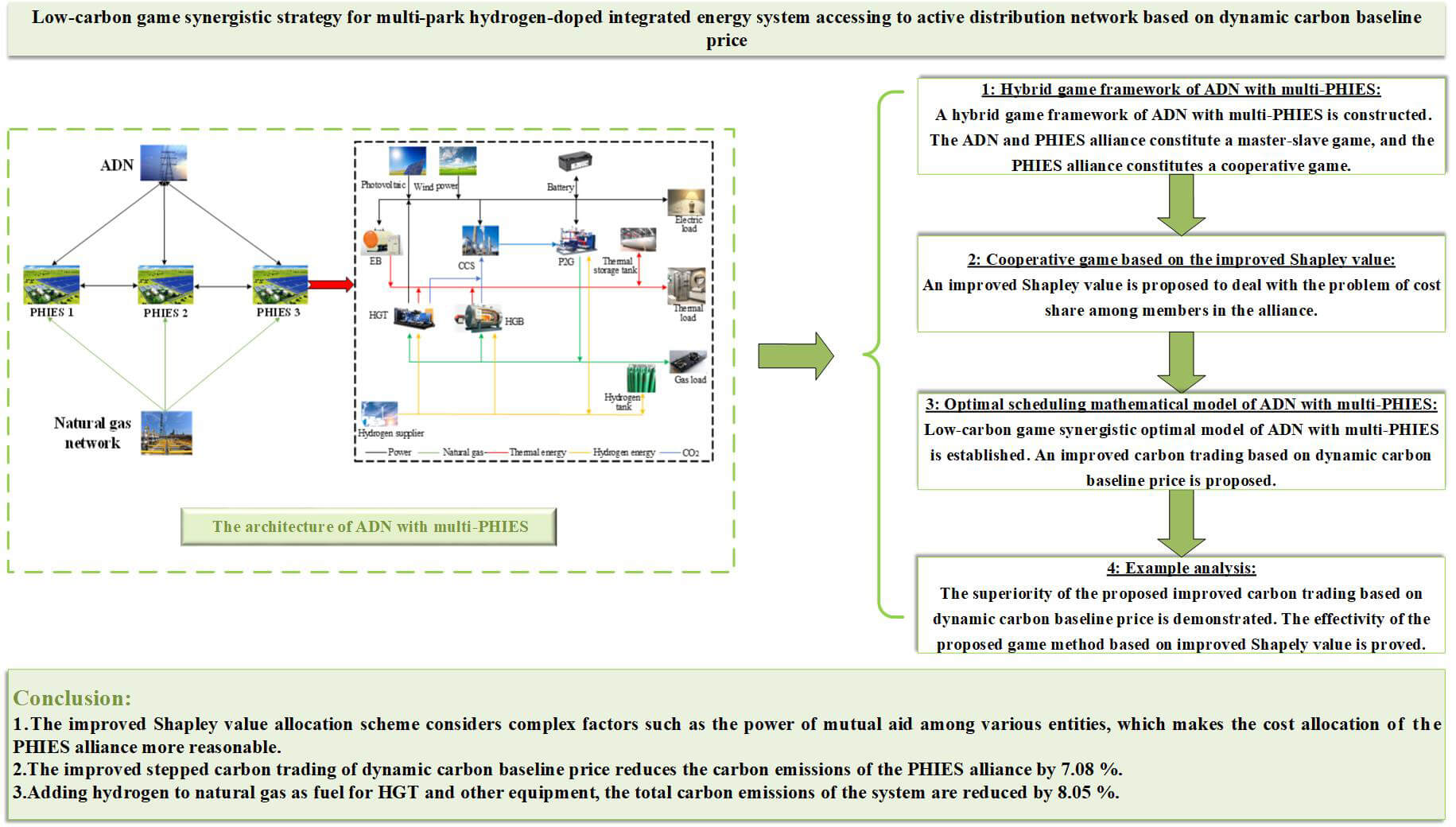
A park hydrogen-doped integrated energy system (PHIES) can maximize energy utilization as a system with multiple supplies. To realize win-win cooperation between the PHIES and active distribution network (ADN), the cooperative operation problem of multi-PHIES connected to the same ADN is studied. A low-carbon hybrid game coordination strategy for multi-PHIES accessing ADN based on dynamic carbon base price is proposed in the paper. Firstly, multi-PHIES are constructed to form a PHIES alliance, including a hydrogen-doped gas turbine (HGT), hydrogen-doped gas boiler (HGB), power to gas and carbon capture system (P2G-CCS), and other equipment. Secondly, a hybrid game system model of the ADN and PHIES alliance is constructed, in which the ADN and PHIES alliance constitute a master-slave game, and the members of the PHIES alliance constitute a cooperative game. An improved Shapley value is proposed to deal with the problem of cost share among members in the alliance. Thirdly, an improved stepped carbon trading based on dynamic carbon baseline price is proposed. The carbon emissions at each moment and the total carbon emissions in a cycle are set as the dynamic adjustment factors of the carbon baseline price. The pricing mechanism of carbon baseline price increases with carbon emissions is constructed so that carbon emissions decrease. Finally, the quadratic interpolation optimization (QIO) algorithm is combined with Gurobi to solve the model. The results of the example analysis show that the cost of ADN is reduced by 4.47%, the cost of PHIES 1 is reduced by 3.67%, the cost of PHIES 2 is reduced by 0.97%, and the cost of PHIES 3 is reduced by 4.91% respectively. The total carbon emissions of the PHIES alliance are reduced by 7.08%. The low-carbon and economical operation of the multi-PHIES accessing ADN is achieved.Graphic Abstract
Keywords
Improved shapley value; ADN; hybrid game; PHIES; QIO
Cite This Article
APA Style
Zhang, X., Zhang, S., Chen, L., Zhang, J., Yang, P. et al. (2025). Low-Carbon Game Synergistic Strategy for Multi-Park Hydrogen-Doped Integrated Energy System Accessing to Active Distribution Network Based on Dynamic Carbon Baseline Price. Energy Engineering, 122(9), 3647–3679. https://doi.org/10.32604/ee.2025.067035
Vancouver Style
Zhang X, Zhang S, Chen L, Zhang J, Yang P, Zhang Z, et al. Low-Carbon Game Synergistic Strategy for Multi-Park Hydrogen-Doped Integrated Energy System Accessing to Active Distribution Network Based on Dynamic Carbon Baseline Price. Energ Eng. 2025;122(9):3647–3679. https://doi.org/10.32604/ee.2025.067035
IEEE Style
X. Zhang et al., “Low-Carbon Game Synergistic Strategy for Multi-Park Hydrogen-Doped Integrated Energy System Accessing to Active Distribution Network Based on Dynamic Carbon Baseline Price,” Energ. Eng., vol. 122, no. 9, pp. 3647–3679, 2025. https://doi.org/10.32604/ee.2025.067035
 Copyright © 2025 The Author(s). Published by Tech Science Press.
This work is licensed under a Creative Commons Attribution 4.0 International License , which permits unrestricted use, distribution, and reproduction in any medium, provided the original work is properly cited.
 Downloads
 Citation Tools
