
 Login
Login Register
 Submit a Paper
 Propose a Special lssue
 Open Access
ARTICLE

Low-Carbon Economic Dispatch Strategy for Integrated Energy Systems with Blue and Green Hydrogen Coordination under GHCT and CET Mechanisms
1 School of Electric Power Engineering, School of Shen Guorong, Nanjing Institute of Technology, Nanjing, 211167, China
2 Jiangsu Collaborative Innovation Center for Smart Distribution Network, Nanjing, 211100, China
3 State Grid Huaian Power Supply Company, Huai’an, 223000, China
4 State Grid Jiangsu Electric Power Co., Ltd., Nanjing, 210000, China
* Corresponding Author: Aidong Zeng. Email:
(This article belongs to the Special Issue: Revolution in Energy Systems: Hydrogen and Beyond)
Energy Engineering 2025, 122(9), 3793-3816. https://doi.org/10.32604/ee.2025.069410
Received 22 June 2025; Accepted 30 July 2025; Issue published 26 August 2025
 View Full Text
 Download PDF
Abstract
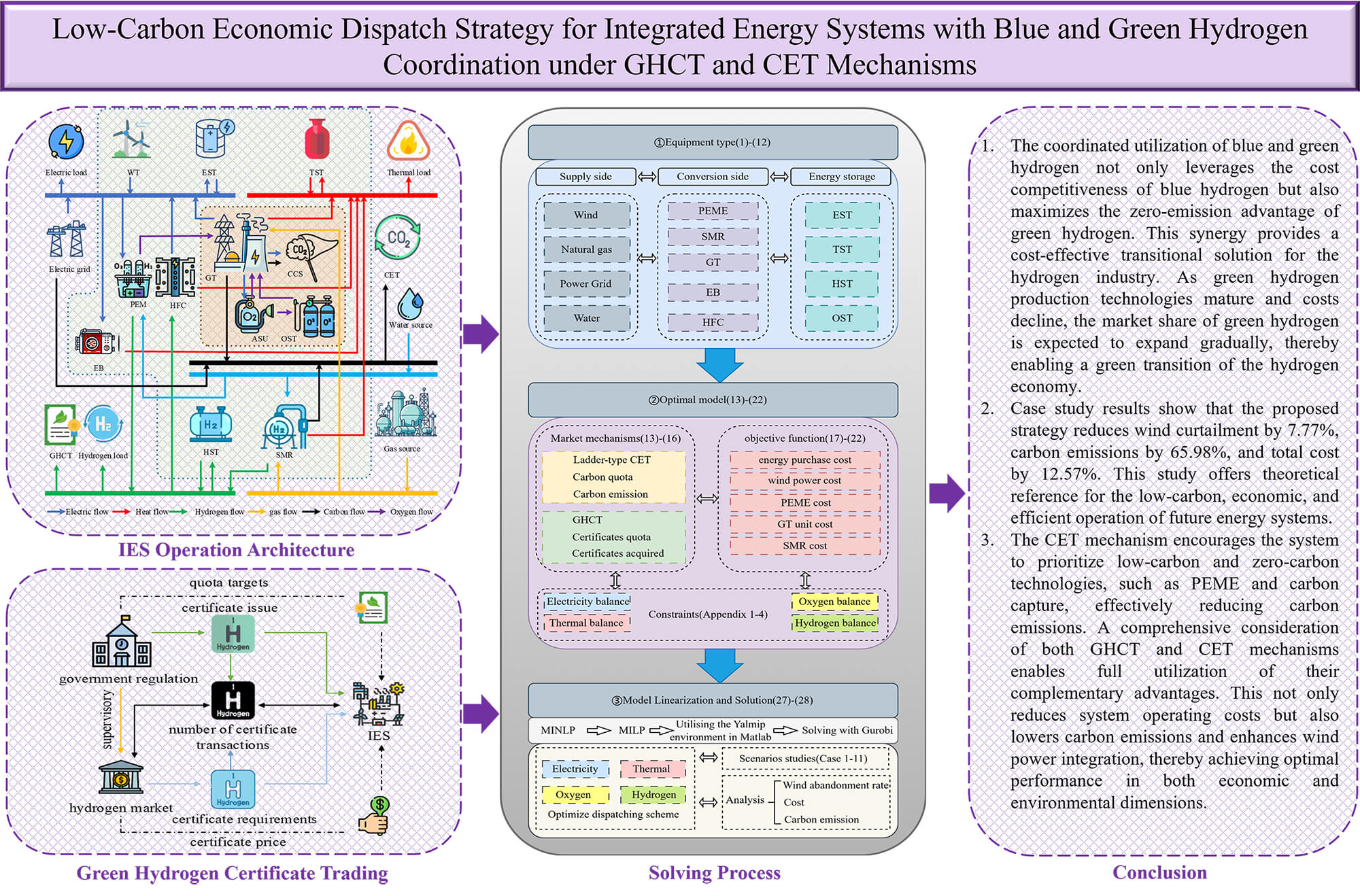
With the intensification of the energy crisis and the worsening greenhouse effect, the development of sustainable integrated energy systems (IES) has become a crucial direction for energy transition. In this context, this paper proposes a low-carbon economic dispatch strategy under the green hydrogen certificate trading (GHCT) and the ladder-type carbon emission trading (CET) mechanism, enabling the coordinated utilization of green and blue hydrogen. Specifically, a proton exchange membrane electrolyzer (PEME) model that accounts for dynamic efficiency characteristics, and a steam methane reforming (SMR) model incorporating waste heat recovery, are developed. Based on these models, a hydrogen production–storage–utilization framework is established to enable the coordinated deployment of green and blue hydrogen. Furthermore, the gas turbine (GT) unit are retrofitted using oxygen-enriched combustion carbon capture (OCC) technology, wherein the oxygen produced by PEME is employed to create an oxygen-enriched combustion environment. This approach reduces energy waste and facilitates low-carbon power generation. In addition, the GHCT mechanism is integrated into the system alongside the ladder-type CET mechanism, and their complementary effects are investigated. A comprehensive optimization model is then formulated to simultaneously achieve carbon reduction and economic efficiency across the system. Case study results show that the proposed strategy reduces wind curtailment by 7.77%, carbon emissions by 65.98%, and total cost by 12.57%. This study offers theoretical reference for the low-carbon, economic, and efficient operation of future energy systems.Graphic Abstract
Keywords
Cite This Article
 Copyright © 2025 The Author(s). Published by Tech Science Press.
This work is licensed under a Creative Commons Attribution 4.0 International License , which permits unrestricted use, distribution, and reproduction in any medium, provided the original work is properly cited.
 Downloads
 Citation Tools
