
 Login
Login Register
 Submit a Paper
 Propose a Special lssue
 Open Access
ARTICLE

Probabilistic Enhancement of Solar Photovoltaic System Hosting Capacity Using Smart Photovoltaic-STATCOM Inverters and the Fire Hawk Optimizer
1 School of Automotive Engineering, Iran University of Science and Technology, Tehran, Iran
2 Department of Electrical and Computer Engineering, Shahid Bahounar University, Kerman, Iran
3 School of Engineering and Energy, Murdoch University, Perth, Australia
* Corresponding Authors: Iman Soltani. Email: ; Farhad Shahnia. Email:
Energy Engineering 2026, 123(10), 12 https://doi.org/10.32604/ee.2026.081627
Received 05 March 2026; Accepted 17 July 2026; Issue published 30 August 2026
 View Full Text
 Download PDF
Abstract
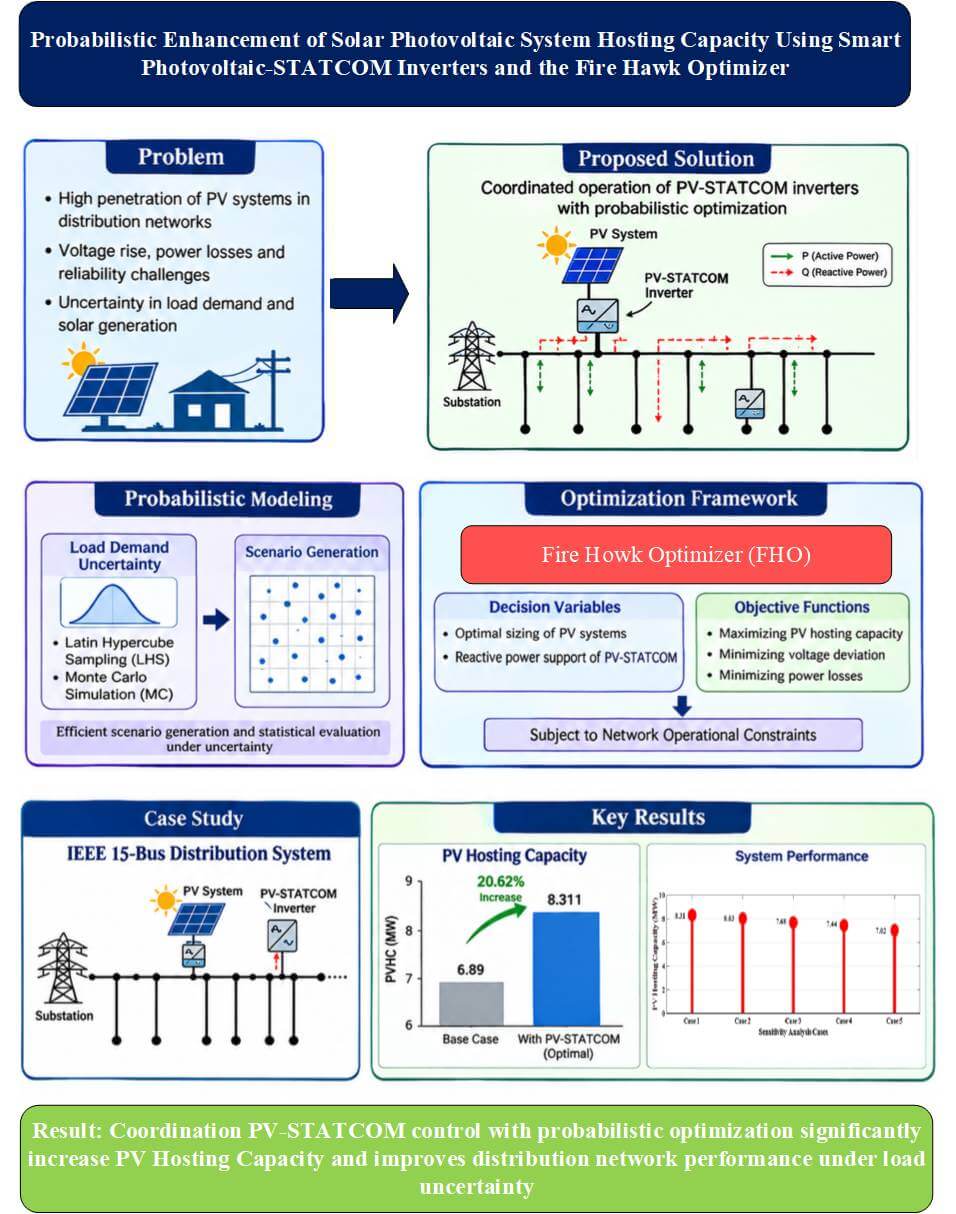
This paper presents a probabilistic optimization framework for enhancing the photovoltaic hosting capacity of distribution networks through the coordinated operation of smart photovoltaic-static synchronous compensator (PV-STATCOM) inverters. High penetration of photovoltaic systems introduces significant operational challenges, including voltage rise, increased power losses, and reduced system reliability, particularly under uncertain load demand and intermittent solar generation. To address these challenges, a multi-objective optimization problem is formulated to simultaneously maximize the photovoltaic hosting capacity while minimizing voltage deviation and power losses, subject to network operational constraints. The proposed approach employs the Fire Hawk optimizer, a recently developed metaheuristic algorithm, to efficiently solve this nonlinear and non-convex optimization problem. The decision variables include the optimal sizing of photovoltaic systems and the reactive power support provided by PV-STATCOM inverters. Unlike conventional deterministic approaches, uncertainty in load demand is explicitly modeled using a probabilistic framework based on Latin Hypercube sampling and Monte Carlo simulation. The Latin Hypercube sampling is utilized for efficient scenario generation while Monte Carlo studies enable statistical evaluation of system performance under diverse operating conditions. The effectiveness of the proposed method is validated on the IEEE 15-bus distribution system. Simulation results demonstrate that the coordinated control of PV-STATCOM inverters significantly improves voltage profiles and reduces power losses, leading to an increase in photovoltaic hosting capacity from 6.89 to 8.311 MW, corresponding to a 20.62% enhancement in the network under study. Furthermore, studies demonstrate that the Fire Hawk optimizer algorithm exhibits fast convergence and superior performance compared to conventional optimization techniques, including genetic algorithm, particle swarm optimization, and Aquila optimizer. The probabilistic analysis also confirms improved system robustness by reducing voltage violation risks under uncertainty.Graphic Abstract
Keywords
The increasing penetration of photovoltaic (PV) systems in distribution networks has become a defining feature of modern power systems, driven by environmental concerns, declining technology costs, and supportive energy policies. While PV integration offers substantial sustainability benefits, high levels of penetration pose significant operational challenges, including voltage rise, increased power losses, thermal overloading of network components, and voltage unbalance, particularly in unbalanced feeders under high-solar, low-load conditions [1,2]. These challenges are especially pronounced due to the inherent intermittency of PV output, which can lead to overvoltage violations and limit the network’s ability to absorb additional renewable capacity without active management. For instance, traditional volt-VAr control often fails to eliminate all violations in realistic feeders, necessitating more advanced strategies [3].
To quantify these limitations, the concept of photovoltaic hosting capacity (PVHC) has been widely adopted as a key performance indicator. PVHC represents the maximum allowable PV penetration that a distribution network can sustain while maintaining acceptable voltage profiles, power quality, and system reliability [4]. However, accurately determining and enhancing PVHC is a challenging task, as it is strongly influenced by network topology, load behavior, and the inherent variability of renewable energy sources.
The assessment of PVHC has therefore become an important research topic in modern distribution system planning and operation. An accurate estimation of PVHC enables network operators to identify the maximum renewable energy integration level without violating technical constraints such as voltage limits, thermal ratings of distribution lines, and transformer loading capabilities [5]. Nevertheless, PVHC is not a fixed parameter and may vary significantly depending on operating conditions, load demand patterns, feeder characteristics, and control strategies employed within the network. In addition, the increasing penetration of distributed energy resources has introduced new operational complexities that require more advanced analytical tools for PVHC assessment. As a result, conventional deterministic approaches may not fully capture the stochastic nature of practical distribution systems, potentially leading to inaccurate or overly conservative PVHC estimations. Consequently, there is a growing need for more comprehensive methodologies that can accurately evaluate hosting capacity while accounting for network uncertainties and operational flexibility resources. Conventional approaches, such as network reinforcement or infrastructure upgrades, often entail high capital expenditures and long implementation periods, motivating the exploration of alternative, more flexible solutions like smart inverter controls and distributed energy resources coordination [6]. Recent studies have further emphasized that accurate estimation of PVHC requires considering multiple technical constraints simultaneously, including voltage deviation, line loading, and power quality indices [7]. Moreover, the integration of high PV penetration has been shown to significantly affect the operational flexibility of distribution networks, necessitating advanced control strategies [8].
On the other hand, smart inverter-based technologies can significantly improve PVHC, up to 3× in realistic feeders, by providing ancillary services such as reactive power support and voltage regulation. In particular, PV-STATCOM configurations enable PV inverters to operate as static synchronous compensators (STATCOMs) [9], offering bidirectional reactive power control independent of active power generation [10]. The concept of PV-STATCOM has gained considerable attention in recent years as an effective solution for providing dynamic reactive power support without requiring additional reactive power compensation devices [11]. Several researchers have demonstrated the capability of PV inverters operating in STATCOM mode to mitigate voltage fluctuations and improve the overall hosting capacity of distribution feeders [12].
Among the various techniques proposed for enhancing PVHC, PV-STATCOM technology has emerged as a promising and cost-effective solution. Unlike conventional PV systems that primarily inject active power into the grid, PV-STATCOM enables PV inverters to provide dynamic reactive power support, thereby contributing to voltage regulation and improved power quality [9]. By utilizing the existing inverter infrastructure, PV-STATCOM can mitigate voltage rise issues associated with high PV penetration without requiring additional compensation devices or significant network reinforcement. Furthermore, during periods of low solar irradiance or even at night, the inverter can operate in STATCOM mode and continue supplying reactive power to support grid operation. Owing to its flexibility and fast response characteristics, PV-STATCOM has attracted considerable attention as an effective approach for increasing PVHC while maintaining network security and operational reliability [13].
This capability allows PV-STATCOM units to mitigate voltage rise during peak generation periods, enhance voltage stability, and address unbalance issues across the network, often outperforming traditional methods like on-load tap changers [14,15] or battery energy storage systems [16,17] in cost-effectiveness. For example, coordinated Volt/VAr control with battery energy storage systems has shown superior performance in minimizing voltage deviations compared to default settings. Despite their demonstrated potential, the effective utilization of PV-STATCOM units for PVHC enhancement remains relatively underexplored, especially under stochastic operating conditions involving correlations between PV output and load, as well as fast fluctuations like voltage flicker [18].
A critical limitation of many existing PVHC studies is their reliance on deterministic assumptions regarding load demand and PV generation. In practice, both parameters are subject to significant uncertainty due to fluctuating weather conditions, meteorological factors, and dynamic consumption patterns, which can lead to overly optimistic or conservative PVHC estimates [19]. Probabilistic methods, such as Latin Hypercube sampling (LHS) and Monte Carlo (MC) simulations, offer a more realistic framework by explicitly accounting for these uncertainties and enabling comprehensive assessment of constraint violations across a wide range of operating scenarios [20]. These methods generate vast quantities of realistic profiles using probability density functions and scenario reduction techniques, improving PVHC by up to 20% when combined with local reactive power regulation.
The MC studies have been extensively employed in literature as a robust probabilistic tool for evaluating the impact of uncertainties. By generating many random scenarios based on probability distributions of load demand, MC enables a comprehensive statistical assessment of voltage violations, line overloading, and other operational constraints under uncertain conditions [21]. This approach provides valuable insights into the risk of constraint violations and has been widely adopted for hosting capacity studies in distribution networks. On the other hand, the LHS has emerged as an efficient sampling technique to reduce the computational burden associated with traditional MC studies while maintaining high accuracy. The LHS ensures a more uniform coverage of the input variable space by stratifying the probability distributions, thereby requiring fewer samples to achieve statistically reliable results. Several studies have successfully applied LHS in combination with probabilistic analysis to model uncertainties in load demand more effectively [22].
The integration of probabilistic modeling with PV-STATCOM and efficient optimization techniques has received limited attention in the literature, particularly when compared to metaheuristics like genetic algorithm (GA) [23], particle swarm optimization (PSO) [24], or aquila optimizer (AO) [25]. Moreover, emerging issues like voltage flicker mitigation in sub-second timescales remain underexplored, where multi-agent systems could provide autonomous coordination.
To address these gaps, this paper proposes a probabilistic optimization framework for enhancing PVHC through the coordinated control of smart PV-STATCOM inverters. The optimization problem is formulated to maximize PVHC while satisfying voltage regulation and operational constraints under uncertainty and is solved using the Fire Hawk optimizer (FHO) [26], a recently developed metaheuristic algorithm with superior exploration, exploitation capabilities compared to alternatives like GA, PSO and AO.
The selection of the FHO is motivated by its superior balance between exploration and exploitation, which is particularly important for solving highly nonlinear and non-convex optimization problems such as PVHC enhancement. Unlike conventional metaheuristic algorithms, FHO employs adaptive search mechanisms that improve global search capability while maintaining local refinement, reducing the likelihood of premature convergence to local optima. These characteristics make FHO well-suited for complex power system optimization problems involving multiple conflicting objectives and operational constraints [26].
Uncertainties associated with load demand and PV generation are modeled using LHS and MC simulations to ensure robust and statistically meaningful results, incorporating probabilistic overvoltage risk and source-load. The proposed approach is validated on the IEEE 15-bus distribution network, demonstrating up to 20% improvement in PVHC and voltage performance under stochastic conditions, outperforming deterministic baselines and traditional Volt/VAr controls.
The main contributions of this paper can be summarized as follows: First, a probabilistic framework for enhancing PVHC is proposed, which explicitly considers the uncertainties associated with load demand. Unlike conventional deterministic approaches, the proposed method provides a more realistic and robust assessment of PVHC under stochastic operating conditions. Furthermore, a coordinated control strategy for PV-STATCOM inverters is developed to simultaneously regulate voltage profiles and improve hosting capacity, where reactive power support is integrated with probabilistic system behavior rather than being treated in a deterministic or isolated manner. In addition, a probabilistic modeling approach based on LHS and MC simulation is implemented, in which LHS is utilized for efficient scenario generation and MC simulation is employed for statistical evaluation, enabling accurate representation of uncertainties with reduced computational complexity. Moreover, the FHO is adopted to solve the multi-objective PVHC enhancement problem, offering an improved balance between exploration and exploitation compared to conventional metaheuristic algorithms, which results in faster convergence and higher-quality solutions in nonlinear and non-convex search spaces. Finally, a comprehensive comparative analysis is conducted with well-known optimization techniques, including GA, PSO, and AO, demonstrating the superior performance of the proposed approach in terms of PVHC improvement, voltage regulation, and convergence characteristics.
The remainder of this paper is organized as follows: Section 2 presents the mathematical modeling of the system studied, including the detailed models of the PV system and the PV-STATCOM, along with their operational characteristics and governing equations. Section 3 introduces the proposal including the formulated objective function, system constraints, and the implementation of the FHO algorithm. The employed probabilistic modeling based on LHS and MC studies are discussed in Section 4. Section 5 evaluates the performance of the proposed technique and discusses the study results. In this section, the success of the proposed method is first evaluated on the IEEE 15-bus distribution network. This section then presents the sensitivity analysis and uncertainty impact on the proposed technique performance. The scalability of the proposed technique has been also evaluated by employing the proposed technique on the larger IEEE 33, 69, and 123-bus test systems in this section too. Finally, the key findings of the research are summarized and highlighted in Section 6.
Fig. 1 shows the single-line diagram of the studied system. The system under investigation consists of the upstream network, distribution transformer, various types of electrical loads (residential, commercial and industrial) and PV system. The active power, indicated by blue arrows, flows unidirectionally from the PV systems toward the grid, representing power injection.

Figure 1: Single-line diagram of system.
First, the main equations for modeling PV systems based on the standard single-diode model are presented. This model is derived from the equivalent circuit of a PV cell and includes the photocurrent, diode current, series resistance, and shunt (parallel) resistance. The current-voltage characteristic of a PV cell based on the single-diode model can be expressed as [27]
where I is the output current, and V is the output voltage of the cell. The photocurrent
Eq. (2) describes the maximum power output Pmpp of a PV module at the maximum power point. Pmpp,ref is the power at standard test conditions (Gref = 1000 W/m2, Tref = 298 K). G is the actual irradiance, scaling power linearly. T and γ are the cell temperature and temperature coefficient.
The output power of PV array is directly proportional to number of parallel and series cells, given by [27]
where Ns, Np and Pcell are the number of series cell, number of parallel cell and power of each cell, respectively.
The PV-STATCOM concept involves PV inverters that not only inject active power generated by solar panels into the grid but also function as a STATCOM to supply or absorb reactive power for voltage regulation and enhanced grid stability, particularly at night or during low PV generation. By controlling the inverter’s voltage magnitude and phase angle, the system modulates reactive power injection or absorption, leveraging the inverter’s spare capacity to support the grid. This approach enhances PVHC, efficiency and reduces the need for additional equipment in power systems, optimizing cost and performance [28].
Based on Fig. 2, the control of injected or absorbed active and reactive power is achieved by adjusting the voltage magnitude and phase angle at bus C. The relationships are given as: Qc2 = +QPV-STATCOM, Pc2 = +PPV-STATCOM, Qc1 = −QPV-STATCOM and Pc1 = −PPV-STATCOM.

Figure 2: PV-STATCOM connection.
More discussions on the rating and operational principle of the PV-STATCOM inverter have been presented in the next section.
In this study, the PVHC is defined as the maximum allowable penetration of PV generation (in kW or MW) that can be integrated into the distribution network without violating the distribution network’s operational constraints. These constraints primarily include voltage limits at all buses and loading condition of all lines. This definition is consistent with widely adopted formulations in the literature, enabling a meaningful comparison with existing studies.
In the proposed method, the PV-STATCOM technology is utilized to enhance PVHC systems in distribution networks by simultaneously controlling reactive power through PV inverters, thereby improving voltage stability and mitigating network constraints. The objective function maximizes the PVHC and is optimized using the FHO algorithm. System equations are modeled probabilistically to account for inherent load uncertainties. To achieve this, LHS is employed for efficient scenario generation, combined with MC studies for statistical evaluation of results, ensuring high accuracy and reliability in the optimization process.
The proposed objective function is designed as a multi-objective optimization to enhance the performance of PV systems integrated with PV-STATCOM. It aims to maximize the PVHC of the network for greater PV integration, minimize voltage deviations from the nominal value across network buses, and reduce power losses. The function is formulated as
where PVHC represents hosting capacity, Vi is the voltage at bus i, Ploss is total loss, and w1, w2, w3 are weighting factors to balance the objectives. The selection of the weighting factors and their impact are discussed in Section 5.4. In the objective function of (8), the PVHC component is formulated as a benefit term and therefore appears with a positive sign. Conversely, voltage deviation and power losses are undesirable performance indices and are included with negative signs to ensure their minimization during the optimization process.
The constraints of the system under study, which need to be evaluated and incorporated into the optimization computations, are expressed as follows:
Eqs. (9) and (10) depict the power balance restrictions of the system, guaranteeing that the overall power generated matches the combined total of load demand and power losses. Eq. (11) outlines the voltage limitations in the network buses. Likewise, Eq. (12) ensures that the voltage levels at the PV-STATCOM inverter connection points stay within the defined upper and lower limits. Eq. (13) stands out as a key constraint, illustrating the relationship between the reactive power exchanged by the PV-STATCOM inverter and its immediate active power injection. Eqs. (12) and (13) denote the inverter voltage and power capability limits that are essential to be considered in the PV-STATCOM inverter model. In addition to power and voltage constraints, line thermal capacity is also enforced by (14) to ensure that the power flows through each feeder and line does not exceed their thermal ratings (Iline).
In this study, the PV-STATCOM inverter is assumed to have an additional 15% apparent power capacity beyond the maximum active power rating of the PV panels. This design ensures sufficient reactive power support under varying levels of active power generation, as defined by (13). During periods of high solar output, the inverter’s reactive power capability is constrained by its apparent power rating, as defined by its P-Q capability curve. Under this condition, the inverter can deliver full active power from the PV panels while simultaneously providing reactive power support of up to approximately 56% of the panels’ active power. As solar irradiance decreases, and consequently the active power output of the PV panels drops, the inverter gains additional capacity to exchange reactive power. For instance, when the active power generation falls to 50% of its maximum, the inverter can provide reactive power exchange capability of up to twice the active power output. During low irradiance conditions or at night, the inverter operates in STATCOM mode, continuing to supply reactive power compensation within its rated capacity. This assumption reflects the operational characteristics of modern smart inverters widely used in active distribution networks.
It is worth noting that other practical constraints, such as transformer loading limits and protection coordination, can also influence the hosting capacity. However, since the primary focus of this study is on voltage regulation and probabilistic performance assessment, these aspects can be considered as potential extensions in future work.
The decision variables in this study are the optimal sizing of photovoltaic systems and the reactive power support provided by PV-STATCOM inverters. These are determined by the FHO. FHO has been proposed in 2023 by [26]. This algorithm draws inspiration from the hunting and mobility patterns of fire hawks, a type of predatory bird. Typically, the FHO algorithm is divided into three primary phases, mimicking the smart, aggressive, and adaptable nature of fire hawks as they detect, strike, and seize their prey.
In Eq. (15),
To accurately capture the uncertainties associated with load demand a probabilistic modeling framework is adopted. In this study, load demand is modeled using a normal probability distribution characterized by its mean and standard deviation, reflecting typical variations in consumption patterns. The normal distribution with a standard deviation of 10% is adopted to represent the inherent variability of load demand, as this assumption has been widely employed in probabilistic distribution network studies and provides a realistic representation of load fluctuations. In the proposed framework, load uncertainty is explicitly modeled through the combined use of LHS and MC simulation. LHS is utilized as an efficient stratified sampling technique to generate a representative set of input scenarios from the defined probability distributions. Compared to conventional random sampling, LHS ensures better coverage of the input space with a reduced number of samples. Later, the generated samples are then transformed into actual load and PV generation values using the inverse cumulative distribution function (CDF). For each scenario, a power flow analysis is performed to evaluate system performance. Subsequently, the MC studies are used as a statistical evaluation tool to analyze the distribution network’s response across all generated scenarios. In this framework, LHS is primarily responsible for scenario generation while the MC studies provide statistical assessment of performance indicators such as voltage profiles and power losses. This combined approach enables accurate and computationally efficient probabilistic analysis of PVHC.
The fundamental process of LHS relies on sampling and permutation, with the success of the method heavily dependent on achieving an effective permutation. The standard LHS technique is typically applied to estimate the uncertainty in an output variable, such as Y, derived from a deterministic model Y = g(X), where X = (X1, …, Xk) represents a k-dimensional input vector. To create an independent LHS with a size of N and k dimensions, a collection of independent random variables uniformly distributed over the interval [0, 1] is employed, with i ranging from 1 to N and j from 1 to k. A random uniformly distributed LHS can be generated from:
which denotes an independent random permutation. Drawing from Eq. (19), the following expression can be formulated:
Eq. (20) indicates that a random value from each interval has an equal chance of being selected without overlap, thus showing that the sample values more accurately reflect the true distribution compared to the MC method.
where
This section evaluates the performance of the proposed and developed technique through numerical simulation studies. The simulations aimed at enhancing PVHC were carried out using MATLAB (version R2018b). This section provides a detailed discussion and analysis of the studied network, the scenarios considered, and the outcomes of the simulations.
5.1 Network under Study and Considered Study Parameters
First, the IEEE 15-bus distribution system of Fig. 3 has been examined and studied. This system comprises 15 buses with a nominal voltage of 12.5 kV. The single-line diagram of the test network is depicted in Fig. 3. Within this network, buses 7, 10, and 13 are identified as potential sites for PV systems, with their simulation and PVHC improvement being explored.

Figure 3: Considered IEEE 15 bus network.
This system is employed as a benchmark test network in this paper due to its extensive use in recent studies on PVHC and reactive power control and to ensure the validity and comparability of the results. This system exhibits notable reactive power characteristics, making it particularly suitable for evaluating the performance of the PV-STATCOM based control strategy and its impact on voltage regulation. Furthermore, to enhance the generality of the findings, sensitivity analyses under varying load and PV penetration levels are conducted to evaluate and confirm the robustness of the proposed approach under different operating conditions.
The main configuration parameters of the probabilistic simulation framework used in this study are summarized in Table 1. Furthermore, the parameters of the employed FHO are listed in Table 2. Both MC and LHS methods are implemented using 5000 samples based on the forecasted hourly load profile. The probabilistic analysis considers normally distributed load variations and evaluates the uncertainty impacts on PVHC and bus voltage profiles. It is to be noted that this study has focused on the steady-state operation of the system rather than the time-series studies. While time-series analysis can provide some temporal insights, the probabilistic framework presents a much wider spectrum of the various operating conditions in the network. As such, the employed probabilistic snapshot framework using LHS and MC studies can properly capture a wide range of operating conditions which can occur at any specific time and better suit the PVHC determination, focused here.


Table 3 presents the PVHC before and after implementing the proposed method, along with the maximum and minimum voltage levels across the network. As evident from the table, the proposed PV-STATCOM approach significantly increases the hosting capacity while maintaining voltage profiles within acceptable limits. Table 4 lists the determined best solution for the network considered and includes the defined capacity for each PV system in Fig. 3 as well as the maximum and minimum observed network voltage. Fig. 4 illustrates the convergence curve of the FHO algorithm and shows that the employed FHO algorithm converges to the optimal solution within 50 iterations, demonstrating fast convergence and high stability.


Figure 4: Convergence curve of FHO.
The amount of reactive power exchanged with the grid is presented in Fig. 5. This figure shows the expected (mean) reactive power profile derived from the probabilistic snapshot analysis. After performing a large number of probabilistic scenarios, the average reactive power exchange at each hour was calculated across all valid scenarios. As observed, the PV-STATCOM units typically absorb reactive power during midday hours (when PV generation is high) and inject reactive power at night (when solar output is zero). This behavior, obtained from the averaged probabilistic results, provides effective voltage regulation and enhances the overall grid support throughout the daily cycle.

Figure 5: Mean reactive power exchanged with the grid by PV-STATCOMs (derived after performing a large number of probabilistic scenarios).
Figs. 6–8 present the probabilistic voltage profiles of buses equipped with PV-STATCOM units. The blue bars represent the voltage distribution obtained using LHS, while the dashed line curves correspond to the results from MC simulation. This comparison highlights the consistency and accuracy of the probabilistic modeling approach in capturing voltage behavior under uncertainty.

Figure 6: Probabilistic voltage at bus 7.

Figure 7: Probabilistic voltage at bus 10.

Figure 8: Probabilistic voltage at bus 13.
To provide a quantitative assessment of uncertainty impacts, several probabilistic risk indicators are extracted from the LHS and MC studies. These statistical metrics obtained for PVHC and voltage behavior are summarized in Table 5. It can be seen from this table that the LHS method yields lower standard deviation and a lower estimated violation probability compared to the MC approach for the same number of samples, indicating improved sampling efficiency and more stable statistical estimation of PVHC.

5.4 Impact of Weighting Factors
A sensitivity analysis is performed to investigate the influence of the objective function weighting factors in (8) on the optimization solutions. Different combinations of weighting coefficients associated with PVHC, power loss, and voltage deviation are evaluated, and the obtained results are summarized in Table 6. The results demonstrate that increasing the weighting factor associated with PVHC improves the maximum PVHC but slightly increases network voltage deviation. Conversely, assigning higher weights to loss minimization and voltage regulation enhances operational performance at the expense of reduced PVHC. The selected weighting factors provide a balanced compromise between technical performance and PVHC enhancement and can be eventually determined by the utility (network operator) depending on their preferences. Fig. 9 illustrates the variations impact of weighting factors on the PVHC and demonstrates that highest PVHC is achieved considering the weightings in case 1. Therefore, these weightings have been used in the rest of the studies of this paper when evaluating other systems or aspects.


Figure 9: Highest PVHC achieved by different sets of weighting factors used in the objective function.
5.5 Comparison against Other Optimization Techniques
To demonstrate the superior performance of the employed FHO technique against other conventional metaheuristic approaches, the case study of Section 5.2 has been also re-solved by GA, PSO and AO independently. Table 7 presents the parameter values of AO, PSO, and GA algorithms. As seen from this table, the population size, number of iterations, and execution time are set identically for all three algorithms to ensure a fair comparison of their performance under equal conditions. The other internal parameters are selected based on recommendations reported in the original algorithm references and preliminary numerical experiments to ensure the best possible result by each algorithm. As described, G1 and G2 are coefficients of AO, and C1 and C2 are coefficients of PSO while the crossover rate is the parameter of GA. Table 8 lists the determined PV systems capacities, the total PVHC and the minimum and maximum voltage across the network by the FHO and compares them with those determined by the three other optimization techniques. As it can be seen from this table, the FHO outperforms the other methods, resulting in a slightly higher PVHC (i.e., 8.311 MW by FHO vs. 7.264–8.104 MW by the other techniques) and an improved voltage drop across the network (i.e., 0.981 by FHO vs. 0.972–0.980 p.u. by the others). The observed maximum voltage across the network by all four optimization techniques are almost equal (i.e., all between 1.0500 and 1.0502 p.u.).


To ensure a fair and statistically reliable comparison, each of the optimization algorithms of FHO, GA, PSO, and AO have been independently implemented and each executed 20 times under identical input conditions. Given the stochastic nature of metaheuristic methods, multiple runs are essential to assess both solution quality and consistency. The performance of each algorithm is evaluated using statistical indicators, including the mean, standard deviation, best, and worst values of the obtained PVHC. Table 9 shows statistical performance comparison of optimization algorithms over these 20 independent runs. It can be seen from this table that the employed FHO technique outperforms the other metaheuristic approaches in solving the considered multi-objective problem in this paper.

5.6 Effectiveness and Scalability on Larger Systems
To demonstrate the effectiveness and scalability of the proposal, the performance of the proposed method in increasing the PVHC of the network has been further assessed on 3 larger well-known IEEE benchmark systems, i.e., IEEE 33, 69 and 123 bus networks. These networks are modeled and analyzed under the same operating conditions as Section 5.1. Table 10 summarizes the results of these studies and shows that the proposed method can increase the PVHC of these networks by 17.06% to 19.54%. The maximum and minimum observed voltages and the probability of the voltage violation are also reported in this table. According to Table 10, the proposed method achieves a substantial increase in the maximum PVHC compared to the base case (without PV-STATCOM). This improvement is consistently observed across different network sizes, highlighting the effectiveness of the PV-STATCOM in providing dynamic reactive power support and enabling higher PV penetration levels while maintaining voltage profiles within acceptable limits.

This paper proposed an enhanced approach for improving the PVHC of electrical networks by utilizing PV-STATCOM technology. The system has been designed and controlled using a developed multi-objective optimization framework, which is solved through the FHO algorithm. The developed objective function aims at maximizing the PVHC of the network for greater PV integration while minimizing voltage deviations from the nominal value across network buses and reducing power losses. The effectiveness of the proposed probabilistic framework has been demonstrated through comprehensive numerical simulations. The results confirm that PV inverters can significantly reduce voltage deviations and power losses by providing intelligent reactive power support. For instance, simulations conducted on the IEEE 15-bus test system show that the PVHC increases from 6.890 to 8.311 MW, corresponding to a 20.62% improvement, thanks to the proposed PV-STATCOM technology, coordinated under the developed objective function. Furthermore, the findings verify that probabilistic modeling based on LHS and MC studies effectively captures load uncertainties. The results also indicate that the FHO algorithm achieved rapid convergence within 50 iterations, demonstrating both robustness and computational efficiency compared to conventional methods such as GA, PSO and AO. In addition, the combination of snapshot-based probabilistic modeling and the computational efficiency of the FHO algorithm ensures strong scalability, which was validated successfully through further studies on larger IEEE 33, 69, and 123-bus test systems.
It is important to note that this study adopts a probabilistic snapshot-based framework rather than a time-series simulation approach. While time-series analysis can more accurately capture temporal dynamics, such as PV generation intermittency and ramping effects, the proposed method leverages LHS and MC techniques to represent a broad range of operating conditions and uncertainties in a computationally efficient manner. Therefore, incorporating time-series analysis to further examine dynamic operational characteristics is recommended as a valuable direction for future research.
Acknowledgement: Not applicable.
Funding Statement: The authors received no specific funding for this study.
Author Contributions: The authors confirm contribution to the paper as follows: Conceptualization, Iman Soltani and Farzin Fardinfar; methodology, Iman Soltani; software, Iman Soltani and Farzin Fardinfar; validation, Farhad Shahnia; formal analysis, Iman Soltani and Farzin Fardinfar; writing—original draft preparation, Iman Soltani and Farzin Fardinfar; writing—review and editing, Iman Soltani, Farzin Fardinfar and Farhad Shahnia; supervision, Iman Soltani and Farhad Shahnia. All authors reviewed and approved the final version of the manuscript.
Availability of Data and Materials: Not applicable.
Ethics Approval: Not applicable.
Conflicts of Interest: The authors declare no conflicts of interest.
Abbreviations
The following abbreviations are used in this manuscript:
| AO | Aquila optimizer |
| FHO | Fire Hawk optimizer |
| GA | Genetic algorithm |
| LHS | Latin Hypercube sampling |
| MC | Monte Carlo |
| PSO | Particle swarm optimization |
| PV | Photovoltaic |
| PVHC | Photovoltaic hosting capacity |
| PV-STATCOM | Photovoltaic-Static synchronous compensator |
| STATCOM | Static synchronous compensator |
References
1. Anny HR, Agustin IR, Ricardo CH. Increasing photovoltaic hosting capacity in distribution networks in Puerto Rico: seasonal and technical characteristics analysis and solutions. Energy Rep. 2025;14(3):867–85. doi:10.1016/j.egyr.2025.06.034. [Google Scholar] [CrossRef]
2. Son YJ, Lim SH, Yoon SG, Khargonekar PP. Residential demand response-based load-shifting scheme to increase hosting capacity in distribution system. IEEE Access. 2022;10:18544–56. doi:10.1109/access.2022.3151172. [Google Scholar] [CrossRef]
3. Khan MK, Kauhaniemi K, Laaksonen H, Zafar MH. Quantized deep learning model based Volt-Var control for hosting capacity maximization: a practical case study. Int J Electr Power Energy Syst. 2026;174(4):111524. doi:10.1016/j.ijepes.2025.111524. [Google Scholar] [CrossRef]
4. Karmaker AK, Du Y, Yang J, Jacob M. Challenges and applications of hosting capacity analysis in DER-rich power systems. Appl Energy. 2026;407(1):127323. doi:10.1016/j.apenergy.2025.127323. [Google Scholar] [CrossRef]
5. Chatzistylianos ES, Psarros GN, Papathanassiou SA. Export constraints applicable to renewable generation to enhance grid hosting capacity. Energies. 2024;17(11):2588. doi:10.3390/en17112588. [Google Scholar] [CrossRef]
6. Ustun TS, Hashimoto J, Otani K. Impact of smart inverters on feeder hosting capacity of distribution networks. IEEE Access. 2019;7:163526–36. doi:10.1109/access.2019.2952569. [Google Scholar] [CrossRef]
7. Mulenga E, Etherden N. Multiple distribution networks hosting capacity assessment using a stochastic approach. Sustain Energy Grids Netw. 2023;36:101170. doi:10.1016/j.segan.2023.101170. [Google Scholar] [CrossRef]
8. Zhou C, Wang N, Zhang W, Ni F. Grid-connected/islanded switching control strategy for photovoltaic storage hybrid inverters based on modified chimpanzee optimization algorithm. Energy. 2025;122(1):265–84. doi:10.32604/ee.2024.057380. [Google Scholar] [CrossRef]
9. Gush T, Kim CH, Admasie S, Kim JS, Song JS. Optimal smart inverter control for PV and BESS to improve PV hosting capacity of distribution networks using slime mould algorithm. IEEE Access. 2021;9:52164–76. doi:10.1109/ACCESS.2021.3070155. [Google Scholar] [CrossRef]
10. Golnazari R, Hasanzadeh S, Heydarian-Forushani E, Kamwa I. Coordinated active and reactive power management for enhancing PV hosting capacity in distribution networks. IET Renew Power Gener. 2025;19(1):e12773. doi:10.1049/rpg2.12773. [Google Scholar] [CrossRef]
11. Babu KR, Khatod DK. Smart inverter-based distributed volt/var control for voltage violation mitigation of unbalanced distribution networks. IEEE Trans Power Deliv. 2024;39(3):1481–90. doi:10.1109/tpwrd.2024.3372603. [Google Scholar] [CrossRef]
12. Jaramillo-Leon B, Zambrano-Asanza S, Franco JF, Soares J, Leite JB. Allocation and smart inverter setting of ground-mounted photovoltaic power plants for the maximization of hosting capacity in distribution networks. Renew Energy. 2024;223:119968. doi:10.1016/j.renene.2024.119968. [Google Scholar] [CrossRef]
13. Gui Y, Nainar K, Bendtsen JD, Diewald N, Iov F, Yang Y, et al. Voltage support with PV inverters in low-voltage distribution networks: an overview. IEEE J Emerg Sel Topics Power Electron. 2024;12(2):1503–22. doi:10.1109/jestpe.2023.3280926. [Google Scholar] [CrossRef]
14. Aydin M, Alnaser S, Althaher S. Using OLTC-fitted distribution transformer to increase residential PV hosting capacity: decentralized voltage management approach. Energies. 2022;15(13):4836. doi:10.3390/en15134836. [Google Scholar] [CrossRef]
15. Soleimani N, Ghasemi-Marzbali A. Optimizing photovoltaic systems with on-load tap changer and electric vehicle management: a double-layer approach. Eng Appl Artif Intell. 2026;166(5):113598. doi:10.1016/j.engappai.2025.113598. [Google Scholar] [CrossRef]
16. Ismeil MA, Alfouly A, Hussein HS, Hamdan I. Improved inverter control techniques in terms of hosting capacity for solar photovoltaic energy with battery energy storage system. IEEE Access. 2023;11(2):140161–73. doi:10.1109/ACCESS.2023.3340035. [Google Scholar] [CrossRef]
17. Shabbir N, Kütt L, Astapov V, Daniel K, Jawad M, Husev O, et al. Enhancing PV hosting capacity and mitigating congestion in distribution networks with deep learning based PV forecasting and battery management. Appl Energy. 2024;372(January):123770. doi:10.1016/j.apenergy.2024.123770. [Google Scholar] [CrossRef]
18. Hamdan I, Alfouly A, Ismeil MA. Hosting capacity improvement for solar systems based on model predictive controller of volt-watt-var smart inverter functions. Int J Model Simul. 2025;45(2):682–96. doi:10.1080/02286203.2023.2237400. [Google Scholar] [CrossRef]
19. Chen C, Peng W, Xie C, Dong S, Hua Y. Photovoltaic hosting capacity assessment of distribution networks considering source–load uncertainty. Energies. 2025;18(8):2134. doi:10.3390/en18082134. [Google Scholar] [CrossRef]
20. Taghavi R, Samet H, Seifi AR, Ali ZM. Stochastic optimal power flow in hybrid power system using reduced-discrete point estimation method and Latin hypercube sampling. IEEE Can J Electr Comput Eng. 2022;45(1):63–7. doi:10.1109/icjece.2021.3123091. [Google Scholar] [CrossRef]
21. Ayaz MS, Malekpour M, Azizipanah-Abarghooee R, Karimi M, Terzija V. Probabilistic photovoltaic generation and load demand uncertainties modelling for active distribution networks hosting capacity calculations. Int J Electr Power Energy Syst. 2024;159:110016. doi:10.1016/j.ijepes.2024.110016. [Google Scholar] [CrossRef]
22. Su H, Song S, Wang X. Probabilistic calculation of tidal currents for wind powered systems using PSO improved LHS. Energy. 2024;121(11):3289–303. doi:10.32604/ee.2024.054643. [Google Scholar] [CrossRef]
23. Katoch S, Chauhan SS, Kumar V. A review on genetic algorithm: past, present, and future. Multimed Tools Appl. 2021;80(5):8091–126. doi:10.1007/s11042-020-10139-6. [Google Scholar] [PubMed] [CrossRef]
24. Gad AG. Particle swarm optimization algorithm and its applications: a systematic review. Arch Comput Meth Eng. 2022;29(5):2531–61. doi:10.1007/s11831-021-09694-4. [Google Scholar] [CrossRef]
25. Taleb SM, Yasin ET, Saadi AA, Dogan M, Yahia S, Meraihi Y, et al. A comprehensive survey of Aquila optimizer: theory, variants, hybridization, and applications. Arch Comput Methods Eng. 2025;32(8):4643–89. doi:10.1007/s11831-025-10281-0. [Google Scholar] [CrossRef]
26. Azizi M, Talatahari S, Gandomi AH. Fire Hawk Optimizer: a novel metaheuristic algorithm. Artif Intell Rev. 2023;56(1):287–363. doi:10.1007/s10462-022-10173-w. [Google Scholar] [CrossRef]
27. Al Smadi T, Handam A, Gaeid KS, Al-Smadi A, Al-Husban Y, Khalid AS. Artificial intelligent control of energy management PV system. Results Control Optim. 2024;14(5):100343. doi:10.1016/j.rico.2023.100343. [Google Scholar] [CrossRef]
28. Arif S, Rabbi AE, Ahmed SU, Hossain Lipu MS, Jamal T, Aziz T, et al. Enhancement of solar PV hosting capacity in a remote industrial microgrid: a methodical techno-economic approach. Sustainability. 2022;14(14):8921. doi:10.3390/su14148921. [Google Scholar] [CrossRef]
Cite This Article
 Copyright © 2026 The Author(s). Published by Tech Science Press.
This work is licensed under a Creative Commons Attribution 4.0 International License , which permits unrestricted use, distribution, and reproduction in any medium, provided the original work is properly cited.
 Downloads
 Citation Tools
