
 Login
Login Register
 Submit a Paper
 Propose a Special lssue
 Open Access
ARTICLE

Operational Constraints and Energy System Resilience under Low-Carbon Transition
1 Department of Spatial Development and Quality of Life, Mykhailo Ptukha Institute of Demography and Quality of Life Research, National Academy of Sciences of Ukraine, Kyiv, Ukraine
2 Higher Educational Institution, Academician Yuriy Bugay International Scientific and Technical University, Kyiv, Ukraine
3 Institute of Agroecology and Environmental Management, National Academy of Agrarian Sciences of Ukraine, Kyiv, Ukraine
4 Interregional Academy of Personnel Management, Kyiv, Ukraine
5 Department of Entrepreneurship and Trade, Pryazovskyi State Technical University, Dnipro, Ukraine
6 National University of Water and Environmental Engineering, Rivne, Ukraine
* Corresponding Author: Viktoriia Mykytenko. Email:
(This article belongs to the Special Issue: Circular Energy Systems and Sustainable Pathways for Decarbonization)
Energy Engineering 2026, 123(10), 22 https://doi.org/10.32604/ee.2026.084053
Received 15 April 2026; Accepted 03 June 2026; Issue published 30 August 2026
 View Full Text
 Download PDF
Abstract
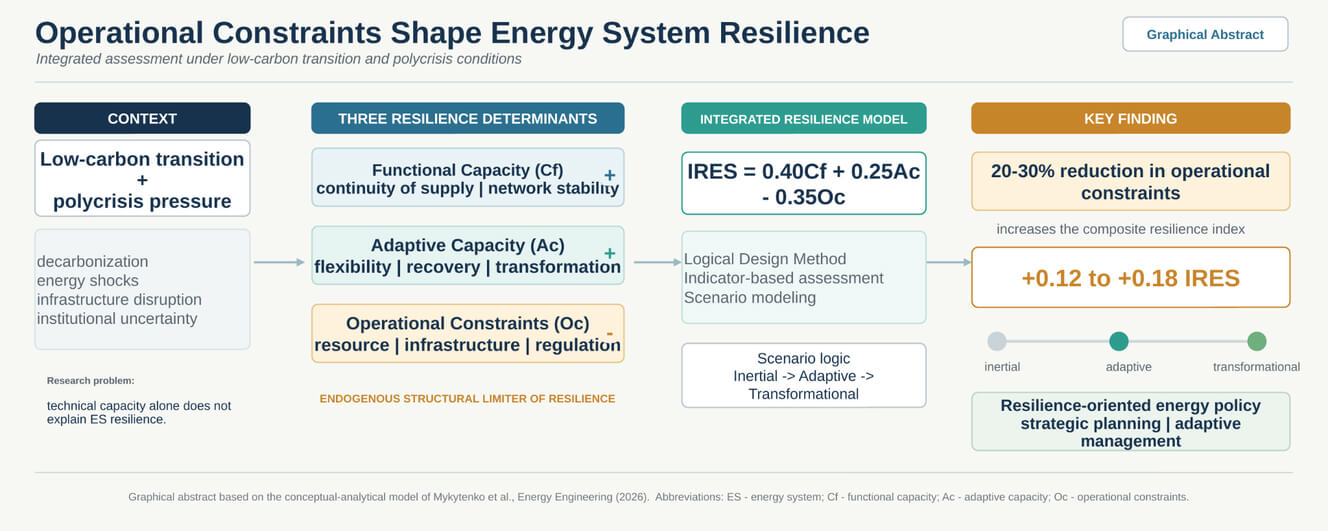
This study develops a conceptual and analytical approach to assessing energy system (ES) resilience under conditions of a low-carbon transition, with particular attention to the role of operational constraints and adaptive capacity. The study demonstrates that, under conditions of polycrisis transformation, ES resilience cannot be adequately evaluated solely through technical and technological indicators, but requires the integration of functional, institutional, and operational parameters. An integrated resilience model is proposed in which operational constraints are interpreted as an endogenous structural factor that determines the boundary conditions of system functioning and shapes ES development trajectories. The methodological framework combines structural and functional analysis, the logical design method, indicator-based assessment, and scenario modeling. The results indicate that increasing functional capacity alone does not ensure a resilient state of the ES unless accompanied by a reduction in operational constraints and strengthening of adaptive capacity. Scenario-based calculations show that a 20%–30% reduction in operational constraints increases the composite resilience index by 0.12–0.18 points, corresponding to a transition from a medium to a high level of resilience. The proposed approach provides an analytical basis for resilience-oriented energy policy, strategic planning, and managerial decision-making under conditions of uncertainty and low-carbon transformation.Graphic Abstract
Keywords
Cite This Article
 Copyright © 2026 The Author(s). Published by Tech Science Press.
This work is licensed under a Creative Commons Attribution 4.0 International License , which permits unrestricted use, distribution, and reproduction in any medium, provided the original work is properly cited.
 Downloads
 Citation Tools
