
 Login
Login Register
 Submit a Paper
 Propose a Special lssue
 Open Access
ARTICLE

Operational Constraints and Energy System Resilience under Low-Carbon Transition
1 Department of Spatial Development and Quality of Life, Mykhailo Ptukha Institute of Demography and Quality of Life Research, National Academy of Sciences of Ukraine, Kyiv, Ukraine
2 Higher Educational Institution, Academician Yuriy Bugay International Scientific and Technical University, Kyiv, Ukraine
3 Institute of Agroecology and Environmental Management, National Academy of Agrarian Sciences of Ukraine, Kyiv, Ukraine
4 Interregional Academy of Personnel Management, Kyiv, Ukraine
5 Department of Entrepreneurship and Trade, Pryazovskyi State Technical University, Dnipro, Ukraine
6 National University of Water and Environmental Engineering, Rivne, Ukraine
* Corresponding Author: Viktoriia Mykytenko. Email:
(This article belongs to the Special Issue: Circular Energy Systems and Sustainable Pathways for Decarbonization)
Energy Engineering 2026, 123(10), 22 https://doi.org/10.32604/ee.2026.084053
Received 15 April 2026; Accepted 03 June 2026; Issue published 30 August 2026
 View Full Text
 Download PDF
Abstract
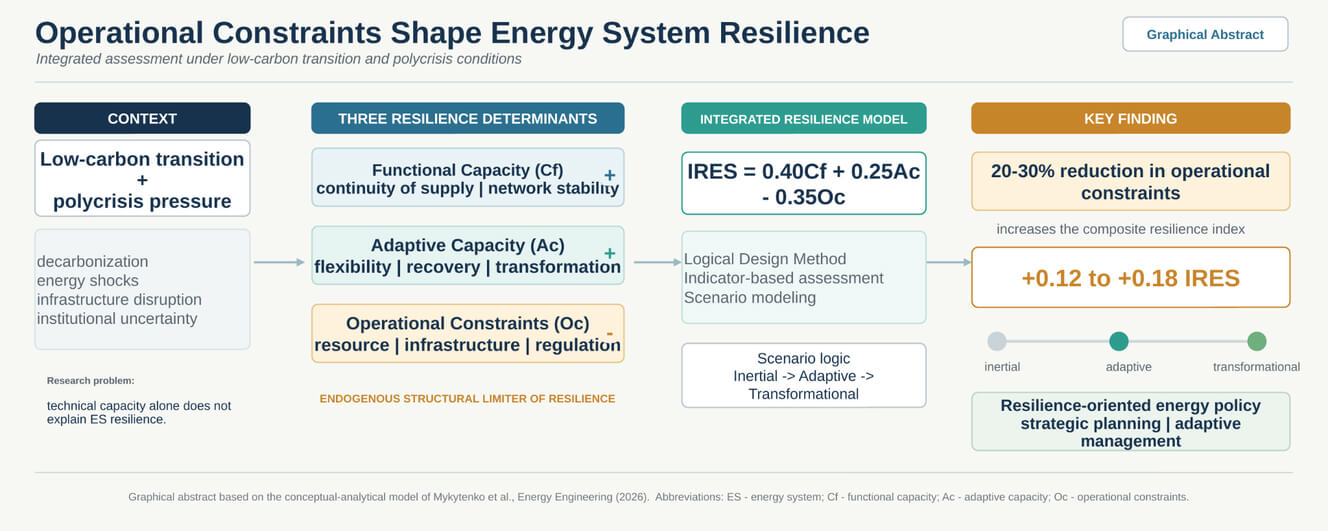
This study develops a conceptual and analytical approach to assessing energy system (ES) resilience under conditions of a low-carbon transition, with particular attention to the role of operational constraints and adaptive capacity. The study demonstrates that, under conditions of polycrisis transformation, ES resilience cannot be adequately evaluated solely through technical and technological indicators, but requires the integration of functional, institutional, and operational parameters. An integrated resilience model is proposed in which operational constraints are interpreted as an endogenous structural factor that determines the boundary conditions of system functioning and shapes ES development trajectories. The methodological framework combines structural and functional analysis, the logical design method, indicator-based assessment, and scenario modeling. The results indicate that increasing functional capacity alone does not ensure a resilient state of the ES unless accompanied by a reduction in operational constraints and strengthening of adaptive capacity. Scenario-based calculations show that a 20%–30% reduction in operational constraints increases the composite resilience index by 0.12–0.18 points, corresponding to a transition from a medium to a high level of resilience. The proposed approach provides an analytical basis for resilience-oriented energy policy, strategic planning, and managerial decision-making under conditions of uncertainty and low-carbon transformation.Graphic Abstract
Keywords
In the context of global climate transformation and the intensification of decarbonization policies in the energy sector, the development of low-carbon energy systems has become a key priority for the sustainable development of national economies. The transition to a low-carbon economy is accompanied by profound structural changes in energy generation, transmission, distribution, and consumption, leading to increased complexity in the functioning of energy systems (ES) and raising the requirements for their reliability, flexibility, and adaptability. Recent studies emphasize that the acceleration of decarbonization processes substantially increases the sensitivity of energy systems to operational, infrastructural, and institutional disturbances under conditions of geopolitical and market uncertainty [1,2].
At the same time, modern ES operate under conditions of polycrisis, characterized by geopolitical instability, infrastructure disruption, imbalances in energy supply and demand, as well as technological and institutional constraints. Under such conditions, the concept of ES resilience becomes particularly relevant, referring to the ability of a system to withstand external shocks, maintain functionality, recover from disruptions, and adapt to changing environmental conditions.
It should be noted that contemporary research in energy engineering predominantly focuses on technical and technological aspects of ES resilience, particularly on enhancing infrastructure reliability, improving network efficiency, integrating renewable energy sources (RES), and developing intelligent control systems [3–6]. At the same time, studies on decarbonization emphasize the importance of transforming ES through the adoption of innovative technologies, including those aligned with the principles of the circular economy [7–10]. However, in most existing approaches, the resilience of ES is examined without adequate consideration of systemic operational constraints that define the actual parameters of system functioning [11–13]. Moreover, the impact of such constraints on system operation, recovery, and adaptation processes within the context of the low-carbon transition remains insufficiently explored. In this regard, there is a clear need to develop an integrated approach to modeling energy systems resilience that explicitly accounts for the influence of operational constraints on both functional capacity and adaptive capacity, in interaction with risks and threats to sustainable development [14–16]. Such an approach involves the integration of indicator-based assessment, the logical design method, and scenario modeling under conditions of uncertainty [17,18].
Within this study, the key analytical categories are further refined. Operational constraints are defined as a set of systemic factors that determine the boundary conditions of energy generation, transmission, distribution, and consumption processes. Functional capacity is interpreted as the ability of the ES to ensure the continuity and effectiveness of energy supply, while adaptive capacity refers to the system’s ability to undergo structural transformation and restore equilibrium in response to external changes.
The aim of this study is to develop a conceptual and analytical integrated model for enhancing ES resilience in the context of a low-carbon transition, combining an indicator-based approach, scenario modeling, and the assessment of adaptive capacity based on the modeling of operational constraints. To address the identified research gap, the following research questions are formulated:
Research Questions
Within the framework of this study, the following research questions (RQs) are formulated to guide the achievement of the stated objective:
RQ1. How can the resilience of energy systems be conceptually defined in the context of a low-carbon transition, considering the interaction between functional capacity, adaptive capacity, and operational constraints?
RQ2. What types of operational constraints determine the boundary conditions of energy system performance, and how do they influence both functional and adaptive capacities?
RQ3. How can an integrated indicator-based framework for assessing energy system resilience be developed to ensure its operationalization and quantitative interpretation?
RQ4. To what extent does the integration of indicator-based analysis, the logical design method, and scenario modeling enhance the comprehensive assessment of energy system resilience under conditions of uncertainty?
RQ5. To what degree do operational constraints affect the overall level of energy system resilience, and what policy and managerial implications can be derived from scenario-based modeling results?
Despite the significant development of resilience-oriented approaches in energy studies, existing models often insufficiently account for the integrated influence of operational constraints on both the functional and adaptive dimensions of energy systems under conditions of low-carbon transformation, geopolitical instability, and increasing operational uncertainty. In addition, many existing approaches remain fragmented and do not provide a unified analytical framework capable of simultaneously incorporating structural, operational, institutional, and scenario-based components of resilience assessment. The importance of this study lies in addressing these limitations through the development of an integrated conceptual and analytical model that explicitly considers operational constraints as a system-forming factor affecting both functional capacity and adaptive capacity. The study contributes to the literature by integrating indicator-based assessment, logical design methodology, and scenario modeling within a unified analytical framework. The obtained results demonstrate that reducing operational constraints is a key prerequisite for strengthening energy system resilience and improving resilience-oriented energy policy and strategic decision-making under conditions of systemic uncertainty and polycrisis transformation.
The answers to the formulated research questions are presented throughout the manuscript as follows. The conceptual interpretation of energy system resilience and the interaction between functional capacity, adaptive capacity, and operational constraints (RQ1–RQ2) are developed in Sections 2 and 3. The construction of the integrated indicator-based assessment framework and the justification of the weighting and normalization procedures (RQ3–RQ4) are presented in Sections 3.4–3.7. The assessment of the influence of operational constraints on the composite resilience index and the corresponding policy implications derived from scenario-based modeling (RQ5) are discussed in Sections 4 and 7.
2.1 Review of Existing Approaches to Energy System Resilience Assessment
It is widely recognized that research in the fields of energy engineering and energy policy has made significant progress in developing approaches to assessing the resilience of energy systems (ES). The majority of these studies are grounded in a techno-technological paradigm, within which primary attention is given to ensuring infrastructure reliability, optimizing the operational modes of energy networks, integrating renewable energy sources (RES), and implementing intelligent control systems [19–23].
Within this paradigm, ES resilience is predominantly interpreted in terms of the system’s ability to ensure continuity of energy supply and minimize technical disruptions. However, contemporary literature provides limited insight into the role of systemic operational constraints that determine the boundary conditions of ES functioning under conditions of structural transformation [24–27]. In particular, insufficient attention has been given to the quantitative assessment of how such constraints affect the processes of operation, recovery, and adaptation of ES within the context of the low-carbon transition.
Moreover, existing approaches to ES resilience assessment generally lack the integration of indicator-based analysis, institutional-adaptive assessment, and scenario modeling, which limits their ability to adequately capture uncertainty and the multiplicity of possible development pathways [17,28,29]. As a result, most models are either focused on static assessments of system performance or on the analysis of isolated scenarios without considering the interaction among key resilience determinants. At the same time, recent studies on ES decarbonization emphasize the growing importance of innovation-driven approaches and institutional transformations in achieving sustainable energy development. In particular, Kazancoglu et al. [30] substantiate the role of eco-innovation in the transformation of energy systems, while Savina et al. [31] highlight the significance of public policy in shaping decarbonization trajectories.
Thus, the conducted review demonstrates that existing approaches to ES resilience assessment predominantly focus on technical and infrastructural dimensions, while insufficient attention is given to the integrated influence of operational constraints on functional capacity and adaptive capacity under conditions of low-carbon transformation. In addition, current studies rarely combine indicator-based assessment, logical design methodology, and scenario modeling within a unified analytical framework. This research gap determines the necessity of developing an integrated conceptual and analytical model capable of comprehensively assessing ES resilience through the interaction of functional capacity, adaptive capacity, and operational constraints under conditions of systemic uncertainty and polycrisis transformation.
2.2 Conceptualization of Energy System Resilience: Synthesis and Research Gap Refinement
Building upon the identified research gap, this study advances a conceptual refinement of energy system resilience by the synthesis of contemporary scientific approaches indicates that the concept of ES resilience is inherently multidimensional and is formed at the intersection of techno-technological, economic, institutional, and functional-operational perspectives. Prevailing interpretations in the literature remain predominantly engineering-oriented, where resilience is primarily understood as the system’s ability to ensure infrastructure reliability, maintain network stability, and recover from disruptions.
However, the results of the conducted analysis reveal the limitations of such an approach under conditions of a low-carbon transition and polycrisis transformations. In particular, it does not adequately account for the systemic influence of operational constraints and fails to capture the system’s capacity to adapt to structural changes.
Within this study, the necessity of extending the interpretation of ES resilience is substantiated by incorporating functional capacity and adaptive capacity as integral characteristics of system development. This makes it possible to conceptualize energy system resilience as the ability to ensure the continuity of energy supply, maintain functional efficiency, and adapt to changes in the external environment under conditions of systemic constraints.
Unlike existing approaches, the proposed interpretation enables a shift from a static understanding of resilience toward its dynamic conceptualization as the result of the interaction between system functional parameters and the constraints shaping its development trajectory.
2.3 Theoretical Foundations of Energy System Resilience Assessment
The theoretical foundations of this study are based on the conceptual provisions of resilience theory, systems analysis, and contemporary approaches to ES transformation under conditions of low-carbon transition [4,11,16,26]. In the context of modern energy studies, resilience is interpreted as the ability of the ES to maintain functional stability, adapt to external and internal disturbances, and restore its operational capacity under conditions of uncertainty and systemic disruptions [3,4,12].
The proposed conceptual and analytical approach also relies on the principles of integrated systems modeling, according to which the resilience of ES is determined by the interaction between functional capacity, adaptive capacity, and operational constraints as an endogenous structural factor influencing the limits of resilience realization [1,15,16,18]. This theoretical perspective forms the basis for the selection of variables, the structuring of indicator groups, and the development of the integrated resilience assessment model proposed in this study.
The methodology of this study is grounded in a systemic and interdisciplinary approach to analyzing energy system (ES) resilience and involves the integration of structural and functional analysis, an indicator-based approach, the logical design method (LDM) [32], and scenario modeling. This approach enables a consistent transition from the conceptualization of ES resilience to its operationalization through a system of indicators, a composite index, and the scenario-based interpretation of results.
Compared to alternative weighting approaches, including purely expert-based scoring methods, entropy weighting, or principal component techniques, the LDM provides a more structured and reproducible procedure for constructing integrated assessment models under conditions of systemic uncertainty and polycrisis transformation. The application of LDM makes it possible to reduce the influence of subjective bias through hierarchical decomposition, logical structuring of indicator relationships, and formalized determination of weighting coefficients. In addition, unlike statistical weighting approaches that depend on stable datasets and distributional assumptions, LDM remains applicable under conditions of incomplete, heterogeneous, and dynamically changing information, which is particularly important for resilience assessment in the context of low-carbon transition and operational instability.
The determination of weighting coefficients within the proposed framework was carried out primarily on the basis of the LDM and reflects the functional prioritization embedded in the conceptual structure of the study. At the same time, the development of the weighting structure was informed by scientific discussions and expert consultations with specialists in the field of energy economics and resilience assessment. However, a formal external expert survey or Delphi-based weighting procedure was not conducted within the scope of this study.
3.1 Conceptual Framework of the Model
Within the scope of this study, ES resilience is conceptualized as an integral function of the interaction among three key components: functional capacity, adaptive capacity, and operational constraints. Such a conceptualization allows resilience to be interpreted not only as the system’s ability to maintain continuity of energy supply, but also as its capacity to respond to external disturbances and adapt to structural transformations. We give the formal representation of the model by the Eq. (1):
where
Within the formalized model:
(1) Functional capacity reflects the ability of the ES to ensure the continuity and effectiveness of energy supply.
(2) Adaptive capacity characterizes the system’s potential for structural transformation, changes in operational regimes, and recovery.
(3) Operational constraints define the boundary conditions governing the processes of energy generation, transmission, distribution, and consumption.
The selection of variables and indicator groups was based on the conceptual provisions of resilience theory [4,11,26], systems analysis [5,16], and contemporary approaches to ES transformation under conditions of low-carbon transition [1,8,19,20]. The proposed structure reflects the interaction between the functional capacity of the ES, its adaptive capacity, and the influence of operational constraints as a system-forming factor determining the limits of resilience realization. The selected variables were chosen according to their ability to characterize the structural stability, adaptability, and operational vulnerability of energy systems under conditions of systemic uncertainty and polycrisis transformation.
3.2 Structural and Functional Decomposition of Energy System
The methodological foundation of the modeling framework is based on structural and functional analysis, which involves decomposing the energy system (ES) as a complex, multi-level organizational and technical system into interconnected subsystems, including generation, transmission, distribution, consumption, control systems, and the institutional environment. Such decomposition enables the identification of functional relationships among the structural components of the ES, the specification of their operational characteristics, and the detection of constraints affecting system resilience parameters.
At this stage, for each structural component, the following elements are defined: key functions; types of operational constraints; manifestations of constraints in the course of system operation; their impact on functional capacity and adaptive capacity. The results of the structural and functional decomposition are summarized in Table 1.

3.3 Identification of Operational Constraints
Within the scope of this study, operational constraints of the energy system (ES) are systematized into five groups: resource-related, infrastructure-related, technological, organizational and managerial, and regulatory constraints. Their classification is based on the nature of their impact on ES operational processes as well as on the system’s capacity to adapt under conditions of a low-carbon transition. This approach allows operational constraints to be conceptualized as an endogenous structural factor that modifies system performance parameters and directly influences the overall level of ES resilience.
3.4 Formation of the Indicator-Based Framework
The indicator-based framework for assessing energy system (ES) resilience is developed according to the principle of functional correspondence. It encompasses three analytical blocks: functional capacity, adaptive capacity, and operational constraints. For each block, a set of relevant indicators is defined to reflect the key parameters of ES functioning as well as the influence of major constraints. The selection of indicators is based on the following criteria: 1) functional relevance to the processes under study; 2) the ability to represent one of the three core components of the model; 3) suitability for subsequent normalization and aggregation; 4) applicability in scenario modeling.
The systematization of indicators for assessing ES resilience is presented in Table 2. It includes indicators related to generation, transmission, distribution, consumption, control systems, and the institutional environment.

3.5 Logical Design Method (LDM)
The formation of the indicator-based framework and the subsequent construction of the composite resilience index are carried out using the logical design method (LDM) [32], which enables the alignment of conceptual, analytical, and applied levels of the study. Unlike purely statistical approaches to indicator selection, LDM provides a logic-driven and structurally consistent construction of the indicator system based on the functional role of each element within the model.
The LDM algorithm is implemented as a sequence of nine interrelated stages:
Stage 1. Development of the conceptual foundation of the model, including the definition of the research objective function and key analytical categories.
Stage 2. Structural decomposition of the energy system and identification of functional relationships among its components.
Stage 3. Identification of operational constraint types and assessment of their impact on system performance.
Stage 4. Construction of a hierarchical indicator structure in the format “analytical block–sub-block–indicator”.
Stage 5. Selection of relevant indicators for each structural component of the ES.
Stage 6. Normalization of indicators to ensure comparability.
Stage 7. Determination of weighting coefficients based on logical prioritization.
Stage 8. Aggregation of normalized indicators into block-level and composite indices.
Stage 9. Interpretation of results and classification of resilience levels.
The application of LDM ensures the hierarchical consistency of the indicator system and its alignment with the conceptual resilience model of the energy system. Furthermore, it enhances the transparency and reproducibility of the assessment procedure, allowing the integration of qualitative system logic with quantitative evaluation tools.
3.6 Weighting and Composite Index Construction
For the quantitative interpretation of the conceptual and analytical model, a composite resilience index of the ES is employed. This index is defined as an aggregated function of three block-level components and is expressed in Eq. (2):
where
The aggregated indicators are constructed as weighted sums of the corresponding groups of normalized indicators according to the following formulations:
where
This formulation allows the differentiation of positive and negative contributions to system resilience and ensures the sensitivity of the composite index to changes in key system parameters.
3.7 Normalization and Weighting Procedure
To ensure the comparability of indicators measured in different units, all variables are normalized within the interval [0, 1]. For benefit-type (stimulant) indicators, direct normalization is applied, whereas for cost-type (non-stimulant) indicators, inverse normalization is used. The determination of weighting coefficients is performed using the logical design method (LDM) [32] based on the principle of functional prioritization. In this process, the following factors are taken into account:
(a) the functional role of the indicator in ensuring ES resilience;
(b) the degree of its influence on the core parameters of functional capacity and adaptive capacity;
(c) the sensitivity of the system to changes in the respective indicator under operational constraints.
Within this framework, indicators that directly affect the continuity of energy supply, the stability of network operation, and the system’s responsiveness to disturbances are assigned higher weights. The general principle of weight assignment is presented in Table 3. The weighting coefficients assigned to the upper-level analytical blocks are presented in Table 4, while illustrative normalization parameters are reported in Table 5. The weighting coefficients of individual indicators are subsequently presented in Tables 6–8.


To ensure hierarchical consistency in the composite assessment, weighting coefficients are additionally assigned to the upper-level analytical blocks—functional capacity, adaptive capacity, and operational constraints—as presented in Table 4.
The weighting coefficients were determined using the Logical Design Method (LDM) [32], which relies on a structured analytical procedure rather than a formal expert elicitation technique (e.g., Delphi or AHP). Within this approach, weights are assigned based on the functional role of each indicator in ensuring ES resilience, its impact on functional capacity and adaptive capacity, and the system’s sensitivity to changes in the respective parameter under operational constraints. Thus, the weighting procedure reflects a logic-based prioritization of indicators grounded in the conceptual model of the study, rather than the aggregation of individual expert judgments. At the same time, the procedure incorporates elements of expert-informed reasoning embedded in the model design.
Within the proposed framework, the weighting system is operationalized through the hierarchical structure of indicators and analytical blocks. The weight assignment principle is presented in Table 3, while the weights of upper-level analytical blocks used in the composite index calculation are reported in Table 4. Furthermore, the resulting weighting coefficients of individual indicators reflect their relative importance within the structure of functional capacity, adaptive capacity, and operational constraints (see Tables 6–8). Accordingly, considering the block-level weights defined in Table 4, the composite resilience index takes the following specified form (3):
where the weighting coefficients reflect the structural significance of each analytical block within the overall ES resilience model.
To improve the transparency and reproducibility of the proposed normalization procedure, illustrative examples of the observed minimum and maximum values, normalization benchmarks, and normalization types for selected indicators are presented in Table 5.
The presented examples illustrate the application of the normalization procedure for indicators with different functional characteristics within the proposed resilience assessment framework.
3.8 Interpretation Scale and Application in Scenario Analysis
To interpret the values of the composite resilience index, a three-level scale is applied:
0.00–0.33—low level of resilience;
0.34–0.66—moderate level of resilience;
0.67–1.00—high level of resilience.
The proposed methodological framework ensures the reproducibility of calculations and provides a robust basis for the empirical validation of the model, as well as for scenario-based modeling of energy system development under conditions of a low-carbon transition.
The empirical results should be interpreted as scenario-oriented estimates due to data limitations under wartime conditions and the use of partially aggregated and interval-based statistical indicators.
4.1 Identification of Operational Constraints in ES Functioning
The results of the structural and functional analysis (see Table 1 in Methods) make it possible to identify operational constraints as a key system-forming factor that determines the boundary conditions of energy system (ES) functioning and directly affects the level of its resilience. It is established that operational constraints are complex and multi-level in nature and manifest across all stages of ES operation—from generation to institutional support. At the same time, their impact is differentiated depending on the structural component of the system and the functions performed. In particular:
(1) resource-related and technological constraints determine the parameters of energy generation;
(2) infrastructure-related constraints affect transmission and distribution processes;
(3) organizational and managerial, as well as regulatory constraints shape the system’s adaptive capacity.
The analysis further indicates that infrastructure and technological constraints are the most critical for ensuring ES resilience, as they directly influence the continuity of energy supply. At the same time, organizational and regulatory constraints largely determine the system’s ability to adapt and undergo structural transformation.
The generalization of the obtained results allows the classification of operational constraints into five key groups: (1) resource-related; (2) infrastructure-related; (3) technological; (4) organizational and managerial; and (5) regulatory and environmental. It is demonstrated that the combined effect of these constraints forms the operational capacity of the ES and defines its development trajectory under conditions of a low-carbon transition.
The findings confirm that operational constraints do not merely limit the functioning of ES, but act as an endogenous factor that modifies both its functional capacity and adaptive capacity. This enables the interpretation of ES resilience as the outcome of their interaction and provides an analytical basis for the further operationalization of the model through an indicator-based framework.
Accordingly, the formalization of this approach necessitates the development of a structured system of indicators capable of capturing both quantitative and qualitative characteristics of each model component, as well as the nature of their interaction. To this end, the next stage of the study involves the construction of an indicator-based framework for ES resilience assessment, enabling the practical implementation of the proposed model.
4.2 Formation of the Indicator-Based Framework for ES Resilience Assessment
4.2.1 Construction of the Indicator System
The synthesis of the results of the structural and functional analysis of the energy system (ES) (see Table 1) enables the identification of key groups of operational constraints that determine the parameters of its functional capacity and adaptive capacity, and provides the methodological basis for constructing the indicator-based framework for resilience assessment.
Unlike conventional approaches to indicator system development, which are typically limited to the use of individual techno-economic metrics, this study proposes an integrated indicator-based approach that combines structural and functional decomposition of the ES with the assessment of the impact of operational constraints. This approach allows not only the measurement of the current state of the system, but also the evaluation of its capacity to adapt under conditions of uncertainty.
The formation of the indicator-based framework is carried out according to the principle of functional correspondence, whereby each structural component of the ES and each type of operational constraint is associated with a relevant group of indicators. In this context, the indicators reflect:
(a) the level of functional capacity (efficiency, reliability, stability);
(b) the level of adaptive capacity (flexibility, redundancy, digitalization);
(c) the degree of impact of operational constraints (resource availability, infrastructure losses, regulatory stability).
The systematization of indicators is presented in Table 2 (see Methods), which serves as the analytical foundation for subsequent scenario modeling and the substantiation of managerial decisions. The results obtained indicate that operational constraints perform the function of a structural “resilience limiter”, determining not only the current parameters of ES functioning but also the trajectories of its adaptation.
Using the logical design method (Amosha & Mykytenko 2023) [32], the indicator-based framework for ES resilience assessment is constructed as a three-level hierarchical structure encompassing three analytical blocks: (1) functional capacity; (2) adaptive capacity; and (3) operational constraints. This structure enables the operationalization of the proposed conceptual and analytical model and supports its application in empirical assessments and scenario-based calculations.
4.2.2 Algorithm of Logical Design for the Indicator-Based Framework
The formation of the indicator-based framework is carried out using the logical design method (LDM), which ensures structural consistency and reproducibility of the results. The LDM algorithm is implemented as a sequential procedure for constructing the system of indicators based on causal relationships among the components of the energy system (ES) and comprises nine stages (see Methods).
The application of LDM makes it possible to:
(a) ensure the hierarchical organization of indicators;
(b) align the indicator system with the conceptual resilience model;
(c) develop a logically consistent and complete assessment framework.
Thus, the indicator-based framework is not formed as a statistical aggregation of variables, but as a functionally structured system that reflects the internal logic of ES functioning.
4.2.3 Determination of Indicator Weighting Coefficients
The results of the study indicate that the weighting coefficients of indicators should be determined with due consideration of their functional role in ensuring ES resilience. Within the framework of this study, the logical design method (LDM) is applied, which makes it possible to substantiate the weights without relying on rigidly formalized statistical procedures, taking into account: the functional significance of the indicator; the degree of its influence on functional capacity and adaptive capacity; and the sensitivity of the system to changes in the respective parameter. As a result, a system of weighting coefficients is formed (Tables 6–8), reflecting the differentiated impact of indicators on ES resilience. The weighting coefficients presented in Tables 6–8 were determined using the LDM, based on the functional prioritization of indicators within the proposed conceptual model. This approach ensures methodological consistency and avoids subjectivity associated with purely expert-based weighting techniques.
We found that the indicators related to the continuity of energy supply, network stability, and the system’s ability to respond quickly have the greatest weight [32–35]. In contrast, indicators reflecting long-term and structural development parameters exert an indirect influence, which is reflected in their lower weighting coefficients.
In addition, the study determines the weights of the upper-level analytical blocks (see Table 4 in Methods), which makes it possible to account for their unequal contribution to the formation of the composite resilience index. In particular:
• functional capacity is defined as the core component;
• operational constraints are treated as a structural influencing factor;
• adaptive capacity is interpreted as the transformation potential of the system.
The proposed system of weights ensures the consistency of the indicator-based framework with the conceptual model, enhances the sensitivity of the composite index, and enables the correct implementation of scenario-based modeling of ES development. This, in turn, ensures coherence between the indicator system and the conceptual-analytical model, forming a methodological basis for further scenario modeling of ES development under conditions of a low-carbon transition.
4.3 Scenario-Based Modeling of ES Development
4.3.1 Formation of the Scenario Model
To validate the proposed conceptual and analytical model and to assess possible development trajectories of the energy system (ES) under conditions of a low-carbon transition, a scenario-based approach is implemented, which allows accounting for the variability in the combination of key model parameters: functional capacity (
Scenario modeling is based on varying these components of the composite resilience index (see Eq. (2) in Methods) and enables the construction of alternative ES development trajectories under conditions of global socio-economic turbulence driven by geopolitical instability, energy crises, accelerated decarbonization, disruptions of global supply chains, and war-induced risks. Within the study, a triad of baseline scenarios is developed and substantiated.
Scenario 1—Inertial (crisis-preserving scenario). This scenario is characterized by the preservation of the existing ES structure under conditions of high turbulence in the global environment. Model parameters:
Scenario 2—Adaptive (stabilization-adaptive scenario). This scenario implies a partial transformation of the ES in response to global challenges. Model parameters:
Scenario 3—Transformational (resilient-reconstruction scenario). This scenario is characterized by a systemic restructuring of the ES in response to the challenges of the low-carbon transition and global polycrisis conditions. Model parameters:
Comparative Analysis of Scenarios.
The comparative analysis of scenarios (Table 9) indicates that:
(a) the key trigger for transitions between scenarios is the reduction in the intensity of operational constraints combined with an increase in adaptive capacity;
(b) functional capacity alone does not ensure resilience, which is fully consistent with the modeling results presented in this study.

Generalization of Results. Thus, it is established that the proposed scenario model allows:
(1) assessing ES development trajectories;
(2) identifying critical risk zones;
(3) forming an analytical basis for managerial decision-making under conditions of uncertainty and low-carbon transformation.
It can therefore be concluded that the study develops a triad of ES development scenarios under conditions of a low-carbon transition, taking into account the variability in the impact of operational constraints and the level of adaptive capacity. Three baseline scenarios are distinguished:
(1) an inertial scenario, characterized by the preservation of existing system parameters under limited adaptability;
(2) an adaptive scenario, reflecting gradual system transformation with partial mitigation of operational constraints;
(3) a transformational scenario, involving active system modernization with a high level of adaptive capacity and the integration of innovative solutions.
This scenario-based framework makes it possible to evaluate ES development trajectories depending on the intensity and significance of constraints and the effectiveness of managerial decisions.
4.3.2 Scenario-Based Validation of the Model (Case Study: Ukraine)
We conduct empirical validation of the model on the example of the case of the ES of Ukraine based on data for 2021–2024, which reflect system functioning under the combined impact of low-carbon transformation, war-induced shocks, and high macroeconomic volatility. The information base is formed using data from the State Statistics Service of Ukraine [36], materials from the International Energy Agency [35], recent studies (Zhydyk, 2025) [37], and the authors’ own developments [33,34]. The indicators are normalized within the interval [0; 1], which ensures their integration into a unified assessment model.
Key assessment results.
The analysis of normalized indicator values (Table 10) shows that:
(a) the functional capacity of the ES ranges from 0.52 to 0.60, which indicates a relative level of stability even under polycrisis conditions;
(b) adaptive capacity ranges from 0.50 to 0.55, suggesting that it is being formed and shows a tendency to strengthen, although it remains insufficient;
(c) operational constraints range from 0.40 to 0.47, indicating that they remain a critical factor in ensuring the resilience of Ukraine’s ES.

The normalized values presented in Table 10 were derived from the initial statistical indicators collected from the State Statistics Service of Ukraine, the International Energy Agency, and recent analytical studies, including Zhydyk (2025), as well as the authors’ own calculations. To ensure comparability across indicators with different units of measurement, all variables were transformed into a dimensionless scale within the interval [0; 1] using the normalization procedure described in Section 3.7. In particular, direct normalization was applied for stimulant indicators, while inverse normalization was used for non-stimulant indicators. Thus, the normalized values represent standardized measures of the relative position of each indicator within the defined analytical framework and serve as the basis for the subsequent aggregation and calculation of the composite resilience index. The normalization bounds were defined based on observed and benchmark ranges of the respective indicators within the study period.
Thus, the assessment results indicate the following:
1. There is a structural asymmetry between the components of ES resilience in Ukraine. First of all, it should be recognized that the Ukrainian system is able to function, but is not capable of fully adapting to conditions of continuously intensifying threats and risks of different nature. This corresponds to an adaptive scenario with inertial elements, which is typical of ES under polycrisis conditions.
2. The indicators of functional capacity remain within the medium range (0.52–0.60), reflecting the relative stability of the basic system performance parameters even under crisis impacts.
3. The adaptive capacity of Ukraine’s ES is characterized by moderate values (0.50–0.55), indicating the gradual formation of transformation potential, in particular through the increasing share of RES and, to some extent, the intensification of investment processes.
4. The most problematic block remains that of operational constraints, whose normalized values are lower (0.40–0.47) than those of functional capacity and adaptive capacity. This points to their dominant influence as a systemic factor that substantially restrains, slows, and impedes the achievement of a high level of resilience in Ukraine’s ES.
Accordingly, it is confirmed that even with the growth of functional capacity, system resilience is not achieved unless the level of operational constraints is reduced, which is consistent with the result of a +0.12–0.18 increase in the resilience index when constraints are reduced by 20%–30%. This confirms the study hypothesis regarding the determining role of operational constraints in shaping ES resilience and substantiates the need for their systemic reduction as a key direction for increasing the overall resilience level. It should be emphasized that the application of scenario modeling makes it possible to account for the variability in the impact of operational constraints, different levels of the system’s adaptive capacity, and possible changes in its functional capacity under conditions of uncertainty and permanent transformational change.
At the same time, it should be taken into account that part of the statistical indicators used in the modeling has an estimated or interval-based character. This is associated with limited access to complete information under martial law and ongoing structural changes in Ukraine’s energy sector, which necessitates interpreting the obtained results as scenario-oriented. Therefore, in order to ensure consistency between the conceptual and analytical model and its empirical validation, the indicator framework was refined through the integration of theoretically defined and substantiated indicators with the corresponding statistical measures used for the quantitative assessment of ES performance parameters (Tables 11–13).


The above makes it possible to operationalize the model through the use of empirical proxy indicators reflecting the key characteristics of the energy balance, energy efficiency, environmental burden, investment activity, regulatory influence, and related dimensions. The use of these measures ensures the integration of environmental, economic, and institutional characteristics of ES development, which is consistent with the logic of the model’s indicator framework and makes it possible to capture the influence of both structural and operational constraints on the formation of system resilience. Accordingly, the validation results reflect not only the current state of ES resilience, but also its behavior under the cumulative impact of polycrisis factors, among which war-induced risks are of decisive importance within the framework of long-term transformational change.
The calculation of block-level and composite ES resilience indicators on the basis of Tables 11–13 is carried out through the normalization of the initial statistical measures into the dimensionless interval [0; 1], followed by their aggregation using weighting coefficients determined with the application of the LDM. The use of this approach makes it possible to ensure a consistent assessment of functional capacity, adaptive capacity, and the impact of operational constraints, and to employ the obtained results as the basis for scenario modeling of the prospects for the functioning and development of Ukraine’s ES.
Attention should be drawn to the following:
1. Table 13 is the key table, since it demonstrates the elasticity of ES resilience, confirms the cause-and-effect relationship, and provides direct managerial implications. Thus, the analysis shows that a 20%–30% reduction in the level of operational constraints ensures an increase in the composite resilience index by 0.12–0.18 points, corresponding to a transition from a medium to a high level of resilience.
2. In order to ensure the objectivity of the empirical scenario-based validation of the proposed conceptual and analytical model, the calculation of integrated ES resilience indicators uses aggregated statistical data formed on the basis of the analytical dataset of the study (Zhydyk, 2025). In particular, measures characterizing the structure of the energy balance, the level of energy efficiency, environmental burden (carbon footprint), investment activity in the energy sector, and fiscal regulation instruments are applied. The use of these indicators as empirical proxies makes it possible to operationalize the indicator framework and carry out an applied verification of the proposed model without violating its conceptual integrity.
Therefore, the statistical measures presented in Tables 11–13 should not be treated as isolated empirical characteristics. Rather, they are used as proxy indicators of the corresponding analytical blocks of the conceptual and analytical model. Their application ensures the quantitative operationalization of the functional capacity, adaptive capacity, and operational constraints of Ukraine’s ES, followed by normalization and aggregation into the composite resilience index. At the same time, given the high volatility of Ukraine’s energy sector in 2021–2024, the interval nature of certain statistical estimates, and the impact of war-induced threats, the obtained results should be interpreted as scenario-oriented, reflecting probable ES development trajectories in the medium term (up to 2030).
Thus, the results of the scenario-based validation of the model make it possible:
• first, to draw the fundamentally important conclusion that operational constraints act not merely as a restraining factor, but as the key determinant of the ES development trajectory, whereas adaptive capacity serves as the mechanism of transformation but cannot compensate for a high level of constraints without their systemic reduction. These results form the analytical basis for the further development of managerial decisions and substantiate the need to move toward a transformational scenario of ES development;
• second, to confirm that the validation results demonstrate the applied relevance of the model and its ability to reflect the sensitivity of ES resilience to changes in key parameters.
4.3.3 Scenario Modeling of the Development and Functioning of Ukraine’s ES under Polycrisis Conditions
Scenario modeling of the development of Ukraine’s ES is carried out by varying the key parameters of the conceptual and analytical model, in particular the level of functional capacity, adaptive capacity, and the intensity of operational constraints. Each scenario is formed on the basis of corresponding changes in indicators of energy efficiency, energy balance structure, investment activity, and the institutional environment. The scenario design, within the framework of scenario testing, is based on varying the values of the integral model components (functional capacity, adaptive capacity, and operational constraints), which are preliminarily formed on the basis of the indicator framework and weighted in accordance with the LDM. The composite resilience index (
To illustrate the practical application of the model, scenario-based normalized values of the components are used (see Table 4 in Methods), formed on the basis of a generalization of the ecological and economic parameters of the transformation of Ukraine’s energy sector, including, in particular, RES development, energy efficiency, investment activity, environmental constraints, and institutional capacity. This ensures the substantive representativeness of the scenarios without violating the methodological correctness of the calculations. According to the logic proposed in the study, three baseline scenarios of the development of Ukraine’s ES are identified (Table 14): inertial, adaptive, and transformational.

The formation of the scenarios is based on varying the values of indicators characterizing the structure of the energy balance, the level of energy efficiency, environmental burden, and the institutional and investment parameters of the development of the energy sector. As shown in Table 14, the composite resilience index of Ukraine’s ES demonstrates and confirms substantial sensitivity to the balance among the three key model components.
To enhance the interpretability of the scenario modeling results, scenario-based trajectories of the composite resilience index (

Figure 1: Scenario-based trajectories of the composite resilience index (
The trajectories are illustrative projections based on modeled scenario values rather than empirical time-series data.
However, it should also be taken into account that, under the conditions in which Ukraine currently exists, ES development scenarios are shaped not only by decarbonization imperatives and structural market constraints, but also within an environment of continuously accumulating war-induced threats, including the destruction of energy infrastructure, periodic disruptions in the balance between generation and consumption, logistical complications, investment risks, and rising costs of maintaining operational capacity. In view of this, each of the proposed scenarios reflects not an abstract modernization trajectory, but rather different models of Ukraine’s ES response to the combination of the low-carbon transition and long-term security challenges up to 2030. Therefore, within the framework of scenario modeling, war-induced threats are interpreted precisely as a factor that intensifies operational constraints and reduces the adaptive capacity of the energy system.
1. Inertial scenario (crisis-preserving).
The inertial scenario is characterized by the combination of a medium level of ES functional capacity, low adaptive capacity, and a high level of operational constraints. Such a configuration reflects a critical situation associated with the preservation in Ukraine of existing structural imbalances, dependence on traditional energy sources, and limited capacity for institutional and technological change. As a result, it can be observed that the composite resilience index of the ES (0.005) approaches an almost zero value, indicating a critically low ability of the system to withstand both external and internal disturbances.
If the inertial scenario is realized in the medium term up to 2030, a decline in the composite resilience index, an increase in systemic vulnerability, and the preservation of critical dependence on accumulating war-induced threats are projected, all of which substantially constrain the adaptive capacity of the ES to respond to external shocks.
2. Adaptive scenario (stabilization-adaptive).
The adaptive scenario envisages a partial improvement in system parameters through the development of individual infrastructure elements, the implementation of energy-efficient solutions, and the enhancement of management flexibility. A reduction in the level of operational constraints, combined with an increase in adaptive capacity, ensures a certain positive dynamic of the composite index. At the same time, the obtained value (0.206) indicates the transitional nature of this scenario, under which Ukraine’s ES has not yet reached stabilization or a high level of resilience.
The implementation of the adaptive scenario by 2030 would make it possible to partially stabilize the functioning of Ukraine’s ES by reducing sensitivity to war-induced disturbances, increasing management flexibility, and developing local recovery mechanisms; however, taken together, this would not ensure the full elimination of systemic vulnerability.
3. Transformational scenario (resilient-reconstruction).
The transformational scenario reflects the conditions of systemic modernization of the energy sector, including the active integration of RES, increased investment activity, the development of digital control systems, and reduced dependence on fossil fuels. Under such a combination of high values of functional capacity and adaptive capacity, together with a certain reduction in operational constraints, the composite resilience index reaches the highest value among the scenarios considered (0.384), indicating the formation of preconditions for the stable and long-term functioning of Ukraine’s ES.
The implementation of the transformational scenario by 2030 would ensure the formation of a model of resilient reconstruction of Ukraine’s ES, within which infrastructure modernization, digitalization, the development of RES, storage technologies, and distributed generation would be combined with the systemic reduction of war-induced risks and an increase in the system’s capacity to function under conditions of repeated shocks and new challenges.
4. Generalized interpretation of the scenario results.
Summarizing the above, it should be emphasized that within the implementation of the scenario approach, variation is carried out across the three key parameters of the model—namely, the level of functional capacity, adaptive capacity, and the intensity of operational constraints—which makes it possible to form alternative trajectories of Ukraine’s ES development depending on the nature of their interaction.
Accordingly, the results of scenario modeling confirm that ES resilience is formed as a result of the nonlinear interaction of functional capacity, adaptive capacity, and operational constraints. It is established that the key factor enabling the transition from the inertial to the transformational scenario is the simultaneous increase in the adaptive capacity of the ES and the reduction of the level of operational constraints, which together ensure the growth of the composite resilience index.
It is demonstrated that even under conditions of increasing functional capacity, a high level of operational constraints is capable of substantially offsetting the positive effects of ES modernization, which underscores their determining role as a destructive structural factor. At the same time, an increase in adaptive capacity acts as a necessary condition for realizing the potential of functional capacity in the context of transformational change.
It is established that variation of the composite index within the range of [0.3–0.7] corresponds to the transition from an unstable to a conditionally stable state of the ES under conditions of operational and institutional uncertainty.
The scenario approach proposed in the study makes it possible not only to assess the current state of ES resilience, but also to identify priority directions of managerial influence aimed at achieving the target parameters of its development under conditions of a low-carbon transition and the accumulation of threats and risks of various nature to sustainable economic functioning. This confirms the applied value of the developed conceptual and analytical model for supporting resilience-oriented energy policy and strategic decision-making under conditions of a low-carbon transition.
5.1 Theoretical and Methodological Contributions
The obtained results confirm that, under contemporary conditions of a low-carbon transition, the resilience of energy systems (ES) cannot be adequately assessed solely through the technical and technological characteristics of their functioning. Unlike the majority of current studies, in which approaches oriented toward infrastructure reliability, RES integration, and the optimization of grid operating modes predominate, this study substantiates the need to consider resilience as an integral category shaped by the interaction of functional capacity, adaptive capacity, and operational constraints. In particular, unlike the approaches proposed by Panteli and Mancarella [3,12] and Francis and Bekera (2014) [13], the model developed in this study interprets operational constraints as an endogenous structural element that determines the boundary conditions of system functioning rather than as an external influencing factor.
The conceptual and analytical approach proposed in this paper develops and generalizes the results of the authors’ previous studies [32,33,35,39], in which the role of socio-ecological-economic and socio-ecological-energy determinants in shaping the resilience of economic systems was substantiated, and the feasibility of using integrated models for assessing complex transformational processes was demonstrated and confirmed. In this context, the proposed conceptual and analytical model deepens existing scientific approaches by combining the engineering, economic, and institutional components of resilience within a single analytical framework.
5.2 Implications for Energy System Resilience Modeling
The results of the structural and functional analysis and the subsequent formalization of the indicator-based framework are consistent with the conclusions of contemporary studies that emphasize the importance of a comprehensive approach to ES resilience assessment, particularly with regard to accounting for multi-level risks, uncertainty, and transformational change. At the same time, unlike existing methodological approaches and modeling solutions, the proposed model treats operational constraints as a system-forming factor that integrally affects both the functional capacity and the adaptive capacity of the system, thereby determining the limits of their realization. In addition, the results of this study are consistent with the findings [1,40,41], in which the decisive role of institutional, regulatory, and resource constraints in shaping energy system development trajectories and adaptive transformation pathways is emphasized. However, unlike these approaches, the present study interprets operational constraints as an endogenous factor that forms the boundary conditions of system resilience. Moreover, the proposed methodology for constructing an indicator-based framework for assessing the resilience of complex systems advances the previously substantiated provisions of Mykytenko et al. (2025) [42] regarding the significance of multicrisis processes for the functional capacity of systems, particularly in the identification of operational constraints as a key factor in the degradation of their adaptive potential.
Scenario modeling made it possible to establish that even under conditions of growing ES functional capacity, a high level of operational constraints can substantially reduce the integral level of system resilience. This result confirms that system resilience is not a linear function of capacity or efficiency alone, but is formed through the balanced interaction of internal characteristics and external constraints. This finding is consistent with contemporary research in energy policy and system modeling, where particular attention is paid to the role of institutional, investment, and resource constraints in shaping ES development trajectories. It is also aligned with recent studies emphasizing the importance of environmental and institutional factors in sustainable development processes. In particular, Lopushynskyi et al. [43] highlighted the interdependence between economic and environmental components in sustainability management, while Koval et al. (2024) [44] demonstrated the growing importance of behavioral and perception-driven factors in supporting circular and low-carbon transitions. These insights further confirm the multidimensional nature of resilience and the necessity of integrating economic, environmental, institutional, and behavioral dimensions into energy system modeling.
At the same time, the obtained results have a number of important scientific and applied implications.
First, they expand existing approaches to ES resilience assessment through the integration of indicator-based analysis, scenario modeling, and the logical design method (LDM) into a single conceptual and analytical framework, making it possible not only to assess the current state of the system, but also to model alternative development scenarios while accounting for the interaction of key factors.
Second, the findings indicate the need to shift the focus of energy policy away from the extensive expansion of generation capacities and toward reducing the level of operational constraints and enhancing the adaptive capacity of the system itself. These conclusions become particularly significant under conditions of war-induced shocks, when operational constraints acquire a dominant role in shaping ES resilience. Under such conditions, traditional models and approaches to ensuring the reliability of energy supply prove insufficient, while priority should be given to measures aimed at increasing flexibility, decentralization, reserve capacity, and the institutional adaptability of energy systems.
Unlike conventional resilience assessment models that treat constraints as exogenous disturbances, the proposed framework explicitly internalizes operational constraints as an endogenous structural determinant shaping system boundaries and development trajectories.
From a policy perspective, the interpretation of operational constraints as endogenous rather than purely exogenous factors fundamentally changes the logic of resilience-oriented regulation and strategic management. If constraints are treated primarily as exogenous disturbances, policy responses are generally focused on reactive adaptation and compensatory stabilization measures. In contrast, the endogenous interpretation proposed in this study implies the necessity of proactive structural modernization, institutional transformation, and targeted reduction of internal systemic vulnerabilities in order to expand the functional and adaptive capacity of energy systems under conditions of low-carbon transition. This distinction expands the practical applicability of the proposed framework for resilience-oriented energy policy and long-term strategic planning under conditions of systemic transformation.
At the same time, certain methodological constraints should be acknowledged, which are further discussed in the following subsection. This determines the feasibility and necessity of further systematic research aimed at expanding the empirical basis and deepening the methods of quantitative ES resilience assessment through the use of econometric and simulation-based approaches grounded in scenario modeling.
Despite the methodological rigor and the integrative nature of the proposed conceptual and analytical model, several limitations of the study should be acknowledged.
First, the empirical validation of the model is based on a limited dataset covering the period 2021–2024, which reflects the functioning of Ukraine’s energy system under conditions of war-induced disruptions and high macroeconomic volatility. In particular, the ongoing military conflict has significantly affected the availability, consistency, and reliability of statistical data, due to infrastructure damage, disruptions in data collection processes, and the partial loss or inaccessibility of regional information. As a result, the restricted availability of consistent and fully disaggregated statistical data necessitated the use of partially estimated and interval-based indicators, which constrains the precision of quantitative assessments and may affect the comparability of certain indicators across time periods. This context should be taken into account when interpreting the empirical results.
Second, the normalization procedure relies on observed and benchmark ranges defined within the study period, which may limit the comparability of results across different countries, institutional environments, or longer time horizons. Future research may therefore benefit from the development of standardized cross-country normalization frameworks for comparative resilience assessment under conditions of structural and systemic heterogeneity.
Third, the weighting coefficients of indicators are determined using the Logical Design Method (LDM) [32], which, while ensuring structural consistency and conceptual coherence of the model, incorporates elements of expert-informed reasoning embedded in its analytical design. Unlike purely data-driven or statistically estimated weighting techniques, LDM relies on the functional prioritization of indicators based on their role in shaping system resilience. Although this approach enhances the interpretability and internal consistency of the model, the absence of formal econometric estimation procedures implies that alternative weighting techniques (e.g., econometric, entropy-based, or hybrid methods) may yield variations in the resulting composite index values. This highlights the sensitivity of the model to the specification of weighting schemes and indicates the need for further comparative methodological testing.
Fourth, the scenario modeling approach is based on stylized trajectories of key model components rather than fully dynamic econometric simulations. These trajectories are constructed to reflect logically consistent and analytically grounded development pathways under different configurations of functional capacity, adaptive capacity, and operational constraints. Therefore, the obtained results should be interpreted as scenario-oriented analytical projections rather than precise forecasts of ES development. At the same time, the applied approach provides a robust framework for exploring alternative trajectories of system transformation under conditions of uncertainty, where the use of fully specified econometric models may be constrained by data limitations and structural instability.
Finally, the proposed model focuses primarily on the structural and operational determinants of ES resilience and does not explicitly incorporate certain external factors, such as global energy market fluctuations, geopolitical alliances, behavioral responses of market agents, or long-term macroeconomic volatility, all of which may significantly influence resilience dynamics under conditions of polycrisis transformation. Therefore, further research should be directed toward expanding the model through the integration of external systemic drivers and multi-level uncertainty factors affecting ES development trajectories.
These limitations, however, do not diminish the analytical value of the study but rather indicate directions for further methodological refinement and empirical expansion of the proposed approach. At the same time, they highlight the growing importance of developing robust and adaptable analytical frameworks for assessing ES resilience under conditions of low-carbon transition and polycrisis transformations. In this context, the proposed model provides a relevant basis for further research aimed at improving the accuracy, scalability, and cross-country applicability of resilience assessment methodologies.
As a result of the study, a conceptual and analytical integrated model for ensuring the resilience of ES under conditions of a low-carbon transition has been developed. The model combines an indicator-based approach, scenario modeling, and the assessment of ES adaptive capacity while accounting for the impact of operational constraints. Unlike existing methodological approaches, the proposed model interprets operational constraints as a significant endogenous structural factor that determines the boundary conditions of system functioning and directly affects the level of its functional capacity and adaptive capacity.
The results of the structural and functional analysis demonstrate that ES resilience is formed as an integral characteristic reflecting the balance among three key components: functional capacity, adaptive capacity, and the intensity of operational constraints. It is shown that operational constraints perform the function of a systemic “resilience limiter”, determining not only the current state of the ES but also its development trajectories under conditions of transformational change.
The developed indicator-based framework for ES resilience assessment, constructed on the basis of the logical design method (LDM), ensures the hierarchical consistency of the system of indicators and enables a comprehensive assessment of the ES state. The proposed formalization of the composite resilience index makes it possible to interpret the assessment results quantitatively and to analyze the sensitivity of the system to changes in particular groups of factors.
The results of scenario modeling confirm that an increase in ES functional capacity, without a simultaneous reduction in the level of operational constraints, does not ensure that the system reaches a resilient state. It is established that the critical condition for improving resilience lies in combining the development of the system’s adaptive capacity with a reduction in the intensity of resource-related, infrastructure-related, technological, and institutional constraints.
The practical significance of the obtained results lies in the possibility of using the proposed model as a decision-support tool in the field of energy policy, as well as for the formation of energy system development strategies under conditions of low-carbon transformation and increasing polycrisis impacts.
Prospects for further research are associated with improving methods for determining weighting coefficients, integrating econometric instruments in order to enhance the accuracy of ES resilience assessment, and expanding the data base for cross-national comparisons.
Based on the obtained results, a set of managerial decisions aimed at enhancing the resilience of energy systems is substantiated. These include:
(a) reducing the level of operational constraints through the modernization of energy infrastructure, increasing its reliability, and developing reserve capacities;
(b) strengthening the adaptive capacity of ES through the deployment of smart-grid technologies, the digitalization of management, and the development of rapid response mechanisms;
(c) diversifying the structure of the energy balance by increasing the share of renewable energy sources (RES) and reducing dependence on limited national resources;
(d) reinforcing the institutional capacity of energy sector governance, including improving the stability of the regulatory environment and stimulating investment activity;
(e) developing decentralized energy systems as an instrument for increasing ES flexibility and resilience under conditions of uncertainty.
In the short term, the practical implementation of the proposed approach may be implemented through the introduction of a resilience-oriented operational monitoring system aimed at identifying critical operational constraints within the energy sector. In the context of Ukraine, such a mechanism could support the prioritization of infrastructure modernization measures, adaptive reserve allocation, and rapid identification of systemic vulnerabilities under conditions of wartime uncertainty and low-carbon transformation. The implementation of such monitoring instruments may significantly improve the responsiveness and strategic flexibility of energy policy decision-making.
It is established that the effectiveness of implementing these managerial decisions directly depends on the extent to which operational constraints are taken into account in the process of energy policy formation. Under conditions of war-induced threats and infrastructure damage, operational constraints acquire decisive significance, which necessitates a transition from an extensive model of energy sector development to a model oriented toward enhancing flexibility, adaptability, and systemic resilience.
Acknowledgement: The authors express their sincere gratitude to the academic community and colleagues for valuable discussions and methodological support that contributed to the development of this research. The authors are also grateful to the Head of the Department of Problems of Prospective Development of the Fuel and Energy Complex of the Institute of Industrial Economics of the National Academy of Sciences of Ukraine for methodological consultations and constructive recommendations regarding the conceptual structuring and analytical interpretation of the proposed resilience assessment framework. The authors particularly acknowledge that the results of this research were discussed and verified within the framework of expert consultations, which confirms their consistency with contemporary transformation processes in the energy sector under conditions of a low-carbon transition and global polycrisis challenges. Special appreciation is extended to the institutions that provided access to analytical materials and statistical data used in this research.
Funding Statement: This research was carried out within the framework of scientific research projects of the National Academy of Sciences of Ukraine.
Author Contributions: Conceptualization, Viktoriia Mykytenko; methodology, Viktoriia Mykytenko; formal analysis, Viktoriia Mykytenko, Halyna Kryshtal and Veronika Khudolei; investigation, Viktoriia Mykytenko, Veronika Khudolei and Oleksandr Hurin; data curation, Veronika Khudolei, Roman Iskiv and Svetlana Mishchenko; validation, Halyna Kryshtal and Svetlana Mishchenko; writing—original draft preparation, Viktoriia Mykytenko; writing—review and editing, all authors; visualization, Oleksandr Hurin, Roman Iskiv and Halyna Kryshtal; project administration, Viktoriia Mykytenko; supervision, Viktoriia Mykytenko. All authors reviewed and approved the final version of the manuscript.
Availability of Data and Materials: The data supporting the findings of this study are available within the article. Additional aggregated data may be provided by the corresponding author upon reasonable request.
Ethics Approval: Not applicable.
Conflicts of Interest: The authors declare no conflicts of interest.
Glossary
| Energy System Resilience (ES Resilience) | The ability of an energy system to withstand external shocks, maintain functionality, recover after disruptions, and adapt to changing conditions. |
| Operational Constraints | A set of endogenous systemic factors that determine the boundary conditions of energy system functioning across generation, transmission, distribution, and consumption processes. |
| Functional Capacity | The ability of an energy system to ensure continuity, reliability, and effectiveness of energy supply. |
| Adaptive Capacity | The ability of an energy system to adjust its structure, operational modes, and response mechanisms under conditions of uncertainty and transformation. |
| Composite Resilience Index (I_RES) | An integrated indicator reflecting the combined effect of functional capacity, adaptive capacity, and operational constraints on the overall resilience of the energy system. |
Abbreviations
The following abbreviations are used in this manuscript
| ES | Energy System |
| LDM | Logical Design Method |
| RES | Renewable Energy Sources |
| GDP | Gross Domestic Product |
References
1. Sovacool BK. How long will it take? Conceptualizing the temporal dynamics of energy transitions. Energy Res Soc Sci. 2016;13:202–15. doi:10.1016/j.erss.2015.12.020. [Google Scholar] [CrossRef]
2. Cherevatskyi D. The resilience of economics and the economics of resilience. Econ Ind. 2023;1(101):31–9. doi:10.15407/econindustry2023.01.031. [Google Scholar] [CrossRef]
3. Panteli M, Mancarella P. The grid: stronger, bigger, smarter?: presenting a conceptual framework of power system resilience. IEEE Power Energy Mag. 2015;13(3):58–66. doi:10.1109/MPE.2015.2397334. [Google Scholar] [CrossRef]
4. Hosseini S, Barker K, Ramirez-Marquez JE. A review of definitions and measures of system resilience. Reliab Eng Syst Saf. 2016;145(12):47–61. doi:10.1016/j.ress.2015.08.006. [Google Scholar] [CrossRef]
5. Ouyang M. Review on modeling and simulation of interdependent critical infrastructure systems. Reliab Eng Syst Saf. 2014;121(8):43–60. doi:10.1016/j.ress.2013.06.040. [Google Scholar] [CrossRef]
6. Mathiesen BV, Lund H, Connolly D, Wenzel H, Østergaard PA, Möller B, et al. Smart energy systems for coherent 100% renewable energy and transport solutions. Appl Energy. 2015;145(611):139–54. doi:10.1016/j.apenergy.2015.01.075. [Google Scholar] [CrossRef]
7. Geissdoerfer M, Savaget P, Bocken NMP, Hultink EJ. The circular economy—a new sustainability paradigm? J Clean Prod. 2017;143(6):757–68. doi:10.1016/j.jclepro.2016.12.048. [Google Scholar] [CrossRef]
8. Markard J. The next phase of the energy transition and its implications for research and policy. Nat Energy. 2018;3(8):628–33. doi:10.1038/s41560-018-0171-7. [Google Scholar] [CrossRef]
9. Sinha A, Venkatesh A, Jordan K, Wade C, Eshraghi H, de Queiroz AR, et al. Diverse decarbonization pathways under near cost-optimal futures. Nat Commun. 2024;15(1):8165. doi:10.1038/s41467-024-52433-z. [Google Scholar] [PubMed] [CrossRef]
10. Ellen MacArthur Foundation. Completing the picture: how the circular economy tackles climate change. Cowes, UK: Ellen MacArthur Foundation; 2021[cited 2026 May 26]. Available from: https://www.ellenmacarthurfoundation.org/completing-the-picture. [Google Scholar]
11. Holling CS. Resilience and stability of ecological systems. Annu Rev Ecol Syst. 1973;4(1):1–23. doi:10.1146/annurev.es.04.110173.000245. [Google Scholar] [CrossRef]
12. Panteli M, Trakas DN, Mancarella P, Hatziargyriou ND. Power systems resilience assessment: hardening and smart operational enhancement strategies. Proc IEEE. 2017;105(7):1202–13. doi:10.1109/JPROC.2017.2691357. [Google Scholar] [CrossRef]
13. Francis R, Bekera B. A metric and frameworks for resilience analysis of engineered and infrastructure systems. Reliab Eng Syst Saf. 2014;121(4):90–103. doi:10.1016/j.ress.2013.07.004. [Google Scholar] [CrossRef]
14. Okonkwo EC, Abdullatif YM, AL-Ansari T. A nanomaterial integrated technology approach to enhance the energy-water-food nexus. Renew Sustain Energy Rev. 2021;145(12):111118. doi:10.1016/j.rser.2021.111118. [Google Scholar] [CrossRef]
15. Ghanbari M, Jiang J. A comprehensive review on power system resilience: definition, assessment, and enhancement strategies. Int J Electr Power Energy Syst. 2025;172:111149. doi:10.1016/j.ijepes.2025.111149. [Google Scholar] [CrossRef]
16. Pfenninger S, Hawkes A, Keirstead J. Energy systems modeling for twenty-first century energy challenges. Renew Sustain Energy Rev. 2014;33(3):74–86. doi:10.1016/j.rser.2014.02.003. [Google Scholar] [CrossRef]
17. Frey UJ, Cao KK, Sasanpour S, Buschmann J, Breuer T. The benefits of exploring a large scenario space for future energy systems. Nat Commun. 2026;17(1):873. doi:10.1038/s41467-025-67593-9. [Google Scholar] [PubMed] [CrossRef]
18. Yue X, Pye S, DeCarolis J, Li FGN, Rogan F, Gallachóir BÓ. A review of approaches to uncertainty assessment in energy system optimization models. Energy Strategy Rev. 2018;21(21):204–17. doi:10.1016/j.esr.2018.06.003. [Google Scholar] [CrossRef]
19. Panos E, Kannan R, Hirschberg S, Kober T. An assessment of energy system transformation pathways to achieve net-zero carbon dioxide emissions in Switzerland. Commun Earth Environ. 2023;4(1):157. doi:10.1038/s43247-023-00813-6. [Google Scholar] [CrossRef]
20. Mohanty A, Ramasamy AK, Verayiah R, Bastia S, Dash SS, Cuce E, et al. Power system resilience and strategies for a sustainable infrastructure: a review. Alex Eng J. 2024;105(5):261–79. doi:10.1016/j.aej.2024.06.092. [Google Scholar] [CrossRef]
21. Yeboah SJ, Nunoo S, Attachie JC, Asihene WD, Asuamah EY. Impact and integration techniques of renewable energy sources on smart grid operations: a systematic review. Sci Afr. 2025;29(11):e02845. doi:10.1016/j.sciaf.2025.e02845. [Google Scholar] [CrossRef]
22. Lund H, Østergaard PA, Connolly D, Mathiesen BV. Smart energy and smart energy systems. Energy. 2017;137(10):556–65. doi:10.1016/j.energy.2017.05.123. [Google Scholar] [CrossRef]
23. Mo S, Liu X. Strengthening the resilience of urban energy systems amid renewable energy transition: a new method based on double machine learning. Energy Policy. 2025;206:114776. doi:10.1016/j.enpol.2025.114776. [Google Scholar] [CrossRef]
24. Basaran K, Lőrincz MJ, Alaei MH, Lautert RR, Siano P, Kia M, et al. Review of transmission planning and scaling of renewable energy in energy communities. Renew Sustain Energy Rev. 2025;222:115928. doi:10.1016/j.rser.2025.115928. [Google Scholar] [CrossRef]
25. Khodaparast P, Rasouli-Keshvar K, Bayat H, Ledari MB, Maleki F, Hosseini SJ, et al. Decarbonizing residential energy systems through integrated renewable and bioenergy pathways. Energy Convers Manag X. 2026;30:101491. doi:10.1016/j.ecmx.2025.101491. [Google Scholar] [CrossRef]
26. Righi AW, Saurin TA, Wachs P. A systematic literature review of resilience engineering: research areas and a research agenda proposal. Reliab Eng Syst Saf. 2015;141(3):142–52. doi:10.1016/j.ress.2015.03.007. [Google Scholar] [CrossRef]
27. Hickford AJ, Blainey SP, Ortega Hortelano A, Pant R. Resilience engineering: theory and practice in interdependent infrastructure systems. Environ Syst Decis. 2018;38(3):278–91. doi:10.1007/s10669-018-9707-4. [Google Scholar] [CrossRef]
28. Libanova EM, Bystriakov IK, Hladun OM, Kyzym MO, Khaustova VE, Sheludko NM, et al. Institutional support for the resilience of Ukraine’s economy. Kharkiv, Ukraine: FOP Liburkina LM; 2025. 424 p. (In Ukrainian). [Google Scholar]
29. Chivunga JN, Lin Z, Blanchard R. Power systems resilience. Encyclopedia. 2023;16(21):7256. doi:10.3390/en16217256. [Google Scholar] [CrossRef]
30. Kazancoglu Y, Berberoglu Y, Lafci C, Generalov O, Solohub D, Koval V. Environmental sustainability implications and economic prosperity of integrated renewable solutions in urban development. Energies. 2023;16(24):8120. doi:10.3390/en16248120. [Google Scholar] [CrossRef]
31. Savina N, Sribna Y, Pitel N, Parkhomenko L, Osipova A, Koval V. Energy management decarbonization policy and its implications for national economies. IOP Conf Ser Earth Environ Sci. 2021;915(1):012007. doi:10.1088/1755-1315/915/1/012007. [Google Scholar] [CrossRef]
32. Amosha A, Mykytenko V. Methodical approach to assessment of the stability of energy systems based on a composite indicator. Econ Her Donbas. 2023;2(72):4–13. doi:10.12958/1817-3772-2023-2(72)-4-13. [Google Scholar] [CrossRef]
33. Mykytenko VV, Chuprina MO. Algorithmization of management actions and monitoring tasks: socio-ecological-energy solutions to ensure the stability of national energy systems. Econ Bull NTUU KPI. 2025;32:80–8. doi:10.20535/2307-5651.32.2025.328544. [Google Scholar] [CrossRef]
34. Huryn OH. Five-dimensional system for assessing the effectiveness of the organizational and economic mechanism of energy efficiency: sectoral approbation. Investytsiyi Prakt Ta Dosvid. 2026;7(7):361–8. doi:10.32702/2306-6814.2026.7.361. [Google Scholar] [CrossRef]
35. Mykytenko V, Mykytenko D, Chuprinа M. Scenario modeling of spatial regeneration of macro-regional zones of Ukraine: socio-ecological-economic priorities of reconstruction. Demogr Soc Ekon. 2025;2025(1):109–32. doi:10.15407/dse2025.01.109. [Google Scholar] [CrossRef]
36. State Statistics Service of Ukraine. Energy balance of Ukraine [dataset]. Kyiv: state statistics service of Ukraine; 2025[cited 2026 May 30]. Available from: https://data.gov.ua/dataset/31be29ae-7fa6-4605-ba38-cc3d97a653d5/resource/5c97694e-6d7c-4337-a0a9-dcd59a689e86. [Google Scholar]
37. Zhydyk I. Environmental and economic aspects of the transformation of Ukraine’s energy supply [dissertation]. Rivne, Ukraine: National University of Water Management and Environmental Management; 2025. [Google Scholar]
38. International Energy Agency (IEA). Energy system resilience [Internet]. Paris, France: International Energy Agency; 2026[cited 2026 May 26]. Available from: https://iea.blob.core.windows.net/assets/2c6f2378-31e8-442a-815a-18e693167915/EnergySystemResilience.pdf. [Google Scholar]
39. Mykytenko V, Mykytenko D, Sheludko N. Hybrid model of socio-economic rehabilitation of monofunctional cities. Demogr Soc Ekon. 2025;2025(3):92–114. doi:10.15407/dse2025.03.092. [Google Scholar] [CrossRef]
40. Kuzmynchuk N, Kutsenko T, Aloshyn S, Terovanesova O. Energy marketing and fiscal regulation of a competitive energy efficiency system. Econ Ecol Soc. 2024;8(1):112–21. doi:10.61954/2616-7107/2024.8.1-9. [Google Scholar] [CrossRef]
41. Koval V, Savina N, Sribna Y, Filipishyna L, Zherlitsyn D, Saiapina T. European energy partnership on sustainable energy potential. IOP Conf Ser Earth Environ Sci. 2023;1126(1):012026. doi:10.1088/1755-1315/1126/1/012026. [Google Scholar] [CrossRef]
42. Mykytenko V, Sheludko N, Khudolei V, Dobrovolskienė N. Acquired helplessness syndrome in monofunctional systems experiencing multicrisis: mechanisms overcoming challenges in resilient circular economy. Econ Ecol Soc. 2025;9(3):80–92. doi:10.61954/2616-7107/2025.9.3-6. [Google Scholar] [CrossRef]
43. Lopushynskyi I, Grechanyk B, Vahonova O, Kondur A, Akimov O. Economic and environmental component in the field of sustainable development management. Qual-Access Success. 2024;25(201):7–14. doi:10.47750/QAS/25.201.02. [Google Scholar] [CrossRef]
44. Koval V, Suhartanto D, Kryshtal H, Amalia FA, Udovychenko V, Arsawan IWE. Model of environmental perceptions on value of recyclable products and its effects on consumers behaviour. J Bus Econ Manag. 2024;25(4):665–84. doi:10.3846/jbem.2024.21994. [Google Scholar] [CrossRef]
Cite This Article
 Copyright © 2026 The Author(s). Published by Tech Science Press.
This work is licensed under a Creative Commons Attribution 4.0 International License , which permits unrestricted use, distribution, and reproduction in any medium, provided the original work is properly cited.
 Downloads
 Citation Tools
