
 Login
Login Register
 Submit a Paper
 Propose a Special lssue
 Open Access
ARTICLE

Researches on Low-Carbon Development Pathways for Provincial Power Systems from the Perspective of Carbon Emission Factor
1 Guangdong Power Grid Co., Ltd., Guangzhou, 510000, China
2 Sichuan Energy Internet Research Institute, Tsinghua University, Chengdu, 610218, China
* Corresponding Author: Yi Lei. Email:
Energy Engineering 2026, 123(4), 17 https://doi.org/10.32604/ee.2025.072189
Received 21 August 2025; Accepted 10 October 2025; Issue published 27 March 2026
 View Full Text
 Download PDF
Abstract
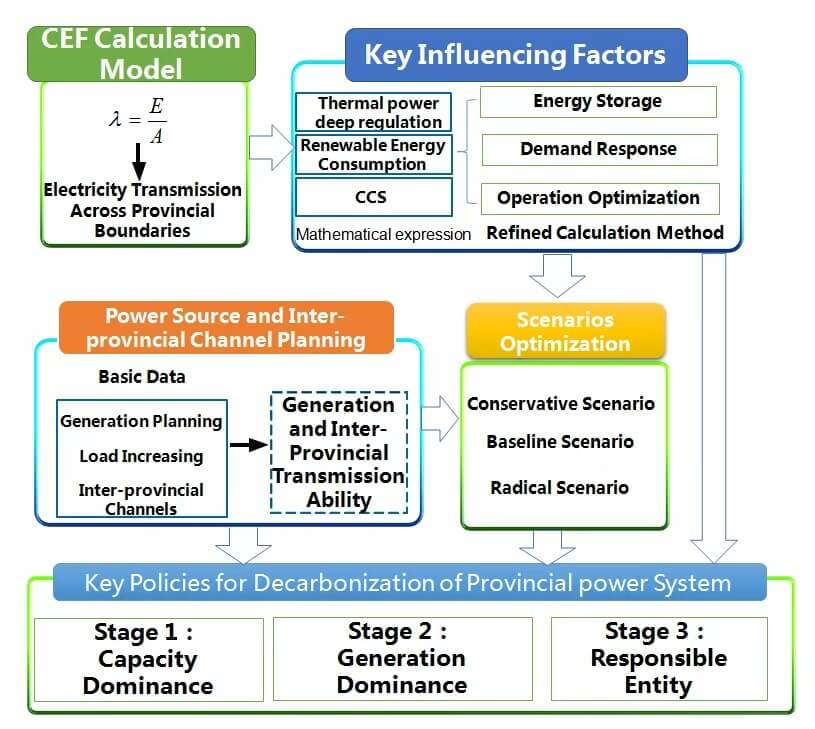
This paper develops an innovative computational model for assessing the Carbon Emission Factor (CEF) of provincial power systems that incorporates inter-provincial electricity transfers and hybrid generation portfolios combining conventional and renewable sources. A key contribution lies in evaluating how deep regulation of thermal power plants influence the carbon intensity of coal-fired generation and coal-fired generation together with high penetration renewables. Furthermore, the study quantitatively analyzes the role of renewable energy consumption and the prospective application of Carbon Capture and Storage (CCS) in reducing system-wide CEF. Based on this framework, the paper proposes phased carbon emission targets for Guangdong’s power system for key milestone years (2030, 2045, 2060), along with targeted implementation strategies. Results demonstrate that in renewable-dominant systems, deep regulation of thermal units, load peak-shaving, and deployment of flexible resources such as energy storage are effective in cutting carbon intensity. To achieve the defined targets—0.367 kg/kWh by 2030, 0.231 kg/kWh by 2045, and 0.032 kg/kWh by 2060—the following innovation-focused policy is recommended: in early stage, mainly on expansion of renewable capacity and inter-provincial transmission infrastructure along with energy storage deployment; in mid-term, mainly on enhancement of electricity market mechanisms to promote green power trading and demand-side flexibility; and in late-stage, mainly on systematic retirement of conventional coal assets coupled with large-scale CCS adoption and carbon sink mechanisms.Graphic Abstract
Keywords
Carbon emission factor; power system; renewable energy consumption; thermal power flexibility; CCS; demand-side response
Cite This Article
APA Style
Li, Y., Gong, X., Chen, S., Lei, Y., Zhang, D. et al. (2026). Researches on Low-Carbon Development Pathways for Provincial Power Systems from the Perspective of Carbon Emission Factor. Energy Engineering, 123(4), 17. https://doi.org/10.32604/ee.2025.072189
Vancouver Style
Li Y, Gong X, Chen S, Lei Y, Zhang D, Xing Y. Researches on Low-Carbon Development Pathways for Provincial Power Systems from the Perspective of Carbon Emission Factor. Energ Eng. 2026;123(4):17. https://doi.org/10.32604/ee.2025.072189
IEEE Style
Y. Li, X. Gong, S. Chen, Y. Lei, D. Zhang, and Y. Xing, “Researches on Low-Carbon Development Pathways for Provincial Power Systems from the Perspective of Carbon Emission Factor,” Energ. Eng., vol. 123, no. 4, pp. 17, 2026. https://doi.org/10.32604/ee.2025.072189
 Copyright © 2026 The Author(s). Published by Tech Science Press.
This work is licensed under a Creative Commons Attribution 4.0 International License , which permits unrestricted use, distribution, and reproduction in any medium, provided the original work is properly cited.
 Downloads
 Citation Tools
