
 Login
Login Register
 Submit a Paper
 Propose a Special lssue
 Open Access
REVIEW

CO2 Capture in Construction Materials: Review of Uptake Approaches and Energy Considerations
1 c5Lab–Sustainable Construction Materials Association, Rua Central Park 6, 2795-242 Linda-a-Velha, Portugal
2 CERENA–Centro de Recursos Naturais e Ambiente, Instituto Superior Técnico, Av. Rovisco Pais 1, 1049-001 Lisbon, Portugal
3 LNEC–National Laboratory for Civil Engineering, Av. do Brasil 101, 1700-066 Lisbon, Portugal
4 CERIS–Instituto Superior Técnico, University of Lisbon, Av. Rovisco Pais, 1049-001 Lisbon, Portugal
* Corresponding Author: Cinthia Maia Pederneiras. Email:
Energy Engineering 2026, 123(4), 6 https://doi.org/10.32604/ee.2026.074246
Received 06 October 2025; Accepted 17 December 2025; Issue published 27 March 2026
 View Full Text
 Download PDF
Abstract
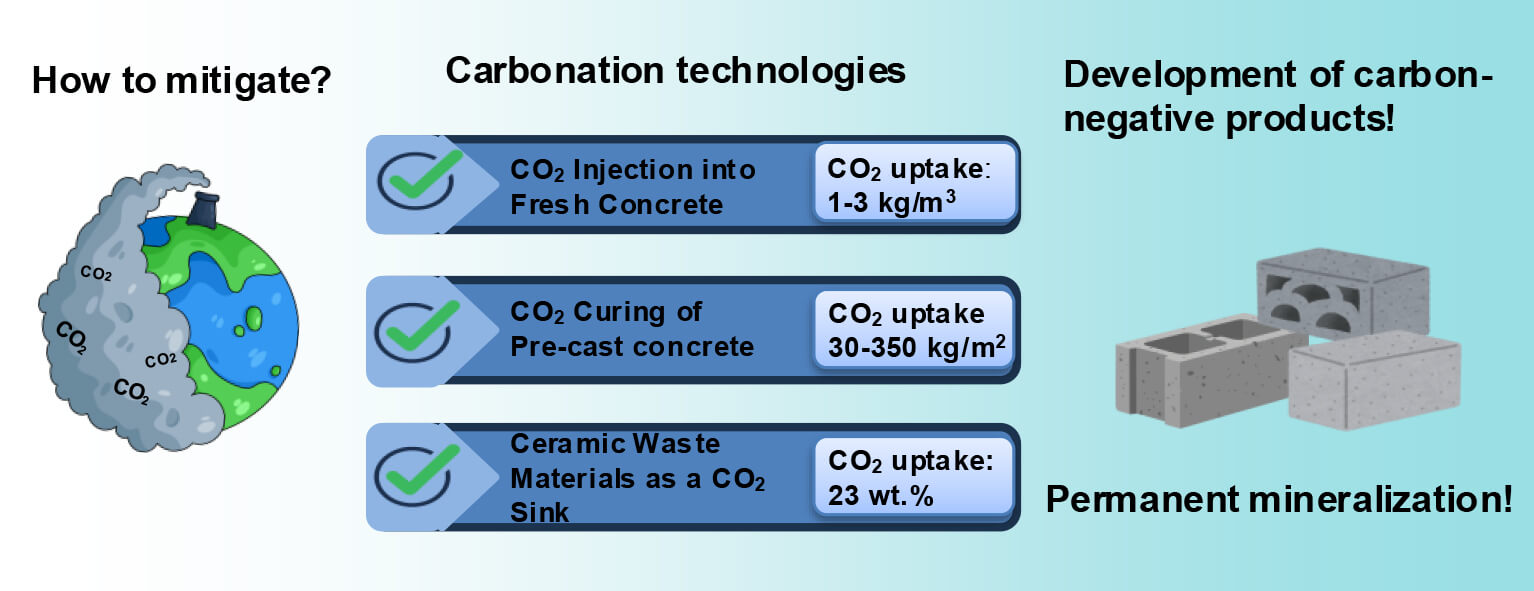
The construction industry is a significant contributor to global CO2 emissions, and urgent innovation is needed to mitigate its environmental impact. This paper provides a comprehensive review of scalable approaches for CO2 uptake in construction materials, including the injection of CO2 into fresh concrete, the CO2 curing of precast concrete, and the use of ceramics as CO2 sinks. Among these three approaches, CO2 curing methods for concrete represent the most advanced and widely adopted strategies within industrial practice, with substantial research supporting their effectiveness and scalability. The comparison of carbonation mineralisation across three distinct material groups reveals that the direct injection of CO2 into fresh concrete mixes results in CO2 uptake of less than 3 kg/m3. For the precast concrete elements, the CO2 uptake ranges from 30 to 350 kg/m3, while ceramics can achieve uptake efficiencies up to 23 wt.% under pilot-scale conditions. Achieving efficient CO2 uptake in fresh and precast concrete without compromising mechanical properties relies on precise control over the CO2 dose, a tailored mix design, and optimised curing conditions, while avoiding excessive carbonation that could reduce alkalinity or durability. Valorisation of carbonated materials as supplementary cementitious components or aggregates is identified as an important circular solution, though further research is needed to address regeneration, performance, and standardisation. The review highlights ongoing gaps in life-cycle assessment and industrial-scale validation, and recommends future work on durability and techno-economic optimisation for robust decarbonisation in the cement and concrete industries.Graphic Abstract
Keywords
Cite This Article
 Copyright © 2026 The Author(s). Published by Tech Science Press.
This work is licensed under a Creative Commons Attribution 4.0 International License , which permits unrestricted use, distribution, and reproduction in any medium, provided the original work is properly cited.
 Downloads
 Citation Tools
