
 Login
Login Register
 Submit a Paper
 Propose a Special lssue
 Open Access
ARTICLE

Towards Resilient Cities: Robust Selection of Rooftop Renewable Energy Technologies in Mediterranean Multifamily Buildings
1 Department of Industrial Engineering, University of Naples Federico II, Naples, Italy
2 School of Materials Science and Engineering, Nanyang Technological University, 50 Nanyang Avenue, Singapore
3 Information Technologies Institute, Centre for Research & Technology Hellas, Thermi, Thessaloniki, Greece
4 Department of Electrical and Computer Engineering, Democritus University of Thrace, Xanthi, Greece
* Corresponding Author: Federico Minelli. Email:
(This article belongs to the Special Issue: Innovative Renewable Energy Systems for Carbon Neutrality: From Buildings to Large-Scale Integration)
Energy Engineering 2026, 123(6), 20 https://doi.org/10.32604/ee.2026.074048
Received 30 September 2025; Accepted 08 April 2026; Issue published 27 May 2026
 View Full Text
 Download PDF
Abstract
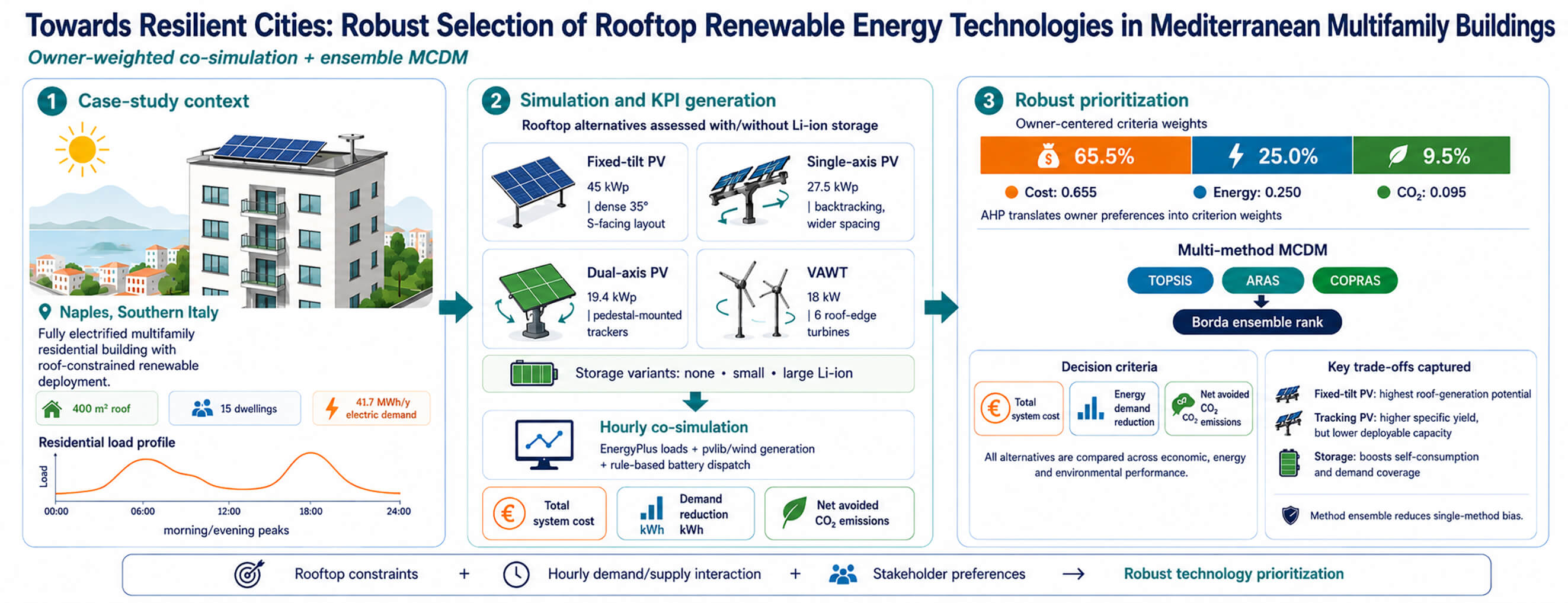
This study investigates the problem of prioritizing rooftop renewable energy (RE) system configurations for a multi-family residential building in Mediterranean climate. The analysis focuses on fixed-tilt photovoltaics (PV), single-axis and dual-axis tracking PV, and small vertical-axis wind turbines (VAWT), each assessed with and without lithium-ion storage. A co-simulation framework is used, coupling EnergyPlus building-HVAC system simulation with PV and wind generation modeling and rule-based battery dispatch to evaluate hourly demand–supply interactions. Three decision criteria are considered for each alternative: total system cost, annual building electric energy demand reduction, and net avoided life-cycle emissions. Stakeholder preferences are elicited via Analytic Hierarchy Process (AHP), considering the building owner as the decision-maker. The design alternatives are then ranked with three multi-criteria decision-making (MCDM) methods (TOPSIS, ARAS, and COPRAS) and a global rank is computed through an ensemble (Borda) aggregation. Results show that due to roof-area constraints, dense fixed-tilt PV system layouts are favored to achieve maximum annual generation (≈60.8 MWh per year), whereas tracking systems achieve higher specific yield but lower system capacity per roof because of increased need of spacing and maintenance corridors. Design alternatives that incorporate energy storage significantly raise self-consumption and demand reduction. Indeed, fixed PV with large storage can reach high annual coverage of building electric energy consumption, while the same PV without storage can reduce it by ~43.7%. VAWT options contribute modestly to energy demand reduction given unfavorable urban wind conditions and their shorter lifetime. Under owner-centric weights that emphasize cost, the ensemble ranking prioritizes low-CAPEX PV solutions (dual-axis PV without storage, single-axis PV without storage, single-axis PV with small storage, and fixed-tilt PV). Instead, design alternatives encompassing large energy storage and small-wind alternatives occupy the lower ranks. The findings provide useful insights and a stakeholder-wise tool to select rooftop RE technologies on Mediterranean residential buildings, balancing economic feasibility with energy and environmental performance.Graphic Abstract
Keywords
Cite This Article
 Copyright © 2026 The Author(s). Published by Tech Science Press.
This work is licensed under a Creative Commons Attribution 4.0 International License , which permits unrestricted use, distribution, and reproduction in any medium, provided the original work is properly cited.
 Downloads
 Citation Tools
