
 Login
Login Register
 Submit a Paper
 Propose a Special lssue
 Open Access
REVIEW

Active Cell Equalization for Battery Management Systems: A Comprehensive Review of DC-DC Converter Topologies
Department of Electrical Engineering, UPL University of Sustainable Technology, Ankleshwar, India
* Corresponding Author: Jigneshkumar Joshi. Email:
(This article belongs to the Special Issue: Advanced Energy Management and Process Optimization in Industrial Manufacturing: Towards Smart, Sustainable, and Efficient Production Systems)
Energy Engineering 2026, 123(6), 3 https://doi.org/10.32604/ee.2026.078205
Received 26 December 2025; Accepted 24 February 2026; Issue published 27 May 2026
 View Full Text
 Download PDF
Abstract
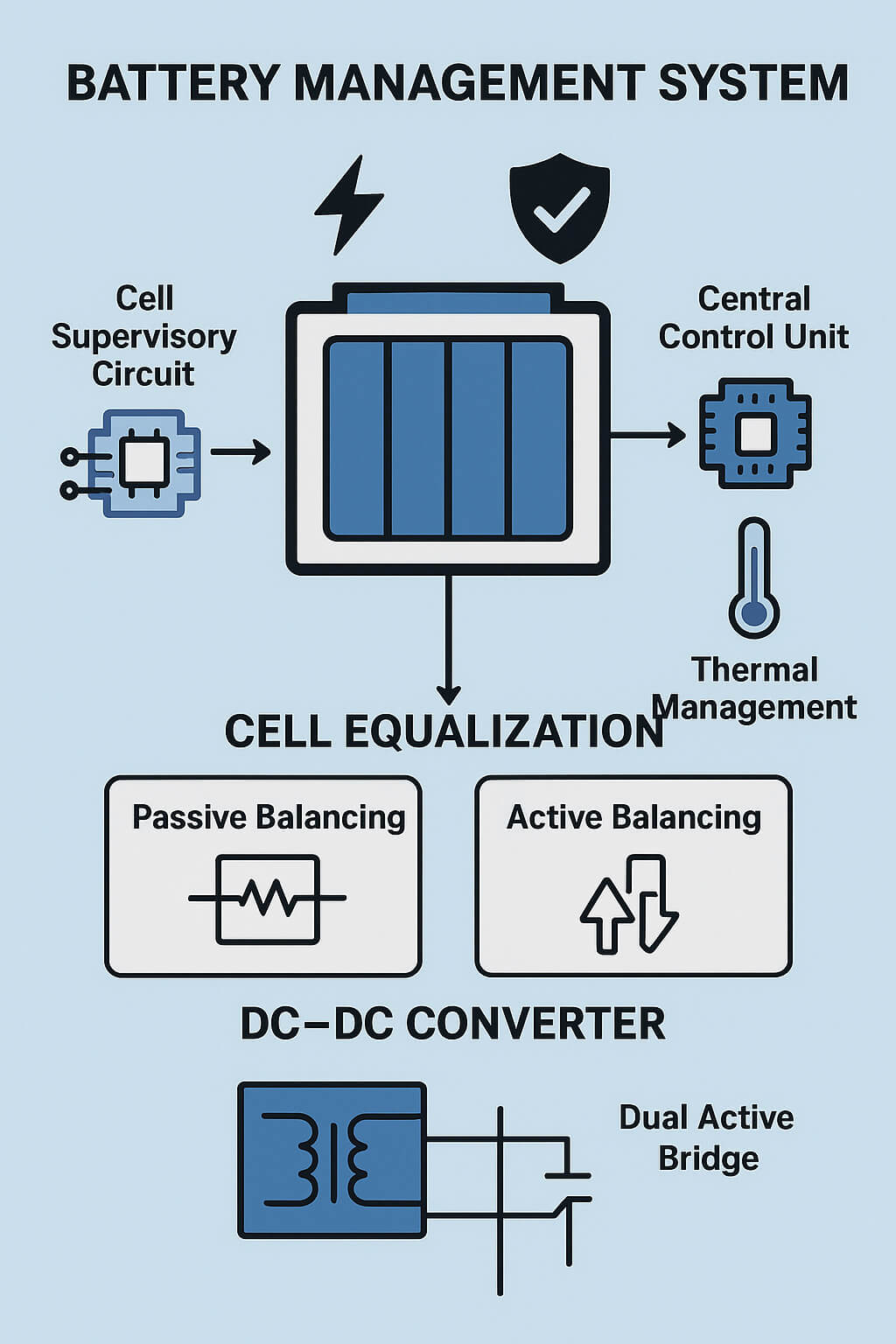
Battery Management Systems (BMS) are critical for ensuring the safety, reliability, and optimal performance of modern battery packs. Among the various BMS functions, cell balancing plays a pivotal role in mitigating capacity degradation and safety risks caused by cell imbalances originating from manufacturing variations and non-uniform operating conditions. This paper presents a comprehensive review of cell balancing strategies within BMS architectures. Passive and active cell balancing techniques are systematically classified and examined based on their operating principles, energy transfer mechanisms, and implementation requirements. In addition, DC-DC converter topologies employed in active cell balancing are reviewed, with particular emphasis on their structural features and control approaches. The analysis indicates that passive cell balancing methods offer simplicity and low cost but are limited by energy dissipation and reduced efficiency. Active cell balancing techniques demonstrate superior performance by enabling controlled energy redistribution among cells, thereby improving efficiency and voltage uniformity. Among the reviewed active approaches, converter based topologies especially the Dual Active Bridge (DAB) converter exhibit notable advantages in bidirectional power flow, high efficiency, and flexible control capability, albeit at the expense of increased system complexity. The reviewed findings highlight critical trade-offs among efficiency, complexity, and cost in the selection of cell balancing strategies for practical applications. Advanced active balancing techniques, supported by sophisticated converter topologies and control schemes, are identified as promising solutions for high capacity and dynamically operated battery systems. This review underscores the necessity for robust and adaptive BMS designs capable of meeting the evolving demands of real-world energy storage applications.Graphic Abstract
Keywords
Cite This Article
 Copyright © 2026 The Author(s). Published by Tech Science Press.
This work is licensed under a Creative Commons Attribution 4.0 International License , which permits unrestricted use, distribution, and reproduction in any medium, provided the original work is properly cited.
 Downloads
 Citation Tools
