
 Login
Login Register
 Submit a Paper
 Propose a Special lssue
 Open Access
ARTICLE
Energy and Exergy Analysis with Heat Exchanger Network Optimization of an Indian Dairy Industry
1 Industrial & Production Engineering, SJCE, JSSSTU, Mysuru, Karnataka, India
2 Electrical and Electronics Engineering, SJCE, JSSSTU, Mysuru, Karnataka, India
3 Department of I and M Systems Engineering, West Virginia University, Morgantown, WV, USA
* Corresponding Author: Dayakar G. Devaru. Email:
Energy Engineering 2026, 123(8), 6 https://doi.org/10.32604/ee.2026.080851
Received 16 February 2026; Accepted 06 May 2026; Issue published 12 July 2026
 View Full Text
 Download PDF
Abstract
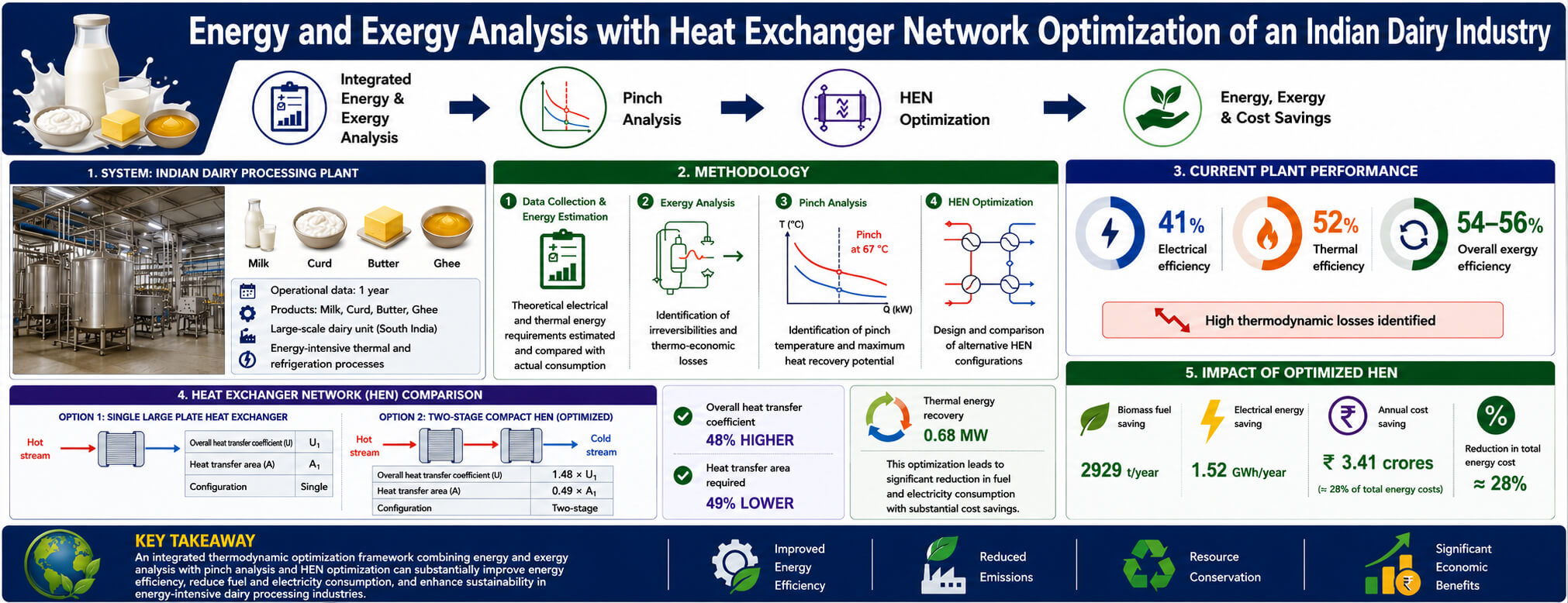
The dairy processing industries are energy-intensive because of the high level of thermal and refrigeration processes. In this study, a large-scale dairy processing unit in South India has been analyzed thermodynamically and optimized by applying integrated energy and exergy analysis along with heat exchanger network (HEN) optimization. The operational data of one year of a plant manufacturing milk, curd, butter and ghee was analysed. Estimation of theoretical electrical and thermal energy requirements was carried out and compared with the actual plant energy consumption. The exergy analysis was used to identify the thermodynamic irreversibilities and the thermo-economic losses, and pinch analysis was used to identify the potential of maximum heat recovery and to design an optimum HEN configuration. The outcomes reveal that the plant has a mean electrical efficiency of around 41%, a thermal efficiency of 52%, and the overall exergy efficiency is 54%–56%, which shows that the plant has high thermodynamic losses. A pinch analysis was performed, and a pinch temperature of 67°C and significant heat recovery opportunities were identified. Two HEN configurations were compared: one large plate heat exchanger and a two-stage compact system. The optimized two-stage design had an overall heat transfer coefficient that is 48% higher than the single-exchanger design and needed 49% of the heat transfer area. The proposed system can recover 0.68 MW of thermal energy, which translates to an annual reduction in biomass fuel consumption of 2929 t and electrical energy consumption of 1.52 GWh, equating to an estimated annual savings cost of ₹ 3.41 crores (or about 28% of the total energy costs). The proposed thermodynamic optimization framework is a viable and cost-effective method to enhance energy efficiency and sustainability in energy-intensive dairy processing industries.Graphic Abstract
Keywords
Energy analysis; exergy analysis; dairy processing industry; heat exchanger network (HEN); pinch analysis; energy efficiency
Cite This Article
APA Style
A. S., K., Devaru, D.G., N., M., Gopalakrishnan, B. (2026). Energy and Exergy Analysis with Heat Exchanger Network Optimization of an Indian Dairy Industry. Energy Engineering, 123(8), 6. https://doi.org/10.32604/ee.2026.080851
Vancouver Style
A. S. K, Devaru DG, N. M, Gopalakrishnan B. Energy and Exergy Analysis with Heat Exchanger Network Optimization of an Indian Dairy Industry. Energ Eng. 2026;123(8):6. https://doi.org/10.32604/ee.2026.080851
IEEE Style
K. A. S., D. G. Devaru, M. N., and B. Gopalakrishnan, “Energy and Exergy Analysis with Heat Exchanger Network Optimization of an Indian Dairy Industry,” Energ. Eng., vol. 123, no. 8, pp. 6, 2026. https://doi.org/10.32604/ee.2026.080851
 Copyright © 2026 The Author(s). Published by Tech Science Press.
This work is licensed under a Creative Commons Attribution 4.0 International License , which permits unrestricted use, distribution, and reproduction in any medium, provided the original work is properly cited.
 Downloads
 Citation Tools
