
 Login
Login Register
 Submit a Paper
 Propose a Special lssue
 Open Access
REVIEW
Building Less to Achieve More: A Review of Service-Based Sufficiency Pathways in Global Net-Zero Transitions
1 School of Accounting and Finance, Xiamen University Tan Kah Kee College, Zhangzhou, China
2 School for Environment and Sustainability, University of Michigan, Ann Arbor, MI, USA
3 Institute of Ecology and Sustainable Development, Shanghai Academy of Social Sciences, Shanghai, China
* Corresponding Authors: Zewen Ge. Email: ; Mufan Zhuang. Email:
(This article belongs to the Special Issue: Toward Net-Zero Emission: Multidimensional Perspectives on Energy Transition)
Energy Engineering 2026, 123(8), 12 https://doi.org/10.32604/ee.2026.082217
Received 12 March 2026; Accepted 20 March 2026; Issue published 12 July 2026
 View Full Text
 Download PDF
Abstract
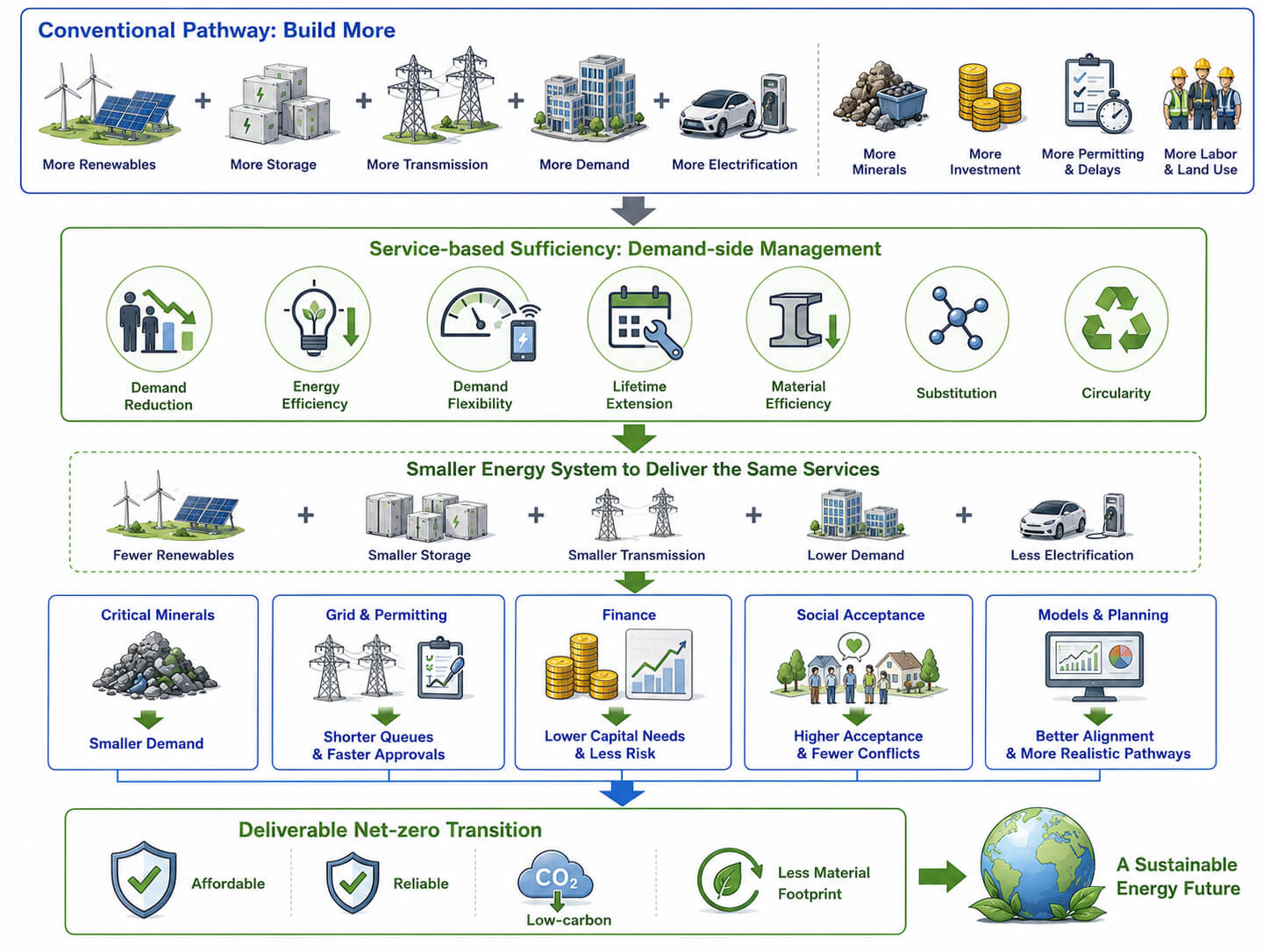
Limiting warming to the Paris temperature goals requires a rapid scale-up of low-carbon energy, yet recent experience suggests that deployment is increasingly shaped by delivery constraints rather than by technology cost trends alone. This review synthesizes peer-reviewed evidence on five constraints that repeatedly slow net-zero buildouts: lengthy approval and grid-connection processes; capital-intensive investment profiles that heighten sensitivity to the cost of capital and revenue risk; bottlenecks in critical minerals, processing, and manufacturing; social contestation and local governance that translate into siting exclusions, delays, and cancellations; and modeling traditions that can underrepresent these non-marginal frictions. Accordingly, we adopt an energy-services perspective to examine how demand-side strategies affect the scale and timing of the required buildout. We interpret degrowth as service-based sufficiency, rather than as a blanket reduction in welfare, and organize the evidence using the Avoid, Shift, Improve (ASI) sequence. Across sectors, the reviewed literature indicates that lowering baseline service demand and, in particular, peak requirements can reduce project counts and network upgrades, limit exposure to interconnection queues and permitting backlogs, ease upstream material pressures, and improve bankability under risk-averse finance. We conclude that net-zero pathways are more credible when service provision and demand-side design are treated as core planning variables alongside clean-energy supply expansion.Graphic Abstract
Keywords
Cite This Article
 Copyright © 2026 The Author(s). Published by Tech Science Press.
This work is licensed under a Creative Commons Attribution 4.0 International License , which permits unrestricted use, distribution, and reproduction in any medium, provided the original work is properly cited.
 Downloads
 Citation Tools
